
Yew wood is the timber of the yew tree (Taxus), a slow-growing conifer that gives one of the densest, most elastic softwoods. Its orange-brown heartwood and cream sapwood made the English longbow and still go into turned bowls, veneers and fine furniture. Every part of the tree is toxic, so it needs care. Minh Thanh Plywood sums up its properties, uses and limits.
What is yew wood?
Yew wood is the timber of trees in the genus Taxus, evergreen conifers that grow slowly for centuries and give a dense, fine-textured, elastic wood. The yew most traded in Europe is European or English yew, Taxus baccata. Its heartwood is orange-brown to purplish red; a thin band of cream sapwood surrounds it.
Yew is valued for three things at once: high density and hardness for a conifer, exceptional elasticity, and natural decay resistance. That mix made it the bow wood of prehistoric and medieval Europe and keeps it in demand for turning, carving and veneer.
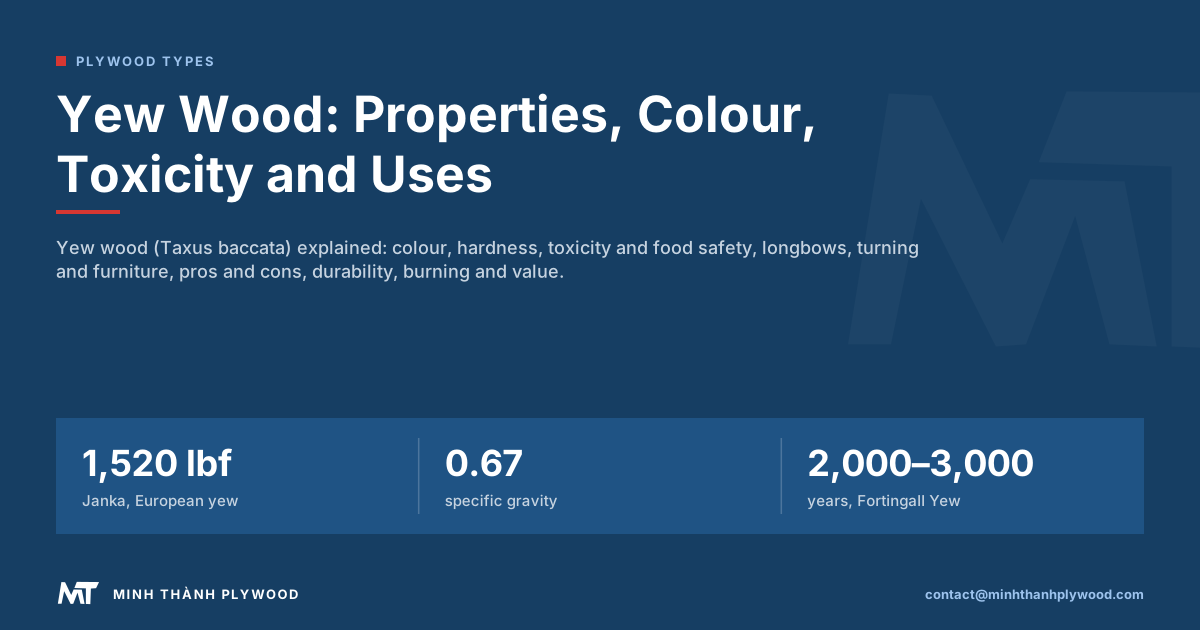
Yew trees are long lived and slow growing. Churchyard yews in Britain are among Europe’s oldest living trees; the Fortingall Yew in Scotland is estimated at 2,000 to 3,000 years old. Slow growth gives narrow growth rings, many knots, ingrown bark and burrs, so clear yew boards are small and rare.
Taxus baccata wood and the other yew species
Taxus baccata wood is the European yew sold in Britain and continental Europe; other yews give similar timber in smaller volumes. All yews share the red, fleshy aril around the seed and the toxic alkaloids in the rest of the plant.
| Yew | Botanical name | Where it grows | Timber notes |
|---|---|---|---|
| European or English yew | Taxus baccata | Europe, North Africa, western Asia | Main traded yew; longbows, turning, veneer |
| Pacific or western yew | Taxus brevifolia | Pacific Northwest of North America | Small trees; bow staves; bark first source of paclitaxel |
| Japanese yew | Taxus cuspidata | Japan, Korea, north-east China | Carving, traditional crafts |
| Chinese yew | Taxus chinensis | Southern and central China | Furniture and carving locally |
| Canada yew | Taxus canadensis | Eastern Canada, north-east US | Shrub; no timber trade |
The drug paclitaxel (Taxol), used in cancer treatment, was isolated from Pacific yew bark in the 1960s, and its structure was published in 1971. It is now made from the needles of cultivated yews and by plant cell culture, so it does not drive yew felling.
Is yew a hardwood or softwood?
Yew is a softwood. Botanically it is a gymnosperm, a conifer with needle leaves, like pine and larch, and its wood has no vessels. Unlike most conifers, yew has no resin canals and bears its seed in a red aril instead of a woody cone.
In practice, yew is harder than most hardwoods. European yew scores 1,520 lbf (6,760 N) on the Janka hardness test according to The Wood Database (checked on 21 October 2026). That is above red oak at about 1,290 lbf and black walnut at about 1,010 lbf. Its specific gravity, 0.55 basic and 0.67 at 12 % moisture content, is close to oak. That is why yew is often described as “a softwood with hardwood density”.
What colour is yew wood?
Yew heartwood is orange-brown, often with reddish or purplish streaks, and the sapwood is a narrow cream to white band. Freshly cut heartwood can look bright orange; with light and age it darkens to a deep amber or honey brown.
The contrast between cream sapwood and dark heartwood is a feature, not a defect. Turners leave a band of sapwood on the rim of a bowl, and furniture makers use it along edges. Burrs show tight clusters of dark pin knots, and ingrown bark leaves dark streaks in the figure.
What are the properties of yew wood?
Yew wood is dense, hard, elastic and fine textured, with good natural durability. The table compares European yew with woods buyers often weigh it against.
| Property | European yew | European oak | Black walnut | Larch (European) |
|---|---|---|---|---|
| Group | Softwood | Hardwood | Hardwood | Softwood |
| Specific gravity at 12 % MC | About 0.67 (0.55 basic) | About 0.7 | About 0.61 | About 0.59 |
| Janka hardness | 1,520 lbf | About 1,120 lbf | About 1,010 lbf | About 1,100 lbf |
| Texture | Very fine, even | Coarse, ring-porous | Medium | Medium, resinous |
| Elasticity | Very high | Medium | Medium | Medium |
| Decay resistance | Durable to very durable | Durable | Durable | Moderate to slight |
| Workability | Good, tearout on wild grain | Good | Very good | Fair, resin |
The mechanical and shrinkage figures below are for European yew from The Wood Database, a standard reference for timber data (read 21 October 2026).
| Property | European yew |
|---|---|
| Tree size | 10–20 m tall, 1–1.5 m trunk diameter |
| Average dried density | 675 kg/m³ |
| Janka hardness | 1,520 lbf (6,760 N) |
| Modulus of rupture (bending strength) | 96.8 MPa |
| Elastic modulus | 10.15 GPa |
| Crushing strength | 58.0 MPa |
| Shrinkage, radial / tangential / volumetric | 3.4 % / 5.3 % / 8.3 % |
| T/R ratio | 1.6 |
A T/R ratio of 1.6 is low, which means yew shrinks fairly evenly and stays stable once dry. Two properties matter most in use. First, yew bends a long way before it breaks, which suits bows and steam-bent chair parts. Second, the very fine texture takes a high polish straight off the tool, which suits turning.
What is yew wood used for?
Yew wood is used mostly for small, high-value pieces where its colour, polish and toughness show: longbows, turned bowls, furniture, veneer, carvings and instrument parts. It is rarely used for building or flooring, because the trees are small and the boards too knotty for long, clear lengths.
The main uses today:
- Longbows and archery: traditional English longbows and flatbows from Pacific yew staves.
- Woodturning: bowls, vases, hollow forms, lidded boxes, pens and lace bobbins.
- Furniture: Windsor chairs, small cabinets and table tops, often in solid yew or yew veneer.
- Veneer: burr yew veneer for marquetry, boxes, car dashboards and furniture panels.
- Carving: figures, spoons for display, handles.
- Musical instruments: historic lute ribs and parts of bagpipes and recorders.
- Knife and tool handles: hard, tough, polished.
- Fence posts and garden pieces: heartwood posts last for decades in the ground.
- Living hedges and topiary: the yew’s main commercial use as a plant.
The US Forest Service’s Silvics of North America records that Pacific yew wood has been used for archery bows, canoe paddles, tool handles, gunstocks, furniture, musical instruments and carved figurines.
Why did yew make the English longbow?
Yew made the English longbow because one stave holds two materials: heartwood that resists compression and sapwood that resists tension. A bowyer splits the stave so the cream sapwood forms the back of the bow (the side facing the target) and the dense heartwood forms the belly (the side facing the archer). When the bow is drawn, each layer does what it does best.
Yew’s role in weapons goes back further than any other wood:
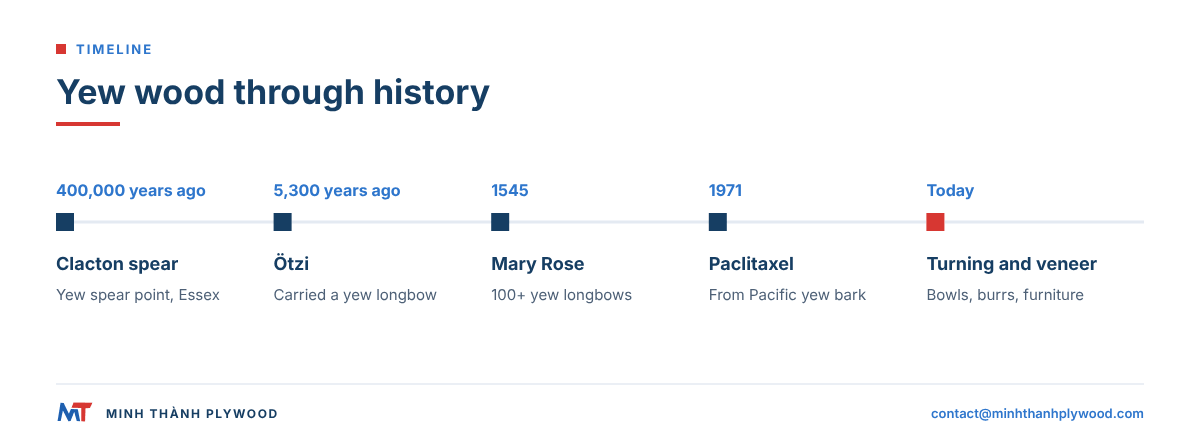
- The Clacton spear from Essex, England, a yew spear point about 400,000 years old, is one of the oldest known wooden tools and predates our own species.
- Ötzi, the Alpine iceman who died around 3300 BC, carried an unfinished yew longbow about six feet long.
- The Mary Rose, Henry VIII’s warship sunk in 1545, yielded more than a hundred yew longbows when it was raised.
Medieval demand for bow staves was so high that England imported yew from across Europe, and old yew stands on the continent were cut out.
Is yew wood toxic, and is it food safe?
Yes, yew is toxic. The leaves, bark, seeds and wood contain taxine alkaloids that disturb heart rhythm; only the red flesh of the aril is free of them, and the seed inside it is poisonous. A small amount of chewed leaves can kill horses and cattle, and children must be kept from the seeds. A case report in the US National Library of Medicine archive describes taxine alkaloids causing fatal poisoning through their toxic effect on the heart.
For woodworkers:
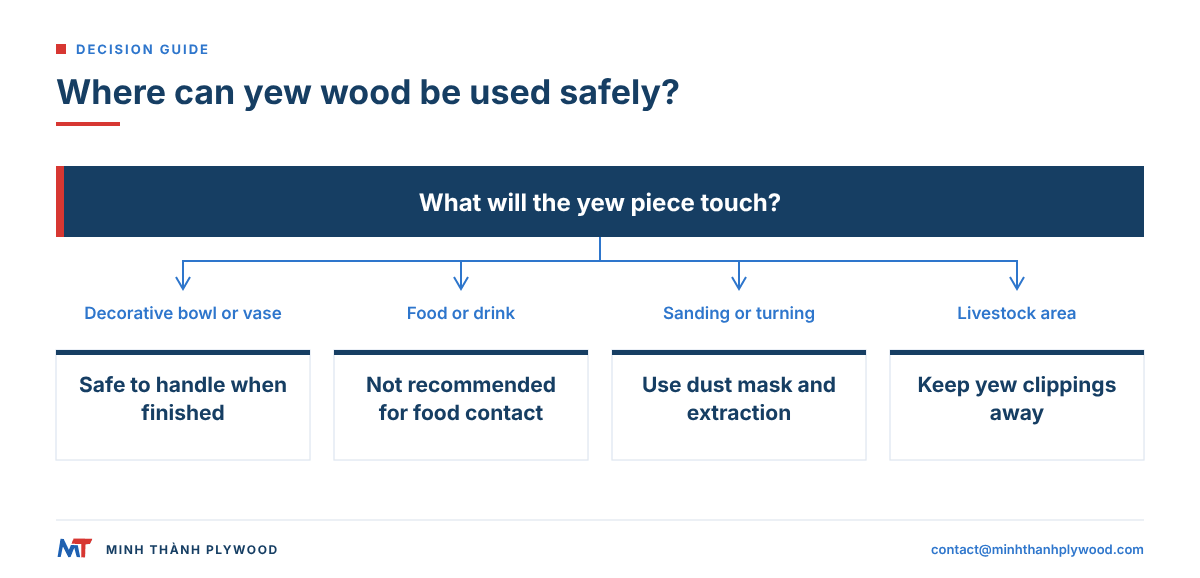
- Dust: wear a fine-dust mask and extraction when sanding or turning; yew dust is an irritant and contains the alkaloids.
- Skin: gloves for long sessions with fresh, wet yew.
- Food contact: yew is not recommended for cutting boards, spoons, cups or salad bowls. Use maple, beech, cherry or birch for kitchenware.
- Animals: never leave clippings where livestock graze.
A finished, decorative yew bowl or vase is safe to handle. The care belongs in the workshop and in kitchen use.
Advantages and disadvantages of yew wood
Yew offers beauty, hardness and toughness; its downsides are toxicity, small sizes, defects and cost.
| Advantages | Disadvantages |
|---|---|
| Rich orange-brown colour with cream sapwood | Toxic leaves, seeds, bark and dust |
| Hard and dense for a conifer, about 1,520 lbf | Small trees: narrow, short boards |
| Very elastic, ideal for bows and bent parts | Knots, ingrown bark, ring shake and splits |
| Fine texture that polishes off the tool | Tearout on wild or interlocked grain |
| Durable heartwood for outdoor posts | Checks and cracks if dried too fast |
| Striking burr figure for veneer | High price for clear stock |
Is yew wood waterproof and durable outdoors?
Yew is not waterproof, but its heartwood is rated durable to very durable against decay, which is why yew fence posts and garden structures last for decades. Sapwood has no such resistance and rots quickly outside.
For outdoor or damp use, select heartwood, keep end grain off wet ground, and finish with a penetrating oil that slows water uptake. For indoor pieces near water, such as bathroom shelves, an oil or hard-wax finish keeps the colour and stops water marks.
Can you burn yew wood?
Seasoned yew burns hot and long, like other dense woods. Because the wood and its smoke carry toxic alkaloids, burn yew only in a closed wood stove or an outdoor fire, never use it to cook or smoke food, and never burn fresh green clippings.
Most turners and furniture makers value yew too highly to burn it. Offcuts and short pieces make pens, knife scales and inlay.
How much is yew wood worth?
Yew is worth more than most temperate hardwoods per board foot, and the price depends on clear size and figure more than on volume. As an indicative US range, Pacific yew lumber sells for about US$8–16 per board foot from specialty sellers (Easy DIY Wood guide, checked on 21 October 2026), and English yew turning blanks sell by size, from roughly US$6 for a small casting blank at Oakbrook Wood Turning Supply to a few tens of US dollars for a 3 in square blank.
Finished decorative bowls sell for about US$80–150 at craft fairs, which shows where the value sits. Clear yew wider than a hand is rare, so price climbs steeply with width and length.
What sets the price, from highest to lowest:
- Bow staves: straight, knot-free, with sapwood intact.
- Burrs and burr veneer: for marquetry and furniture.
- Wide, clear boards: for furniture tops and doors.
- Turning blanks: priced by size and figure.
- Knotty boards and offcuts: for small crafts.
For a current quote on English yew, ask a specialty merchant that stocks it, such as Duffield Timber in the UK, which saws yew and publishes the history of its work with the timber. Prices change with the lot, so ask for a per-board-foot or per-cubic-metre figure on the grade you need.
Old churchyard and hedgerow yews are often protected, so legal timber comes from managed estates, windblown trees and approved felling.
How do you work and finish yew?
Yew works well with sharp tools and finishes to a high natural polish. The steps that avoid the usual problems:
- Dry slowly: seal end grain and air-dry before kilning; fast drying opens checks.
- Plane with sharp, low-angle edges: wild and interlocked grain tears out; a scraper or card scraper cleans it up.
- Turn wet or dry: wet turning to rough shape, then dry and finish turn.
- Glue: wipe the surfaces with a solvent first to lift natural oils.
- Finish: oil, hard wax or shellac; the wood darkens to amber under ultraviolet light.
- Protect yourself: mask, extraction and gloves throughout.
Yew veneer on panels: what this means for your order
Yew furniture parts wider than a board are made as panels: yew veneer laid on a stable plywood or MDF core. A cross-laminated plywood core keeps a wide yew panel flat, holds hinges and screws in the edge, and weighs less than MDF.
Minh Thanh does not sell yew veneer. The factory makes the plywood under decorative veneers: white Styrax or Eucalyptus cores, stitched horizontally and vertically, pressed twice, with faces sanded and polished for veneering and thickness held down to ±0.2 mm. Face veneers include EV (engineered veneer), poplar, birch, okoume and pine, with sapele and other faces on request. A panel plant that lays its own yew veneer buys this core as the substrate.
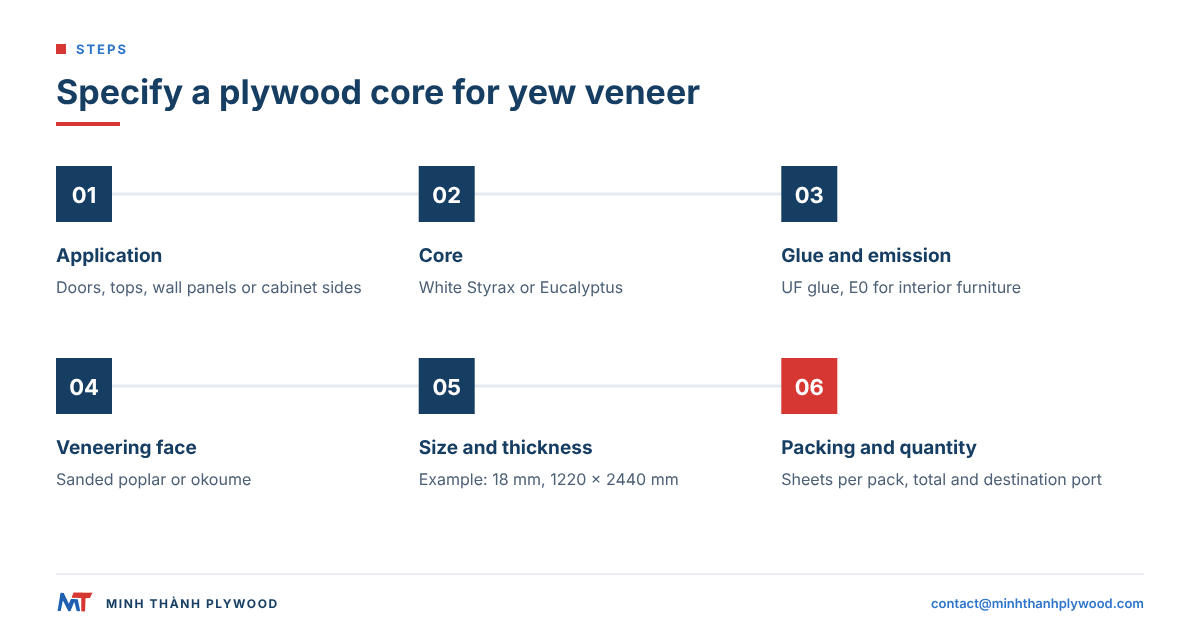
Write the core order in six lines:
- Application: furniture doors, tops, wall panels, cabinet sides.
- Core: white Styrax for light, flat panels; Eucalyptus for harder panels.
- Glue and emission: UF glue at E0 emission for interior furniture.
- Face for veneering: poplar or okoume, sanded and polished.
- Size and thickness: for example 18 mm, 1220 × 2440 mm, ±0.2–0.3 mm.
- Packing and quantity: sheets per pack, total sheets or m³, destination port.
Minh Thanh Plywood ships from Ha Hoa, Phu Tho, Vietnam: MOQ one 40HC, 15–45 days after the 30% deposit, FOB Hai Phong, CFR or CIF, free samples. Furniture plywood starts from US$350/m³ (October 2026). Send your specification to contact@minhthanhplywood.com or see Minh Thanh plywood products.
Buyer questions, answered
What is yew wood?
Yew wood is timber from trees of the genus Taxus, mainly European yew (Taxus baccata). It is a dense, elastic softwood with cream sapwood and orange-brown to purplish heartwood, used for bows, turning, veneer and furniture.
What is yew wood used for?
Yew is used for longbows, turned bowls and vases, carving, furniture and Windsor chairs, decorative veneer from burrs, knife and tool handles, musical instrument parts and very durable fence posts.
Is yew a hardwood or softwood?
Yew is a softwood, because it is a conifer. It is harder than most hardwoods used in furniture, at about 1,520 lbf on the Janka test against about 1,290 lbf for red oak.
What colour is yew wood?
Yew heartwood is orange-brown to reddish or purplish brown, and the sapwood is a narrow cream to white band. The heartwood darkens to a deep amber-brown with light and age.
Is yew wood toxic?
Yes. Leaves, bark, seeds and wood contain taxine alkaloids that affect the heart. Wear a dust mask and gloves when sanding, and keep clippings away from children and livestock.
Is yew wood food safe?
Yew is not recommended for food contact. Its taxine alkaloids make it unsuitable for cutting boards, spoons and serving bowls; turners use it for decorative bowls and vases instead.
Is yew wood waterproof?
No wood is waterproof, but yew heartwood is rated durable to very durable against decay, so yew fence posts and garden pieces last for decades. An oil finish slows water uptake.
Can you burn yew wood?
Seasoned yew burns hot and long. Because it contains toxic alkaloids, never cook or smoke food over it, and burn it only in a closed stove or outdoors.
How much is yew wood worth?
Yew sells at a premium to common hardwoods because clear, wide boards are rare. Burrs, wide clear boards and bow staves fetch the highest prices; knotty boards and small blanks are cheaper.
Why was yew used for longbows?
Yew stave combines dense heartwood that resists compression with elastic sapwood that resists tension. Bowyers left both layers in the stave, giving a natural two-layer spring.