
LVL furniture uses laminated veneer lumber for the long, straight, hidden members of a piece: sofa and bed frames, slats, table rails, cabinet frames and door stiles. Because every veneer runs along the member, LVL stays straight, comes in full billet lengths without finger joints and holds the same strength from piece to piece. Minh Thanh Plywood presses LVL from Acacia or Eucalyptus plantation veneers for furniture and door makers.
LVL furniture: the short answer
LVL furniture means using laminated veneer lumber for the members a buyer never sees but always feels: the frame that keeps a sofa square, the slats under a mattress, the rails that stop a table racking and the stiles inside a door. Factories choose it because it arrives straight, stays straight and behaves the same in every piece.
Three properties make the case. Every veneer runs along the member, so the strength is in the direction the part is loaded. Thin veneers spread knots and small defects through the section, so one piece is much like the next. And LVL comes in billet lengths up to 2440 mm or 2500 mm, so a long bed rail needs no finger joint. For the build itself, see what LVL is and how it is made.
| Furniture part | Why LVL fits | What to put on the drawing |
|---|---|---|
| Sofa and armchair frames | Straight, nail and staple holding, lower cost than hardwood | Section, length, hidden or visible |
| Bed frames and side rails | Long lengths without joints, no bow | Length, bolt and fitting positions |
| Bed slats | Every slat flexes alike | Thickness, width, length, curve if any |
| Table and chair rails | Resists racking and twist | Section, tenon or dowel positions |
| Cabinet and wardrobe frames | Square, stable face frames | Section, edge finish, machining allowance |
| Door stiles, rails and lock blocks | Straight long members, screw holding | Section, length, hardware zones |
LVL furniture in Australia: Level, structural LVL and where our LVL fits
This guide is about laminated veneer lumber (LVL) inside furniture, not about Level, the Australian furniture retailer that shares the search term; if you want chairs, sofas or dining tables, that is a shop and this is a factory guide for the people who build them. For makers, the Australian market splits into two products: structural LVL marked to AS/NZS 4357 and sold in long beams, and furniture LVL cut as short non-structural members.
Structural LVL in Australia is made to AS/NZS 4357 and graded by stiffness, with names such as E13 or F17 and treated H2S framing. Makers and merchants list sections from 90 × 45 mm up to 400 × 45 mm and lengths from 3 m to 12 m for beams, for example meySPAN and Wesbeam, and 90 × 45 mm is the common framing size. A furniture frame does not need a stress grade. It needs straightness, a section that matches the drawing, a glue class and an emission class.
| Point | Structural LVL (AS/NZS 4357) | Furniture LVL from Minh Thanh |
|---|---|---|
| Use | Beams, lintels, joists, bearers | Sofa and bed frames, rails, slats, door stiles |
| Common sections | 90 × 45 to 400 × 45 mm | 70 × 35 mm, 90 × 45 mm, 95 × 65 mm, 36 × 70 mm or your drawing |
| Length | Continuous up to 12 m | Billet length, 2440 or 2500 mm |
| Marking | Stress grade (E13, F17) and treatment | Species, glue, emission class and moisture |
| Species | Radiata pine, some hardwood | Acacia or Eucalyptus plantation veneer |
Our limit is the billet: members run to 2440 mm or 2500 mm, which covers a bed rail, a sofa rail and a door stile but not a house beam. Australian frame makers send the section list, for example 95 × 65 mm, 70 × 35 mm or 90 × 45 mm, and we cut it from the billet. Trade proof we can show is the paperwork: CARB P2 / TSCA Title VI certification under ICTT mill no. 23024, SGS emission tests on request, the EUDR dossier with each order, and photos and video of every shipment before loading.
Why do furniture makers switch from solid wood to LVL?
Furniture makers switch to LVL for hidden frames because it removes the three problems of sawn timber: pieces that bow or twist after machining, knots that break under load, and the cost and wait of long, clear, kiln-dried hardwood. LVL is made to a section, so the factory receives the part it ordered.
- Straightness. Sawn boards keep the stresses of the tree and move when they are ripped. LVL is pressed flat from dried veneers and balanced through its depth, so a rail stays straight on the CNC table and in the finished piece.
- Even strength. In sawn timber one knot can sit at the worst point of a rail. In LVL the same defect is one thin veneer among many, and the joints between veneer sheets are staggered.
- Length. A billet of 1220 × 2440 mm or 1250 × 2500 mm gives members up to the full billet length, cut side by side.
- Yield. Plantation logs of small diameter become furniture members; a sawmill would need larger, older trees for the same clear section.
- Lead time. A hardwood frame stock has to be dried for weeks. LVL is pressed from veneers already dried to 8–12 % moisture.
Solid wood keeps its place where the wood is seen, carved, turned or bent. LVL is the frame; solid wood is the show surface.
What is a laminated veneer lumber door shutter?
A laminated veneer lumber door shutter is a door leaf whose frame, the vertical stiles and horizontal rails, is cut from LVL instead of sawn timber. The door maker then fills the frame with a core and faces it with plywood, HDF or decorative veneer. “Door shutter” is the term used in South Asia and the Middle East for the door leaf.
LVL suits door frames because a door is a long, thin panel that must not bow. A stile of 2000 mm or more must stay straight for the leaf to close against its stop, and it must hold hinge and lock screws without splitting. The same reasons apply to:
- Stiles, the long verticals that carry the hinges and the lock.
- Top, middle and bottom rails, which hold the frame square.
- Lock blocks and hinge blocks, the solid zones where hardware is fixed.
- Door frames and jambs, where the profile is machined from a straight blank.
For a door order, mark the hardware zones on the drawing. We set the grain along the stile, and the cutting plan keeps the full billet length available for the longest member.
LVL vs solid wood vs plywood for furniture frames
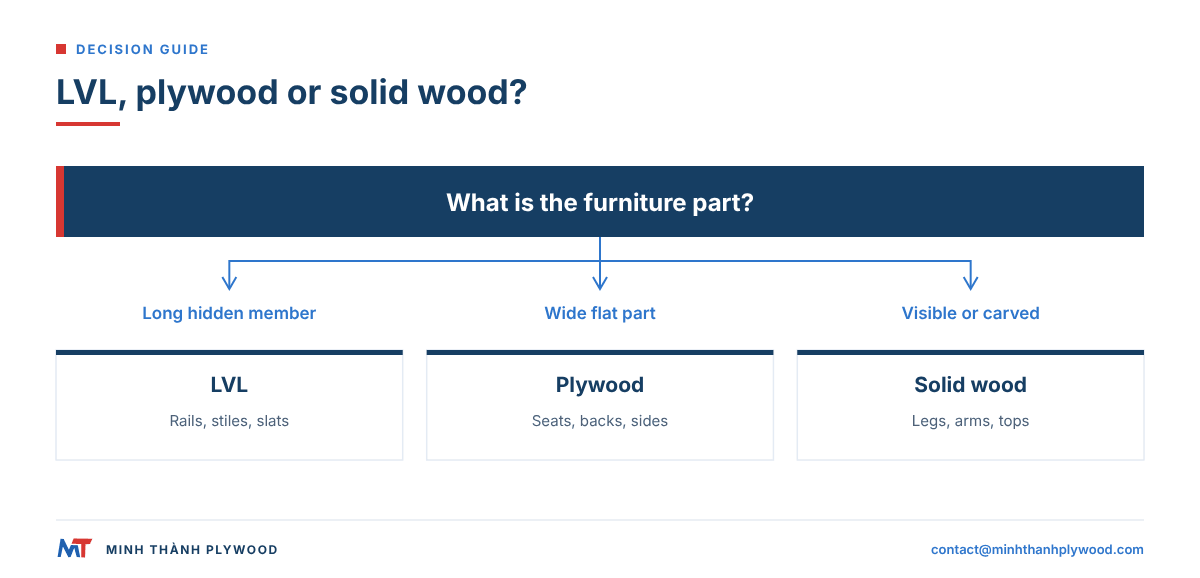
LVL beats sawn timber on straightness and consistency and beats plywood on strength along a member; plywood wins for wide panels and solid wood for visible parts. The right choice depends on whether the part is a long member, a wide panel or a show surface.
| Property | LVL | Sawn hardwood | Plywood strip |
|---|---|---|---|
| Grain direction | Nearly all along the member | Along the board | Alternating, half across |
| Straightness after machining | Very good | Varies by board | Good |
| Strength along a long rail | High and even | High but knot-dependent | Lower: half the veneers run across |
| Strength across a wide panel | Low | Low | High |
| Edge appearance | Glue lines, veneer stripes | Natural wood | Cross-banded plies |
| Lengths without joints | Up to the billet length | Depends on log and drying | Up to the sheet length |
| Screw holding in the edge | Good with pre-drilling | Good | Fair |
| Typical use | Frames, rails, slats, stiles | Visible legs, arms, carved parts | Backs, seats, gussets, panels |
A frame often combines all three: LVL for the rails, plywood for the gussets and seat boards, solid wood for the visible arms. Our LVL vs plywood guide goes further on the panel side.
Upholstered furniture: sofa and armchair frames
Sofa and armchair frames are the largest furniture use of LVL. The frame is hidden under foam and fabric, so appearance does not matter, but it carries people sitting, leaning and dropping onto it for years. LVL rails give that strength in a straight, light member that takes staples, nails and screws.
A typical upholstered frame uses LVL for the front rail, the back rail and the seat side rails, and plywood for the curved arm and back profiles that are cut from a sheet. Ask for:
- the section of each rail and its length;
- the fixings: staples, screws, dowels or corner blocks;
- whether the rail edges are seen through the fabric (a sanded edge is then worth it);
- the moisture at dispatch, 8–12 %, so the frame does not move after upholstery.
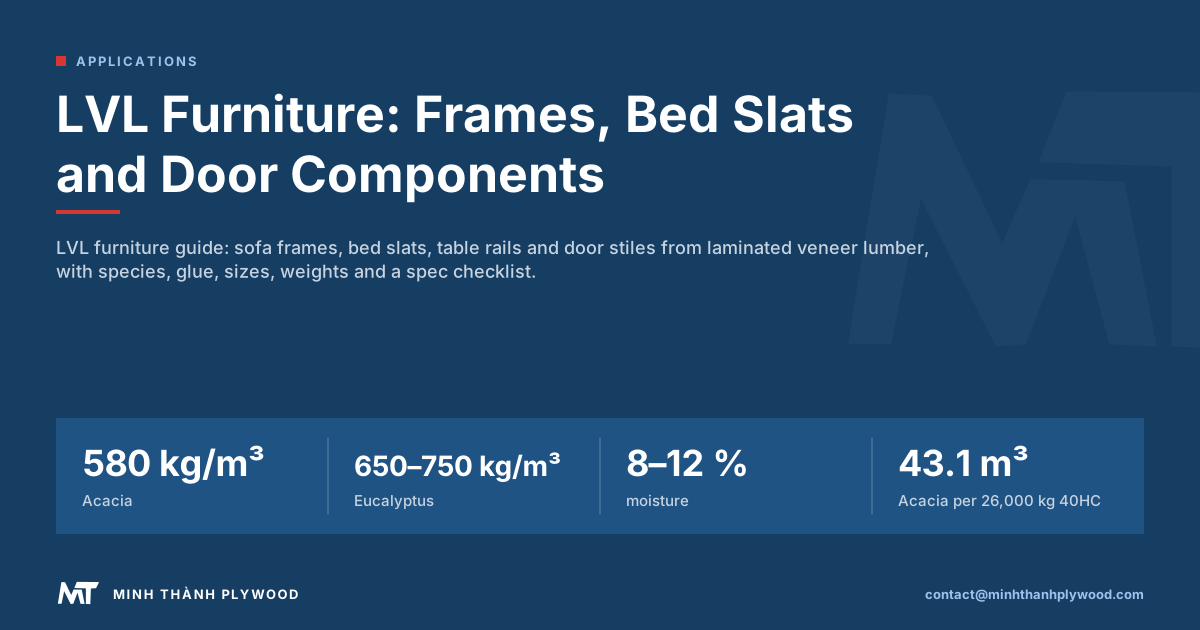
Acacia LVL at about 580 kg/m³ is the lighter option and keeps the shipping weight of a flat-packed or assembled sofa down. Eucalyptus LVL at 650–750 kg/m³ is denser and harder, which helps where staples and screws are close together.
Beds: side rails, centre rails and LVL slats
Beds use LVL in two ways: as long side and centre rails that must stay straight across the full length of the bed, and as slats that carry the mattress. Both depend on LVL being even from piece to piece.
Rails. A double bed side rail is close to the full billet length. Sawn timber of that length often bows; LVL stays straight, so the bolts at each end line up with the head and foot boards.
Slats. A slatted base works only when every slat flexes alike. Because the veneers average out the wood, LVL slats cut from one billet bend almost the same under the same load. Thin slats are cut flat; curved, sprung slats are pressed over a form from veneers and are a different, moulded product.
For slats, give the thickness, width and length, the number per bed and whether the ends are rounded or capped. The grain runs along the slat.
Tables, chairs and cabinets
Tables, chairs and cabinets use LVL for the rails and frames that hold the piece square: table aprons, chair seat rails, the face frames of cabinets and wardrobes, shelf supports and drawer runners. These parts are short to medium in length and are often machined with tenons, dowel holes or grooves.
- Table aprons and stretchers stop the legs racking. LVL keeps the apron straight between the legs.
- Chair seat rails take the load of the seat and the racking forces from the legs. Hidden rails in upholstered chairs are the classic LVL use.
- Cabinet face frames and wardrobe frames need square, stable members that will not twist the doors out of line.
- Shelf edges and drawer runners need straightness over the full width of the carcass.
A visible LVL edge shows its veneer stripes. Some designers leave it on show as a feature under a clear finish; most edge-band it or face it with veneer.
Which species: Acacia or Eucalyptus LVL?
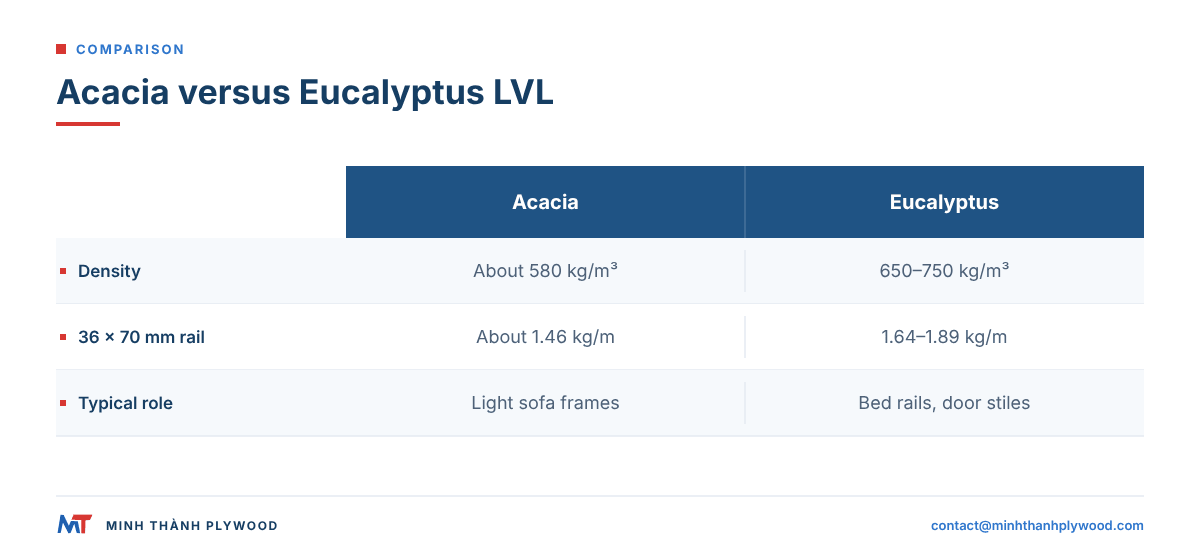
Choose Acacia LVL for lighter frames and Eucalyptus LVL for denser, harder members that carry more fixings. Both are Vietnamese plantation timber, and both are the woods we use for LVL.
| Property | Acacia LVL | Eucalyptus LVL |
|---|---|---|
| Density | About 580 kg/m³ | 650–750 kg/m³ |
| Weight of a 36 × 70 mm rail | About 1.46 kg per metre | 1.64–1.89 kg per metre |
| Colour | Light to mid brown | Pinkish to reddish brown |
| Best for | Sofa frames, light frames, packaging members | Bed rails, door stiles, rails with many fixings |
| Moisture at dispatch | 8–12 % | 8–12 % |
The weight per metre is density times the section: 0.036 × 0.070 × 580 gives about 1.46 kg for Acacia. Use the same sum for your own sections before you plan a container. Radiata pine and poplar LVL are other species on the market; our guide to pine LVL vs hardwood LVL compares them.
Glue and emission for indoor furniture
LVL for indoor furniture uses UF glue at E0 emission as standard, with E1 as an option; humid rooms take melamine-fortified MR glue and weather-exposed parts phenolic WBP. The glue and the emission class are two separate lines on the order.
| Where the part is used | Glue | Emission line |
|---|---|---|
| Dry indoor furniture | UF glue at E0 emission | E0 standard, E1 option |
| Kitchens, bathrooms, humid climates | MR / melamine-fortified | State the class you need |
| Garden furniture under cover, outdoor parts | Phenolic WBP | State the class you need |
Furniture sold into the United States must meet the formaldehyde limits of TSCA Title VI. For hardwood plywood with a veneer core the limit is 0.05 ppm under 40 CFR 770.10. Our plywood carries CARB P2 / TSCA Title VI certification under ICTT mill no. 23024, and six ASTM D6007 chamber tests on 9, 15 and 18 mm panels averaged 0.014–0.032 ppm against that limit. For LVL, we name the glue and emission class on the quote, and SGS tests to the buyer’s method, such as EN 717-1, on request.
How is furniture LVL made?
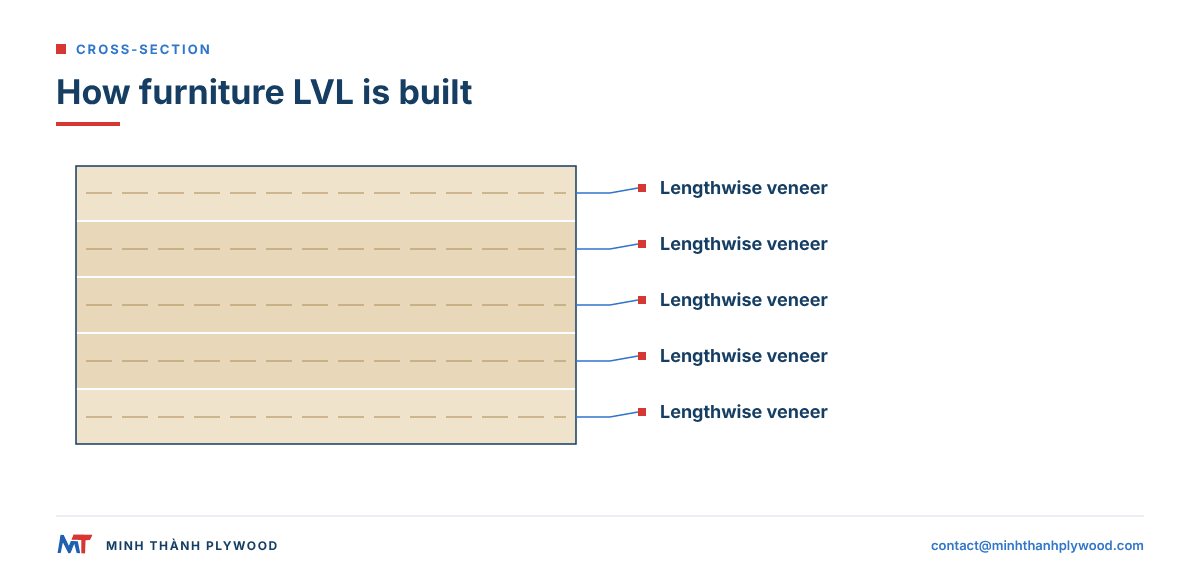
Furniture LVL is made by peeling plantation logs into thin veneers, drying them, gluing them with the grain all running one way and pressing the stack into a billet. The billet is then sawn into the sections of the order.
- Peel. Acacia or Eucalyptus logs are rotary-peeled into veneers, typically 1.4–2.0 mm thick.
- Dry and grade. Veneers are dried to 8–12 % moisture and graded; split or very knotty sheets go to the inner layers or are rejected.
- Glue and lay up. Glue is spread and the veneers are laid with the grain along the billet. The joints between veneer sheets are staggered so no two fall in the same place.
- Press. The stack is hot-pressed into a billet of 1220 × 2440 or 1250 × 2500 mm; MR glue presses at 110–120 °C and phenolic WBP at 130–145 °C.
- Calibrate and saw. The billet is sanded to thickness and ripped into members of the ordered width and length.
- Pack. Members are bundled by section and length, marked and strapped.
A cross-banded variant, laminated veneer board (LVB), puts one or more veneers across the grain to steady wide parts. Name it on the order if you need it; the trade name alone does not define every layer. The full process is in our guide on how LVL is made.
Machining, fixing and finishing LVL
LVL machines like a dense hardwood: it saws, planes, routes and drills cleanly with sharp tools, and it holds screws and staples well in its face. The one rule is to treat the narrow edge with care, because a screw driven between glue lines can open the veneers.
- Screws in the wide face hold well. In the narrow edge, pre-drill, keep a good distance from the end and avoid large screws in thin sections.
- Staples and nails used in upholstery hold firmly in Acacia and Eucalyptus LVL.
- Dowels and tenons work as in hardwood. Cut the tenon with the grain along it.
- Glue joints bond well to sanded LVL with standard PVA and urea glues.
- Paint and veneer: sanded LVL takes primer, paint, foil and decorative veneer. Fill small voids at veneer joints before painting a visible edge.
- Clear finish: the striped edge can be shown as a design feature; ask for a sanded edge and a clean outer veneer.
Is LVL strong enough for furniture?
Yes. LVL is a structural product made to carry beams and headers in buildings, so the loads in a sofa, bed or table are well within what it does. In the EU, structural LVL is CE marked under the Construction Products Regulation (EU) No 305/2011. Its strength runs along the member, which is the direction a furniture rail is loaded.
The only weak direction is across the width of a wide, thin piece, where there are no cross veneers. That is why wide parts such as seat boards and cabinet sides are plywood, and long narrow parts are LVL. For furniture, the useful questions are straightness, fixing and machining, not beam strength. For beam data, our page on LVL strength gives the E-values and how they compare.
Packing and container loads for furniture LVL
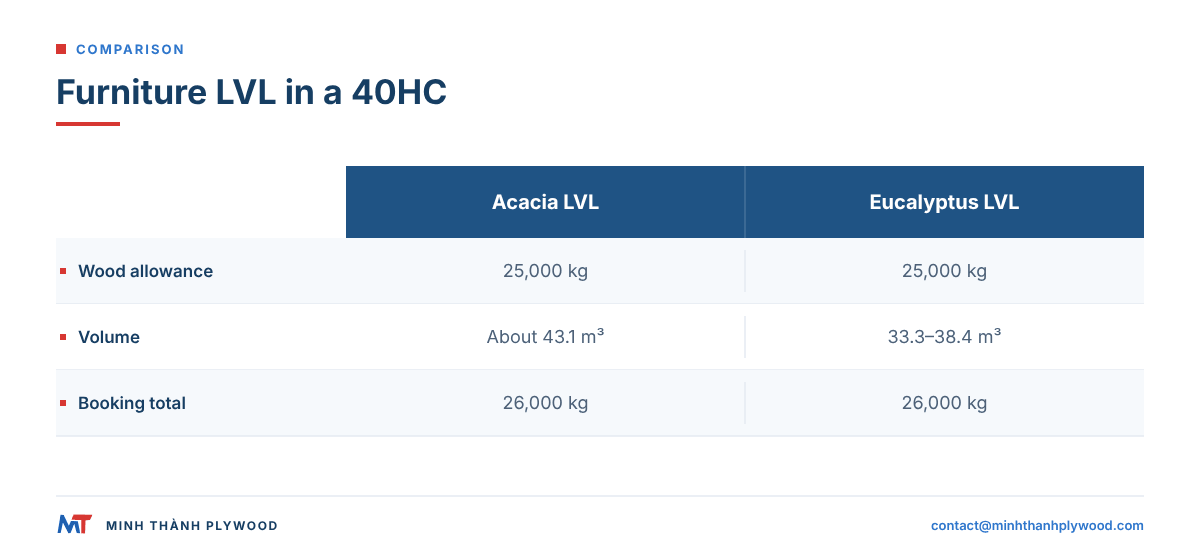
Furniture LVL ships in strapped bundles of one section and length, and a container is planned by weight before volume. With a 40HC booking capped at 26,000 kg, allowing 25,000 kg for wood and 1,000 kg for packing, about 43.1 m³ of Acacia LVL fits, or 33.3–38.4 m³ of Eucalyptus.
| Species | Density | Wood in a 26,000 kg booking | Volume |
|---|---|---|---|
| Acacia LVL | About 580 kg/m³ | 25,000 kg | About 43.1 m³ |
| Eucalyptus LVL | 650–750 kg/m³ | 25,000 kg | 33.3–38.4 m³ |
The volume is the wood weight divided by the density: 25,000 ÷ 580 is about 43.1 m³. The number of pieces then follows your section and length schedule. A container can mix sections by agreement, in whole bundles. Pricing per cubic metre is in our LVL price guide.
Why order furniture LVL from Minh Thanh Plywood?
We are a plywood and LVL manufacturer in Ha Hoa, Phu Tho, built for furniture and interior panels with Europe as our main market. The LVL comes off the same lines and the same veneer supply as our furniture plywood, so the dryness, glue and grading of a furniture mill come with it.
- Local plantation veneers. Acacia and Eucalyptus grow around Ha Hoa, which keeps the veneer supply close and the price competitive.
- Furniture-mill habits. Veneers dried to 8–12 %, UF glue at E0 emission as standard and panels graded to the buyer’s approved sample.
- Documents. We supply the EUDR compliance dossier (origin records and geolocation files) with orders, as Regulation (EU) 2023/1115 asks of importers into the EU (read 20 October 2026).
- Mixed orders. LVL members and plywood panels can share one 40HC by agreement, so a furniture maker can buy frames and panels in one shipment.
- Terms. MOQ one 40HC, production 15–45 days after the 30% deposit, 70% against the scanned B/L, FOB Hai Phong, CFR or CIF, free samples.
What to send for an LVL furniture quote
Send a parts list, not a product name: the quote then prices the members you will use. A single line per part is enough.
| Line | Example for a sofa frame order |
|---|---|
| Application | Upholstered sofa frames, hidden rails |
| Species | Acacia LVL |
| Glue and emission | UF glue at E0 emission |
| Sections and lengths | 36 × 70 mm, lengths from the cutting list |
| Surface | Rough-sawn, or sanded on visible edges |
| Moisture | 8–12 % at dispatch |
| Packing | Bundles by section and length, marked |
| Quantity and port | Pieces per section, destination port |
Send it to us through the LVL product page, with your drawing. We reply within hours with a written quote and can send free samples of the section.
Buyer questions, answered
Can LVL be used for furniture?
Yes. LVL is widely used for the hidden structural parts of furniture: sofa and bed frames, slats, table and chair rails, cabinet frames and door stiles. It is straighter and more uniform than sawn timber of the same size, and it comes in long pieces without finger joints.
Is LVL better than solid wood for furniture frames?
For hidden frames, usually yes: LVL resists warping and twisting, has fewer weak spots and is often cheaper than kiln-dried hardwood of the same section. For visible, carved or turned parts, solid wood is still the better choice because LVL shows glue lines on its edges.
What is an LVL bed slat?
An LVL bed slat is a thin strip cut from laminated veneer lumber with the grain running along its length, used across a bed frame to carry the mattress. The veneers make it stiffer and more even than a sawn slat of the same thickness, so slats in one base flex alike.
Which glue should LVL for furniture have?
For indoor furniture, UF glue at E0 emission is the standard choice, with E1 as an option. Choose melamine-fortified MR glue for kitchens, bathrooms and humid climates, and phenolic WBP only for parts exposed to the weather.
Can you screw into LVL?
Yes. Screws hold well in the face of LVL and along its length. Screws driven into the narrow edge, between the glue lines, should be pre-drilled and kept away from the ends so the veneers do not split apart.
Can LVL be painted or veneered?
Yes. Sanded LVL takes paint, foil and decorative veneer. For a visible painted edge, ask for a calibrated, sanded surface and fill the small voids at the veneer joints before priming.
How heavy is LVL for furniture?
Acacia LVL is about 580 kg/m³ and Eucalyptus LVL 650–750 kg/m³. A 36 × 70 mm Acacia rail weighs about 1.46 kg per metre; the same rail in Eucalyptus weighs 1.64–1.89 kg.
What sizes does Minh Thanh LVL come in?
We press LVL billets of 1220 × 2440 and 1250 × 2500 mm and cut them into the sections and lengths of your drawing. Send the finished thickness, width and length of each part with the grain direction.
Is LVL the same as plywood?
No. Plywood alternates the grain of each veneer across the sheet; LVL runs nearly all veneers in one direction, along the member. That makes LVL stronger along its length and plywood steadier across its width.
How much LVL fits in a 40HC container?
With a 26,000 kg booking, 25,000 kg for wood and 1,000 kg for packing, about 43.1 m³ of Acacia LVL fits, or 33.3–38.4 m³ of Eucalyptus LVL. The piece count follows your section and length schedule.