
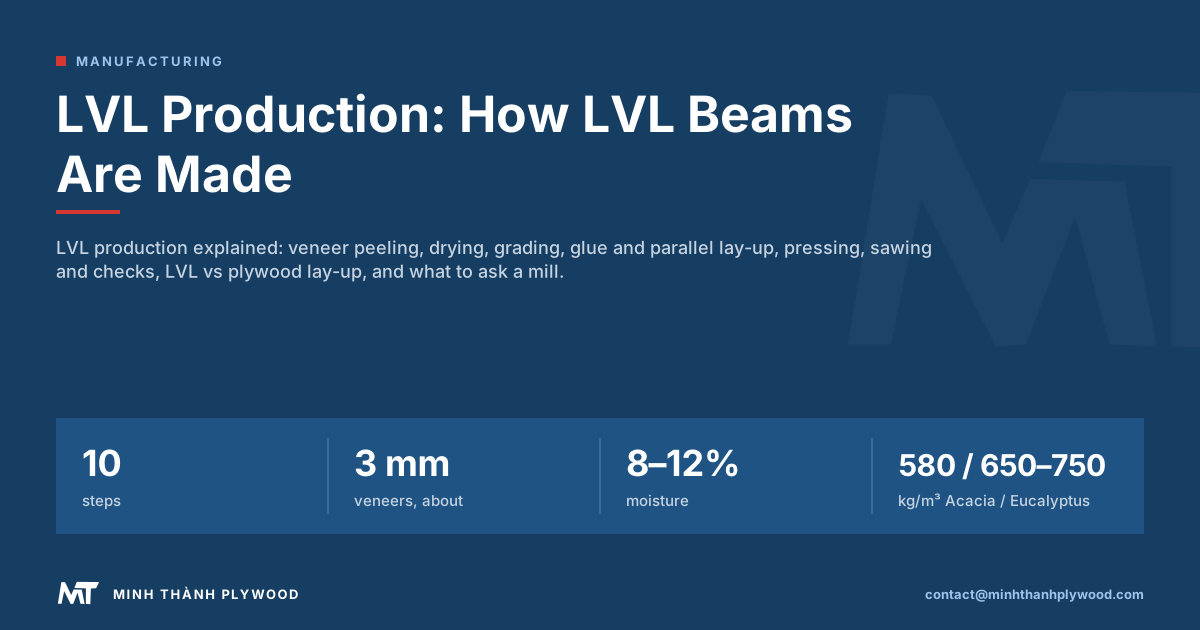
LVL production turns logs into rotary-peeled veneers, dries and grades them, then glues the sheets with every grain running the same way and hot-presses the stack into a billet that is sawn into beams and members. The parallel lay-up is what separates LVL from plywood. Minh Thanh Plywood makes LVL from Acacia and Eucalyptus plantation veneer in Phu Tho, Vietnam.
What is LVL made of?
LVL (laminated veneer lumber) is made of thin wood veneers bonded with adhesive, with the grain of almost every veneer running the same way, along the length of the member. Veneer and glue are the only two ingredients.
| Ingredient | Common choices | Ours |
|---|---|---|
| Veneer species | Radiata pine, Douglas fir, spruce, poplar, birch, plantation eucalyptus and acacia | Acacia or Eucalyptus plantation veneer |
| Density | Varies with species | Acacia about 580 kg/m³; Eucalyptus 650–750 kg/m³ |
| Adhesive | Phenolic for structural and exterior; UF or melamine-fortified for interior | UF glue at E0 emission for interiors, E1 as an option; MR (melamine-fortified) or phenolic WBP for humid service |
| Moisture | Dried veneer, dry billet | 8–12% |
Species decides density, weight and colour; the glue decides water resistance and emission. Our Acacia and Eucalyptus veneers come from plantation timber grown around Ha Hoa, Phu Tho. For a species comparison, see pine LVL vs hardwood LVL.
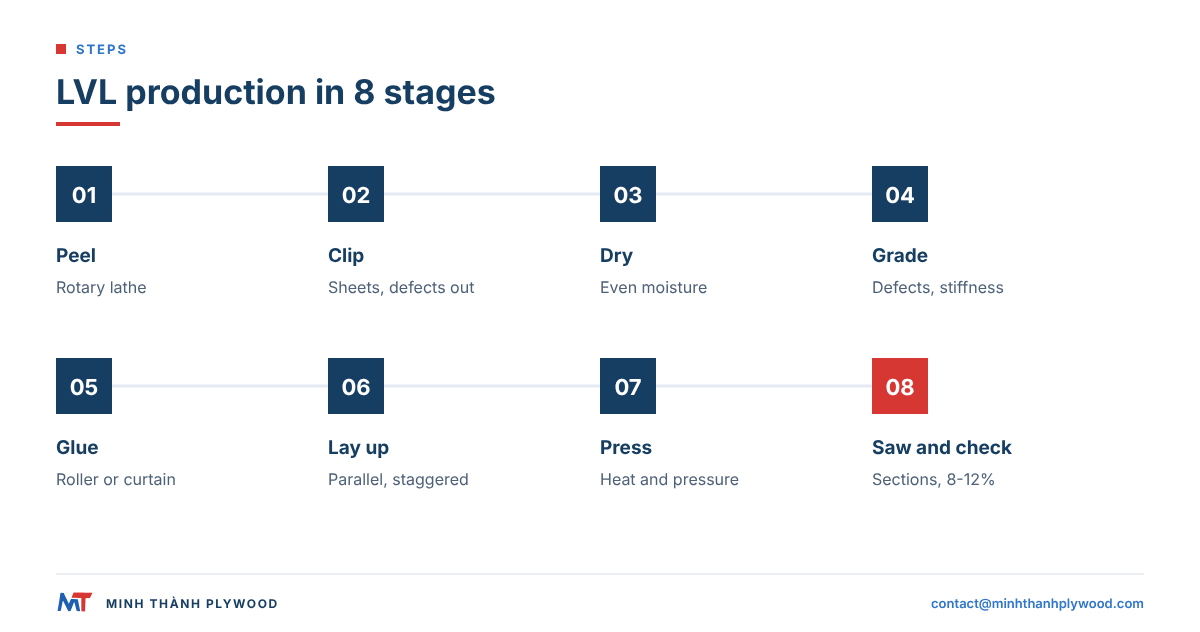
How are LVL beams made? The LVL production process in 10 steps
LVL beams are made by peeling logs into veneer, drying and grading it, gluing it in a parallel lay-up, hot-pressing it into a billet and sawing the billet into members of the section and length the order calls for. The LVL production process runs in ten steps, in this order:
- Log selection: straight, round logs of the chosen species are cut to the lathe length.
- Conditioning: some plants soak or steam the logs so the wood peels smoothly.
- Rotary peeling: a lathe turns the log against a knife and peels a continuous ribbon of veneer.
- Clipping: the ribbon is cut into sheets, and splits and large defects are clipped out.
- Drying: veneer goes through a dryer to a low, even moisture content.
- Grading: each sheet is graded for defects, and in structural plants for stiffness.
- Glue spreading: adhesive is spread on the veneer by roller or curtain coater.
- Lay-up: sheets are stacked with all grain parallel, joints staggered along the length.
- Pressing: heat and pressure cure the glue and bond the stack into a solid billet.
- Sawing, sanding and checking: the billet is cut to sections, sanded where needed, measured and marked.
| Step | What it controls in the finished LVL |
|---|---|
| Peeling | Veneer thickness, smoothness, yield from the log |
| Drying | Bond quality, shrinkage, moisture at dispatch |
| Grading | Strength, stiffness and appearance consistency |
| Glue spreading | Bond along every glue line |
| Lay-up | Grain direction and where the weak joints fall |
| Pressing | Density, thickness, full cure |
| Sawing and sanding | Section size, straightness, surface |
The sections below explain each stage and what a buyer should check in it.
How does LVL differ from plywood in lay-up?
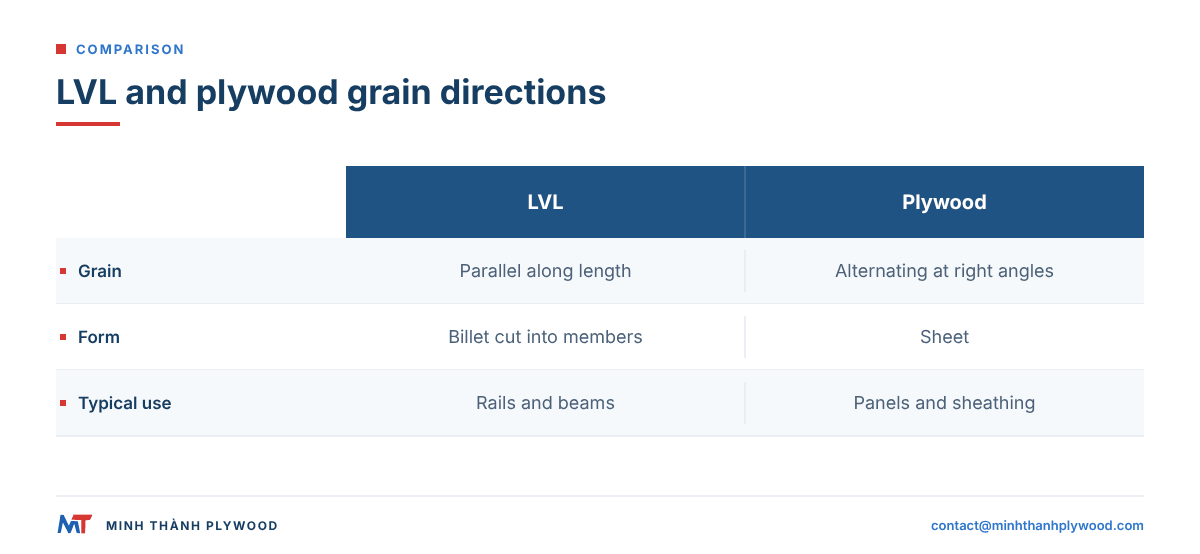
LVL differs from plywood in one thing that changes everything: grain direction. In LVL, the veneers run parallel, along the member; in plywood, each layer runs at a right angle to the next.
| Feature | LVL (laminated veneer lumber) | Plywood |
|---|---|---|
| Grain direction | All or nearly all veneers along the length | Alternating at a right angle, layer to layer |
| Shape | Billet sawn into beams, studs, rails | Sheet |
| Strong direction | Along the length, like a beam | Direction-dependent; use the values for each panel axis |
| Stability across the width | Moves more across the grain | Very stable in both directions |
| Typical uses | Beams, headers, rails, frames, runners | Furniture panels, sheathing, formwork, packing |
| Veneer joints | Staggered along the length | Butted or stitched within each layer |
Some LVL includes one or two cross-banded veneers to limit splitting and cupping across the width; that version is sometimes called LVB (laminated veneer board). Our LVL vs plywood guide compares the two for furniture frames, packing and beams.
Log selection, peeling and drying: how is LVL veneer prepared?
LVL veneer is prepared by rotary-peeling logs into sheets about 3 mm thick and drying them evenly before gluing. Veneer quality sets the limit for the whole billet.
- Logs: straight, low-taper logs give long, even veneer ribbons. Plantation hardwood such as eucalyptus and acacia is grown in rotations and harvested at small diameters, which suits modern spindleless lathes.
- Peeling: a rotary lathe peels the log against a knife set to the veneer thickness. A tight, smooth veneer with few lathe checks glues better.
- Clipping: the ribbon is cut to sheet width; open splits and large knots are clipped out.
- Drying: veneer is dried in a jet or roller dryer. Wet patches cause blows in the press and weak glue lines; overdried veneer absorbs glue too fast.
Drying is where mills differ most. Uneven moisture across a stack of veneers produces billets that bow after sawing. Our veneers and finished panels are dried to 8–12% moisture content at dispatch, the normal range for furniture plywood and the range we supply LVL at. See veneer drying for plywood for dryer types and drying defects.
How is veneer graded for LVL?
Veneer for LVL is graded visually for defects and, in structural lines, by stiffness. Grading decides where each sheet goes in the billet.
| Grading method | What it measures | Where the graded sheet goes |
|---|---|---|
| Visual grading | Knots, splits, holes, stain, rough peel | Clean sheets to faces and visible members; lower grades inside |
| Stress-wave (ultrasonic) grading | Speed of sound through the sheet, which tracks stiffness | Stiffest sheets to the outer layers of structural beams |
| Moisture check | Moisture after the dryer | Wet sheets back to the dryer |
In a beam, the outer layers carry most of the bending stress, so structural plants place their stiffest veneers there. In furniture and packaging LVL, grading follows appearance and soundness: clean outer veneers where the member is visible or machined, sound inner veneers elsewhere.
Glue spreading and LVL lamination: how is the billet laid up?
LVL lamination spreads adhesive on the veneers and stacks them in the specified grain orientation, with end joints offset according to the required stagger pattern. That stagger is what lets LVL be longer and more uniform than the logs it came from.
- Spread the glue: a roller or curtain coater puts an even film on each veneer.
- Lay the first sheet with its grain along the billet.
- Lay each next sheet with the same grain direction, its end joint offset from the joint below.
- Repeat to the planned number of veneers for the thickness.
- Add cross-bands only if the specification calls for them.
| Joint type | How it works | Used in |
|---|---|---|
| Scarf joint | Ends cut to a long taper and glued over the taper | Long structural billets |
| Lap joint | Ends overlap by a short length | Continuous lines |
| Butt joint | Ends meet square, staggered from neighbours | Structural or non-structural LVL, according to the specified joint design |
The glue system is chosen for the service. Phenolic glue gives water resistance for structural and exterior LVL. For indoor furniture components, our LVL uses UF glue at E0 emission, with E1 available; glue and emission are two separate lines on the specification.
How is LVL pressed?
LVL is pressed with heat and pressure that cure the glue and compress the stack into a solid billet. Two press types are used in the industry.
| Press type | How it works | Billet |
|---|---|---|
| Continuous press | Steel belts carry the laid-up mat through heated zones without stopping | Very long billets, cut to beam lengths |
| Multi-opening (daylight) hot press | Laid-up stacks are loaded between heated platens and pressed in batches | Billets in sheet formats |
| Cold press, then hot press | A pre-press consolidates the stack before hot pressing | Common in panel plants |
Heat drives the glue cure; pressure closes the glue lines and sets the thickness. Phenolic glue needs more heat than UF glue to cure, so the pressing cycle follows the glue. After pressing, billets cool and rest flat before sawing, so the glue reaches full strength and internal stresses settle.
Sawing and finishing: how does a billet become a beam?
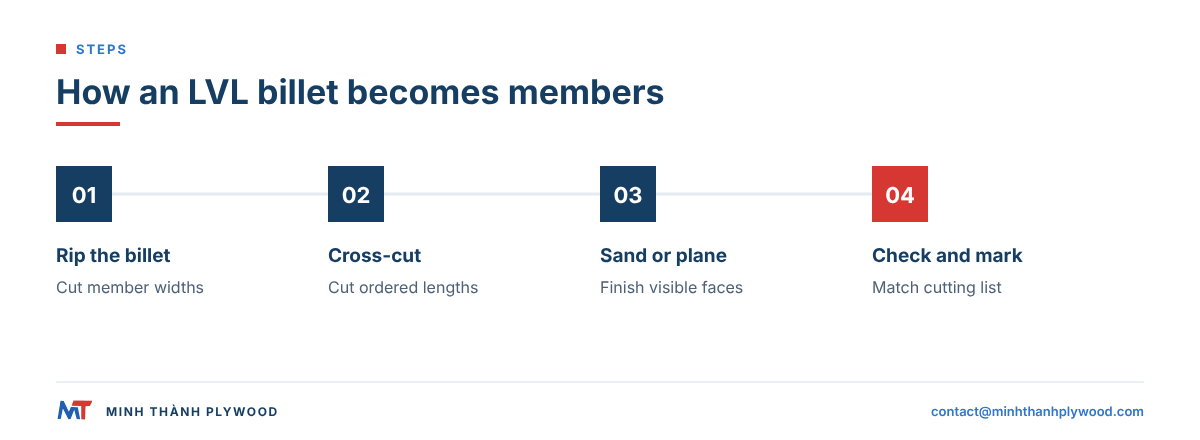
A billet becomes a beam, stud or rail when it is ripped into sections, cross-cut to length and sanded or planed where needed. The cutting plan follows the buyer’s drawing.
- Ripping cuts the billet along its length into the member width.
- Cross-cutting trims to the ordered lengths.
- Sanding or planing brings visible faces to the required finish; concealed members often stay as pressed.
- Edge and end sealing may be applied for members going into humid service.
Our LVL billet formats are 1220 × 2440 and 1250 × 2500 mm, cut to the member thickness, width and length on your drawing, with the grain along the longer billet direction. Group repeating parts by section and length; the cutting list then travels with the order through production, bundle marking and receiving. For sizes used in building, see LVL beams.
Structural vs non-structural LVL: what is the difference?
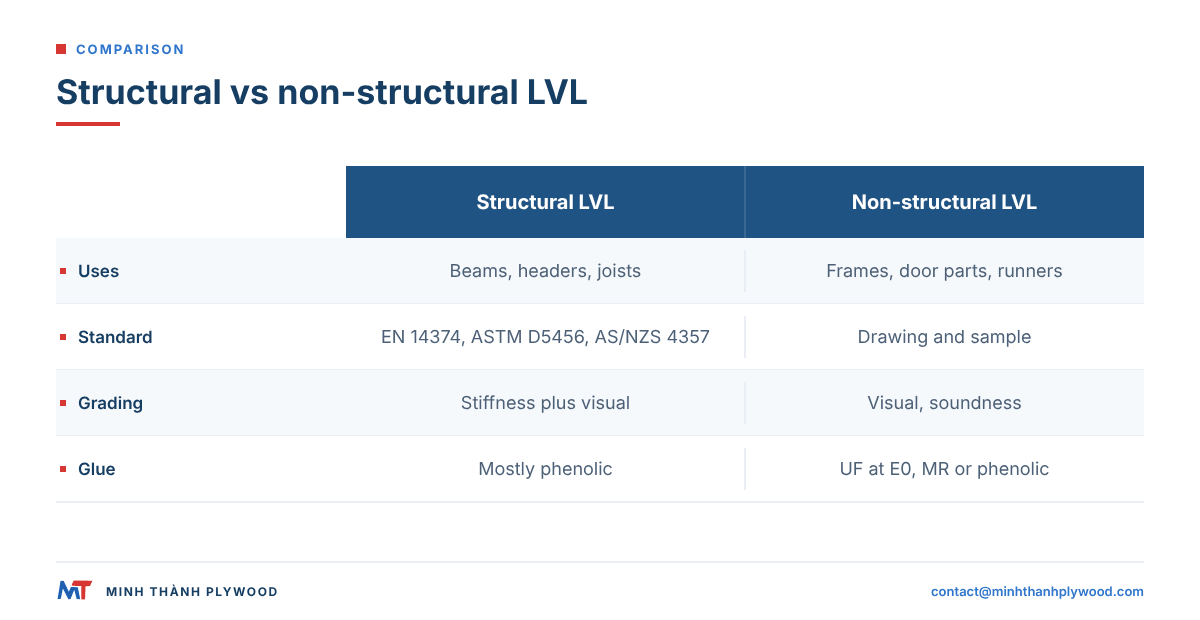
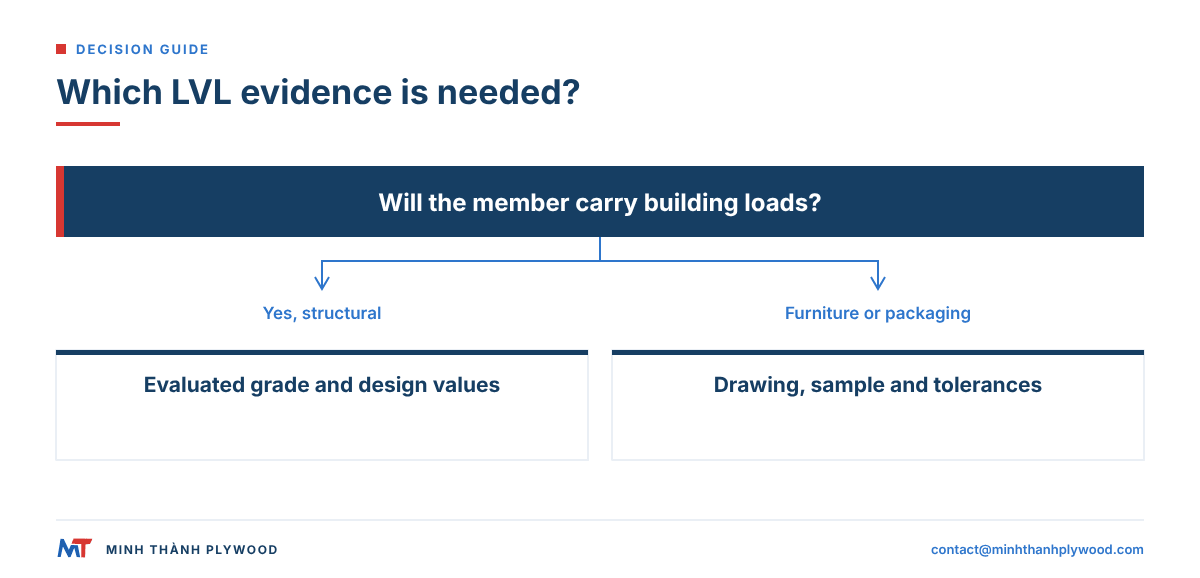
Structural LVL is made and tested to a product standard and sold with design values for engineers. Non-structural LVL is made for components where the drawing and the approved sample define the order. The production steps are similar; the grading, testing and paperwork are not.
| Structural LVL | Non-structural LVL | |
|---|---|---|
| Uses | Beams, headers, rafters, joists, I-joist flanges, scaffold planks | Furniture frames and rails, door and window components, packaging runners and frames |
| Standards | EN 14374 (Europe), ASTM D5456 (US), AS/NZS 4357 (Australia and New Zealand), JAS (Japan) | Buyer’s drawing, sample and agreed tolerances |
| Veneer grading | Stiffness grading plus visual | Visual and soundness |
| Glue | Mostly phenolic | UF at E0, MR or phenolic by service |
| Evidence | Certified design values, ongoing factory production control | Dimensions, moisture, glue line and appearance against the sample |
The APA structural composite lumber page describes how structural LVL is evaluated in North America. Our LVL is supplied for furniture frames, door components and industrial packaging. For load-bearing construction, the engineer names the evaluated product and its design values, and the member is sized from that evidence. LVL strength explains the properties engineers use.
What equipment does an LVL plant need?
An LVL plant needs the same front end as a plywood mill, peeling, drying and grading, plus a lay-up and press line built for parallel stacks. The difference is in the back end.
| Line | Equipment | Shared with a plywood mill? |
|---|---|---|
| Log yard | Log deck, cut-off saw, conditioning vats | Yes |
| Peeling | Rotary lathe, clipper | Yes |
| Drying | Jet or roller veneer dryer | Yes |
| Grading | Visual grading station; ultrasonic grader on structural lines | Partly |
| Gluing | Roller or curtain glue spreader | Yes |
| Lay-up | Parallel lay-up with joint staggering | Different |
| Pressing | Continuous press or multi-opening hot press | Panel press can serve sheet-format billets |
| Finishing | Rip saws, cross-cut saws, sander or planer | Partly |
| Testing | Moisture meters; bending and bond tests on structural lines | Partly |
That overlap is why many plywood mills also make LVL: the veneer supply, dryers and glue kitchen are already in place.
Which quality checks matter on LVL?
The checks that matter on LVL are moisture, dimensions, straightness, the glue lines and the surfaces the member will show. Run them at the mill before packing and again on arrival.
| Check | What to look for | How |
|---|---|---|
| Moisture | 8–12% for our LVL | Moisture meter on several pieces per bundle |
| Section size | Width and thickness to the drawing | Caliper at both ends and the middle |
| Length | To the cutting list | Tape |
| Straightness | Bow, spring and twist within the agreed limit | Straightedge or string line along the member |
| Glue lines | No open lines or delamination at ends and edges | Visual; bond test on samples if specified |
| Joints | Joint positions and offsets follow the specified layup | Check against the layup record and visible edges |
| Surfaces | Visible faces match the sample | Side-by-side with the approved sample |
| Bundle marks | Match the order and cutting list | Labels against the packing list |
Every shipment is photographed and filmed before loading, and buyers get the photos and video. Third-party testing to the buyer’s method is arranged through SGS on request.
What documents does LVL need for export?
LVL for export needs the shipping documents for the destination, timber legality evidence and, for structural use, the product’s evaluation. Plan them before production.
- Shipping documents: commercial invoice, packing list, bill of lading, certificate of origin (EUR.1 for the EU), phytosanitary and fumigation certificates.
- EU: under the EU Deforestation Regulation (Regulation (EU) 2023/1115) the importer needs origin data; we supply the EUDR compliance dossier (origin records and geolocation files) with orders.
- Australia: import conditions for timber products are set by the Department of Agriculture and listed in the BICON database; the broker checks the case for processed wood and the packaging.
- US: EPA’s product-scope guidance excludes structural composite lumber meeting ASTM D5456 from TSCA Title VI. Confirm the exact product’s scope before specifying emissions documents. Our certificates and test reports identify the factory’s hardwood-plywood certification. Species and harvest origin support the importer’s Lacey Act declaration.
- Structural use: the evaluation or certificate for the specific product and grade, named by the engineer.
LVL for furniture and packaging: why choose it over sawn timber?
Furniture and packaging makers choose LVL over sawn timber because it comes straight, dry and uniform in the section they need, with fewer knots and splits. A sawn rail from one log carries all of that log’s defects; an LVL rail spreads them through many thin veneers.
| Need | Sawn timber | LVL |
|---|---|---|
| Straight, long rails | Bow and twist as it dries | Straight from a pressed billet |
| Consistent strength along the length | Varies with knots and grain | More uniform, defects spread out |
| Exact sections | Sawn and dried, then machined | Cut from the billet to the drawing |
| Moisture | Depends on kiln and storage | Dry billet, 8–12% for ours |
| Supply | Depends on log size | Small plantation logs make long members |
Typical non-structural uses are sofa and bed frames, chair rails, door stiles and frames, window components, pallet and crate runners, and packing frames. For load cases in packaging, the packaging design sets the span, load and fastening; the LVL member is specified from it.
What should you ask an LVL manufacturer before ordering?
Ask an LVL manufacturer for the species, glue and emission, lay-up, moisture, sizes and the evidence that fits your use. Then send a specification line that leaves nothing open:
- Application: furniture frame, door component, packaging runner, or structural member with the named evaluated product.
- Species: Acacia (about 580 kg/m³) or Eucalyptus (650–750 kg/m³).
- Lay-up: all parallel, or with specified cross-bands.
- Glue and emission: UF glue at E0 emission for interiors, E1 as an option; MR or phenolic WBP for humid service.
- Section and length: thickness × width × length from your drawing, with tolerances and visible faces marked.
- Moisture: 8–12%.
- Packing and quantity: pieces by section and length, total volume, destination port.
Production is 15–45 days after the 30% deposit, with the 70% balance against the scanned B/L, FOB Hai Phong, CFR or CIF. Free samples are available. See our LVL product page for formats and uses, or LVL price for how the price is built, and send your drawing to [email protected]; we reply within hours.
Buyer questions, answered
How are LVL beams made?
Logs are rotary-peeled into veneer, the veneer is dried and graded, glue is spread on each sheet, and the sheets are laid up with all grain running along the length and joints staggered. The stack is hot-pressed into a billet, then sawn and sanded into beams.
What is LVL made of?
LVL is made of thin wood veneers and adhesive. Common species are radiata pine, Douglas fir, spruce, poplar and plantation hardwoods such as eucalyptus and acacia; the glue is phenolic for structural and exterior LVL, and UF or melamine-fortified for interior components.
How does LVL differ from plywood in lay-up?
In LVL nearly every veneer runs in the same direction, along the member. In plywood, each layer runs at a right angle to the next. LVL is stronger along its length; plywood is more stable across its width.
What glue is used in LVL?
Structural LVL mostly uses phenol-formaldehyde (phenolic) glue for its water resistance. Interior and furniture LVL can use UF glue at E0 emission or melamine-fortified glue, chosen for the service environment.
Is LVL stronger than solid timber?
Usually, size for size, along the length. Peeling and re-gluing spreads knots and grain faults through many thin layers, so LVL has fewer weak points and more consistent strength than a sawn piece of the same species.
What is the difference between structural and non-structural LVL?
Structural LVL is made and tested to a product standard such as EN 14374, ASTM D5456 or AS/NZS 4357 and carries design values for beams and headers. Non-structural LVL is made for furniture frames, door components and packaging, where the drawing and sample define the order.
How thick are LVL veneers?
LVL veneers are typically about 3 mm thick, peeled from the log on a rotary lathe. Thicker veneers mean fewer glue lines; thinner ones spread defects more evenly.
Why are veneer joints staggered in LVL?
A joint is a weak point. Staggering joints according to the specified layup limits their concentration and allows neighbouring continuous veneers to transfer load.
What moisture content should LVL have?
Veneers for LVL are dried before gluing, and finished LVL is supplied dry. Our LVL is supplied at 8–12% moisture content, the same range as our furniture plywood.
What sizes does LVL come in?
Continuous lines make long billets cut to beam lengths; panel presses make billets in sheet formats. Our LVL billets are 1220 × 2440 and 1250 × 2500 mm, cut to the sections on your drawing.