
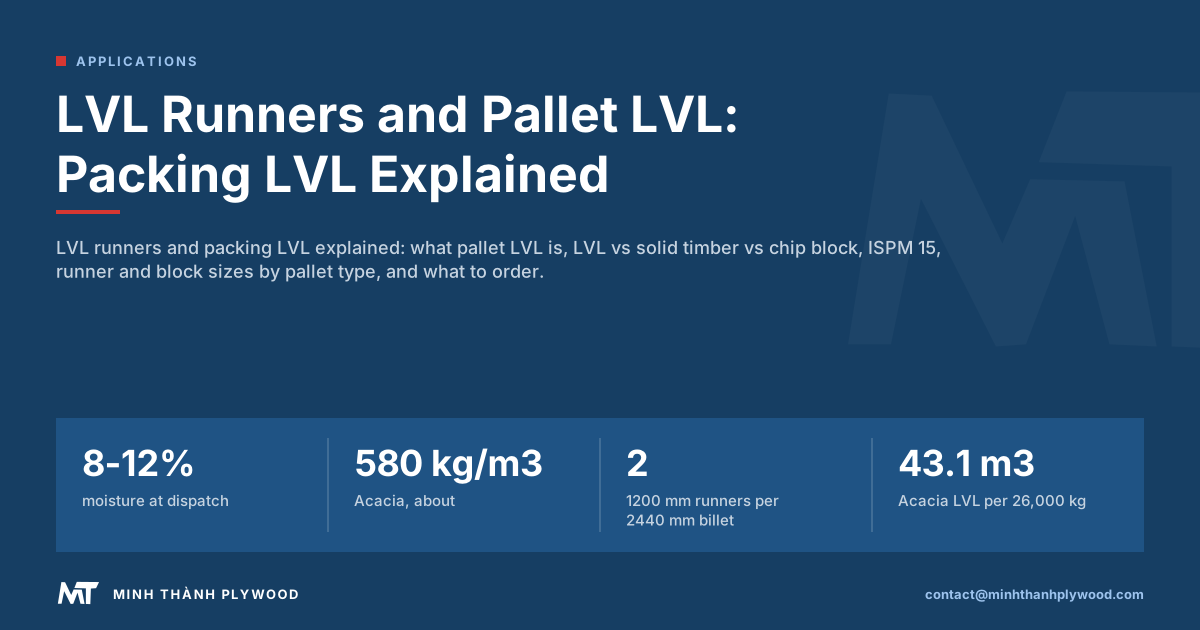
LVL runners are pallet and skid runners cut from packing LVL, laminated veneer lumber made of thin veneers glued with the grain running one way. They stay straight, arrive dry, resist splitting at nails and need no ISPM 15 stamp. This guide from Minh Thanh Plywood explains packing LVL, compares it with solid timber and chip blocks, and shows how to specify runners and blocks.
What are LVL runners?
LVL runners are the long bearers under a pallet, skid or crate base, cut from packing LVL instead of sawn timber. LVL, laminated veneer lumber, is made of thin veneers glued and pressed with their grain running along the piece, so a runner ripped from it is straight, even and dry.
Packing LVL is the general name for LVL made for packaging: runners, stringers, bearers, blocks, battens and crate frames. Buyers also call it pallet LVL or LVL for packing, and pallets built on it LVL pallets or LVL wooden pallets. It differs from structural LVL in its grading: packing LVL is chosen for straightness, size and bond, not for published design values in a building code.
Three parts of a pallet are commonly made from engineered wood:
- Runners or stringers: long members under the deck, LVL or sawn timber.
- Blocks or feet: short posts between deck and base, chip blocks, LVL blocks or timber.
- Deck: boards or a single sheet of plywood.
Why use LVL instead of solid timber for pallet runners?
LVL replaces solid timber in runners because it fixes the four faults that cause most pallet failures and rejections: it stays straight, it does not split at nails, it is even from piece to piece, and as processed wood it falls outside ISPM 15, so it needs no heat treatment or stamp.
- It stays straight. Sawn runners twist, bow and cup as they dry. LVL is pressed flat from veneers already dried, so it keeps its shape in the container.
- It does not split at nails. Many thin glue lines stop a split from running along the grain, so nails and staples can go close to the end.
- It is even from piece to piece. Knots and slope of grain are spread through many veneers instead of sitting in one weak spot.
- It is outside ISPM 15. As processed wood, LVL needs no heat treatment, no fumigation and no stamp.
A fifth reason is moisture. Packing LVL leaves the mill at 8–12%, while fresh sawn pallet timber can be far wetter. Wet runners shrink, loosen their nails and can carry mould onto the goods in a closed container.
LVL vs solid timber vs chip block for pallets
The three materials compete for the same pallet parts. One metric per row:
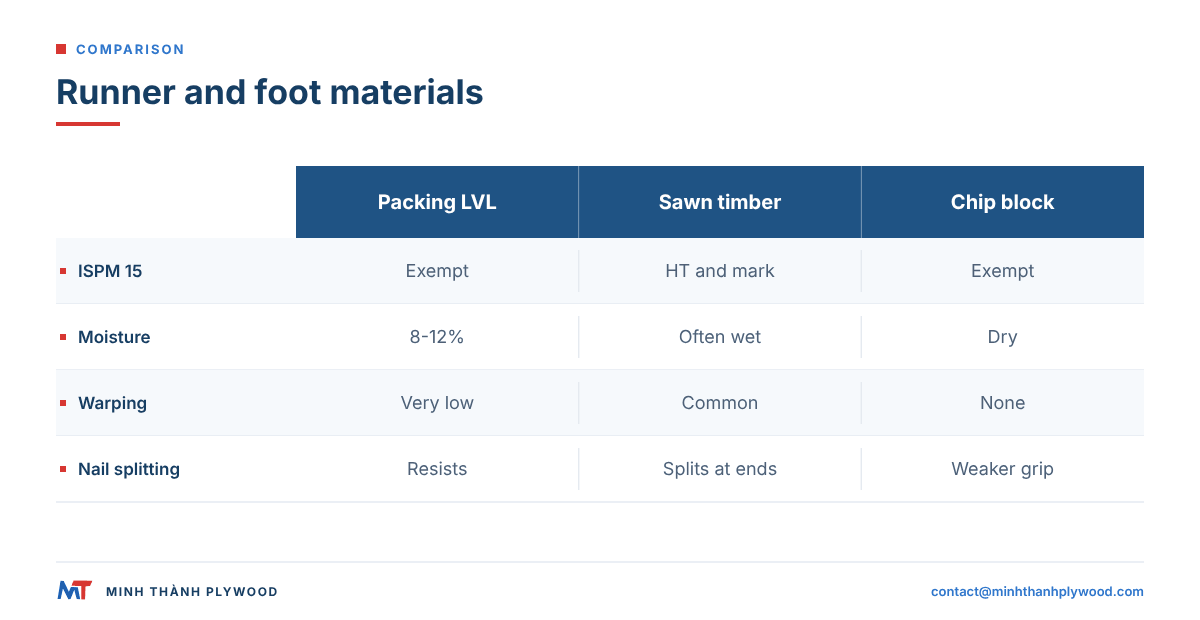
| Metric | Packing LVL | Solid sawn timber | Chip block |
|---|---|---|---|
| Typical part | Runners, stringers, blocks, crate frames | Runners, blocks, deck boards | Blocks (pallet feet) only |
| ISPM 15 | Exempt (processed wood) | Heat treatment and IPPC mark required | Exempt (processed wood) |
| Moisture at dispatch | 8–12% | Varies; often wet unless kiln dried | Dry from the press |
| Warping and twist | Very low | Common as it dries | None in use |
| Splitting at nails | Resists splitting | Splits near ends | Holds nails less well than LVL |
| Strength consistency | Even, defects spread | Varies with knots and grain | Even, low bending strength |
| Spans (runner use) | Yes | Yes | No, blocks only |
| Wet service | With MR or phenolic glue | Yes, but moves | Swells with long wetting |
| Lengths | Ripped from billets, to the drawing | By log length | Cut from a moulded beam |
Verdict by use. For runners and stringers on export pallets, LVL beats sawn timber on straightness, splitting and border rules. For blocks, chip blocks and LVL blocks both remove the ISPM 15 step; LVL blocks hold nails better, chip blocks cost less. Solid timber remains the choice for domestic pallets that never cross a border.
What is a chip block?
A chip block is a pallet foot made by mixing wood chips or sawdust with resin, pressing the mix in a heated mould into a long beam, and cutting it to block length. It is a processed wood product, so it falls outside ISPM 15, and it does not shrink, split or twist.
Chip blocks are often supplied with or without a central hole; the hole saves weight and material. They suit block pallets where the block only carries compression between deck and base. Where the foot also has to hold long nails from several directions, an LVL block or a sawn block grips better.
Which pallet types use LVL runners and blocks?
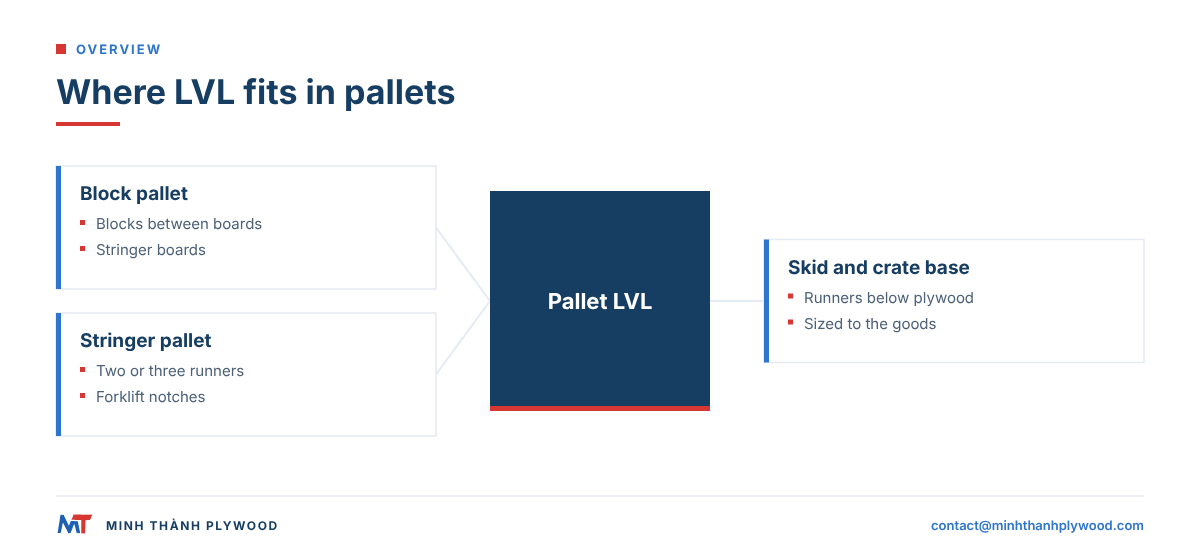
LVL runners and blocks appear in three pallet designs:
| Pallet type | Where LVL goes | Common size reference |
|---|---|---|
| Block pallet (EUR / EPAL type) | Blocks between deck and bottom boards; stringer boards | EUR pallet 1200 × 800 mm |
| Stringer pallet | Two or three runners under the deck, notched for forklifts | 1200 × 1000 mm and 48 × 40 in (1219 × 1016 mm) |
| Skid and crate base | Runners under a plywood deck, bolted to the goods | Sized to the machine or crate |
The EUR pallet is a licensed design with its own material rules; an EPAL-marked pallet must follow the EPAL specification. One-way export pallets and crate bases are free designs, and that is where LVL runners are used most.
Runner and block dimensions come from the pallet drawing: deck size, load, entry for forklift or pallet truck, and the fastener pattern. Send that drawing with the order; the LVL is ripped and cut to it.
How are LVL runners made?
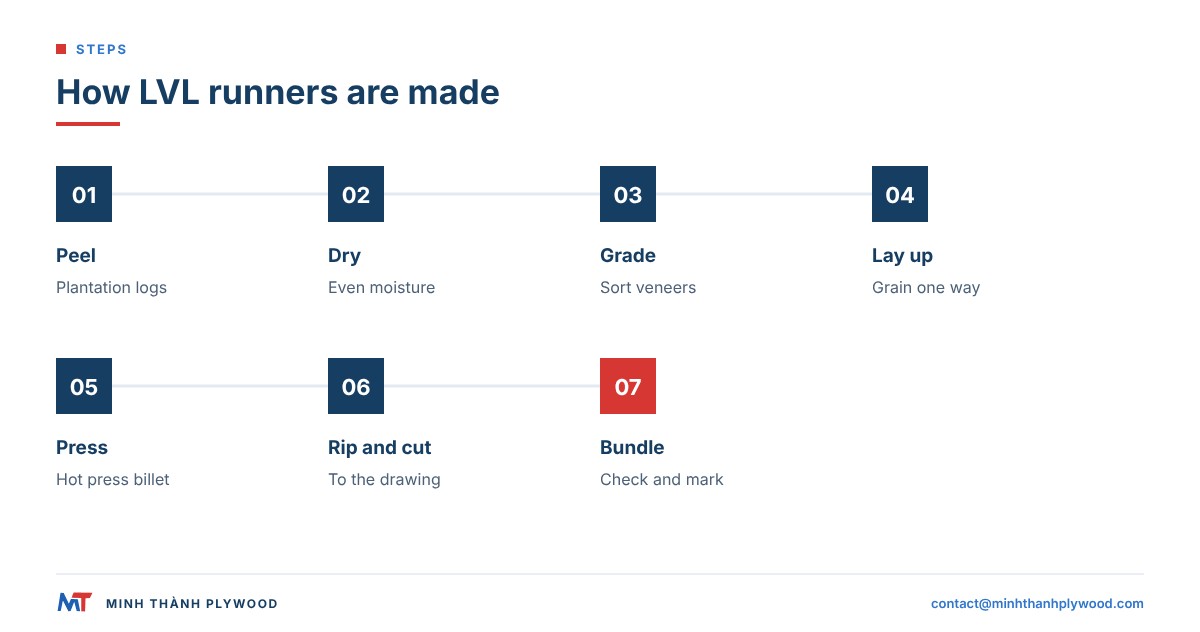
LVL runners are made in seven steps, from log to bundle:
- Peel. Plantation logs are rotary-peeled into thin veneer sheets.
- Dry. Veneers are dried to an even moisture before gluing.
- Grade. Veneers are sorted; open defects are cut out or patched.
- Lay up. Veneers are glued and stacked with the grain running the same way, joints staggered so no two fall together.
- Press. The lay-up is hot-pressed into a billet of the required thickness.
- Rip and cut. Billets are sawn into runners, stringers or blocks of the ordered section and length.
- Check and bundle. Sections, lengths and straightness are checked, then pieces are strapped into marked bundles.
Our LVL page shows the members and the billet formats, 1220 × 2440 mm and 1250 × 2500 mm.
Packing LVL specification: what to define
A packing LVL order defines the wood, the bond and the cut. The table lists every line and the options Minh Thanh Plywood offers:
| Line | Options | Notes |
|---|---|---|
| Species | Acacia or Eucalyptus plantation veneers | Locally grown around the factory |
| Density | Acacia about 580 kg/m³; Eucalyptus 650–750 kg/m³ | Sets weight per piece and per container |
| Glue | UF for dry service; MR / melamine-fortified; phenolic WBP | By route and reuse |
| Emission | UF at E0 for indoor use; E1 as an option | A separate line from the glue |
| Moisture | 8–12% at dispatch | Dry enough to nail straight away |
| Billet format | 1220 × 2440 mm or 1250 × 2500 mm | Runners are ripped from the billet |
| Section and length | To your drawing | Thickness, width, length, grain along the length |
| Ends and edges | Square cut; chamfers or notches on the drawing | Notches for forklift entry |
| Bundling | Strapped bundles, marked per part | Repeat the part reference on the packing list |
Standard LVL runner sizes
Runner sections are ripped from the billet, so any section on your drawing can be cut. Market listings from Indian and other packing-LVL makers show the sizes buyers ask for most:
| Dimension | Common sizes | Source of the range |
|---|---|---|
| Thickness | 25, 30, 35, 50, 55, 75 and 100 mm; heavier skids at 150 mm and 200 mm | Premium Plywood and Magnus Plywood |
| Length | 2440, 2745, 3050 and 3200 mm | Magnus Plywood |
| Our billets | 1220 × 2440 mm and 1250 × 2500 mm, cut to length | Minh Thanh Plywood |
| Density | 0.65 to 1.20 g/cm³ on the Indian market | Magnus Plywood |
Runners are bundled per part, with the pieces per bundle written on the packing list from your schedule.
Standards and tests for packing LVL
Buyers name the standard the LVL is checked against, and the test goes on the order:
- IS 14616:1999: the Indian standard for laminated veneer lumber, which Indian packing-LVL makers quote.
- EN 14374: the European product standard for structural LVL, used when a runner doubles as a load-bearing member.
- EN 314-1: the bond-quality test for plywood and veneer products, with a soak or boil cycle. Premium Plywood publishes a 72 h boil result, and the same cycle can be written into your order.
- Thickness swelling: measured after 2 h and after 24 h in water; a spec line states the limit you accept.
- Fastener holding: screw and nail withdrawal in N, tested on the section you buy. Premium Plywood lists 3,150 to 3,250 N for screws and 1,130 to 1,440 N for nails.
- Moisture: 8–12% at dispatch, read with a meter on arrival.
The ISPM 15 exemption sits above all of these: neither of the two Indian makers above uses it in their copy, and for an exporter it is the line that saves a border stop.
UK pallet sizes and runner buying
The UK standard pallet is 1200 × 1000 mm and the Euro pallet 1200 × 800 mm, per the Pallet Truck Shop size guide. Both are ISO 6780 footprints. Runners for both are cut from the same billet length: a 2440 mm billet gives two 1200 mm runners. Pallet makers buy runners by the container, so a mixed schedule of section sizes on one booking is how the freight cost per piece stays low.
A billet 2440 mm long gives two runners of 1200 mm with a saw cut between them, which suits EUR- and 1200 mm-based pallets. Longer runners for crates come from a billet ordered to that length.
ISPM 15 and LVL pallets
ISPM 15, the International Plant Protection Convention standard for wood packaging, does not apply to packaging made wholly of processed wood. The standard’s own text names plywood, particleboard, oriented strand board and veneer products made with glue, heat or pressure among the exempt materials (checked 20 October 2026). LVL and chip blocks are made that way.
UK guidance on wood packaging says its rules “do not apply to processed, non solid WPM like plywood” (GOV.UK, wood packaging material for import and export).
That makes the material choice part of compliance:
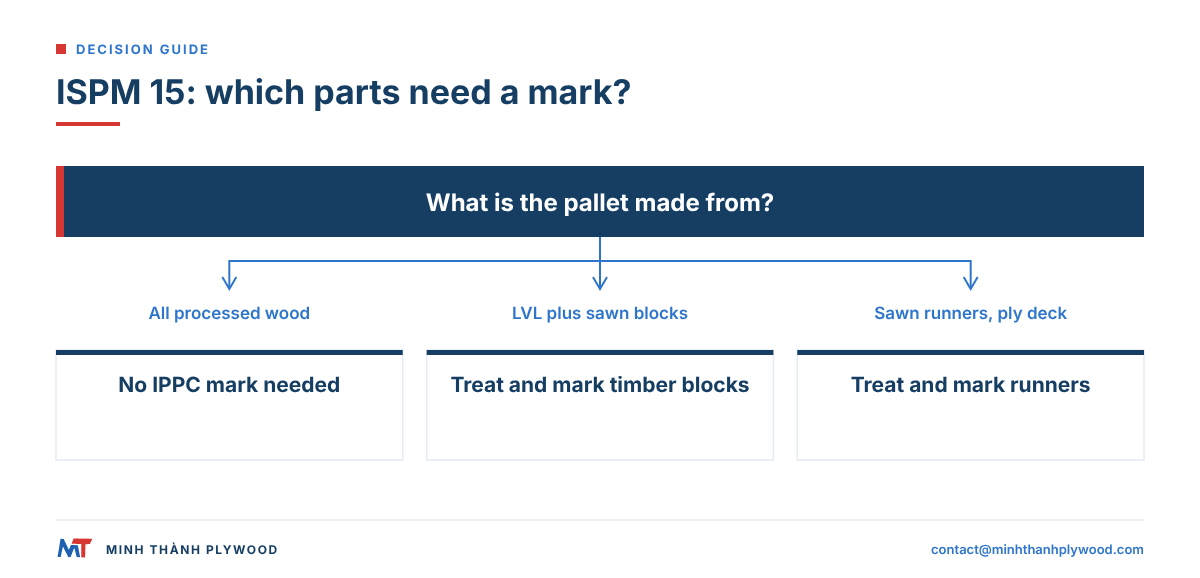
- LVL runners + chip or LVL blocks + plywood deck: processed wood throughout, no IPPC mark needed.
- LVL runners + sawn timber blocks: the timber blocks must be heat treated and marked.
- Sawn timber runners + plywood deck: the runners must be heat treated and marked.
A pallet that needs no mark cannot be stopped for a missing or illegible mark. For exporters shipping to many countries, that is the main reason to build on LVL.
Packing LVL vs structural LVL
Packing LVL and structural LVL are made the same way; they differ in how they are graded and sold. Structural LVL for beams and headers carries design values from a product standard such as EN 14374 in Europe and an evaluation for its grade. Packing LVL is sold by section, species, glue and straightness for pallets, crates and frames.
For a pallet or crate base, packing LVL is the right product: the packaging designer tests the assembled pallet, not the runner on its own. For a structural member in a building, specify structural LVL with its design values. Our article on LVL vs plywood explains where each lay-up is stronger.
LVL runners for crates and skids
Under heavy crates and machine skids, LVL runners carry the whole load to the forklift or the container floor. They are bolted through the plywood base to the goods, so they must hold bolts and lag screws without splitting, and stay straight so the base sits flat.
For crate bases, specify:
- Section sized by the packaging designer for the weight and the span between forklift points.
- Phenolic or melamine-fortified glue where the crate stands outdoors before or after the trip.
- Chamfered ends so the runner slides onto a trailer or container floor without catching.
- Plywood base deck of 15–18 mm on top, as our guide to plywood for crates and pallets sets out.
How many LVL pieces fit in a container?
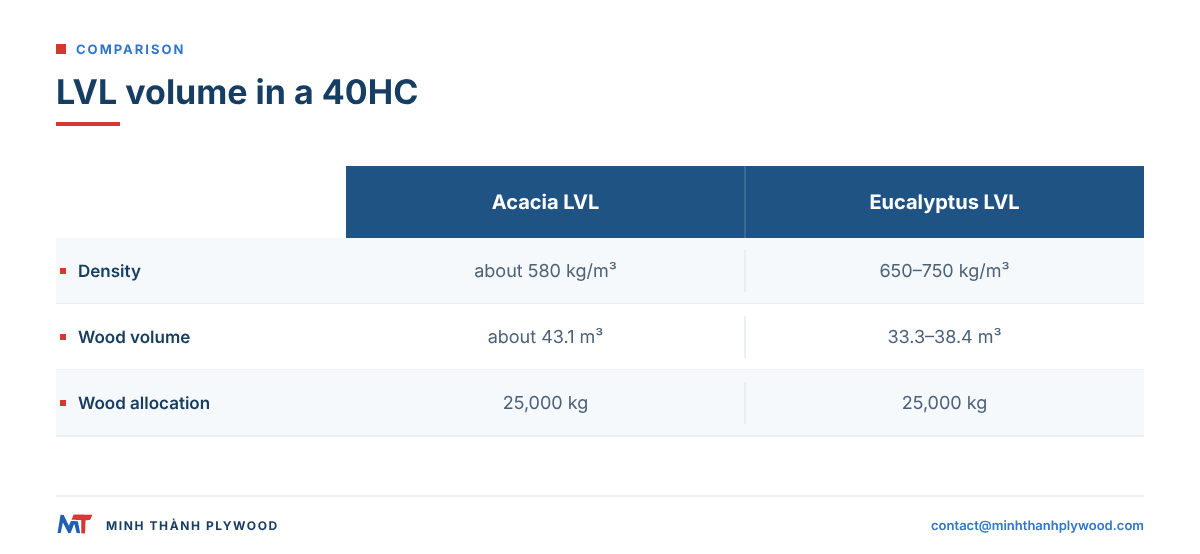
A 40HC of packing LVL is limited by weight before volume, because LVL is dense. The quantity is planned in cubic metres from the booking payload and the density, then converted to pieces from your section and length schedule.
| Plan | Acacia LVL | Eucalyptus LVL |
|---|---|---|
| Density | about 580 kg/m³ | 650–750 kg/m³ |
| Example booking | 26,000 kg gross: 25,000 kg wood, 1,000 kg packing | Same |
| Wood volume | about 43.1 m³ | about 33.3–38.4 m³ |
The 26,000 kg cap is an example; the real plan uses your booking payload and the weighed bundles. Pieces per container follow from the volume divided by the volume of one piece.
How to check LVL runners on arrival
Check LVL runners on arrival before they reach the nailing line:
- Bundles. Match each bundle mark to the packing list and the part reference.
- Sections. Measure thickness and width on several pieces per bundle.
- Length and ends. Check length, square ends and any chamfer or notch against the drawing.
- Straightness. Sight along a sample of runners or lay them on a flat floor.
- Glue lines. Look at the ends for open glue lines.
- Moisture. A meter reading of 8–12% is the dispatch range.
Keep the bundle records and photos with the receiving record. Every Minh Thanh shipment is photographed and filmed before loading, so the buyer can compare what left the factory with what arrived.
Packing LVL from Minh Thanh Plywood
Minh Thanh Plywood, a manufacturer in Phu Tho, Vietnam, makes LVL from locally grown Acacia and Eucalyptus plantation veneers for furniture frames, door components and industrial packaging. The same factory makes packing plywood for decks and crate panels, so runners and decks can travel in one container.
- Species: Acacia or Eucalyptus plantation veneers.
- Glue: UF at E0 for interiors, E1 as an option, MR / melamine-fortified or phenolic WBP for exposed service.
- Moisture: 8–12% at dispatch.
- Formats: billets of 1220 × 2440 mm or 1250 × 2500 mm, cut to your sections.
- Documents: EUDR compliance dossier (origin records and geolocation files) with orders for Europe, under Regulation (EU) 2023/1115.
- Terms: MOQ one 40HC, mixed specifications by agreement; production 15–45 days after the 30% deposit; balance against the scanned B/L or L/C at sight; FOB Hai Phong, CFR or CIF; free samples.
Send this line for a quote: “Packing LVL runners, [Acacia/Eucalyptus], [UF/MR/phenolic] glue, [section] × [length] mm, [quantity] pieces per pallet drawing attached, moisture 8–12%, bundled and marked per part, [quantity] × 40HC, [FOB/CIF port].”
Buyer questions, answered
What are LVL runners?
LVL runners are the long bearers under a pallet or skid, cut from laminated veneer lumber instead of sawn timber. The veneers run along the runner, so it stays straight, holds nails without splitting and needs no ISPM 15 treatment.
Why use LVL instead of solid timber for pallet runners?
LVL is dry, straight and even in strength from piece to piece, because defects are spread through many thin veneers. It does not twist or split like green sawn timber, and as processed wood it travels without ISPM 15 heat treatment or stamping.
Is LVL exempt from ISPM 15?
Yes. ISPM 15 exempts wood packaging made wholly of processed wood produced with glue, heat or pressure, and LVL is made that way. Solid timber parts on the same pallet still need heat treatment and the IPPC mark.
What is a chip block?
A chip block is a pallet foot pressed from wood chips or sawdust and glue in a mould, then cut to length. Like LVL, it is processed wood and falls outside ISPM 15.
What is the difference between LVL and plywood?
In LVL the veneers run in one direction, which makes a strong, straight member such as a runner or beam. In plywood alternate veneers are cross-laid, which makes a stable flat panel such as a pallet deck.
What glue is used in packing LVL?
UF glue for dry, covered service; melamine-fortified (MR) glue for humid routes; phenolic WBP glue where pallets stand in rain or are reused outdoors. The emission class is a separate line on the order.
What moisture content does packing LVL have?
Minh Thanh Plywood dries its veneers and finished LVL to 8–12% moisture at dispatch. Fresh sawn pallet timber is usually much wetter and dries, shrinks and moves in transit.
Can LVL pallets be reused?
Yes, when the glue matches the service. A phenolic-bonded LVL runner under a plywood deck survives several trips; a UF-bonded runner is meant for one-way, covered export.
How heavy is packing LVL?
Acacia LVL is about 580 kg/m³ and Eucalyptus LVL 650–750 kg/m³. A runner's weight follows from its section and length times that density.
Which wood is packing LVL made from?
Minh Thanh Plywood makes LVL from locally grown Acacia or Eucalyptus plantation veneers, with the EUDR dossier supplied for European orders.