
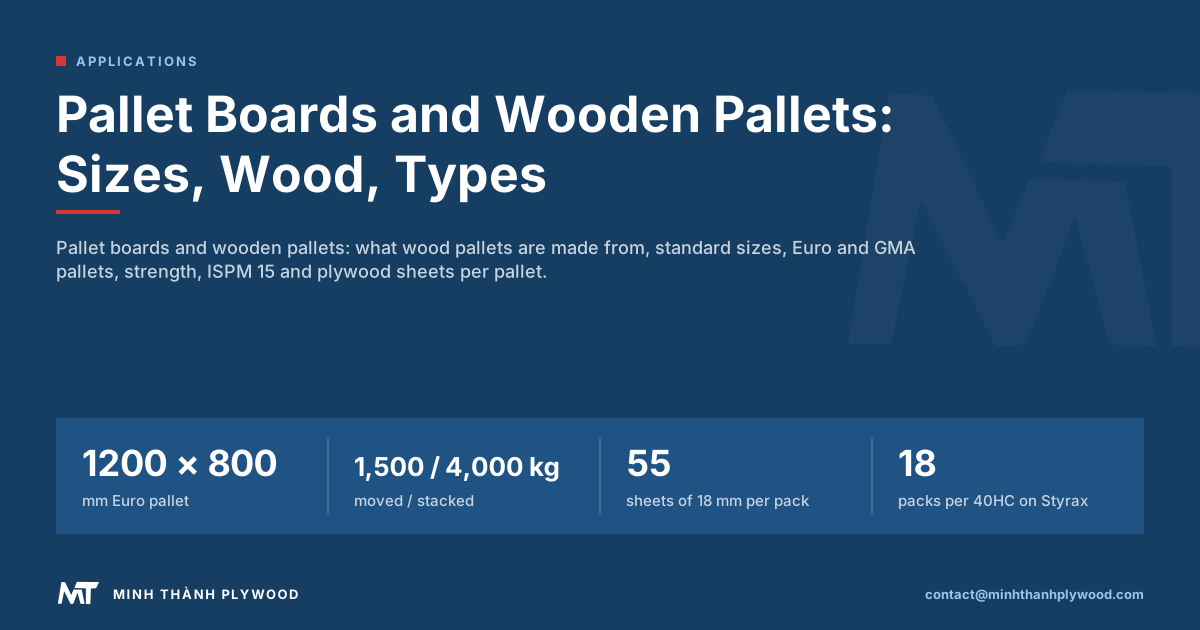
Pallet boards are the deck boards nailed across the stringers or blocks of a wooden pallet; together they carry the load and the forklift. Most pallets are pine, spruce or mixed hardwood, built to standard sizes such as the 1200 × 800 mm Euro pallet and the 48 × 40 inch GMA pallet. Minh Thanh Plywood supplies plywood and LVL for pallet decks and blocks.
What are pallet boards?
Pallet boards are the deck boards of a wooden pallet: the top boards that carry the goods and the bottom boards that spread the load on the floor or on a rack. They are nailed across the pallet’s stringers or blocks, and their thickness, spacing and wood decide how much the pallet carries.
A wooden pallet has three kinds of part:
- Top deck boards, which take the load and the forklift tines.
- Stringers or blocks, the members between the decks that leave room for the tines.
- Bottom deck boards, which stand on the floor, a rack or the pallet below.
On a Euro pallet the deck boards are about 22 mm thick. On many one-way export pallets the top deck is a single plywood panel instead of boards, which spreads the load evenly and needs no ISPM 15 treatment.
Pallet board sizes and where loose boards are used
Loose pallet boards come in a few standard sizes, and UK buyers mostly want them for DIY, cladding and garden projects. The EPAL Euro pallet is built from deck boards 22 mm thick and 145 mm or 100 mm wide, 1200 mm long, with bottom boards chamfered on the upper edge of both long sides. EPAL’s own page describes the EPAL Euro pallet, and its boards run 22 to 24 mm thick.
| Board | Size | Where it sits |
|---|---|---|
| Wide deck board | 1200 × 145 × 22 mm | Top and bottom deck of a Euro pallet |
| Narrow deck board | 1200 × 100 × 22 mm | Intermediate top-deck boards and outer bottom-deck boards |
| Loose DIY board, UK | 1000–1300 mm long, one width and thickness per pack | Wall covering, cladding, garden furniture |
| New pallet wood, UK | 100 mm wide, unsanded | Craft, cladding, furniture |
UK shops sell identical loose boards in packs: a pack of 50 same-style boards, average length 1000 to 1300 mm, is £50 at Universal Pallets, about £1 a board, with delivery added at checkout (Universal Pallets, read in October 2026). A UK seller of new pallet wood, 100 mm wide and unsanded, ships in 2 to 7 business days (The Scaff Shop, read in October 2026). Reclaimed boards are also sold as wall and exterior cladding.
Reclaimed boards need a check before they go indoors. Look at the ISPM 15 stamp: HT means heat treated, which is the safe code, and MB means methyl bromide fumigation, which you should avoid for wall panelling, furniture and anything near food or children. Sand reclaimed boards, remove old nails and wash off oil stains. New, kiln-dried boards cost more than reclaimed but arrive clean, with a known thickness. A pallet’s deck can also be a single plywood panel; that is the part we supply, described below.
What wood are pallets made from?
Pallets are made mostly from softwoods, chosen for low cost, straight grain and good nail holding, with hardwoods where heavy loads or local supply favour them. Europe mostly uses pine, spruce and fir, North America southern yellow pine and oak, and Asia acacia, rubberwood and eucalyptus.
| Region | Main pallet woods | Why |
|---|---|---|
| Europe | Pine, spruce, fir | Plentiful, light, take nails well; standard for Euro pallets |
| North America | Southern yellow pine, oak, mixed hardwoods | Hardwood offcuts from sawmills, strong for heavy loads |
| Asia | Acacia, rubberwood, eucalyptus, imported pine | Plantation timber close to export factories |
| Engineered options worldwide | Plywood decks, LVL runners, pressed wood blocks | Uniform strength, no ISPM 15 treatment |
Softwood pallets are lighter; hardwood pallets resist forklift damage better. In Vietnam, plantation acacia and eucalyptus are the common pallet woods, the same species used for plywood cores.
Which types of wooden pallet are there?
There are six common types of wooden pallet, set by how the deck is carried and how a forklift enters.
| Type | Build | Size | Forklift entry | Typical use |
|---|---|---|---|---|
| Euro pallet (EPAL 1) | Block pallet, 11 boards, 9 blocks, 78 nails | 1200 × 800 × 144 mm | Four sides | European retail and industry pools |
| GMA pallet | Stringer pallet, 3 stringers | 48 × 40 inch (1219 × 1016 mm) | Two sides, four with notches | North American grocery and retail |
| Industrial block pallet | Block pallet | 1200 × 1000 mm | Four sides | Chemicals, bulk goods in Europe |
| Stringer pallet | Deck boards on stringers | By order | Two or four sides | One-way export |
| Skid | Top deck on runners, no bottom deck | By the cargo | Two sides | Machinery, crates |
| Plywood or presswood pallet | Plywood deck on pressed wood or LVL blocks | By order | Four sides | Export without ISPM 15 treatment |
A pallet with a stackable wooden collar added on top turns any of these into an open box; collars are covered below.
Wooden pallets standard dimensions
Wooden pallets standard dimensions are set by ISO 6780, which lists six sizes used in international trade:
| Size (mm) | Common name | Main region |
|---|---|---|
| 1200 × 800 | Euro pallet | Europe |
| 1200 × 1000 | Industrial pallet | Europe, Asia |
| 1219 × 1016 | GMA pallet, 48 × 40 inch | North America |
| 1165 × 1165 | Australian pallet | Australia |
| 1067 × 1067 | 42 × 42 inch | North America, Europe |
| 1100 × 1100 | Asia pallet | Japan, Korea, Asia |
Wooden pallet dimensions outside these sizes are common for one-way export, where the pallet is made to the product rather than to a pool. A plywood pack of 1220 × 2440 mm, for example, needs a base sized to the sheet.
The Euro pallet in numbers
The Euro pallet (EPAL 1) measures 1200 × 800 × 144 mm, weighs about 25 kg and is built from 11 boards, 9 blocks and 78 special nails to the EN 13698-1 build. Licensed makers brand each pallet on the blocks, and the pallets are exchanged in pools across Europe.
The European Pallet Association rates the EPAL 1 for about 1,500 kg spread evenly when it is moved (EPAL, checked October 2026). It is rated up to about 4,000 kg as the bottom pallet of a stack on a flat, even floor. A Euro pallet in a rack carries less, set by how it is supported.
How strong are wooden pallets?
Wooden pallets are strong enough to carry about one to two tonnes when moved and several tonnes when stacked on a floor, but every pallet has three ratings, not one:
- Dynamic load: what it carries while a forklift or pallet truck moves it.
- Static load: what it carries standing on a flat floor, including stacked loads above.
- Racking load: what it carries spanning the beams of a rack, usually the lowest of the three.
The test methods for these ratings are in ISO 8611. Strength comes from the wood species, the deck board thickness, the number of boards and the nailing; a pallet loaded unevenly or with a point load fails well below its rating. For export plywood packs, which are heavy and evenly spread, the base must carry the full pack weight on the container floor.
How pallets are made
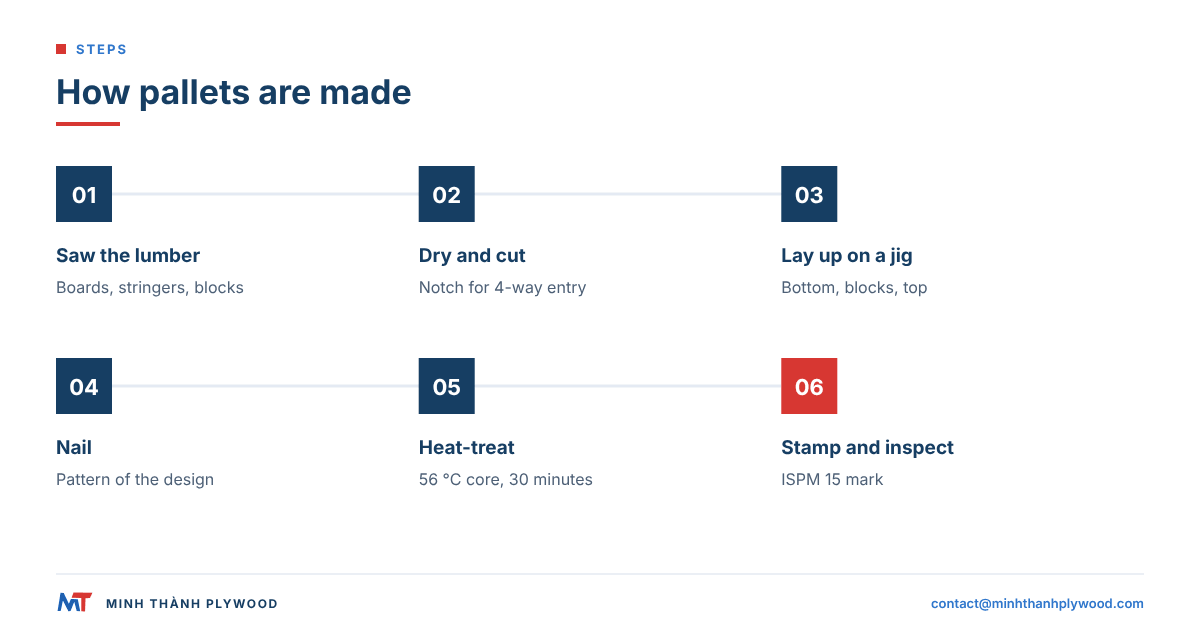
How pallets are made, step by step, in a pallet plant:
- Saw the lumber into deck boards, stringers or blocks, to the thickness and width of the design.
- Dry the timber to reduce mould and splitting.
- Cut to length and notch stringers where four-way entry is needed.
- Lay up on a jig: bottom boards, then stringers or blocks, then top boards.
- Nail with the nail type and pattern of the design, by machine or nail gun.
- Chamfer the edges of the bottom boards so pallet trucks can enter.
- Heat-treat the finished pallets to ISPM 15 if they will cross a border.
- Stamp the ISPM 15 mark and any pool brand.
- Inspect and stack for dispatch.
Plywood pallets follow the same steps with a plywood top deck cut to size and pressed wood or LVL blocks; they skip the heat treatment because their parts are processed wood.
Timber skids and wooden block pallets
Timber skids are platforms of deck boards on two or three runners, with no bottom deck. They carry machinery, crates and long loads, can be slid on rollers or lifted by forklift from two sides, and are the base of most heavy wooden crates.
A wooden block pallet stands on nine blocks, usually in three rows of three, under bottom boards that join them. Forklifts and pallet trucks enter from all four sides, which makes block pallets the standard for pallet pools such as EPAL. Blocks can be solid wood, pressed wood chips or LVL; pressed and LVL blocks are dimensionally stable and need no ISPM 15 treatment.
What is a wooden pallet collar?
A wooden pallet collar is a hinged frame of boards that sits on a pallet to form an open-top box; several collars stack to build a deeper box. The standard collar fits the 1200 × 800 mm Euro pallet and is about 200 mm high.
Collars fold flat when empty, so they suit returnable loops for loose parts and bulk goods. A plywood lid closes the top; for sea transit, a plywood box or crate protects better.
Which standards apply to wooden pallets?
The international standards for wooden pallets cover four things: size, testing, build and treatment.
| Standard | What it sets |
|---|---|
| ISO 6780 | Principal pallet sizes for international handling |
| ISO 8611 | Test methods and load ratings for flat pallets |
| EN 13698-1 | The build of the 800 × 1200 mm flat wooden pallet (Euro pallet) |
| ISPM 15 | Treatment and marking of solid wood packaging in international trade |
Under ISPM 15 (IPPC, checked October 2026), solid wood pallets are treated by an approved method and stamped with the IPPC symbol, country code, producer number and treatment code. Solid wood pallets are debarked and heat-treated to a core temperature of at least 56 °C for 30 continuous minutes, or treated by another approved method (GOV.UK wood packaging guidance). Pallets made wholly of plywood, LVL or pressed wood are processed wood and exempt, as the IPPC list of standards shows for ISPM 15.
Where do plywood and LVL fit in pallets?
Plywood and LVL fit into pallets wherever a uniform, treatment-free part is worth more than the cheapest sawn board. Three uses are common:
- Plywood top decks: one panel instead of boards, flat and closed, so small parts and bags do not fall through, and nothing splits at the nails.
- LVL runners and stringers: straight, knot-free and the same strength along their length, for skids and heavy pallets.
- Pressed wood or LVL blocks: stable blocks that do not crack at the nails.
Because plywood and LVL are processed wood, a pallet made wholly of them ships without ISPM 15 treatment. Minh Thanh supplies packing plywood and LVL for these parts; the comparison with solid wood pallets is in plywood pallets vs solid wood pallets.
How many sheets of plywood are on a pallet?
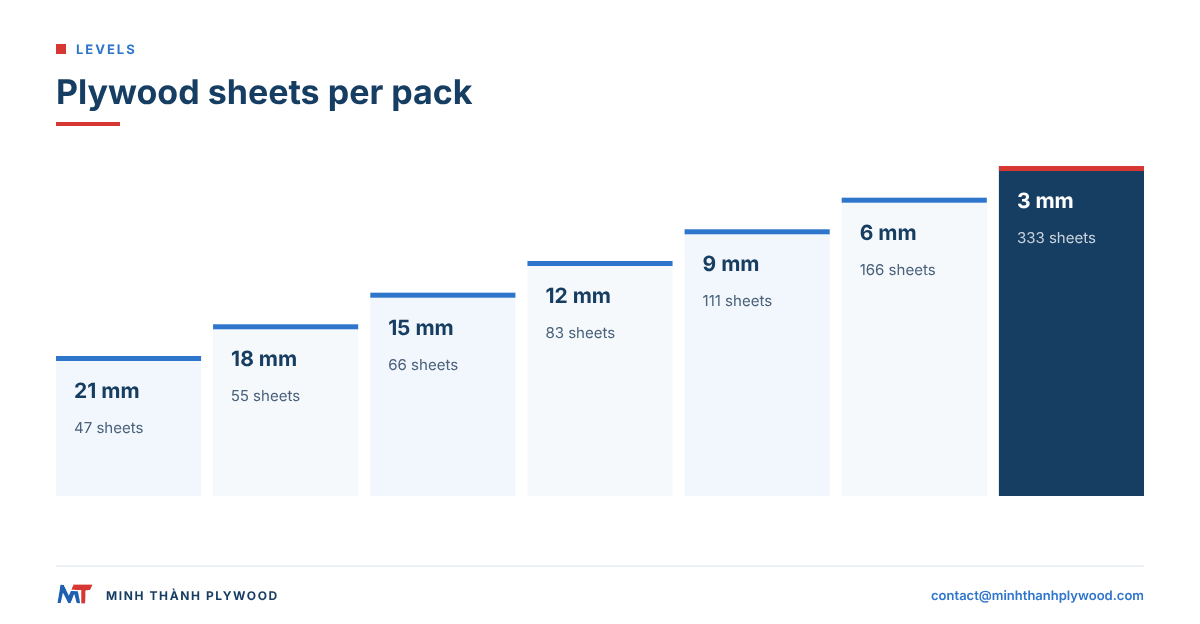
The number of plywood sheets on a pallet is the pack height divided by the sheet thickness. An export pack is about 1,000 mm high, so it holds 1,000 ÷ thickness, rounded down, unless the weight cap stops it lower.
| Thickness | Sheets per pack (about 1,000 mm high) |
|---|---|
| 3 mm | 333 sheets |
| 6 mm | 166 sheets |
| 9 mm | 111 sheets |
| 12 mm | 83 sheets |
| 15 mm | 66 sheets |
| 18 mm | 55 sheets |
| 21 mm | 47 sheets |
US lumber yards often sell plywood by the unit or bunk, with counts that differ by mill; the rule above lets you check any count against the thickness.
How much does a pallet of plywood weigh?
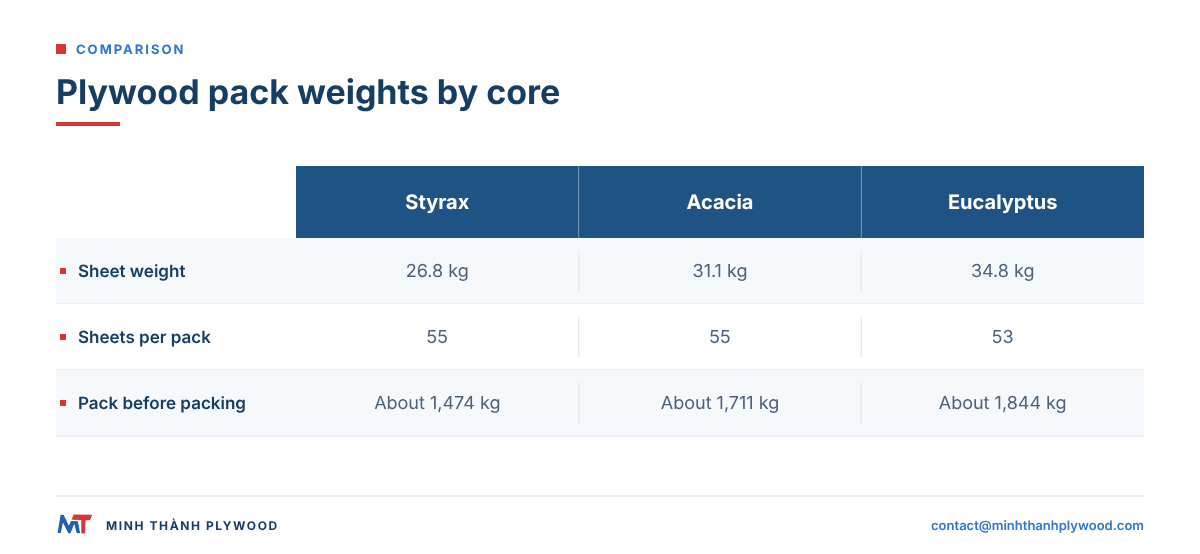
A pallet of plywood weighs the sheet weight times the sheet count, plus the base and packing. For 18 mm sheets of 1220 × 2440 mm:
| Core | Sheet weight | Sheets per pack | Pack weight before packing |
|---|---|---|---|
| Styrax (500 kg/m³) | 26.8 kg | 55 sheets | About 1,474 kg |
| Acacia (580 kg/m³) | 31.1 kg | 55 sheets | About 1,711 kg |
| Eucalyptus (650 kg/m³) | 34.8 kg | 53 sheets | About 1,844 kg |
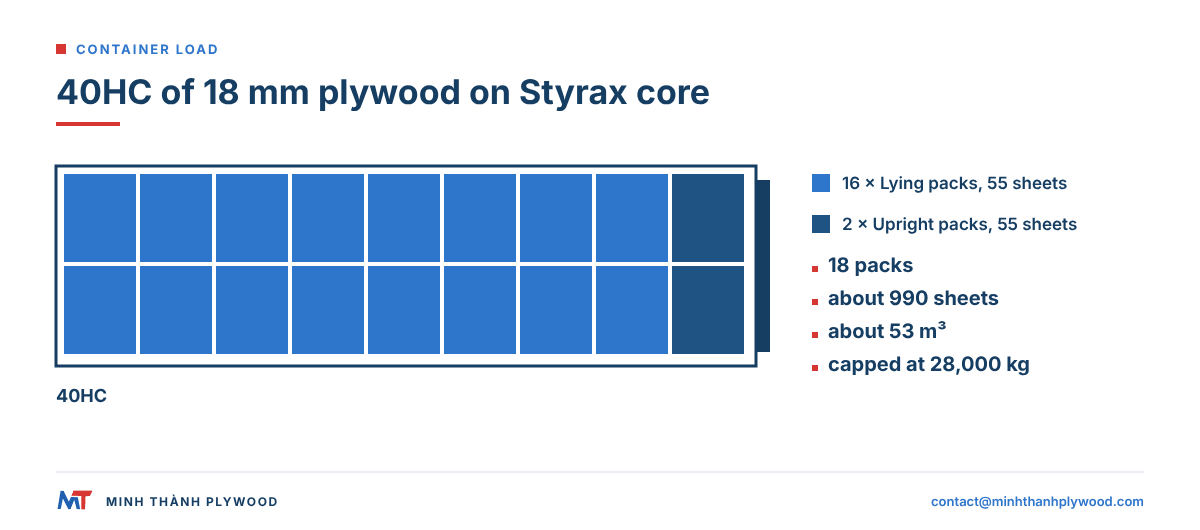
These weights are why the pack base matters: it carries one and a half to nearly two tonnes on a container floor, and a weak base breaks at the forklift. A heavier core also fills the container payload sooner, which is why a 40HC takes 18 packs on Styrax core, 16 on Acacia and 15 on Eucalyptus.
How is export plywood packed and palletised in Vietnam?
Export plywood in Vietnam is packed in strapped packs about 1,000 mm high on a base of plywood and pallet blocks, with cardboard and plywood covers, then loaded into the container by forklift. At Minh Thanh the packing follows the same steps for every order:
- Count and stack the sheets by specification, faces protected.
- Set the base: plywood and pallet blocks under the pack, or an export pallet on order.
- Cover the top and edges with cardboard and plywood boards.
- Strap the pack with steel or polyester bands.
- Label the pack with its specification and pack number, or the buyer’s own label on order.
- Load the 40HC: on 18 mm Styrax core, 18 packs, 16 lying and 2 upright, about 990 sheets and about 53 m³, capped at the 28,000 kg planning payload or the booking, if lower.
- Photograph and film the container before it is closed, and send the photos and video to the buyer.
Our export packing materials were tested by SGS in September 2026 under Regulation (EU) 2025/40: lead, cadmium, mercury and hexavalent chromium were not detected in the cardboard, plywood and pallet blocks, strapping band or wrapping film, against the 100 mg/kg limit.
Which plywood should pallet and crate makers order?
Pallet and crate makers should order packing plywood by the part it becomes: deck panels cut to the pallet size, sheathing in full sheets, and LVL for runners and blocks. A pallet maker in Germany, the Netherlands or Poland buying in full containers typically orders 12 to 18 mm packing plywood, 1220 × 2440 or 1250 × 2500 mm, or cut to size, with tolerance ±0.5–1.0 mm.
From Hai Phong, typical days at sea to Northern Europe are 30–40, by carrier and route. Minimum order is one 40HC with mixed specifications by agreement, production 15–45 days after the 30% deposit, FOB Hai Phong, CFR or CIF, and free samples.
A complete line reads: “Pallet decks, packing plywood 15 mm, cut to your deck size, melamine-fortified glue, Acacia core, ±0.5 mm, export packs, 1 × 40HC.” Send it to [email protected] or through the packing plywood page, and we reply within hours.
Buyer questions, answered
What are pallet boards?
Pallet boards are the deck boards of a wooden pallet: the top boards that carry the goods and the bottom boards that spread the load on the floor or a rack. They are nailed across stringers or blocks.
What wood are pallets made from?
Mostly softwoods such as pine, spruce and fir in Europe, southern yellow pine and mixed hardwoods such as oak in North America, and acacia, rubberwood, eucalyptus and imported pine in Asia.
What are the standard dimensions of a wooden pallet?
ISO 6780 lists six sizes: 1200 × 800, 1200 × 1000, 1219 × 1016 (48 × 40 inch), 1165 × 1165, 1067 × 1067 and 1100 × 1100 mm. The Euro pallet is 1200 × 800 × 144 mm.
How strong are wooden pallets?
A Euro pallet is rated for about 1,500 kg spread evenly when moved and up to about 4,000 kg as the bottom pallet of a stack on a flat floor. Racking loads are lower and depend on the rack beams.
What are the international standards for wooden pallets?
ISO 6780 for sizes, ISO 8611 for test methods and load ratings, EN 13698-1 for the Euro pallet build, and ISPM 15 for treatment of solid wood in international trade.
Do wooden pallets need ISPM 15?
Yes, solid wood pallets shipped across borders must be heat-treated or fumigated and stamped with the ISPM 15 mark. Pallets made wholly of plywood, LVL or pressed wood blocks are exempt.
How many sheets of plywood are on a pallet?
It depends on thickness. In a pack about 1,000 mm high there are 55 sheets of 18 mm, 83 of 12 mm, 111 of 9 mm and 166 of 6 mm, unless the weight cap stops the pack lower.
How much does a pallet of plywood weigh?
A pack of 55 sheets of 18 mm, 1220 × 2440 mm, weighs about 1,474 kg on a Styrax core and about 1,711 kg on Acacia; 53 sheets on Eucalyptus weigh about 1,844 kg, before packing.
What is the difference between a block pallet and a stringer pallet?
A block pallet stands on nine blocks and a forklift enters from all four sides; a stringer pallet stands on three long stringers and is entered from two sides, or four with notches.
What is a timber skid?
A skid is a platform of deck boards on runners with no bottom deck. It is used under machinery and crates, and is lifted by forklift or slid on rollers.