
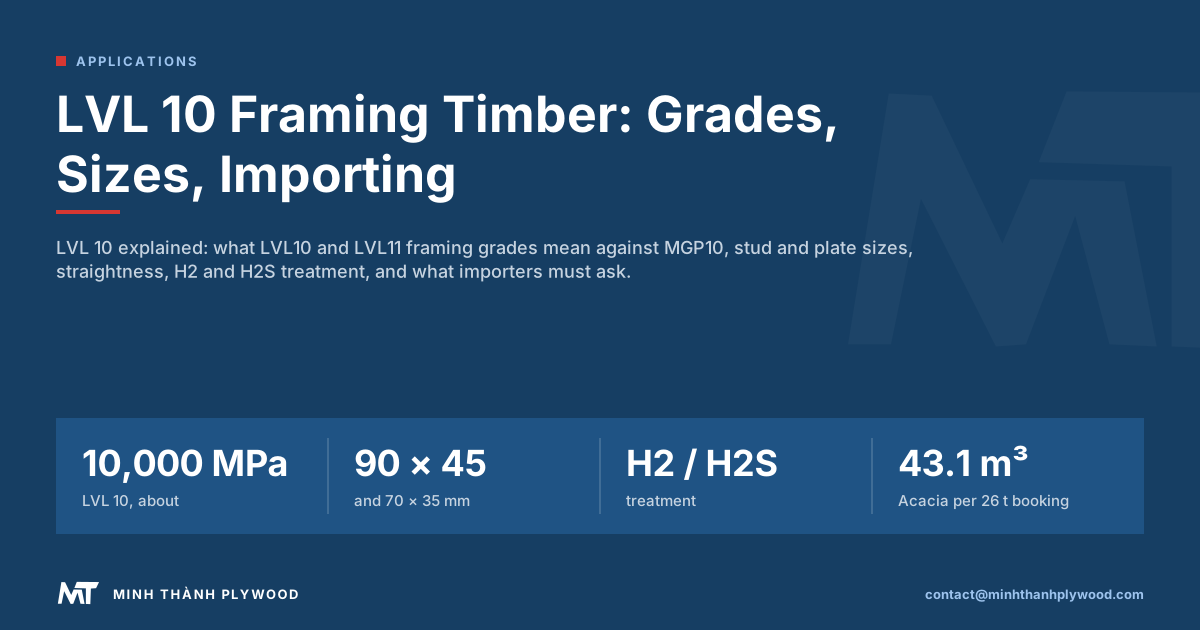
LVL 10 is laminated veneer lumber framing timber with a modulus of elasticity of about 10,000 MPa, the same stiffness class as MGP10 pine. It is used for wall studs, plates, noggings and rafters where straightness matters. Imports must be certified to AS/NZS 4357. Minh Thanh Plywood makes non-structural LVL for furniture, joinery and packaging.
What is LVL 10?
LVL 10 is a framing grade of laminated veneer lumber (LVL) with a modulus of elasticity (E) of about 10,000 MPa. The “10” stands for that stiffness, the same as MGP10 machine-graded pine. LVL 10 is sold in Australia and New Zealand for wall studs, plates, noggings and light roof framing.
Framing LVL is made like any LVL: thin veneers are dried, glued with their grain running along the member and pressed into a long billet, then sawn into framing sizes. Because every veneer runs the same way, the member is stiff and strong along its length, and because defects are spread across many veneers, it stays straight.
Makers sell LVL 10 and LVL 11 under their own product names, sometimes written as “Smart 10” or “Frame 10” style names. The grade number, not the brand name, tells you the stiffness.
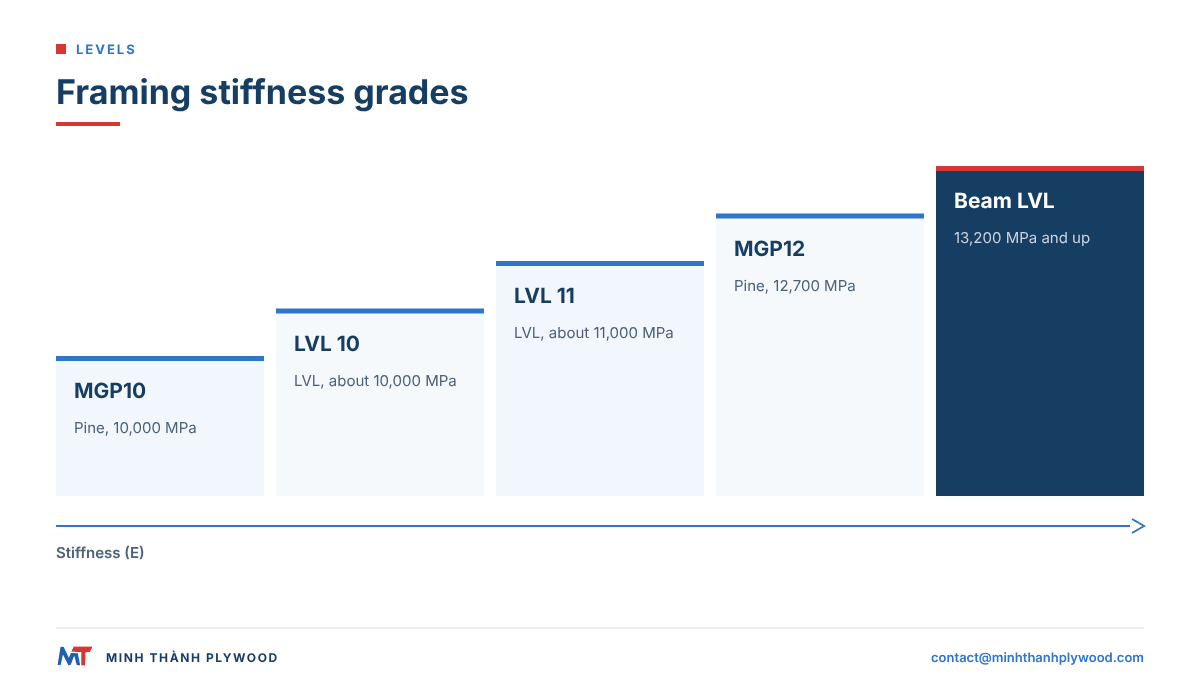
LVL 10, LVL 11 and MGP10: how the grades compare
LVL 10 and MGP10 share a stiffness of about 10,000 MPa; LVL 11 is stiffer at about 11,000 MPa. The difference between LVL and MGP is how they are made, which changes straightness, consistency and lengths.
| Grade | Material | Modulus of elasticity | How it is graded | Typical use |
|---|---|---|---|---|
| MGP10 | Sawn radiata or slash pine | 10,000 MPa | Machine stress-graded | Studs, plates, noggings |
| MGP12 | Sawn pine | 12,700 MPa | Machine stress-graded | Rafters, joists, lintels |
| LVL 10 | Laminated veneer lumber | about 10,000 MPa | Product certification, AS/NZS 4357 | Studs, plates, straight walls |
| LVL 11 | Laminated veneer lumber | about 11,000 MPa | Product certification, AS/NZS 4357 | Studs, rafters, longer spans |
| Structural LVL (beam grades) | Laminated veneer lumber | 13,200 MPa and up | Product certification | Beams, lintels, headers |
MGP values are set by AS/NZS 1748; LVL values are published by each maker for its product, tested under AS/NZS 4357.0. Some LVL 10 products are listed as interchangeable with MGP10 in the span tables of AS 1684, the Australian standard for residential timber-framed construction. Check the maker’s literature for that statement before swapping one for the other.
Is LVL stronger than plywood?
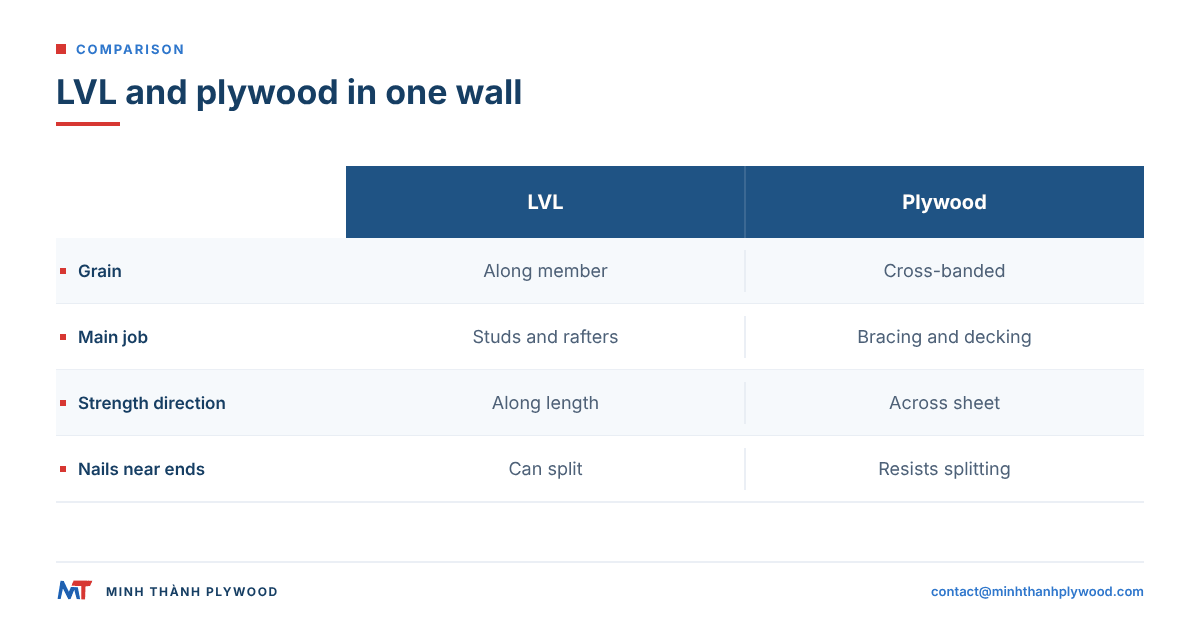
Along its length, yes. LVL runs all its veneers in one direction, so it is stronger and stiffer as a stud, rafter or beam. Plywood cross-bands its veneers at right angles, so it is stronger as a sheet that carries load in two directions.
| Point | LVL | Plywood |
|---|---|---|
| Veneer direction | All along the member | Alternating, cross-banded |
| Strongest as | Beam, stud, rafter, post | Sheet: floor, wall bracing, roof deck |
| Stiffness along length | Highest | About half the veneers carry it |
| Splitting at nails near ends | Can split if nailed close to the end | Resists splitting |
| Dimensional change across width | Moves like timber | Very stable both ways |
The two often work together: LVL studs and plates in the frame, plywood bracing on the face of the wall.
LVL 10 sizes, lengths and typical prices in Australia
LVL 10 framing in Australia is sold in sections from 70 × 35 mm up to 290 × 45 mm, in lengths of 2.4 to 6.0 m in 600 mm steps, and Tilling’s Smart10 lists the same lengths, with H2S termite treatment as standard south of the Tropic of Capricorn (Tilling, checked October 2026). A 90 × 45 mm stud costs about A$5.80 to A$8.40 per lineal metre as listed in 2026.
Blacktown Building Supplies lists the range from 70 × 35 up to 290 × 45 mm as single lengths or framing packs (Blacktown Building Supplies), and Dindas lists depths of 70, 90, 120, 140, 190, 240, 290, 300 and 360 mm in lengths up to 12 m, with H2S as standard and H2 or H3 LOSP treatment on request (Dindas).
| Item | What Australian merchants list |
|---|---|
| Common sections | 70 × 35, 70 × 45, 90 × 35, 90 × 45 mm |
| Deeper sections | 120, 140, 190, 240 and 290 × 45 mm |
| Lengths | 2.4 to 6.0 m in 600 mm steps; up to 12 m from some makers |
| Treatment | H2S as standard; H2 or H3 LOSP on request |
| Grade and certification | E10, certified to AS/NZS 4357.0 |
| 90 × 45 mm price | about A$5.80 to A$8.40 per lineal metre, by merchant and length |
| Replaces | MGP10 pine; some makers list it as a design alternative to MGP12 |
Prices as listed in October 2026 by Cornwells Mitre 10 Lilydale (A$5.79 per lineal metre, listing), Bunnings Trade (A$7.92 per lineal metre for 3.6 m and A$8.38 for 5.4 m, listing) and Brisbane Building Products (A$7.20 per lineal metre for 6.0 m, listing). GST treatment and pack discounts differ by merchant, so this is a market band and not an offer; buying a full pack works out cheaper per metre than single lengths.
The three stamps on a pack mean different things. A Bond is the structural-grade adhesive rating, E0 is the low-emission rating for indoor air quality, and H2S is the termite treatment for framing kept dry inside the building envelope.
Australian frame, joinery and packaging buyers can source E0 non-structural LVL components direct from Vietnam by the 40HC, cut to their own drawings from Minh Thanh’s 1220 × 2440 or 1250 × 2500 mm billets. The certified framing above is a different product, and the sections below say what separates the two.
LVL 10 stud and plate sizes
LVL 10 framing comes in the standard Australian wall frame sizes: 90 × 45, 90 × 35, 70 × 45 and 70 × 35 mm. The 90 mm and 70 mm depths match the two common wall thicknesses; 45 and 35 mm are the stud widths.
| Size (depth × width) | Typical use | Notes |
|---|---|---|
| 70 × 35 mm | Internal non-load-bearing walls | Lightest stud |
| 70 × 45 mm | Internal load-bearing walls | Wider nailing face |
| 90 × 35 mm | External walls, single storey | Thicker wall for insulation |
| 90 × 45 mm | External and load-bearing walls, plates | Most common framing size |
| 90 × 45 mm doubled | Jamb studs, lintel supports | Two members nailed together |
Lengths are made for wall heights and plate runs, from 2.4 to 6.0 m as standard. LVL can be made far longer than a sawn stud, up to 12 m from some makers, so long top and bottom plates go in without joins.
Why choose LVL framing over pine studs?
Builders choose LVL framing timber because it stays straight. A frame of straight studs gives flat walls, square corners and fewer callbacks for cracked plaster or uneven tiles.
- Straightness: dried veneers pressed into one member do not bow, spring or twist the way drying sawn timber can.
- Consistent strength: every stud of a grade performs alike, with no weak knots.
- Long lengths: plates and tall studs come in one piece.
- Flat walls for finishes: kitchens, bathrooms, tiled and tall walls show any bowed stud.
- Fewer rejects: almost every piece in a pack is usable.
The trade-off is cost: LVL framing is priced above MGP10 pine. Many builders use it only where flatness counts most.
H2 and H2S treatment on LVL framing
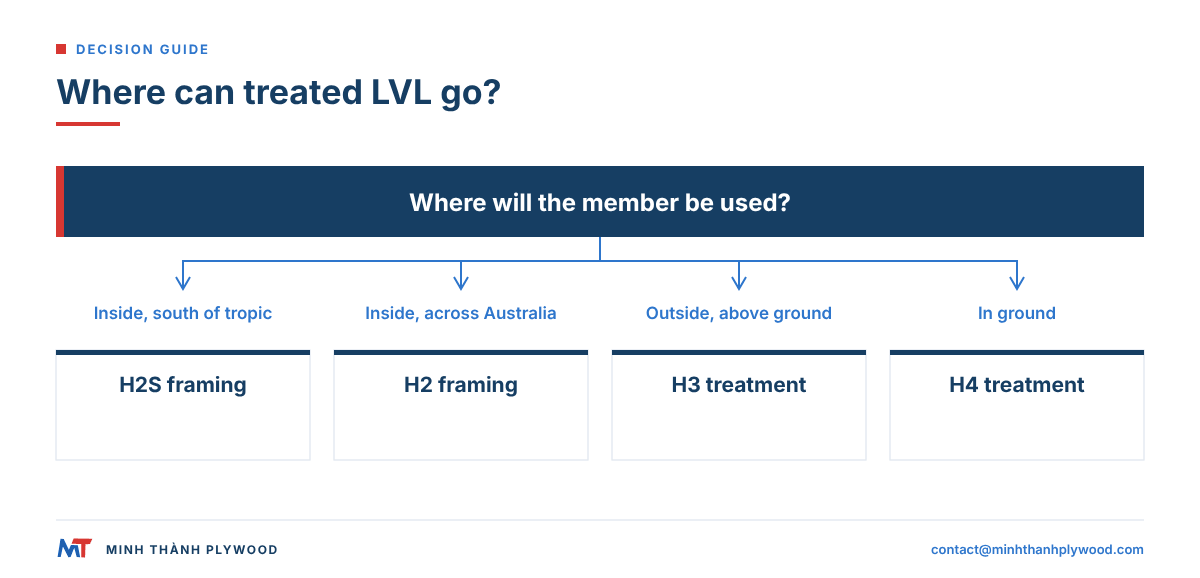
H2 and H2S are termite and borer treatment classes for framing used inside the building, above ground. H2S applies south of the Tropic of Capricorn, where termite risk is lower; H2 covers all of Australia.
| Class | Where it applies | How LVL is treated | Outdoor use? |
|---|---|---|---|
| H1 | Inside, borers only | Glueline or envelope | No |
| H2 | Inside, above ground, all of Australia | Envelope or glueline | No |
| H2S | Inside, above ground, south of the Tropic of Capricorn | Glueline during pressing | No |
| H3 | Outside, above ground | Pressure or envelope after pressing | Yes, above ground |
| H4 | Outside, in ground | Pressure treatment | Yes, in ground |
These classes come from AS 1604. Glueline treatment mixes the preservative into the glue as the veneers are pressed, so it protects the whole section. It is the usual way to make H2S framing LVL. It does not make the member fit for outdoor use: outdoor LVL needs H3 or higher. Our guide can LVL be used outside? covers outdoor treatment and detailing.
What certification does LVL framing need in Australia?
Structural LVL framing sold in Australia must be certified to AS/NZS 4357.0, carry a product stamp on every piece, and come with published design values and span tables. Product certification is usually run through the Engineered Wood Products Association of Australasia (EWPAA).
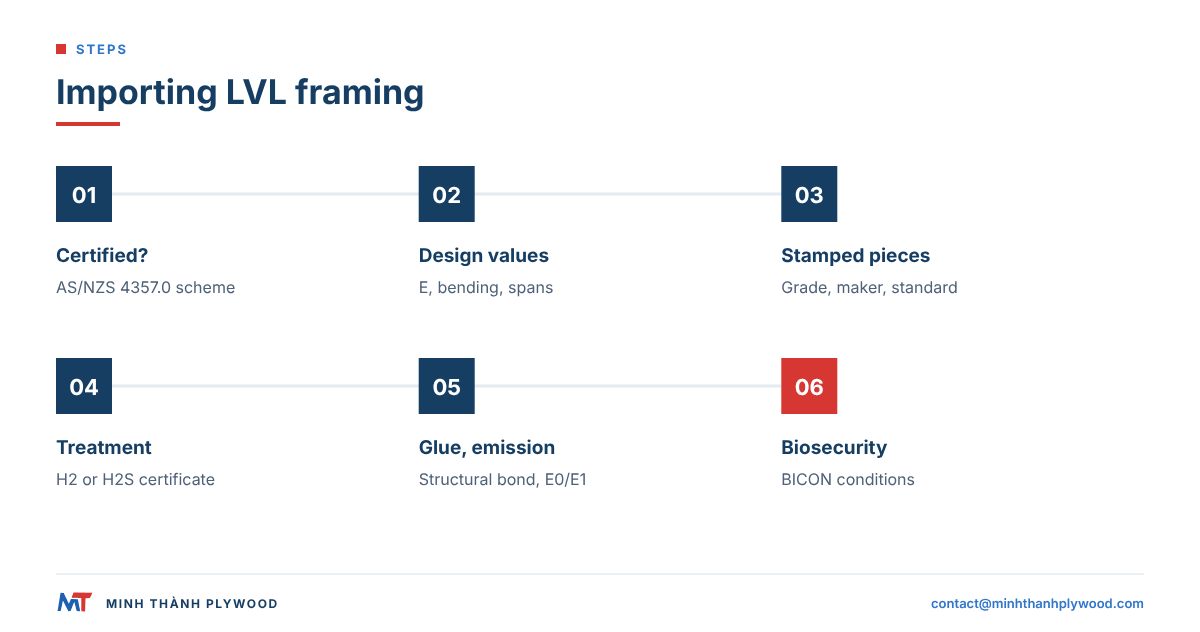
The same applies to LVL imported from any country. An importer selling LVL 10 to builders needs:
- AS/NZS 4357.0 certification of the product from a recognised scheme.
- Stamped members showing the grade, maker and standard.
- Design values and span tables that an engineer or builder can use with AS 1684 or AS 1720.1.
- Treatment certification for the H2 or H2S class claimed.
- Formaldehyde emission class for the glue: E0 or E1 under the market’s rules.
- Biosecurity clearance under the import conditions of the Australian Department of Agriculture, listed in BICON.
Without certification, LVL cannot be sold as framing, whatever its quality. It can still be sold for non-structural uses.
Do plywood and LVL from Vietnam need JAS for Japan?
For structural use in Japanese buildings, yes. Structural plywood and LVL are graded to the Japanese Agricultural Standard (JAS), and building rules call for JAS-graded members. Non-structural uses, such as furniture, interior joinery and packaging, do not need JAS.
The same pattern runs through every market: a structural framing member needs the local grading and certification; a non-structural component needs the right bond, emission class and moisture. In North America, structural LVL carries an evaluation report, and in Canada it carries CSA O86 design values. In Europe, CE marking is a legal requirement for construction products covered by a harmonised standard, set by the Construction Products Regulation (EU) No 305/2011. For LVL the standard is EN 14374.
What must an importer ask a non-Australian LVL mill?
An importer of LVL framing must ask whether the product is already certified for the destination market. If it is not, it can be sold only for non-structural uses, however good it is.
- Is this LVL certified to AS/NZS 4357.0, and by which scheme? Ask for the certificate and the product listing.
- Which grade, and where are the design values? Ask for the published E, bending and compression values and span tables.
- Is every piece stamped? Uncertified and unstamped stock cannot go into a frame.
- Which treatment, and to which class? H2 or H2S for framing, with the treatment certificate.
- Which glue and emission class? A phenolic or MUF structural bond, and the emission class.
- Which species and density? Density affects nail holding and weight per container.
- What moisture at dispatch, and how is it wrapped? Framing must arrive dry and straight.
A mill that answers “not certified” to the first question is offering LVL for components, not framing. That is a sound product for furniture, joinery, packaging and engineered members designed by the project, and that is the LVL we make.
Which Vietnamese factories supply LVL in full containers?
Minh Thanh Plywood, in Ha Hoa, Phu Tho, supplies LVL in full 40HC containers for furniture-frame components, door-frame members, industrial packaging members and engineered members specified by the project. We do not sell it as certified structural framing; the certificates we hold are listed on our quality page.
| Specification | Minh Thanh LVL |
|---|---|
| Veneers | Acacia or Eucalyptus plantation timber |
| Density | Acacia about 580 kg/m³; Eucalyptus 650–750 kg/m³ |
| Moisture | 8–12% |
| Billet formats | 1220 × 2440 or 1250 × 2500 mm |
| Interior bond | UF glue at E0 emission; E1 as an option |
| Water-resistant bonds | MR / melamine-fortified or phenolic WBP |
| Minimum order | 1×40HC, mixed specifications by agreement |
| Production | 15–45 days after the 30% deposit |
For a 40HC booking capped at 26 t, with 25 t allocated to wood and 1 t to packaging, the material plan allows about 43.1 m³ of Acacia LVL, or 33.3–38.4 m³ of Eucalyptus at 650–750 kg/m³. We supply the EUDR compliance dossier (origin records and geolocation files) for Regulation (EU) 2023/1115 with the order. See our LVL laminated veneer lumber page for the full range.
Where can you buy LVL framing in Australia?
Certified LVL framing in Australia is sold through timber merchants, frame and truss plants and building supply chains, under the product names of local and imported certified makers. Builders buy it by the length or the pack; frame and truss plants buy it by the container.
For trade buyers, the choice is between buying certified framing from a local distributor and importing non-structural LVL for components. The first goes into houses; the second goes into furniture, joinery, packaging and display work.
How do you nail and fix LVL framing?
LVL framing is nailed and screwed like pine framing, with one difference: keep fixings away from the ends and edges, because nails driven close to an end can split along the glue lines. Follow the maker’s nailing schedule for the product.
| Fixing | Practice for LVL framing | Why |
|---|---|---|
| Nails near ends | Keep the maker’s end distance | Stops splitting along the veneers |
| Nails into the narrow edge | Use the maker’s spacing | The edge shows the glue lines |
| Gun nails through plates | Same as pine framing | Standard frame assembly |
| Screws for bracing | Into the wide face where possible | Better withdrawal strength |
| Bolts and brackets | To the engineer’s detail | Lintels, tie-downs and uplift |
| Cutting and notching | Within the maker’s limits | Notches cut through load-carrying veneers |
Holes for services follow the same logic: drill on the centre line and within the limits the maker publishes, because each cut veneer is one less carrying the load.
Storing and handling LVL framing on site
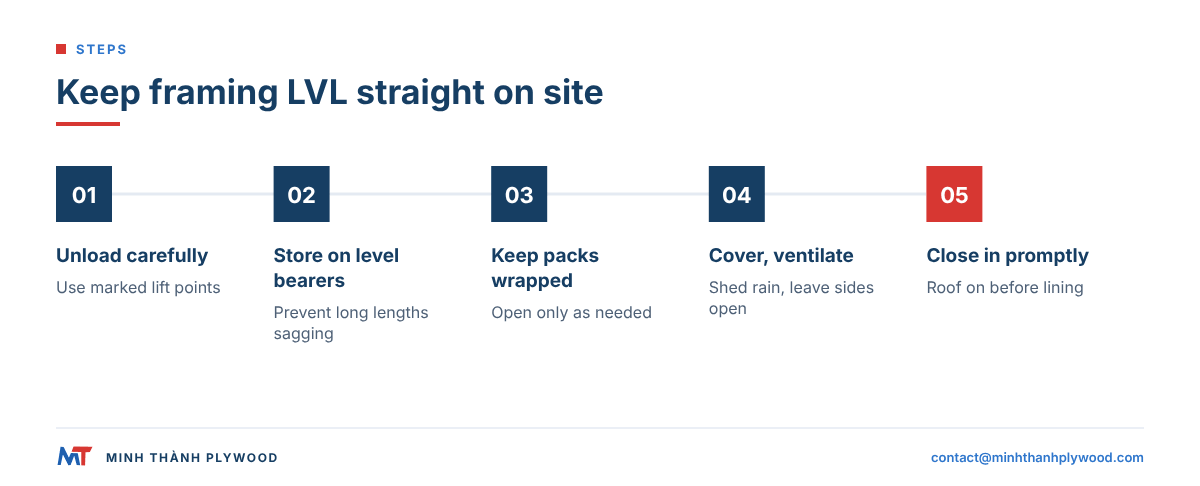
LVL framing stays straight only if it is stored flat and dry. Keep packs wrapped, on level bearers off the ground, and under cover until the frame is stood.
- Unload with care: lift packs on forks or slings at the marked points, never by dropping them off the truck.
- Store flat on bearers: close enough together that long lengths cannot sag.
- Keep the wrap on: open the pack only to take what is needed that day.
- Cover from the top: shed rain but leave the sides open for air.
- Close in fast: get the roof on, then let the frame dry before linings go up.
H2 and H2S framing is made for use inside the building, so long periods of rain on an open frame are the main risk. Short wetting during construction is normal; standing water and weeks of exposure are not.
LVL framing timber: what to put on your enquiry
For non-structural LVL, send the member sizes, lengths, species, bond, moisture, quantity and destination port; we reply within hours and can send free samples. For structural framing, specify the grade (LVL 10 or LVL 11), the AS/NZS 4357.0 certification and the treatment class, and buy from a certified mill. For background, read what LVL is, LVL strength and E-values and LVL posts and columns.
Buyer questions, answered
What is LVL 10?
LVL 10 is a framing grade of laminated veneer lumber with a modulus of elasticity of about 10,000 MPa, matching the stiffness of MGP10 pine. It is sold in Australia and New Zealand for wall framing.
What is the difference between LVL10 and MGP10?
Both have a stiffness of about 10,000 MPa. MGP10 is machine-graded sawn pine; LVL10 is pressed from veneers, so it is straighter, more consistent and made to long lengths, and it usually carries higher strength values.
What is the difference between LVL10 and LVL11?
LVL11 has a higher modulus of elasticity, about 11,000 MPa, so it is stiffer than LVL10 and can span further in the same section. Both are framing grades.
What sizes does LVL 10 framing come in?
The common LVL 10 stud and plate sizes are 90 × 45, 90 × 35, 70 × 45 and 70 × 35 mm, matching standard wall frame depths.
Is LVL stronger than plywood?
Along its length, yes. LVL runs all veneers in one direction, so it is stronger and stiffer as a beam or stud. Plywood cross-bands its veneers, so it is stronger as a sheet in two directions.
What does H2S mean on LVL framing?
H2S is a termite treatment class for framing used inside, above ground, south of the Tropic of Capricorn in Australia. LVL framing often gets it as a glueline treatment during pressing.
Can LVL 10 be used outside?
No, not as supplied. H2 and H2S framing LVL is for use inside the building envelope. Outdoor members need H3 treatment or higher and protection from weather.
Does LVL framing from Vietnam need certification for Australia?
Yes. Structural LVL sold for framing in Australia must be certified to AS/NZS 4357.0, carry a product stamp and come with published design values, usually through the EWPAA scheme.
Do plywood and LVL from Vietnam need JAS certification for Japan?
For structural use in Japanese buildings, yes: structural plywood and LVL are graded to the Japanese Agricultural Standard. Non-structural furniture and packaging uses do not need JAS.
Why use LVL 10 instead of pine studs?
LVL 10 stays straight, so walls go up flat and true, which matters for kitchens, bathrooms, tiled walls and tall walls. It also comes in long lengths without finger joints.