
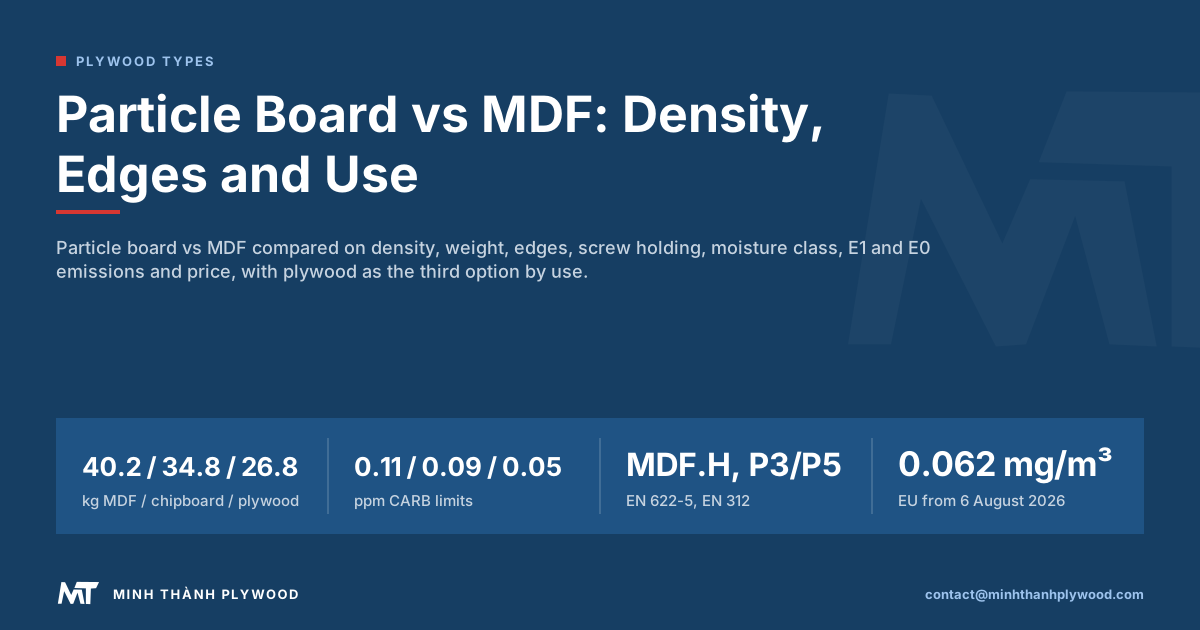
MDF is denser, smoother and machines to a clean edge; particle board, also called chipboard, is lighter, cheaper and the standard carcass board under melamine. An 18 mm sheet weighs about 40.2 kg in MDF and 34.8 kg in particle board. Minh Thanh Plywood compares both on every spec a furniture buyer checks, and puts plywood alongside as the third option.
Particle board vs MDF: the short answer
Choose MDF for doors, profiled and painted parts, and any face that must be perfectly smooth; choose particle board for flat, melamine-faced carcasses where price and weight matter. MDF is denser, stronger and machines to a clean edge. Particle board is lighter and cheaper but has a coarse core that must be edge-banded and holds screws less well.
For parts that carry load or screws in the edge, or that may meet water, neither board is the best answer: plywood is. Plywood on a Styrax or Acacia core is lighter than both, holds fixings in the face and edge, and spans further as a shelf, at a higher price per sheet. Minh Thanh makes plywood, not MDF or particle board, so the comparison below sets all three side by side on the specs a furniture buyer checks.
MDF board vs particle board: side by side
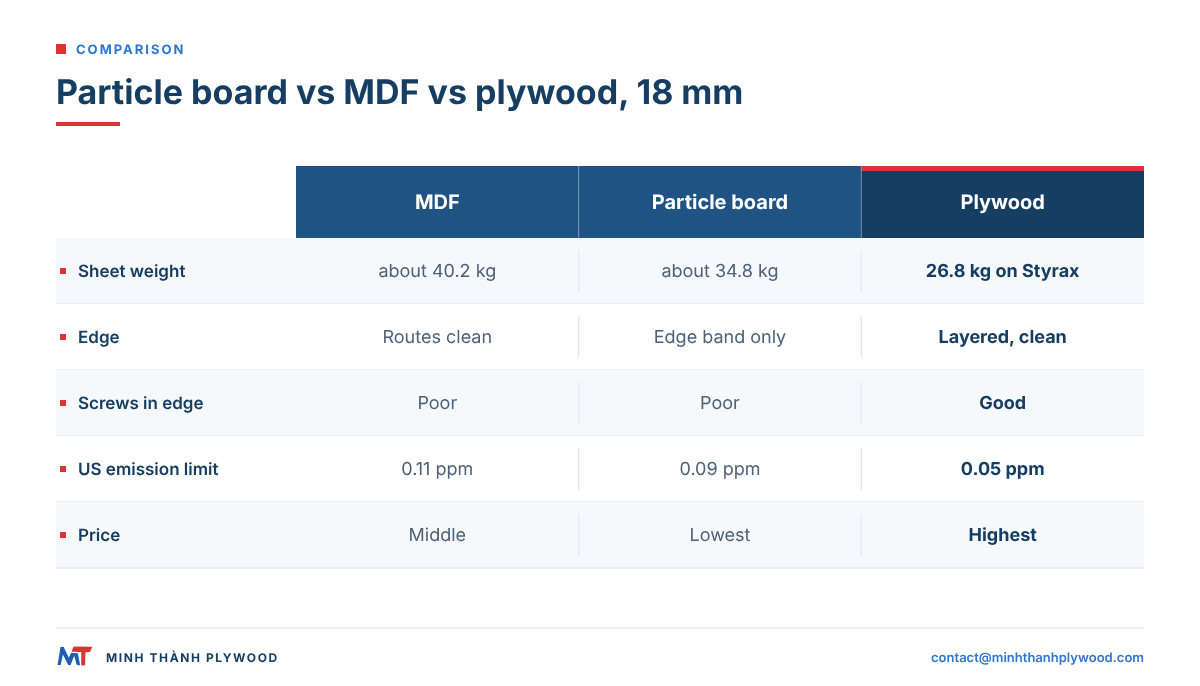
MDF board vs particle board on the specs that decide the use, for 18 mm boards in 1220 × 2440 mm:
| MDF | Particle board (chipboard) | Plywood | |
|---|---|---|---|
| Made from | Wood fibres and resin | Wood chips and resin | Crossed veneers and glue |
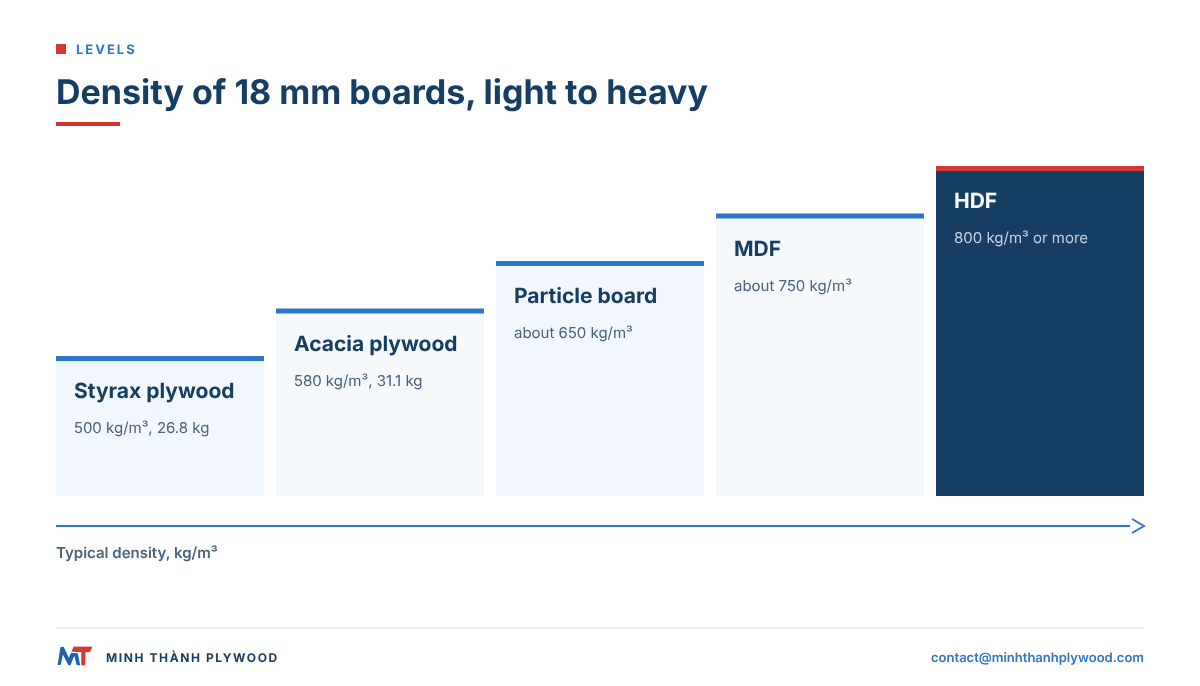
| Typical density | about 750 kg/m³ | about 650 kg/m³ | 500–650 kg/m³ by core species |
| Sheet weight, 18 mm | about 40.2 kg | about 34.8 kg | 26.8 kg on Styrax core |
| Surface | Very smooth, paints well | Fine outer layers, coarse core | Wood face, sanded |
| Edge machining | Clean, routes and profiles | Crumbles, edge band only | Clean, layered edge |
| Screw holding, face | Good | Fair | Very good |
| Screw holding, edge | Poor | Poor | Good |
| Shelf sag | Moderate | Highest | Lowest |
| Moisture | Swells at edges; MDF.H grade | Swells; P3 or P5 grade | Depends on bond class |
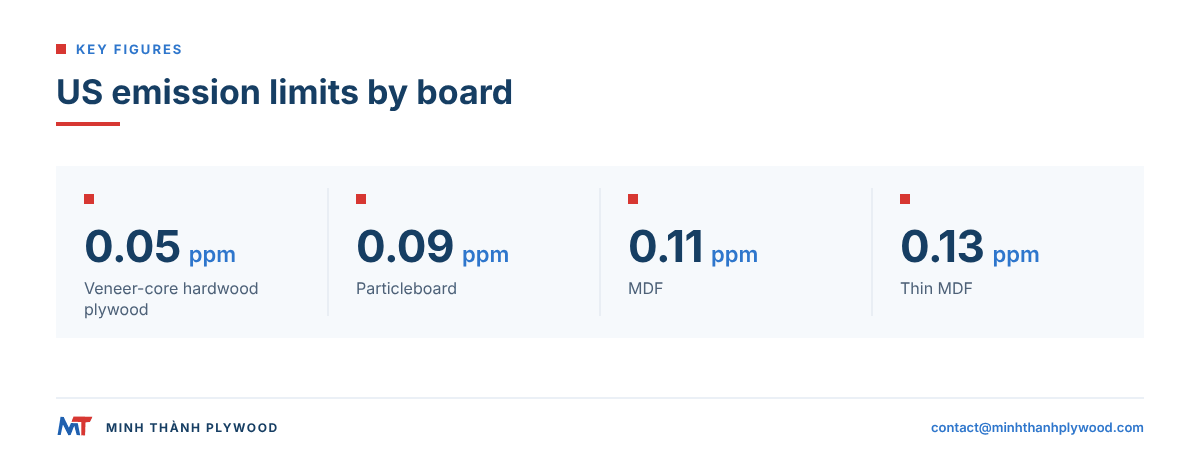
| US emission limit | 0.11 ppm | 0.09 ppm | 0.05 ppm |
| Price per sheet | Middle | Lowest | Highest |
Weights are volume times density: one sheet is about 0.0536 m³, so 750 kg/m³ gives about 40.2 kg. Plywood’s 26.8 kg is Minh Thanh’s reference weight for 18 mm on a Styrax core at 500 kg/m³.
MDF board vs chipboard: are chipboard and particle board the same?
Yes, chipboard and particle board are the same board. Chipboard is the name in the UK, Ireland and Australia; particle board or particleboard is the name in the US and in standards. So MDF vs chipboard, MDF v chipboard and particleboard vs MDF all ask the same question.
Melamine-faced chipboard, MFC, is chipboard with a decorative melamine paper on both faces, the board behind most flat-pack and office furniture. Melamine-faced MDF exists too and costs more. Both are often called “melamine board”, which names the surface and not the core; our guide to melamine-faced chipboard covers MFC on its own.
Medium density fiberboard vs particle board is the same comparison in American spelling. Fibreboard family members by density are softboard, MDF and HDF; HDF, at 800 kg/m³ or more, is the thin, dense board behind drawer bottoms, cabinet backs and laminate flooring.
How MDF and particle board are made
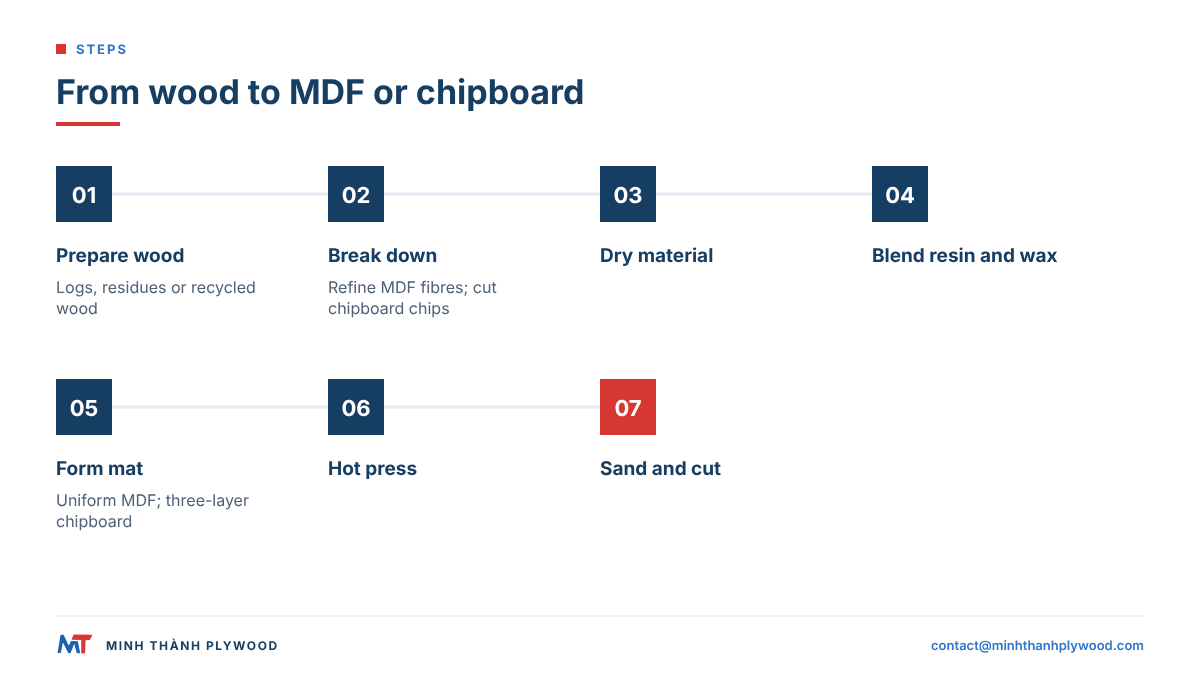
Both boards start as wood broken into small pieces, mixed with resin and hot pressed; the size of the pieces makes the difference. In order:
- Raw material. Logs, thinnings, sawmill residues and recycled wood.
- Breaking down. For MDF, chips are steamed and ground in a refiner into fine fibres. For particle board, wood is cut into flakes and chips.
- Drying. Fibres or chips are dried.
- Resin. Urea-formaldehyde, melamine-urea-formaldehyde or formaldehyde-free (NAF) resins are added, with wax for moisture resistance.
- Forming. MDF is laid as a uniform fibre mat. Particle board is laid in three layers: fine particles at the faces, coarser chips in the core.
- Hot pressing. Continuous or multi-opening presses cure the resin.
- Sanding and cutting. Boards are sanded to thickness and cut to size.
Plywood is made differently: logs are peeled into continuous veneer, dried, glued and laid with the grain crossing, then pressed. Minh Thanh presses furniture panels twice: the core board is pressed and calibrated, then face and back are pressed on.
Density and weight
MDF is the denser and heavier board. Typical MDF sits at about 700–800 kg/m³ and typical furniture particle board at about 600–700 kg/m³, with light and ultra-light versions of both for furniture where weight counts.
Density shows up in the carton and the container. At 18 mm, one 1220 × 2440 mm sheet weighs:
| Board | Density used | Weight, 18 mm |
|---|---|---|
| MDF | 750 kg/m³ | about 40.2 kg |
| Particle board | 650 kg/m³ | about 34.8 kg |
| Plywood, Eucalyptus core | 650 kg/m³ | 34.8 kg |
| Plywood, Acacia core | 580 kg/m³ | 31.1 kg |
| Plywood, Styrax core | 500 kg/m³ | 26.8 kg |
A wardrobe built from 18 mm boards with eight sheets in it weighs about 107 kg more in MDF than in Styrax-core plywood (8 × 13.4 kg). For flat-pack furniture sold by courier, that difference decides the carton class. Our plywood weight calculator works out other thicknesses.
Edges and machining
MDF machines to a clean, solid edge that can be routed, profiled and painted; particle board’s coarse core crumbles under a router and must be edge-banded. That single difference decides most door choices.
- MDF edges take shaker, bevel and ogee profiles, V-grooves and CNC carving. After sealing, the routed edge paints like the face.
- Particle board edges need an edge band: melamine, ABS, PVC or veneer. Exposed chipboard edges soak up water and chip.
- Plywood edges show the layers. A void-free, stitched core gives a striped edge that can be left exposed, edge-banded, or filled and painted.
Tool wear runs the other way: MDF’s resin and fine fibres blunt cutters, and its dust is very fine, so extraction must be good on MDF lines. Minh Thanh stitches core layers both horizontally and vertically, which keeps plywood edges tight for exposed-edge designs.
Screw holding and fittings
Plywood holds screws best, MDF second and particle board least, and in the edge the gap widens. Particle board’s chips give a screw little to grip, and repeated assembly enlarges the hole; MDF grips well in the face but splits along the edge if a screw is driven too close to the face or without a pilot hole.
In practice:
- Use dedicated fittings in particle board: confirmat screws, cam locks, dowels and inserts, drilled to exact depth.
- Pre-drill MDF edges and keep screws away from the corners.
- Use standard wood screws in plywood, face and edge.
- Fit hinges in the face: all three take 35 mm cup hinges; plywood keeps them tight longest.
Furniture that is assembled more than once, such as office, rental and contract furniture, lasts longer on plywood carcasses.
Moisture: MDF.H, P3 and P5
Both standard boards swell when water gets in, and the swelling stays. The European standards define moisture-resistant grades: under EN 622-5, MDF.H is the humid-conditions grade, sold as MR MDF and often dyed green; under EN 312, chipboard P3 is for humid, non-load-bearing use and P5 for humid, load-bearing use. Standard furniture grades are MDF and P2.
For construction use, wood-based panels are CE-marked to the harmonised standard EN 13986, which calls up EN 622-5 and EN 312, under the Construction Products Regulation (Regulation (EU) No 305/2011, being replaced by Regulation (EU) 2024/3110) (checked 20 October 2026). For kitchens and bathrooms, specify the moisture grade, seal every cut edge and keep boards off wet floors.
Plywood’s moisture behaviour comes from its glue. Interior furniture plywood uses UF glue; melamine-fortified (MR) and phenolic (WBP) bonds are made to the customer’s specification. Our guide Is plywood waterproof? covers the bond classes.
Strength and shelf sag
MDF is stronger and stiffer than particle board, and plywood is stronger and stiffer than both along its face grain. That order shows most in shelves: a long particle board shelf loaded with books sags within months, MDF sags less, and plywood least.
The reason is structure. Particle board’s chips are short and loosely bonded in the core; MDF’s fibres are fine and evenly bonded; plywood’s veneers are continuous wood fibres running the full length of the panel, crossed for stability. Under a constant load, the boards also creep, which is the slow sag that keeps growing.
For shelves: shorten the span, add a front lip, or choose plywood with the face grain along the span. Our guide How much weight can plywood hold? covers plywood shelf loads.
E1, E0 and CARB emission classes
MDF and particle board are bonded mostly with urea-formaldehyde resins, so their emission class is part of every order. In the US, CARB Phase 2 and TSCA Title VI limit particleboard to 0.09 ppm, MDF to 0.11 ppm, thin MDF to 0.13 ppm and veneer-core hardwood plywood to 0.05 ppm under 40 CFR 770.10. The CARB composite wood products programme (checked 20 October 2026) covers the California side.
In the EU, E1 was the long-standing class. Commission Regulation (EU) 2023/1464 (checked 20 October 2026) limits formaldehyde released from furniture and wood-based articles to 0.062 mg/m³ from 6 August 2026, tighter than E1. E0 and NAF (no added formaldehyde) are lower classes used in purchasing.
Minh Thanh furniture plywood uses UF glue at E0 emission and is certified CARB P2 / TSCA Title VI (ICTT mill no. 23024); six ASTM D6007 chamber tests between April 2025 and June 2026 averaged 0.014–0.032 ppm against the 0.05 ppm limit.
Which panel for carcass, door and shelf?
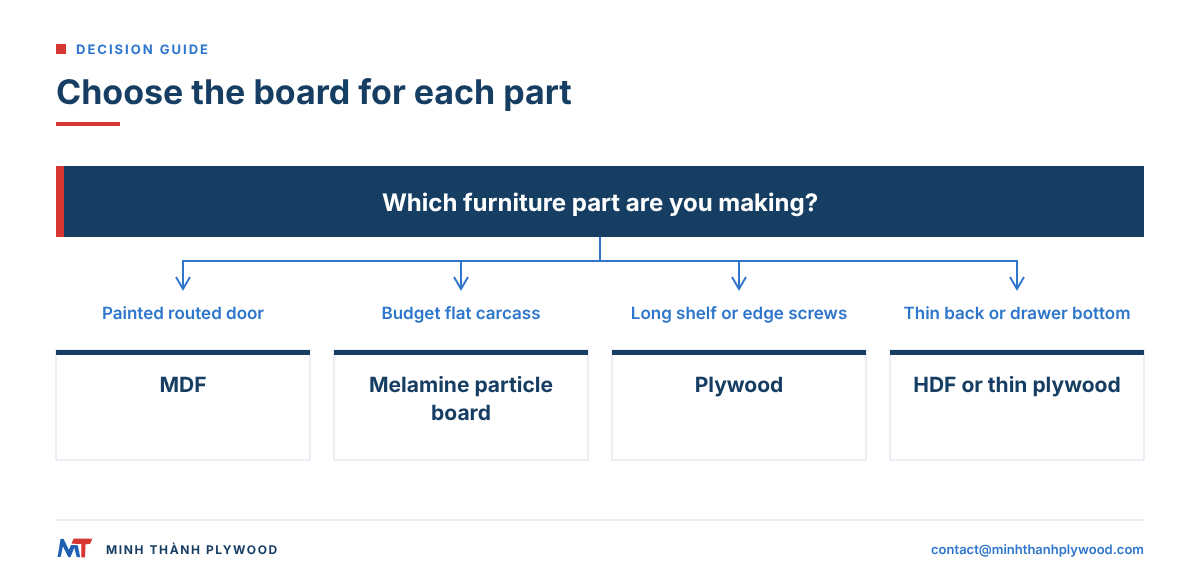
Match the board to the part. The verdict by use:
| Part | Budget choice | Better choice | Why |
|---|---|---|---|
| Cabinet carcass | Melamine particle board | Plywood | Weight, screws, moisture |
| Painted door | MDF | MDF | Routed profile, smooth face |
| Laminated or veneered door | MDF | MDF or plywood | Flat face; plywood lighter |
| Shelf | MDF | Plywood | Sag |
| Drawer side | Particle board | Plywood | Edge screws, exposed edge |
| Back panel and drawer bottom | HDF | HDF or thin plywood | Thin and flat |
| Kitchen sink unit | P3 chipboard or MDF.H | Plywood, water-resistant bond | Water |
| Worktop core | P2 or P5 chipboard | Plywood | Strength, moisture |
Many plants mix all three in one cabinet: MDF doors, plywood carcass and shelves, HDF backs. Our article on particle board vs plywood covers the carcass choice alone.
Where plywood fits as the third option
Plywood fits where the part carries load, takes screws in the edge, must be light, or may get wet. It costs more per sheet than MDF or particle board and its face is wood grain, not a blank surface, so doors and gloss panels often stay MDF.
What the buyer gets from a furniture-grade plywood:
- Lower weight: 26.8 kg per 18 mm sheet on a Styrax core.
- A flat, calibrated face: furniture panels are pressed twice, the core calibrated before the faces go on.
- Tight thickness: ±0.2–0.3 mm on sanded panels, down to ±0.2 mm.
- Faces for every finish: poplar and eucalyptus B/B for paint or overlay, A/B for one clear show face; both faces UV-ready.
- Low emission: UF glue at E0 emission, CARB P2 / TSCA Title VI.
Our comparison of plywood vs MDF goes through doors and carcasses in detail.
Price: which is cheaper?
Particle board is the cheapest of the three per sheet, MDF sits in the middle and plywood costs most. That order holds in most markets because particle board uses the lowest-grade wood and the simplest process, MDF adds the refining step and more resin, and plywood needs peelable logs and more labour.
Price per sheet is not the whole cost. Count also:
- Edge banding on every particle board edge.
- Fittings: inserts and confirmat screws for particle board.
- Weight: freight and carton class.
- Rejects and returns: chipped edges and swollen corners.
- Life: furniture that is moved and reassembled.
For furniture and interior plywood, Minh Thanh’s indicative prices start from US$350/m³ (October 2026), depending on face, core, glue, thickness, size, quantity and delivery term.
Is MDF particle board or plywood?
MDF is neither particle board nor plywood; it is a fibreboard, a separate panel type. All three are engineered wood panels, but they are made from different pieces of wood: fibres for MDF, chips for particle board, and whole sheets of veneer for plywood.
The way to tell them apart is the edge. MDF’s edge is smooth and uniform, like dense cardboard. Particle board’s edge shows visible chips, coarser in the middle. Plywood’s edge shows distinct layers, alternating in grain direction. OSB, the fourth common panel, shows large flat strands on its face.
Pressed wood is a loose name that covers MDF, hardboard and particle board, and sometimes plywood too. In a specification, always name the board and its standard instead.
How to specify MDF, particle board or plywood in an RFQ
Name the board, its standard and grade, the emission class and the surface:
18 mm furniture plywood for carcasses, 1220 × 2440 mm; face/back: poplar B/B for melamine overlay; core: Styrax, double pressed; UF glue at E0 emission, CARB P2 / TSCA Title VI; thickness ±0.3 mm; 1×40HC CIF your port.
For MDF write “EN 622-5 MDF or MDF.H”; for particle board “EN 312 P2, P3 or P5”, plus the surface. Minh Thanh makes plywood; send plywood RFQs to contact@minhthanhplywood.com or WhatsApp +84 988 586 601 for free samples and a reply within hours.
Buyer questions, answered
Which is stronger, MDF or particle board?
MDF. It is denser and more uniform, so it has higher bending strength, holds screws better in the face and sags less as a shelf. Particle board is the weaker and lighter of the two.
Are chipboard and particle board the same?
Yes. Chipboard is the British and Australian name, particle board or particleboard the American and international name for the same board of wood chips and resin.
Is MDF particle board or plywood?
Neither. MDF is fibreboard, made from wood broken down into fibres; particle board is made from chips; plywood is made from whole sheets of veneer glued in crossed layers.
Which is cheaper, MDF or particle board?
Particle board is usually the cheaper board per sheet, which is why most flat-pack carcasses are melamine-faced particle board.
Which is better in a damp room, MDF or chipboard?
Neither standard board likes water. Specify moisture-resistant grades, MDF.H for MDF and P3 or P5 for chipboard, seal the edges, or use plywood with a water-resistant bond.
Which board is best for kitchen cabinet doors?
MDF, painted or laminated: it routes into profiles and gives the smoothest face. Carcasses are made in melamine particle board on a budget or in plywood for weight, screws and moisture.
Is MDF heavier than particle board?
Yes. A typical MDF of about 750 kg/m³ makes an 18 mm 1220 × 2440 mm sheet of about 40.2 kg; particle board at about 650 kg/m³ weighs about 34.8 kg.
Does MDF or particle board release more formaldehyde?
Under the US CARB Phase 2 and TSCA Title VI limits, MDF is allowed 0.11 ppm and particleboard 0.09 ppm. Actual emission depends on the resin; E0 and NAF boards sit far below both.
Can you screw into the edge of MDF or particle board?
Only with care: pre-drill, use screws made for board materials, and keep away from the corners. Both split or crumble more easily than plywood, whose crossed veneers grip a screw in the edge.
What are MDF and particle board standards in Europe?
MDF is specified under EN 622-5 (MDF, MDF.H, MDF.LA and others) and particleboard under EN 312, types P1 to P7. EN 13986 covers wood-based panels for construction.