
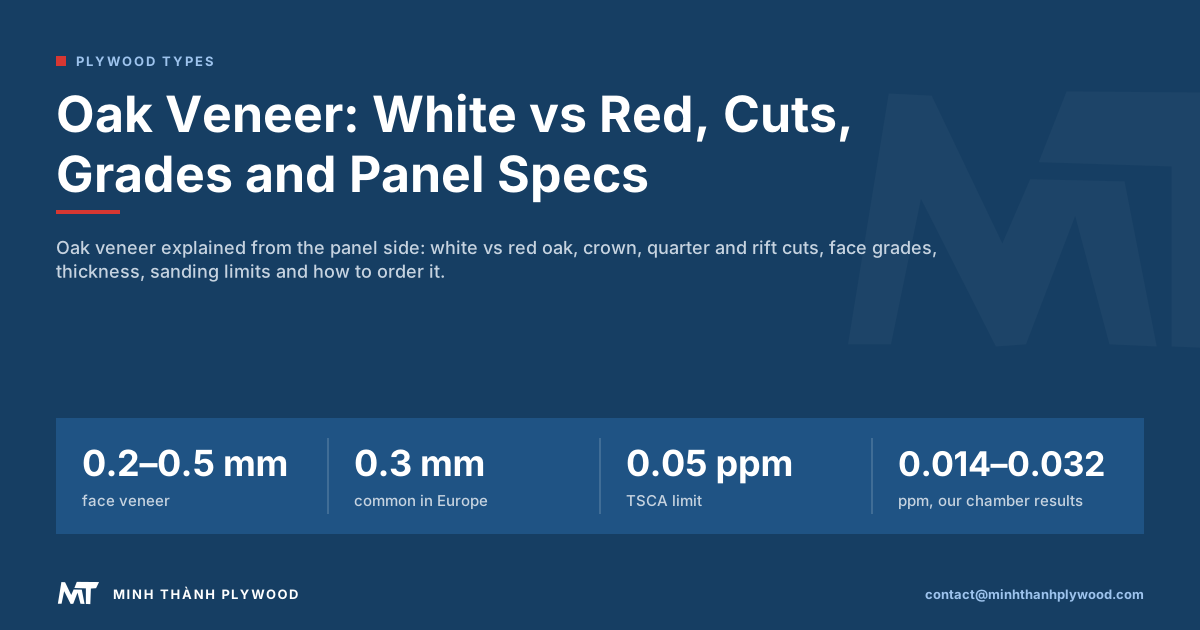
Oak veneer is a thin slice of real oak, usually 0.2–0.5 mm thick, glued to a stable core such as plywood or MDF. It gives the look of solid oak on large flat panels that do not warp. What you see depends on four choices: white or red oak, the cut, the face grade and the panel underneath. Minh Thanh Plywood, a Vietnamese furniture plywood mill, explains each choice and what to write on the order.
What is oak veneer?
Oak veneer is a thin sheet of real oak, sliced or peeled from a log, that is glued to a core panel to give it an oak face. On plywood the face is typically 0.2–0.5 mm thick, and about 0.3 mm is common in Europe.
Is oak veneer real wood?
Yes. Oak veneer is real wood: a thin slice cut from an oak log, so the face shows real oak grain, pores and colour. Only the core underneath is a different material, usually plywood, MDF or particleboard, which keeps a large panel flat and stable and uses a fraction of the oak.
- Veneered oak panels combine that face with a stable core: plywood, MDF or particleboard.
- Why use it: a large, flat panel that does not cup or split, at a fraction of the oak used in solid boards.
Wood veneer oak faces are sold loose, as backed sheets, or already pressed onto panels. For furniture makers the panel is usually what matters, so this guide treats oak veneer from the panel side.
Buying oak veneer in the UK: loose veneer, veneered sheets and prices
UK buyers meet oak veneer in three forms, and each has its own minimum order and price band. The table sets them side by side, with the Minh Thanh container route as the last row. The UK merchant figures were checked on 21 October 2026.
| Form | What you get | Minimum and price signal (October 2026) | Best for |
|---|---|---|---|
| Natural loose veneer | Bundles of oak leaves, over 200 veneers stocked by one specialist | Minimum order 2 bundles (DF Richards) | Workshops that press their own panels or veneer curves |
| Engineered or reconstituted oak | Uniform, repeatable oak-look veneer, such as Silver Oak 154C | Minimum order 10 sheets (DF Richards) | Large runs where leaf-to-leaf colour must match |
| Oak-veneered MDF, 2440 × 1220 × 18 mm | Finished sheet, A/B face, often FSC | About £66–94 per sheet across UK merchants, VAT basis varies by seller (£66.00 at Build Depot; £78.75 at Haldane Fisher; £94.20 at Timber Supplies Online) | One-off jobs, cabinet makers, joinery shops |
| Cut-to-size, pre-lacquered | Oak MDF cut to ±1 mm with a matt lacquer of 10 % sheen on both sides (Cutmy) | Priced per cut part, free delivery over £250 | Small runs and DIY cabinet doors |
| Oak-faced plywood by the container | Sheets of 1220 × 2440 or 1250 × 2500 mm on a Styrax or Eucalyptus core, face and grade to your sample | MOQ one 40HC; plywood base from US$350/m³, which is about US$18.8 per 18 mm sheet before the oak face and freight | Importers, furniture factories, joinery chains |
Calculation for the last row: an 18 mm sheet of 1220 × 2440 mm is 0.0536 m³, and 0.0536 × US$350/m³ = US$18.76. That is the raw FOB cost of the furniture-plywood base from our price list, not an oak-faced quote; the oak face, grade and finish add to it, and your landed cost adds sea freight and duty. A UK buyer who needs a few sheets pays the merchant band above; a buyer who needs a container of oak-faced sheets can compare the container price per sheet against that band and see the margin.
Two UK points before ordering. First, a factory finish saves site time: the UK cut-to-size shops spray lacquer on both faces, and our sanded furniture panels arrive ready for the buyer’s own UV or lacquer line, so the finish is applied at the buyer’s plant.
Second, imported timber and wood panels placed on the Great Britain market fall under the UK Timber Regulation, which has applied there since 1 January 2021 (GOV.UK, regulations: timber and FLEGT licences). It requires due diligence before the timber is placed on the market, with records kept for 5 years (Carbmee, Great Britain deforestation policy, checked on 21 October 2026). We supply origin records with orders; if your specification needs FSC or PEFC chain of custody, say so on the enquiry so the veneer source is chosen to match.
White oak vs red oak veneer: which species?
White oak veneer is the standard choice for furniture and interiors in Europe; red oak veneer is a lower-priced North American option with a pink tone and more open grain. The two look similar at a distance and finish very differently.
| Property | White oak veneer | Red oak veneer |
|---|---|---|
| Species | European oak and American white oak | Northern red oak |
| Colour | Light tan to golden brown | Light brown with a pink or reddish cast |
| Pores | Closed by tyloses | Open, porous |
| Ray fleck in quarter cut | Long, pronounced | Shorter, less pronounced |
| Stain response | Even, takes fumed and smoked tones well | Pink cast shows through light stains |
| Typical market | Europe, premium interiors worldwide | North America |
The pore difference is real anatomy: the earlywood pores of white oaks are blocked by tyloses, while those of red oaks stay open, which is why white oak holds liquid and red oak does not (USDA Forest Products Laboratory, Wood Handbook, read 20 October 2026). For panels, open red oak pores take more filler and can show glue bleed under a clear finish.
Crown cut vs quarter cut oak veneer, and rift cut
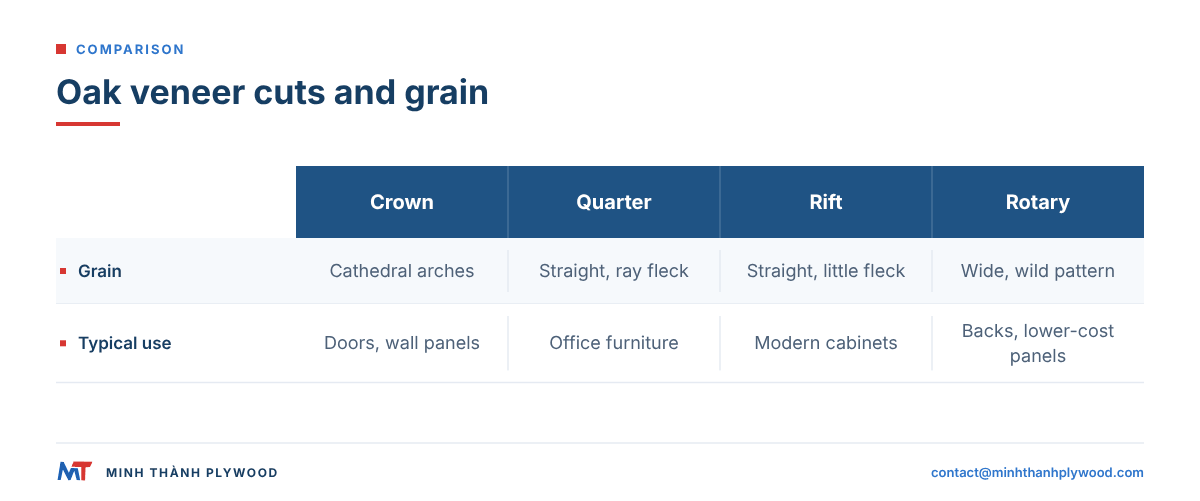
Crown cut oak veneer shows arched cathedral grain, quarter cut shows straight grain with ray fleck, and rift cut shows the straightest grain with little fleck. The cut decides the look more than the species does.
| Cut | How it is sliced | What you see | Typical use |
|---|---|---|---|
| Crown cut (plain sliced) | Parallel to the log centre, across the rings | Cathedral arches in the middle, straight grain at the edges | Doors, wall panels, traditional furniture |
| Quarter cut | At right angles to the rings | Straight stripes with silvery ray fleck | Arts and crafts styles, office furniture |
| Rift cut | At a slight angle to the rays | Very straight, tight grain, little fleck | Modern cabinetry, matched elevations |
| Rotary cut | Peeled around the log | Wide, wild grain pattern | Backs, lower-cost panels |
Rift and quarter cuts yield fewer usable leaves per log than crown cut, so they cost more. Light oak veneer looks come mostly from the species and the selection of light leaves, then from the finish: a clear matt lacquer keeps the tone pale.
How thick is oak veneer, and why it matters for sanding
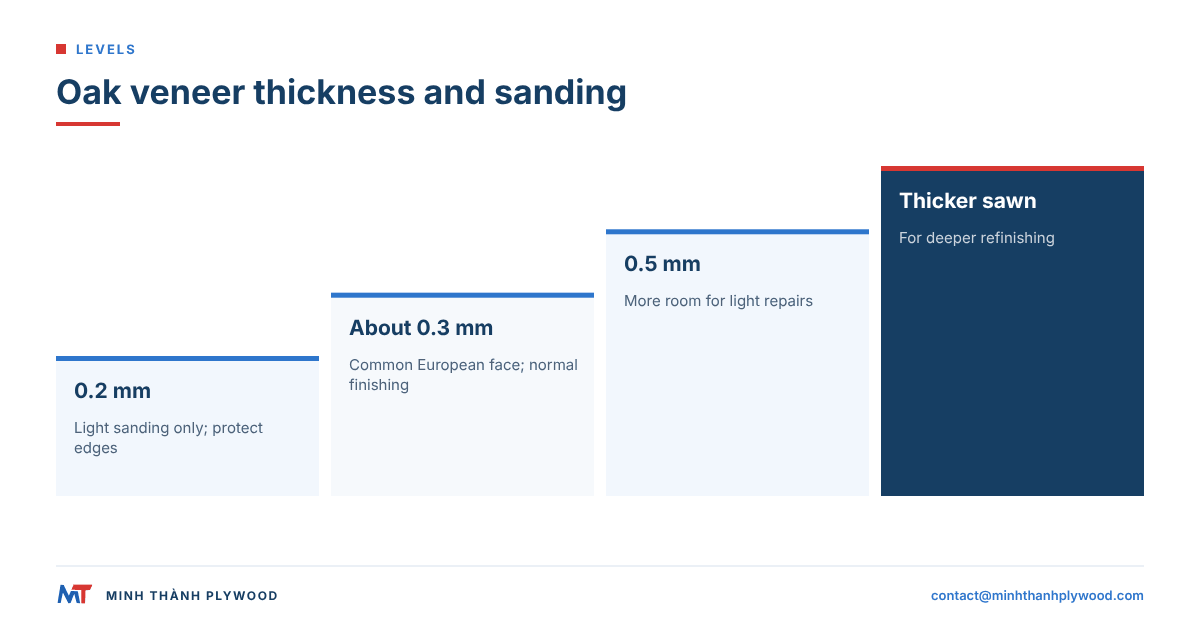
Oak veneer on plywood is usually 0.2–0.5 mm thick, and the thickness sets how much sanding and refinishing the face can take. A thin face is fine for a finished panel; it is the sanding before and after finishing that needs care.
- 0.2 mm faces: light sanding only, fine grits, no hand sanding on edges.
- About 0.3 mm: the common European face; normal finishing works well.
- 0.5 mm faces: more tolerance for sanding and light repairs.
- Thicker sawn veneers: used for premium work that must be refinished deeply.
Sand-through, where sanding cuts through the face and shows the glue or the core, is the main defect on thin oak faces. Calibrate the panel before the face is pressed, not after. At our mill, furniture-grade panels are pressed twice as standard: the core board is pressed and calibrated, then face and back are pressed on, so the face does not have to be sanded to correct thickness.
Oak wood veneer sheets vs oak veneer plywood: what to buy
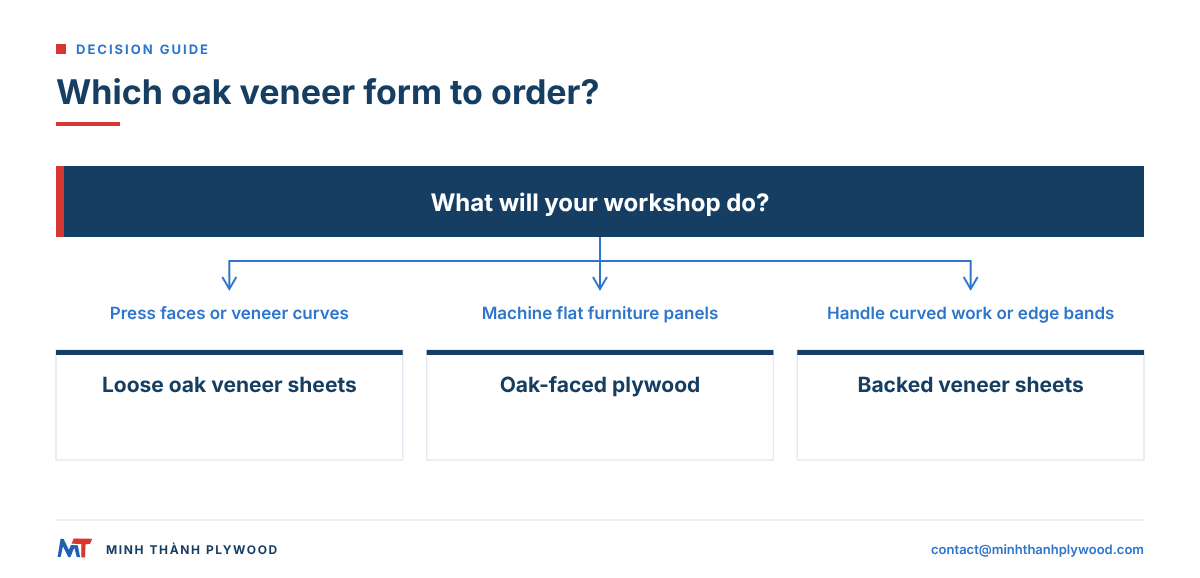
Buy oak veneer sheets when your workshop presses its own panels or veneers curved parts; buy oak veneer plywood when you need flat panels ready to machine. Most furniture factories buy the panel.
| Point | Loose oak veneer sheets | Oak-faced plywood |
|---|---|---|
| What arrives | Leaves or bundles of veneer | Finished panels, face and back pressed |
| Needs a press | Yes | No |
| Flat panels | Pressed in your shop | Ready to cut |
| Curved and shaped parts | Possible | Limited to flat or slightly bent |
| Matching control | Full, leaf by leaf | Fixed by the panel maker and the sample |
| Edges | Banded in your shop | Banded in your shop |
Backed veneer sheets, with paper or fleece backing, sit between the two: they are easier to handle and glue on site, and they suit edge-banding and curved work. Our guide to backed veneer sheets compares the backing types, and the pillar on wood veneer sheets covers all species.
Solid oak vs oak veneer: which to choose?
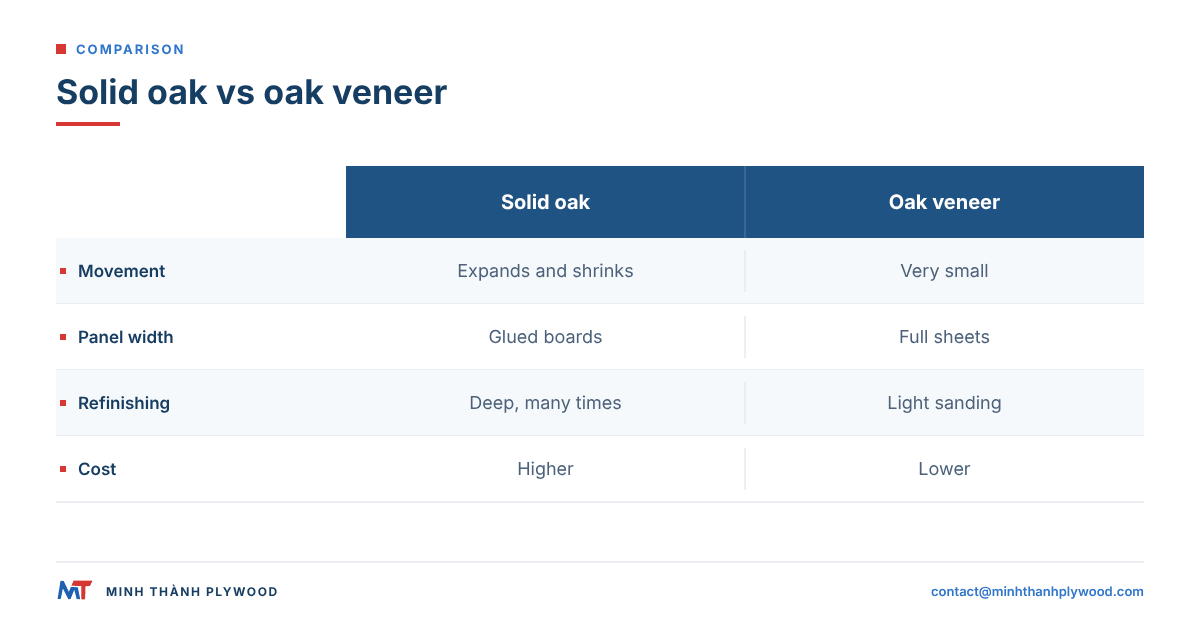
Choose oak veneer for large flat parts that must stay flat and match; choose solid oak for parts with exposed edges, heavy wear or deep shaping. Veneer moves very little with humidity and costs less per square metre of face, while solid oak can be sanded back many times. Many pieces use both: veneered panels in solid oak frames.
| Point | Solid oak | Oak veneer on plywood |
|---|---|---|
| Movement with humidity | Expands and shrinks across the grain | Very small; crossed core holds it flat |
| Panel width | Glued from narrow boards | Full sheets, 1220 × 2440 mm or 1250 × 2500 mm |
| Matching | Board to board | Leaf to leaf, book or slip matched |
| Refinishing | Deep sanding many times | Light sanding |
| Edges | Oak all through | Need banding or lipping |
| Weight | Heavy | Depends on the core; lighter on a Styrax core |
| Oak used | All of it | Only the face |
| Cost | Higher | Lower per square metre of face |
Weight is density times volume. An 18 mm panel at 1220 × 2440 mm is 0.0535824 m³; on a white Styrax core at 500 kg/m³ it weighs about 26.8 kg, on Eucalyptus at 650 kg/m³ about 34.8 kg.
For doors and windows the choice follows exposure and repair. Solid oak is the first choice for exterior joinery and for hard-wearing doors and stairs, because sheet veneers are unsuitable for areas of high wear or humidity, and a damaged thin face is close to impossible to repair; solid oak repairs easily, takes a finish readily and can move a little, which a door stop adjustment usually absorbs (GS Haydon, solid oak vs oak veneer, checked on 21 October 2026). Veneered panels win for interior doors, wall linings and cabinet fronts, where flatness and a matched grain across the whole leaf matter more than repairability.
Veneered oak panels: plywood, MDF or particleboard core?
Veneered oak panels on a plywood core are the strongest and lightest choice and hold screws best; MDF gives the flattest face for thin veneer; particleboard is the low-cost option for flat, light-duty parts. The core decides how the panel behaves.
| Core | Face flatness | Screw holding | Weight | Moisture tolerance | Best for |
|---|---|---|---|---|---|
| Plywood | Very good when calibrated | Good, also in edges | Light to medium | Good | Carcasses, doors, shelves, shopfitting |
| MDF | Excellent | Fair, poor in edges | Heavy | Low | Flat doors, wall panels |
| Particleboard | Good | Fair | Medium to heavy | Low | Flat, light-duty parts |
On plywood, the face flatness comes from the core. Our furniture panels use white Styrax or Eucalyptus cores, with core layers stitched both horizontally and vertically, so voids and overlaps do not show through a thin oak face.
Oak veneer face grades: what A and B mean on a panel
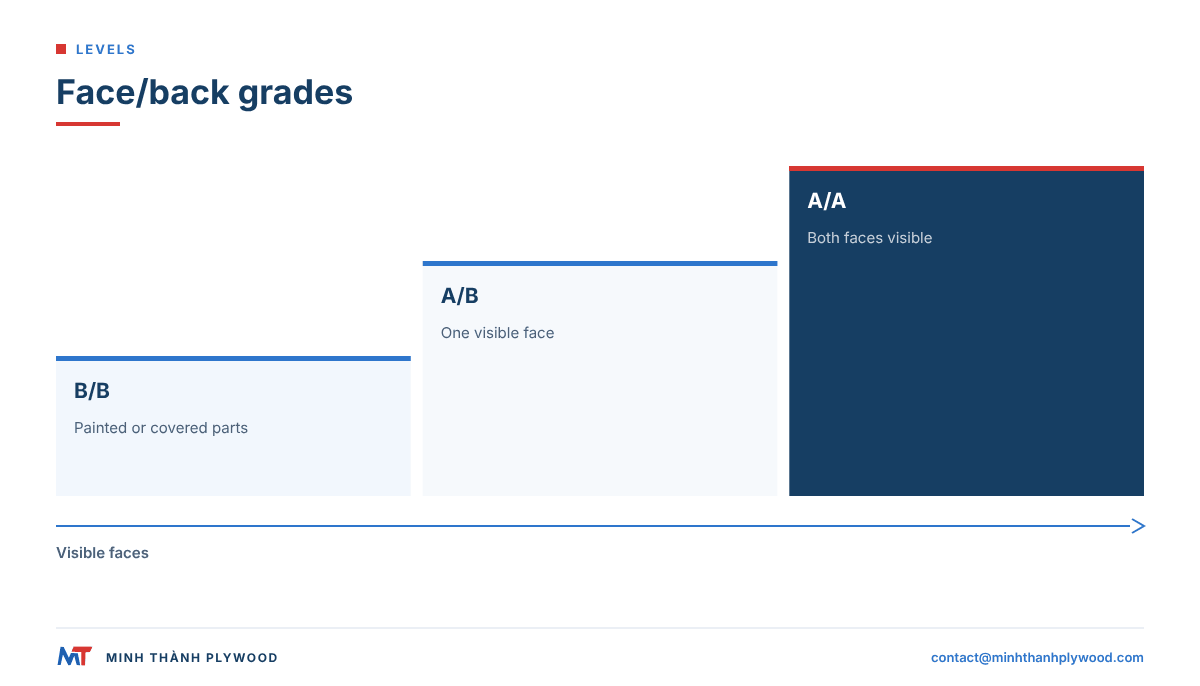
Oak veneer panels are quoted as face/back grade pairs, such as A/A for two visible faces, A/B for one visible face and B/B for parts that are painted or covered, matched to the buyer’s approved sample. The letters describe defects allowed on each side.
| Grade on a face | What is allowed | Use |
|---|---|---|
| A | Clean, well-matched leaves; small, sound features only; even colour | Visible faces of doors and fronts |
| B | Small knots, colour variation, more mineral streaks; well-made joints | Inside faces, backs of visible parts |
| Lower grades | Patches, open defects filled | Hidden or covered parts |
Grade names differ by market and by mill, so a letter alone is not a specification. Write down whether sapwood, mineral streaks, burls and stronger figure are accepted, and approve a full-size sample. We quote poplar, pine and eucalyptus faces the same way, as face/back pairs matched to the approved sample.
Matching: book match, slip match and panel layout
Matching is how veneer leaves are placed side by side on one face: book match mirrors each leaf like an open book, slip match repeats them side by side, and random match mixes them. It is part of the specification, not a detail for later.
- Book match: alternate leaves flipped; mirror-image joints; the classic look for crown cut.
- Slip match: leaves slid along without flipping; even repeat; common for quarter and rift cut.
- Random match: leaves mixed for a plank-like look.
- Panel layout: running, balanced or centre-balanced leaf widths on each panel.
For wall cladding and long runs of doors, number the panels on an elevation drawing and say whether the grain must run on from panel to panel.
Glue line, bleed-through and finishing
The glue line under an oak face must be thin, even and invisible: too much glue or a glue that soaks through open pores shows as dark spots under a clear finish. Red oak, with open pores, is the more sensitive species.
- Spread: an even, measured glue spread for the veneer thickness.
- Press: heat, pressure and time set for the glue and the veneer thickness.
- Check bleed-through: inspect faces before sanding for spots and shadows.
- Sand lightly: fine grits on the face; the panel is already calibrated.
- Finish test: lacquer or oil a sample; stain shows every glue spot.
Both faces of our furniture panels are UV-ready, made to the standard customers need to apply their own UV coating, and faces are sanded and polished.
Oak veneer and emissions for European and US buyers
Oak veneer panels for furniture sold in Europe and the US must meet formaldehyde rules, and the core and glue decide the result, not the oak face. Under TSCA Title VI, hardwood plywood with a veneer core is limited to 0.05 ppm (40 CFR 770.10).
Our furniture plywood uses UF glue at E0 emission. Six ASTM D6007 chamber tests between April 2025 and June 2026, on 9, 15 and 18 mm panels, averaged 0.014–0.032 ppm, against the 0.05 ppm limit; three were run by Shanghai Hongjun and three by ICTT Vietnam. We hold CARB P2 / TSCA Title VI certification as ICTT mill no. 23024, and the TCVN 11902:2017 certificate for veneer-faced plywood, VietCert 141.1-VNC-HC.
Engineered veneer (EV) as an oak-look alternative
Engineered veneer (EV) is a recomposed veneer, made from plantation veneers that are dyed, laminated into a block and sliced again, so it reproduces an oak grain in the same colour on every sheet. It suits long runs of matching parts.
| Point | Natural oak veneer | Oak-pattern EV |
|---|---|---|
| Look | Every leaf different | Same pattern, sheet after sheet |
| Colour match across a run | Selected and matched | Built in |
| Ray fleck and figure | Natural | Printed into the pattern by the block |
| Defects | Natural features graded | Few |
| Lead time | Depends on oak supply | Planned production |
EV is the face we produce most, and our EV plywood page lists the builds. Natural oak faces are quoted on request on the same stitched Styrax or Eucalyptus cores; approve a sample of each before choosing.
What is oak veneer plywood used for?
Oak veneer plywood is used for furniture and interiors where a real oak face is wanted on a flat, stable, screw-holding panel. The table matches the use to the cut and the grade.
| Use | Suggested cut | Face/back |
|---|---|---|
| Kitchen and wardrobe doors | Crown or rift cut | A/A |
| Cabinet carcasses | Crown cut or rotary | A/B |
| Wall panelling | Crown cut, book matched | A/B |
| Office desks and tables | Quarter or rift cut | A/A or A/B |
| Shelving | Crown or rift cut | A/A |
| Shopfitting and displays | Any, by design | A/B |
| Painted or overlaid parts | Not oak; use another face | B/B |
What to write on an oak veneer plywood order
An oak veneer order names the species, the cut, the matching, the face/back grades and the core, then the size and packing. Send these lines with your request:
- Application: doors, carcasses, wall panels or furniture parts.
- Face: white or red oak, crown, quarter or rift cut, book or slip match; or oak-pattern EV.
- Face/back grade: A/A, A/B or B/B, fixed by an approved sample.
- Core: white Styrax or Eucalyptus core, stitched both ways.
- Glue and emission: UF glue at E0 emission as standard.
- Size and thickness: 1220 × 2440 mm or 1250 × 2500 mm, 3–40 mm, sanded to ±0.2–0.3 mm.
- Packing and quantity: from one 40HC, mixed specifications by agreement.
Production takes 15–45 days after the deposit, and free samples are available. Compare the decorative faces in our guide to plywood face veneers and colours, or the walnut option in walnut veneer.
Buyer questions, answered
Is oak veneer real wood?
Yes. Oak veneer is a thin slice cut from an oak log, so the face is real oak with real grain and pores. Only the core underneath is a different material, usually plywood or MDF.
What is the difference between solid oak and oak veneer?
Solid oak is oak all the way through; oak veneer is a thin oak face on a stable core. Veneer gives large flat panels that move less and cost less, while solid oak can be sanded back many times and shows oak on every edge.
What is the difference between crown cut and quarter cut oak veneer?
Crown cut oak veneer shows arched, cathedral-shaped grain from slicing across the growth rings. Quarter cut veneer is sliced at right angles to the rings, giving straight, parallel grain and the silvery ray fleck typical of oak.
Which is better, white oak or red oak veneer?
White oak is the usual choice for furniture and interiors in Europe: it has a warmer, even tone and closed pores. Red oak has a pinkish tone and open pores, and it is popular in North America at a lower price.
How thick is oak veneer on plywood?
Face veneers on plywood are usually 0.2–0.5 mm thick, with about 0.3 mm common in Europe. Thicker faces allow more sanding; thinner faces need careful sanding to avoid sand-through.
What is oak veneer plywood used for?
Oak veneer plywood is used for cabinet doors and carcasses, wardrobes, wall panels, shelving, tables, office furniture and shopfitting, where a real oak face is wanted on a flat, stable panel.
Can oak veneer be sanded and refinished?
Yes, lightly. A veneer face can be sanded with fine grits and refinished, but it is thin, so heavy sanding or coarse grits cut through to the glue line. Plan for light refinishing, not deep repairs.
What is rift cut oak veneer?
Rift cut oak veneer is sliced at a slight angle to the rays, which gives very straight, tight grain with little or no ray fleck. It is the most uniform oak look and usually the most expensive cut.
Are there alternatives to natural oak veneer for furniture panels?
Yes. Engineered veneer (EV) faces reproduce an oak grain pattern on a recomposed veneer, giving the same look from sheet to sheet. They suit large runs of matching furniture parts.
What face grade should I order for oak veneer plywood?
Order by what will be seen: a top face grade on both sides for parts seen on both faces, a top face with a lower back for one visible side, and lower grades for parts that are painted or covered. Fix the grade with an approved sample.