
Walnut veneer is a thin slice of walnut wood, usually American black walnut or European walnut, glued onto a panel to give it the look of solid walnut. Buyers choose it by species, cut, matching and how much pale sapwood they accept. Minh Thanh Plywood compares the options and explains when a pressed walnut panel beats loose sheets.
What is walnut veneer?
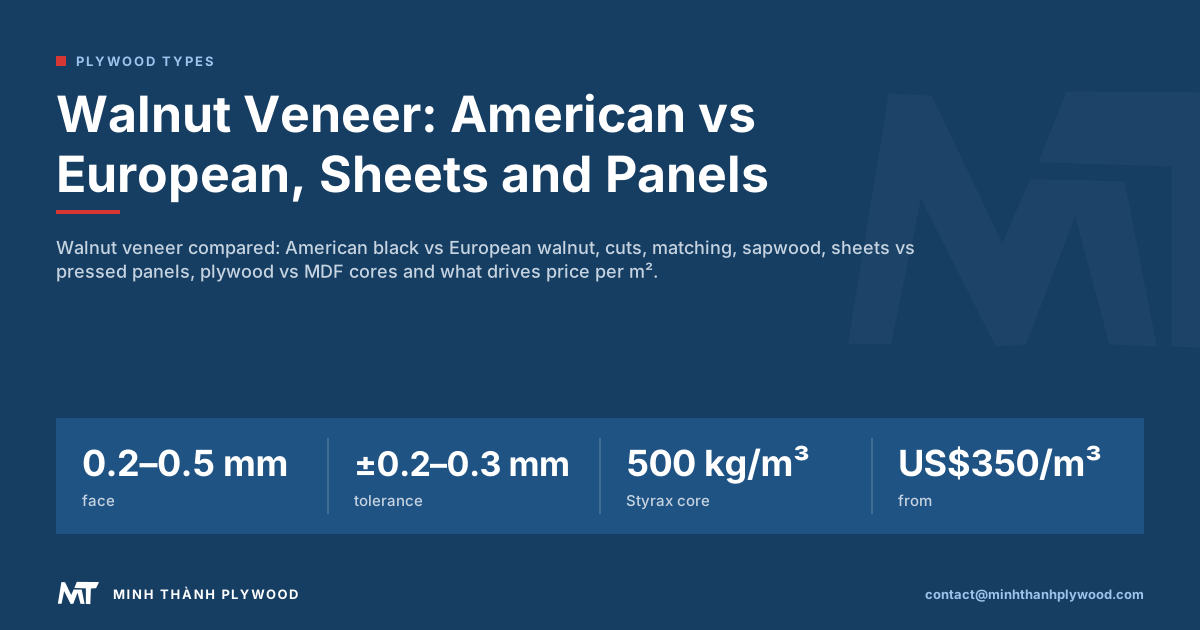
Walnut veneer is walnut wood sliced into thin leaves and glued onto a stable core, so a panel shows real walnut grain without being solid walnut. The leaves come from American black walnut or European walnut logs, and they reach buyers as loose sheets, backed sheets, rolls or ready-pressed panels.
The core does the structural work. A walnut face on plywood or MDF stays flat and dimensionally stable in a way a wide solid walnut board does not, because the core layers resist the wood’s movement with humidity. A furniture plant gets the look of walnut across a whole cabinet run while using far less walnut log.
For an importer, “walnut veneer” can mean two different purchases. One is loose veneer sheets that your own plant lays and presses. The other is walnut-faced panels that arrive ready to cut. This guide covers both, and the wood veneer sheets guide explains veneer in general.
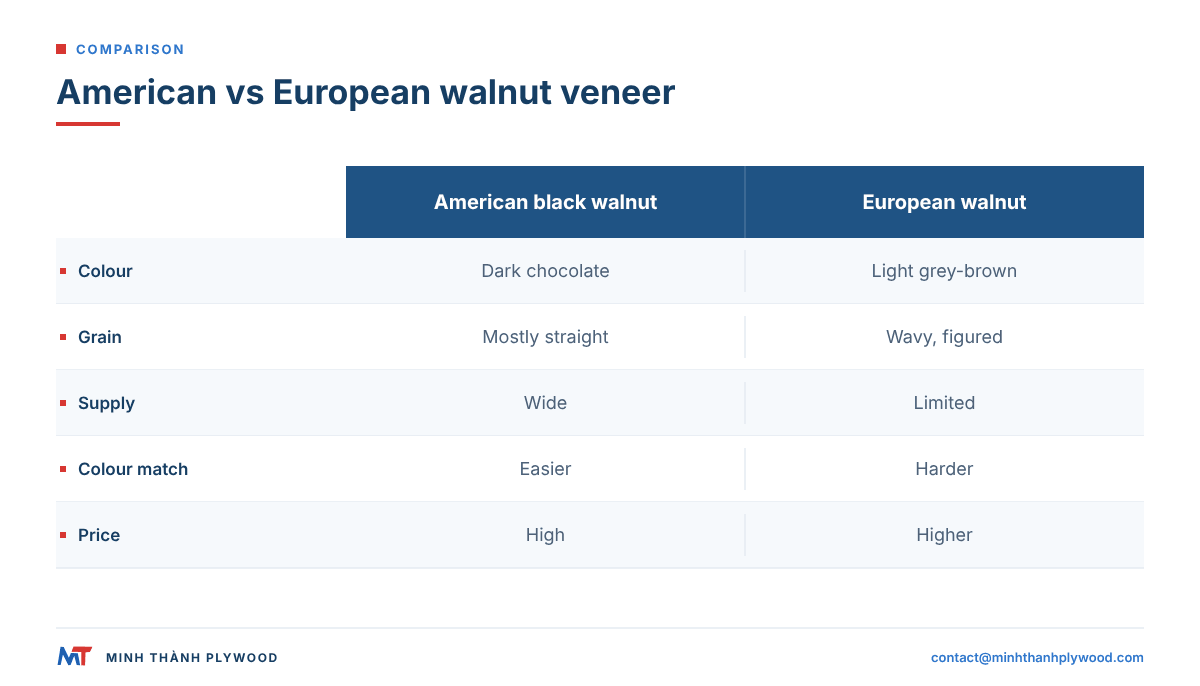
American walnut vs European walnut veneer
American black walnut veneer is darker and more even; European walnut veneer is lighter, greyer and more figured, and it costs more. Choose American black walnut for a consistent dark face across many panels, and European walnut when the figure itself is the design.
| Feature | American black walnut | European walnut |
|---|---|---|
| Botanical name | Juglans nigra | Juglans regia |
| Heartwood colour | Chocolate to purple-brown | Light grey-brown with dark streaks |
| Sapwood | Pale cream band, often present | Pale, usually trimmed out |
| Grain | Mostly straight, open | Wavy, often figured or burled |
| Supply | Wide, from managed North American forests | Limited, smaller logs |
| Colour match across a large order | Easier | Harder |
| Relative price per m² | High | Higher |
| Best fit | Kitchen runs, wardrobes, wall panels | Feature doors, desks, one-off pieces |
American black walnut dominates furniture production because the logs are larger and supply is steady. A buyer specifying fifty matching kitchen doors gets closer colour from one American walnut batch than from European walnut, where each log can differ.
European walnut is the traditional cabinetmaker’s walnut. Its lighter colour and dark streaks show figure that American walnut rarely has, which is why it is chosen for statement pieces rather than full runs.
Burr walnut and figured walnut leaves
Burr walnut, also called burl, comes from the knotted growth at the base or crotch of a walnut tree, and it is sold as small individual leaves, not as flitch sheets. UK retailer Original Marquetry lists English and European burr walnut leaves with the size in the product name, for example No. 43 at 20 × 14 in (50 × 35 cm), priced by figure and size: from £14.60 for a small leaf, then £38.90, £59.95 and £79.95, all ex VAT (October 2026). Crotch and curl walnut sell the same way, per leaf or bundle.
| Figured walnut | Typical form | UK retail price (ex VAT, Oct 2026) | Use |
|---|---|---|---|
| Burr walnut leaf | Single leaf, about 50 × 35 cm | £14.60 to £79.95 by size and figure | Inlays, dashboards, guitar and box lids |
| Crotch and curl walnut | Leaf or small bundle | Similar per-leaf range | Feature panels, door centres |
| Flitch walnut, straight grain | Bundle of leaves in log order | Priced per m² on quotation | Full furniture runs and kitchen doors |
Leaves like these are too small and too costly for production runs. A plant that wants burr walnut on a door buys a few leaves for the centre panel and uses straight-grain walnut or EV walnut-look plywood for the rest.
How walnut veneer is cut: crown, quarter and rotary
The cut decides the grain pattern more than the species does. Walnut is mostly sliced, not peeled, to keep the figure buyers pay for.
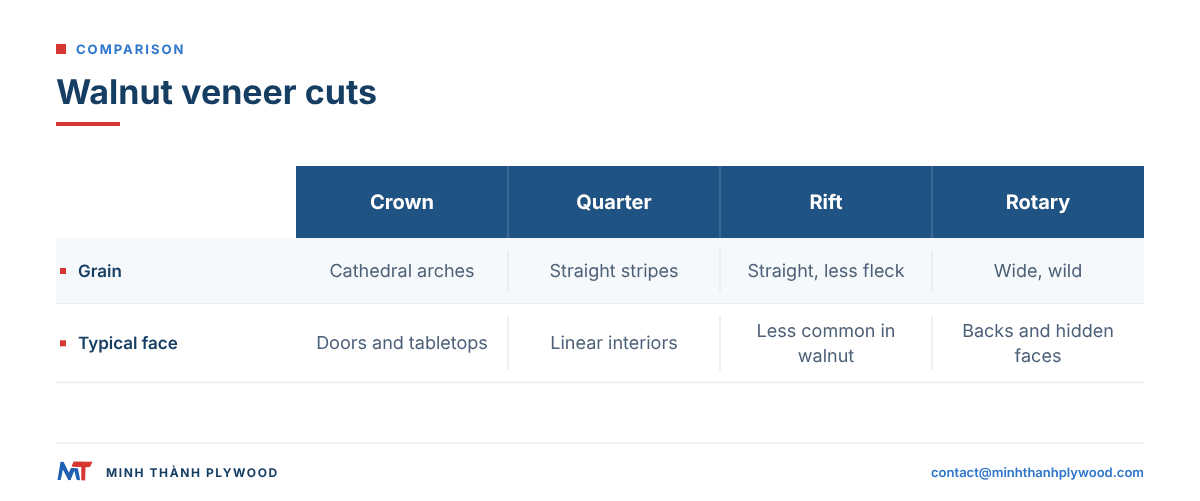
- Crown cut (flat cut): the log is sliced parallel to its centre, showing cathedral arches in the middle of each leaf. It is the classic walnut look for doors and tabletops.
- Quarter cut: the log quarter is sliced across the growth rings, giving straight, striped grain. It suits modern, linear interiors and matches well from leaf to leaf.
- Rift cut: sliced at an angle to the rays, giving straight grain with less ray fleck. It is less common in walnut than in oak.
- Rotary cut: the log turns against a knife and the veneer peels off as a continuous sheet. It gives wide, wild grain and lower cost; it is used for backs and hidden faces more than for show faces.
Cut also changes yield. Crown and quarter slicing produce narrower leaves that must be joined; rotary veneer comes off wide. That is one of the reasons sliced walnut faces cost more than rotary ones.
Book match, slip match and other walnut veneer layouts
Matching is how individual leaves are joined into a full panel face, and it changes how a walnut panel reads from across the room. Specify it on the order, because two panels from the same flitch can look very different with a different match.
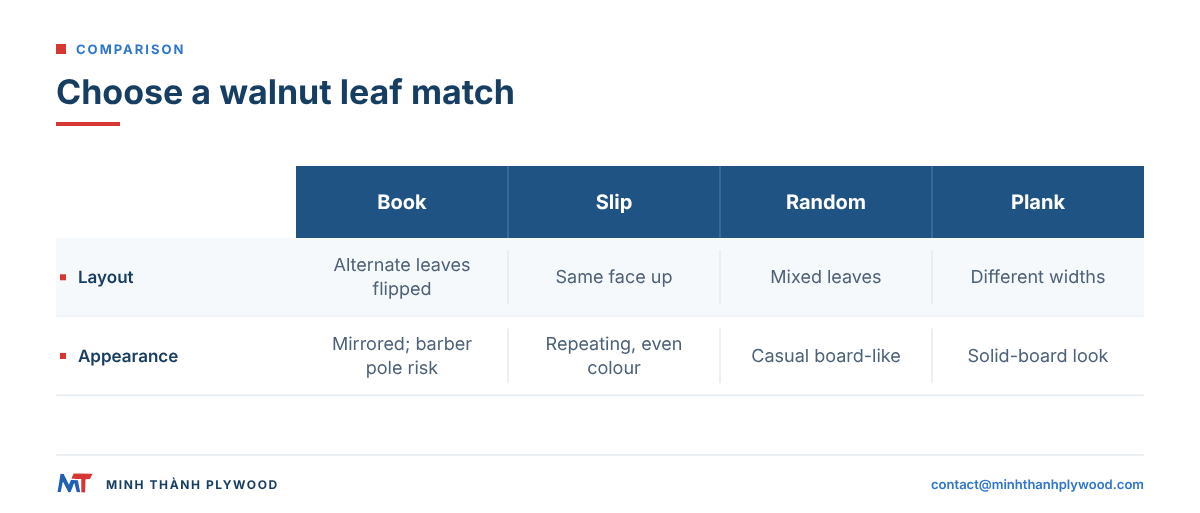
| Match | How leaves are laid | Look | Typical use |
|---|---|---|---|
| Book match | Every second leaf turned over | Mirrored grain at each joint | Doors, feature walls, tabletops |
| Slip match | Leaves side by side, same face up | Repeating grain, even colour | Long cabinet runs, wall panelling |
| Random match | Leaves mixed by width and pattern | Board-like, casual | Rustic furniture, backs |
| Plank match | Leaves of different widths, slight colour shifts | Looks like solid boards | Wall cladding, table tops |
Book match is the most requested layout for walnut. Turning alternate leaves makes a mirror image at each joint, which suits the arched crown-cut figure. Its drawback is a light and dark “barber pole” effect, because each turned leaf reflects light differently under a finish.
Slip match avoids that effect and keeps colour even, which matters on long runs of kitchen doors. Leaves with straight quarter-cut grain are usually slip matched.
Sapwood, streaks and grade: what to accept on a walnut face
Sapwood is the pale outer wood of the walnut log, and how much of it you accept is the single biggest grade decision for a walnut face. State it on the order: heartwood only, sapwood allowed in small streaks, or sapwood allowed as a design feature.
Walnut heartwood is dark; the sapwood band is cream to light brown. In the veneer trade, faces that allow sapwood cost less because more of each log is usable. Many furniture buyers now accept some sapwood streaks as natural character, especially on American black walnut, while others reject any visible pale wood.
The other things graded on a walnut face are:
- Colour consistency within one panel and across a run.
- Open defects: splits, worm holes and knots, usually not allowed on show faces.
- Mineral streaks: dark lines in the grain, accepted as character in most grades.
- Joint quality: tight joints with no gaps or overlaps.
- Sanding and glue bleed: no sand-through, no glue spots on the face.
Write the grade as face and back, the same way plywood faces are graded. A walnut face on the show side with a lower-grade or different species back is normal for cabinet parts that show one side. Grades follow the buyer’s approved sample, which is kept on file for later orders.
Walnut wood veneer sheets: loose, backed and on a roll
Walnut veneer sheets are sold loose in bundles from one flitch, backed with paper or another veneer, or as flexible rolls. Loose sheets suit plants that press their own panels; backed sheets and rolls suit workshops and edge wrapping.
| Format | What it is | Who buys it |
|---|---|---|
| Loose flitch sheets | Raw leaves kept in log order | Panel pressers, high-end joiners |
| Spliced faces | Leaves joined into a full face ready to press | Furniture plants without splicing lines |
| Paper-backed sheets | Leaves on a paper backing, flexible | Workshops, curved work |
| Wood-backed (2-ply) | Walnut on a cross-grain veneer backing | Larger flat areas laid with contact glue |
| Walnut veneer roll | Backed walnut on a roll, or edge banding | Edge wrapping, columns, curved panels |
| Pressed panel | Walnut face hot-pressed on a core | Cabinet and furniture plants, shopfitters |
| UK format and size | Example from the market |
|---|---|
| Loose burr leaf, about 50 × 35 cm | £14.60 to £79.95 ex VAT per leaf (Original Marquetry) |
| Backed or pressed board | 2440 × 1220 mm, the standard UK board size |
| Walnut veneer wall panel | 800 × 600 mm, 2440 × 600 mm or 2440 × 1200 mm, 13 mm thick (Panels by Sofia) |
| Walnut veneer wall panel, slatted or acoustic | Veneered MDF slats on felt; the base board is veneered plywood or EV walnut-look plywood |
Walnut veneer wall panels are the retail face of the same material: Panels by Sofia sells them in the three sizes above at 13 mm, and the panel makers behind such ranges slat, groove and veneer a base board. Minh Thanh supplies that base board as veneered plywood or EV walnut-look plywood.
Loose walnut sheets need equipment and skill. The leaves must be kept in flitch order, trimmed, spliced and pressed with a balancing back. A plant without that line usually buys walnut-faced panels instead and saves the waste from splicing.
Walnut wood veneer sheets also vary in moisture. Store them flat, covered and away from direct sun, because walnut changes colour with light and dry leaves split when handled.
Walnut plywood vs walnut veneered MDF
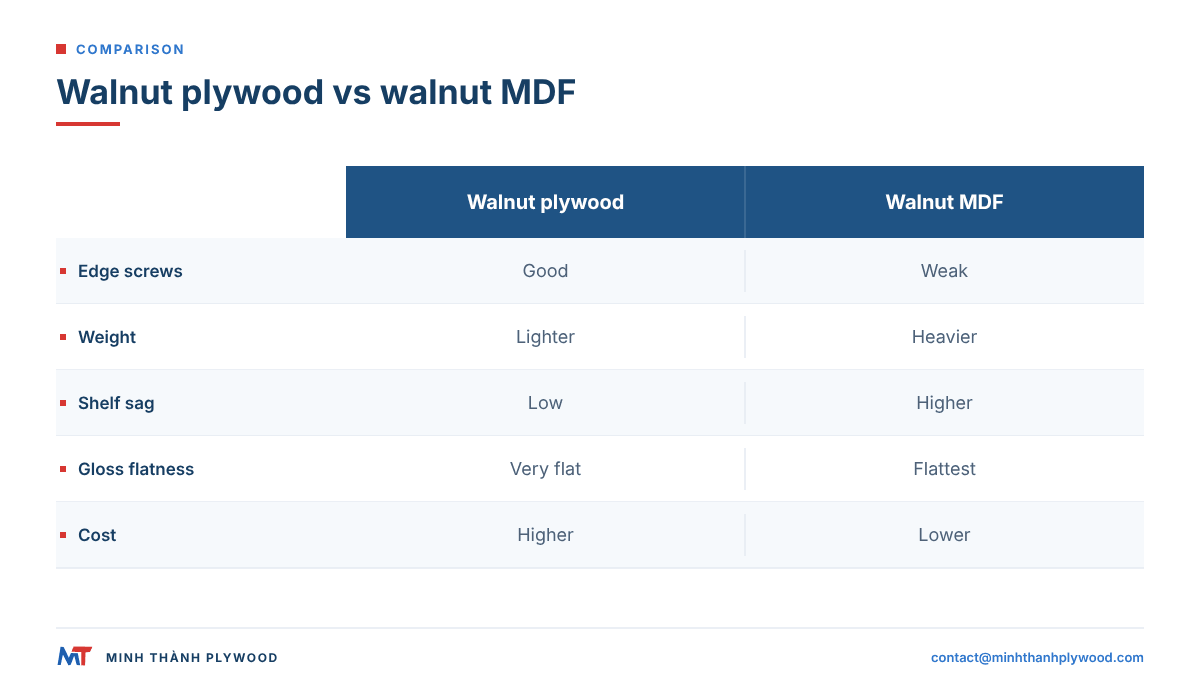
Walnut on plywood is the stronger, lighter panel; walnut on MDF is the flatter, cheaper one. Pick plywood for doors, shelves and carcass parts that take hinges and screws, and MDF for flat, finely finished parts that never carry load.
| Metric | Walnut-faced plywood | Walnut-veneered MDF |
|---|---|---|
| Screw holding in face and edge | Good in face and edge | Good in face, weak in edge |
| Weight | Lighter: Styrax core about 500 kg/m³ | Heavier |
| Sag over a shelf span | Low | Higher |
| Surface flatness under gloss | Very flat when calibrated | Flattest |
| Edge finishing | Shows layers, needs banding or lipping | Smooth edge, needs banding |
| Moisture tolerance | Better | Swells at edges if wet |
| Relative cost | Higher | Lower |
The core of the panel decides most of these points. A double-pressed plywood core, calibrated before the faces go on, removes most of the flatness gap with MDF. The plywood vs MDF comparison covers the substrates in full, and the guide to veneered panels compares plywood, MDF and particleboard as veneer bases.
For export, weight is a cost point too. A Styrax-core panel is lighter than a walnut MDF panel of the same thickness, so more square metres fit under a container’s payload limit.
How thick is the veneer on walnut plywood?
Face veneers on plywood are 0.2–0.5 mm thick, and European furniture plywood usually carries about 0.3 mm. Walnut veneer sold as loose sheets is often thicker, so the face survives a plant’s own sanding and finishing.
Thin faces are normal and are not a sign of low quality. The face is a decorative layer; the core layers carry strength. What matters is that the core under the face is flat and void-free, so the thin walnut leaf does not telegraph core joints or sink into gaps.
A thin face does limit refinishing. A walnut-faced cabinet door can be sanded and recoated, but not taken back as deep as solid walnut. For tabletops that will see heavy wear and later refinishing, specify a thicker face or a solid edge.
The veneer thickness guide gives face and core veneer thickness by panel type.
Is walnut veneer expensive? What drives price per m²
Walnut is among the more expensive veneers, priced above oak and ash, because walnut logs are smaller and figured flitches are scarce. A walnut-veneered panel still costs far less than the same part in solid walnut.
The price per square metre of a walnut face moves with these drivers, roughly in order of weight:
- Species and origin: European walnut above American black walnut.
- Cut: quarter and figured crown cut above plain crown; rotary lowest.
- Sapwood rule: heartwood only costs more than sapwood allowed.
- Leaf length and width: long, wide leaves cost more and give fewer joints.
- Matching: book match and sequence-matched panels cost more than random.
- Face thickness: thicker faces use more log per square metre.
- Core and back: a calibrated plywood core and a matching walnut back add cost.
- Panel size and quantity: full sheets in one specification price better than mixed small lots.
On a pressed panel the face is only part of the cost. Core species, glue and emission class, thickness tolerance and sanding all add to the price. Minh Thanh’s furniture and interior plywood starts from US$350/m³ (October 2026) on standard faces; decorative imported faces such as walnut are priced on the specification.
Engineered walnut veneer: the EV alternative
Engineered veneer, or EV, is a reconstituted face made from fast-growing plantation wood that is dyed and re-sliced to imitate walnut. It gives a repeatable walnut look with no sapwood, no colour drift between batches and a lower price than natural walnut.
EV walnut suits large projects where every door must match: hotel rooms, office fit-outs and flat-pack furniture. Natural walnut suits buyers who want real figure and accept variation as part of the product.
| Point | Natural walnut veneer | EV walnut-look veneer |
|---|---|---|
| Source | Walnut logs | Dyed plantation veneer, re-sliced |
| Grain | Unique per flitch | Repeating, designed |
| Colour across batches | Varies | Consistent |
| Sapwood and defects | Present per grade | None |
| Price | Higher | Lower |
EV is one of the faces Minh Thanh produces most. The EV plywood page lists its cores and sizes.
How Minh Thanh presses walnut-faced plywood
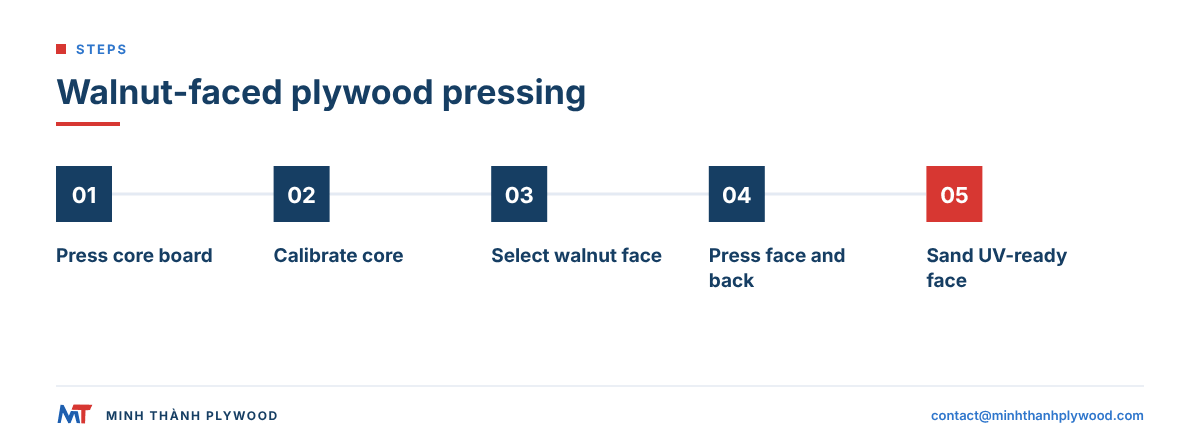
Minh Thanh presses walnut and other imported decorative faces on request onto white Styrax or Eucalyptus cores, using the same double-pressing route as its furniture plywood. The core board is pressed and calibrated first, then the walnut face and the back are pressed on.
The details a furniture buyer gets on a walnut panel from our line:
- Core: white Styrax (about 500 kg/m³) for light, flat panels, or Eucalyptus (about 650 kg/m³) for harder cores; stitched horizontally and vertically.
- Calibration: sanded panels to ±0.2–0.3 mm thickness tolerance, down to ±0.2 mm.
- Glue: UF glue at E0 emission as standard for interior panels.
- Emission proof: CARB P2 / TSCA Title VI certification (ICTT mill no. 23024) and six ASTM D6007 chamber tests between April 2025 and June 2026 that averaged 0.014–0.032 ppm against the 0.05 ppm limit.
- Faces: sanded and UV-ready, so your plant can apply its own UV or lacquer finish.
- Sizes: 1220 × 2440 mm and 1250 × 2500 mm, plus custom sizes, thickness from 3 to 40 mm.
- Moisture: dried to 8–12 % at dispatch.
The limit that those chamber tests compare against is 0.05 ppm for hardwood plywood with a veneer core under EPA’s formaldehyde emission limits. For furniture sold in the EU, formaldehyde from furniture and wood-based articles is limited to 0.062 mg/m³ from 6 August 2026 by Regulation (EU) 2023/1464. Walnut-faced plywood also falls under the origin rules of Regulation (EU) 2023/1115. More on our cores and grades is on the furniture plywood page.
Walnut veneer for furniture and interiors: where each option fits
Choose the walnut option by the part, not by the room. A kitchen with walnut doors may use three walnut products: pressed panels for doors and carcass sides, a walnut veneer roll or banding for edges, and EV or a plain back on hidden faces.
| Part | Best walnut option | Why |
|---|---|---|
| Kitchen and wardrobe doors | American walnut on plywood, slip or book match | Even colour, screw hold for hinges |
| Tabletops | Crown-cut walnut on plywood, solid lipping | Figure on show, solid edge takes wear |
| Wall panelling | Plank or slip-matched walnut panels | Long runs with consistent look |
| Desk and feature fronts | European walnut, book match | Figure is the design |
| Shelves | Walnut-faced plywood | Lower sag than MDF |
| Curved parts and edges | Walnut veneer roll or backed sheet | Bends without cracking |
| Hotel and office fit-out runs | EV walnut-look plywood | Repeatable colour across many rooms |
Order walnut panels for one project from one face batch where possible. Mixing batches on adjacent doors shows colour differences that no finish hides.
What to write on a walnut veneer panel order
A walnut panel order needs the species, cut, match and sapwood rule on top of the normal plywood specification. Without them, two suppliers can quote the same “walnut plywood” for very different faces.
- Application: cabinet doors, carcasses, wall panels or tabletops; interior.
- Core: Styrax or Eucalyptus, stitched, double-pressed.
- Glue and emission: UF glue at E0 emission; CARB P2 / TSCA Title VI if the panels go to the US.
- Face: American black walnut or European walnut; crown or quarter cut; book or slip match; heartwood only or sapwood allowed; face thickness.
- Back: walnut, a lower walnut grade, or another species.
- Panel: thickness, size (1220 × 2440 or 1250 × 2500 mm), tolerance, sanded and UV-ready.
- Packing and quantity: pallet packs, number of panels, destination port.
A filled line reads: “18 mm walnut-faced plywood, Styrax core stitched, UF glue at E0 emission, American black walnut crown cut, book match, sapwood streaks allowed, walnut back B grade, 1220 × 2440 mm, sanded, 400 panels, CIF Genoa.”
Send that line through the quote form or by email to contact@minhthanhplywood.com, and we reply within hours with a price and a free sample of the face.
Buyer questions, answered
What is walnut veneer?
Walnut veneer is a thin leaf of walnut wood sliced from a log and glued onto a stable core such as plywood or MDF. It gives a panel the grain and colour of walnut at a fraction of the timber used in solid walnut.
What is the difference between American and European walnut veneer?
American black walnut is darker, chocolate to purple-brown, with straighter grain and wide supply. European walnut is lighter and greyer with dark streaks and more figure, and it is scarcer, so it usually costs more per square metre.
Is walnut veneer expensive?
Walnut is one of the dearer veneers, above oak and ash, because walnut logs are smaller and the best flitches are in demand. A walnut-veneered panel still costs far less than solid walnut of the same size.
How thick is the veneer on walnut plywood?
Face veneers on plywood are 0.2–0.5 mm thick, and European furniture plywood usually takes about 0.3 mm. That is enough for sanding and finishing, but not for deep repeated refinishing.
Do they make walnut veneer plywood?
Yes. Walnut veneer is pressed onto plywood cores for cabinets, wall panels and furniture. Minh Thanh presses imported decorative faces such as walnut on request, on Styrax or Eucalyptus cores.
What is sapwood in walnut veneer?
Sapwood is the pale outer wood of the walnut log. Some grades allow it as streaks or a band; furniture buyers who want an even dark face specify heartwood only or a limit on sapwood.
Is walnut veneer on MDF or plywood better?
Plywood holds screws better, is lighter and resists sagging, so it suits doors, shelves and furniture carcasses. MDF is flatter for high-gloss finishes and cheaper. For cabinet parts with hinges and fixings, walnut on plywood is the safer choice.
What is a walnut veneer roll?
A walnut veneer roll is a backed, flexible walnut sheet, or walnut edge banding, sold on a roll for wrapping edges and curved parts. It is not the face of a pressed panel.
What does book match mean on walnut veneer?
Book match turns every second leaf over, like the pages of a book, so the grain mirrors at each joint. Slip match lays leaves side by side the same way up, giving a repeating pattern with even colour.
Can walnut veneer be stained or finished like solid walnut?
Yes. Walnut veneer takes oil, lacquer and UV coatings like solid walnut. Sand lightly, because the face is thin, and test the finish on an offcut from the same batch.