
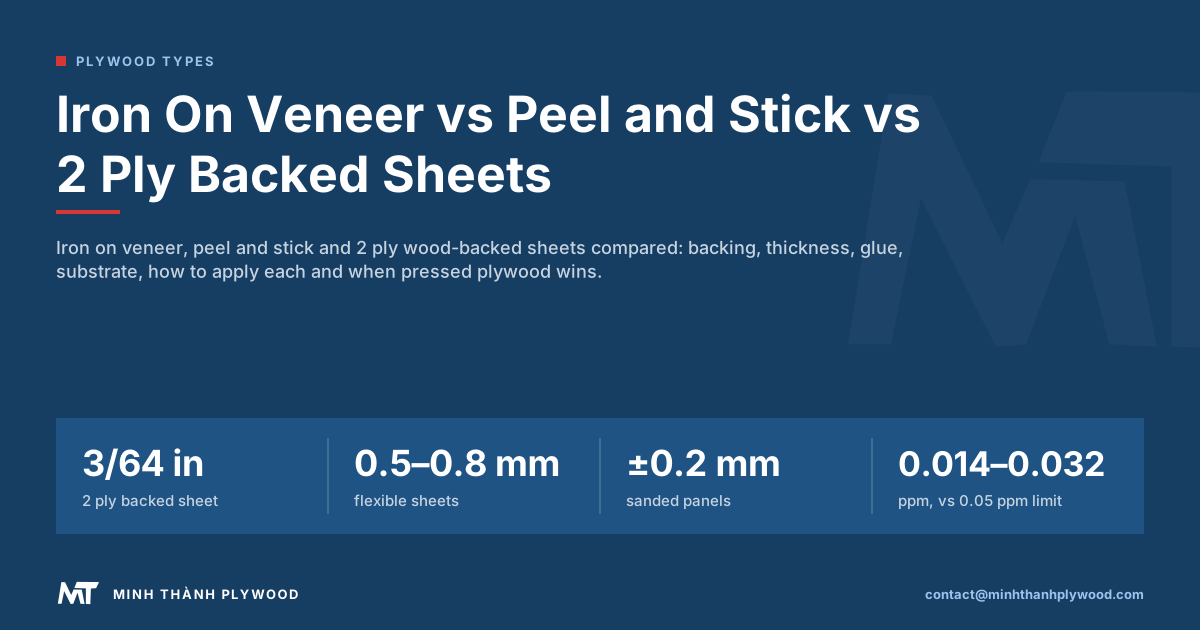
Iron on veneer is a real wood veneer sheet with a dry hot-melt glue on its back that bonds when you press it with a household iron; peel and stick sheets use a pressure-sensitive adhesive, and 2 ply sheets carry a second wood veneer as the backer. Minh Thanh Plywood presses veneer faces on plywood in the factory and sets out which backing suits which job.
Iron on veneer: the short answer
Iron on veneer is real wood veneer with a dry hot-melt glue film on its back: heat from an iron melts the glue and bonds the sheet to the panel in minutes, with no clamps or press. It is one of five backings sold on veneer sheets, and the backing decides how the sheet bends, glues and lies.
- Iron on (hot-melt): glue already on the back; bond with heat.
- Peel and stick (PSA): pressure-sensitive adhesive under a release liner; bond with a roller.
- Paper backed: thin paper behind the face; glue with contact cement or PVA.
- Fleece backed: textile fleece behind the face; glue with contact cement.
- 2 ply (wood backed): a second veneer cross grain behind the face; glue with PVA, contact cement or PSA.
For a single table top or a curved reception desk, a backed sheet is the right tool. For a run of matching cabinet doors or wall panels, factory-pressed veneered plywood is faster and flatter; the switch point is set out further down this guide.
What are backed veneer sheets?
Backed veneer sheets are thin decorative wood veneers bonded to a backing layer so that the face can be handled, cut and glued without splitting. Raw veneer is brittle along the grain; the backing holds it together and turns it into a flexible wood sheet.
Most decorative faces are sliced about 0.6 mm thick, and the face on a backed sheet is often thinner. Finished paper- or fleece-backed sheets are typically 0.5 to 0.8 mm thick; 2 ply wood-backed sheets are about 1.2 mm (3/64 in). The face species is real wood: oak, walnut, maple, ash, cherry, sapele and birch are the common stock items, alongside engineered (recon) faces that repeat the same grain on every sheet.
Backed sheets are also called flexible veneer sheets, flexible wood sheets, veneer sheets with backer, or simply wood veneer paper when the backing is paper. Rolls and narrow strips are the same product cut for edges.
The face, not the backing, sets the look. The backing sets everything else: which glue you can use, how tightly the sheet bends, whether it telegraphs dents in the substrate and how much skill the job needs.
Backing by backing: paper, fleece, 2 ply, PSA and iron-on compared
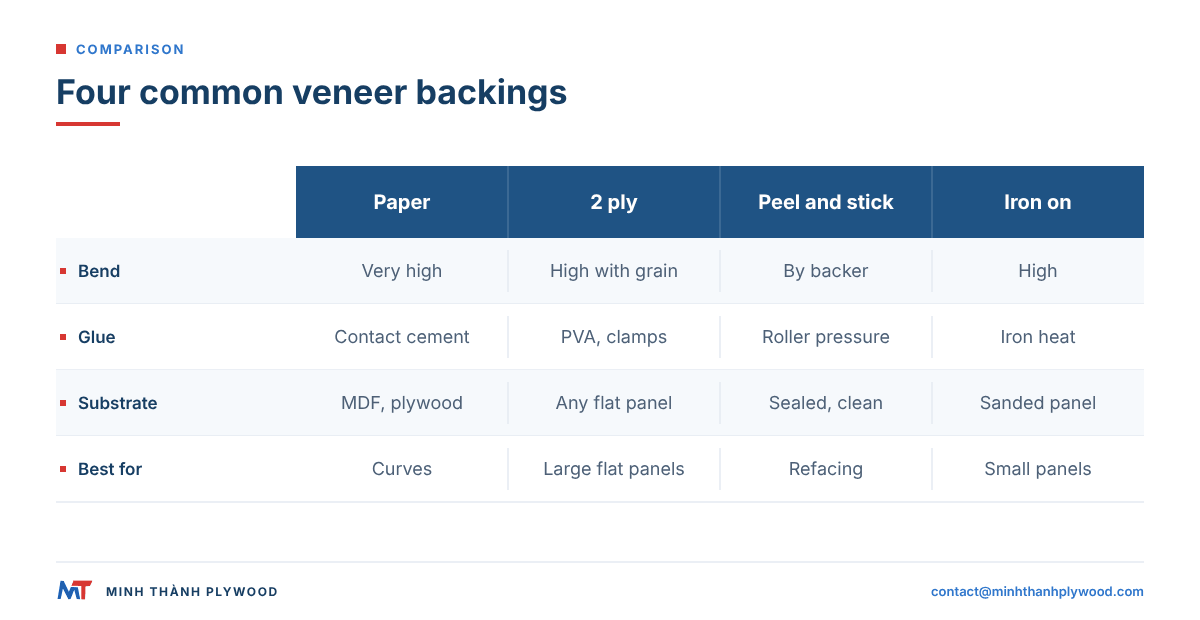
The five backings differ in stiffness, glue method and the substrate they forgive. The table compares them one line at a time.
| Backing | Build | Flexibility | Glue method | Best substrate | Best use |
|---|---|---|---|---|---|
| Paper backed | Face + thin paper | Very high along the grain | Contact cement, PVA, press glue | MDF, sanded plywood | Columns, curved fronts, wrapped panels |
| Fleece backed | Face + textile fleece | High | Contact cement | MDF, sanded plywood | Curves, furniture repairs |
| 2 ply (wood backed) | Face + cross-grain wood backer, about 3/64 in | High with the grain, moderate across | PVA with clamps or vacuum, contact cement, PSA | Plywood, MDF, particleboard | Large flat panels, table tops, cabinet sides |
| Peel and stick (PSA) | Face + backer + pressure-sensitive adhesive and liner | Depends on the backer | Roller pressure, no wet glue | Sealed, clean, flat surfaces | Cabinet refacing, small panels, repairs |
| Iron on (hot-melt) | Face + backer + dry hot-melt glue | High | Heat from an iron, then roll | Sanded MDF or plywood | Small panels, shelf faces, edge banding |
Two rules decide most choices. Use paper or fleece where the sheet must bend; use 2 ply where the panel is large and flat and the substrate may have small flaws. PSA and iron-on are about speed and tools: neither needs clamps, a press or wet glue.
What is 2 ply veneer?
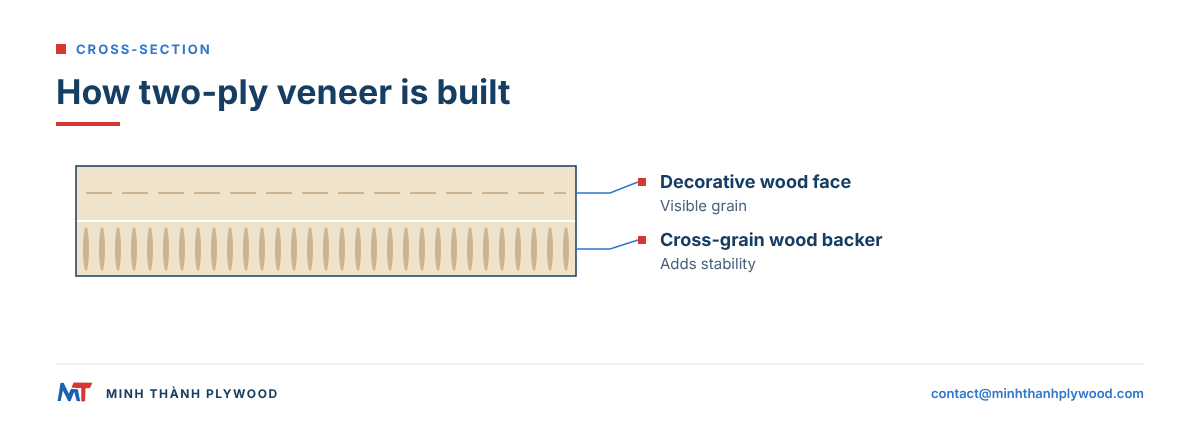
2 ply veneer is a decorative face veneer laminated to a second wood veneer laid with its grain across the face, so the sheet behaves like a very thin plywood. The trade also calls it wood-backed veneer, wood-on-wood veneer and 2 ply wood veneer.
The cross-grain backer does three jobs:
- Stability. The backer resists the face’s natural movement, so the sheet lies flat on wide panels.
- Bleed-through control. Finish soaks into the face but stops at the backer, so stain does not reach the glue line and cause blotches.
- Hiding the substrate. Small dents, scratches and particle texture in the panel do not telegraph through to the face as easily as they do with paper backing.
A 2 ply sheet is about 3/64 in thick, roughly double a paper-backed sheet. It can be glued with yellow or white wood glue under clamps or vacuum, with contact cement, or bought with a factory-applied PSA. Its weak point is tight curves across the grain, where the backer resists.
Paper backed vs wood backed veneer: which one?
Paper backed veneer is the better choice for curves and contact cement; wood backed veneer is the better choice for big flat panels and imperfect substrates. Both carry the same real wood face.
| Line | Paper backed | Wood backed (2 ply) |
|---|---|---|
| Backer | Thin paper | Cross-grain wood veneer |
| Thickness | Thinner | About 3/64 in |
| Bend along the grain | Very tight | Tight |
| Bend across the grain | Tight | Moderate |
| Telegraphing of substrate flaws | Higher | Lower |
| Finish bleed-through | Possible with thin stains | Stopped by the backer |
| Typical glue | Contact cement | PVA, contact cement or PSA |
| Typical job | Column wraps, curved desks | Table tops, cabinet sides, wall panels |
A practical test: if the panel is flat and larger than a door, choose 2 ply. If the panel curves, choose paper or fleece.
How to apply iron on veneer: step by step
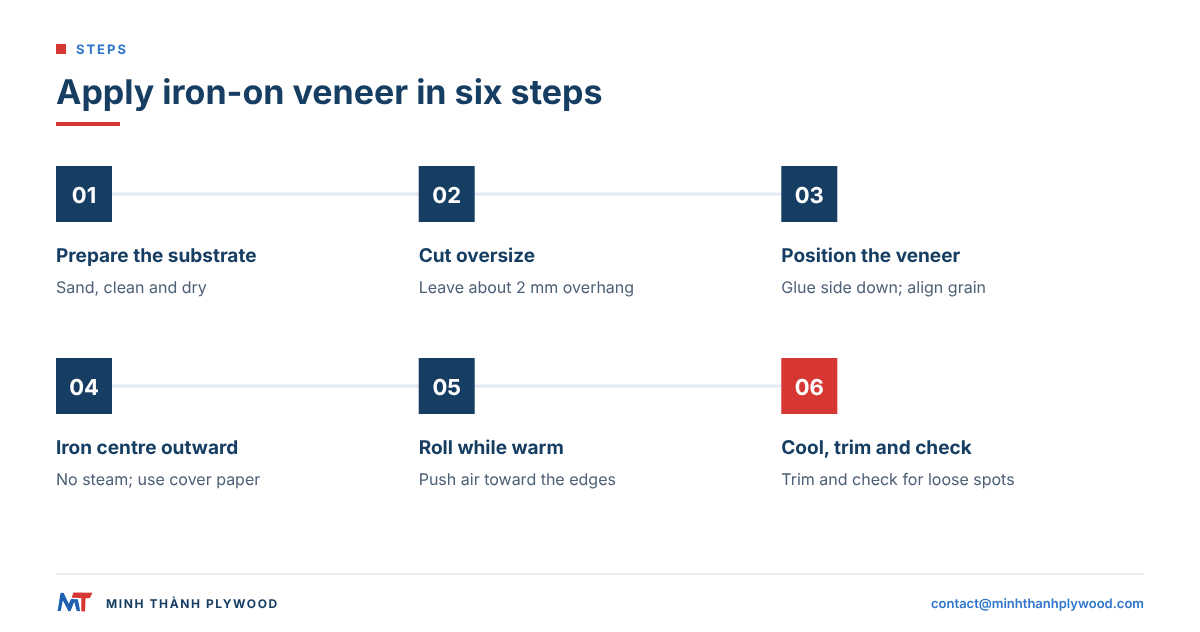
Applying iron on veneer takes six steps and a household iron set to the cotton heat with steam off. Work on a flat, dust-free panel and keep a hard roller or a block of wood ready.
- Prepare the panel. Sand MDF or plywood smooth, remove dust with a tack cloth and make sure the face is dry and free of oil or old finish.
- Cut the sheet oversize. Leave about 2 mm of overhang on each edge to allow for shrinkage as the glue cools; the excess is trimmed after bonding.
- Position the sheet. Lay it glue-side down and check the grain direction against the panel and its neighbours.
- Iron from the centre out. Move the iron slowly over a cover sheet of brown paper so the face does not scorch; overlap each pass so the glue melts evenly.
- Roll while warm. Follow the iron with a veneer roller or a wooden block, pressing from the centre to the edges to push out air.
- Trim and check. Once cool, trim the edges with a sharp knife or a flush trimmer, ease the sharp edges with 120-grit paper and tap the surface: a hollow sound means a loose spot that needs reheating.
Two or more sheets on one panel: butt the edges tight, bond the first sheet, then lay the next against it and iron outward from the joint so the seam does not open.
Iron-on bonds suit panels a person can handle on a bench. For whole sheets, sides of tall cabinets or batches of parts, a heated press does the same job evenly across the panel.
How to iron wood veneer with PVA glue
To iron wood veneer that has no glue on it, coat both the panel and the veneer back with ordinary PVA wood glue, let both coats dry until clear, then reactivate the glue with a hot iron. This is the glue-and-iron method, and it turns any raw or paper-backed veneer into an iron-on sheet.
- Glue: standard yellow or white PVA; one thin, even coat on each surface.
- Drying: wait until both coats are dry to the touch and clear.
- Ironing: hot iron, no steam, over a cover sheet; the dried glue softens and the two coats fuse.
- Rolling: roll immediately while the glue is warm.
The method works well on small curved parts and edges because there is no wet glue to squeeze out. It is slower than hot-melt sheets on large panels, and each glue coat must be even or the face shows ridges after finishing.
Peel and stick wood veneer: how PSA sheets work
Peel and stick wood veneer is real veneer on a backer with a pressure-sensitive adhesive (PSA) under a release liner: you peel the liner, place the sheet and bond it with firm roller pressure. Veneer peel and stick sheets are sold on paper, fleece and 2 ply backers, so the same choice of backer still applies.
PSA sheets work best on surfaces that are flat, sealed and clean: cabinet doors being refaced, painted or laminated panels after a scuff sand, small furniture parts. The bond comes from pressure, not heat or curing, so the roller does the work. Press hard from the centre outward with a J-roller or a hard veneer roller over every part of the sheet.
Stick on veneer has three limits. Placement is final once the adhesive touches, so dry-fit first and peel the liner in stages. Porous or dusty surfaces weaken the bond, so seal raw MDF or particleboard first. Heat sources such as ovens and dishwashers soften the adhesive, so keep PSA away from them or use a glued or pressed panel instead.
What is the best sheet to apply veneer to?
The best sheet to apply veneer to is a flat, stable, sanded panel: MDF for the smoothest face, or furniture-grade hardwood plywood when weight, screw holding and moisture behaviour matter. Particleboard works when it is sealed and clean.
| Substrate | Face quality | Weight | Screw holding | Notes |
|---|---|---|---|---|
| MDF | Smoothest | Heavy | Fair on the face, weak on edges | Seal edges; best for paper-backed sheets |
| Sanded furniture plywood | Smooth, calibrated | Lighter on a Styrax core | Strong on face and edge | Best all-round panel for 2 ply and iron-on |
| Particleboard | Fair | Medium | Weak | Seal first; 2 ply hides texture best |
| Painted or laminated panel | Smooth after scuffing | As the panel | As the panel | PSA only, after cleaning |
Plywood quality matters as much as type. A substrate for thin veneer needs a calibrated thickness and a void-free face: our sanded furniture panels hold ±0.2–0.3 mm, down to ±0.2 mm, so a backed sheet or a pressed face sits on a flat, even surface. Light white Styrax cores at about 500 kg/m³ keep large veneered panels easy to handle.
Can flexible veneer sheets go around curves?
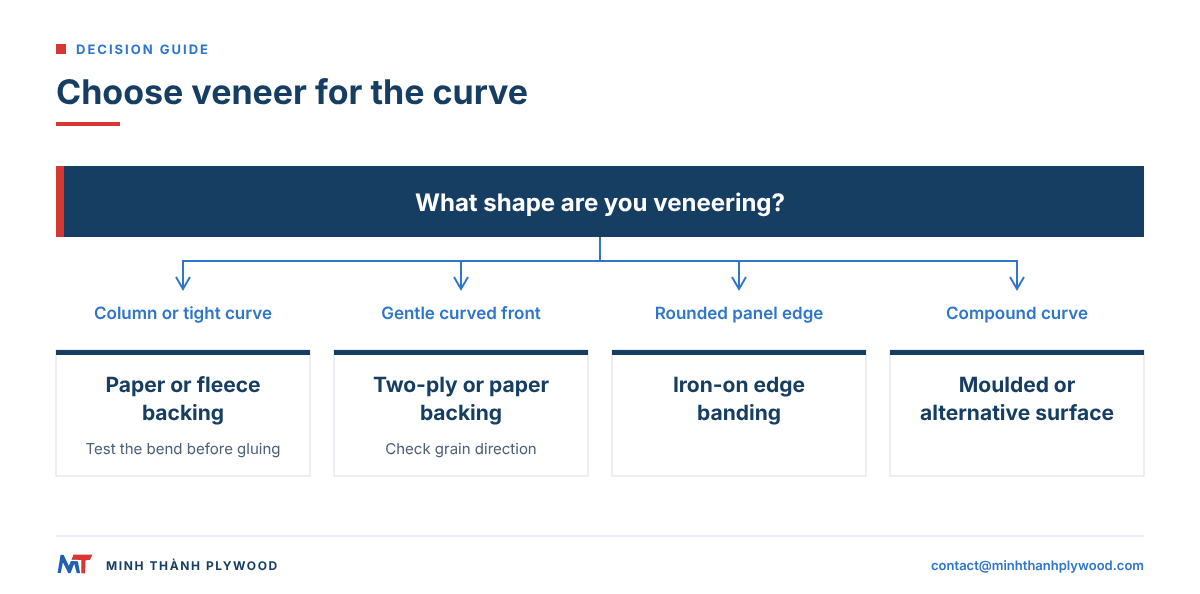
Flexible veneer sheets go around curves well when they bend along the grain, with the grain running around the curve’s axis rather than across it. Paper and fleece backed sheets bend tightest; 2 ply sheets bend well with the grain and less across it.
- Columns and round posts: paper or fleece backing, grain running vertically, contact cement on both surfaces.
- Curved desk and bar fronts: paper backing for tight radii; 2 ply for gentle sweeps.
- Bullnose and rounded edges: iron-on strips or edge banding.
- Compound curves: not a job for sheet veneer; use a moulded part or a different surface.
Test-bend an offcut around a former of the same radius before gluing. If the face cracks along the grain, change backing or turn the grain direction. Bend the panel or former first, then veneer it: a veneered flat panel that is bent afterwards strains the face.
Veneer rolls, strips and iron-on edge banding
Veneer rolls, strips and edge banding are backed veneer cut narrow and long for edges, shelf fronts and trims. Pre-glued edge banding carries the same hot-melt glue as iron on veneer sheets and is applied with an iron or an edge bander.
| Product | What it is | How it is applied | Use |
|---|---|---|---|
| Pre-glued edge banding | Veneer strip with hot-melt glue | Iron, then trim | Shelf and panel edges |
| Non-glued edge banding | Veneer strip without glue | Contact cement or edge bander | Workshop and factory edging |
| Thick edge banding | Heavier veneer strip | Edge bander | Edges that take wear |
| Wood veneer roll | Long backed sheet on a roll | As its backing | Long runs, wall strips |
| Wood veneer strips | Narrow cuts of sheet veneer | As their backing | Trims, inlays, repairs |
Common edge banding widths cover panels of 18 mm and 22 mm, with a little overhang to trim. Match the banding species and cut to the face so the edge does not read as a different wood.
Sizes, species and iron on oak veneer
UK iron-on sizes and prices
A UK buyer searching for iron on veneer finds narrow pre-glued strips, not panels. The standard sheet is 2500 × 300 mm (0.75 m² of face), sold by species; a shorter 1240 × 300 mm sheet and 300 mm wide edging also exist. Prices below are retail, dated 21 October 2026.
| Product | Size | Retail price | Source |
|---|---|---|---|
| American white oak, sanded, pre-glued | 2500 × 300 mm | from GBP 20.69 ex VAT | Veneers Online |
| American white oak, pack of two | 2500 × 300 mm each | GBP 38.95 ex VAT | Veneers Online |
| Oak roll, pre-glued, 0.6 mm | 2500 × 300 mm | GBP 47.95 inc VAT | B&Q |
| Walnut, cherry, ash, beech, sapele, pine | 2500 × 300 mm | by species, same range | Veneers Online |
| Iron-on edging | 22, 30, 50 and 300 mm wide | by width; 50 m rolls | Champion Timber |
Veneers Online ships free over GBP 75 + VAT. At the single-sheet price, covering one 1220 × 2440 mm board (2.98 m²) takes four 2500 × 300 mm sheets, about GBP 83 ex VAT for the veneer alone, before the substrate, glue, labour and offcut waste.
Ten full boards need about 40 sheets and over GBP 800 of veneer. A factory-veneered 18 mm board of the same size works out at about US$18.8 as a raw FOB example at US$350/m³ furniture plywood (1.22 × 2.44 × 0.018 = 0.0536 m³), with the face already pressed on both sides. Past a handful of panels, the pressed board is cheaper and flatter than hand-laid strips.
Sheet sizes, species and iron on oak veneer
Backed veneer sheets for the trade are sold mainly in 4 × 8 ft and 4 × 10 ft sheets, with the 4 × 8 ft sheet matching the 1220 × 2440 mm panel and the longer sheet the 1220 × 3050 mm format. Smaller cuts and rolls serve edges and repairs.
| Species | Colour | Common cuts | Typical use |
|---|---|---|---|
| Oak (white and red) | Pale to mid brown | Crown, quarter, rift | Cabinets, wall panels, iron on oak veneer for shelves |
| Walnut | Dark chocolate brown | Crown, quarter | Furniture, feature walls |
| Maple | Cream white | Flat, quarter, figured | Cabinets, white interiors |
| Ash | Pale with strong grain | Crown, quarter | Furniture, wall panelling |
| Cherry | Pink brown, darkens | Flat, quarter | Furniture, joinery |
| Sapele | Red brown, ribbon stripe | Quarter | Doors, furniture |
| Birch | Pale cream | Rotary | Light interiors, painted look |
| Engineered (recon) | Any colour, repeating grain | Straight or crown pattern | Matching runs |
Iron on oak veneer is the most stocked iron-on face, because oak suits shelf fronts and cabinet parts in most interiors. Our guides to oak veneer and to walnut veneer cover the cuts and grades of those two species in detail.
Finishing backed veneer: stain, oil and lacquer
Backed veneer finishes like any sanded hardwood: stain, oil, lacquer or varnish all work, provided you sand lightly and do not cut through the thin face. The backing affects only how stains behave at the glue line.
- Sanding: fine paper only, by hand or with a light orbital sander; stop as soon as the surface is even.
- Stain: test on an offcut; on paper-backed sheets a thin water stain can soak through, while 2 ply stops it.
- Oil: penetrating oils give a natural look and are easy to repair.
- Lacquer and varnish: give the hardest surface for table tops and cabinet doors.
- Prefinished sheets: arrive lacquered and need only cleaning after bonding.
Sanding through is the most common failure. On a pressed veneered panel, the factory has already calibrated and polished the face, so the buyer coats it directly. Our panels leave the line sanded and polished, with both faces UV-ready for the buyer’s own coating.
When should you switch to factory-pressed veneered plywood?
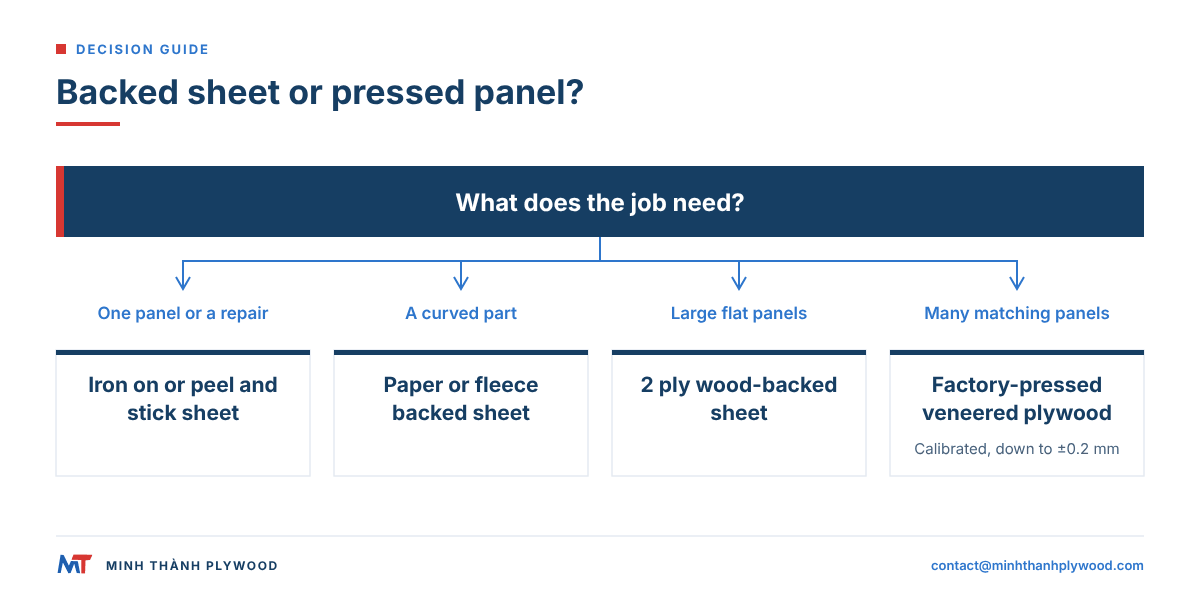
Switch from backed veneer sheets to factory-pressed veneered plywood when the job has many matching panels, needs flat calibrated parts, or must ship with emission certification. Backed sheets are a site and workshop tool; a pressed panel is a production material.
| Need | Backed veneer sheet | Factory-pressed veneered plywood |
|---|---|---|
| One-off panel or repair | Best fit | Too much material |
| Curved part | Best fit | Not for tight curves |
| Ten or more matching doors or panels | Slow, hand-laid | Best fit, same face batch |
| Flatness and thickness | Depends on the substrate | Calibrated core, down to ±0.2 mm |
| Bond | Hot-melt, PSA or contact cement | Pressed in a heated press |
| Emission proof | Depends on the adhesive used | CARB P2 / TSCA Title VI certified |
| Labour per panel | Cutting, gluing, trimming, sanding | Cut and coat |
Our furniture-grade panels are pressed twice as standard: the core board is pressed and calibrated, then the face and back are pressed on. The result is a flat, balanced panel with a veneer face on both sides, which a hand-applied sheet on one face cannot match. Plywood for general use is specified in BS EN 636. Panels use UF glue at E0 emission; six third-party ASTM D6007 chamber tests between April 2025 and June 2026 averaged 0.014–0.032 ppm. The US limit for hardwood plywood is 0.05 ppm under 40 CFR 770.10, part of the US EPA’s TSCA Title VI rule.
For a furniture maker who now veneers raw boards in the workshop, the change saves the gluing step and the rejects that come with it. EV plywood is the pressed panel most buyers order when every part must match.
What this means for your veneered panel order
An order for pressed veneered plywood replaces the backing decision with six specification lines. Send these and we quote factory-direct:
- Application: cabinet doors, carcass sides, wall panels, table tops or shop fit-out.
- Face: EV pattern and colour, or a natural face such as birch, poplar, okoume or pine; face and back grade.
- Core: white Styrax for light panels or Eucalyptus for denser ones, stitched horizontally and vertically.
- Glue and emission: UF glue at E0 emission for dry interiors; MR or WBP bonds to your specification.
- Size and thickness: 1220 × 2440 mm or 1250 × 2500 mm, 3–40 mm; cut-to-size into 4, 6 or 8 pieces.
- Packing and quantity: from one 40HC, mixed specifications by agreement; destination port.
Production is 15–45 days after the 30% deposit, FOB Hai Phong, CFR or CIF, with free samples. Our guides to veneered plywood and veneered panels on plywood, MDF and particleboard compare the pressed options, and the wood veneer sheets guide covers loose sheets by species and cut.
Buyer questions, answered
What is iron on veneer?
Iron on veneer is a thin real wood veneer with a heat-activated hot-melt glue already on the back. You lay it on a clean panel, press it with a hot iron so the glue melts, then roll it flat while it cools.
What is 2 ply veneer?
2 ply veneer is a face veneer glued to a second wood veneer laid cross grain behind it, also called wood-backed or wood-on-wood veneer. It is about 3/64 in thick overall, stiffer than paper-backed sheets and less likely to show glue or substrate defects.
What is the difference between paper backed and wood backed veneer?
Paper backed veneer has a thin paper or fleece layer behind the face, so it bends tightly around curves and suits contact cement. Wood backed veneer has a cross-grain wood backer, so it lies flatter on large panels and hides small substrate flaws better.
Is peel and stick wood veneer any good?
Peel and stick wood veneer is real wood on a pressure-sensitive adhesive, good for cabinet refacing, small panels and repairs. It needs a clean, sealed, flat surface and firm roller pressure; it is not a substitute for a pressed panel in high-heat or wet areas.
Can I iron veneer onto plywood?
Yes. Sand the plywood smooth, remove dust, then press iron on veneer or PVA-coated raw veneer with a hot dry iron. Sanded furniture plywood with a flat, void-free face gives the best result.
What is the best substrate for veneer sheets?
MDF and sanded hardwood plywood are the best substrates because they are flat and stable. Plywood holds screws better and weighs less; MDF has the smoothest face. Particleboard works when its surface is sealed and clean.
Can backed veneer go around curves?
Yes. Paper and fleece backed sheets bend tightly along the grain and are the usual choice for columns and curved desk fronts. 2 ply sheets bend well with the grain but are stiffer across it.
Can you stain iron on veneer?
Yes. The face is real wood, so it takes stain, oil and lacquer like any sanded wood. Sand lightly with fine paper, because the face of a backed sheet is thin and can be sanded through.
When should I buy veneered plywood instead of veneer sheets?
Buy factory-pressed veneered plywood when you need many matching panels, a flat and calibrated thickness, or emission certification. Backed sheets suit one-off jobs, curves and on-site repairs.
Do you sell iron on veneer sheets?
No. Minh Thanh Plywood makes veneered plywood panels: the face is pressed on a stitched Styrax or Eucalyptus core in the factory, sanded and polished. Buyers who would otherwise laminate backed sheets themselves order these finished panels.