
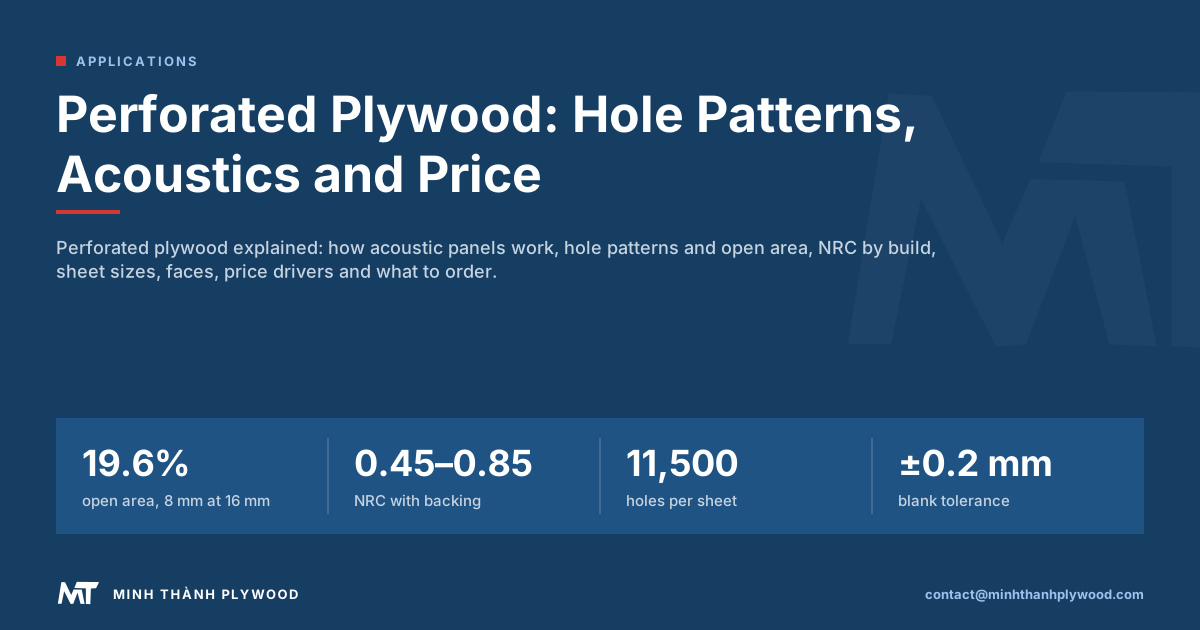
Perforated plywood is plywood drilled with a regular grid of holes, used as an acoustic wall or ceiling panel over a cavity and sound-absorbing backing, or as a decorative screen. Minh Thanh Plywood explains how the holes absorb sound, the standard hole patterns and their open area, faces and sizes, what drives the price, and the blank panel a perforating shop needs.
What is perforated plywood?
Perforated plywood is a plywood panel drilled with a regular grid of round holes. Fixed over a cavity with sound-absorbing material behind it, it works as an acoustic wall or ceiling panel that cuts echo in a room; without backing it becomes a decorative screen, a display wall or a ventilated cabinet front.
Plywood suits perforation because its crossed veneers hold together between holes. A grid of thousands of holes would weaken a solid board along the grain; in plywood every hole is surrounded by veneer running in two directions, so the panel stays stiff and the bridges between holes do not split.
Perforated panels are made in two stages. A plywood mill makes the blank: flat, calibrated, sanded and faced for the look. A panel maker drills the holes on a CNC machine, adds the acoustic fleece and finishes the face. Minh Thanh Plywood makes the blanks.
How do perforated plywood acoustic panels work?
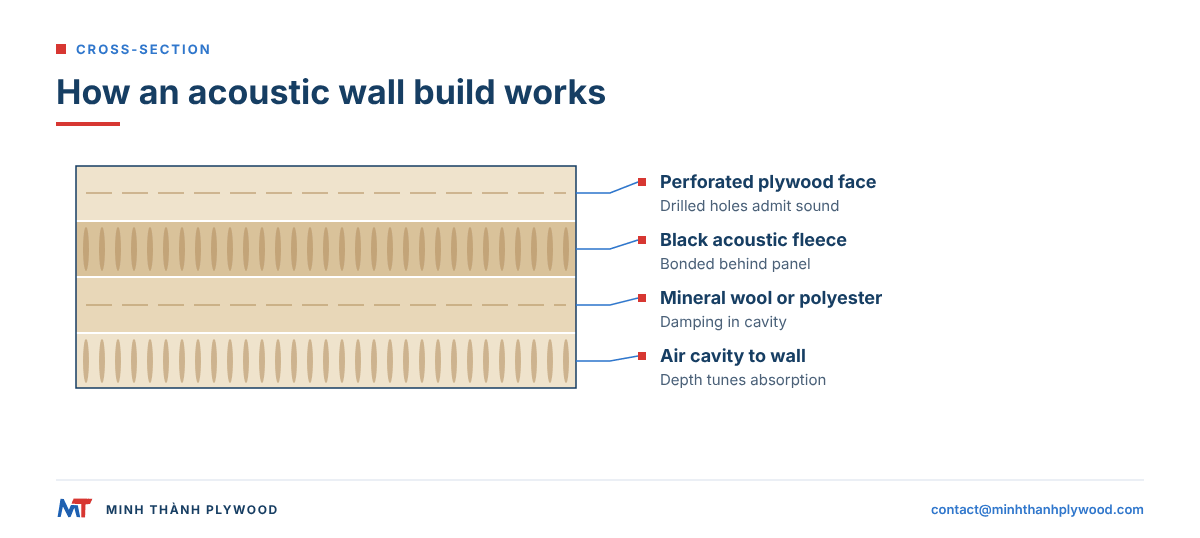
Perforated plywood acoustic panels work as resonant absorbers. Sound waves pass through the holes into the air cavity behind the panel; the air in each hole moves back and forth like a mass on a spring, and the sound-absorbing layer behind it turns that movement into heat. Sound that would bounce off a hard wall is absorbed instead.
Three parts make the absorber, and each changes the result:
- The holes. Hole diameter and spacing set the open area, the share of the face that is holes. More open area lets more high-frequency sound through.
- The cavity. The air space between panel and wall tunes the frequency: a deeper cavity moves absorption towards the bass.
- The backing. A black acoustic fleece glued to the back of the panel and a layer of mineral wool or polyester fibre in the cavity give the damping. Without them a perforated panel absorbs only a narrow band.
Because the panel, the holes and the backing all count, absorption is measured on the full build in a reverberation room to ISO 354, and the result is reported as absorption by frequency and as a single rating such as NRC or the weighted coefficient αw.
Standard hole patterns and open area
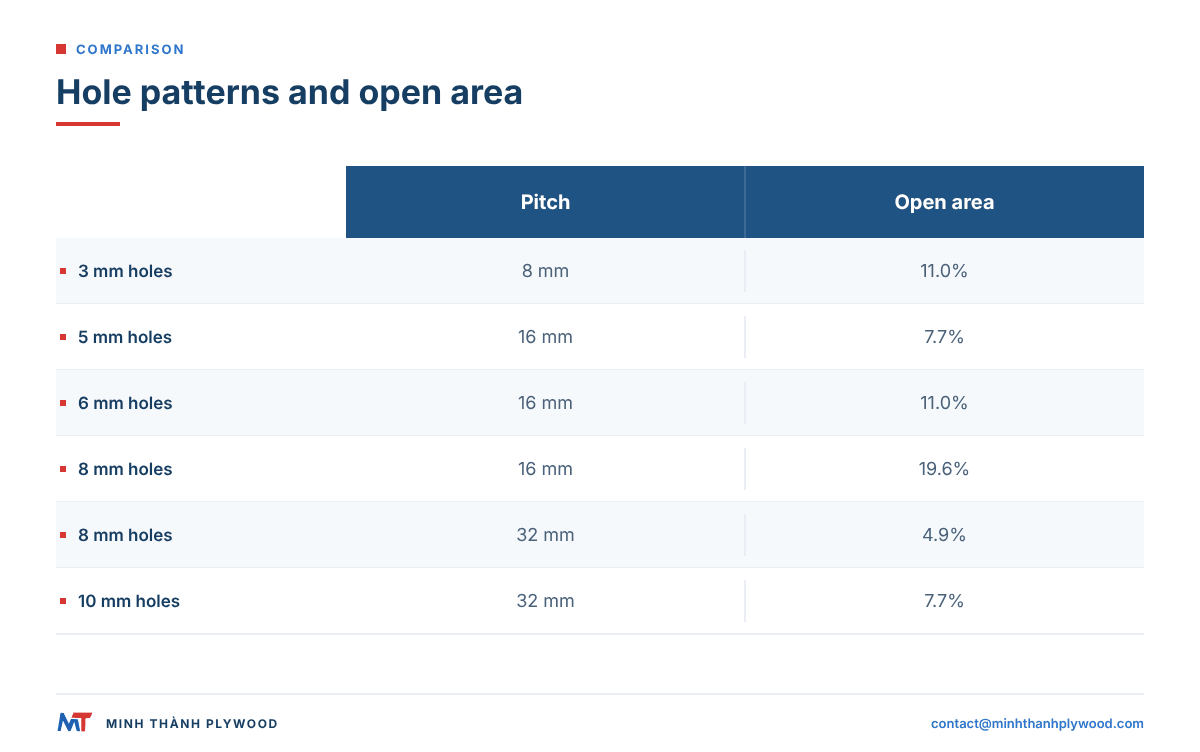
Standard hole patterns for perforated plywood are round holes of 3 to 10 mm on a square grid of 8 to 32 mm pitch. The open area follows from the two numbers: on a square grid, open area = π × d² ÷ (4 × pitch²).
| Hole diameter | Pitch (square grid) | Open area | Typical use |
|---|---|---|---|
| 3 mm | 8 mm | 11.0% | Micro-perforated look, fine texture close up |
| 5 mm | 16 mm | 7.7% | Offices, meeting rooms |
| 6 mm | 16 mm | 11.0% | Schools, open-plan offices |
| 8 mm | 16 mm | 19.6% | Auditoriums, sports halls, broad absorption |
| 8 mm | 32 mm | 4.9% | Decorative walls, bass control |
| 10 mm | 32 mm | 7.7% | Ceilings, large rooms seen from afar |
Patterns are also drilled on staggered (diagonal) grids, in bands with plain margins for fixing, or in slots instead of round holes. A plain border, usually left around the edge of each panel, gives room for screws and keeps the edge strong.
Hole count drives the drilling work. At 16 mm pitch, a full 1220 × 2440 mm sheet carries about 11,500 holes; at 32 mm pitch, about a quarter of that.
Open area, cavity and NRC
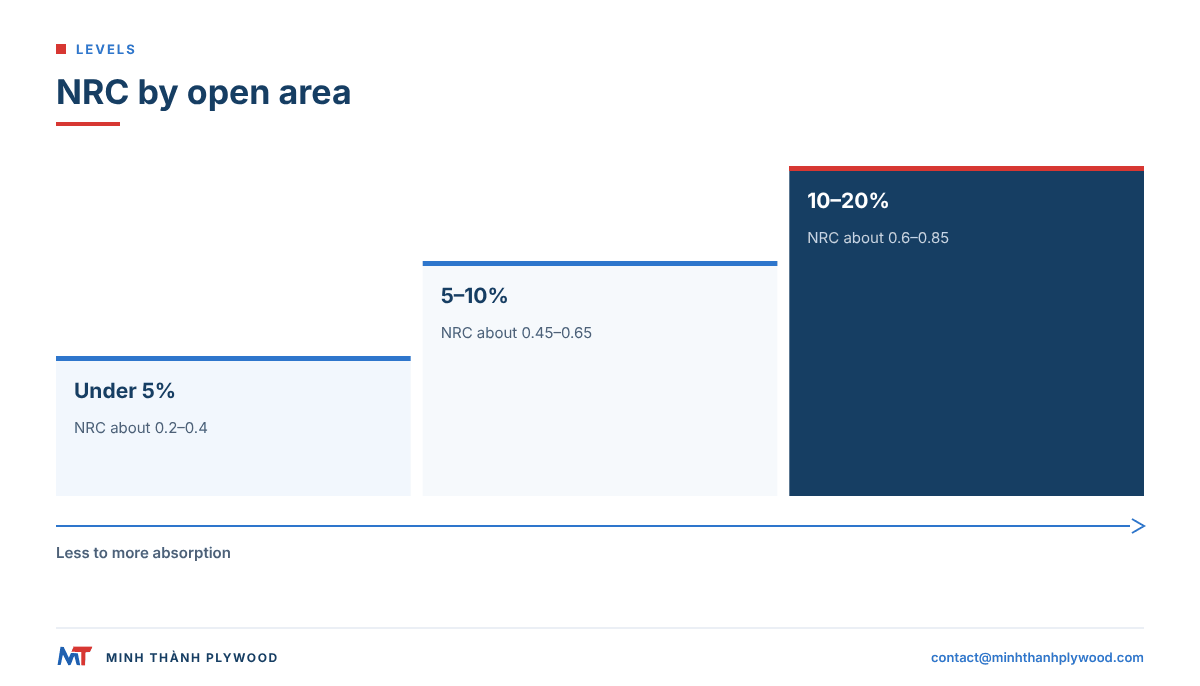
Open area sets how much sound reaches the absorber, cavity depth sets the frequencies, and the backing sets how much is absorbed. Built with acoustic fleece, mineral wool and a cavity, perforated wood panels usually reach a noise reduction coefficient (NRC) between 0.45 and 0.85.
| Open area | Absorption character, with fleece and mineral wool | Typical NRC range |
|---|---|---|
| Under 5% | Narrow band, mainly low frequencies; reflects mid and high | About 0.2–0.4 |
| 5–10% | Mid and low frequencies; good for speech rooms | About 0.45–0.65 |
| 10–20% | Broad absorption across speech frequencies | About 0.6–0.85 |
The ranges are a starting point for design; the project figure comes from an ISO 354 test of the exact build. Two habits move a build to the top of its range: a cavity of 50 mm or more, filled with mineral wool, and a fleece bonded flat to the whole back of the panel, so no hole opens onto bare air.
Perforated plywood sheet sizes and thickness
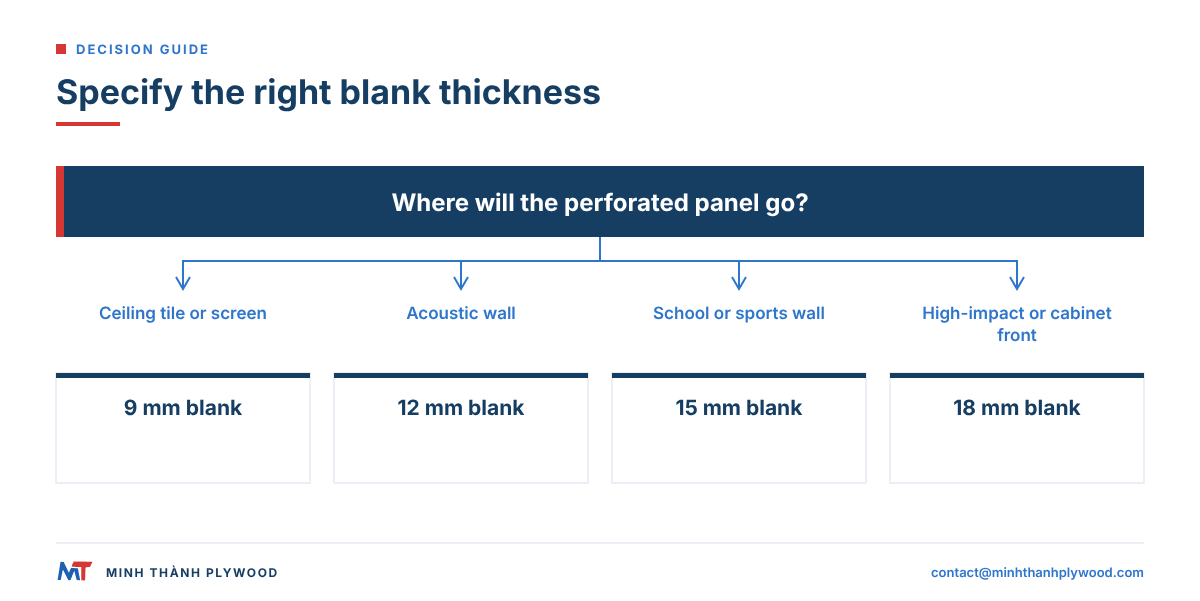
Perforated plywood sheets start from full panels of 1220 × 2440 mm or 1250 × 2500 mm, in 12, 15 or 18 mm for walls and 9 mm for ceiling tiles and screens. Panel makers cut them into the module of the project: full-height wall panels, ceiling tiles, or narrow planks.
- 12 mm: the common acoustic wall panel, light to fix and stiff between battens.
- 15 mm: walls in schools and sports halls that take knocks.
- 18 mm: high-impact zones, panels with deep edge profiles, cabinet fronts.
- 9 mm: ceiling tiles and suspended panels, where weight counts.
Custom sizes such as 1220 × 2500 mm suit taller rooms. A panel maker who cuts the same module all year saves sawing with cut-to-size supply: one panel cut into 4, 6 or 8 pieces before shipping. Thickness tolerance on sanded furniture panels is ±0.2–0.3 mm, down to ±0.2 mm, so the depth of every hole and every edge profile is the same across a wall.
Face options and finishes
Perforated plywood takes the face the room’s design asks for, and the face grade matters more than on most uses because the panel is seen at close range.
- Birch: pale, fine grain, the classic acoustic panel look under clear lacquer. Quoted as face/back pairs, D+/D for a show face.
- Poplar and EV (engineered veneer): even colour, ideal for stain or paint; EV gives the same look on every panel of a large job.
- Okoume: warm red-brown tone for design rooms.
- Pine: visible grain for informal spaces, quoted as A/A, A/B or B/B.
- Painted or laminated: any face, primed and painted after drilling, or laminated before drilling.
Minh Thanh faces are sanded and polished, and both faces are UV-ready to the standard a panel maker needs to apply its own UV lacquer after drilling. More than ten face veneers are offered, chosen for the look the buyer orders.
Perforated board vs perforated plywood vs slotted panels
Perforated board usually means pegboard: thin hardboard, about 3 to 6 mm, drilled at an even grid for hanging tools and shop displays. Perforated plywood is thicker veneer plywood drilled for sound or design. Slotted and grooved panels are the third family, where grooves on the face open into slots or holes behind.
| Perforated board (pegboard) | Perforated plywood | Slotted or grooved acoustic panel | |
|---|---|---|---|
| Material | Hardboard or thin MDF | Veneer plywood | Plywood or MDF, grooved face |
| Thickness | 3–6 mm | 9–18 mm | 12–18 mm |
| Main use | Tool walls, retail hooks | Acoustic walls and ceilings, screens | Acoustic walls with a linear look |
| Look | Small even holes | Round holes, wood face | Lines on the face |
| Acoustic backing | None | Fleece and mineral wool | Fleece and mineral wool |
For a linear look, our guide to grooved plywood panels covers V-groove and slotted faces. For tool walls in a workshop or garage, see plywood garage walls, which covers pegboard zones and French cleats.
Perforated plywood price: what drives the cost
The perforated plywood price is the price of the base panel plus drilling, backing, finishing and packing. The base panel is the most predictable part: furniture and interior plywood starts from US$350/m³ (indicative, October 2026), and the final panel price follows face, core, glue, thickness, size, quantity and delivery term. The other drivers are set by the design.
| Price driver | What raises it | What lowers it |
|---|---|---|
| Face | Birch D+/D show face, matched veneers | Poplar or EV under paint |
| Thickness | 18 mm | 12 mm where the wall allows |
| Hole count | Small pitch: about 11,500 holes per sheet at 16 mm | Wider pitch, hole bands instead of full field |
| Hole size | Micro-perforation, many small holes | Larger holes at wider pitch |
| Backing | Acoustic fleece bonded to every panel | Fleece in the cavity only, for decorative walls |
| Finish | Lacquer on both faces and in the holes | Factory UV lacquer before drilling, touch-up after |
| Edges and fixing | Profiled tongue-and-groove edges, hidden clips | Square edges, visible screws |
| Quantity | Small, mixed batch | Full container of one module |
A perforated plywood price quote is therefore asked for as a full specification, not per sheet. Buyers who import the blanks and drill locally pay the panel price per cubic metre and keep the drilling cost in their own plant.
Perforated plywood suppliers: what the blank panel decides
When choosing perforated plywood suppliers, check the blank panel first, because CNC drilling shows every flaw in it. A panel that is not flat lifts on the machine bed and the holes drift off the grid; a thickness that varies changes the depth of every edge profile; a core with gaps leaves half-holes and splits between holes.
The blank checks a panel maker writes into the order:
- Flatness. Furniture-grade panels are pressed twice: the core board is pressed and calibrated, then face and back are pressed on, which gives the flat panel CNC drilling needs.
- Thickness tolerance. ±0.2–0.3 mm on sanded furniture panels, down to ±0.2 mm.
- Closed core. Core layers stitched both horizontally and vertically, so drills meet veneer, not gaps.
- Moisture. Veneers and panels dried to 8–12 % moisture content at dispatch, so drilled panels stay flat on the wall.
- Face grade on both sides. A matched back where the panel can be seen from behind, such as screens and baffles.
- Cut-to-size. Panels cut to the module, one panel into 4, 6 or 8 pieces, to save sawing.
Minh Thanh Plywood supplies these blanks from Ha Hoa, Phu Tho, with a capacity of 50,000+ m³ per year, to panel makers who perforate and finish them in their own plants.
Fire and emission rules for acoustic panels
Acoustic wall and ceiling panels are building linings, so the building’s reaction-to-fire class applies to them: Euroclasses under EN 13501-1 in Europe, flame-spread classes under ASTM E84 in the US. The specifier sets the class by room, usually stricter in escape routes than in offices and classrooms, and the panel build is tested or classified to it.
The classes buyers meet most often:
| Market | Test and class | What it means for a plywood panel |
|---|---|---|
| UK and EU | BS EN 13501-1: B-s1,d0 or C-s2,d0 | Reached by fire-retardant (FR) treated plywood or a fire-rated lacquer; untreated plywood is usually class D |
| Australia and New Zealand | AS 5637.1 with AS ISO 9705, Group 1 to Group 3 | Group 3 is the common rating for untreated timber panels in rooms that allow it; Group 1 or 2 needs treatment |
| US | ASTM E84 flame spread | Class A, B or C by the building code for the room |
The class belongs to the finished build: face, lacquer, fleece and fixings. The blank can be supplied untreated for the panel maker to treat, or specified as FR-treated plywood by agreement, and the fire certificate is then taken on the panel maker’s finished build. Minh Thanh gives the glue and face data the test lab asks for.
Emission is the other rule, because acoustic panels cover large areas of a room’s surface. Minh Thanh furniture panels use UF glue at E0 emission and are certified to CARB P2 / TSCA Title VI under ICTT mill no. 23024, the proof European and US buyers accept. Six ASTM D6007 chamber tests, run between April 2025 and June 2026 on 9, 15 and 18 mm panels, averaged 0.014–0.032 ppm against the 0.05 ppm limit set by CARB and the US EPA.
In the EU, REACH Annex XVII entry 77 limits formaldehyde from furniture and wood-based articles to 0.062 mg/m³ from 6 August 2026, measured on the article. SGS tests to the buyer’s method, such as EN 717-1, on request.
How to install perforated plywood acoustic panels
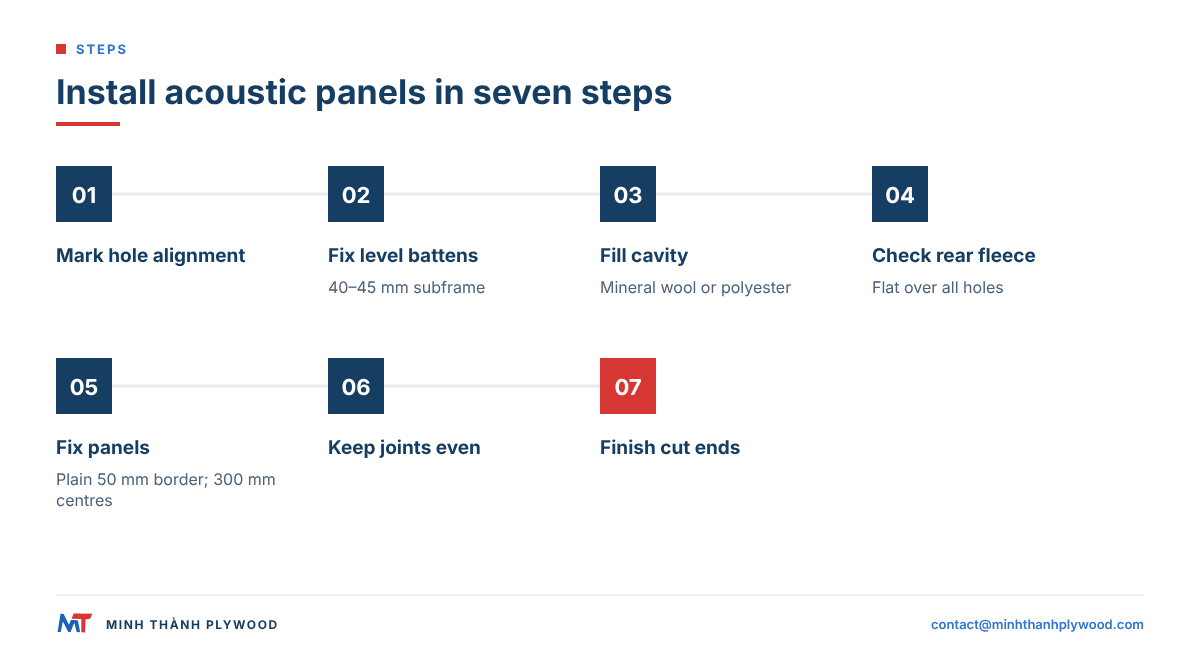
Perforated plywood acoustic panels are installed in seven steps, and the cavity is built before the first panel goes up:
- Mark the layout so hole fields line up from panel to panel and joints fall on battens.
- Fix battens to the wall at the cavity depth, level and in plane. A timber subframe of 40–45 mm, in CE-marked timber, is the usual build; split battens give a hidden fixing.
- Fill the cavity with mineral wool or polyester fibre between the battens.
- Check the fleece on the back of each panel: a black acoustic fleece of about 180 microns and 50 g/m², flame-retardant class B1, bonded flat with no folds over the holes.
- Fix the panels with a stainless screw and washer in a plain 50 mm border at 300 mm centres (24 fixings on the outer border of a full panel), or with a lost-head nail into the studwork at 300 mm centres for a clean face. Hidden clips and profiled edges are the alternatives.
- Keep the joints even, with the gap the panel maker specifies, so the hole grid reads as one surface.
- Finish cut ends and service openings with the face coating.
Specifiers match a tested build by its ISO 11654 class as well as NRC. The class comes from the weighted coefficient αw: A is 0.90 to 1.00, B is 0.80 to 0.85, C is 0.60 to 0.75 and D is 0.30 to 0.55. SPP in the UK publishes a class C result tested to ISO 354.
Ceilings follow the same order on a suspended grid or battens, and their cavity above can be deep, which helps low-frequency absorption.
Where perforated plywood is used
Perforated plywood is used wherever a room needs less echo and a wood surface:
- Schools and lecture halls, where speech has to carry without echo.
- Open-plan offices and meeting rooms, to cut noise between desks.
- Restaurants and cafés, where hard floors and glass make rooms loud.
- Sports halls and gyms, behind impact-resistant 15 or 18 mm panels.
- Cinemas, studios and home theatres, tuned with cavity depth.
- Retail and exhibition walls, where unbacked perforated panels serve as display walls.
The panel is one part of a wall system that also includes indoor linings and decorative panelling; our plywood wall panels guide covers the rest of that system.
What to write in your RFQ for perforated plywood blanks
An RFQ for perforated plywood blanks names the face, the thickness, the flatness and the module, so the mill quotes a panel ready for your CNC:
Use: blanks for perforated acoustic wall panels; 12 mm; face/back birch D+/D; Styrax core; UF glue at E0 emission, CARB P2 / TSCA Title VI; sanded, thickness ±0.2 mm; 1220 × 2440 mm, or cut-to-size into 4 pieces; 1×40HC CIF your port.
MOQ is one 40HC with mixed specifications by agreement. Lead time is production of 15–45 days after the 30% deposit plus sea freight to your port. A blank order lands in about the same window as the 4 to 10 weeks that Maxiply in Australia quotes for finished panels, and your drilling shop starts from stock. FSC-certified supply (pure or mixed-source) is available*; write it on the RFQ with the chain-of-custody code you need, as Australian project specifiers usually do. *Supplied directly or through qualified partner mills.
Minh Thanh sends free samples and replies within hours: contact@minhthanhplywood.com or WhatsApp +84 988 586 601. The cut-to-size plywood page lists the cutting options.
Buyer questions, answered
What is perforated plywood?
Perforated plywood is a plywood panel drilled with a regular grid of round holes. Over a cavity filled with sound-absorbing material it works as an acoustic panel; without backing it is a decorative screen or display board.
How do perforated plywood acoustic panels work?
Sound passes through the holes into the cavity behind, where the air in each hole resonates and a mineral wool or fleece backing turns the sound energy into heat. The holes, the open area and the cavity depth set which frequencies are absorbed.
What are the standard hole patterns for perforated plywood?
Common patterns are 8 mm holes at 16 mm or 32 mm pitch, 5 or 6 mm holes at 16 mm pitch, 10 mm holes at 32 mm pitch and micro-perforations of about 3 mm at 8 mm pitch, on a square grid.
What open area does an acoustic perforated panel need?
About 10–20% open area gives broad absorption when the panel has fleece and mineral wool behind it. Below 5% the panel absorbs a narrow band of low frequencies and reflects most mid and high sound.
What NRC does perforated plywood reach?
Built with fleece, mineral wool and a cavity, perforated wood panels usually reach NRC 0.45–0.85 depending on open area and cavity depth. Only a reverberation-room test to ISO 354 on the full build gives the figure for a project.
What thickness is perforated plywood?
Acoustic panels are usually 12, 15 or 18 mm. Thinner 9 mm sheets suit ceiling tiles and light screens, and 18 mm suits walls that take knocks.
How much does perforated plywood cost?
The price is the base panel plus drilling, backing and finish. Furniture plywood starts from US$350/m³ (indicative, October 2026); the hole count, face grade, fleece, coating and quantity add the rest.
Is perforated board the same as perforated plywood?
No. Perforated board usually means pegboard, a thin hardboard drilled at an even grid for hanging tools. Perforated plywood is thicker veneer plywood, used for acoustic panels, ceilings and design screens.
Can perforated plywood be used on ceilings?
Yes. Perforated plywood ceiling panels are hung on a grid or battens with backing above; ceilings often absorb more than walls because the cavity above can be deep.
Who makes the holes in perforated plywood?
Acoustic panel makers drill or bore the holes on CNC machines from flat, calibrated blank panels. Minh Thanh supplies those blanks, sanded and cut to size, ready for perforation.