
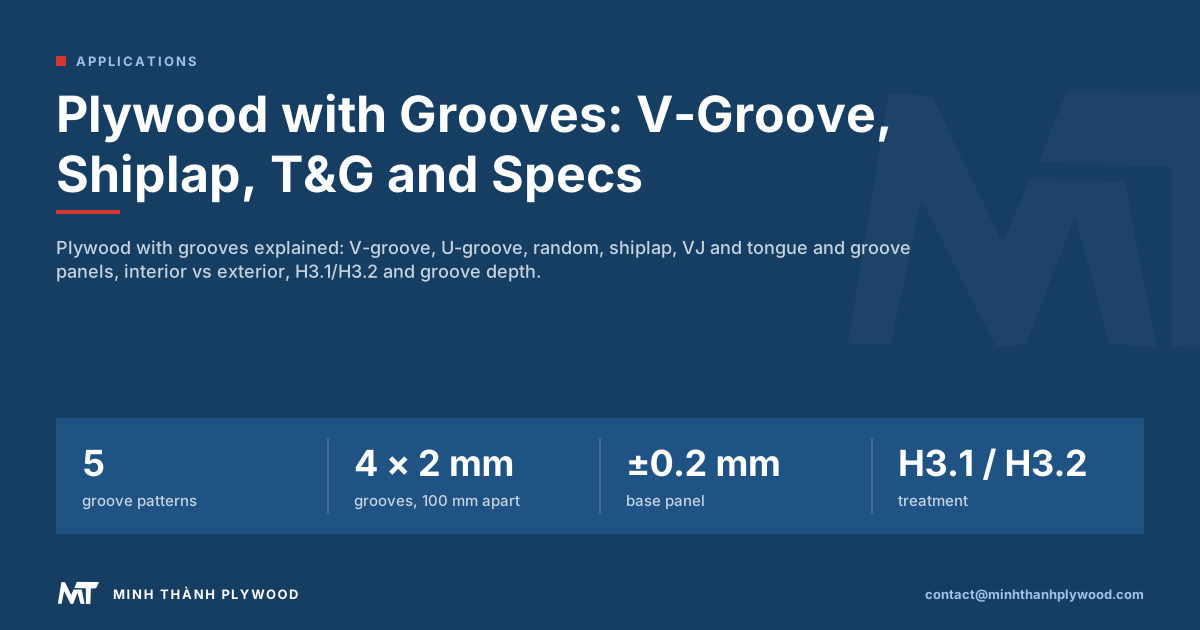
Plywood with grooves is a plywood sheet with shallow channels machined into its face, sold as grooved plywood, V-groove lining, shiplap or tongue and groove panels. The groove pattern sets the look; the panel under it decides whether the grooves stay crisp. Minh Thanh Plywood makes the flat, calibrated panels that panel shops groove, sanded to ±0.2 mm.
What is plywood with grooves called?
Plywood with grooves is called grooved plywood, V-groove plywood or V-groove lining, and the names point to the profile machined into its face. Shallow channels run along the sheet, so one panel looks like a wall of narrow boards while going up as quickly as a flat sheet.
Each market has its own word. New Zealand and Australia say V-groove lining or VJ (V-jointed) lining. North America says T1-11 for exterior siding with wide flat-bottomed grooves, and beadboard for small rounded profiles. The UK and Europe say grooved plywood, panelling or plywood shiplap when the edge overlaps. “Plywood with lines in it” is the same product described by its look.
What all of them share: a plywood base, a groove pattern, and an edge detail that hides the joint between sheets. The plywood wall panels guide covers flat and grooved panels for whole rooms.
Which groove patterns are there, and where is each used?
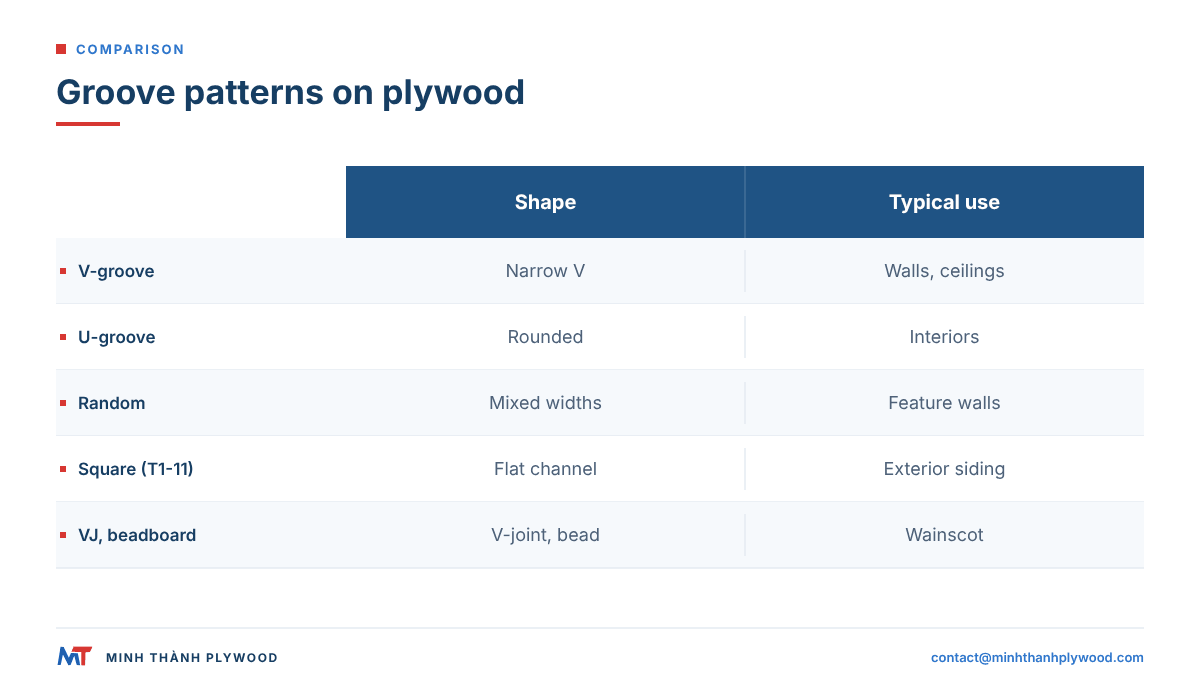
Five groove patterns cover most grooved plywood: V-groove, U-groove, random groove, kerfed or square groove, and the beaded VJ profile. They differ in shape, spacing and the look they give.
| Pattern | Groove shape | Spacing | Look | Typical use |
|---|---|---|---|---|
| V-groove | Narrow V, shallow | Even, often 100 mm | Classic boarded lining | Interior walls, ceilings, feature walls |
| U-groove | Rounded bottom | Even | Softer shadow line | Interiors, furniture backs |
| Random groove | V or square | Irregular | Like boards of mixed widths | Feature walls, retail interiors |
| Square groove (T1-11 style) | Flat-bottomed channel | 4 or 8 inches on centre in North America | Board-and-gap siding | Exterior siding, sheds, garages |
| VJ and beadboard | V-joint or small bead | Narrow | Cottage panelling | Wainscot, bathrooms, kitchens |
A common New Zealand V-groove lining, for example, has grooves 4 mm wide and 2 mm deep every 100 mm, on sheets of 2400 × 1200 mm and 2700 × 1200 mm in 9 or 12 mm, with tongue and groove edges (Woodmart product page, read 20 October 2026). The North American square-groove pattern is the T1-11 siding described by YellaWood’s T1-11 page.
Tongue and groove or plywood shiplap: which edge joins grooved sheets?
Grooved sheets join with one of three edge details: tongue and groove, shiplap, or a half-groove butt edge. The edge decides whether the joint between two sheets reads as one more groove or as a seam.
- Tongue and groove (T&G): a tongue on one long edge fits a groove on the next sheet. The joint is tight and locks the sheets in plane; used on lining and on floors.
- Shiplap: each edge is rebated so the sheets overlap. The overlap sheds water, which is why exterior tongue and groove panels and siding often use it.
- Half-groove edge: each edge carries half a groove, so two sheets butted together make a full groove and the joint disappears into the pattern.
A tongue and groove effect panel can also be made from a flat sheet with V-grooves and half-groove edges, with no tongue at all. Tongue and groove, VJ and beadboard panelling compares board panelling with plywood sheets.
How is grooved plywood made?
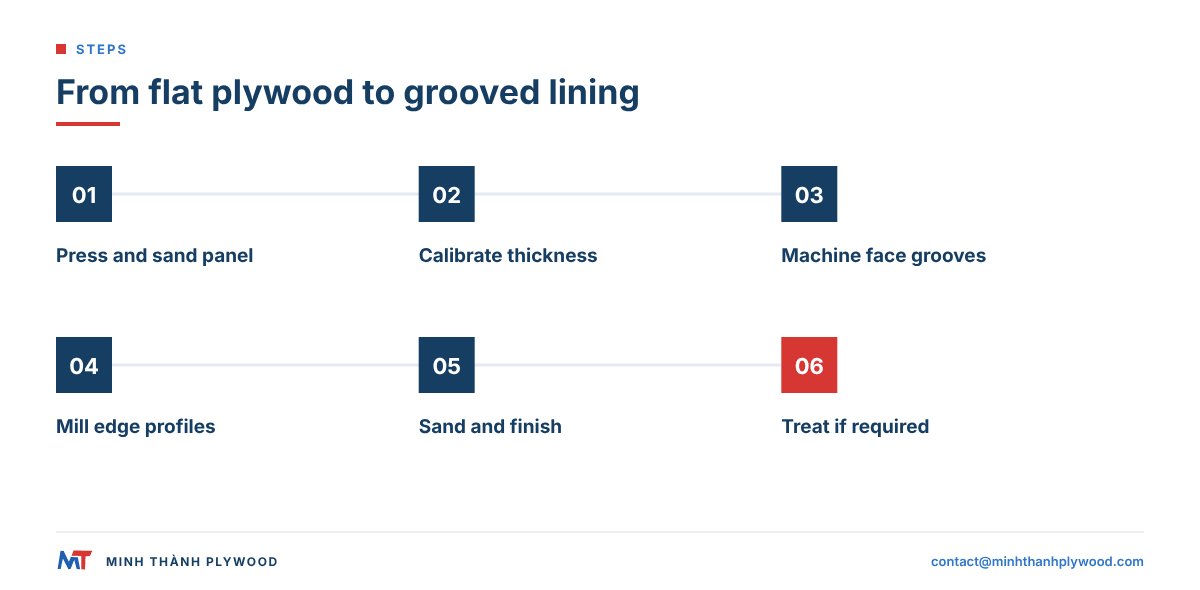
Grooved plywood is made by machining a flat, finished plywood panel: the grooves and edges are cut after pressing and sanding, not pressed in. The order of work is the same in any panel shop.
- Panel: a plywood sheet with a paint-grade or clear-finish face, pressed and sanded.
- Calibration: thickness brought to a tight tolerance, so every sheet runs through the machine at the same height.
- Grooving: a gang of cutters, a CNC router or a moulder cuts the grooves to a set depth and spacing.
- Edges: tongue, groove, shiplap or half-groove profiles milled on the long edges.
- Finish: sanded again, then primed, stained or left raw for site finishing.
- Treatment: for exterior lining in some markets, preservative treatment to the local hazard class.
Step 2 is where the base panel matters. Minh Thanh presses furniture-grade panels twice, calibrating the core board before the face and back go on, and sands them to ±0.2–0.3 mm, down to ±0.2 mm. A panel shop grooving those sheets sets the cutter depth once for the whole run.
How deep should the grooves be, and why does the ply build matter?
Grooves should be shallow enough to stay within the outer plies of the panel, so the sheet keeps its strength and the groove floor shows clean wood rather than a glue line or an open core joint. That is why V-groove lining is grooved only a couple of millimetres deep.
Three points for the specification:
- Face and cross-band: a groove that cuts through the face veneer exposes the cross-band below it; the cross-band must be sound and closed, or the groove floor shows gaps.
- Core quality: a core stitched horizontally and vertically, as at Minh Thanh, has closed joints, so a groove crossing the panel does not open onto a void.
- Thickness consistency: distinguish the cutter’s reference surface from the groove depth. A fixed depth from the face leaves less wood beneath the groove in a thinner panel; with a fixed cutter height above the bed, a thicker panel receives a deeper groove.
For deep or wide profiles, such as square-groove siding, use a thicker panel with more plies, so the remaining wood under the groove still carries the load.
Interior lining or exterior tongue and groove panels: which to choose?
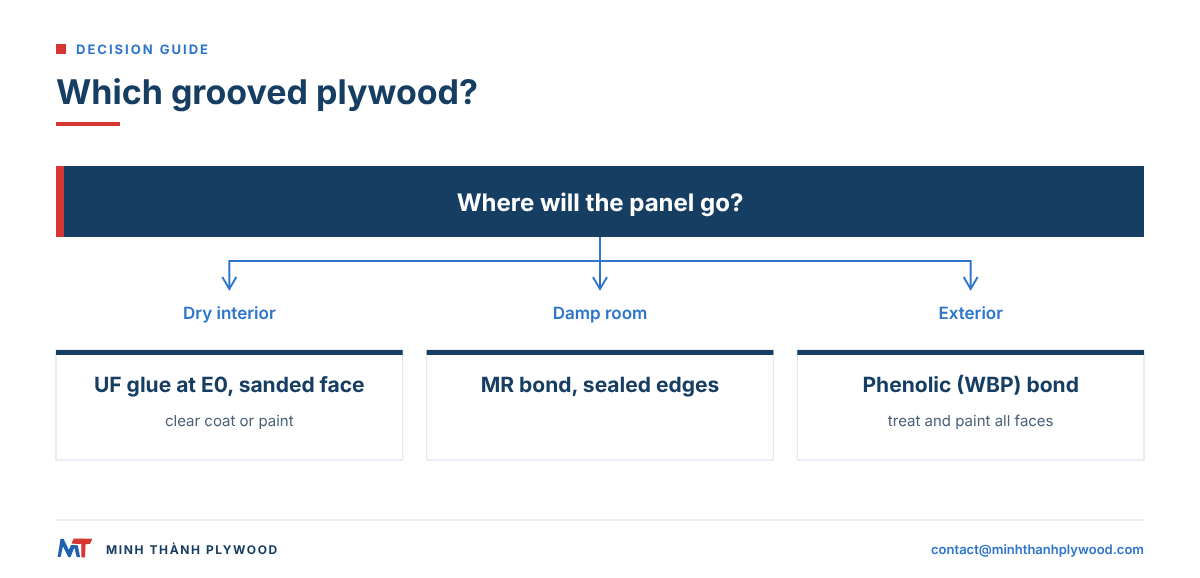
Use interior grooved plywood with UF or MR glue for dry rooms, and exterior grooved plywood with a phenolic (WBP) or melamine-fortified bond for anything exposed to weather. The face, the bond and the finish change together. BS EN 636:2012+A1:2015 covers plywood for dry, humid or exterior conditions.
| Point | Interior grooved lining | Exterior grooved panels and siding |
|---|---|---|
| Bond | UF glue at E0 emission; MR for damp rooms | Phenolic (WBP) or melamine-fortified |
| Face | Poplar, pine, birch, EV or okoume, sanded | Paint-grade face; utility C/D on cladding behind boards |
| Treatment | None in dry interiors | To the local hazard class where the code asks (H3.1 or H3.2 in New Zealand) |
| Finish | Clear coat, stain or paint | Primer on every face, groove and edge, then exterior paint |
| Typical uses | Walls, ceilings, wainscot, furniture backs | Siding, soffits, sheds, garages |
Exterior and CDX-type plywood from Minh Thanh uses low-grade faces with water-resistant melamine-fortified or phenolic (WBP) glue, for outdoor uses such as stair treads and wall sheathing. See exterior plywood. For bathrooms, plywood panels for bathrooms covers moisture in detail.
What do H3.1 and H3.2 mean for grooved plywood in New Zealand?
H3.1 and H3.2 are New Zealand hazard classes for treated timber used above ground: H3.1 covers painted, non-structural exterior uses such as linings and cladding, and H3.2 covers more demanding exposure, including structural uses above ground. Grooved exterior lining in New Zealand is commonly sold as H3.1, often LOSP-treated, while H3.2 plywood is usually CCA-treated.
The treatment is applied by the panel maker or a treatment plant in the buyer’s market to the New Zealand treatment standard NZS 3640, and BRANZ advises painting H3.1 timber on all faces and cut ends. BRANZ guidance on treated timber explains where each class is used.
For an importer, the hazard class is a local specification. Untreated grooved lining is sold for internal dry use only; a panel meant for H3.1 or H3.2 treatment needs a bond that survives the treatment and the weather, so order the base panel with a phenolic (WBP) or melamine-fortified bond.
Which face suits grooved plywood?
The best face for grooved plywood depends on the finish: poplar for paint, pine or birch for a clear wood look, and engineered veneer (EV) or okoume for a decorative tone. Every groove cuts through the face, so the veneer must be sound along the whole length.
- Poplar: smooth and even, the usual paint-grade face; quoted as A/A, A/B or B/B.
- Pine: the classic boarded look under a clear coat; A/A, A/B, B/B, and B/C for utility parts.
- Birch: a pale, fine face for clear-coated interiors; D+/D or D/E, D+ close to European B.
- EV and okoume: uniform colour for feature walls and shop interiors.
- Utility C/D: for exterior cladding that is painted or covered.
Grooves show the face grade more than a flat sheet does, because the eye follows each line. Fix the face grade with an approved sample before the panels are grooved.
What thickness and size should grooved plywood be?
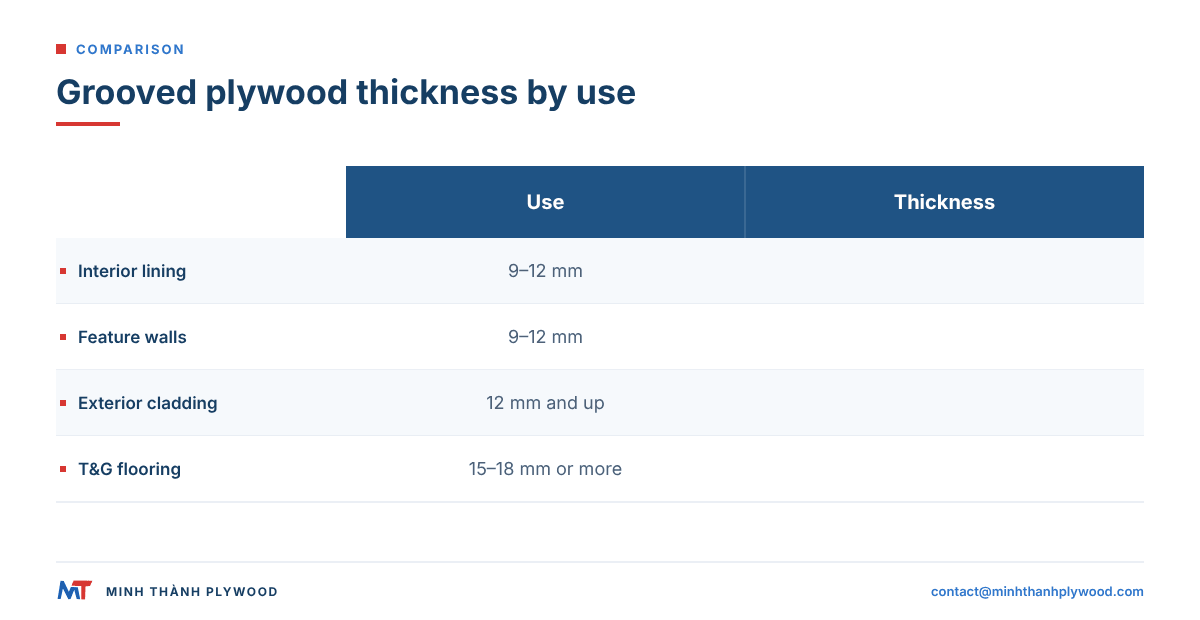
Grooved interior lining is usually 9 or 12 mm, exterior grooved cladding thicker, and tongue and groove plywood flooring 15–18 mm or more, depending on the joist spacing set by the local building code.
| Use | Common thickness | Notes |
|---|---|---|
| Interior wall and ceiling lining | 9–12 mm | Fixed to studs or battens |
| Feature walls and wainscot | 9–12 mm | Thinner where glued to a wall |
| Exterior cladding and siding | 12 mm and up | Bond and treatment to the local code |
| Tongue and groove flooring | 15–18 mm or more | Span set by the joist spacing |
Base panels come in 1220 × 2440 mm and 1250 × 2500 mm, plus custom sizes such as 1220 × 2500 and 1220 × 2280 mm. Markets that sell 2400 × 1200 or 2700 × 1200 mm lining usually trim and groove a larger base sheet.
Is tongue and groove plywood good for floors?
Tongue and groove plywood is good for floors when the panel is rated for the span and the bond suits the site. The tongue and groove edge locks the sheets so they deflect together under a load between joists, which stops squeaks and step-downs at the joints.
Floor sheets differ from grooved wall lining: they have no face grooves, they are thicker, and in North America they are structural panels rated under PS 1-22 (NIST, October 2023) or PS 2. Buyers who search for tongue and groove plywood flooring or subfloor want that structural product, not a decorative V-groove panel. Glue the joints and the joists, and leave the expansion gap the panel maker sets.
How do you install tongue and groove or V-groove plywood?
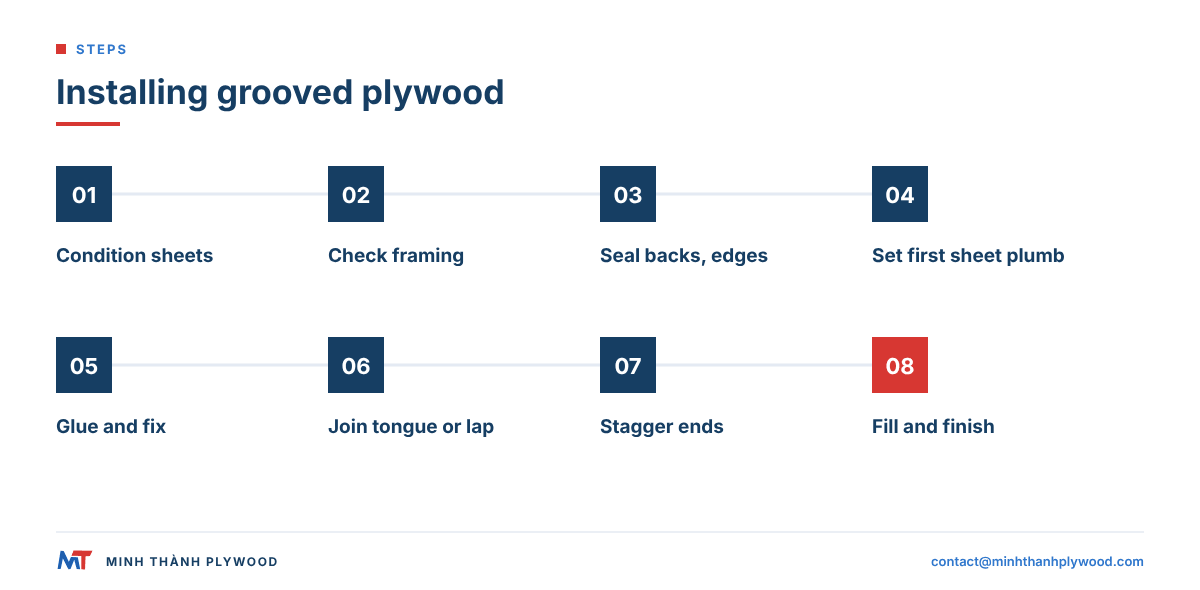
Install grooved plywood in eight steps, the same for wall lining and ceilings.
- Condition: keep the sheets dry and flat in the room for a few days.
- Frame: check studs or battens are straight and at the spacing the sheet needs.
- Seal: prime the back and edges of exterior or bathroom sheets before fixing.
- Start: set the first sheet plumb, groove edge to the corner.
- Fix: glue to the frame and nail or screw through the grooves, where the heads hide.
- Join: slide each next sheet’s tongue or shiplap edge into place, leaving the gap the profile allows.
- Ends: stagger end joints or cover them with a trim.
- Finish: fill nail holes, then paint or clear-coat, working the brush along the grooves.
On ceilings, run the grooves along the longest view of the room. Plywood for ceilings covers fixing and finishes overhead.
What should you check on grooved plywood when it arrives?
Check grooved plywood on arrival for four things: groove depth, edge fit, face and flatness.
- Groove depth: measure several grooves on sheets from different packs; depth should be even within and between sheets.
- Edge fit: dry-fit two sheets; the tongue or shiplap should close without force or a visible gap.
- Face: compare with the approved sample; check that grooves show no open joints or glue lines at their floor.
- Flatness and moisture: lay a straight edge across the sheet and read moisture; panels should be dry and flat before fixing.
For base panels bought to groove in your own shop, run the same checks on thickness and moisture before machining: Minh Thanh panels leave at 8–12 % moisture content, and every container is photographed and filmed before loading.
What this means for your order
If your plant or panel shop machines its own grooved plywood, the order that matters is the base panel: a calibrated, sanded sheet with a sound face, a closed core and the bond the end use needs. For interior panels sold in the US, the EPA’s TSCA Title VI guidance sets the formaldehyde emission limit for veneer-core hardwood plywood at 0.05 ppm.
Base panel for V-groove lining · 12 mm · white Styrax core, stitched, pressed twice · UF glue at E0 emission, or phenolic (WBP) for exterior · poplar face A/B, sanded · 1220 × 2440 mm · ±0.2 mm · export packs · 1 × 40HC, FOB Hai Phong.
Minh Thanh’s minimum order is one 40HC with mixed specifications by agreement, so 9 mm and 12 mm base panels, or interior and exterior bonds, can share a container. Production runs 15–45 days after the 30% deposit, and samples are free. Interior panels carry UF glue at E0 emission with CARB P2 / TSCA Title VI certification as ICTT mill no. 23024. Send the specification to [email protected], or see furniture plywood from Vietnam for the full build.
Buyer questions, answered
What is the plywood that has grooves in it called?
It is called grooved plywood, V-groove plywood or V-groove lining; with wide flat-bottomed channels it is T1-11 siding in North America, and with overlapping edges it is plywood shiplap.
What is the plywood with lines in it called?
Plywood with lines is grooved or V-groove plywood. The lines are machined grooves that imitate separate boards, so a single sheet looks like a wall of narrow planks.
What is tongue and groove plywood?
Tongue and groove plywood has a tongue machined on one long edge and a groove on the other, so sheets lock together. It is used for floors and for wall lining without visible joints.
Is grooved plywood suitable for exterior use?
Only when the panel is built for it: an exterior bond such as phenolic (WBP), a face that takes paint, treatment where the local code asks for it, and every face, groove and cut edge sealed.
What do H3.1 and H3.2 mean on grooved plywood in New Zealand?
They are New Zealand hazard classes for treated timber above ground. H3.1 suits painted, non-structural exterior uses such as lining and cladding; H3.2 covers more demanding exposure.
How deep are the grooves in V-groove plywood?
Shallow. A common New Zealand lining has grooves 4 mm wide and 2 mm deep at 100 mm centres on a 9 mm sheet, so the groove stays in the outer plies.
What thickness is grooved plywood?
Interior lining is usually 9 or 12 mm, exterior cladding thicker, and tongue and groove flooring 15–18 mm or more, depending on the joist spacing.
How do you install tongue and groove plywood?
Fix framing or battens, start with the groove edge against the first wall, glue and nail or screw the first sheet, slide the tongue of each next sheet into the groove, and stagger the end joints.
How do you make tongue and groove plywood?
Mill a tongue on one edge and a matching groove on the other with a shaper, router table or CNC, using a calibrated panel so the tongue fits every sheet.
Is grooved plywood the same as shiplap?
No. Grooves are cut into the face; shiplap is a rebated edge that overlaps the next sheet. Many panels combine both: grooves in the face and a shiplap or tongue edge.
Can grooved plywood be painted?
Yes. Prime all faces, the grooves and the cut edges before painting; a paint-grade face such as poplar takes paint evenly.
Why does panel thickness tolerance matter for grooved plywood?
With cutters set relative to the machine bed, panel thickness variation changes groove depth. A cutter referenced to the face holds its depth from that surface instead. Panels calibrated to ±0.2 mm help keep profiles and edge joints consistent.