
Plastic coated plywood is plywood coated with a bonded plastic or resin layer, such as polypropylene (PP), PVC or vinyl, glass-fibre reinforced plastic (FRP), polyester or phenolic film, that makes the face hard-wearing, washable and water resistant. The right coating follows the job: formwork, trailer floors, hygienic walls or furniture. Minh Thanh Plywood compares each one below.
What do coated plywood sheets cost in the UK, and in what sizes?
In the UK, coated plywood is sold mostly as phenolic film faced birch or hardwood in 2440 × 1220 mm (8 × 4 ft) sheets, and an 18 mm sheet costs about £87-128 ex VAT. Smaller cut sheets, such as 1220 × 940 mm, and plain brown or black film are cheaper; fire-rated or anti-slip mesh film costs more.
| UK coated plywood (2024-2026 listings) | Size | Thickness | Indicative price |
|---|---|---|---|
| Birch core, brown anti-slip mesh phenolic film | 2440 × 1220 mm | 18 mm | £87.46 ex VAT, £104.95 inc VAT per sheet (pack of 35) |
| Same board, fire-retardant Euroclass B | 2440 × 1220 mm | 18 mm | £125.38 ex VAT per sheet |
| Birch, smooth black phenolic film | 2440 × 1220 mm | 18 mm | about £103-128 per sheet (Penn Elcom) |
| Brown coated birch core | cut pieces and sizes | various | Gards lists £3.54-41.64 inc VAT across its coated range (cut pieces and smaller sizes), cutting at £0.60 per cut |
| Phenolic birch | 1220 × 940 mm | 18 mm | Ilkeston Ply, live pricing by branch |
| Phenolic mixed hardwood | 2440 × 1220 mm | 12-18 mm | Ilkeston Ply, live pricing by branch |
UK film-faced birch tops out at 1500 × 3000 mm, the maximum at HM Wood Shop, with 5-8 working days delivery. Buyers pick smooth film on both sides for concrete forms and shopfitting, and mesh film on one side for floors and ramps.
Importer view. An importer who lands 18 mm coated sheets from Vietnam works from a raw FOB example: furniture-grade plywood from US$350/m³ means an 18 mm 2440 × 1220 mm sheet starts near US$18.8 before the film, freight and duty, so the margin against the UK shelf price above is wide. Film, mesh and colour are quoted on top of the base panel on order.
What is plastic coated plywood (plastic coated ply)?
Plastic coated plywood is a plywood panel with a plastic or resin layer bonded to one or both faces, so that the face resists water, abrasion and chemicals and wipes clean. The plywood gives the stiffness and screw holding; the coating gives the wear surface.
The trade uses many names for the same idea:
- By the material: plastic coated ply, PP plywood, PVC or vinyl faced plywood, FRP or GRP plywood, polyester plywood (“poly ply”), aluminium faced plywood.
- By the method: overlaid plywood, faced plywood, laminated plywood, covered plywood.
- By the use: formwork plywood, trailer floor plywood, hygienic panels.
“Film faced plywood” sits in the same family. Its phenolic film is a paper soaked in phenolic resin, not a thermoplastic, but buyers often count it as coated plywood because it does the same job.
What coatings can plywood have?
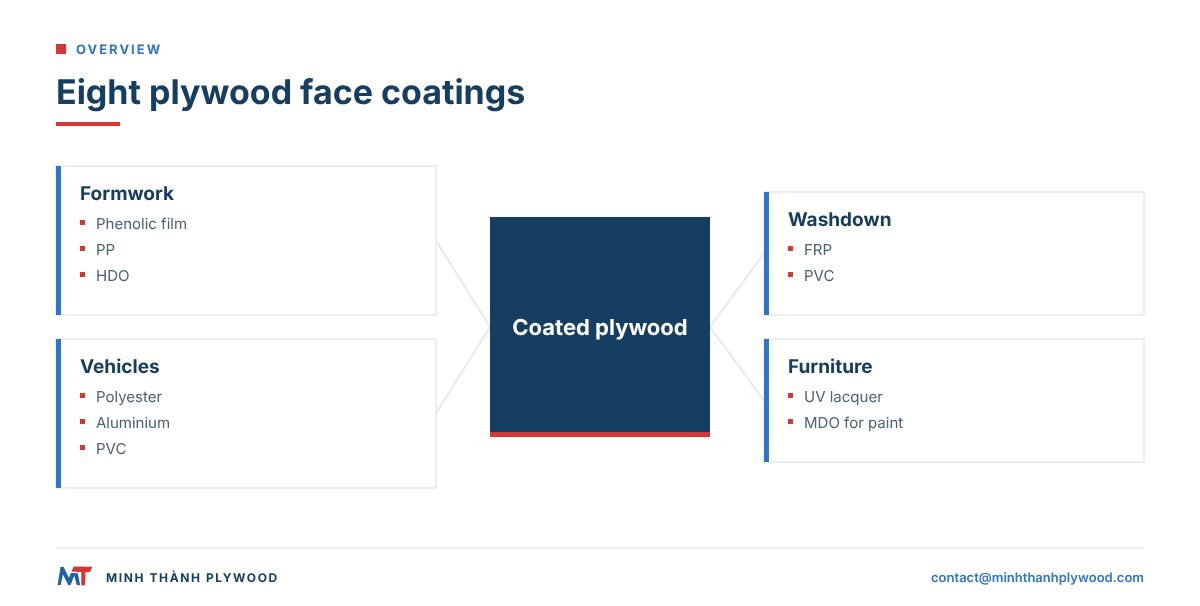
Plywood can be coated with eight main types of layer, and each one suits a different job.
| Coating | What it is | Best uses | Reuse or wear | Cleaning | Slip | Relative cost |
|---|---|---|---|---|---|---|
| Phenolic film | Resin-impregnated paper, hot-pressed | Concrete formwork, packaging | Many pours with care | Good | Smooth, or mesh-embossed anti-slip | Low |
| PP (polypropylene) | Thermoplastic sheet, bonded with heat | Premium formwork, vehicle linings | Most pours of any face; repairable | Very good | Smooth or textured | Medium to high |
| PVC or vinyl | Flexible or rigid PVC sheet or foil | Van linings, wall cladding, furniture, displays | Good surface wear | Very good | Smooth | Medium |
| FRP or GRP | Glass-fibre reinforced plastic sheet | Truck bodies, refrigerated vans, cold rooms, hygienic walls | Very high impact and wear resistance | Excellent | Smooth or gritted | High |
| Polyester (poly ply) | Polyester resin overlay, often grey embossed | Trailer floors, shop fitting, packaging | Good | Good | Embossed | Medium |
| Aluminium | Thin aluminium sheet bonded to the face | Trailer and truck sides, signs, special fittings | High | Good | Smooth or tread pattern | High |
| HDO or MDO | High or medium density resin overlay | HDO: formwork; MDO: signs and paint work | HDO high; MDO for paint | Good | Smooth | Medium |
| UV lacquer | Clear or coloured lacquer cured by UV lamps | Furniture, shelving, interior panels | Furniture wear | Good | Smooth | Medium |
Melamine paper and high-pressure laminate (HPL) are the decorative members of the family; our sibling guide laminated plywood compares them in detail.
How do you choose a coating for your use?
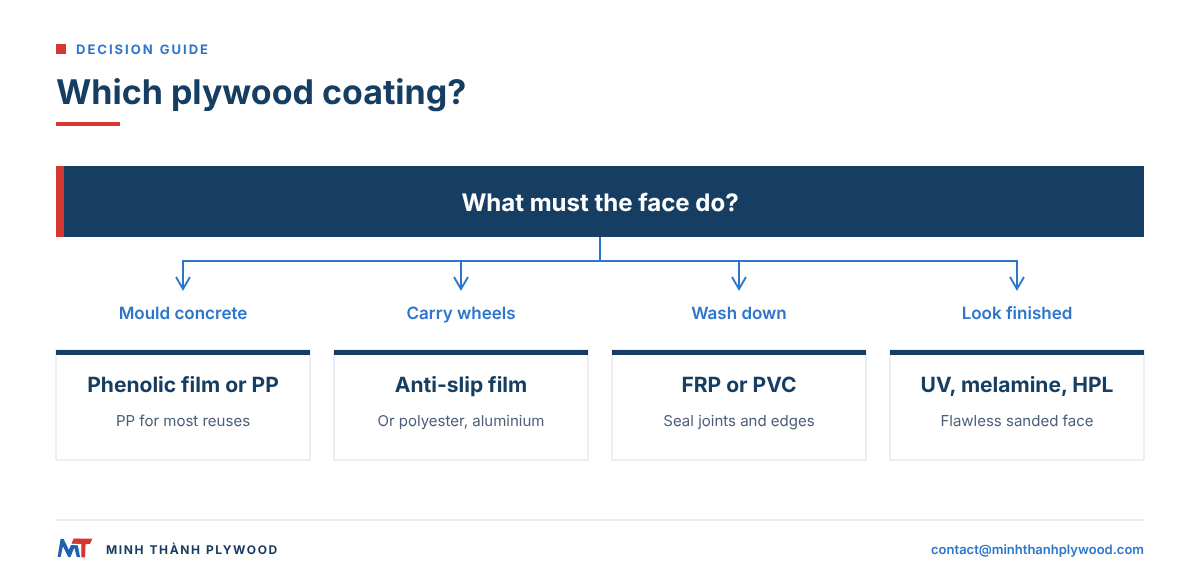
Choose the coating from the job the face must do, then the panel underneath from the load and the exposure.
- Concrete formwork: phenolic film for most sites; PP when you need the most reuses or a very smooth concrete finish.
- Trailer, truck and van floors: phenolic film with a mesh-embossed anti-slip face, or polyester or aluminium where impact is heavy.
- Van and truck linings: PP or PVC, light and washable.
- Cold rooms, refrigerated bodies and washable walls: FRP, which takes cleaning chemicals and impact.
- Signs and painted work: MDO, which takes paint without showing the wood grain.
- Furniture and shelving: UV lacquer, melamine or HPL, chosen for the look and the wear.
Then fix the base: core species, thickness, bond (an exterior phenolic bond wherever the panel can get wet) and tolerance. A coated face on a weak or gappy core still fails at the edges and fixings.
Which coated plywood is best for concrete formwork?
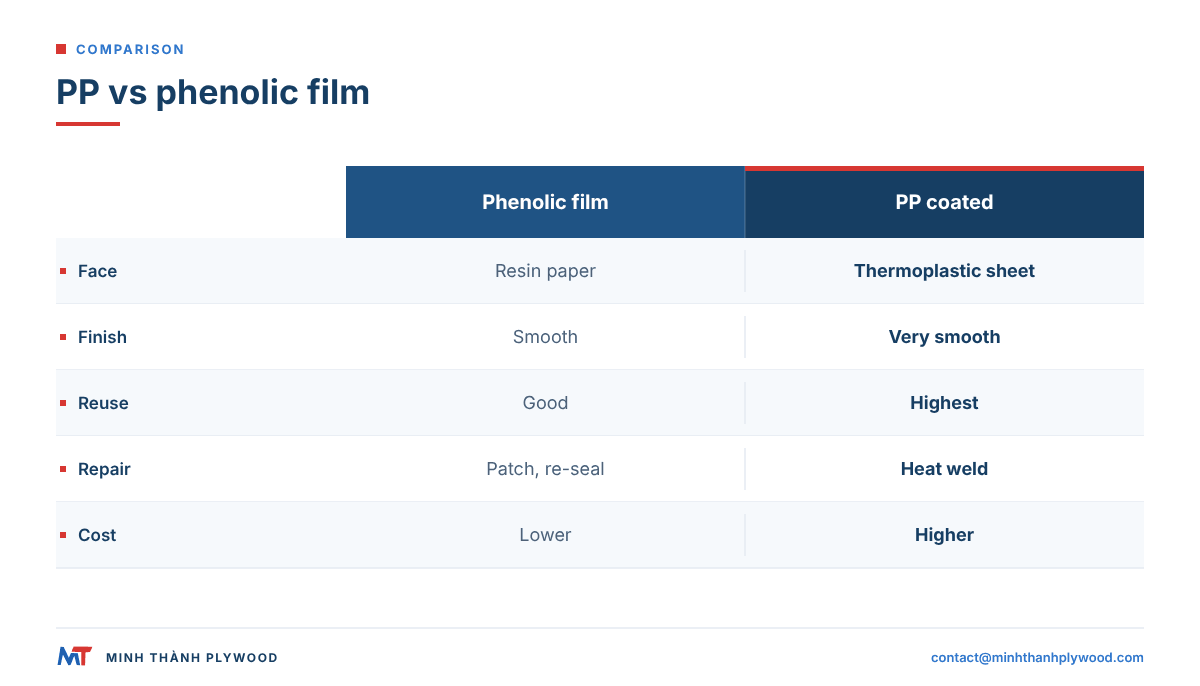
Phenolic film faced plywood is the standard formwork panel, and PP coated plywood is the premium choice where more reuses or a finer concrete surface are needed.
| Formwork question | Phenolic film faced | PP coated |
|---|---|---|
| Face | Resin-impregnated paper | Thermoplastic polypropylene sheet |
| Concrete finish | Smooth | Very smooth, less pattern from the face |
| Reuse | Good, with release agent and sealed edges | Highest of the coated faces |
| Repair | Patch and re-seal | Scratches and holes can be welded with heat |
| Cost per sheet | Lower | Higher |
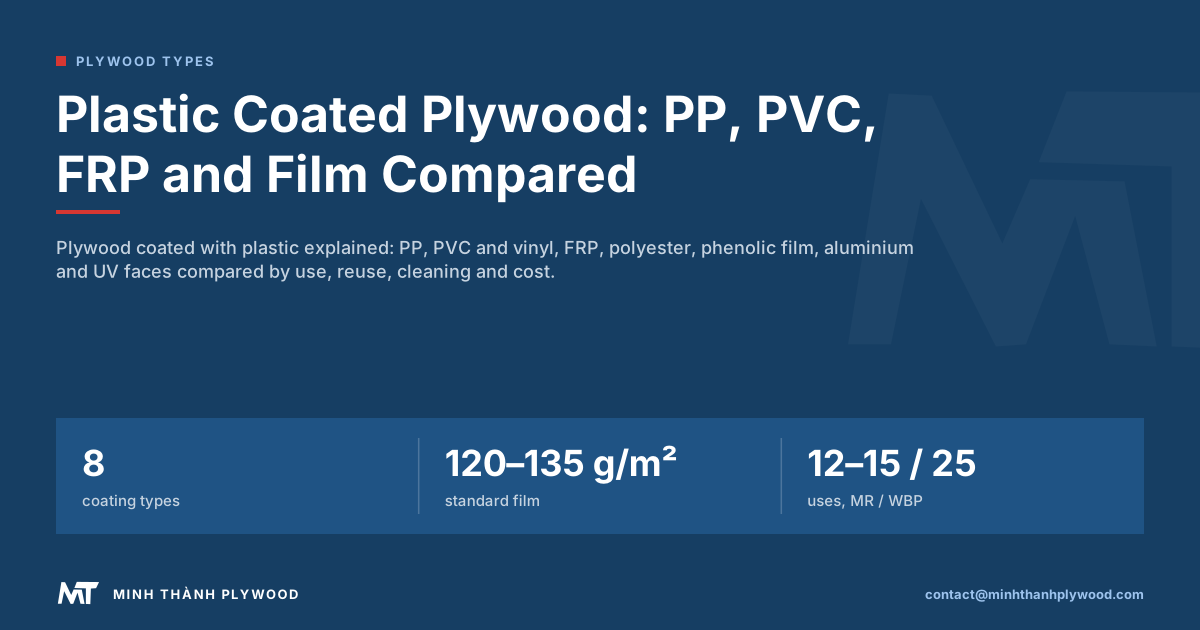
Minh Thanh’s film faced plywood uses 120–135 g/m² standard film or premium film from 135 g/m², on Eucalyptus or Acacia cores with melamine-fortified or phenolic WBP glue, 12–21 mm thick at ±0.5 mm. With proper handling, release agent and edge sealing, melamine-fortified panels give about 12–15 uses and phenolic WBP panels up to about 25.
The sibling guide on concrete form plywood covers grades, edge sealing and site care.
Which coated plywood suits trailer floors and vehicle linings?
Trailer and truck floors use phenolic film with a mesh-embossed anti-slip face, or polyester and aluminium faces where impact is heavy; van and truck linings use PP, PVC or FRP, which are light and washable.
- Floors: the anti-slip face is a wire-mesh pattern pressed into the film; the core must be dense and the bond exterior, because floors take wheel loads from pallet trucks and forklifts.
- Linings: a thin plywood with a PP or PVC face keeps weight down and wipes clean.
- Refrigerated bodies: FRP faces over plywood or foam cores resist cleaning chemicals and impact.
Minh Thanh makes anti-slip plywood on order. Our guide to plywood for trailer and truck floors explains core, thickness and face choices for vehicle floors.
Which coated plywood is used for hygienic walls and cold rooms?
FRP coated plywood is the usual choice for hygienic walls, cold rooms and washdown areas, because the glass-fibre reinforced face is hard, smooth and resists the cleaning chemicals used in those rooms. PVC faced panels serve lighter-duty washable walls.
What to specify:
- Face material and finish: smooth FRP for walls, gritted FRP for floors.
- Colour: usually white for hygienic rooms.
- Joints and edges: sealed joint profiles, so water and dirt cannot reach the wood.
- Base panel: an exterior phenolic bond, because cleaning water reaches every joint over time.
The coating does not change the fact that the edges are wood. Factory-sealed edges and sealed joints decide how long a hygienic wall lasts.
What is UV coated plywood?
UV coated plywood is plywood with a lacquer rolled onto the face and cured in seconds under ultraviolet (UV) lamps, which gives a hard, clear or coloured, ready-finished surface. It is used mostly for furniture, shelving, children’s furniture and interior panels, and most often on birch.
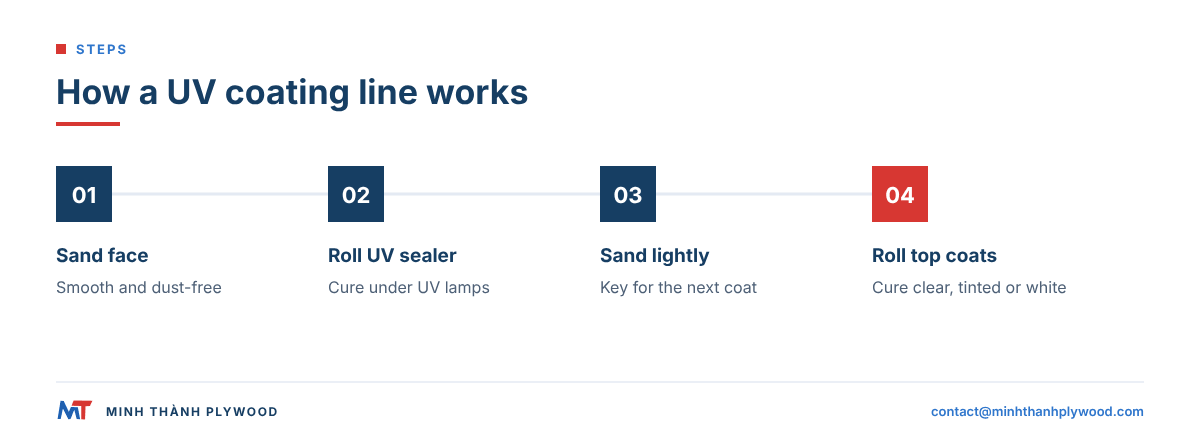
How a UV line works:
- Sanding: the panel face is sanded smooth and dust-free.
- Sealer coat: a UV sealer is rolled on and cured.
- Sanding between coats: a light sanding gives the next coat a key.
- Top coats: one or more top coats are rolled on and cured, in a clear, tinted or white finish.
The face quality decides the result: every scratch, glue spot or open joint shows through a clear UV coat. That is why buyers who run their own UV lines order plywood with smooth, sanded faces and tight thickness tolerance.
Can you paint UV coated plywood?
Yes, but only after preparation, because cured UV lacquer is hard, smooth and chemically closed, and paint does not grip it well.
- Scuff-sand the whole face with fine sandpaper until the gloss is dull.
- Clean off the dust with a damp cloth and let it dry.
- Prime with an adhesion primer made for glossy or lacquered surfaces.
- Paint with two coats of your chosen finish.
Test on an offcut first. For any project that will be painted, order uncoated, sanded plywood: it saves the sanding and gives a better bond.
Is birch plywood UV coated?
Not as standard. Most birch plywood is sold sanded and uncoated, and UV coated birch is a separate prefinished product, coated on one or both faces by the mill or by a finishing plant.
Buyers ask for UV coated birch for furniture that goes straight to assembly: wardrobes, shelving, children’s furniture and shop fittings. The face grade matters more under a clear UV coat than under paint. Minh Thanh’s birch faces are named D+, D and E in Vietnam and quoted as face/back pairs such as D+/D or D/E; individual D+ is comparable to European B grade, D to BB and E to CP/C.
Minh Thanh’s birch plywood is sanded and polished with both faces UV-ready, to the standard customers need to apply their own UV coating.
Can covered plywood be used outdoors?
Yes, when the base panel has an exterior bond and the edges are sealed. The plastic face itself is waterproof; the weak points are the glue lines, the cut edges and the holes.
- Bond: phenolic WBP for outdoor and wet use; melamine-fortified for covered and humid use.
- Edges: seal every cut with edge paint or sealant on the day it is cut.
- Holes and fixings: seal drilled holes, and use stainless or coated fixings.
- Sunlight: some plastics fade or chalk in sun; check the coating’s UV stability for exposed outdoor faces.
Coated faces on interior-glued plywood fail outdoors from the edges inward, however good the plastic is.
What should a UK buyer check before importing coated plywood?
A UK buyer importing coated plywood checks four things: the bond class to EN 636-3 for exterior use, the CE or UKCA marking to EN 13986 where the panel goes into a building, UK Timber Regulation due diligence, and the landed cost with duty and VAT.
- Standard. EN 636-3 is the exterior-use class that UK specifiers name for film faced and coated panels; ask for the test report with the quote.
- Marking. Panels used structurally or in construction need the construction-products mark to EN 13986 for the Great Britain market.
- Timber due diligence. Under the UK Timber Regulation, the importer is the operator and must run a due diligence system for every import, with no volume threshold. Enforcement has focused on birch plywood and Russian-origin veneer, so ask for origin records; Minh Thanh supplies origin records and geolocation files with orders.
- Duty and VAT. Third-country duty on plywood is 6% for most hardwood- and softwood-faced sheets and 10% where the face is tropical wood other than okoume, plus 20% VAT; Vietnam-origin goods enter at 0% under the UK-Vietnam trade agreement with proof of origin.
From Hai Phong, transit to a UK port is about 30-40 days at sea, with production 15–45 days after the 30% deposit. UK buyers who cut their own sheets order 2440 × 1220 mm, or 1220 × 2500 mm as a custom size, and buy sanded base panels to laminate locally for custom colours.
What should you send to get a coated plywood quote?
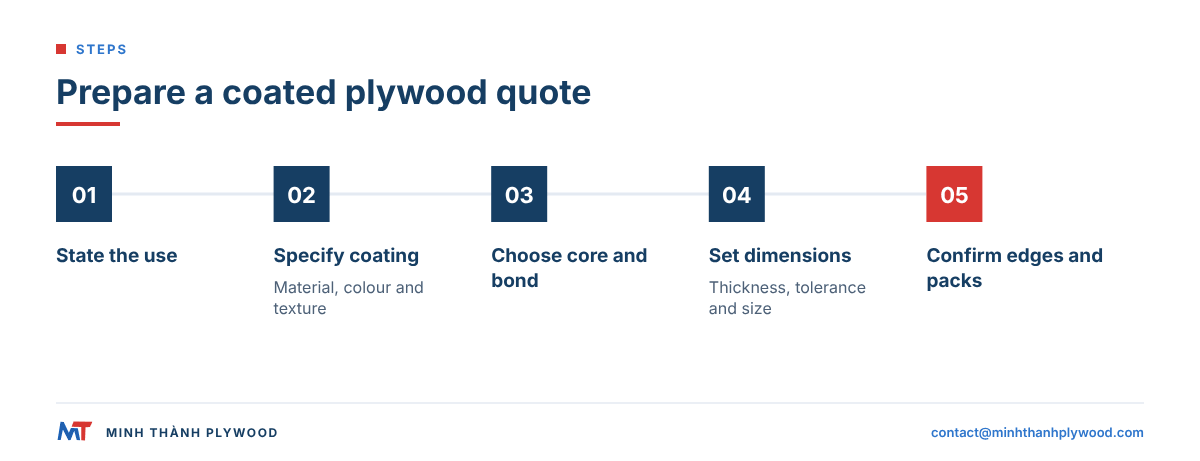
Send the face and the base panel as two separate parts of one specification:
- Use: formwork, trailer floor, lining, hygienic wall, furniture.
- Coating: material, colour, smooth or textured, one or both faces.
- Core: species and density, for example Eucalyptus for floors and formwork, Styrax for lighter furniture panels.
- Bond: UF glue at E0 emission for interior furniture, melamine-fortified for humid use, phenolic WBP for wet and outdoor use.
- Thickness, tolerance and size: for example 18 mm, 1220 × 2440 mm or 1250 × 2500 mm.
- Edges and packing: sealed edges, pack size, quantity and destination port.
What does Minh Thanh supply for coated and laminated work?
Minh Thanh Plywood makes film faced plywood for formwork and anti-slip plywood on order, and supplies sanded, polished base panels for buyers who coat or laminate the faces themselves. Terms are a 1×40HC minimum order, mixed specifications by agreement, and 15–45 days after the 30% deposit.
| Field | Minh Thanh panels for coating and lamination |
|---|---|
| Faces | 10+ face veneers: EV, poplar, birch, okoume and pine most produced; bintangor, eucalyptus, gurjan and others on request |
| Surface | Sanded and polished; both faces UV-ready for the customer’s own UV coating |
| Thickness | 3–40 mm; tolerance down to ±0.2 mm on sanded furniture panels |
| Core | White Styrax or Eucalyptus, stitched horizontally and vertically, pressed twice |
| Glue and emission | UF glue at E0 emission standard; melamine-fortified (MR) or phenolic WBP to your specification |
| Certificates | CARB P2 / TSCA Title VI (ICTT mill no. 23024); FSC and CE available* |
| Terms | MOQ 1×40HC, mixed specifications by agreement; 15–45 days after the 30% deposit; FOB Hai Phong, CFR or CIF |
*Supplied directly or through qualified partner mills.
Our furniture panels are certified to CARB Phase 2 and TSCA Title VI, the US formaldehyde emission rules for hardwood plywood. The limit for veneer-core hardwood plywood is 0.05 ppm under 40 CFR 770.10.
A flat, calibrated base panel decides how a PVC, HPL or UV face looks: the ±0.2 mm tolerance and the double pressing keep the face flat for the laminating line. See our furniture plywood range and the full product list. Free samples are available: write to contact@minhthanhplywood.com.
Buyer questions, answered
What is coated plywood called?
Coated plywood is usually called overlaid or faced plywood, and by its coating: film faced or phenolic plywood, PP or plastic faced plywood, PVC or vinyl faced plywood, FRP plywood, poly ply (polyester), HDO or MDO, and laminated plywood for melamine or HPL faces.
What is plastic coated plywood used for?
Concrete formwork, trailer and van floors and linings, truck bodies, cold rooms and hygienic wall cladding, shop fittings, packaging that is reused, and signs. The plastic face resists water, wear and chemicals and is easy to clean.
What is the difference between PP and phenolic film plywood?
Phenolic film is resin-impregnated paper hot-pressed onto the panel; PP is a thermoplastic sheet bonded to it. PP is tougher, gives more formwork reuses and can be repaired with heat, while phenolic film costs less per sheet.
What is PVC coated plywood?
PVC coated plywood is plywood with a polyvinyl chloride (PVC or vinyl) sheet or foil laminated to one or both faces. It gives a smooth, washable, coloured face for van linings, wall cladding, furniture and displays.
What is FRP plywood?
FRP plywood has a glass-fibre reinforced plastic sheet bonded to its faces. It is very hard-wearing and washable, and is used for truck bodies, refrigerated vans, cold rooms and hygienic walls.
What is UV coated plywood?
UV coated plywood has a clear or coloured lacquer rolled onto the face and cured in seconds under ultraviolet lamps. It gives a hard, ready-finished furniture surface, most often on birch.
Can you paint UV coated plywood?
Only after preparation. Cured UV lacquer is hard and smooth, so scuff it with fine sandpaper, clean off the dust and use an adhesion primer before painting. For painted work, order uncoated, sanded plywood instead.
Is birch plywood UV coated?
Not as standard. Most birch plywood is sold sanded and uncoated; UV coated birch is a separate, prefinished product, coated on one or both faces by the mill or by a finishing plant.
Is plastic coated plywood waterproof?
The plastic face is waterproof, and with an exterior phenolic bond the glue lines are too. The edges and any drilled holes are wood, so seal them with edge paint or sealant after cutting.
Where can I buy coated plywood in the UK?
UK timber merchants such as Gards and Ilkeston Ply sell phenolic and brown coated birch in 8 x 4 ft sheets, with cutting services. Container buyers import coated or sanded base panels from mills in Asia and run UK Timber Regulation due diligence.
Does Minh Thanh make coated plywood?
Minh Thanh Plywood makes film faced plywood for formwork and anti-slip plywood on order, and supplies sanded, calibrated birch, poplar and other faced panels with both faces UV-ready for buyers who coat or laminate the panels themselves.