
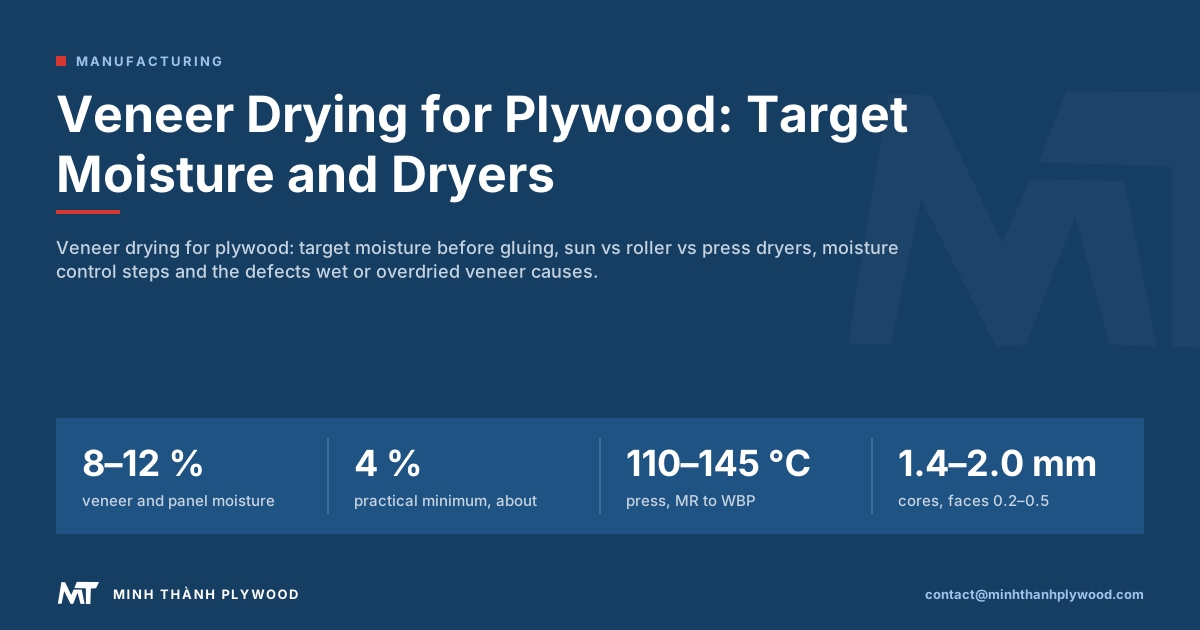
Veneer drying brings freshly peeled veneer down from green, wet wood to a moisture content the glue can bond, before glue spread and hot pressing. Minh Thanh Plywood dries veneers and finished furniture panels to 8–12 % moisture content. Veneer that goes into the press too wet blisters and delaminates; veneer dried too hard turns brittle, cracks and starves the glue line.
Why veneer drying comes before pressing
Veneer drying comes before pressing because glue only bonds wood that is close to its working moisture. Freshly peeled veneer is green wood, full of free water. Pressed like that, the water boils into steam under the hot platens, pushes the layers apart and dilutes the glue.
Drying solves four problems at once:
- Bond. UF, melamine-fortified and phenolic glues all cure through heat and the loss of water. Too much water in the veneer leaves the glue line under-cured and weak.
- Steam. Water turned to steam has to escape when the press opens. If it cannot, it lifts the face as a blister or splits the core.
- Shrinkage. Wood shrinks as it dries. Dried before gluing, the veneer has already shrunk; dried after pressing, it would shrink inside the panel and pull it out of flat.
- Mould and stain. Wet veneer stacked in a warm climate grows sap stain and mould within days.
For the buyer, veneer drying is invisible in the finished sheet but decides three things you can measure: the glue bond, the flatness and the moisture content on arrival.
What moisture content should veneer have before gluing?
For furniture plywood bonded with UF glue at E0 emission, veneer goes to glue spread at about 8–12 % moisture content. Minh Thanh Plywood dries veneers and finished panels to that range, the normal band for furniture plywood. Drier is not better: the USDA Wood Handbook puts the minimum practical veneer moisture at about 4 %, because drier veneer is brittle and breaks in handling.
| Glue system | Typical use | Veneer moisture at glue spread | Why |
|---|---|---|---|
| UF glue at E0 emission | Dry-room furniture and interior panels | 8–12 % | Standard range; even moisture matters more than the exact figure |
| Melamine-fortified (MR) glue | Kitchens, bathrooms, damp interiors | 8–12 %, kept even | Less water in the glue line helps a full cure |
| Phenolic (WBP) glue | Exterior, formwork, wet use | Drier than UF | Phenolic glue cures hotter and tolerates less water |
| Any glue, practical floor | All | Not below about 4 % | Veneer becomes brittle and cracks |
The spread between sheets matters as much as the average. A stack of veneer at 8 % with a few wet sheets at much higher moisture still produces blisters wherever the wet sheets land. Mills therefore check sheets from every dryer batch, not one sheet per shift.
Press temperature follows the glue: about 110–120 °C for MR glue and 130–145 °C for phenolic WBP. A hotter press drives more steam out of the veneer, which is a second reason phenolic panels need drier veneer.
Sun drying vs machine drying: which is better?
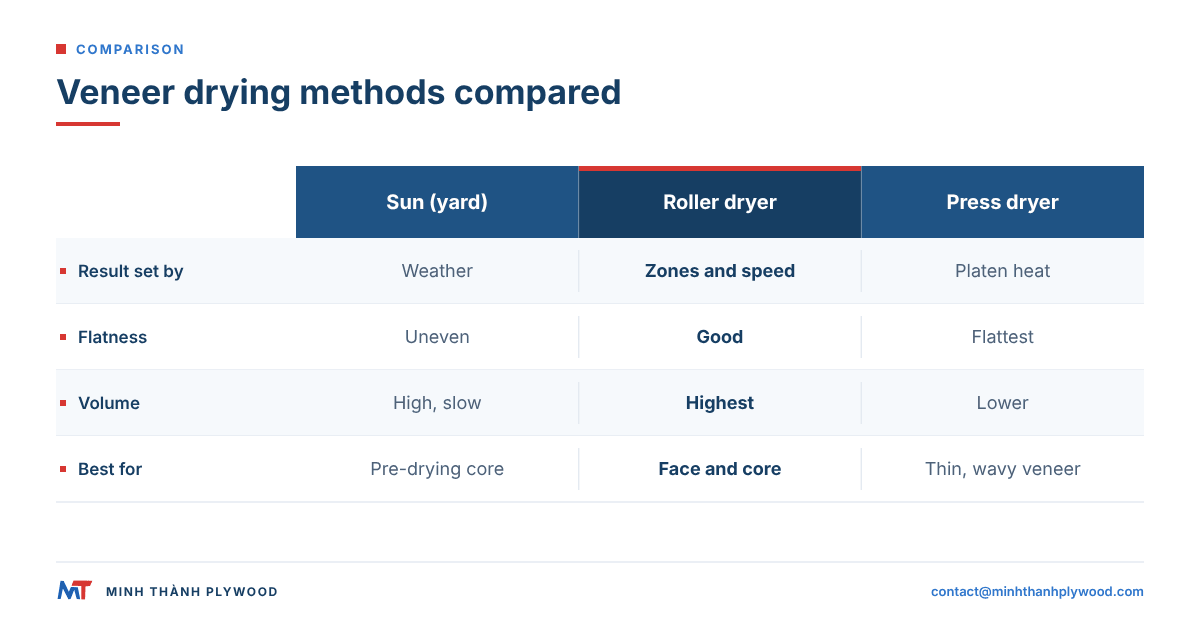
Machine drying is better when the result has to be the same every day; sun drying is cheaper and still common for thick core veneer in Vietnam. The table compares the four methods a buyer is likely to hear about.
| Method | How it works | Best for | Weak point |
|---|---|---|---|
| Sun (yard) drying | Veneer stood on racks or laid on frames in the open air | Pre-drying thick core veneer in dry, sunny weather | Weather, humidity and rain set the result; uneven sheets |
| Roller (jet) dryer | Sheets carried between rollers through hot-air zones | Face and core veneer at high volume | Wavy veneer can stay wavy; needs steady feed |
| Press (platen) dryer | Sheets dried between heated plates that open and close | Thin, buckled or wavy veneer that must come out flat | Lower volume per hour |
| Kiln chamber | Stacked veneer dried in a closed room with heat and fans | Small volumes and re-drying | Slow; stacks dry unevenly without good airflow |
Many mills combine methods: core veneer is pre-dried in the yard when the weather allows and finished in a dryer, so every sheet reaches the same band before glue spread. The method matters less to the buyer than the measurement at the end.
How does a plywood veneer dryer work?
A plywood veneer dryer moves veneer sheets through a long heated chamber on rollers while fans blow hot air onto both faces. The chamber is split into zones: the first zones remove most of the free water, the later ones bring the sheet down to its target, and a cooling section at the exit stops the sheet from drying further on the outfeed.
The operator controls three settings:
- Temperature of each zone, set for the species and thickness.
- Speed of the rollers, which sets how long a sheet stays inside.
- Air flow, which carries moisture out of the chamber.
Thin face veneer passes quickly; thick core veneer runs slower or makes a second pass. Sheets of different thickness or species are not mixed in one run (the same sorting logic as veneer grading at our factory), because one setting cannot dry both correctly. Wet spots that survive a pass are found at the outfeed with a moisture meter and sent back through.
Veneer dryer settings and numbers
Dryer settings are set per species and thickness, but the numbers that frame them are public. The table puts the figures a buyer meets in one place.
| Quantity | Figure | Note |
|---|---|---|
| Green moisture content, yellow-poplar | 83 % heartwood, 106 % sapwood | Wood Handbook, chapter 4; green veneer holds roughly as much water as wood substance, so the dryer removes 40-50 % of the sheet weight |
| Dryer air temperature | 180–190 °C | Reported for an industrial veneer dryer, varying with humidity and load |
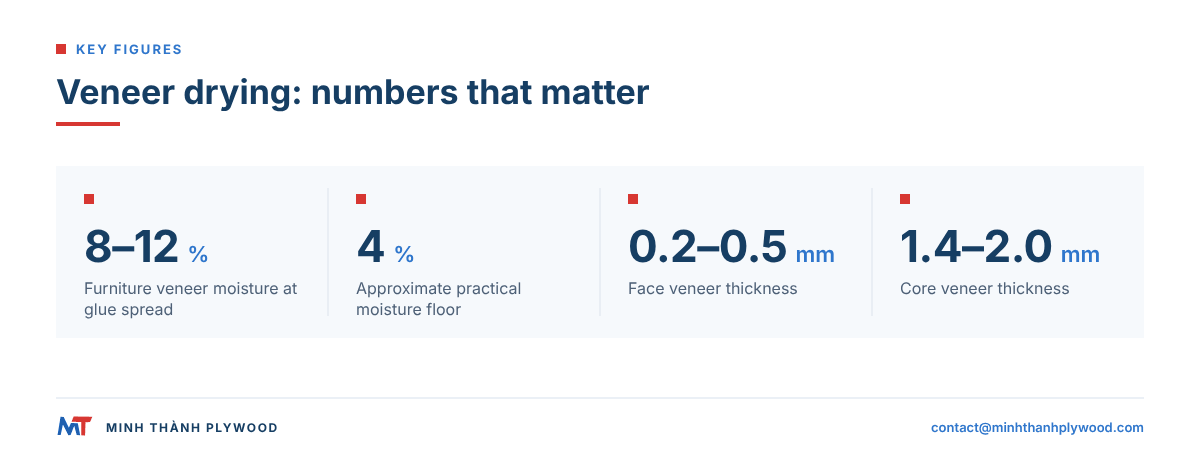
| Target moisture at glue spread | 8–12 % | Minh Thanh’s furniture band |
| Practical floor | about 4 % | Below this veneer is brittle |
| Face veneer thickness | 0.2–0.5 mm | Dries in minutes |
| Core veneer thickness | 1.4–2.0 mm | Dries slower; centre stays wet longer |
Sapwood is wetter than heartwood in many species, so a single log yields veneer that leaves the lathe at very different moisture. That is why one sheet in a stack can come out of the dryer wet while its neighbour is dry.
Even moisture pays. The dryer maker Raute reports that pre-sorting and stacking green veneer by moisture gives up to 5 % more dryer operating hours, up to 10 % more high-quality veneer per stack and up to 3 % more valuable face veneer, and that even veneer moisture cuts glue use by up to 20 % later in production (Raute, veneer drying, accessed 21 October 2026). For a buyer the same logic shows up as fewer blisters and a steadier glue line.
Controlling dryer humidity. The air inside the dryer carries the water out, so its humidity sets how fast and how evenly sheets dry. Instruments measure the dew point of the air directly in each zone and feed the dryer controls; too dry an atmosphere over-dries the surface and wastes energy, and too humid an atmosphere leaves the core wet (Vaisala, veneer drying with humidity control, accessed 21 October 2026).
Exhaust venting is set from that reading. At Minh Thanh the check that counts is at the outfeed: meter readings on sheets from the top, middle and bottom of every stack, logged by batch, with wet sheets sent back through before lay-up.
What is a press dryer for veneer?
A press dryer for veneer dries the sheets between heated metal platens instead of in moving air. The platens close on the veneer, heat it through direct contact and open briefly to let the steam out, then close again until the sheet is dry.
Because the veneer is held flat while it dries, a press dryer gives the flattest sheet of any method. That is useful for:
- Wavy or buckled veneer, such as plantation eucalyptus that ripples in a hot-air dryer.
- Thin veneer that would curl at the edges.
- Face-ready sheets that must lie flat for jointing and lay-up.
The trade-off is volume: a press dryer handles fewer sheets per hour than a long roller dryer, so mills often use it for the sheets that need flattening and the roller dryer for the rest.
How does veneer moisture control work?
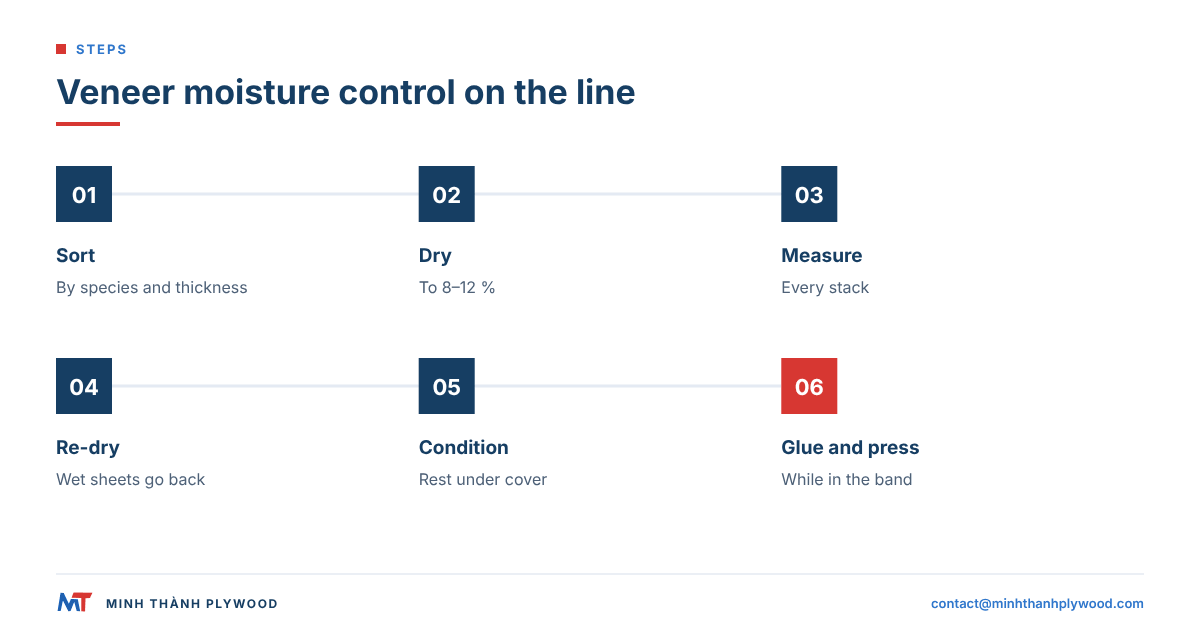
Veneer moisture control is a short loop: dry, measure, sort, re-dry what is wet, and use the dry veneer before it changes again. A typical sequence on a furniture plywood line runs as follows.
- Sort before drying. Separate veneer by species and thickness so one dryer setting suits the whole run.
- Dry to the band. Run the dryer or the yard until sheets reach the target band, 8–12 % for furniture panels.
- Measure every batch. Take readings with a handheld meter on sheets from the top, middle and bottom of each stack.
- Re-dry wet sheets. Any sheet above the band goes back through the dryer; it is not mixed into the lay-up.
- Condition the stack. Let dried veneer rest under cover so moisture evens out between the core and the surface of each sheet.
- Spread and press in time. Glue the veneer while it is still in the band; veneer left for days in humid air picks moisture back up.
The reference method behind the handheld meter is the oven test: weigh a sample, dry it in an oven until the weight stops changing, weigh it again, and divide the water lost by the dry weight. Meters are calibrated against that test for each species.
Core veneer vs face veneer: do they dry differently?
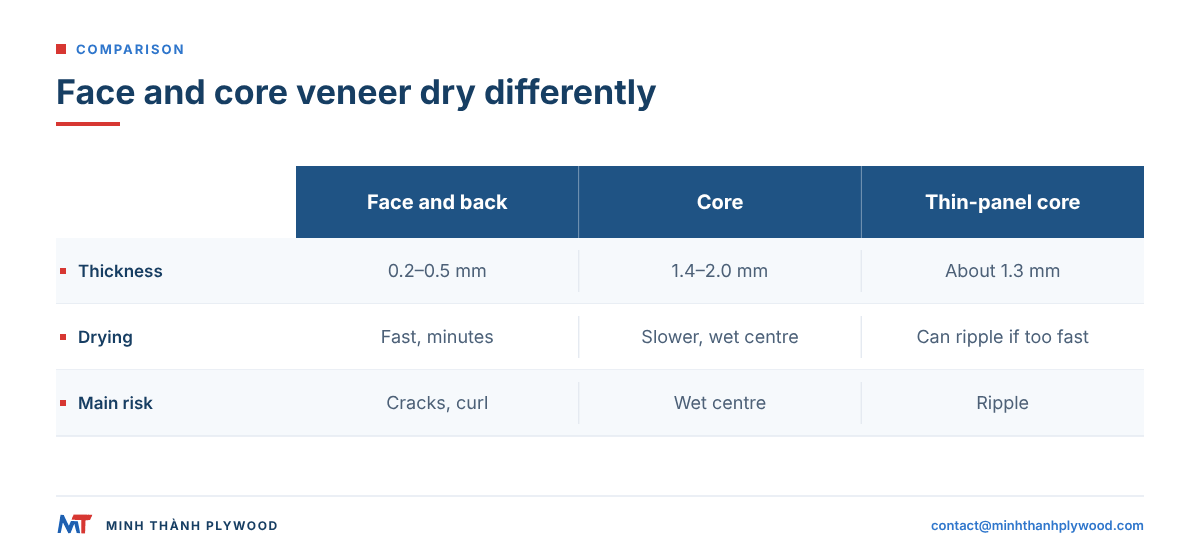
Yes: core veneer is thick and dries slowly, face veneer is thin and dries fast. In Vietnamese furniture plywood, face veneer is usually 0.2–0.5 mm thick, often 0.3 mm for European orders, while core veneer runs about 1.4–2.0 mm.
| Layer | Typical thickness | Source in a Vietnamese mill | Drying behaviour |
|---|---|---|---|
| Face and back veneer | 0.2–0.5 mm | Imported (birch, okoume) or local (eucalyptus, poplar, EV designs) | Dries in minutes; overdries and cracks easily; must lie flat |
| Core veneer | 1.4–2.0 mm | Peeled from plantation logs: Styrax, Eucalyptus, Acacia | Dries slowly; the centre stays wet longer than the surface |
| Thin-panel core veneer | about 1.3 mm in 4 mm panels | Plantation logs | Between the two; ripples if dried too fast |
Imported faces usually arrive already dried and are stored under cover; they still need checking, because face veneer stored in humid air takes up moisture again. Core veneer is the bigger volume and carries most of the water, so most drying effort goes into the core.
Minh Thanh’s factory in Ha Hoa, Phu Tho, works with locally grown plantation timber for its cores.
Which plywood defects does bad veneer drying cause?
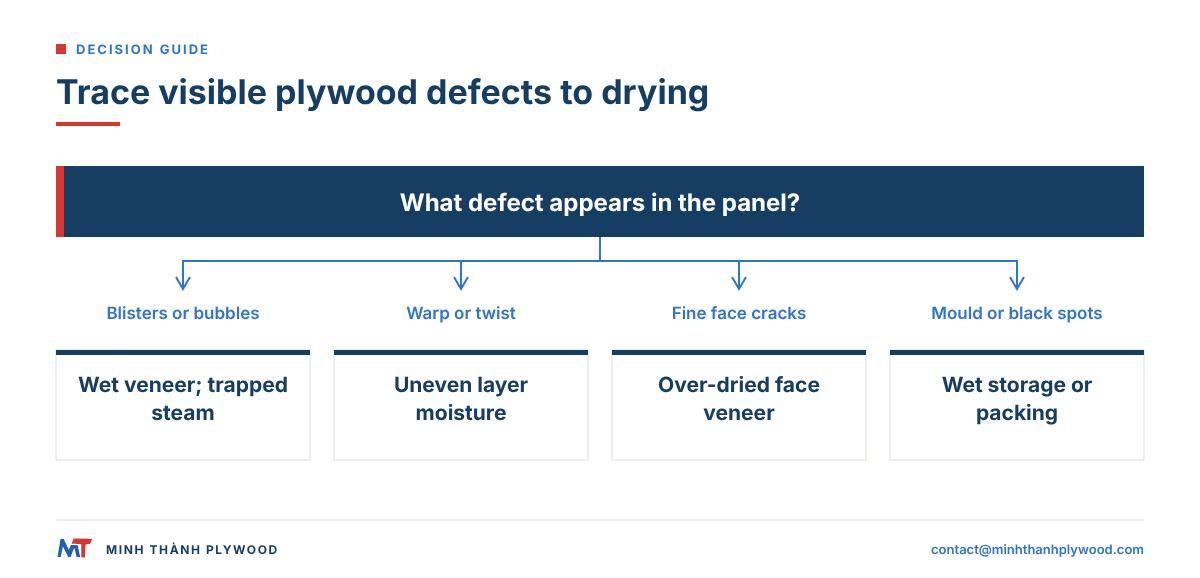
Bad veneer drying causes blisters, delamination, warping, face checks and mould, and each points back to a specific drying fault. The table links what a buyer sees to its cause.
| What you see in the panel | Drying fault behind it | How it shows up |
|---|---|---|
| Blisters, bubbles, soft spots | Veneer too wet; steam trapped in the press | Hollow sound in a knock test; raised patch on the face |
| Delamination at the edge or after soaking | Wet or uneven veneer under-cured the glue line | Layers part on a cut edge or in a soak test |
| Warp, bow or twist | Moisture differs between layers or faces | Sheet will not lie flat on a flat floor |
| Face checks (fine cracks) | Face veneer over-dried or dried too fast | Hairline splits along the grain, often after finishing |
| Open joints in the face | Veneer shrank after jointing | Gaps between face pieces |
| Black spots, sap stain, mould | Veneer stored wet before drying, or panels packed damp | Grey or black dots and streaks |
| Starved glue line, weak bond | Over-dried veneer soaked up the glue | Low bond strength with no blister |
For a buyer’s checklist covering each defect and its acceptance limit, see common plywood defects and how to check them. For blisters and glue failure in detail, see plywood delamination.
Why moisture balance between layers matters
Moisture balance matters because a panel is a stack of layers glued cross-grain, and each layer wants to shrink or swell on its own. If the face veneer goes in drier than the back, or one core layer wetter than its neighbour, the layers pull against each other as the panel settles, and the sheet bows.
Two practices keep a panel balanced:
- Same band for every layer. All veneers of one panel come from batches dried to the same moisture band.
- Same face and back. Face and back veneer are matched in thickness and moisture, so both sides of the sheet move the same way.
Minh Thanh presses furniture-grade panels twice as standard: the core board is pressed and calibrated first, then the face and back are pressed on. The core has settled before the faces are added, which keeps the finished sheet flatter and lets the faces go onto a calibrated, even base. Core layers are stitched both horizontally and vertically (stitched core plywood), so the core stays closed as the veneer dries and shrinks.
Panel moisture at dispatch and in your warehouse
Finished furniture panels from Minh Thanh leave the factory at 8–12 % moisture content, the same band the veneer is dried to. From there, the panel slowly moves toward the moisture of the air around it. Plywood is processed wood and sits outside the ISPM 15 standard, but solid sawn-wood bearers under the packs are inside it and carry the ISPM 15 mark.
At sea, sealed in a container, a pack changes little; typical transit from Hai Phong is 30–40 days to Northern Europe and 25–35 days to the Mediterranean. In your warehouse, the panel settles to local conditions over the following weeks. A heated European warehouse in winter dries panels; a humid port warehouse in summer wets them.
To keep the panel as delivered:
- Store packs flat on level bearers, off the floor, under cover.
- Keep packing film on until the panels are used.
- Bring panels into the room where they will be cut or laminated a few days before processing.
- Check moisture with a meter before laminating; a panel well outside the band should acclimatise first.
How veneer drying shows up in the panel you buy
Veneer drying shows up in four results a buyer can check without visiting the mill:
| Result | What good drying gives | How to check it on arrival |
|---|---|---|
| Glue bond | No blisters, no edge delamination | Knock test across the face; soak test on a cut sample |
| Flatness | Sheets lie flat in the pack and on the floor | Lay a sheet on a flat floor; check the corners |
| Thickness | Calibrated sanded panels hold ±0.2–0.3 mm | Caliper readings at the four corners and the centre |
| Moisture | Panels arrive near 8–12 % | Moisture meter readings on sheets from several packs |
None of these needs a laboratory. The full arrival routine is in plywood quality control. A caliper, a moisture meter and a flat floor tell a buyer most of what drying did to the order. Drying does not set the emission result, which a chamber test proves; for US sales the limit for hardwood plywood with a veneer core is 0.05 ppm under 40 CFR 770.10.
What this means for your order
You do not need to specify a dryer type in a plywood order. You specify the results that depend on drying, and the mill organises its drying to meet them. Put these lines in the order:
- Moisture content at dispatch: 8–12 %.
- Glue and emission: for example UF glue at E0 emission for dry interiors, MR or WBP for damp use; emission class as a separate line.
- Core: species (white Styrax or Eucalyptus) and construction, stitched core, pressed twice.
- Face: species and grade pair, for example EV, poplar or birch D+/D.
- Thickness tolerance: ±0.2–0.3 mm for sanded furniture panels.
- Pre-shipment check: knock test and moisture readings in the inspection photos.
Minh Thanh photographs and films every shipment before loading, and buyers receive the photos and video; certificates and test reports are on the quality and certificates page. MOQ is one 40HC with mixed specifications by agreement; production takes 15–45 days after the 30% deposit; terms are FOB Hai Phong, CFR or CIF; samples are free. Send your specification to contact@minhthanhplywood.com, or start from EV plywood or how Minh Thanh makes plywood. For background on drying science, the USDA Forest Products Laboratory Wood Handbook, chapter 13 (2010) is the standard reference.
Buyer questions, answered
Why must veneers be dried before pressing?
Glue cannot cure properly on wet wood. In a hot press, the water in wet veneer turns to steam, which pushes the layers apart and leaves blisters or weak glue lines. Drying also shrinks the veneer before it is glued, so the panel does not shrink and warp later.
What moisture content should veneer have before gluing?
For furniture plywood bonded with UF glue at E0 emission, veneer is dried to about 8–12 % moisture content, the range Minh Thanh works to. Phenolic (WBP) bonds need drier veneer, toward the low end, and veneer much below about 4 % becomes too brittle to handle.
Is sun drying or machine drying better for veneer?
Machine drying gives a steady, measurable result in any weather; sun drying is cheap but depends on sun, humidity and rain. Many Vietnamese mills combine both: core veneer is pre-dried in the yard and finished in a dryer, so every sheet reaches the same moisture before glue spread.
What is a press dryer for veneer?
A press dryer (platen dryer) dries veneer between heated metal plates that open and close. Contact with the hot plates dries the sheet and flattens it at the same time, which suits wavy or buckled veneer and thin sheets that would ripple in a hot-air dryer.
How is veneer moisture measured?
On the line, with a handheld moisture meter on sheets taken from each stack or dryer batch. For a reference value, a sample is weighed, oven-dried and weighed again; the loss divided by the dry weight gives the moisture content in percent.
Can veneer be too dry?
Yes. Over-dried veneer is brittle, cracks at the edges and in the face, and soaks up glue so fast that the glue line is starved. It can also take up moisture unevenly after pressing, which makes the panel move.
Does veneer drying affect formaldehyde emission?
The emission class is set by the glue system and proven by a chamber test, not by drying. Dry, even veneer helps the glue cure fully in the press, so the panel performs as the glue specification intends.
How long does veneer take to dry?
It depends on thickness, species, starting moisture and method: a thin face veneer passes a roller dryer in minutes, while thick core veneer in a sun yard needs one or more good days. A mill controls the result by measuring moisture, not by the clock.
What happens if plywood is made with wet veneer?
Wet veneer causes blisters, soft spots and delamination, often found by a hollow sound in a knock test. Panels that pass the press may still shrink, warp or grow mould spots in the container as the extra water leaves the core.
What moisture content should plywood have when it arrives?
Furniture plywood from Minh Thanh leaves the factory at 8–12 % moisture content. On arrival it slowly settles to the humidity of your warehouse, so store packs flat, covered and off the floor before cutting or laminating.