
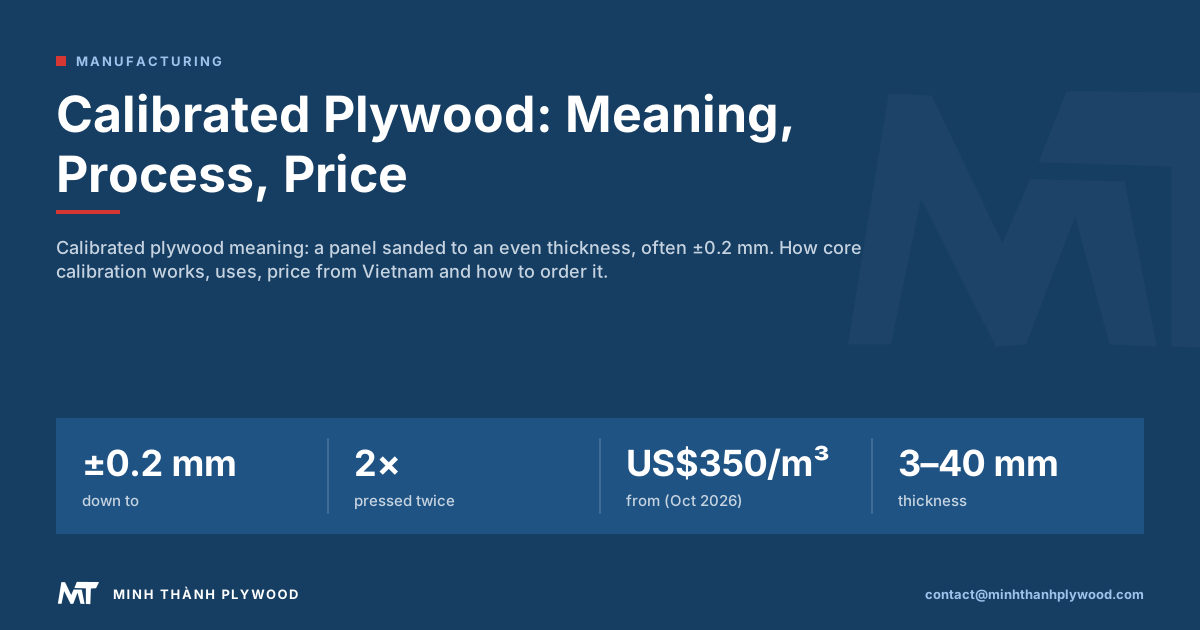
Calibrated plywood is plywood sanded to an even, controlled thickness across the whole sheet and from sheet to sheet, so every panel of a batch measures the same. At Minh Thanh Plywood the core board is pressed and calibrated before the faces go on, then the panel is sanded to ±0.2–0.3 mm, down to ±0.2 mm. Here is how it is made and when it pays.
What is calibrated plywood?
Calibrated plywood is plywood sanded to a controlled, even thickness, so that every point of a sheet and every sheet of a batch measure the same within a stated tolerance. In furniture plywood that tolerance is typically ±0.2–0.3 mm.
Calibration is a step, not a species or a grade. Any face can sit on a calibrated panel: birch, poplar, EV, okoume, pine. What the word adds is a promise about thickness, and that promise is what a furniture line, a CNC router or a lamination press depends on.
Calibrated plywood meaning in a specification
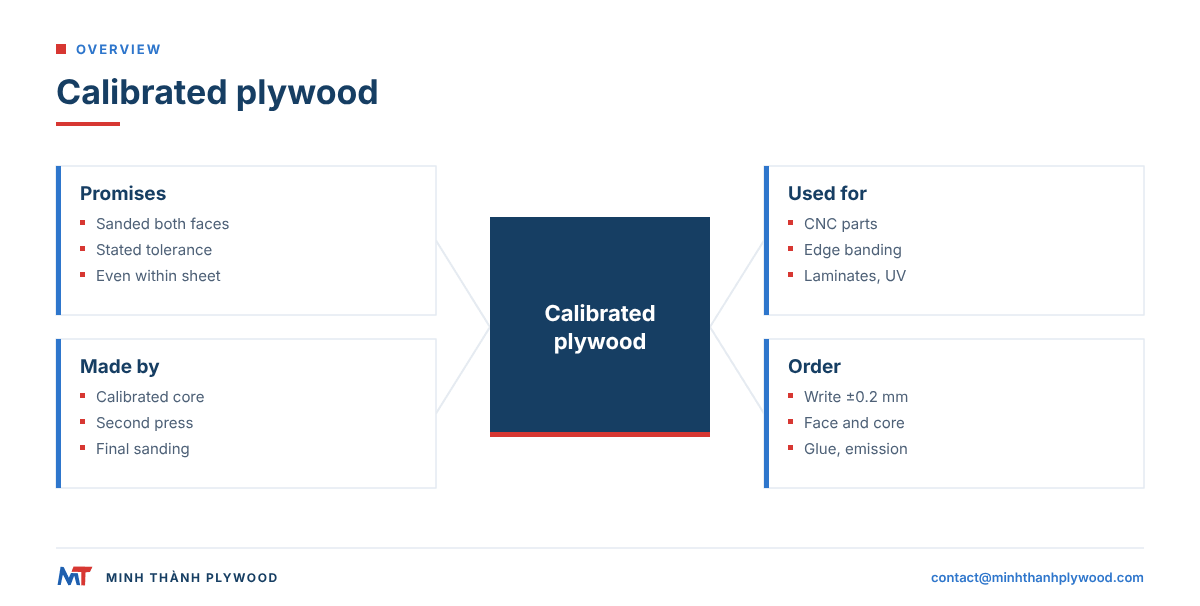
In a buyer’s specification, calibrated plywood means three things: the panel is sanded on both faces, its thickness is held to a stated tolerance, and the thickness is even across the sheet as well as between sheets.
| What “calibrated” promises | What it does not say |
|---|---|
| Sanded both faces | Which face species or grade |
| A thickness tolerance, for example ±0.2 mm | Which glue or emission class |
| Even thickness within one sheet | Moisture content |
| Consistent thickness across the batch | Flatness in storage |
Because the word alone leaves the figure open, a good order writes the number: “calibrated, sanded both faces, ±0.2 mm”. The other lines (face, core, glue, emission, moisture) still need their own entries.
How is calibrated plywood made?
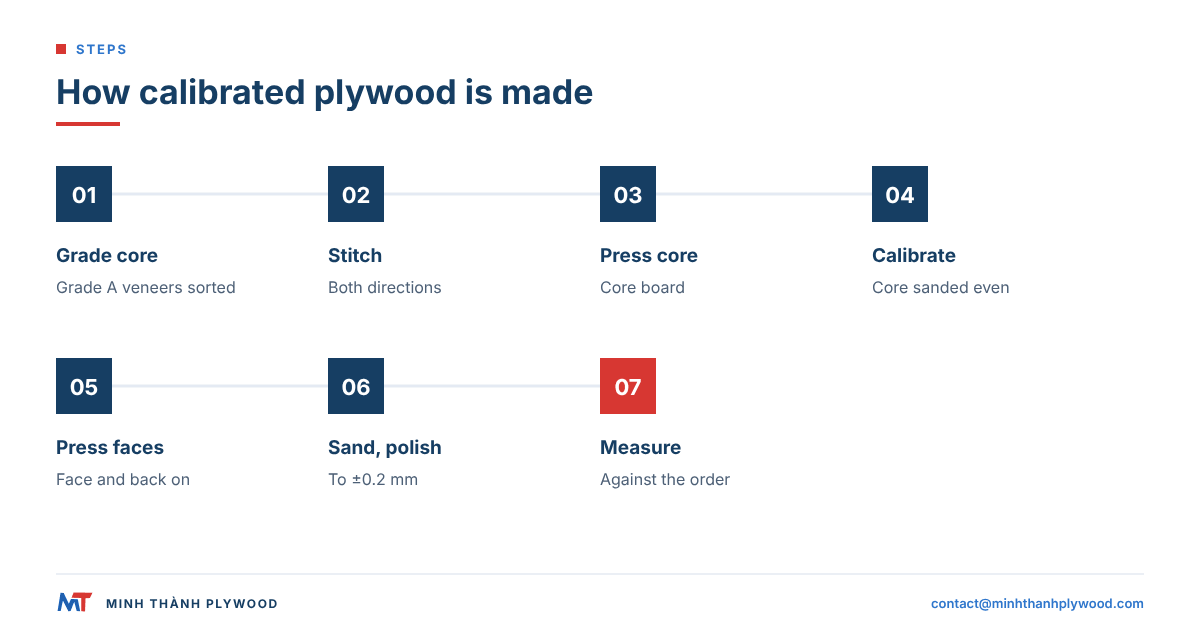
At Minh Thanh, a calibrated furniture panel is pressed twice, with a calibration step in between. The core board is pressed and calibrated, then the face and back are pressed onto it and the panel is sanded.
- Grade the core veneers. Furniture panels use grade A core veneer, sorted so thick and thin sheets do not meet in one panel.
- Stitch the core. Core layers are stitched horizontally and vertically, usually the outer 2–4 layers and every layer on request, so veneers do not open into gaps.
- Press the core board. The cross-banded core veneers are glued and hot-pressed into one board.
- Calibrate the core. The core board is sanded to an even thickness.
- Press face and back. Face veneers, usually 0.2–0.5 mm thick, are pressed onto the calibrated core.
- Sand and polish the panel. Both faces are sanded to the final thickness and polished.
- Measure and pack. Thickness is checked against the order tolerance, and panels are packed flat.
Calibrating the core is what makes the final sanding light. A thin face veneer cannot absorb deep sanding, so a panel pressed once with an uneven core either keeps its thickness steps or loses face veneer where it is sanded flat.
Calibrated vs ordinary plywood
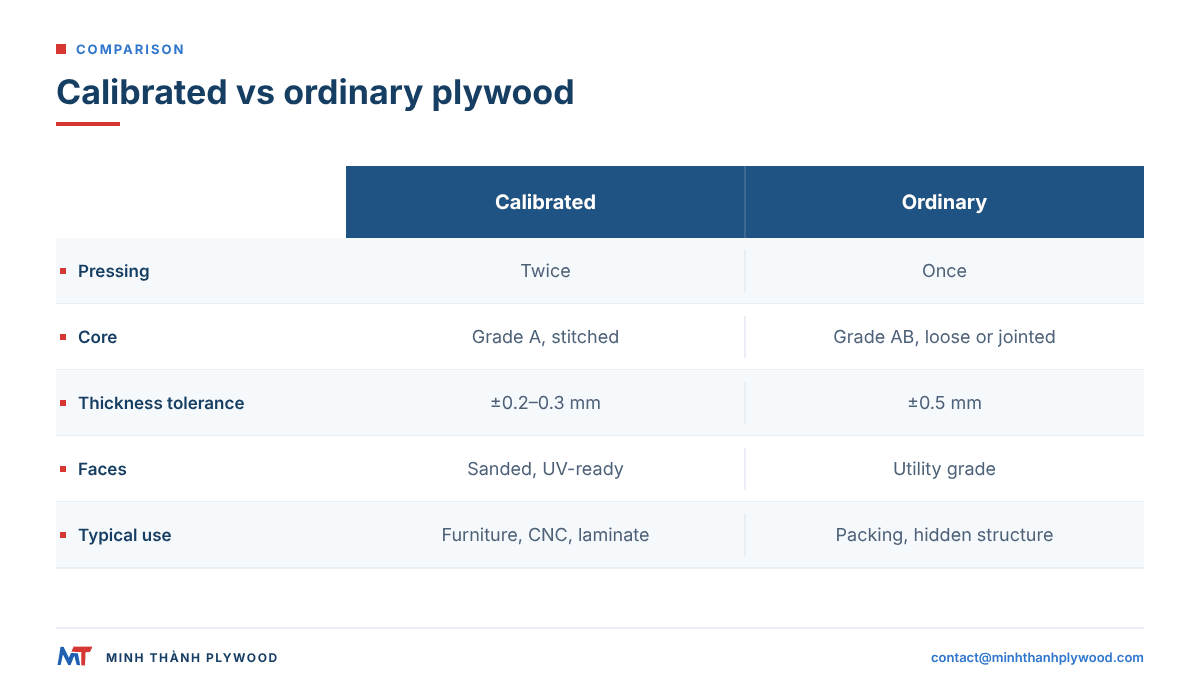
Calibrated plywood differs from ordinary commercial plywood in pressing, sanding and tolerance, and those differences decide where each one is used.
| Property | Calibrated furniture plywood | Ordinary commercial plywood |
|---|---|---|
| Pressing | Twice: calibrated core, then faces | Once |
| Core | Grade A, stitched | Grade AB, laid loose or jointed |
| Sanding | Both faces, to a measured thickness, polished | None or light |
| Thickness tolerance | ±0.2–0.3 mm, down to ±0.2 mm | ±0.5 mm |
| Length and width | ±2 mm | ±2 mm |
| Face | Visible-grade, UV-ready | Utility grade |
| Typical use | Furniture, cabinets, CNC parts, laminated panels | Packing, hidden structure, general use |
The price difference follows the work: more veneer grading, a second press cycle and calibrated sanding. For a part that is machined and finished, that work is paid back on the furniture line.
What thickness tolerance can calibrated plywood hold?
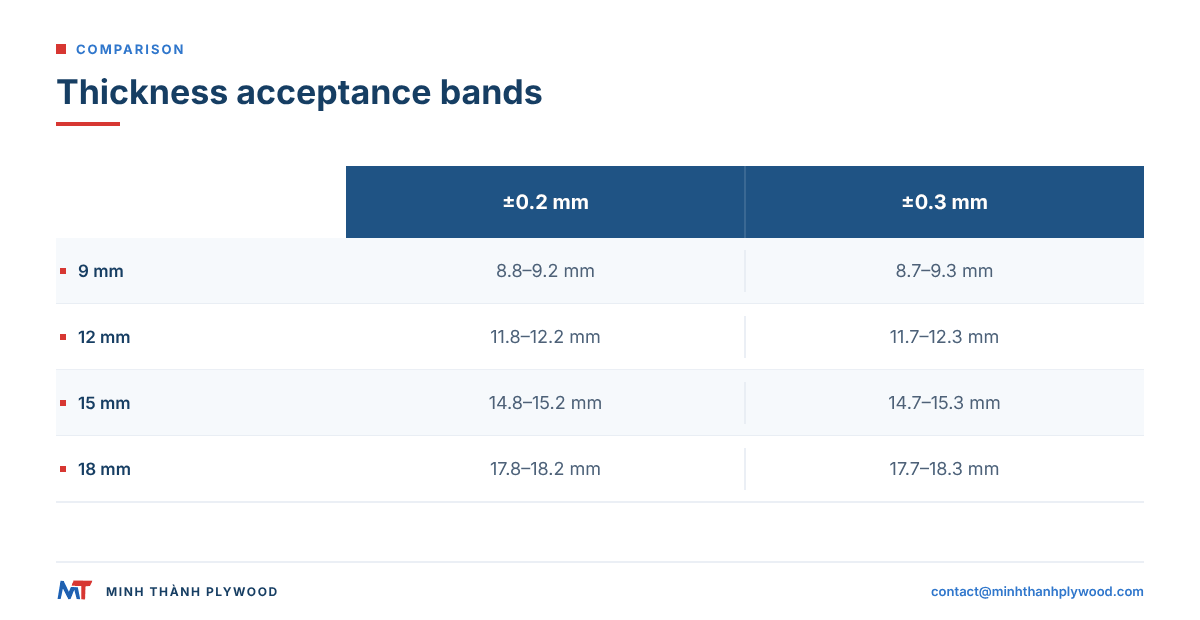
Calibrated furniture plywood from Minh Thanh is held to ±0.2–0.3 mm, down to ±0.2 mm, measured at dispatch at 8–12 % moisture. On an 18 mm panel at ±0.2 mm, every reading lies between 17.8 and 18.2 mm.
| Nominal thickness | ±0.2 mm accept range | ±0.3 mm accept range |
|---|---|---|
| 9 mm | 8.8–9.2 mm | 8.7–9.3 mm |
| 12 mm | 11.8–12.2 mm | 11.7–12.3 mm |
| 15 mm | 14.8–15.2 mm | 14.7–15.3 mm |
| 18 mm | 17.8–18.2 mm | 17.7–18.3 mm |
Plywood thickness tolerance gives the figures for every product line and a measuring routine for loading or arrival.
Where calibrated thickness matters most
Calibrated plywood pays wherever a panel is machined, edged, laminated or coated, because each of those steps assumes a constant thickness.
- CNC routing and nesting. Pocket and groove depths stay constant, and sheets lie flat on a vacuum table.
- Edge banding. A band sized for the panel meets both faces without lips or exposed core.
- Lamination and HPL. A constant thickness presses evenly, so thin spots do not show as dips under gloss.
- UV and lacquer lines. Roller coaters reach every part of the face; both Minh Thanh furniture faces are UV-ready for the buyer’s own coating.
- Flat-pack furniture. Cam locks, dowels and grooves line up from the first panel to the last.
- Drawer boxes and cabinet backs. Panels slide into grooves without forcing or rattling.
For concrete formwork, crates and hidden framing, the extra work buys little; an ordinary panel at ±0.5 mm is the cost-effective choice there.
Which core works best for calibrated plywood?
Styrax and Eucalyptus cores both calibrate well when the core is stitched and pressed twice; the choice is weight and edge colour against hardness.
| 18 mm, 1220 × 2440 mm | Styrax core | Eucalyptus core |
|---|---|---|
| Planning density | 500 kg/m³ | 650 kg/m³ |
| Weight per sheet | 26.8 kg | 34.8 kg |
| Edge | Pale, even | Pink to reddish brown |
| Sheets per 40HC | 990 sheets | 795 sheets |
| Best for | Light furniture parts, exposed edges | Harder, heavier parts |
Styrax core plywood covers weights for every thickness and the faces that suit a white core.
Calibrated plywood from Vietnam: what Minh Thanh makes
Calibrated plywood from Vietnam is the standard build of Minh Thanh’s furniture and interior line, made in Ha Hoa, Phu Tho, with Europe as the main market. Every furniture-grade panel is pressed twice and sanded; no separate “calibrated” grade is needed.
| Item | Minh Thanh calibrated furniture plywood |
|---|---|
| Thickness | 3–40 mm; thin panels 3–5 mm always 5-ply |
| Sizes | 1220 × 2440 mm, 1250 × 2500 mm; custom sizes such as 1220 × 2500 mm |
| Cores | Styrax or Eucalyptus; Acacia and Pine on order |
| Faces | EV, Poplar, Birch, Okoume, Pine; others on request |
| Tolerance | ±0.2–0.3 mm, down to ±0.2 mm |
| Glue and emission | UF glue at E0 emission; MR or phenolic WBP to specification |
| Certification | CARB P2 / TSCA Title VI, ICTT mill no. 23024 |
| Capacity | 50,000+ m³ per year |
The certification follows the CARB composite wood products programme and the EPA formaldehyde standards for composite wood products (checked 20 October 2026). The limit for veneer-core hardwood plywood is 0.05 ppm of formaldehyde under 40 CFR 770.10.
Cut-to-size panels, one sheet cut into 4, 6 or 8 pieces, ship regularly to Italy and other European markets.
Calibrated thin plywood, 3–5 mm
Thin panels of 3–5 mm are where calibration is hardest and most visible. A 4 mm drawer bottom or cabinet back sits in a groove, so a few tenths of a millimetre decide whether it slides in or has to be forced.
Minh Thanh builds every 3–5 mm panel as 5-ply. A 3 mm panel is one core veneer, two cross-band veneers and two face veneers; 4 and 5 mm panels are three core veneers and two faces, with the core veneer thickness chosen to reach the size, for example a 4 mm furniture panel on three 1.3 mm Styrax core veneers. Premium thin veneer is scarce, so 4 mm can take longer; the standard is not lowered to go faster.
For thin calibrated panels, write the tolerance and the groove they must fit, for example “4 mm, ±0.2 mm, for a 4.5 mm groove”, so the mill can check the fit on the sample.
Calibrated plywood price
Furniture plywood from Minh Thanh, calibrated as standard, starts from US$350/m³ (indicative, October 2026), against commercial plywood from US$250/m³. The final price depends on face, core, glue, thickness, size, quantity and delivery term.
What moves the price of a calibrated panel, in order of effect:
- Face species and grade. Imported birch D+/D costs more than EV or poplar.
- Thickness. Thin panels take more veneer and press cycles per cubic metre.
- Glue and emission. MR or phenolic WBP bonds cost more than UF at E0.
- Tolerance. ±0.2 mm takes more sorting and sanding than ±0.3 mm.
- Size and cutting. Custom sizes and cut-to-size add handling.
Prices are quoted FOB Hai Phong, CFR or CIF, with a 30 % deposit and 70 % against the scanned B/L, or an irrevocable L/C at sight.
What does calibrated plywood cost in India, and which grade is it?
Indian buyers order calibrated plywood by glue grade and IS number: the MR, BWR and BWP grades of general-purpose plywood follow IS 303, and marine plywood, which uses a BWP bond, follows IS 710. Minh Thanh’s UF glue panels at E0 sit in the interior MR class; MR or phenolic WBP bonds to specification sit in the water-resistant BWR and BWP classes. These are glue grades, not wood grades, so the face and core are specified separately. The Indian mark on a panel is a separate approval from the glue: say whether your buyer asks for it before you request a quote.
Indian retail shows what a calibrated sheet has to beat. Maker listings of calibrated plywood on Plyneer start from Rs 1,463 and reach Rs 2,555 per sheet (seen October 2026). Dealer guides put an 18 mm MR sheet of 8 × 4 ft at roughly Rs 1,280–4,320 and an 18 mm BWP sheet at roughly Rs 4,480–11,170 (Evospace plywood grade guide, 2026).
| One 8 × 4 ft sheet, 18 mm (1220 × 2440 mm) | Calculation |
|---|---|
| Volume | 0.0536 m³ |
| Raw FOB at US$350/m³ | US$18.75, about Rs 1,780 at Rs 94.92 per US$ |
| Sea freight share | 40HC at US$1,500–2,400 over 990 sheets: about Rs 144–230 |
| Duty-paid, about 32 % on CIF | about Rs 2,540–2,650 before port handling and inland freight |
This is a raw FOB example, not a sheet price: US$350/m³ is the starting price of the furniture line, and the real figure moves with face, glue and thickness. The shelf price a dealer sets adds port handling, inland freight and margin. Set that landed figure beside the Rs 1,280–4,320 an 18 mm MR sheet fetches and you see where a direct import fits; for water-resistant grades, quote the FOB of the glue you need and run the same arithmetic against the Rs 4,480–11,170 a dealer asks for an 18 mm BWP sheet.
Duty on plywood under HS 4412 stacks to about 32 % of the CIF value: 10 % basic customs duty, a 1 % AIDC, a 10 % surcharge on those and 18 % IGST (aggregator sources, checked October 2026; confirm the notification in force for your port before you commit).
Lanes and time: Hai Phong to Nhava Sheva takes 18–20 days, to Chennai 15–20 days and to Mundra 19–23 days on published schedules, and a 40HC is quoted at US$1,500–2,400 to Mundra or Nhava Sheva. Send the grade, thickness and port with the order and Minh Thanh quotes CIF Nhava Sheva, Chennai or Mundra.
How to check calibrated plywood on arrival
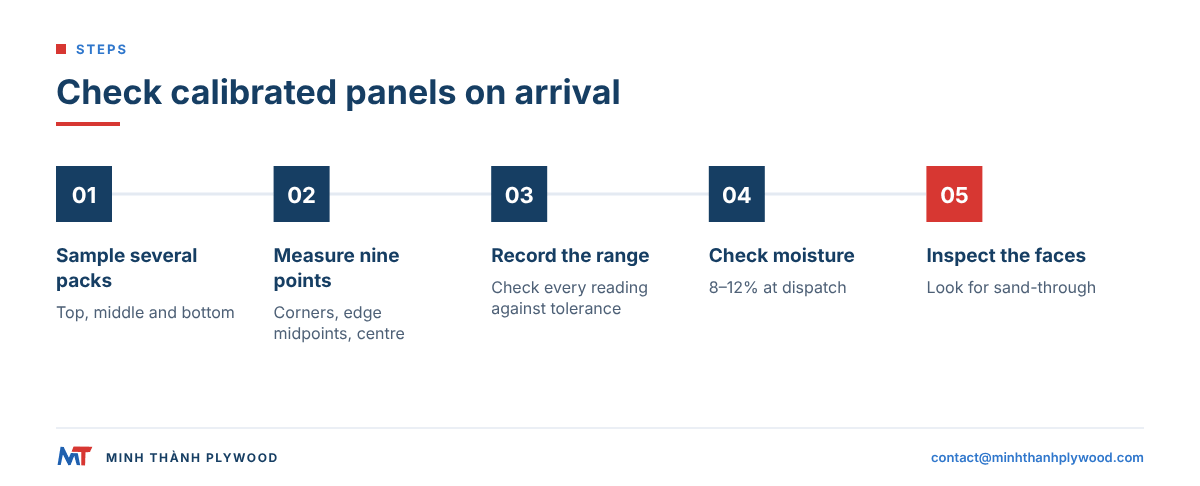
Check calibrated plywood with a caliper at several points per sheet, and with a moisture meter on the same sheets. A panel is calibrated as ordered only if every reading sits inside the tolerance band.
- Pick sample sheets from the top, middle and bottom of several packs.
- Measure nine points per sheet: four corners, four edge midpoints and the centre, set back from the edges.
- Record the range of each sheet as well as each reading.
- Check moisture: 8–12 % at dispatch; a wet sheet reads thick.
- Look at the faces under a raking light for sand-through, where the face veneer has been sanded away.
Every Minh Thanh shipment is photographed and filmed before loading, and buyers receive the photos and video.
How to order calibrated plywood
Order calibrated plywood by writing the tolerance as a number, with the face, core, glue and size on the same line:
18 mm × 1220 × 2440 mm, calibrated, sanded and polished both faces, ±0.2 mm; core: Styrax, stitched; face/back: poplar A/B; UF glue at E0 emission; moisture 8–12 %; 1×40HC, CIF your port.
MOQ is one 40HC, with mixed specifications by agreement, and production runs 15–45 days after the deposit. Minh Thanh sends free samples so you can measure a calibrated panel before ordering. Send your specification to [email protected] or WhatsApp +84 988 586 601; replies come within hours.
Is calibrated plywood worth it?
Calibrated plywood is worth it for any part that is machined, edged, laminated or coated, and rarely worth it for hidden or temporary uses. The test is simple: if a 0.5 mm difference between two panels would show or cost labour, buy calibrated.
| Use | Calibrated? |
|---|---|
| Kitchen and bathroom cabinets | Yes |
| Wardrobes, doors, drawer boxes | Yes |
| CNC-cut and flat-pack furniture | Yes |
| HPL, laminate or lacquer finishes | Yes |
| Wall panels and shop fittings | Yes |
| Packing and crates | No: packing plywood at ±0.5–1.0 mm |
| Concrete formwork | No: film-faced plywood at ±0.5 mm |
Buyer questions, answered
What does calibrated plywood mean?
Calibrated plywood is plywood sanded to a controlled, even thickness across each sheet and from sheet to sheet. The word promises a thickness tolerance, typically ±0.2–0.3 mm on sanded furniture panels, rather than a species or grade.
Is calibrated plywood good or bad?
It is good for any part that is machined, edged, laminated or coated, because parts fit without rework. For formwork, crates and hidden structure, an ordinary panel at ±0.5 mm does the job at a lower price.
How is calibrated plywood made?
The core veneers are graded and stitched, pressed into a core board and sanded to an even thickness; the face and back are then pressed onto that calibrated core, and the finished panel is sanded and measured.
What is the difference between calibrated and non-calibrated plywood?
Calibrated plywood is sanded to a controlled thickness, often ±0.2 mm, usually after a calibrated core. Non-calibrated plywood is pressed once and lightly sanded or left unsanded, at about ±0.5 mm.
What is the price of calibrated plywood from Vietnam?
Furniture plywood from Minh Thanh, the line that is calibrated as standard, starts from US$350/m³ (indicative, October 2026). Face, core, glue, thickness, size, quantity and delivery term set the final price.
What thickness tolerance does calibrated plywood have?
Minh Thanh holds sanded furniture panels to ±0.2–0.3 mm, down to ±0.2 mm, with length and width at ±2 mm. Write the figure you need on the order.
Is calibrated plywood the same as sanded plywood?
Not always. All calibrated plywood is sanded, but sanded plywood is not always calibrated: a light sanding cleans the face without bringing the sheet to a controlled thickness. Calibration means sanding to a measured target.
Is calibrated plywood good for CNC?
Yes. A constant thickness keeps pocket and groove depths constant, lets sheets lie flat on a vacuum bed and makes nesting predictable across a batch.
Can calibrated plywood be cut to size?
Yes. Minh Thanh cuts one sheet into 4, 6 or 8 pieces on order, and cut-to-size panels ship regularly to Italy and other European markets.
Does calibrated plywood stay flat?
An even thickness helps, but flatness also depends on balanced construction, dispatch moisture of 8–12 % and flat, covered storage on even bearers.
What is the price of calibrated plywood in India?
Indian maker listings show calibrated sheets from Rs 1,463 to Rs 2,555 each. A raw FOB example of 18 mm at US$350/m³ comes to about Rs 2,540-2,650 duty-paid before port handling and inland freight, at about 32 % duty on CIF.
Which core is best for calibrated plywood?
Styrax and Eucalyptus cores both calibrate well when stitched and pressed twice. Styrax gives a lighter panel with a pale edge; Eucalyptus gives a harder, heavier panel.