
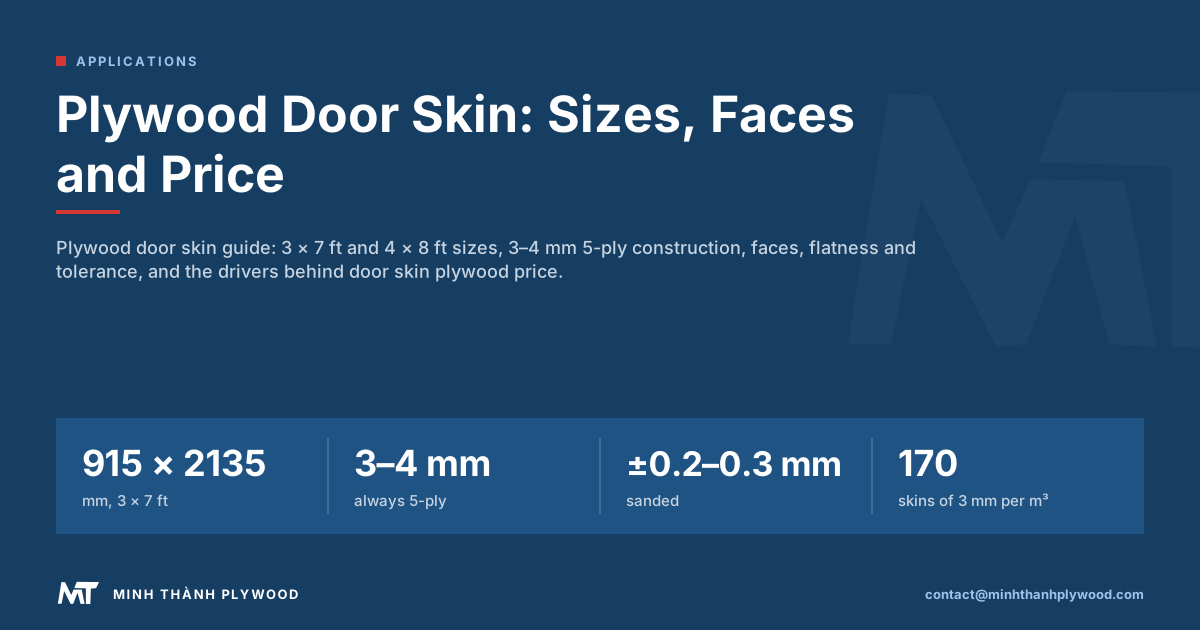
A plywood door skin is a thin decorative plywood sheet, usually 3–4 mm, glued over a door frame and core to form the two faces of a flush door. Buyers order it by size, face, thickness and flatness. This guide covers standard sizes, the 5-ply build that keeps skins flat, faces, and what sets door skin plywood price. Minh Thanh Plywood makes thin 3–5 mm plywood, always 5-ply.
What is a plywood door skin (doorskin plywood)?
A plywood door skin is a thin plywood sheet, usually 3–4 mm thick, that forms one face of a flush door. Two skins are glued over a frame of stiles and rails and a core of honeycomb, particleboard or timber, then pressed flat and trimmed.
The skin is the part the customer sees and touches. It must have a clean decorative face, stay flat after pressing, take paint, stain or lacquer evenly, and resist dents from daily use. Door factories buy skins by the container and expect every sheet in a pack to press the same way.
Plywood door skins are also called doorskin plywood, door skin panels, or by their face, such as “lauan door skin” or “EV door skin”. The build behind the name decides how the door turns out.
Plywood door skin sizes
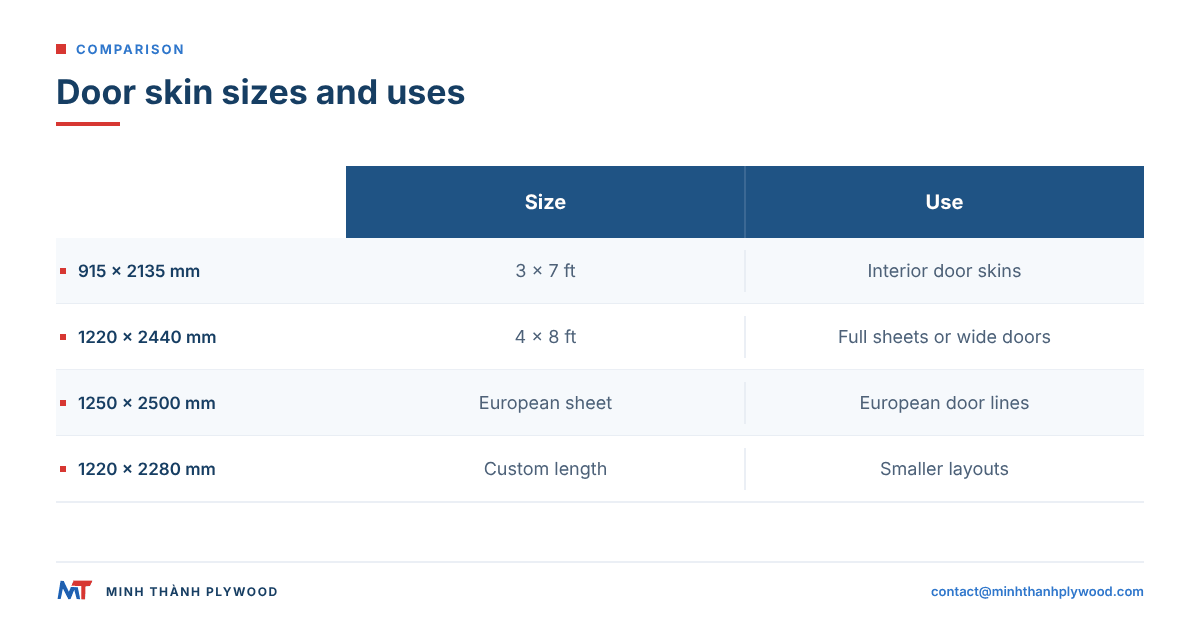
The common plywood door skin size is 3 × 7 ft, about 915 × 2135 mm, which covers most interior door leaves with a trimming margin. Larger and custom sizes follow the door maker’s leaf sizes.
| Size | Metric | Use |
|---|---|---|
| 3 × 7 ft | About 915 × 2135 mm | Standard interior door skins, US and many export markets |
| 4 × 8 ft | 1220 × 2440 mm | Full sheet; cut down for skins, or used for wide and double doors |
| European sheet | 1250 × 2500 mm | Full sheet for European door lines |
| Custom length | 1220 × 2280 mm | Shorter custom sheet for smaller component layouts |
| Cut to size | One sheet into 4, 6 or 8 pieces | Small door panels, cabinet doors, wardrobe fronts |
Skins are ordered slightly larger than the finished leaf, so the edges can be trimmed flush after pressing. Give the supplier the leaf size and your trimming margin rather than a sheet size, and the cutting plan follows. See our plywood sheet sizes guide for the full list of metric and imperial formats.
How thick is a door skin, and why does 5-ply matter?
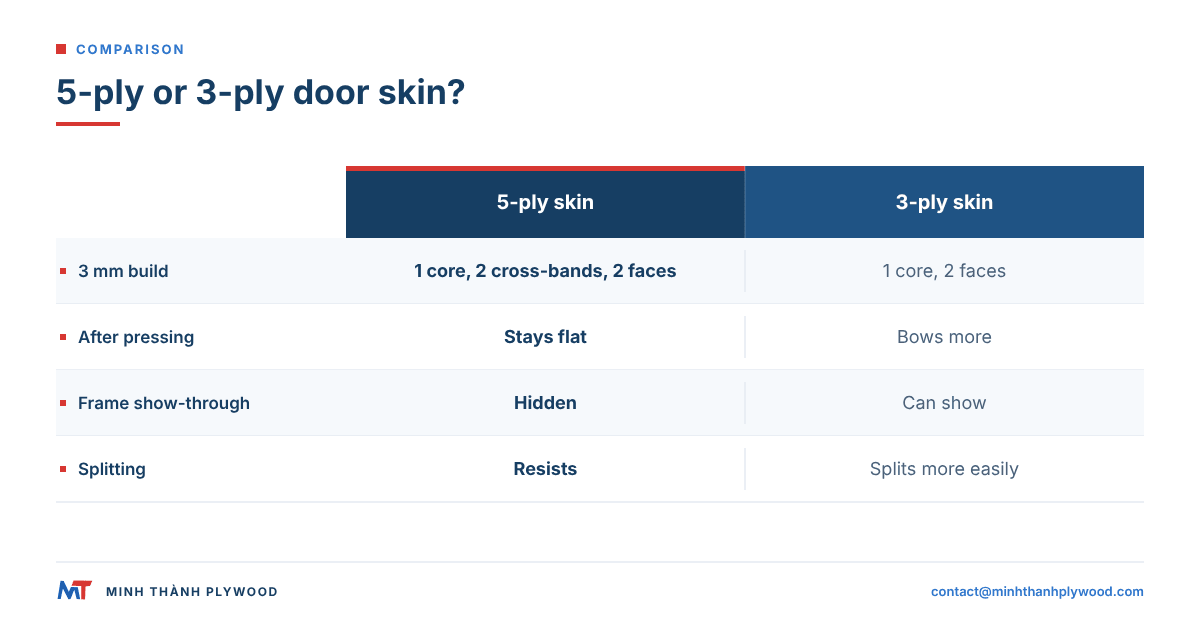
Most plywood door skins are 3 mm or 4 mm thick; in US inches that is 1/8 in (3 mm) and 5/32 in (4 mm), and the market also sells skins of 2.7 mm. US stores label them “1/8 in door skin” or “1/8 in lauan”. The build matters as much as the thickness: a 5-ply skin stays flat and hides the frame, a 3-ply skin moves and telegraphs.
| 5-ply skin | 3-ply skin | |
|---|---|---|
| 3 mm build | 1 core veneer, 2 cross-band veneers, 2 face veneers | 1 core veneer, 2 face veneers |
| 4 mm build | 3 core veneers, 2 faces | 1 thick core veneer, 2 faces |
| Flatness after pressing | Stays flat; layers pull evenly | Bows more with humidity changes |
| Frame telegraphing | Hidden by the cross-bands | Stiles and core can show through the face |
| Splitting along the grain | Resists | Splits more easily at edges and holes |
Our thin plywood of 3–5 mm is always 5-ply: at 3 mm, one core veneer, two cross-band veneers and two face veneers; at 4 and 5 mm, three core veneers and two faces, with the core veneer thickness adjusted to the panel. Premium thin veneer is scarce, so 4 mm can take longer; we do not lower the standard to go faster.
A 4 mm skin resists dents and hides the frame better; a 3 mm skin is lighter and uses less panel per door. A common choice is 3 mm for painted doors and 4 mm for veneered and stained doors.
How to tell a real plywood door skin from a paper-faced one
A plywood door skin shows distinct veneer layers on the cut edge, while an HDF skin shows a uniform fibreboard core. A paper face alone does not identify the core material. Buyers on forums such as boatdesign.net report that much of what big-box stores sell as “door skin” is now a wood-faced paper product, so check before you order a container.
- Look at the edge. Plywood shows cross-laminated veneer layers; HDF shows a fibreboard core.
- Scratch a corner. A paper face peels in a thin film; a veneer face lifts as wood.
- Bend a sample. Plywood springs back along the grain; HDF is brittle and cracks.
- Ask for the build. The supplier should state the plies, the face species and the glue emission on the quote.
Faces for plywood door skins
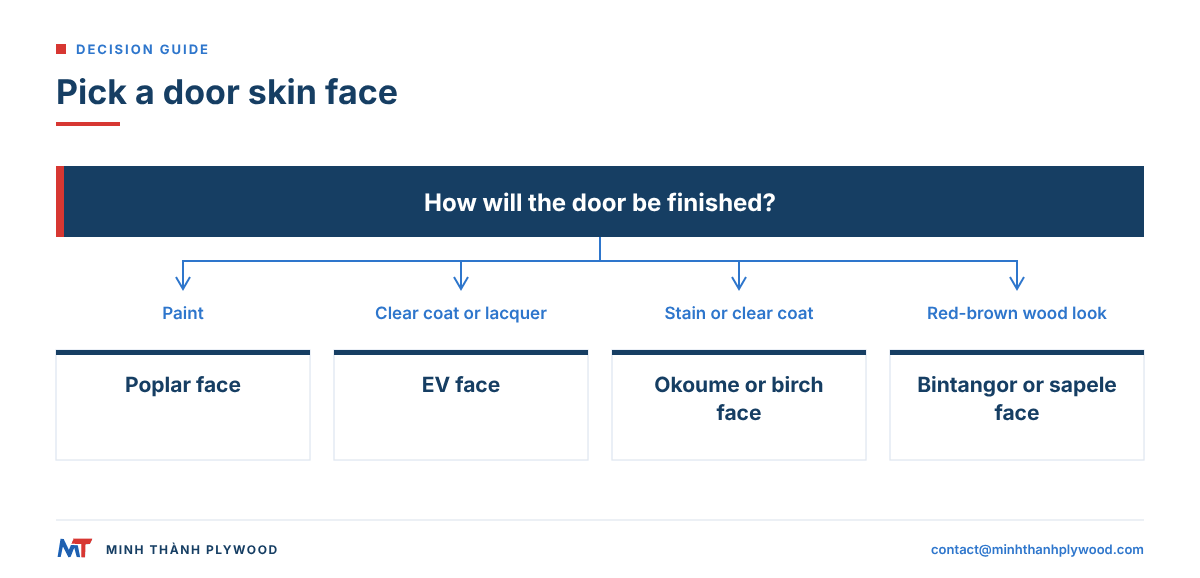
Choose the door skin face by the finish the door will get: stained or clear-coated doors need a real wood face with even colour; painted doors need a smooth, closed face.
| Face | Look | Best finish | Note |
|---|---|---|---|
| EV (engineered veneer) | Repeatable wood looks and colours, from oak and walnut patterns to plain | Clear coat, lacquer | Same look sheet after sheet; see our EV plywood range |
| Okoume | Pink to red-brown, even grain | Stain, clear coat | Light weight |
| Bintangor | Red-brown, close to the traditional lauan look | Stain, paint | A common door skin face in Asia |
| Birch | Pale, fine grain | Clear coat, paint | Hard face, resists dents |
| Poplar | Pale cream | Paint | Cost-effective painted doors |
| Sapele | Red-brown, ribbon figure | Clear coat | On request |
Faces are graded by face and back. For door skins, both faces of a door are visible, but each skin has only one show face; a grade pair such as A/B gives a top face on the show side and a sound back that is glued down.
Plywood, HDF or MDF door skins: which to choose?
Choose plywood door skins for flat doors with a real wood face, moisture resistance and low weight; choose moulded HDF skins for embossed, panelled designs that will be painted.
| Plywood door skin | Moulded HDF door skin | Flat MDF skin | |
|---|---|---|---|
| Face | Real wood veneer or EV | Primed or foil, embossed panels | Paint-grade or laminate |
| Weight | Light | Heavier | Heavier |
| Moisture | Good with the right glue | Swells at edges if wet | Swells at edges if wet |
| Dent and impact | Good, best with 4 mm or hard faces | Fair | Fair |
| Screws and hinges | Holds better | Weak at edges | Weak at edges |
| Typical door | Flush veneered, stained or lacquered | Panel-look painted interior doors | Flat painted doors |
Plywood skins also repair better: a dent in a veneered skin can be filled and refinished, where an embossed HDF face is usually replaced.
Door skin plywood price: what sets it?
Door skin plywood price is set mainly by the face, the thickness, the glue and emission class, the size and cutting, and the quantity per container. As a starting point, our furniture and interior plywood is priced from US$350/m³ and commercial plywood from US$250/m³ (October 2026); the final price follows the specification.
| Price driver | Lower price | Higher price |
|---|---|---|
| Face species | Poplar, bintangor | EV patterns, birch, okoume, sapele |
| Face grade | B/B for paint | A/A or A/B for stain and clear coat |
| Thickness | 3 mm | 4 mm, more panel per skin |
| Build | — | 5-ply as standard in thin plywood |
| Glue and emission | Standard interior glue | UF glue at E0 emission, CARB P2 / TSCA Title VI |
| Size and cutting | Full standard sheets | Custom sizes, cut to leaf size |
| Finish | Sanded | Sanded and polished faces, UV-ready |
| Quantity | Full 40HC of one specification | Small mixed loads |
| Delivery term | FOB Hai Phong | CFR or CIF to your port |
Thin plywood is priced by volume, so a cheaper price per m³ on a thinner skin is not always cheaper per door. Compare offers per finished door skin, with the same face, grade, glue and size. Our plywood price guide explains the m³ basis.
How to convert a price per m³ into a price per door skin
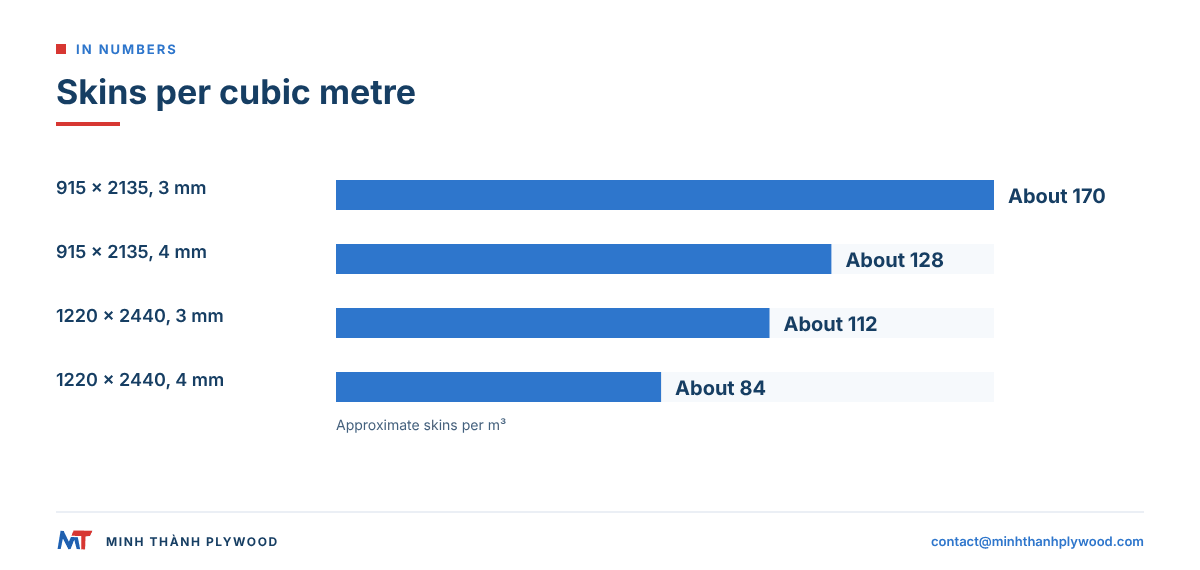
Divide the price per m³ by the number of skins in one cubic metre. One skin’s volume is its length × width × thickness, so the count is easy to work out for any size.
| Skin | Volume per skin | Skins per m³ |
|---|---|---|
| 915 × 2135 mm, 3 mm | 0.0059 m³ | About 170 |
| 915 × 2135 mm, 4 mm | 0.0078 m³ | About 128 |
| 1220 × 2440 mm, 3 mm | 0.0089 m³ | About 112 |
| 1220 × 2440 mm, 4 mm | 0.0119 m³ | About 84 |
Illustrative price per skin. At an assumed US$350/m³, a 3 mm skin of 915 × 2135 mm calculates to about US$2.05 (0.915 × 2.135 × 0.003 × 350) and a 4 mm skin to about US$2.73 (0.915 × 2.135 × 0.004 × 350). A full 1220 × 2440 mm, 3 mm sheet calculates to about US$3.13 (1.22 × 2.44 × 0.003 × 350). These are volume calculations, not offers. The confirmed quotation specifies the construction and delivery term; add cutting, packing or freight only where quoted separately.
US retail runs well above it: a pricing guide puts a 1/8 in (3 mm) 4 × 8 ft sheet at about US$19, and a forum buyer quotes US$11.49 for 1/8 in lauan at Menards. Both prices were checked on 21 October 2026. A door maker buying by the container pays a fraction of the retail sheet price.
Worked method: multiply the quoted price per m³ by the skin’s exact length × width × thickness in metres, then add the cutting and packing lines of the quotation. Do the same for every offer and compare the results per skin and per door, which uses two skins.
Flatness, tolerance and moisture: the specs that stop warping and telegraphing
Door skins fail in three ways: they bow after pressing, they show the frame through the face, or they press unevenly because thickness varies. Three specification lines prevent all three.
- Thickness tolerance. Write it on the order. Our sanded panels are made to ±0.2–0.3 mm, down to ±0.2 mm, so the press closes evenly on every skin in the pack.
- Moisture. Panels leave at 8–12 % moisture content, the normal range for furniture plywood. Condition skins to the door factory’s environment before pressing; later moisture changes can still cause movement.
- Balanced build and flat pressing. A 5-ply build, and furniture-grade panels pressed twice as standard: the core is pressed and calibrated first, then face and back are pressed on. A calibrated core gives a flat skin with an even face.
Length and width tolerance is ±2 mm, which the trimming margin absorbs. Store skins flat on a full pallet, covered, and let them settle in the door plant before pressing.
Glue and emission for interior door skins
Interior door skins use UF glue at E0 emission as standard; finished-door compliance depends on the complete construction and the applicable emission requirements. Glue type and emission class are two separate lines on the order.
- UF glue at E0 emission: interior doors, bedroom and office doors, wardrobe fronts.
- Melamine-fortified (MR) glue: doors for kitchens, bathrooms and humid climates.
- Phenolic (WBP) glue: rarely needed for interior skins; used where the specification requires a boil-resistant bond.
Our panels are CARB P2 / TSCA Title VI certified as ICTT mill no. 23024, and six ASTM D6007 chamber tests between April 2025 and June 2026 on 9, 15 and 18 mm panels averaged 0.014–0.032 ppm against the 0.05 ppm limit. For US doors, the skins carry the TSCA Title VI label. EPA lists a 0.05 ppm limit for veneer-core hardwood plywood, and California applies the same limit through the CARB composite wood products programme.
The bonding quality of the glue lines inside the plywood is covered by BS EN 314-2, the BSI standard for plywood bonding quality requirements.
The glue that bonds the skin to the door frame is the door maker’s choice and a separate specification from the glue inside the skin.
How are door skins pressed onto a door?
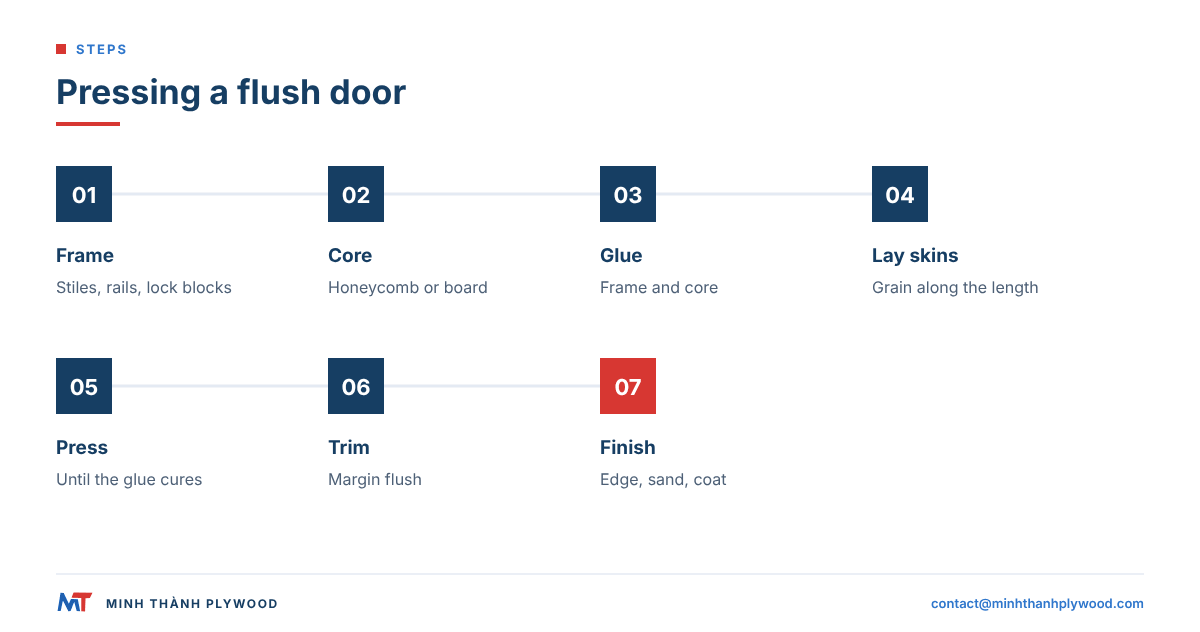
Door skins are glued to both sides of a frame and core, pressed flat until the glue cures, then trimmed and edged.
- Build the frame: stiles, rails and lock blocks in timber or LVL.
- Fill the core: honeycomb paper, particleboard, timber strips or a solid core.
- Spread glue on the frame and core, or on the back of the skin.
- Lay the skins on both faces, show face out, face grain along the door length.
- Press in a cold or hot press until the glue cures.
- Trim the skin margin flush with the frame.
- Edge, sand and finish: lipping, sanding, then paint, stain or lacquer.
The skin’s own flatness and thickness decide step 5: a skin that varies across the pack presses unevenly and shows marks after finishing.
Packing and shipping plywood door skins
Door skins ship flat in covered packs on full pallets, with corner protection, so thin sheets arrive flat and with clean edges.
- Packs: skins of one size, face and grade per pack, face to face, with pack labels showing the specification and count.
- Pallets and covers: a full base under the pack, plywood or carton top cover, and steel or plastic strapping over corner guards.
- Container: thin sheets load by volume and weight; at 3 mm on a white Styrax core, a 40HC planned with 1220 × 2440 mm sheets carries 5,994 sheets in 18 packs of 333, about 4.5 kg per sheet.
- Records: every shipment is photographed and filmed before loading, and buyers get the photos and video.
Mixed loads of several skin sizes or faces are possible by agreement, usually 1–2 specifications per container.
What to write on a plywood door skin order
Write the door skin specification line by line, so every supplier quotes the same skin. Copy and fill in:
- Size: finished leaf size and trimming margin, or the cut size.
- Thickness and build: 3 mm or 4 mm, 5-ply.
- Face and back: species or EV pattern, grade pair such as A/B, approved sample.
- Face grain direction: along the length.
- Glue and emission: UF glue at E0 emission, or MR; CARB P2 / TSCA Title VI for US doors.
- Thickness tolerance: ±0.2–0.3 mm sanded.
- Moisture: 8–12 % at dispatch.
- Finish: sanded, or sanded and polished, UV-ready if you coat it.
- Packing: skins per pack, pallets, covers, labels.
- Quantity and delivery: skins or containers, destination port, FOB, CFR or CIF.
A spec line ready to send: “Plywood door skin 915 × 2135 mm, 3 mm 5-ply, EV face A/B, UF glue at E0 emission, ±0.2–0.3 mm, 8–12 % moisture, sanded, 1×40HC CIF [your port].”
Plywood door skins from Minh Thanh Plywood
We make thin 3–5 mm plywood in Ha Hoa, Phu Tho, always 5-ply, for furniture and interior buyers in Europe and other markets.
| Line | What we offer |
|---|---|
| Thickness | 3, 4 and 5 mm, always 5-ply |
| Faces | EV, poplar, birch, okoume, bintangor, pine; sapele and others on request |
| Cores | White Styrax or Eucalyptus |
| Glue | UF glue at E0 emission standard; MR and phenolic (WBP) to specification |
| Tolerance | ±0.2–0.3 mm sanded, down to ±0.2 mm; ±2 mm length and width |
| Sizes | 1220 × 2440 and 1250 × 2500 mm; custom sizes; cut to size into 4, 6 or 8 pieces |
| Finish | Sanded and polished, both faces UV-ready |
| Order | MOQ 1×40HC, mixed specifications by agreement; 15–45 days after the 30% deposit; free samples |
Send your leaf size, face and quantity through the thin plywood page, or ask for cut-to-size plywood for skins cut to your door. For the wider door picture, see our guide to plywood for doors.
Buyer questions, answered
What is door skin plywood?
Door skin plywood is thin plywood, usually 3–4 mm, made to be glued onto a door frame and core as the visible faces of a flush door. It needs a decorative face, a balanced build and very even thickness so it stays flat after pressing.
What size are plywood door skins?
The common door skin size is 3 × 7 ft, about 915 × 2135 mm, which covers standard interior doors with trimming margin. Skins are also cut from 4 × 8 ft (1220 × 2440 mm) sheets, and custom sizes follow the door maker's leaf sizes.
How thick is a plywood door skin?
Most plywood door skins are 3 mm or 4 mm; the market also sells 2.7 mm skins. Thicker 4 mm skins resist dents and hide the frame better; 3 mm skins are lighter and cheaper per door.
How much does door skin plywood cost?
Price follows the face, thickness, glue, size and quantity. As a guide, our furniture and interior plywood starts from US$350/m³ (October 2026); a 3 mm skin of 915 × 2135 mm uses about 0.0059 m³ of panel.
Is a plywood door skin better than HDF?
Plywood skins are lighter, take real wood veneer faces and resist moisture and screw-pulling better; moulded HDF skins are cheaper for embossed panel designs that are painted. For flat veneered or stained doors, plywood is the usual choice.
Why do door skins need 5-ply construction?
A 5-ply build balances the thin sheet: the layers pull evenly, so the skin stays flat after pressing and does not crack along the grain. Three-ply skins move more with humidity and show the frame through the face.
Which face is best for plywood door skins?
Choose the face by finish: EV (engineered veneer) for repeatable wood looks and colours, okoume or bintangor for a red-brown face that stains well, birch or poplar for a pale face under paint or clear coat.
Can door skins be cut to the door size at the mill?
Yes. A full sheet can be cut into pieces at the mill, so the door factory receives skins close to its leaf size and trims only the margin after pressing.
What glue should a door skin have?
Interior doors use UF glue at E0 emission for low formaldehyde; doors for humid rooms can take a melamine-fortified glue. The glue of the skin and the glue used to press it onto the door are two separate specifications.