
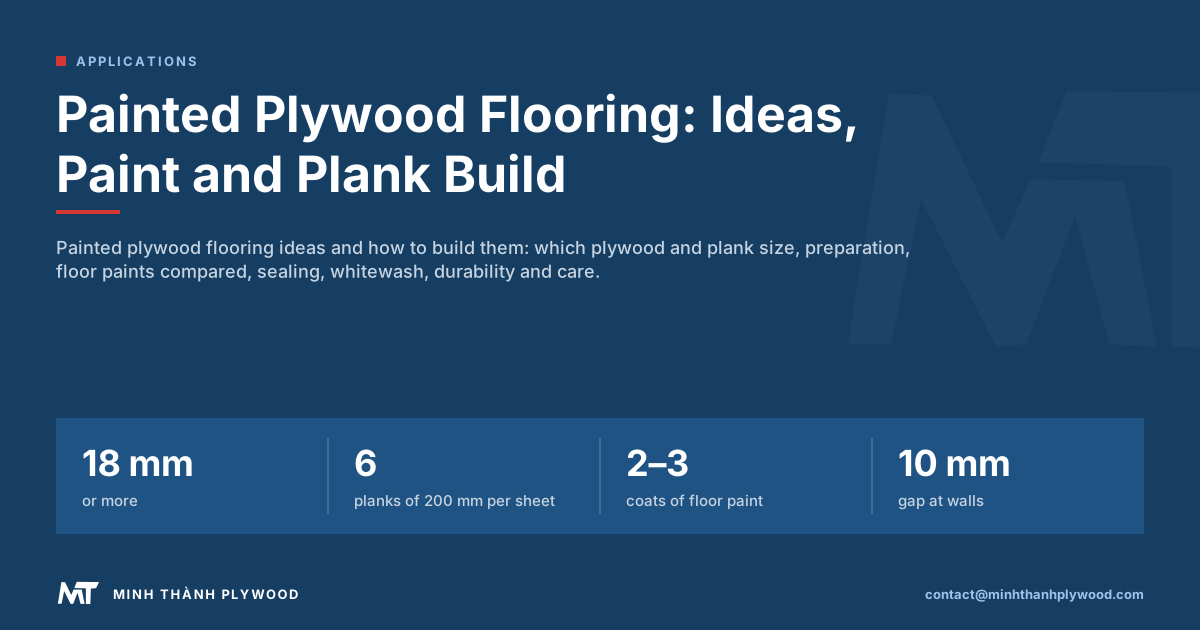
Painted plywood flooring is a low-cost, hard-wearing floor when it is built right: an 18 mm or thicker sanded panel, cut into planks or laid as sheets, primed, then two or three coats of floor paint and a clear topcoat in busy rooms. Whitewashed, stained and clear-sealed plywood floors follow the same build. Minh Thanh Plywood makes the sanded faced panels.
Is painted plywood flooring a good idea?
Painted plywood flooring is a good idea for studios, bedrooms, offices, sheds and rentals where cost and look matter more than a lifetime of sanding. It costs a fraction of hardwood, lays fast, and a proper floor paint system takes daily foot traffic for years.
Where it works and where it does not:
| Room or use | Painted plywood? | Why |
|---|---|---|
| Bedroom, living room, office | Yes | Light to medium traffic, easy touch-up |
| Studio, shop fit, pop-up | Yes | Fast to lay, any colour |
| Shed, cabin, workshop | Yes, with epoxy or exterior floor paint | Hard-wearing, cheap |
| Kitchen | With care | Seal every joint; wipe spills fast |
| Bathroom, laundry | No, unless fully sealed WBP | Standing water reaches the edges |
| Commercial high traffic | Epoxy only | Paint wears at entrances |
The weak points are the joints and edges, not the face. A floor that is built flat, sealed at every edge and painted with a floor paint system lasts; one painted with wall paint over open joints does not.
What a painted plywood floor costs per square foot
The budget case is easy to put in numbers. A 3/4 in (18 mm) sanded 4 × 8 ft sheet sells at US home centres for roughly US$63–85, which is 32 sq ft, so US$2.0–2.7 per sq ft for the plywood.
Floor paint at about US$40 a gallon covers 300–400 sq ft per gallon on a smooth surface and needs two coats, so paint adds about US$0.23 per sq ft. Primer and a clear topcoat bring the finish to a few tens of cents per sq ft; total materials come to roughly US$2.5–3.5 per sq ft before labour.
| Floor | Typical US cost per sq ft |
|---|---|
| Painted 18 mm plywood (materials) | US$2.5–3.5 |
| Luxury vinyl plank, installed | US$4–8 |
| Engineered hardwood, installed | US$7–15 |
| Solid hardwood, installed | US$9–18 |
The saving is largest on big areas, and a worn plywood floor is repainted for the price of a gallon, not replaced.
Real floors and how long they last
A reader of one long-running DIY blog reports birch plywood floors in use for over 20 years that still look good, which is what a sealed panel and a renewed finish deliver. The mill’s own experience is the same: Minh Thanh sanded faced panels leave the press with a flat, even face and a bond that holds, so the finish is the only wear layer, and recoating the finish before it wears through is what keeps the veneer intact.
Plywood flooring ideas: eight looks
Plywood flooring ideas fall into eight looks: solid painted, painted patterns, whitewashed, stained, clear-sealed natural, plank-cut, herringbone or parquet, and burnt. All start from the same flat, sanded panel; the finish makes the look.
- Solid painted: one colour, matt or satin; grey, white and deep green are common.
- Painted pattern: checkerboard, stripes, a border or a stencil over a base colour.
- Whitewashed: thinned white wiped into the grain, then a clear seal; a Scandinavian look.
- Stained: a wood stain in oak, walnut or grey tones, then a clear seal.
- Clear-sealed natural: the plywood face as it is, under water-based floor varnish or hardwax oil.
- Plank-cut: sheets cut into planks, so the floor reads as boards.
- Herringbone or parquet: short plywood blocks in a pattern, sealed or painted.
- Burnt: the face charred with a torch, brushed and oiled.
Modern plywood flooring uses the face and the edge as the design: wide planks with eased edges, or full sheets laid in a grid with the joints as lines. Burnt plywood floors need their own method, covered in our guide to burnt plywood floors.
Painted plywood flooring ideas: colours and patterns
The painted plywood flooring ideas that age best are simple: a single mid-tone colour, a two-colour checkerboard, or a painted border around a plain field. Mid-tones hide dust and scuffs; pure white and near-black show every mark.
| Idea | How it is painted | Wear |
|---|---|---|
| Single mid-grey or green | Primer, two coats floor paint | Hides dust and scuffs |
| Checkerboard | Base coat, tape, second colour | Shows wear at corners of squares |
| Painted border | Field one colour, border another | Border stays crisp at walls |
| Stripes or painted rug | Taped bands or a rectangle | Wear shows in the walking line |
| Stencil pattern | Stencil over base, then clear topcoat | Needs the topcoat to last |
Lay out the pattern on the planks or sheets, not the room: square tiles of 305 or 610 mm line up with sheet joints on 1220 × 2440 mm panels. Every pattern needs a clear floor-grade topcoat over it if it is in a walking line.
What plywood for plank floors and sheet floors?
Use a sanded, flat plywood of 18 mm or more with a sound core: birch, pine, poplar or eucalyptus faces for floors that show the grain, any sound face for floors that will be painted solid. Panels pressed twice are flatter, which matters under paint and gloss.
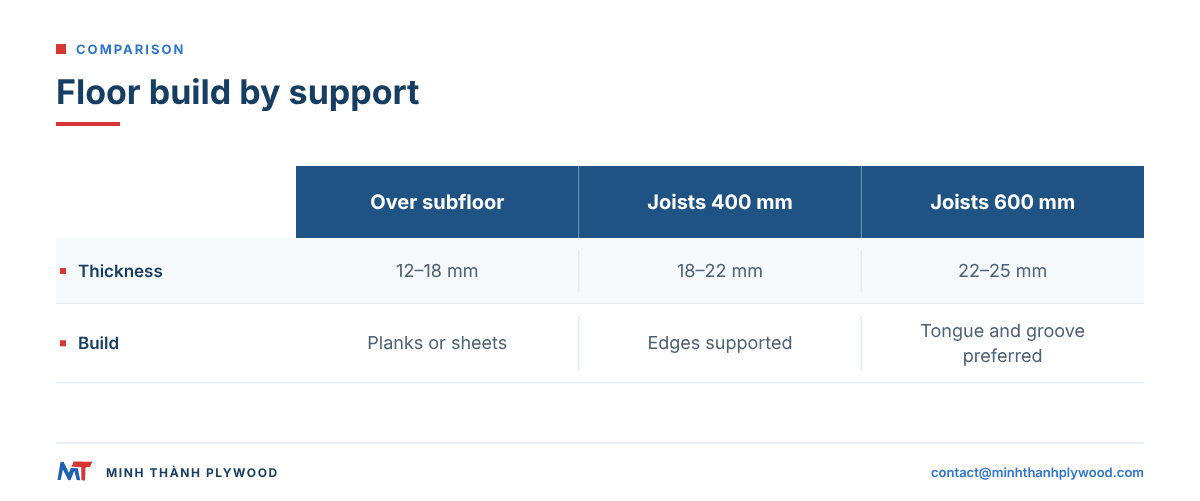
| Floor build | Thickness | Face | Notes |
|---|---|---|---|
| Planks over an existing subfloor | 12–18 mm | Pine A/B, birch D+/D, poplar or eucalyptus A/B | Glued and screwed or nailed to the subfloor |
| Full sheets over a subfloor | 12–18 mm | Any sanded face for paint | Grid of joints as a design |
| Sheets as floor on joists at 400 mm | 18–22 mm | Sanded face | Edges on joists or noggings |
| Sheets as floor on joists at 600 mm | 22–25 mm | Sanded face | Tongue and groove preferred |
| Shed, cabin or garage | 18 mm or more | Utility or pine, WBP bond | Paint all faces and edges |
Face grade matters most when the floor is stained, whitewashed or clear-sealed, because every patch shows. For pine faces, A/B gives a clean face with a sound back; for birch, D+/D, close to European B/BB. Painted solid floors can use a lower face grade with holes filled. Plywood for dry, humid or exterior conditions is covered by BS EN 636:2012+A1:2015, and its bonding quality is set out in BS EN 314-2:1993. Minh Thanh’s pine plywood and birch plywood pages list the face grades.
Plank size and layout from a plywood sheet
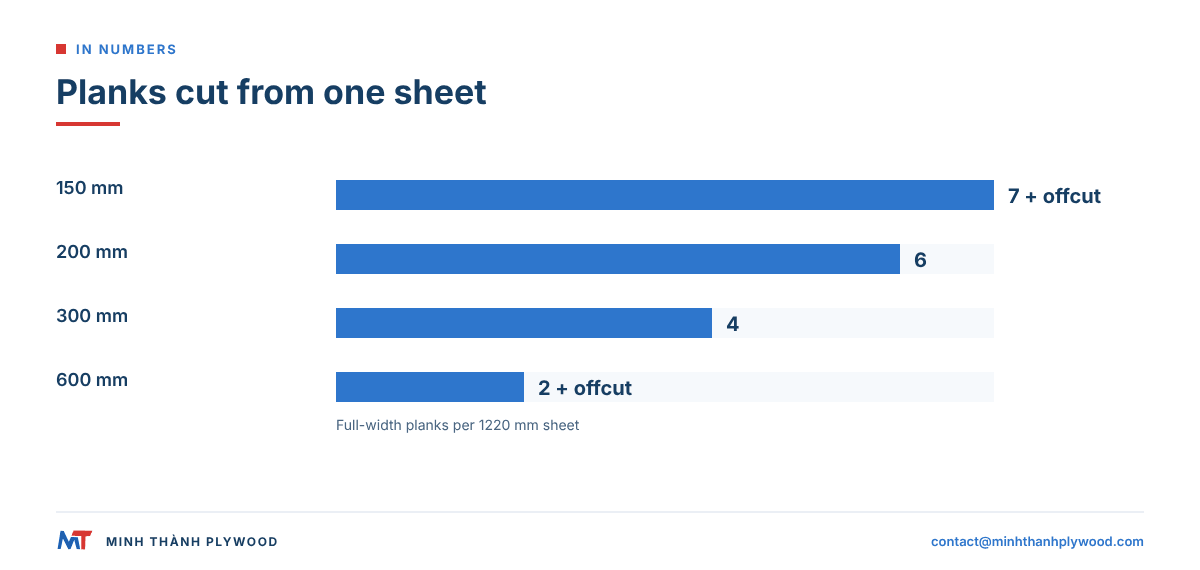
Cut 1220 × 2440 mm sheets into planks of 200 mm or 300 mm width for a board look: six planks of 200 mm or four of 300 mm per sheet, each 2440 mm long. Wider planks mean fewer joints, and fewer joints mean fewer places for paint to crack.
| Plank width | Planks per sheet | Look |
|---|---|---|
| 150 mm | 7 plus a near-full-width offcut (8 with a thin kerf) | Classic board floor |
| 200 mm | 6 | Wide board |
| 300 mm | 4 | Modern wide plank |
| 600 mm | 2, with a narrow offcut | Large panel, tile-like |
Layout rules:
- Run planks along the light from the main window, so joints show less.
- Stagger end joints by at least 300 mm between rows.
- Ease the plank edges slightly with sandpaper, so paint bridges the joint without a sharp ridge.
- Leave a 10 mm gap at the walls, hidden by the skirting, for movement.
How do you prepare a plywood floor for painting?
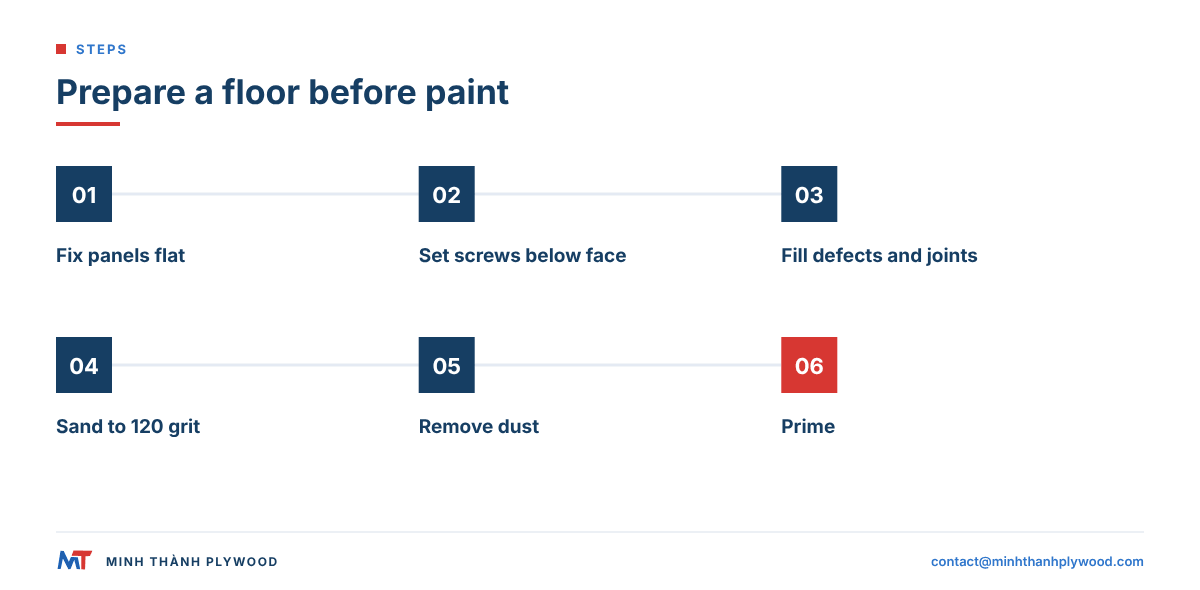
Prepare a plywood floor for painting in six steps: fix every sheet or plank flat, set screws below the surface, fill holes and joints, sand, remove all dust, and prime. Paint only shows the floor underneath; preparation decides the finish.
- Fix: glue and screw every plank or sheet to the joists or subfloor, so nothing moves or squeaks.
- Set the screws about 2 mm below the face.
- Fill screw holes, knots and open defects with a sandable wood filler; fill joints with a flexible filler where they will be painted.
- Sand to 120 grit, with the grain on planks.
- Remove dust by vacuum, then a damp cloth.
- Prime with the primer the floor paint maker specifies; stain-blocking primer over knots in pine faces.
Let the plywood stand in the room for two or three days before laying, so it reaches the room’s moisture. Plywood leaves our mill at 8–12 % moisture, close to most heated interiors.
How to paint plywood floors
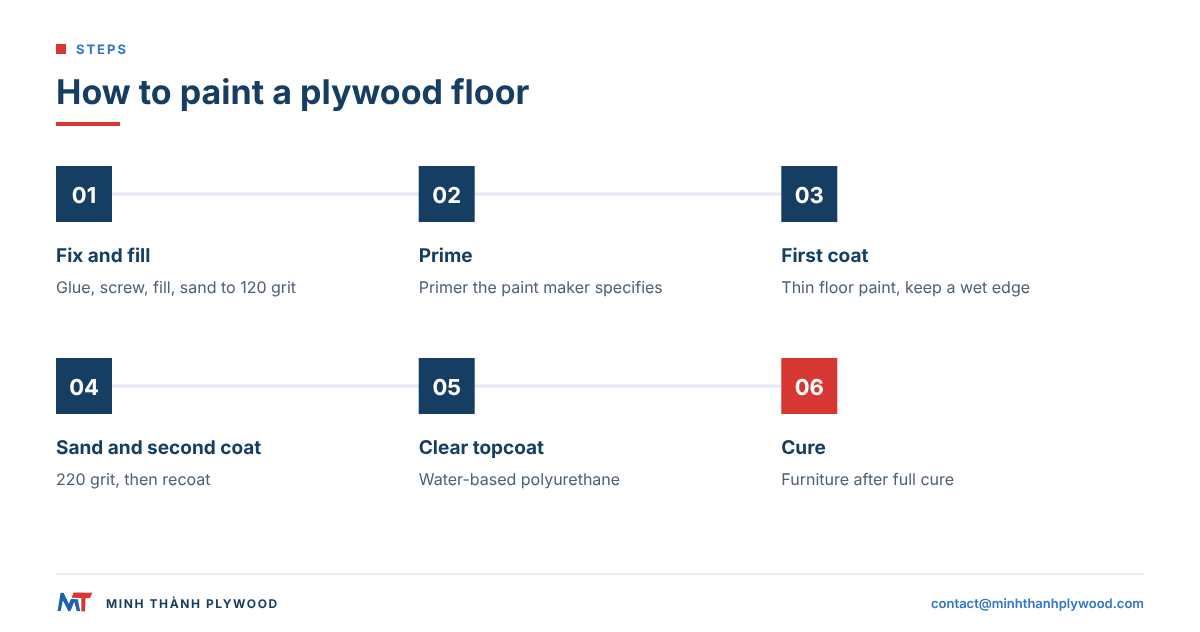
Paint plywood floors with a primer, two or three thin coats of floor paint, and a clear floor-grade topcoat in busy rooms, letting each coat dry fully. Thin coats cure harder than thick ones and level better on plywood.
- Prime the whole floor, and let it dry as the label says.
- Cut in at the walls with a brush.
- Roll the first coat of floor paint thinly, plank by plank, keeping a wet edge.
- Sand lightly with 220 grit when dry, then vacuum.
- Roll the second coat, and a third in entrances and walking lines.
- Apply a clear topcoat, water-based polyurethane for paint colours that must not yellow.
- Wait before use: light foot traffic after a day, furniture and rugs after the full cure in the label’s time.
Add an anti-slip additive to the last coat on stairs and in kitchens. Furniture should go back on felt pads, not dragged.
Which floor paint for plywood?
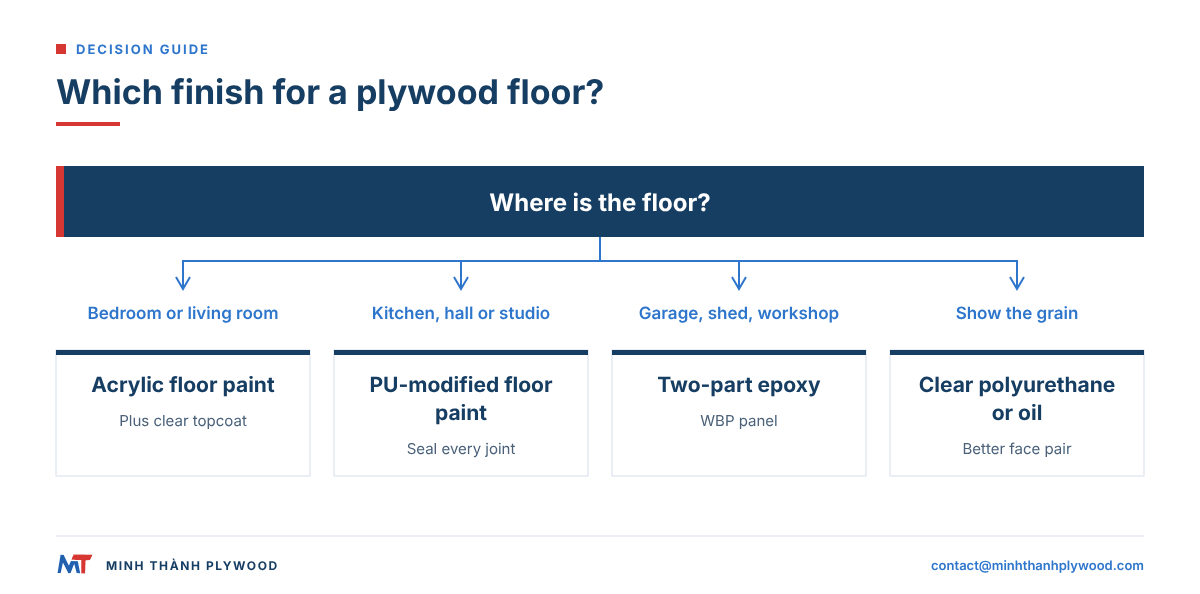
Choose a dedicated floor paint: porch-and-floor acrylic or alkyd for homes, polyurethane-modified floor paint for busier rooms, and two-part epoxy for garages, workshops and sheds. Wall paint is too soft and wears through in the walking line.
| Paint | Hardness and wear | Water resistance | Best for |
|---|---|---|---|
| Acrylic porch and floor paint (for example Behr Premium Porch & Patio Floor Paint) | Good | Good | Bedrooms, living rooms, porches |
| Alkyd (oil-based) floor paint | Good, slow to cure | Good | Older homes, workshops |
| Polyurethane-modified floor paint, or a water-based polyurethane topcoat such as Minwax Polycrylic or Varathane floor finish | High | Very good | Kitchens, halls, studios |
| Two-part epoxy floor paint (for example Rust-Oleum EpoxyShield) | Highest | Very good | Garages, sheds, workshops, commercial |
| Chalk or wall paint plus varnish | Depends on the varnish | Fair | Light-use decorative floors |
| Wall emulsion alone | Low | Poor | Not for floors |
Waterproof paint for a plywood floor does not exist in the sense buyers hope for: epoxy and polyurethane floor paints make the face water-resistant, but water still enters at unsealed edges and joints. In wet areas, the panel’s bond and edge sealing matter more than the paint.
How durable is a painted plywood floor?
A painted plywood floor with primer, floor paint and a clear topcoat lasts for years in a home and is renewed by touching up worn areas; epoxy lasts longest, a plain acrylic floor paint without topcoat wears first at doors and in front of sofas and desks.
How each system wears:
| System | First wear appears | Renewal |
|---|---|---|
| Two-part epoxy | Slowest; scratches before wear-through | Scuff-sand and recoat the area |
| Floor paint plus clear polyurethane | Topcoat dulls in walking lines | Recoat the topcoat |
| Floor paint, no topcoat | Paint thins at entrances | Touch up and recoat |
| Clear-sealed natural face | Finish dulls, face darkens | Light sand and recoat |
| Whitewash under varnish | Varnish dulls | Recoat the varnish |
The plywood face is a veneer, so wear must stop in the finish. The US Forest Products Laboratory’s Wood Handbook covers how film-forming finishes protect wood and why they are renewed before they wear through. A floor recoated before the paint wears through keeps the face intact; one sanded back to bare veneer repeatedly will reach the glue line.
Whitewashed plywood flooring
Whitewashed plywood flooring is made by wiping a thinned white stain or diluted white paint into the sanded grain, then sealing it with a clear, non-yellowing water-based floor varnish. The result is pale and Scandinavian, with the grain still visible.
Method:
- Sand to 120 grit and remove all dust.
- Apply a white wood stain or white paint diluted with water, one plank at a time.
- Wipe back with a cloth after a few minutes, along the grain, until the grain shows through.
- Dry fully, then sand very lightly with 220 grit.
- Seal with two or three coats of clear water-based floor varnish; oil-based varnish turns whitewash yellow.
Whitewash suits faces with even grain: birch, poplar and eucalyptus take it evenly; pine shows strong figure through it. Test on an offcut of the same batch before doing the floor.
How do you seal a stained or natural plywood floor?
Seal a plywood floor with three thin coats of water-based floor polyurethane, or two coats of hardwax oil, after sanding to 120–150 grit; sand lightly between coats. Seal the plank edges before laying so water cannot get into the joints.
| Sealer | Look | Wear | Upkeep |
|---|---|---|---|
| Water-based polyurethane, matt or satin | Clear, does not yellow | High | Recoat when dull |
| Oil-based polyurethane | Ambers the face | High | Recoat when dull |
| Hardwax oil | Natural, low sheen | Good, repairable in spots | Re-oil worn areas |
| Lacquer | Clear | Good | Professional recoat |
Staining plywood evenly is the hardest part: a pre-stain conditioner on pine and birch prevents blotching. Clear-sealed floors show the face grade, so order the better face pair for them.
Should I paint my plywood shed floor?
Yes: paint a plywood shed floor with a primer and two coats of exterior floor paint or epoxy, and paint the underside and edges before the floor goes down. Paint keeps oil and dirt out of the face and slows water damage at the door.
What a shed floor needs:
- Panel: 18 mm or thicker, WBP-bonded exterior plywood.
- Bearers: treated timber, spaced to suit the panel thickness.
- All faces sealed: underside and edges painted before laying.
- Top: primer and two coats of exterior floor paint, or two-part epoxy for a workshop.
- Door threshold: a metal or hardwood strip where water and wear meet.
Minh Thanh’s exterior plywood uses melamine-fortified or phenolic (WBP) glue made for outdoor uses; the WBP bond is the one for floors that see damp.
How do you clean painted plywood floors?
Clean painted plywood floors by sweeping or vacuuming grit, then mopping with warm water and a mild, pH-neutral cleaner, wrung almost dry. Grit is what wears paint; water at the joints is what lifts it.
Do and do not:
- Do use doormats at every outside door.
- Do put felt pads under furniture feet.
- Do wipe spills straight away, especially near joints.
- Do not use steam mops, which drive water into joints.
- Do not use solvent cleaners or abrasive powders on the topcoat.
- Do not leave wet mats or plant pots standing on the floor.
A floor with a clear topcoat cleans more easily than bare floor paint and is the better choice in kitchens and halls.
How to avoid gaps, cupping and peeling
Most problems with painted plywood floors come from moisture and movement: planks laid wet open gaps as they dry, sheets laid tight cup when the air turns humid, and paint over a dusty or moving surface peels. Lay dry, leave gaps, fix firmly.
| Problem | Cause | Prevention |
|---|---|---|
| Gaps between planks | Planks laid wetter than the room | Acclimatise two or three days; panels at 8–12 % |
| Cupping or ridges | No expansion gap, humid room | 10 mm gap at walls, small gaps between sheets |
| Cracked paint at joints | Joints move | Glue and screw; flexible filler; ease edges |
| Peeling | Dust, no primer, wrong paint | Clean, prime, floor paint |
| Squeaks | Loose sheets or planks | Glue and screw to every joist |
| Face checks | Thin or poor face veneer | Sanded panels with a sound face |
A subfloor that is level and dry is the first condition. Our guide to wood flooring types compares plywood with other floor materials.
What this means for your order
Order plywood for a painted or finished floor with six lines: use, thickness, face pair, bond, size and packing with quantity. The face pair matters for stained and clear floors; the thickness and bond matter for every floor.
- Use: interior plank floor, painted; or clear-sealed; or shed floor.
- Thickness: 18 mm for planks over a subfloor; 22–25 mm on joists at 600 mm.
- Face pair: pine A/B, birch D+/D, poplar or eucalyptus A/B; utility faces for painted shed floors.
- Bond: UF at E0 emission or MR for dry interiors; phenolic (WBP) for sheds and damp rooms.
- Size: 1220 × 2440 mm or 1250 × 2500 mm, or cut into planks.
- Packing and quantity: sheets per pack, total sheets, destination port.
Minh Thanh Plywood, Ha Hoa, Phu Tho, Vietnam, makes sanded faced plywood pressed twice for flat faces, at 8–12 % moisture, plus exterior plywood with WBP glue. We ship in full containers: MOQ one 40HC with mixed specifications by agreement, 15–45 days after the 30% deposit, FOB Hai Phong, CFR or CIF, free samples. Send your floor specification to contact@minhthanhplywood.com or WhatsApp Lisa on +84 988 586 601; we reply within hours. For stairs in the same project, see plywood stair treads.
Buyer questions, answered
How durable is a painted plywood floor?
With a primer, two or three coats of floor paint and a clear polyurethane topcoat, a painted plywood floor takes everyday foot traffic for years and is touched up where it wears. Two-part epoxy lasts longest; plain wall paint wears through in weeks.
What plywood is best for plank floors?
A sanded, flat panel of 18 mm or more with a sound core and a hardwood or pine face: birch, pine, poplar or eucalyptus. Panels pressed twice stay flatter, which shows less under paint and gloss.
How do you seal a plywood floor?
Sand to 120–150 grit, vacuum, then apply three thin coats of water-based floor polyurethane or two coats of hardwax oil, sanding lightly between coats. Seal the plank edges before laying, so water cannot enter the joints.
How do you prepare a plywood floor for painting?
Fix every sheet or plank flat, set screw heads below the surface, fill holes and joints, sand to 120 grit, vacuum and wipe the dust, then prime with a primer that suits the floor paint.
What paint is best for plywood floors?
A dedicated floor paint: porch-and-floor acrylic or alkyd for homes, polyurethane-modified floor paint for busier rooms, and two-part epoxy for garages and workshops. Wall paint is too soft.
Is there a waterproof paint for plywood floors?
Two-part epoxy and polyurethane floor paints make a water-resistant surface, but no paint makes plywood waterproof at its edges. Seal every edge and use a WBP-bonded panel in wet areas.
How do you clean painted plywood floors?
Sweep or vacuum grit, then mop with warm water and a mild pH-neutral cleaner, wrung almost dry. Avoid steam mops, solvent cleaners and standing water at the plank joints.
Should I paint my plywood shed floor?
Yes. A primer and two coats of exterior floor paint stop dirt soaking in and slow water damage. Use WBP-bonded plywood for the floor and paint the underside and edges before laying.
How do you whitewash a plywood floor?
Sand the floor, brush on a thinned white stain or diluted white paint, wipe it back so the grain shows, then seal with two or three coats of a clear, non-yellowing water-based floor varnish.
Can you use plywood as a finished floor?
Yes, laid as full sheets or cut into planks over joists or a subfloor, glued and screwed, sanded and finished. It must be thick enough for the joist spacing and sealed against moisture.
What is a burnt plywood floor?
A plywood floor whose face is charred with a torch, brushed and oiled, the shou sugi ban look on plywood. It needs a thick, solid face veneer so the burn does not reach the glue line.