
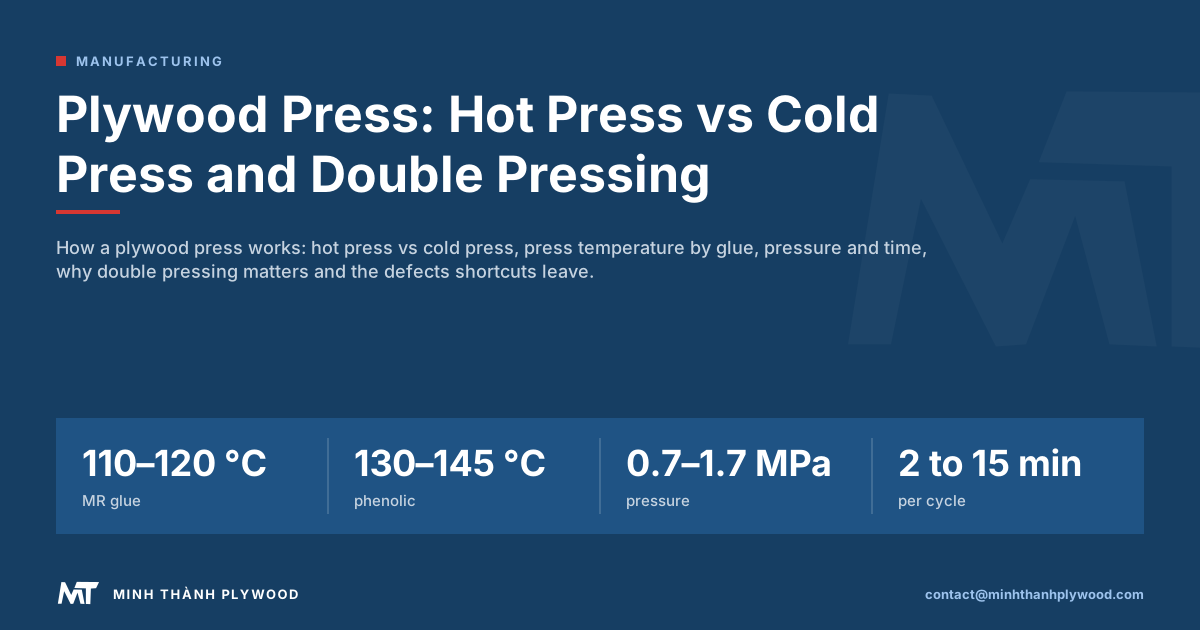
A plywood press bonds glued veneers into one panel with pressure, and in a hot press also with heat that cures the resin. The cold press consolidates the lay-up first; the hot press then cures it, at about 110–120 °C for MR glue and 130–145 °C for phenolic WBP. Minh Thanh Plywood presses furniture panels twice as standard. Here is how each press works and what it means for your panels.
What is a plywood press?
A plywood press is the hydraulic machine that turns a stack of glued veneers into a solid panel by squeezing it between flat platens. A plywood mill runs two kinds: a cold press, which consolidates the lay-up at room temperature, and a hot press, whose heated platens cure the glue.
Every plywood panel goes through at least one press. What separates a commercial sheet from a furniture panel is how many times it is pressed, at what settings, and what the mill does between the presses.
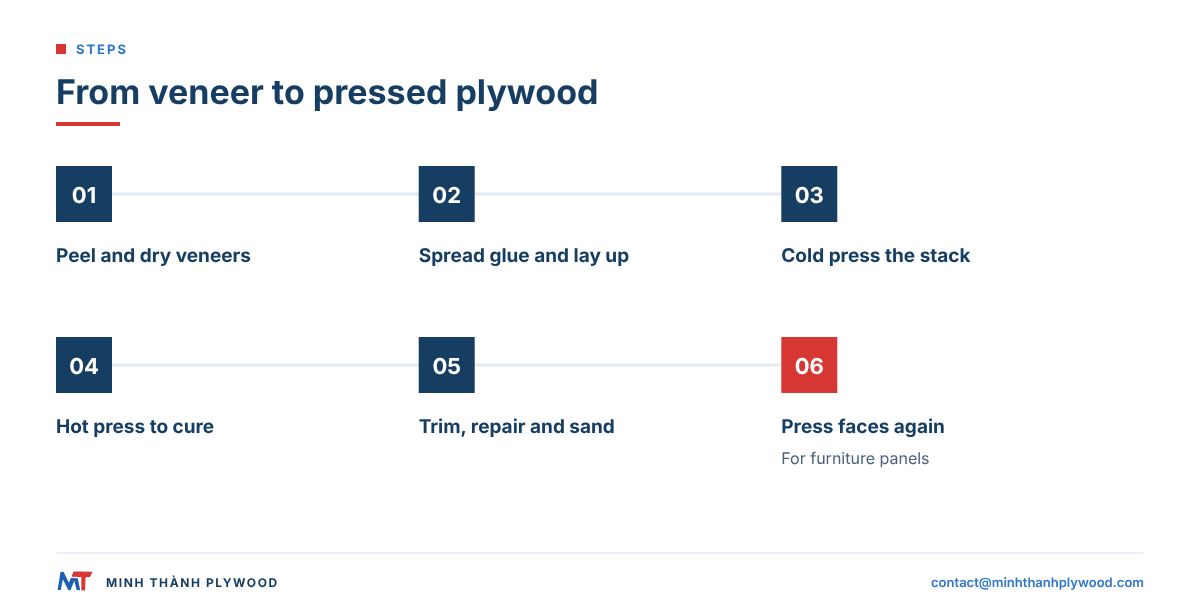
The basic sequence in a Vietnamese mill:
- Veneers are peeled, dried and graded.
- Glue is spread on the cross-band veneers and the stack is laid up, grain crossing at each layer.
- The stack goes into the cold press to consolidate.
- It moves to the hot press to cure.
- The board is trimmed, repaired, calibrated and sanded.
- For furniture panels, face and back veneers are glued on and the panel is pressed again.
Steps 3 to 6 decide most of a panel’s bond strength, flatness and thickness tolerance.
What kinds of plywood presses do mills use, and what do they cost?
Plywood press machines come in six common types, from a single-opening cold press to a through-feed line. A plywood sheet is 4 × 8 ft (1300 × 2600 mm in the platen) at most mills, so the platen is about 3.4 m² and the force follows from the pressure: 0.7 MPa needs about 2,400 kN (about 240 t) and 1.7 MPa about 5,700 kN (about 590 t). That is why new 4 × 8 ft plywood hot presses are sold at 400 to 640 t.
| Press type | Typical platen | Openings | Force | Heating | Used for |
|---|---|---|---|---|---|
| Single-opening cold press | 1300 × 2600 mm | 1 | Per press, room temperature | None | Pre-pressing the glued lay-up; PVA veneering |
| Multi-daylight hot press | 1300 × 2600 mm (up to about 1400 × 2700 mm) | 6–10 on small machines, more on mill lines | 400–640 t | Steam or thermal oil | Curing UF, MR and phenolic plywood |
| Through-feed or continuous line | Sheet-width belt or loader line | Automatic loader | Per line | Thermal oil | High-volume mills; lines such as Raute’s R7 plywood pressing line, Italpresse V/8 through-feed |
| Membrane press | Panel and part size | 1 | Fluid or air membrane, even pressure | Optional | Veneering and laminating shaped parts (Italpresse Formatic 209/P, 2511/P) |
| Short-cycle press | Panel size | 1 | Per press | Heated platens | Pressing melamine paper or film onto a finished board |
| Workshop hydraulic or vacuum press | 1200–1800 mm frame | 1 | 60–100 t, or about 1 bar of vacuum | Optional | Veneering and bending plywood in a joinery shop |
Who builds them: Raute (Finland) supplies complete plywood mills, and SCM Sergiani (GS 6/90, GS 6/120, GS 8/160 hydraulic hot presses) and Italpresse (XL/10, V/8 through-feed, Formatic membrane presses) supply the joinery and panel sector; Chinese and Indian builders sell 4 × 8 ft multi-daylight machines. Large machine dealers such as Wurth Baer list the Italian presses as “call for price”.
Price bands, October 2026: a new Chinese 4 × 8 ft, 600 t hot press is listed at about US$18,000 to US$20,000, and an automatic line at about US$34,000 to US$35,000; Indian 400 to 640 t machines list from about INR 8.5 lakh to INR 38 lakh. Italian and Finnish lines are quoted on request. Used presses sell on marketplaces such as Machineseeker, for example a Sennerskov plywood press of 3650 × 2150 mm and an OTT veneer press of 4000 × 2250 mm.
Which small plywood or veneer press suits a workshop?
A workshop that veneers or laminates plywood needs a cold press, not a hot press. Two types do the job:
- Hydraulic workshop press: a 100 t frame such as the PROFI PRESS 100T has a 1500 mm column spacing, weighs about 1,145 kg and presses at 10 mm/s. It suits cabinet doors, small panels and gluing up laminated parts.
- Vacuum bag press: a sealed bag pulls the air out and atmospheric pressure, about 1 bar, presses the veneer flat over any shape, with no heavy frame. It is the usual choice for bent plywood and curved veneered panels.
For PVA or contact glue, a cold press is enough. A workshop does not need the 110–145 °C platens or the 400 to 640 t force of a plywood mill. If you need plywood made to a recipe rather than a machine to make it, send your specification to a mill; the sections below explain what the mill does with its presses.
Hot press vs cold press plywood laminate: which should you use?
Use both: the cold press prepares the lay-up and the hot press makes the bond. For laminating a decorative veneer or HPL onto a finished plywood panel in a workshop, a cold press with PVA glue is enough; for making the plywood itself with UF, melamine or phenolic resin, a hot press is required.
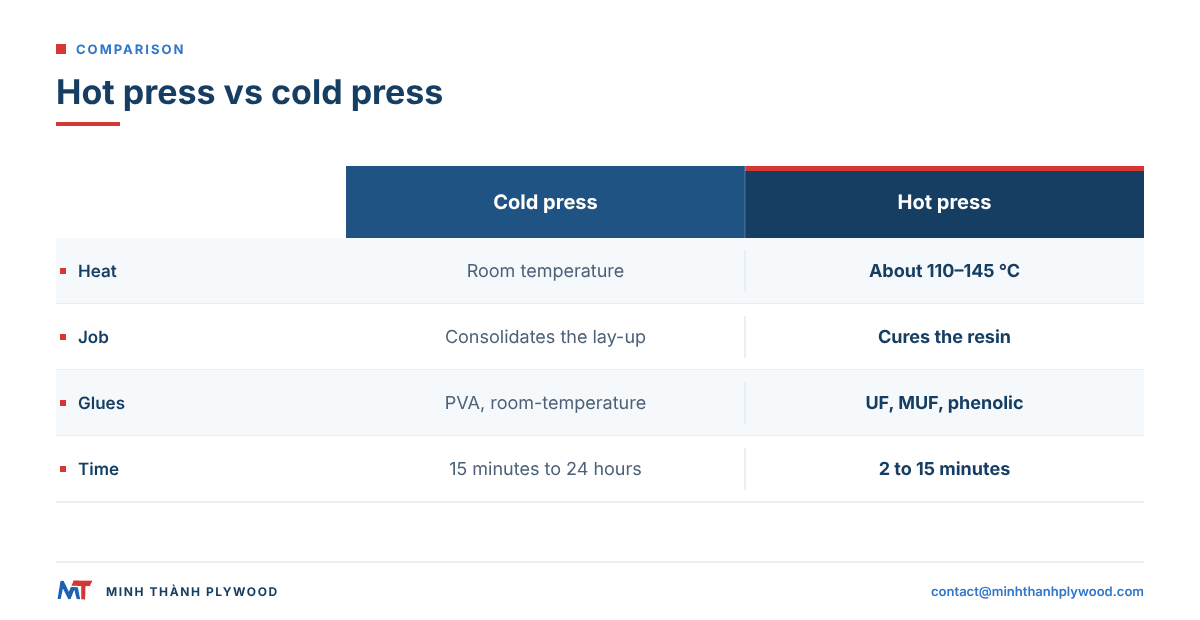
| Metric | Cold press | Hot press |
|---|---|---|
| Heat | None, room temperature | Heated platens, about 110–145 °C by glue |
| Job in a plywood mill | Pre-press: consolidates the glued stack before heat | Cures the resin and bonds the panel |
| Glues it cures | PVA and room-temperature adhesives | UF, MUF/melamine-fortified, phenolic (PF) |
| Time under pressure | 15 minutes to 24 hours for room-temperature glues | Usually 2 to 15 minutes per cycle |
| Openings | One, a tall stack of lay-ups | Multi-opening, one panel or board per daylight |
| What it fixes | Air pockets, sliding veneers, uneven glue spread | Final bond strength, water resistance of the glue line |
| Typical workshop use | Laminating veneer or HPL onto plywood, door skins | Not used in small workshops; a factory press |
The time ranges come from the US Forest Products Laboratory’s Wood Handbook (FPL-GTR-190, 2010), chapter 10 on adhesives.
Verdict by use:
- Making plywood: cold press, then hot press, every time. A mill that skips the cold press saves minutes and gets more blisters and sliding faces.
- Laminating onto plywood in a workshop: cold press with PVA or a contact adhesive for HPL. Hot pressing only pays off at factory volume.
- Film-faced and exterior panels: hot press with phenolic or melamine glue; a cold press cannot cure these resins.
What does the cold press do?
The cold press consolidates the freshly glued veneer stack so that the glue wets both surfaces, trapped air escapes, and the veneers stop sliding. It does not cure UF, melamine or phenolic resin; it makes the stack firm enough to handle and load into the hot press.
Cold pressing also gives the mill a pause to work on the board. On many Vietnamese lines, the cold-pressed stack has its outer core repaired, gaps patched and veneers aligned before it ever sees heat. That repair is only possible because the stack is consolidated but not yet cured.
What goes wrong without it: the veneers move as the hot press closes, joints open into core gaps, and air trapped in the stack turns into blisters. Thin face veneers, 0.2–0.5 mm in Vietnamese practice, are the most likely to trap air.
What temperature is plywood hot pressed at?
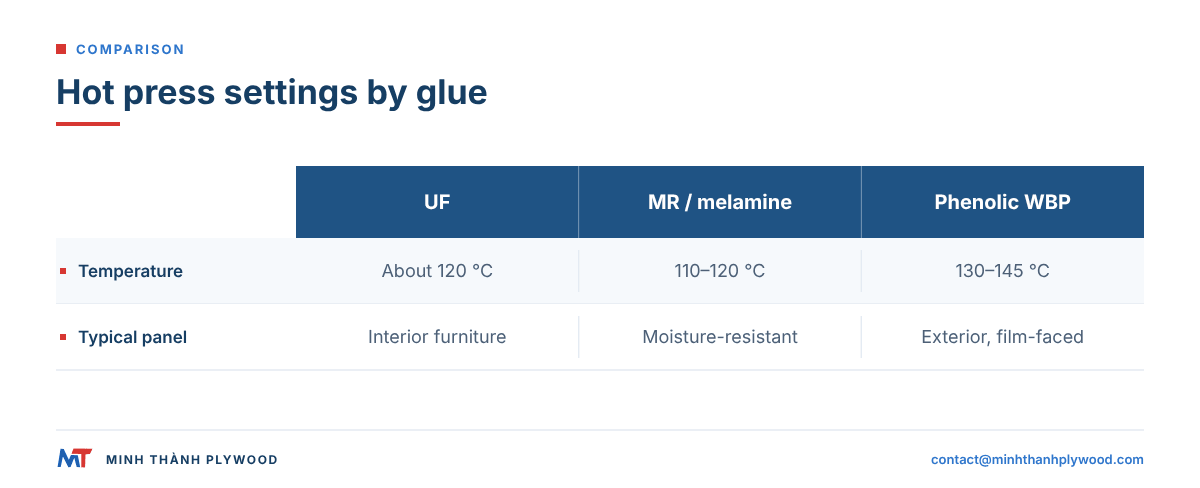
Plywood is hot pressed at about 110–120 °C for MR and melamine-fortified glue and 130–145 °C for phenolic WBP glue, the ranges Vietnamese plywood mills run. Urea-formaldehyde, the standard glue for interior furniture plywood, cures at about 120 °C according to the US Wood Handbook.
| Glue system | Typical use | Hot press temperature | Why |
|---|---|---|---|
| UF glue at E0 emission | Furniture and interior plywood | About 120 °C | UF cures fast at moderate heat; pale faces stay pale |
| MR / melamine-fortified (MUF) | Moisture-resistant interior, commercial | 110–120 °C | Melamine adds water resistance without phenolic heat |
| Phenolic (PF, WBP) | Film-faced, exterior, CDX-type | 130–145 °C | Phenolic resin needs more heat to cross-link fully |
The platen temperature has to be higher than the cure temperature at the centre glue line, because heat travels inward through every veneer. A thick panel at the right platen temperature can still be under-cured in the middle if the press opens too soon.
Glue and emission are separate specifications. UF glue at E0 emission describes a resin and an emission class; MR, melamine-fortified and phenolic describe the bond. A buyer’s spec sheet carries them as two lines.
How long does plywood stay in the hot press?
Plywood usually stays in the hot press for 2 to 15 minutes per cycle, according to the Wood Handbook, with up to 30 minutes for very thick laminates. The press time grows with panel thickness, because the centre glue line has to reach cure temperature.
Four things set the time for a given press:
- Thickness: the further the centre glue line is from the platens, the longer the cycle.
- Glue system: phenolic resin needs more heat and time to cure than UF.
- Veneer moisture: wet veneer turns to steam, cools the stack and slows the cure.
- Species: dense cores conduct heat differently from light Styrax cores.
A multi-opening press loads many boards at once and runs them all on the same cycle, so mills group lay-ups of the same thickness and glue in one load. Cutting the cycle short is the classic shortcut on cheap plywood: the panel looks finished but the glue line in the middle has not fully cured.
How much pressure does a plywood press use?
A plywood hot press works at roughly 0.7 MPa for low-density wood up to 1.7 MPa for the densest species, the range given in the US Wood Handbook. The right pressure brings every veneer into full contact without crushing the wood.
Core species decides where a mill sets the pressure:
- White Styrax (about 500 kg/m³): a light core that compresses easily, so it is pressed at the lower end; too much pressure crushes it and costs thickness.
- Acacia (about 580 kg/m³): a middle setting.
- Eucalyptus (650–750 kg/m³): a dense core that needs more pressure to close every glue line.
The densities are the planning values the Minh Thanh packing model uses. A mill that runs one pressure setting for every core either crushes its Styrax panels or leaves weak glue lines in its Eucalyptus ones.
What is double pressing and why does it matter?
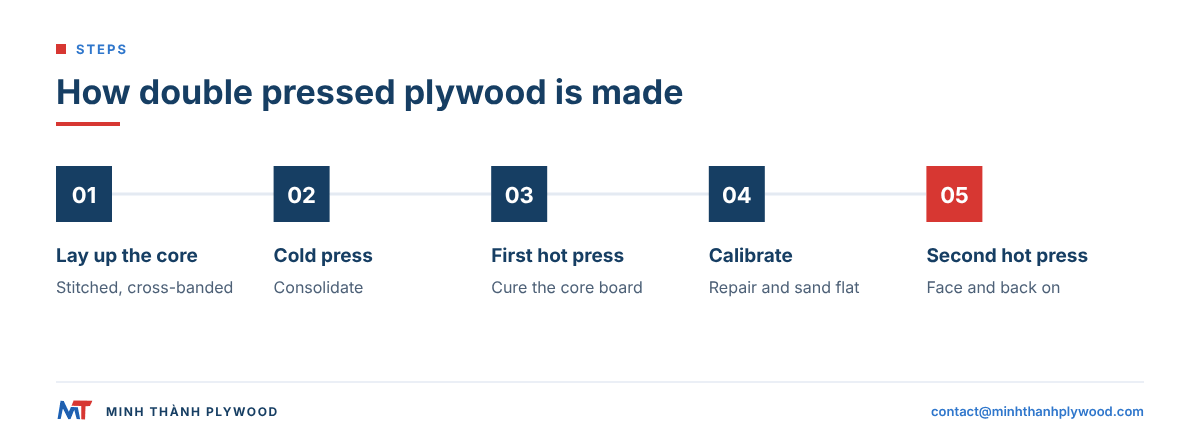
Double pressed plywood is pressed twice: the core board is pressed and calibrated first, then the face and back veneers are glued on and pressed in a second cycle. At Minh Thanh, furniture-grade panels are pressed twice as standard.
The two presses do different jobs:
- First press, the core board. The cross-banded core layers are cold pressed and hot pressed into a board. The board is then trimmed, core gaps are filled and the board is sanded flat to a set thickness, the calibration step.
- Second press, the faces. Face and back veneers are glued onto the calibrated board and pressed on. Because the board is already flat and even, the thin face lies on a true surface.
What the buyer sees: faces without the shadows of core joints or overlaps, a flatter sheet, and a tighter thickness tolerance. Minh Thanh sands furniture panels to ±0.2–0.3 mm, down to ±0.2 mm, which a single pressing struggles to hold on thin faces.
Single pressing still has its place. Packing and commercial plywood is often pressed once, with the faces in the first lay-up; the panel costs less and the tolerance is wider, which suits crates and site use. See stitched core plywood for how the core is joined before the first press.
What is pressed plywood, and is it the same as pressed wood?
Pressed plywood is simply plywood: every plywood panel is pressed from cross-laid veneers, so the term describes the process, not a different product. Pressed wood is a different thing; the term usually means particleboard, MDF or hardboard, made from chips or fibres bonded with resin.
| Point | Plywood (pressed from veneer) | Pressed wood (particleboard, MDF, hardboard) |
|---|---|---|
| Raw material | Whole sheets of rotary-peeled veneer | Wood chips, particles or fibres |
| Structure | Layers crossed at 90° | No layers, or a fine homogeneous mat |
| Screw holding at edges | Good, from the long fibres in each ply | Weaker, especially in particleboard |
| Weight | Lighter for the same stiffness on light cores | Heavier per sheet, MDF above all |
| Machined edge | Shows plies | Smooth, takes paint well (MDF) |
Plywood wins where a part carries load, takes screws near the edge or has to stay light; MDF wins for painted, profiled fronts. Our guide to plywood vs MDF covers the choice part by part.
Is pressed plywood pressure treated?
No. Pressing bonds the veneers into a panel; pressure treatment is a separate process that forces preservative into a finished panel inside a vacuum-pressure cylinder. Standard plywood, CDX-type sheathing and furniture plywood all leave the press untreated.
The two are often confused because both use the word pressure. In short:
- CDX plywood is not pressure treated by default. The X refers to its Exposure 1 bond classification (a moisture-resistant glue line for construction delays), not to a preservative.
- Pressure-treated plywood is ordered as such, with the preservative system and retention level named for the use.
Pressure-treated plywood is not waterproof either. Treatment resists rot and insects; resistance to water comes from the glue bond, phenolic or melamine-fortified, plus sealed edges and a finish. The pressure-treated plywood guide covers treatment classes and uses.
Which press shortcuts cause which defects?
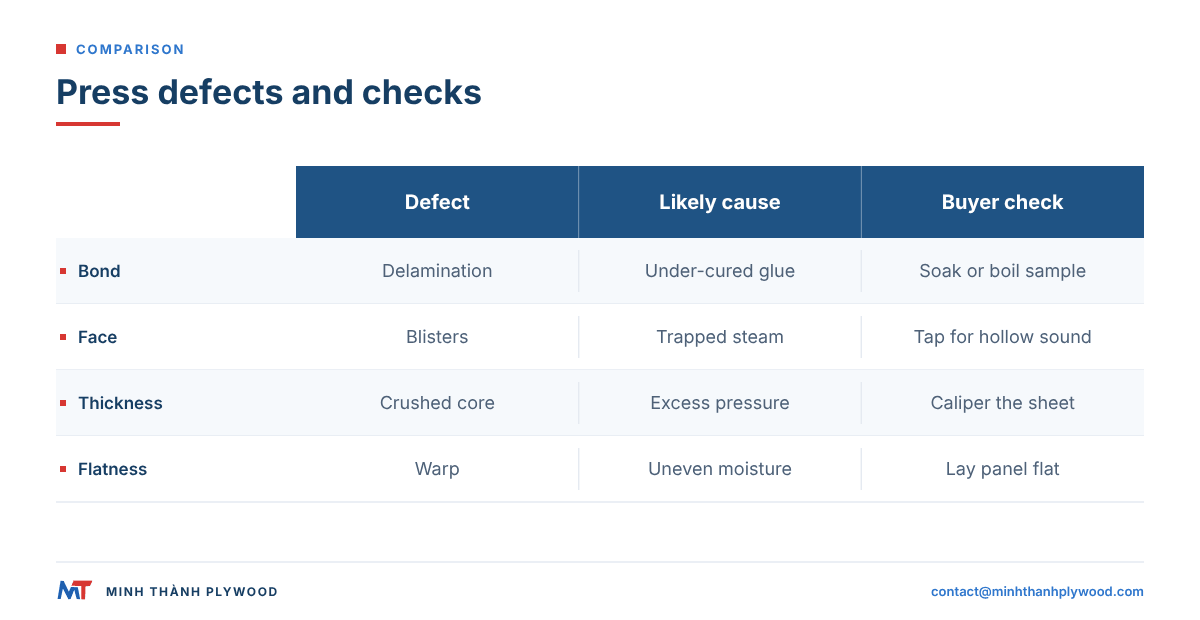
Every press shortcut leaves a defect that shows up at the mill’s QC table or in the buyer’s warehouse. The table links each fault to its usual press cause and the check that finds it.
| Defect | Usual press cause | How to check it |
|---|---|---|
| Delamination | Platen too cool, cycle too short, glue under-cured | Boil or soak test on a sample; look for open glue lines at the edge |
| Blisters (blows) | Wet veneer, steam trapped, press opened too fast | Tap the face; a hollow sound marks a blister |
| Core gaps showing through | Single pressing over an uncalibrated core | Look along the face in low-angle light |
| Thickness loss, crushed core | Pressure too high for a light Styrax core | Caliper at corners and centre against the order |
| Uneven thickness | Worn platens, no calibration step | Caliper readings across the sheet |
| Glue bleed-through on faces | High pressure on thin faces, too much glue | Dark spots on the face veneer |
| Warp | Unbalanced lay-up, uneven moisture, hot panels stacked unevenly | Lay the sheet flat on a table |
Most of these are prevented before the press: dry veneer, even glue spread, a cold press step, and settings matched to glue and core. Our plywood delamination guide covers the bond failures in more detail.
How does Minh Thanh press its furniture plywood?
Minh Thanh presses furniture plywood twice as standard, on white Styrax or Eucalyptus cores with UF glue at E0 emission, with the hot press set for the glue and the pressure set for the core species. The press is the step where the factory’s other controls pay off.
What comes before and after the press at our Ha Hoa, Phu Tho mill:
- Veneer drying: veneers and finished panels are dried to 8–12 % moisture content at dispatch.
- Core stitching: core layers are stitched horizontally and vertically before lay-up.
- First press and calibration: the core board is pressed, repaired and calibrated.
- Second press: face and back are pressed onto the calibrated core.
- Sanding: faces sanded and polished, both faces UV-ready, thickness held to ±0.2–0.3 mm.
Emission evidence comes with the panels: CARB P2 / TSCA Title VI certification as ICTT mill no. 23024. Six ASTM D6007 chamber tests between April 2025 and June 2026, on 9, 15 and 18 mm panels, averaged 0.014–0.032 ppm; three were run by Shanghai Hongjun and three by ICTT Vietnam. The limit for veneer-core hardwood plywood is 0.05 ppm under 40 CFR 770.10. MR, melamine-fortified and phenolic (WBP) bonds are made to the customer’s specification.
What should you specify about pressing in your order?
You rarely specify press settings directly; you specify the glue, the emission class, the pressing method and the tolerance, and those fix the press settings. Write them as separate lines so a quote can be compared like for like.
A pressing-related specification for a furniture panel:
- Glue: UF glue at E0 emission, or MR, melamine-fortified or phenolic (WBP) bond for damp or exterior use.
- Emission: CARB P2 / TSCA Title VI for the US, under the EPA composite wood rule; European buyers accept the same certification and chamber results.
- Pressing: double pressed, faces on a calibrated core.
- Core: species and stitching, for example white Styrax, stitched.
- Tolerance: ±0.2–0.3 mm for sanded furniture panels; ±0.5 mm for commercial and film-faced.
- Moisture: 8–12 % at dispatch.
When two offers for “18 mm furniture plywood” differ in price, the pressing line is often where they differ: single or double pressing, calibrated or not. Send your specification through furniture plywood from Vietnam and we quote the build in writing, with free samples.
Buyer questions, answered
What is a plywood press?
A plywood press is the hydraulic machine that squeezes glued veneers into a panel. A cold press consolidates the lay-up at room temperature; a hot press uses heated platens to cure the resin and bond the panel for good.
What temperature is plywood hot pressed at?
It depends on the glue. In Vietnamese mills, MR and melamine-fortified plywood is hot pressed at about 110–120 °C and phenolic WBP plywood at 130–145 °C; urea-formaldehyde plywood cures at about 120 °C, according to the US Wood Handbook.
How long does plywood stay in the hot press?
Usually 2 to 15 minutes per press cycle, longer for thick panels, because heat has to reach the centre glue line. The Wood Handbook gives up to 30 minutes for very thick laminates.
What is the difference between hot press and cold press plywood?
A cold press only consolidates the glued veneer stack so it holds together and the glue spreads; it does not cure thermosetting resins. The hot press cures the glue with heat, which gives the panel its final bond strength. Good plywood goes through both.
What is double pressed plywood?
Double pressed plywood is pressed twice: first the core board is pressed and calibrated to an even thickness, then face and back veneers are pressed on. Minh Thanh presses furniture-grade panels twice as standard for flat faces without core marks.
Is pressed plywood the same as pressed wood?
No. All plywood is pressed, but it is built from whole sheets of veneer in cross layers. Pressed wood usually means particleboard, MDF or hardboard, made from chips or fibres and resin.
Is plywood pressure treated?
Not by default. Pressing bonds the veneers; pressure treatment is a separate process that forces preservative into the finished panel in a vacuum-pressure cylinder. Standard, CDX and furniture plywood are untreated unless ordered treated.
Is pressure-treated plywood waterproof?
No. Pressure treatment protects plywood against rot and insects, not water. Water resistance comes from the glue bond, phenolic or melamine-fortified, plus edge sealing and a finish.
How much pressure does a plywood hot press use?
The US Wood Handbook gives about 0.7 MPa for low-density wood and up to 1.7 MPa for the densest species. Mills set the pressure by core species: light Styrax cores take less than dense Eucalyptus.
What happens if plywood is not pressed correctly?
Too little heat or time leaves the glue under-cured and the panel delaminates; too much pressure crushes light cores and loses thickness; wet veneer causes blisters. Each fault shows up as a defect a buyer can check on arrival.