
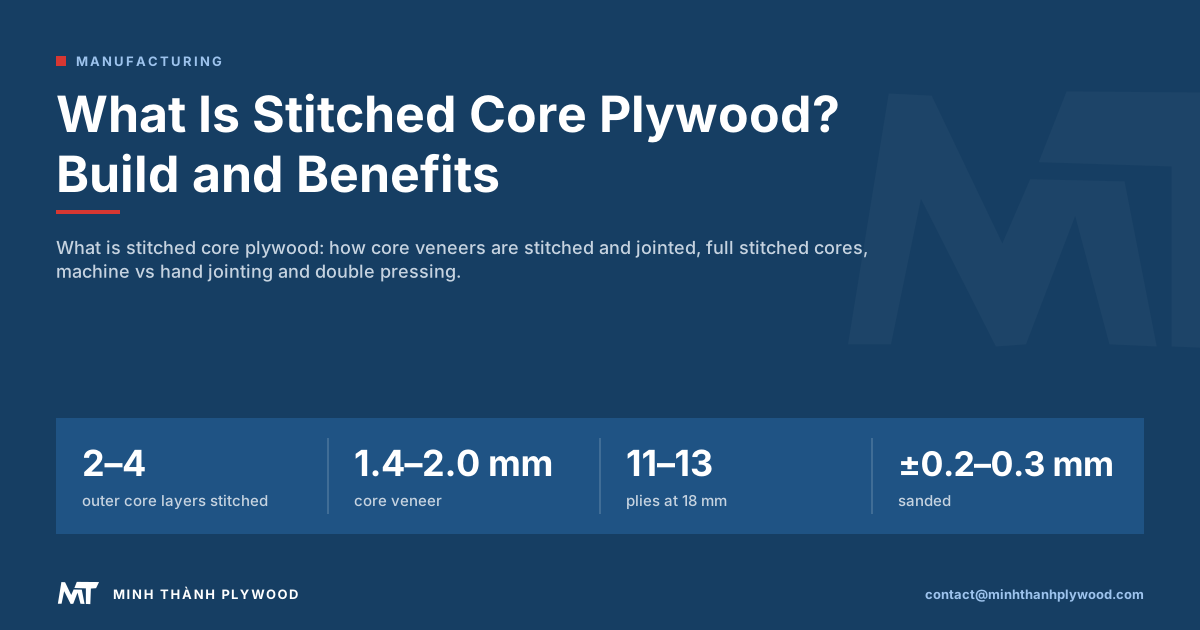
Stitched core plywood is plywood whose inner veneers are sewn or joined edge to edge before pressing, so each core layer behaves as one sheet without gaps or overlaps. The result is a flatter panel, an even thickness and a sound edge. Minh Thanh Plywood stitches furniture cores both horizontally and vertically and presses every furniture panel twice.
What is stitched core plywood?
Stitched core plywood is plywood whose core veneers are sewn or joined edge to edge before the panel is laid up and pressed. Each inner layer then acts as one continuous sheet: no open seams, no overlapping strips, no missing pieces.
The word “stitched” comes from Vietnamese and Chinese mill practice, where narrow core veneers are literally sewn together with thread across the joint. Mills and buyers also say jointed core, composed core or spliced core for the same aim: a core with closed joints.
Why it matters to a buyer:
- Flatness: a core without gaps or overlaps presses to an even thickness, so the face lies flat.
- Thickness tolerance: even cores make tight sanding tolerances reachable.
- Edges: a machined or exposed edge shows solid layers instead of voids.
- Bond: closed joints let the glue line take even pressure across the whole sheet.
At Minh Thanh Plywood, core layers of furniture panels are stitched both horizontally and vertically, and every furniture-grade panel is pressed twice.
Full cross stitched plywood core from Vietnam: what is full stitched core plywood?
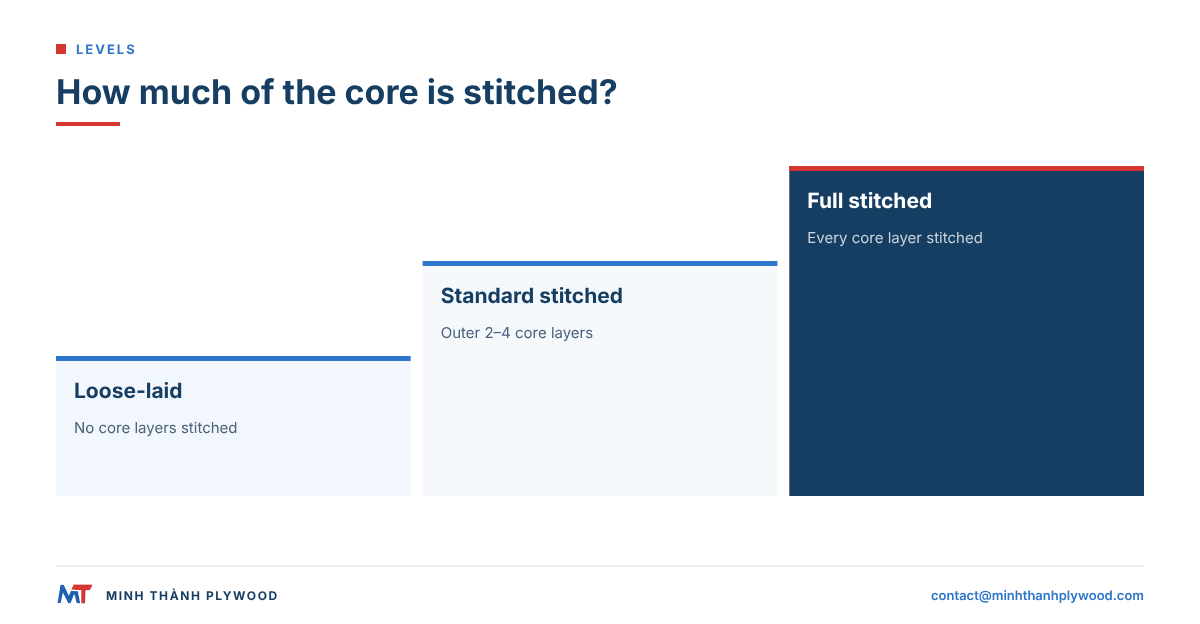
Full stitched core plywood has every core layer stitched, from the layer under the face to the centre ply. A standard stitched core usually has only the outer two to four core layers stitched, because those are the layers that show through the face and carry most of the bending stress.
| Core build | Layers stitched | When buyers order it |
|---|---|---|
| Loose-laid core | None | Packing plywood, crates, hidden parts |
| Stitched core (standard furniture) | Outer 2–4 core layers | Furniture, cabinets, veneered and painted panels |
| Full stitched core | Every core layer | Exposed or machined edges, CNC parts, UV-coated panels, thin decorative faces |
Full stitching through every core layer is made on request. The phrase “full cross stitched plywood core” on a Vietnamese order means the same thing: stitched across and along in every inner layer.
Why are core veneers joined at all?
Core veneers are joined because the logs that make them are too small to give full-width sheets. Vietnamese cores come from plantation species such as white Styrax, Eucalyptus and Acacia, peeled on rotary lathes from young logs.
A rotary-peeled plantation log gives:
- Core veneer 1.4–2.0 mm thick, in strips and short sheets narrower than the panel.
- Natural splits and irregular edges, which must be trimmed or closed.
- Moisture to remove: veneers are dried before lay-up; finished panels leave the factory at 8–12 % moisture.
To build one 1220 × 2440 mm core layer, a mill lays several pieces side by side. How those pieces are joined decides whether the layer has gaps, overlaps or clean joints. Our guide to rotary peeled vs sliced veneer explains how veneer is cut from the log.
Core joining methods compared
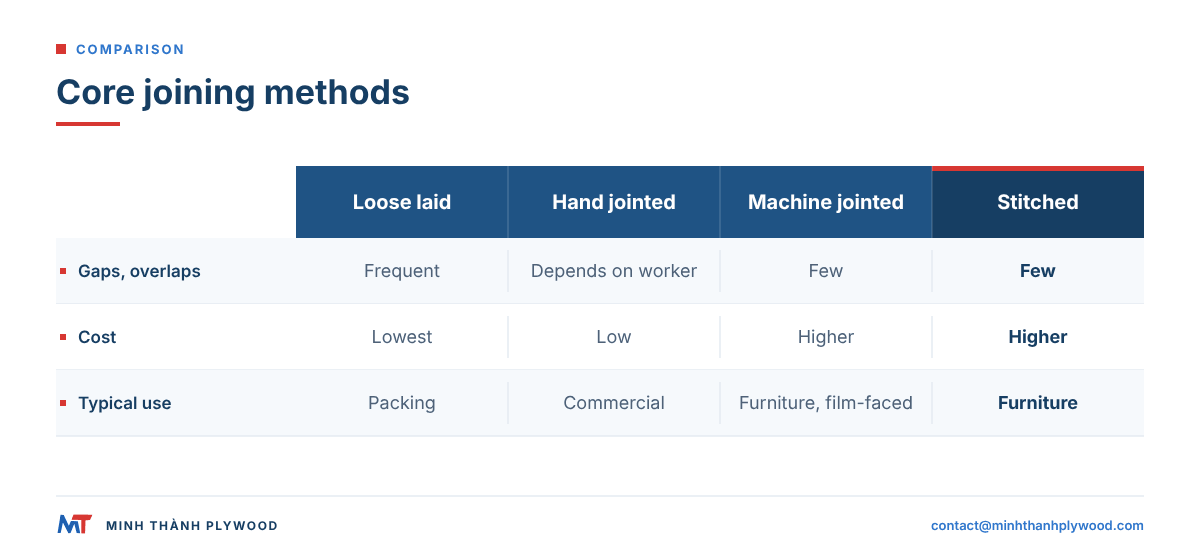
There are four common ways to build a core layer from strips, and they differ in how well the joint stays closed through gluing and pressing.
| Method | How the layer is made | Gaps and overlaps | Cost | Typical product |
|---|---|---|---|---|
| Loose laid | Strips placed side by side on the glue line, no joining | Frequent; strips move when glued and pressed | Lowest | Packing plywood |
| Hand jointed | Workers butt strips tightly and tape or glue the joints | Depends on the worker; fewer than loose laid | Low | Commercial plywood |
| Machine jointed (core composer) | A machine cuts straight edges and joins strips into a continuous sheet | Few; joints straight and tight | Higher | Furniture and film-faced cores |
| Stitched | Strips sewn together with thread across the joint, in one or both directions | Few; the thread holds joints closed through gluing and pressing | Higher | Furniture plywood, full stitched cores |
Stitching and machine jointing aim at the same result. Stitching has one advantage for thick panels: the thread keeps the layer together while glue is spread and the stack is moved to the press, which is when loose strips shift.
Machine vs hand core jointing
Machine jointing and stitching give more consistent cores than hand jointing, because the joint no longer depends on each worker’s eye. Hand jointing can make a good core, but the result varies more from sheet to sheet and from shift to shift.
| Factor | Machine jointed or stitched | Hand jointed |
|---|---|---|
| Joint straightness | Edges trimmed straight before joining | Depends on the strip edge |
| Gap risk | Low | Higher, especially at strip ends |
| Overlap risk | Low | Higher where strips are pushed together |
| Consistency across a container | High | Varies by worker and shift |
| Best for | Furniture, CNC parts, UV and thin faces | Commercial and general-purpose panels |
For a buyer the practical question is not which machine a mill owns, but whether the cut edge of a sample is clean in every layer. That is checked on the sample and on the pre-loading photos.
Why core gaps and overlaps matter
Core gaps and overlaps are the main hidden defects of plywood: they are inside the panel, so the face can look perfect while the panel fails in use.
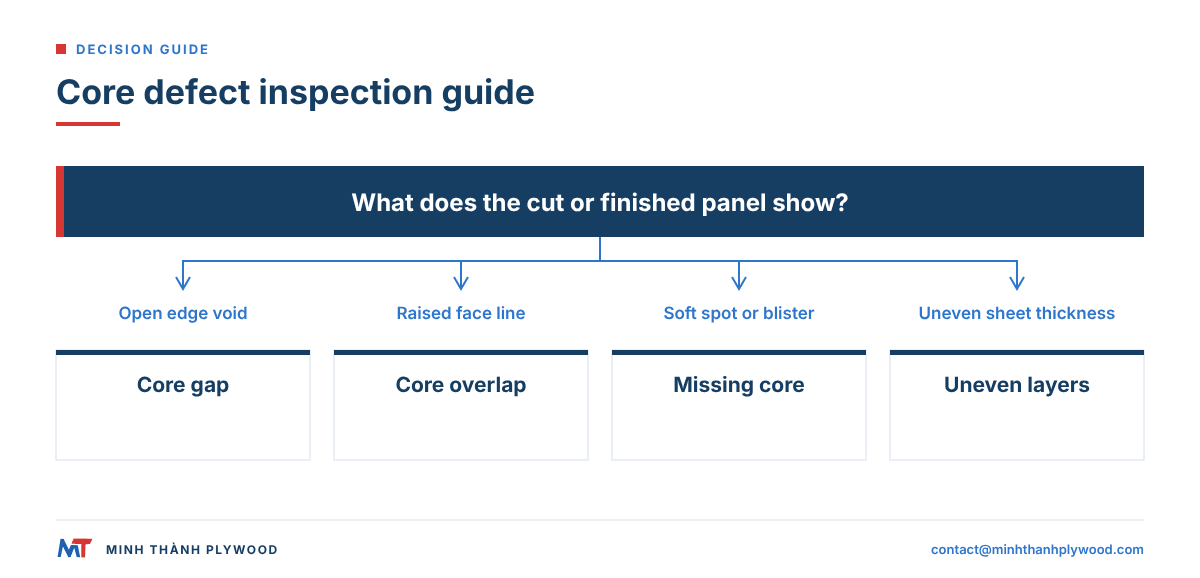
- Core gap: an empty space between two core pieces. It weakens the panel there, can show through as a dip in a thin face, and opens as a hole on a cut or machined edge.
- Core overlap: two pieces lying on top of each other. The panel is thicker at that line, the face shows a ridge, and sanding cuts through the face veneer over it.
- Missing core: an area with no veneer in one layer. It behaves like a large gap and can cause blisters, because the press cannot push glue lines together there.
How each defect shows up in a furniture plant:
| Defect | What the furniture plant sees |
|---|---|
| Core gap | Voids on routed edges, edge banding that sinks, screws with nothing to grip |
| Core overlap | Ridges on the face, sand-through on veneer, uneven thickness |
| Missing core | Soft spots, blisters, local delamination |
| Uneven layers | Thickness variation across the sheet, warping after cutting |
The cheapest moment to prevent these is when the core is built. A stitched or machine-jointed core removes most of them before the glue is spread.
How does stitching affect flatness, thickness and delamination?
Stitching improves flatness, thickness tolerance and bond, because every glue line meets an even layer under even pressure.
- Flatness. A balanced panel with even layers stays flat when cut. Gaps and overlaps unbalance one side, and the cut part bows.
- Thickness. Overlaps make thick lines and gaps make thin spots. With closed joints, sanding brings the panel to tolerance without cutting through the face. Our sanded furniture panels are held to ±0.2–0.3 mm, down to ±0.2 mm.
- Bond. Glue cures best under even pressure. A gap leaves a glue line with nothing pressing on it; an overlap takes all the pressure locally. Both are starting points for delamination.
Stitching does not replace the right glue or the right press. It gives the glue and the press an even core to work on. Our guide on plywood quality control covers the bond and thickness checks.
What is double pressed plywood?
Double pressed plywood is plywood pressed twice: the core board is pressed and calibrated to thickness first, then the face and back veneers are pressed on in a second press cycle. Some traders call it double core plywood or two-time pressed plywood.
Why the second press matters:
- A calibrated core. After the first press, the core board is sanded to an even thickness. Any small dips or ridges are removed before the face goes on.
- A thin face on a flat base. Face veneers are 0.2–0.5 mm thick. Laid on a calibrated core, they lie flat and do not mirror the core’s irregularities.
- Fewer face defects. Dips, ridges and sand-through on the face become rare, which matters for UV coating, lacquer and thin decorative faces.
At our factory, furniture-grade panels are pressed twice as standard. Hot pressing runs at about 110–120 °C for MR glue and 130–145 °C for WBP (phenolic) glue.
Which plywood needs a stitched core?
A stitched core is needed wherever the face, the edge or the thickness of the panel is part of the finished product. It is not needed where the panel is hidden or used once.
| Use | Stitched core? | Why |
|---|---|---|
| Furniture carcasses and doors | Yes | Flat faces, sound edges for banding and fittings |
| Kitchen cabinets | Yes | Hinges and runners screw into the edge |
| CNC-cut parts and cut-to-size | Yes, full stitched for exposed edges | Every cut shows the core |
| UV-coated or lacquered panels | Yes | Any dip or ridge shows through a gloss finish |
| Thin plywood 3–6 mm | Built as 5-ply (3–5 mm) with selected veneers | Each layer is a large share of the panel |
| Commercial plywood | Optional | Hidden parts, painted or covered |
| Packing plywood | No | One-time use, loose-laid core is normal |
Stitched cores are standard on our furniture plywood. See the furniture plywood page for the full specification.
How a stitched core is built, step by step
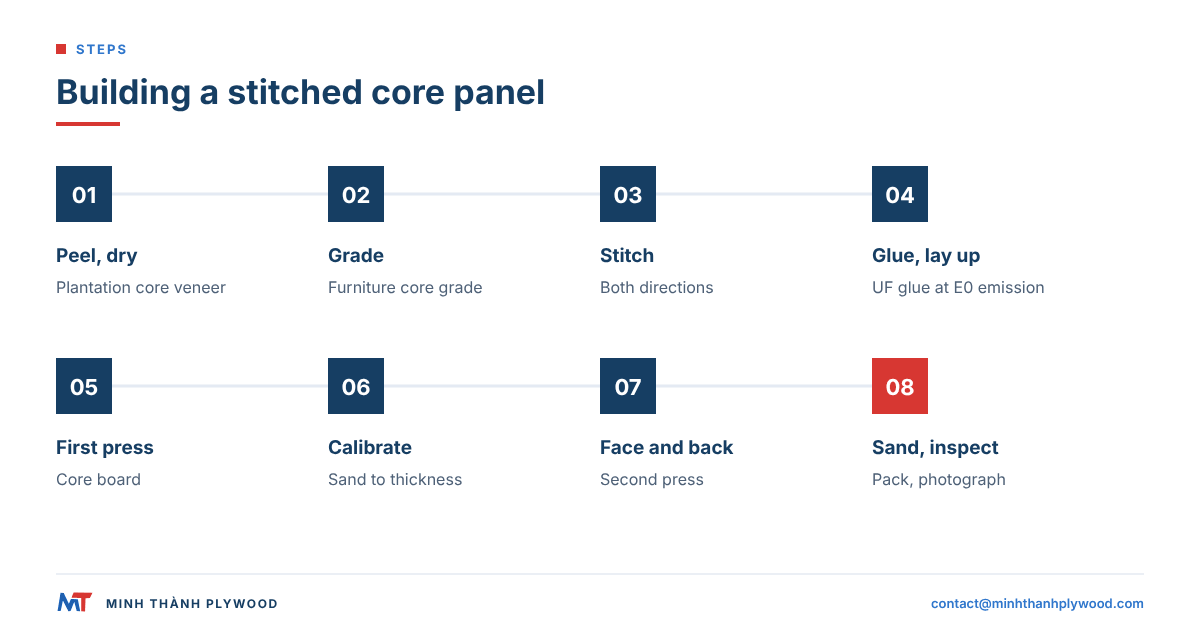
A stitched core panel is built in a fixed order, and each step removes a cause of gaps, overlaps or uneven thickness.
- Peel and dry. Plantation logs are rotary peeled into core veneer and dried. Our guide to veneer drying covers target moisture and drying defects.
- Grade. Core veneers are sorted by quality; furniture panels take the better core grade. See veneer grading at our factory.
- Trim and stitch. Strips are trimmed straight and stitched into full layers, both horizontally and vertically.
- Glue and lay up. UF glue at E0 emission is spread for furniture and interior panels; layers are laid with grain alternating at right angles.
- First press. The core board is hot pressed.
- Calibrate. The core board is sanded to an even thickness.
- Face and back. Face and back veneers are glued and pressed on in the second press cycle.
- Sand and polish. The panel is sanded and polished to tolerance; both faces can be made UV-ready.
- Inspect and pack. Thickness, faces and edges are checked against the order, then the panels are packed, photographed and filmed before loading.
An 18 mm furniture panel built this way usually has 11–13 plies.
How can buyers check core quality?
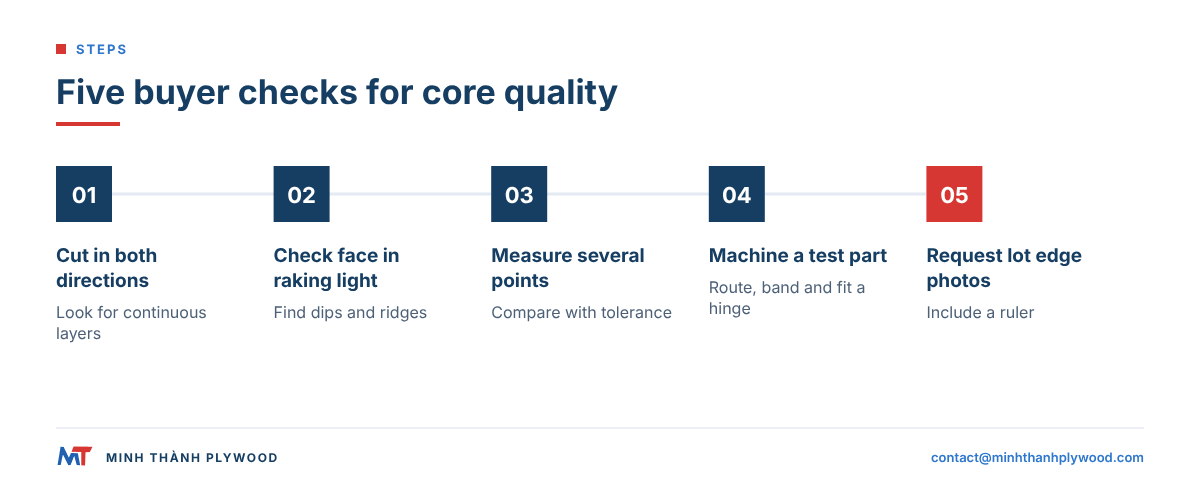
Buyers check core quality on the sample, on the pre-loading photos and on arrival, by looking at the cut edge and measuring thickness.
- Cut the sample both ways. Cut a strip along and across the grain. Each layer should be continuous, with no voids or doubled veneer.
- Look along the face. Under a raking light, dips and ridges show where the core is uneven.
- Measure thickness at several points. Corners and centre, with a calibrated caliper; compare with the written tolerance.
- Machine a test part. Route an edge, band it and fit a hinge. Voids and soft spots show at once.
- Ask for edge photos before loading. Photos of cut edges from the production lot, with a ruler in the frame.
The same checks belong in your arrival inspection. Our page on plywood quality control lists the checks we make before packing.
Whole-piece core, loose core and other trade terms
Core terms differ between mills and countries, so buyers should ask what each term means in the quote in front of them.
| Term | What it usually means |
|---|---|
| Stitched core | Core strips sewn together across the joint before lay-up |
| Full stitched core | Every core layer stitched, not only the outer layers |
| Jointed or composed core | Strips joined edge to edge by machine or by hand |
| Spliced core | Strips joined by glued joints or tape |
| Loose-laid core | Strips placed without joining |
| Whole-piece core | A term from Chinese mills; it can mean hand-laid full-size pieces, machine-jointed pieces or a single veneer sheet, so ask which |
| Double pressed, double core | Core pressed and calibrated, then faces pressed on |
When two quotes use the same product name and differ in price, the core build is often the difference: core grade, joining method, face preparation, adhesive and tolerance.
What to write on your purchase order
Write the core build as specification lines, not as a quality adjective. A stitched core is easy to verify when the order says exactly what was agreed. For the glue line, BS EN 314-2 sets the bonding-quality requirements. For the service condition, BS EN 636:2012+A1:2015 covers plywood for structural and general-purpose use in dry, humid or exterior conditions.
- Core species: white Styrax or Eucalyptus for furniture; Acacia and Pine on order.
- Core grade: furniture core grade, no loose-laid layers.
- Stitching: stitched both directions; state “full stitched, every core layer” if you need it.
- Pressing: double pressed, core calibrated before facing.
- Ply count: for example 11 plies at 18 mm.
- Thickness and tolerance: for example 18 mm ±0.2 mm sanded.
- Glue and emission: UF glue at E0 emission, or MR/melamine-fortified or phenolic (WBP) bond to your specification.
- Faces: species and grade pair, sanded, UV-ready if you coat.
- Moisture: 8–12 % at dispatch.
A spec line reads: 18 mm, 1220 × 2440 mm, white Styrax core, full stitched, double pressed, 11 plies, ±0.2 mm, UF glue at E0 emission, birch D/E faces, UV-ready.
How does Minh Thanh Plywood build its cores?
We build furniture cores from white Styrax or Eucalyptus plantation veneer, stitched both horizontally and vertically, and we press every furniture-grade panel twice. Full stitching through every core layer is made on request.
| Item | Our standard |
|---|---|
| Cores | White Styrax or Eucalyptus; Acacia and Pine on order |
| Core build | Stitched both horizontally and vertically |
| Pressing | Twice: core pressed and calibrated, then face and back |
| Glue | UF glue at E0 emission for furniture and interior panels |
| Tolerance | ±0.2–0.3 mm on sanded furniture panels, down to ±0.2 mm |
| Thickness range | 3–40 mm |
| Emission proof | CARB P2 / TSCA Title VI, ICTT mill no. 23024; six ASTM D6007 chamber tests averaged 0.014–0.032 ppm against the 0.05 ppm limit |
| Quality system | ISO 9001:2015 (KAC25/0185); TCVN 11902:2017 (VietCert 141.1-VNC-HC) |
| Proof per shipment | Photos and video before loading |
The CARB P2 / TSCA Title VI rules are set out on the EPA formaldehyde standards page. Free samples let you cut and check our core before you order. Send your thickness, core and face through the furniture plywood page, or read how the whole line works on our manufacturing page.
Buyer questions, answered
What is stitched core plywood?
Stitched core plywood is plywood whose core veneer pieces are sewn or joined edge to edge before pressing, so each inner layer is one continuous sheet with no gaps or overlaps.
What is full stitched core plywood?
Full stitched core plywood has every core layer stitched, not only the outer two to four layers under the faces. It is ordered for panels where the edge is exposed, machined or must be completely free of voids.
What is core jointing in plywood?
Core jointing is joining the narrow strips of peeled core veneer into full-width sheets before lay-up, by hand, by a jointing machine or by stitching, so the core has no open seams.
Is machine core jointing better than hand jointing?
Machine jointing and stitching hold the joint closed and give more even cores across an order. Hand-laid cores can be good, but gaps and overlaps depend on each worker and vary more from sheet to sheet.
What is double pressed plywood?
Double pressed plywood is pressed twice: the core board is pressed and calibrated to thickness first, then the face and back veneers are pressed on. It gives a flatter panel and a cleaner face.
Why are core gaps bad for plywood?
A core gap is a void inside the panel. It weakens the panel at that point, can show through a thin face as a dip, and leaves a hole on a machined edge where a screw or hinge has nothing to grip.
Does stitched core plywood cost more?
Yes, stitching and double pressing take extra labour and press time. The extra cost is usually smaller than the cost of rejected parts, refacing or claims in furniture and CNC work.
Do packing plywood and commercial plywood use stitched cores?
Usually not. Packing plywood uses loose-laid cores, and commercial plywood uses loose-laid or jointed cores, because flatness and edge quality matter less in those uses.
How can I check the core of a plywood sample?
Cut the sample across both directions and look at the edges for voids, overlaps and uneven layers, measure thickness at several points, and check the face for dips or ridges under a raking light.
What should I write on a purchase order for a stitched core?
Write the core species, stitched core and how many layers are stitched, double pressed, the ply count, thickness and tolerance, glue and emission class, and face and back grades.