
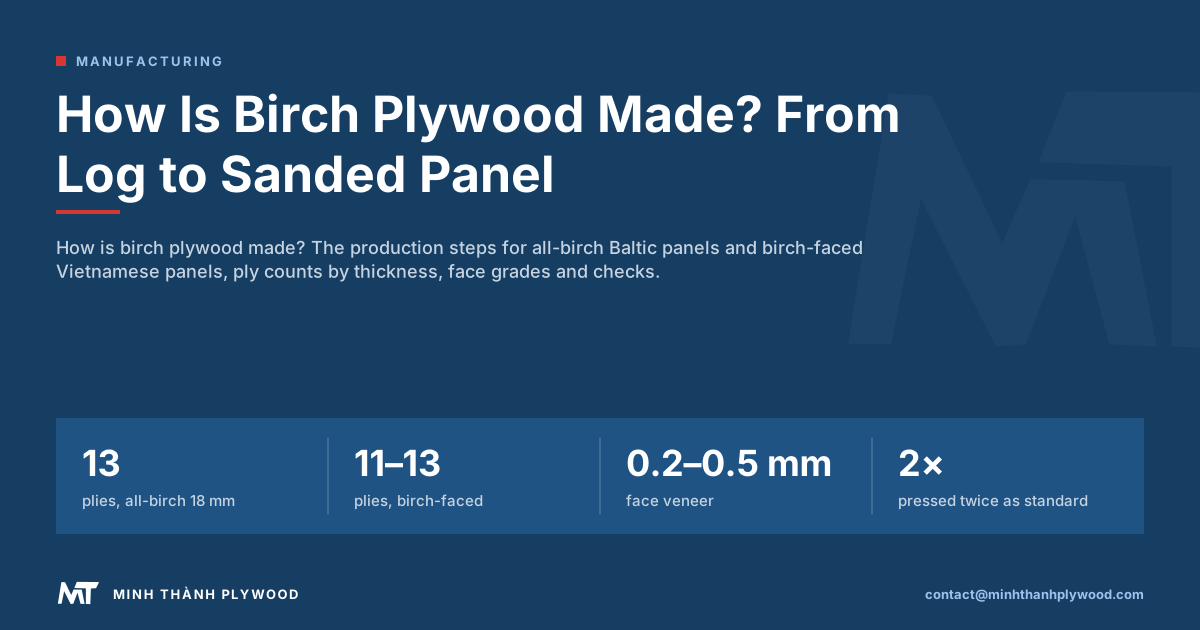
Birch plywood is made by peeling logs into thin veneers, drying and grading them, gluing them in cross layers and curing the stack in a hot press, then trimming and sanding. All-birch Baltic panels use birch in every ply. Vietnamese birch plywood, as Minh Thanh Plywood makes it, is birch-faced: imported birch face and back veneers pressed onto a calibrated white Styrax or Eucalyptus core.
How is birch plywood made? The short answer
Birch plywood is made by peeling logs into thin veneers on a rotary lathe, drying and grading the veneers, gluing them in layers with the grain crossed at 90°, and bonding the stack under pressure and heat. The pressed panel is trimmed, repaired, sanded to thickness and graded by its face and back.
Two builds share the name. In an all-birch panel, the type made around the Baltic Sea, every ply is birch. In a birch-faced panel, the type made in Vietnam, only the face and back are birch veneer, pressed onto a core of local plantation wood.
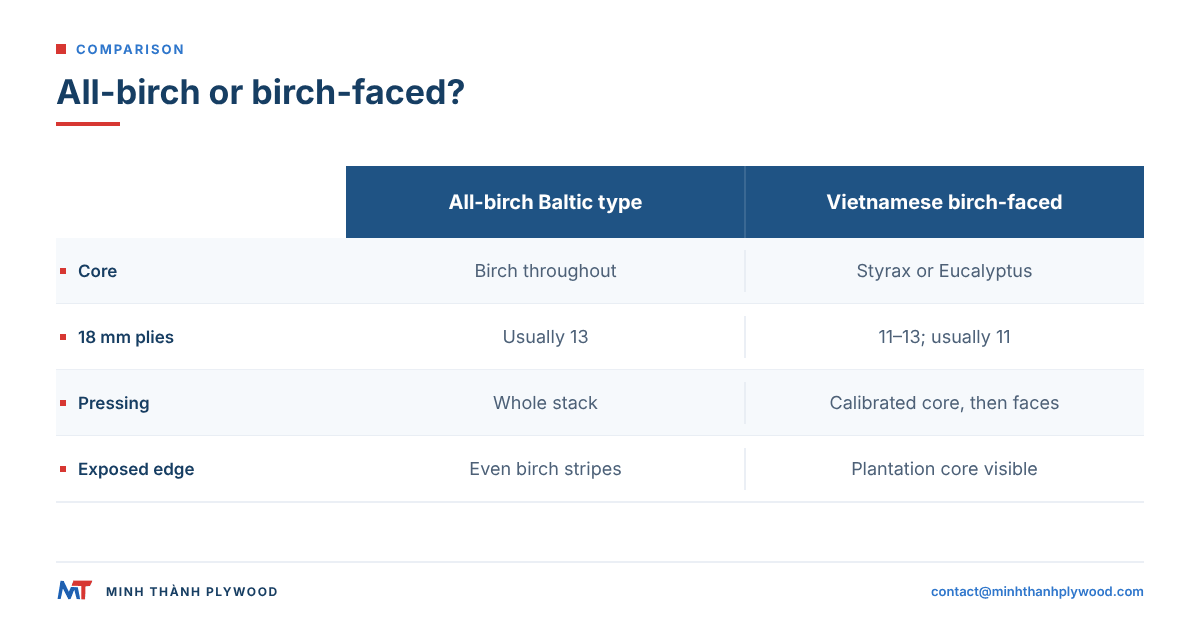
| Point | All-birch (Baltic type) | Birch-faced (Vietnamese type) |
|---|---|---|
| Face and back | Birch veneer | Imported birch veneer |
| Core plies | Birch | White Styrax or Eucalyptus (Acacia or Pine on order) |
| Plies at 18 mm | Usually 13 | 11–13, most often 11 |
| Pressing | Usually one hot press for the whole stack | Core pressed and calibrated, then faces pressed on |
| Edge | Even pale birch plies | Birch faces, core species visible at the edge |
| Weight | Heavier, dense birch throughout | Lighter, especially on Styrax |
| Best for | Exposed edges, CNC parts, oiled finishes | Banded furniture, cabinets, shop fitting |
The rest of this guide walks through both processes, the ply counts by thickness, the face grades and the checks a buyer can run.
Is Vietnamese birch plywood all-birch or birch-faced?
Vietnamese birch plywood is birch-faced. Vietnam grows no birch, so Vietnamese mills import birch face and back veneers and press them onto cores of local plantation wood; the panel is named after its face, as all plywood is.
Vietnamese plywood cores come only from Acacia, Eucalyptus, white Styrax, mixed cores, and rubberwood in the south. There is no birch core and no poplar core in Vietnamese plywood. Any offer of “Vietnamese all-birch plywood” deserves a cut sample before anything else.
At Minh Thanh, birch plywood is built on white Styrax or Eucalyptus cores as standard; Acacia and Pine cores are made on order. Styrax grows only in northern Vietnam, close to our Ha Hoa mill in Phu Tho. It is light and pale, so the edge stays light under the birch face.
Being birch-faced is a construction choice, not a lower grade. The face a customer sees is real birch veneer, graded and matched to the approved sample; the core is chosen for weight, flatness and price.
How birch plywood is manufactured in a Baltic all-birch mill
Baltic all-birch plywood is manufactured from birch logs in eight main steps, with birch in every ply. The sequence is the classic rotary-veneer process.
- Log selection and conditioning. Straight birch logs are cut to length and soaked or steamed so the wood peels smoothly.
- Debarking and peeling. Debarked blocks turn on a rotary lathe against a knife and unroll a continuous ribbon of veneer.
- Clipping and drying. The ribbon is clipped into sheets and dried in a veneer dryer.
- Grading and patching. Veneers are sorted into face and core grades; knots and defects in face veneers are cut out and patched.
- Glue spreading and lay-up. Glue is rolled onto alternate veneers, phenolic for exterior panels, UF or melamine for interior ones, and the plies are laid with the grain crossed.
- Pre-pressing and hot pressing. The stack is consolidated in a cold press, then cured in a multi-opening hot press.
- Trimming and sanding. Panels are cut square and sanded on both faces.
- Grading and packing. Each sheet is graded by face and back, in grades such as B, BB, CP and C, and packed.
Because every ply is birch, the core is uniform, dense and nearly free of voids. That gives the clean, striped edge buyers pay for, and also the weight.
Vietnam birch plywood production process: step by step
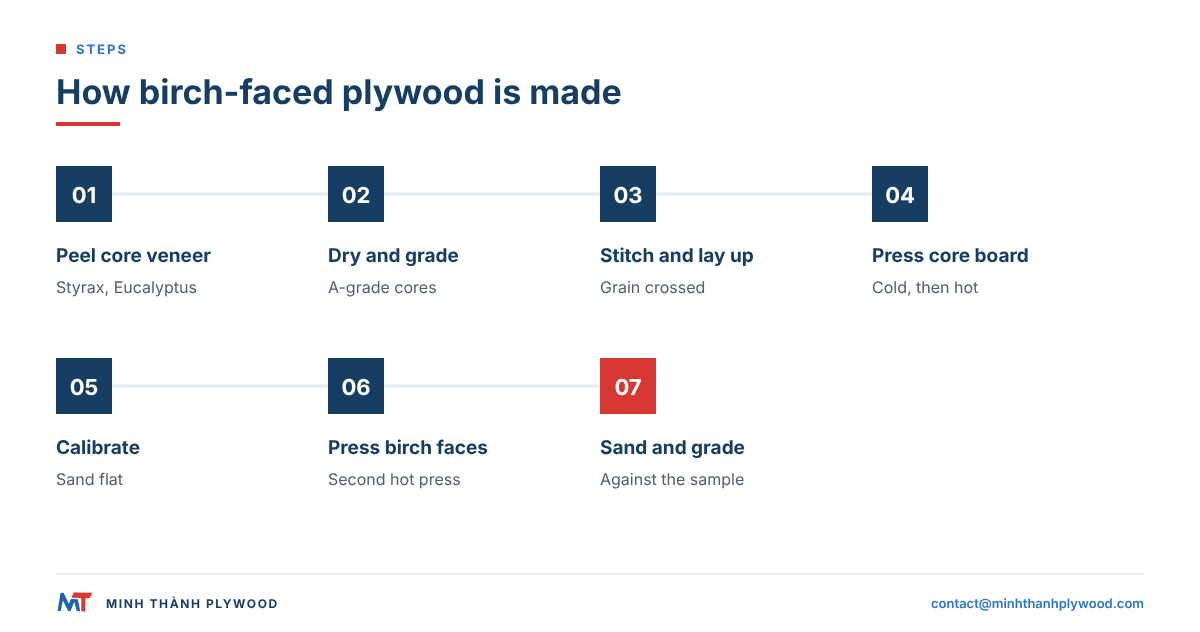
The Vietnam birch plywood production process makes a calibrated plantation core first and presses imported birch faces onto it in a second press. This is how Minh Thanh makes birch plywood at its Ha Hoa, Phu Tho mill, in twelve steps.
- Core logs. White Styrax and Eucalyptus logs come from plantations around Ha Hoa and are cut to length and debarked.
- Peeling. Rotary lathes peel core veneer 1.4–2.0 mm thick.
- Drying. Core veneers are dried in veneer dryers to a stable moisture before gluing.
- Core veneer grading. Furniture panels take A-grade core veneer; split, short or thin sheets go to other lines. See veneer grading at our factory.
- Jointing and stitching. Core sheets are joined and stitched horizontally and vertically, so joints cannot open in the press.
- Glue spreading. UF glue at E0 emission is rolled onto the cross-band veneers.
- Lay-up and cold press. Core layers are laid with the grain crossed and consolidated in a cold press.
- First hot press. The core board is cured in the hot press.
- Repair and calibration. The board is trimmed, any core gaps are filled, and the board is sanded flat to a set thickness.
- Birch faces on. Imported birch face and back veneers, sorted by grade, are glued onto the calibrated board.
- Second hot press. The faces are pressed on. Furniture-grade panels are pressed twice as standard.
- Finishing and grading. Panels are trimmed to size, sanded and polished, both faces UV-ready, then graded as face/back pairs against the approved sample.
Steps 9 to 11 are what separates a furniture birch-faced panel from a commercial one. A face laid on an uncalibrated core shows every core joint and overlap through a 0.3 mm birch veneer.
Where do the birch faces come from, and how thick are they?
The birch faces on Vietnamese plywood are imported rotary-cut birch veneers, bought by grade and thickness for the look the buyer orders. Face veneers on Vietnamese plywood are 0.2–0.5 mm thick; European furniture buyers usually choose about 0.3 mm.
Face thickness is a real choice, not a detail:
- About 0.3 mm: the usual face for furniture and cabinets that will be lacquered or oiled.
- Thinner faces: lighter and cheaper, but they tolerate less sanding and show core marks sooner.
- Thicker faces: more forgiving under heavy sanding and machining, at a higher price.
Faces are sorted before lay-up into the grades the order calls for, with face and back graded separately. The same imported birch is used whether the core is Styrax or Eucalyptus, so the face looks the same; the edge and the weight change.
How many plies in birch plywood?
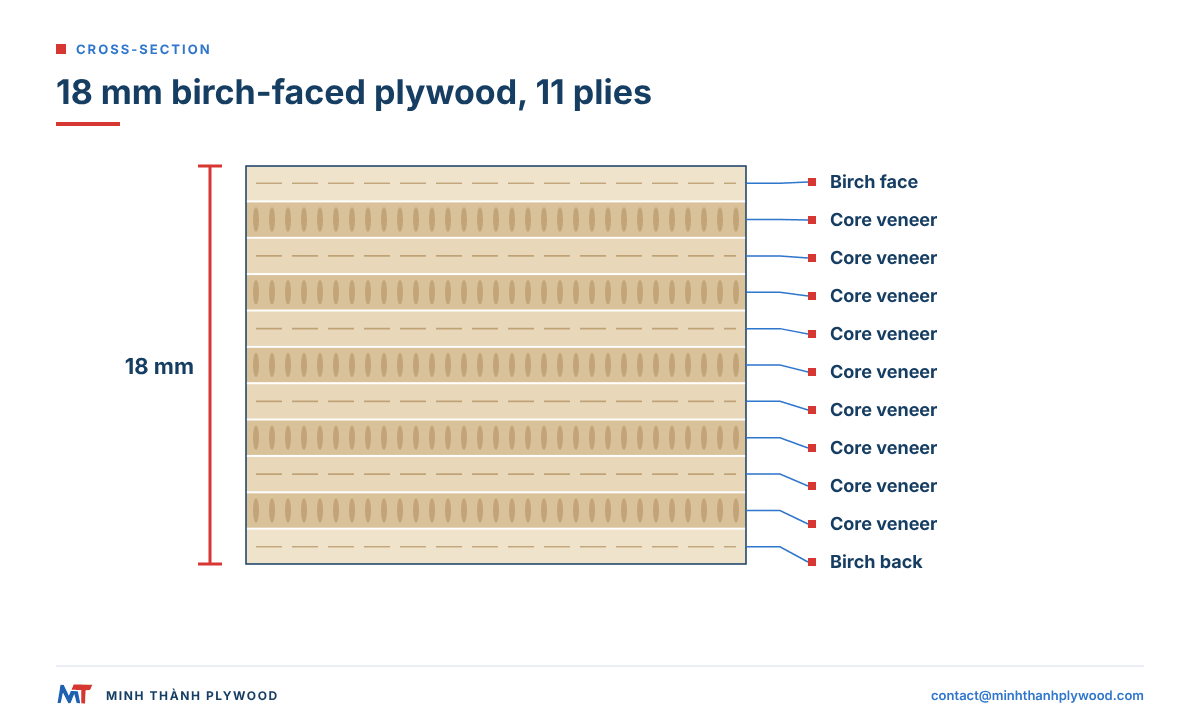
An 18 mm all-birch panel usually has 13 plies. A Vietnamese birch-faced 18 mm panel has 11–13 plies, most often 11, because core veneers are peeled thicker. Thin Vietnamese panels from 3 to 5 mm are always 5 plies.
| Thickness | Vietnamese birch-faced build | How the plies are made up |
|---|---|---|
| 3 mm | 5 plies | 1 core veneer, 2 cross-band veneers, 2 faces |
| 4 mm | 5 plies | 3 core veneers, for example 1.3 mm Styrax, plus 2 faces |
| 5 mm | 5 plies | 3 core veneers adjusted to the panel, plus 2 faces |
| 6 mm | Confirmed with the order | Ply count and lay-up stated on the proforma |
| 18 mm | 11–13 plies | Most often 11; core veneer thickness sets the count |
More plies of thinner veneer give a finer edge and a slightly more stable panel; fewer, thicker plies press faster and cost less. For a banded furniture part the difference is invisible. For an exposed CNC edge it is the main reason to choose all-birch.
Premium thin veneer for 4 mm panels is scarce, so 4 mm birch-faced panels can take longer to make. We do not lower the standard to go faster.
What is birch plywood made from? Glue and core options
Birch plywood is made from birch veneers, or birch faces over a plantation core, bonded with a thermosetting glue chosen for where the panel will be used. The glue and the emission class are two separate lines in the specification. The service conditions are set by the plywood standard: BS EN 636:2012+A1:2015 covers plywood for dry, humid or exterior conditions.
| Option | Choices | Where it fits |
|---|---|---|
| Glue for interior furniture | UF glue at E0 emission | Cabinets, furniture, shop fitting |
| Glue for damp interiors | MR / melamine-fortified | Kitchens, bathrooms, humid stores |
| Glue for exterior and film-faced | Phenolic (WBP) | Exterior uses, film-faced panels |
| Core species (Vietnam) | White Styrax, Eucalyptus; Acacia or Pine on order | Styrax for light, pale panels; Eucalyptus for stiff ones |
Core weight is the main difference buyers notice. Planning densities are about 500 kg/m³ for Styrax, 580 kg/m³ for Acacia and 650–750 kg/m³ for Eucalyptus. An 18 mm 1220 × 2440 mm sheet on Styrax weighs about 26.8 kg in our container model, against about 34.8 kg on Eucalyptus.
Where is Baltic birch plywood made?
Baltic birch plywood is made in the birch-growing countries around the Baltic Sea; for European buyers today that means mainly Latvia, Finland and Estonia. The name describes an all-birch build from that region, not a standard.
Supply has shifted since 2022. Under Council Regulation (EU) 2022/576, which added Article 3i and Annex XXI to Regulation 833/2014, imports of Russian wood products of CN chapter 44, plywood included, into the EU have been prohibited since 9 April 2022. A parallel measure has covered Belarus since March 2022.
That left European buyers with fewer all-birch sources and opened room for birch-faced alternatives. Our comparison of Chinese, Baltic and Vietnamese birch plywood sets the three builds side by side, and the Baltic birch plywood guide covers the all-birch type in detail.
How are birch plywood face grades set?
Birch face grades are set when the veneers are sorted before lay-up and checked again on the finished panel. Vietnamese mills name birch faces D+, D and E, from high to low, and quote them as face/back pairs such as D+/D or D/E.
| Vietnamese face grade | Close European grade | Typical pair | Close European pair |
|---|---|---|---|
| D+ | B | D+/D | B/BB |
| D | BB | D/D | BB/BB |
| E | CP or C | D/E | BB/CP or BB/C |
The comparison is a buying guide, not a conversion table between standards. The appearance of each order is fixed by the sample the buyer approves; the panels are graded against that sample.
Choose the pair by how the panel is used. A D+ face goes where the face is seen and lacquered; a D back suits the inside of a carcass; E faces suit painted or covered parts. The full ladder, with what each grade allows, is in our guide to birch plywood grades.
What quality checks run during birch plywood production?
Birch plywood is checked at five points: veneer grading, core lay-up, after the first press, after sanding and at final grading. Each check catches a defect before the next step makes it expensive.
- Veneer grading: core sheets sorted by defects and thickness; faces sorted by grade.
- Lay-up: joints closed, no gaps or overlaps, stitching in place.
- After the first press: core board checked for blisters and gaps, repaired, then calibrated.
- After sanding: thickness measured at corners and centre; Minh Thanh holds sanded furniture panels to ±0.2–0.3 mm, down to ±0.2 mm.
- Final grading: face and back against the approved sample, flatness, moisture at 8–12 % at dispatch.
Emission is checked by laboratory, not on the line. Minh Thanh holds CARB P2 / TSCA Title VI certification as ICTT mill no. 23024. Six ASTM D6007 chamber tests between April 2025 and June 2026, three by Shanghai Hongjun and three by ICTT Vietnam, averaged 0.014–0.032 ppm. The limit for veneer-core hardwood plywood is 0.05 ppm under 40 CFR 770.10. Every shipment is photographed and filmed before loading, and buyers receive the photos and video. Our quality control page shows the inspection steps.
How do you check a birch plywood sample on arrival?
Check a birch plywood sample in five minutes with a caliper, a straight edge and a cut. Each test confirms one line of the specification.
- Edge: count the plies and look at the core species. A birch-faced panel shows its Styrax or Eucalyptus core; an all-birch panel shows birch throughout.
- Thickness: caliper at the four corners and the centre against the ordered tolerance.
- Face: compare face and back with the approved grade sample in daylight, at a low angle to show core marks.
- Flatness: lay the sheet on a flat table and look for bow or twist.
- Bond: cut a strip and try to split a glue line with a chisel; wood should tear, not the glue line.
If the edge does not match the description on the offer, stop there. Core species is the most common mismatch between a birch plywood quote and the delivered panel.
Which birch plywood should you order?
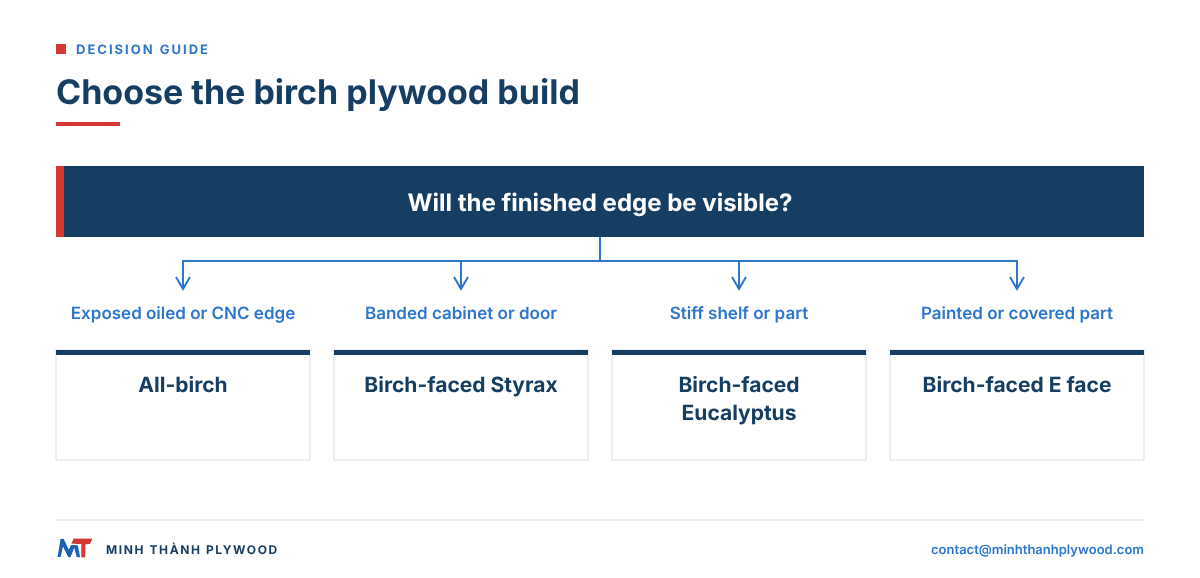
Order all-birch when the edge is part of the design or the part is machined into small, exposed pieces; order birch-faced when the edge is banded or hidden and weight and price matter. Both are made from real birch on the faces.
| Use | Recommended build |
|---|---|
| Kitchen and wardrobe carcasses, banded edges | Birch-faced on Styrax, D+/D or D/D |
| Cabinet doors and visible panels, banded | Birch-faced, D+ face |
| Shelving and stiff parts | Birch-faced on Eucalyptus |
| Exposed oiled edges, furniture with visible plies | All-birch |
| Small CNC parts, toys, laser cutting | All-birch |
| Painted or covered parts | Birch-faced, E face or lower grade pair |
Birch-faced panels on Styrax also load more sheets per container. At 18 mm in a 40HC, our plan fits 990 sheets on Styrax against 795 on Eucalyptus, capped by weight.
What to send for a birch plywood quote
Send the six lines below and we quote the build in writing, with free samples. They match the questions every birch plywood order has to answer.
- Application: what the panel becomes, indoors or outdoors.
- Core: white Styrax or Eucalyptus, stitched.
- Glue and emission: UF glue at E0 emission, or melamine-fortified or phenolic for damp and exterior use; the emission evidence your market asks for.
- Face: birch face/back pair, for example D+/D, sanded or polished, UV-ready.
- Panel: thickness from 3 to 40 mm, 1220 × 2440 mm or 1250 × 2500 mm, tolerance, cut-to-size if needed.
- Packing and quantity: one 40HC minimum, mixed specifications by agreement, destination port.
Production takes 15–45 days after the 30% deposit, with the 70% balance against the scanned B/L, FOB Hai Phong, CFR or CIF. See birch plywood from Vietnam for sizes and grades.
Buyer questions, answered
How is birch plywood made?
Logs are peeled into veneers on a rotary lathe, the veneers are dried, graded and glued in cross layers, and the stack is consolidated in a cold press and cured in a hot press. The panel is then trimmed, repaired, sanded and graded.
Is Vietnamese birch plywood all-birch or birch-faced?
Birch-faced. Vietnam has no birch forests, so Vietnamese mills press imported birch face and back veneers onto a local plantation core, white Styrax or Eucalyptus at Minh Thanh. All-birch panels come from the Baltic region, Finland and other birch-growing countries.
How many plies does birch plywood have?
An 18 mm all-birch panel usually has 13 plies. Vietnamese birch-faced 18 mm panels are built with 11–13 plies, most often 11, and thin 3–5 mm panels are always 5 plies.
What is birch plywood made from?
All-birch plywood is made entirely from birch veneers bonded with UF, melamine or phenolic glue. Birch-faced plywood has birch only on the face and back, over a core of another species such as Styrax, Eucalyptus or poplar.
Where is Baltic birch plywood made?
Baltic birch is all-birch plywood from the birch forests around the Baltic Sea; today EU supply comes mainly from Latvia, Finland and Estonia. EU imports of Russian and Belarusian wood products, including plywood, have been banned since 2022.
What glue is used in birch plywood?
Interior furniture birch plywood uses UF glue, at E0 emission at Minh Thanh. Exterior and film-faced birch panels use phenolic glue, and melamine-fortified glue sits between the two for damp interiors.
How thick is the birch face veneer on birch-faced plywood?
Face veneers on Vietnamese plywood are 0.2–0.5 mm thick, with about 0.3 mm the usual choice for European furniture buyers. The thicker the face, the more sanding and handling it tolerates.
What are the birch face grades in Vietnam?
Vietnamese mills name birch faces D+, D and E, from high to low, and quote them as face/back pairs such as D+/D or D/E. As a buying comparison, D+ is close to European B, D to BB and E to CP or C.
Why is birch-faced plywood lighter than all-birch plywood?
The core is a lighter plantation species. White Styrax is about 500 kg/m³ for planning, well below solid birch, so a birch-faced Styrax panel weighs less and more sheets fit a container.
Can birch-faced plywood have exposed edges?
It can, but the edge shows the core species, not birch. For exposed, oiled edges choose all-birch; for banded or covered edges, birch-faced plywood gives the same face at a lower weight and price.