
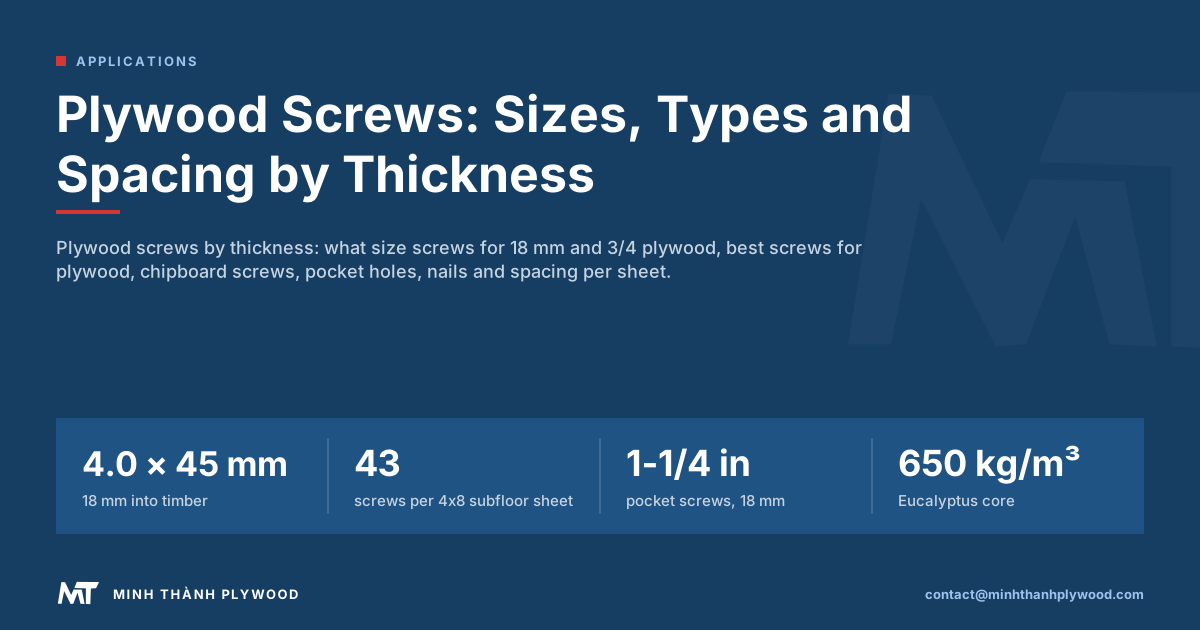
The right plywood screws are sharp, coarse-threaded wood or chipboard screws that pass through the sheet and bite deep into the part below. For 18 mm plywood fixed to timber that means about 4.0 × 45 mm; into the edge of another 18 mm sheet, 4.0 × 40 mm with a pilot hole. Minh Thanh Plywood makes furniture plywood in Vietnam; this guide sizes screws and nails by thickness.
What size screws for plywood: the size table
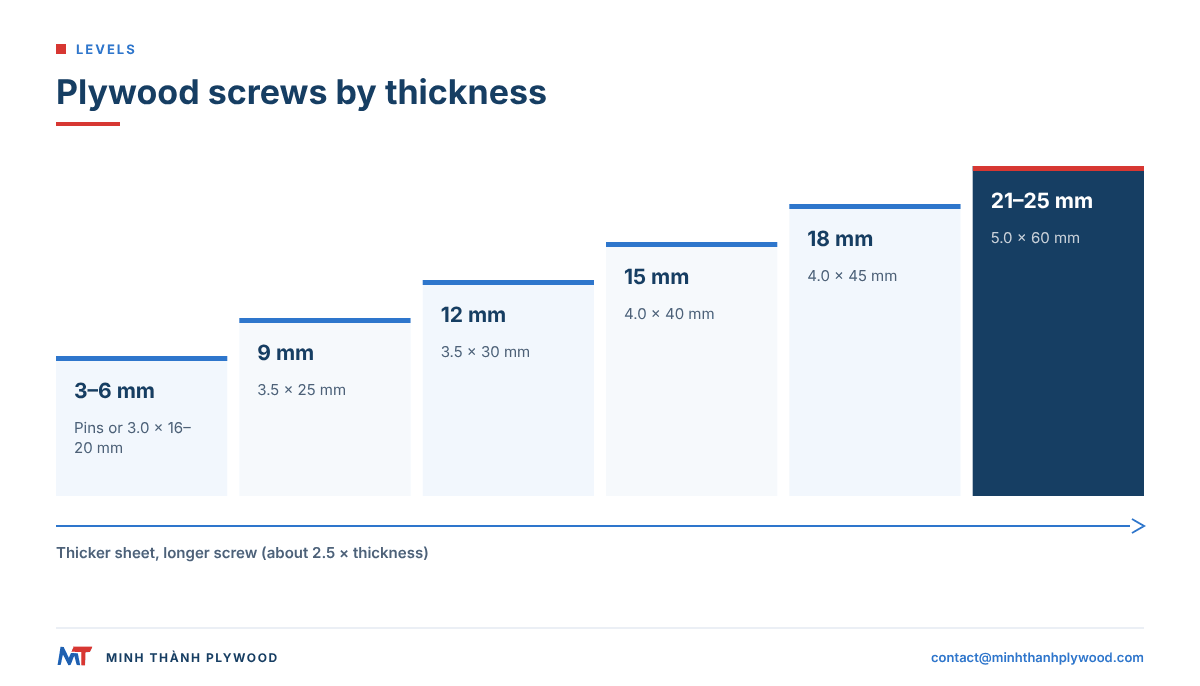
Choose plywood screws by the thickness of the sheet and what it is fixed to. A working rule is a screw about 2.5 times the thickness of the sheet being fixed, so the thread grips deep in the part below.
| Plywood thickness | Into timber or framing | Into the edge of another sheet | Inch equivalent |
|---|---|---|---|
| 3–6 mm | Panel pins or 3.0 × 16–20 mm screws | Do not edge-fix | #4 × 5/8–3/4 in |
| 9 mm | 3.5 × 25 mm | Do not edge-fix | #6 × 1 in |
| 12 mm | 3.5 × 30 mm | 3.5 × 30 mm, pilot hole | #6 × 1-1/4 in |
| 15 mm | 4.0 × 40 mm | 3.5 × 35 mm, pilot hole | #8 × 1-1/2 in |
| 18 mm (3/4 in) | 4.0 × 45 mm | 4.0 × 40 mm, pilot hole | #8 × 1-3/4 in |
| 21–25 mm | 5.0 × 60 mm | 4.5 × 50 mm, pilot hole | #10 × 2-1/2 in |
The edge column assumes a butt joint into a panel of the same thickness. Glue the joint as well: screws clamp it, glue makes it strong.
Best screws for plywood: types compared
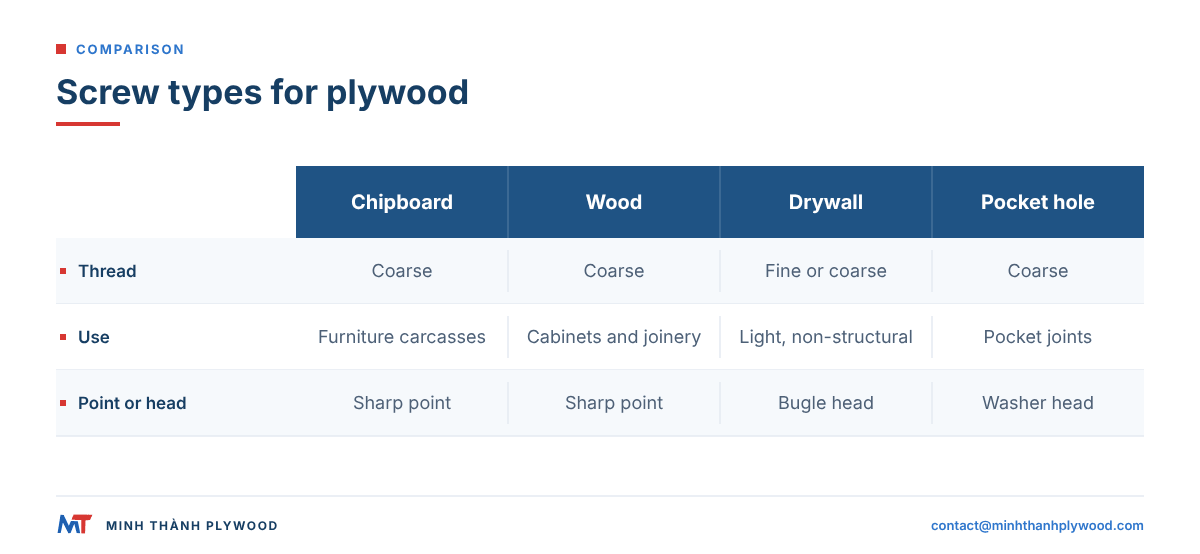
The best screws for plywood are wood screws or chipboard screws with a sharp point, coarse thread and countersunk head. Drywall screws work in a pinch but snap more easily, and machine screws need inserts.
| Screw type | Thread and point | Strength | Use in plywood |
|---|---|---|---|
| Chipboard screw | Coarse, single or twin thread, sharp point | Hardened | General furniture and carcass work |
| Wood screw | Coarse, tapered or parallel, sharp point | Medium | Cabinets, joinery |
| Self-drilling wood screw | Cutting point, coarse thread | Hardened | Faces without pilot holes |
| Pocket hole screw | Coarse thread, washer head | Hardened | Pocket joints |
| Decking or exterior screw | Coarse thread, coated or stainless | Hardened | Outdoor plywood, subfloors |
| Drywall screw | Fine or coarse, bugle head | Brittle | Light, non-structural only |
| Confirmat screw | Thick, blunt thread | Strong | Knock-down furniture with a stepped drill |
Pan-head and wafer-head screws hold thin plywood without a countersink. Self-tapping wood screws save the pilot hole in the face but still need one near edges.
Chipboard screws in plywood
Chipboard screws are a standard plywood screw in Europe: hardened, sharp, with a coarse thread along most of the shank and a countersunk head with ribs that cut their own seat. They hold well in plywood faces and edges.
- Partly threaded screws pull two parts together tightly; fully threaded screws can hold a gap open.
- Twin-thread versions drive faster; single-thread versions hold slightly better in dense faces.
- Nibs under the head countersink into the face without a separate countersink bit.
- Pilot holes still help in hardwood faces and near edges.
Chipboard screws were made for particleboard, which crumbles around a fine thread. In plywood the same coarse thread grips the cross-laminated veneers even better.
What size screws for 3/4 plywood
For 3/4 inch plywood, use #8 screws 1-3/4 to 2 inches long into framing, and #8 × 1-1/2 inch screws into the edge of another 3/4 inch panel. Those are the inch versions of 4.0 × 45 mm and 4.0 × 40 mm.
- Cabinet carcasses: #8 × 1-1/2 in into the edge, with glue and a pilot hole.
- Shelves to frames: #8 × 1-1/4 in through a cleat into the shelf.
- Subfloors to joists: #8 or #10 × 2 in to 2-1/2 in, with construction adhesive.
- Countertop substrates: #8 × 1-1/4 in from below through the cabinet rail.
Sheets sold as 3/4 inch in North America are often a little thinner than 19 mm. Our 18 mm panels are held to ±0.2–0.3 mm thickness tolerance when sanded, so screws sized for 18 mm fit every sheet in the pack.
Pocket hole screws for plywood
Pocket hole screws for 18 mm or 3/4 inch plywood are 1-1/4 inch (about 32 mm) coarse-thread screws; for 12 mm or 1/2 inch plywood use 1 inch (25 mm) screws. Set the jig and the drill collar to the actual thickness.
| Plywood thickness | Pocket screw length | Thread |
|---|---|---|
| 12 mm (1/2 in) | 1 in (25 mm) | Coarse |
| 15 mm (5/8 in) | 1 in (25 mm) | Coarse |
| 18 mm (3/4 in) | 1-1/4 in (32 mm) | Coarse |
Coarse threads suit plywood and softwood; fine threads are for hardwood. Glue pocket joints in plywood, because the screw alone pulls through the outer plies under heavy load.
Screwing into plywood edges
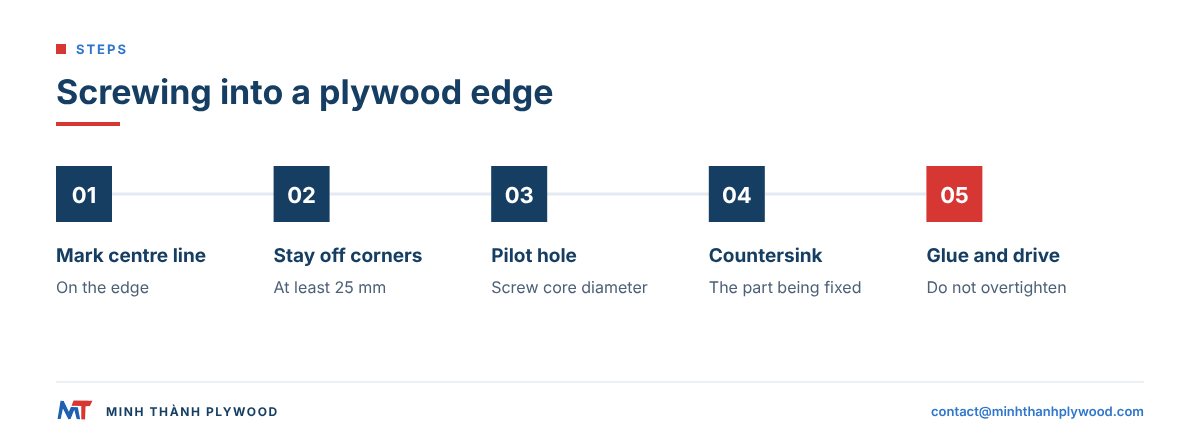
Plywood edges hold screws less well than faces, because the screw runs between and along the plies. Use a pilot hole, select the screw diameter for the panel thickness and joint, and keep screws away from the ends.
- Mark the screw line on the centre of the edge.
- Keep screws back from corners by at least 25 mm.
- Drill a pilot hole about the core diameter of the screw, deep enough for the thread.
- Countersink the face of the part being fixed.
- Glue the joint, then drive the screw without overtightening.
An edge holds a screw only where the core is solid. Our core layers are stitched both horizontally and vertically, so the core strips sit tight and a screw in the edge meets wood, not a gap. Edge-fix 12 mm plywood and thicker; for thinner sheets fix through the face into a batten.
Screw holding: plywood vs MDF vs particleboard
Plywood holds screws better than MDF and particleboard, above all in the edge. Its cross-laminated veneers grip the thread and resist splitting; MDF and particleboard hold reasonably in the face but crumble in the edge.
| Panel | Face screw holding | Edge screw holding | Splitting near edges | Typical fix |
|---|---|---|---|---|
| Plywood | Good | Fair to good | Resists | Wood or chipboard screws |
| MDF | Good | Poor | Can split the edge | Pilot hole, special MDF screws |
| Particleboard | Fair | Poor | Crumbles | Chipboard screws, inserts, dowels |
| Solid softwood | Good | Good across grain, poor in end grain | Splits near ends | Pilot holes near ends |
Two test standards measure this. BS EN 320:2011 tests axial screw withdrawal in particleboards and fibreboards, and ASTM D1761 covers mechanical fasteners in wood and wood-based materials. The US Forest Products Laboratory’s Wood Handbook (FPL-GTR-282, 2021) shows screw withdrawal rising steeply with wood density. Our comparisons of plywood vs MDF and particle board vs plywood cover the other properties.
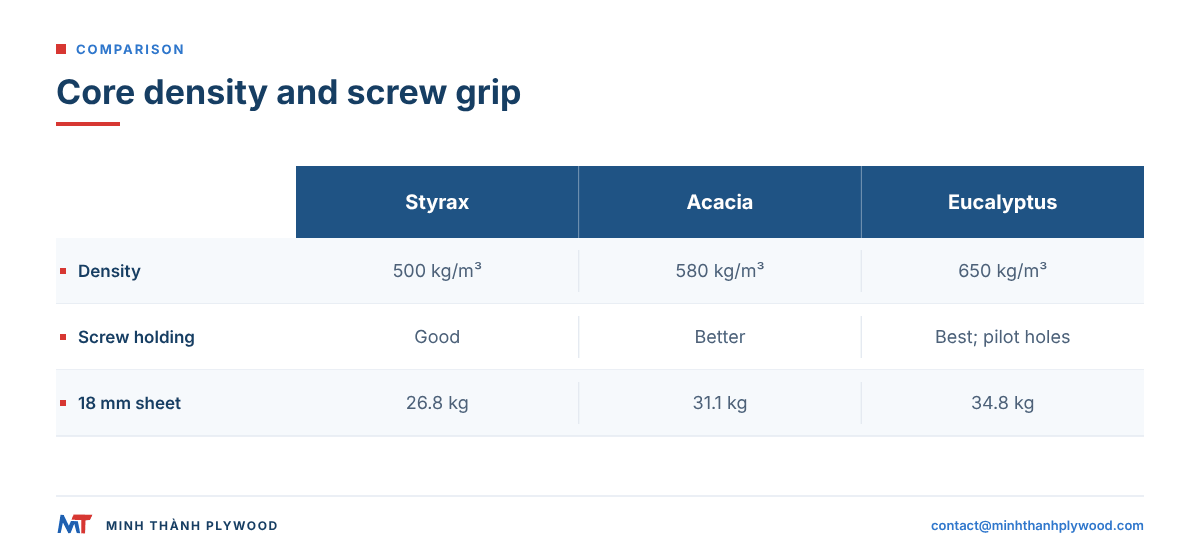
Core species and screw holding
The core species sets how well plywood holds a screw, because denser wood grips the thread harder. A denser core holds more; a lighter core keeps the sheet lighter.
| Core | Reference density | Screw holding | 18 mm sheet weight |
|---|---|---|---|
| Styrax | 500 kg/m³ | Good | 26.8 kg |
| Acacia | 580 kg/m³ | Better | 31.1 kg |
| Eucalyptus | 650 kg/m³ | Best, needs pilot holes | 34.8 kg |
Weights are for 1220 × 2440 × 18 mm sheets at the reference densities. White Styrax and Eucalyptus cores are our standard for furniture panels; Acacia and Pine cores are made on order. Choose Eucalyptus for knock-down furniture, hinges and heavily screwed parts.
Plywood nails and panel pins
Plywood nails are ring-shank or spiral nails for sheathing and subfloors, panel pins for thin backs and drawer bottoms, and common or box nails for crates. Nails flex with the frame and drive fast; screws hold tighter.
- Panel pins: thin plywood of 3–6 mm on cabinet backs and drawer bottoms, with glue.
- Ring-shank nails: subfloors and sheathing; the rings resist pull-out as the frame dries.
- Common nails: wall and roof sheathing, sized by sheet thickness.
- Staples: thin backs and packaging on production lines.
- Galvanised or stainless: any plywood outdoors, and treated timber.
A ply fastener is chosen by load: nails take shear well, screws take withdrawal. Our plywood for subfloors and plywood roof sheathing guides give the fastener rules for floors and roofs.
How many screws per 4x8 sheet
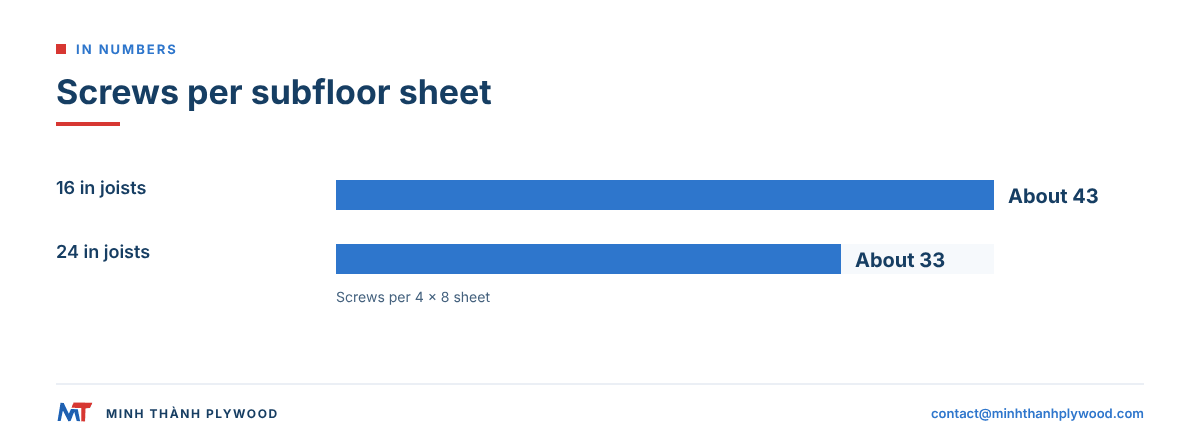
A 4x8 subfloor sheet on joists 16 inches apart takes about 43 screws, at 6 inches along supported panel edges and 12 inches at intermediate joists. On joists 24 inches apart it takes about 33.
| Joist spacing | Supports under an 8 ft sheet | Edge supports at 6 in | Intermediate supports at 12 in | Total |
|---|---|---|---|---|
| 16 in (400 mm) | 7 | 2 × 9 = 18 | 5 × 5 = 25 | About 43 |
| 24 in (600 mm) | 5 | 2 × 9 = 18 | 3 × 5 = 15 | About 33 |
The count assumes the sheet’s long side runs across the joists and tongue-and-groove long edges, as on most floors. Follow the floor maker’s or the building code’s schedule where it differs. APA, The Engineered Wood Association, publishes the fastening schedules used in North America.
Screws for thin plywood and van linings
Screw thin plywood through the face into a frame or batten, never into its edge, with pan-head or wafer-head screws that do not need a countersink. A pilot hole stops the outer ply splitting.
- 3–6 mm sheets: panel pins and glue, or 3.0 mm pan-head screws into battens.
- 9 mm sheets: 3.5 × 25 mm screws, countersunk or with cup washers for a neat look.
- Van linings: 9–12 mm plywood on steel ribs, with self-drilling wafer-head screws long enough to pass the ply and grip the rib, or rivnuts and bolts where the metal is thin.
- Do not overtighten: thin ply crushes under the head; set the drill clutch low.
Our thin plywood is always 5-ply from 3 to 5 mm, which gives a thin sheet more plies for screws to grip than 3-ply construction.
Nail holding in crates: plywood vs timber
Plywood holds nails close to its edges without splitting, where solid timber boards split along the grain. That lets crate makers nail plywood panels near the edge and use fewer, wider parts.
- No splitting: cross-laminated veneers stop a crack running along the grain.
- Even holding in both directions: the panel holds nails across and along the sheet.
- Fewer joints: one panel replaces several boards, so there are fewer nail lines.
- Thinner sections: 9–12 mm plywood often replaces thicker timber boards on crate sides.
Our packing plywood is made for crates and pallets, with utility faces and cores suited to nailing.
Screw materials: indoor, outdoor and treated timber
Use zinc-plated screws indoors, coated exterior screws or stainless steel outdoors, and stainless steel or hot-dip galvanised screws in treated timber and near the sea. The wrong metal rusts and stains the plywood face.
| Exposure | Screw finish |
|---|---|
| Dry interior furniture | Zinc-plated or yellow passivated |
| Humid interiors, kitchens, bathrooms | Coated or stainless |
| Exterior plywood | Coated exterior screws or stainless |
| Coastal and marine | Stainless, marine grade |
| Treated timber framing | Stainless or hot-dip galvanised |
Stainless steel is softer than hardened carbon steel; drill pilot holes and drive gently so the heads do not strip.
What this means for your order
Screws hold best in calibrated plywood with a solid, dense core, so put the core and thickness on your order as clearly as the face. Send these lines with your request:
- Application: furniture, cabinets, subfloor, sheathing or crates.
- Core: Eucalyptus for the best screw holding, white Styrax for lighter sheets.
- Thickness and tolerance: 3–40 mm; sanded furniture panels ±0.2–0.3 mm.
- Glue and emission: UF glue at E0 emission for interiors; melamine-fortified or phenolic (WBP) glue to your specification.
- Size: 1220 × 2440 mm or 1250 × 2500 mm, or cut-to-size parts.
- Quantity: from one 40HC, mixed specifications by agreement.
Ask for free samples to test your fixings, and see our furniture plywood from Vietnam and construction plywood ranges. Our guides on plywood joints and how much weight plywood can hold go further into design.
Buyer questions, answered
What size screws for 18 mm plywood?
To fix 18 mm plywood to timber, use about 4.0 × 45 mm wood or chipboard screws. Into the edge of another 18 mm sheet, use 4.0 × 40 mm screws with a pilot hole, kept away from the ends.
What size screws for 3/4 plywood?
Use #8 screws about 1-3/4 or 2 inches long to fix 3/4 inch plywood to framing, and #8 × 1-1/2 inch screws into the edge of another 3/4 inch panel. Pocket holes in 3/4 inch plywood take 1-1/4 inch coarse-thread screws.
What are the best screws for plywood?
Sharp-pointed wood screws or chipboard screws with coarse threads and a countersunk head. They grip the plies without crushing them; use zinc-plated screws indoors and stainless or coated exterior screws outdoors.
Can you use chipboard screws in plywood?
Yes. Chipboard screws have a sharp point, coarse thread and hardened shank, and are a standard plywood screw in Europe. Use a pilot hole near edges and in dense hardwood faces.
How many screws per 4x8 sheet of plywood subfloor?
With fasteners at 6 inches along supported panel edges and 12 inches at intermediate joists 16 inches apart, a 4x8 subfloor sheet takes about 43 screws. Joists 24 inches apart bring it to about 33.
What size pocket hole screws for 18mm ply?
Use 1-1/4 inch (about 32 mm) coarse-thread pocket hole screws for 18 mm or 3/4 inch plywood. For 12 mm or 1/2 inch plywood, use 1 inch (25 mm) screws with the jig set for that thickness.
What size screws for 9mm plywood?
Fix 9 mm plywood to timber with about 3.5 × 25 mm screws (#6 × 1 inch). Do not screw into the edge of 9 mm plywood; fix through the face into a batten or frame instead.
Do you need pilot holes for screws in plywood?
Yes near edges, in dense hardwood faces and for any screw into the plywood edge. In the face of softer plywood a sharp self-drilling wood screw can go in without one, but a countersink still gives a flush head.
Is plywood better than MDF for holding screws?
Yes. Plywood's cross-laminated veneers grip screws in the face and resist splitting at the edge; MDF holds well in the face but poorly in its edge, and particleboard needs special screws or inserts.
Should I use nails or screws on plywood?
Nails are faster and flex with the frame, so they suit sheathing and crates. Screws hold tighter, pull panels down and can be removed, so they suit subfloors, furniture and cabinets.
What size screws for a ply lining in a van?
For 9 to 12 mm plywood on steel van ribs, use self-drilling wafer-head screws long enough to pass the ply and grip the rib, or rivnuts with bolts where the metal is thin.