
The moisture content of plywood is the weight of water in the panel as a percentage of its oven-dry weight. Furniture and interior plywood is dried to 8–12 % at dispatch, close to the level it will settle at indoors, so it stays flat and glues, sands and finishes well. This guide gives the acceptable levels by use, compares oven-dry testing with pin and pinless meters, explains container condensation, and ends with the moisture line to put on a purchase order. Minh Thanh Plywood is a furniture plywood manufacturer in Phu Tho, Vietnam.

What is the moisture content of plywood?
The moisture content of plywood is the weight of water in the panel divided by the weight of the same panel when fully dry, expressed as a percentage. It is measured on the dry-weight basis used for all wood, so a reading of 10 % means 10 g of water for every 100 g of dry wood.
The formula is simple:
Moisture content (%) = (wet weight − oven-dry weight) ÷ oven-dry weight × 100
A sample cut from a panel that weighs 110 g and dries to 100 g has a moisture content of 10 %. The same rule applies to veneer, plywood and lumber, which is why a moisture figure on a plywood order can be compared with one on a timber order.
Moisture content matters because wood swells as it takes up water and shrinks as it dries, mostly across the grain. Plywood restrains that movement by crossing the grain of each layer, but a panel delivered far wetter or drier than its final room still moves, bows and finishes badly.
What moisture content should plywood have?
Furniture and interior plywood should be dried to 8–12 % moisture content at dispatch, the normal range for furniture plywood and close to what the panel settles at indoors. Our veneers and finished panels are dried to that range before they leave the mill.
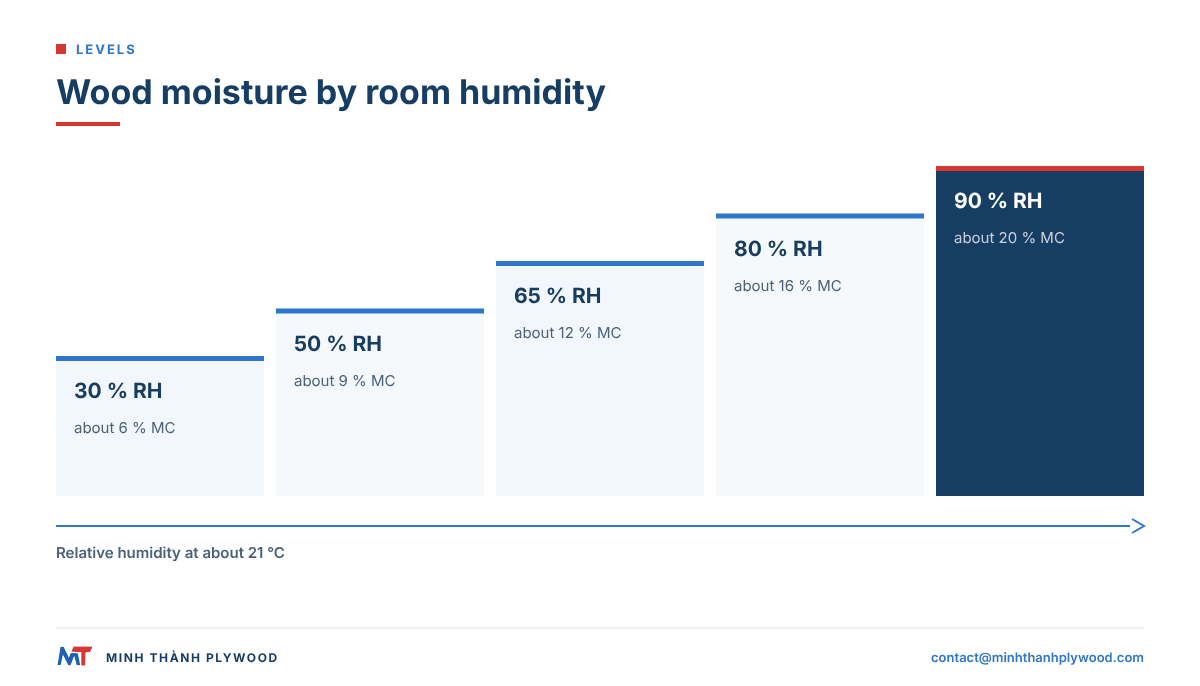
The right level is the one the panel will reach in use, called the equilibrium moisture content. It depends on the air around the panel, mainly its relative humidity.
| Relative humidity at about 21 °C | Equilibrium moisture content of wood |
|---|---|
| 30 % | about 6 % |
| 50 % | about 9 % |
| 65 % | about 12 % |
| 80 % | about 16 % |
| 90 % | about 20 % |
Values for solid wood from the USDA Forest Products Laboratory Wood Handbook, 2021; plywood settles close to these figures.
Acceptable moisture levels in wood by use
Acceptable moisture levels in wood follow the building it goes into. The USDA Wood Handbook (2021) recommends these ranges for wood products when installed:
| Use and climate | Average | Range for individual pieces |
|---|---|---|
| Interior, most heated buildings | about 8 % | 6–10 % |
| Interior, dry inland climates | about 6 % | 4–9 % |
| Interior, damp warm coastal climates | about 11 % | 8–13 % |
| Exterior, most climates | about 12 % | 9–14 % |
Plywood dried to 8–12 % meets the interior ranges after a short period of conditioning in the building. Buyers in very dry, centrally heated regions can ask for the lower half of the range on furniture panels.
Why does moisture content matter in plywood?
Moisture content decides whether plywood stays flat, holds its size, bonds well and finishes cleanly after delivery. Most complaints that appear weeks after a container is opened, such as bow, open joints or a blotchy finish, trace back to moisture.
| Problem | When moisture is too high | When moisture is too low |
|---|---|---|
| Shape | Bow and cup as the panel dries in a heated room | Swelling and cup as it takes up moisture in a humid room |
| Size | Parts shrink after cutting; joints open | Parts swell; tight fits bind |
| Finish | Lacquer blushes or lifts; glue spreads slowly | Finish soaks in unevenly |
| Bond | Weak or blistered glue lines if veneer was wet at pressing | Brittle veneer cracks during handling |
| Mould | Grows on surfaces kept damp in a closed pack | No mould risk |
According to the Wood Handbook, wood kept below about 20 % moisture content does not decay, and mould needs surfaces kept damp for days. A furniture panel at 8–12 % sits well below that line.
How does moisture change plywood strength and size?
Plywood loses stiffness and strength as its moisture content rises, and it grows mostly in thickness. UPM’s WISA plywood states that the mechanical values in its Declaration of Performance are valid for plywood at a moisture content of 10–12 %, and that strength and elasticity decrease as moisture rises. Design values under EN 13986 are read the same way: they belong to a panel at service moisture, not to a wet one. In the EU, plywood used in construction is CE-marked under the Construction Products Regulation (EU) No 305/2011.
APA, the North American panel body, measured how much structural plywood moves between oven-dry and fully soaked. The figures show why plywood is the stable choice for cabinets and floors:
| Movement, oven-dry to vacuum soak | Plywood |
|---|---|
| Length or width, across the strength direction | 0.31–0.34 % |
| Thickness, 3/8 to 1/2 inch panels | 9.4 % |
| Thickness, 19/32 to 3/4 inch panels | 8.8 % |
| Moisture content of plywood leaving the factory | 5–8 % |
APA Technical Topic TT-028, Moisture-Related Dimensional Stability (2010). Thickness swell rises in proportion to moisture content, so a small change in a heated room moves thickness by only a fraction of these totals.
For a furniture plant the working rule is to keep the panels inside the 8–12 % range from dispatch to cutting, and to let a pack acclimate in the workshop before the saw.
Builders and flooring installers: moisture limits before closing in
Builders and flooring installers in the US work to two numbers. Wall and floor framing must not be enclosed above 19 % moisture content under California’s green building code (CALGreen 4.505.3), and Oregon’s residential code (R318.2) sets the same 19 % limit for moisture-sensitive framing. For a plywood subfloor under hardwood, the National Wood Flooring Association asks for no more than 4 % moisture difference between the flooring and the subfloor for strip flooring under 3 inches wide, and no more than 2 % for wider boards. Manufacturer guides add that no wood subfloor should read above 12 %.
A subfloor panel bought at 8–12 % sits inside that window in most heated houses, and a pinless meter reading on the sheet before laying shows whether it is still there.
How does moisture content affect glue and pressing?
Veneer that is too wet when it enters the hot press turns its water to steam, which pushes the layers apart and leaves blisters, soft spots and weak glue lines. Veneer dried evenly before lay-up lets the glue spread, wet the wood and cure across the whole sheet.
This is why moisture is controlled on the veneer before pressing, and not only on the finished panel. Two further points follow:
- Even moisture across all layers. Veneers dried to different levels and pressed together equalise later, and the panel bows toward the layers that shrink most. Our guide on why plywood warps explains this cause in detail.
- Moisture and glue type are separate specifications. UF glue at E0 emission is the standard for our furniture and interior panels; MR/melamine-fortified and phenolic (WBP) bonds are made to the customer’s specification. The bond decides how a panel resists water in service; moisture content describes how much water is in the panel when it is measured.
Furniture-grade panels are pressed twice as standard: the core board is pressed and calibrated, then face and back are pressed on. Each pressing drives off moisture, and the calibrated core gives the faces a flat, even base.
How to test moisture in wood and plywood
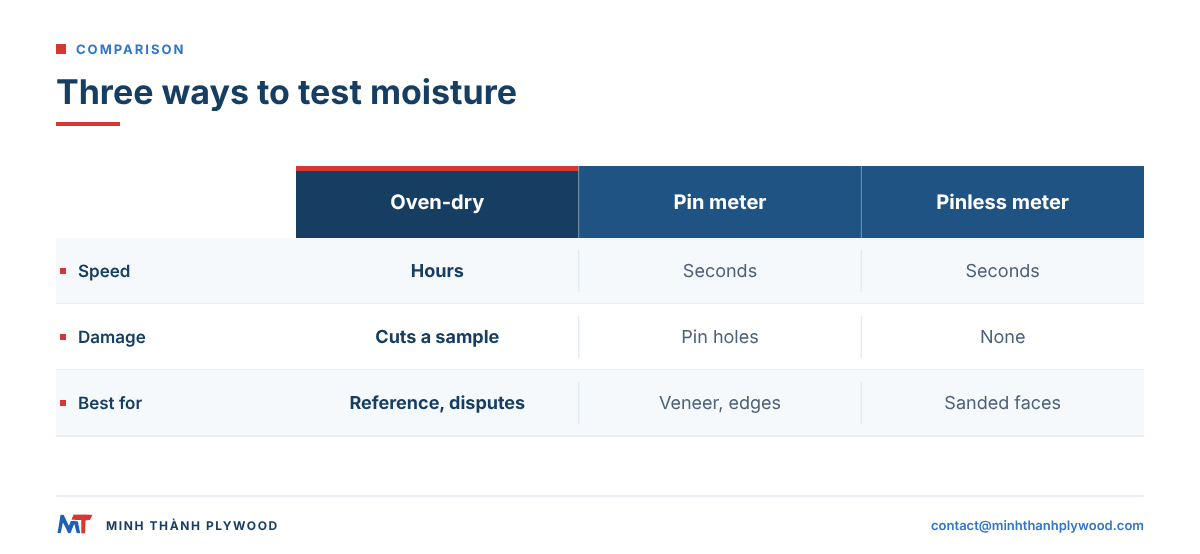
To test moisture in wood and plywood, use the oven-dry method when you need the reference value and a calibrated meter when you need many fast readings. The two methods answer different questions.
| Method | How it works | Speed | Best for | Limits |
|---|---|---|---|---|
| Oven-dry (EN 322, ASTM D4442) | Weigh a cut sample, dry it at about 103 °C to constant weight, weigh again | Hours to a day | Reference value, disputes, meter calibration | Destroys the sample |
| Pin meter (resistance) | Two pins measure electrical resistance between them | Seconds | Veneer, raw edges, readings at a known depth | Leaves holes; needs species and temperature correction |
| Pinless meter (capacitance) | A pad reads the panel’s electrical properties to a set depth | Seconds | Sanded and finished faces, many sheets | Reads an average depth; affected by density and surface water |
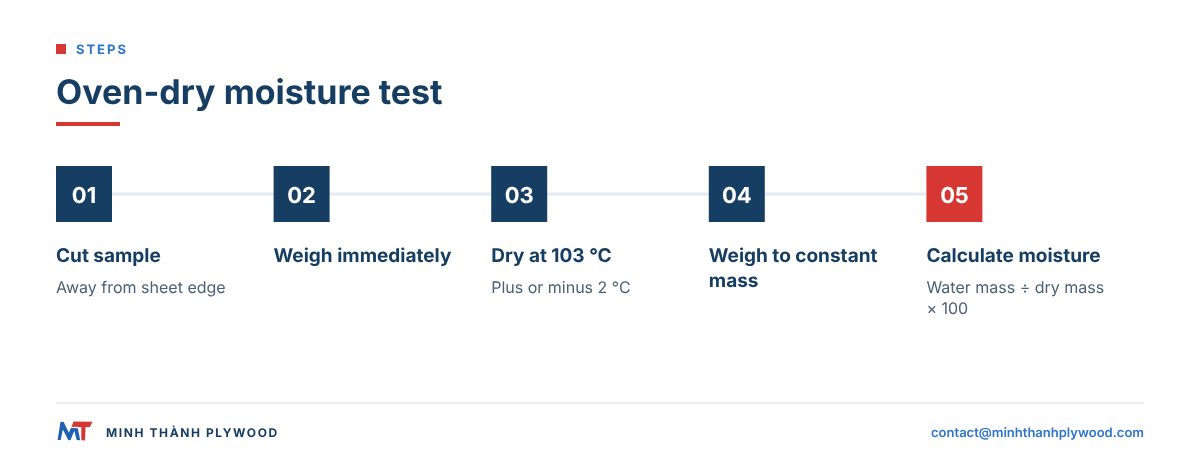
The oven-dry steps, following EN 322 and ASTM D4442:
- Cut a sample clear of the sheet edge and weigh it at once.
- Dry it in a ventilated oven at 103 °C, plus or minus 2 degrees.
- Weigh it again at intervals until the weight stops falling.
- Calculate moisture content with the formula above.
Meter readings on plywood come within a point or two of the oven-dry value when the species setting matches the face or core. When the number matters, cut one sample, dry it, and compare it with the meter reading on the same sheet.
Moisture meters for wood: which type should you use?
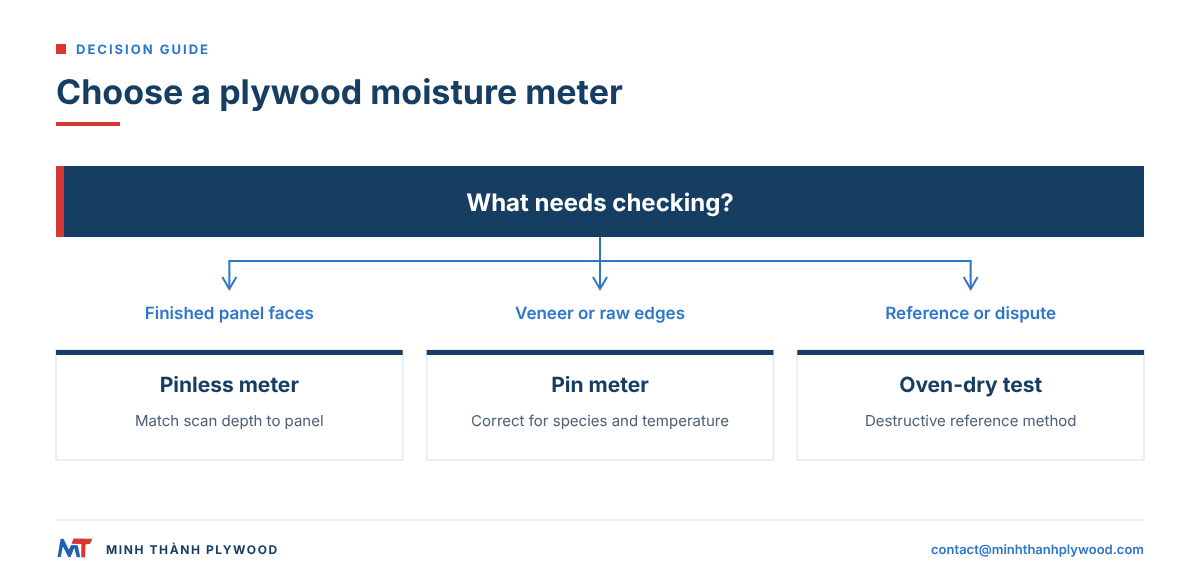
For plywood and furniture panels, a pinless moisture meter with species settings and a scan depth that suits the panel thickness is the most practical tool; a pin meter is the better second tool for veneer and edges. Moisture meters for wood differ mainly in how they read, not in brand.
What to look for when choosing the best moisture meter for woodworking or panel inspection:
- Species or density settings, so the meter can be set for birch, poplar, eucalyptus or pine faces.
- A scan depth matched to the panel: a deep pad on a thin sheet also reads the table beneath it.
- Temperature correction, for pin meters used in cold or hot warehouses.
- A calibration check, either a reference block or comparison with an oven-dry sample.
- Data logging, so readings by pack and sheet can be sent with photos.
How to take a reliable reading:
- Let the meter and the panel reach the same room temperature.
- Read away from the edges, which dry and wet faster than the centre.
- Take at least three readings per sheet on both faces.
- Read several sheets from the top, middle and bottom of each pack.
- Record the meter, the setting and the readings with the pack label.
Moisture content of lumber versus plywood
The moisture content of lumber is calculated exactly as for plywood, but solid lumber is often sold wetter and dries more slowly, because it is thick and dried as a whole board. Plywood is built from thin veneers that are dried individually before pressing, so a finished panel is more even through its thickness.
| Point | Lumber (solid wood) | Plywood |
|---|---|---|
| How it is dried | Air or kiln drying of whole boards | Each veneer dried, then hot-pressed |
| Moisture through thickness | Wetter core, drier surface for weeks | Even across thin layers |
| Movement across width | Large; follows the growth rings | Small; restrained by crossed layers |
| Typical furniture target | Dried to suit the room | 8–12 % at dispatch for furniture plywood |
Wood fibres hold water in their cell walls up to the fibre saturation point, about 30 % moisture content according to the Wood Handbook. Above that, extra water fills the cell cavities and the wood does not swell further; below it, every point of moisture lost shrinks the wood. All drying and all movement in service happen below that point.
How does the mill control moisture content?
The mill controls moisture by drying every veneer before lay-up, pressing panels in two stages and dispatching them at 8–12 %. Moisture control starts at the veneer, because a finished panel cannot be corrected evenly once its layers are glued.
- Veneer drying. Peeled veneer is dried before it is graded and laid up, so each layer starts at a similar moisture.
- Sorting and lay-up. Dried veneers are graded and laid up with the core layers stitched both horizontally and vertically.
- First pressing and calibration. The core board is pressed and calibrated to an even thickness.
- Second pressing. Face and back veneers are pressed on to the calibrated core.
- Sanding. Faces are sanded and polished to a thickness tolerance down to ±0.2 mm.
- Dispatch. Panels leave at 8–12 % moisture content, packed and photographed; every shipment is filmed before loading.
Buyers who want an independent reading can have third-party testing to their own method arranged through SGS on request. Our quality control page shows the checks along the line.
Can plywood take up moisture in a shipping container?
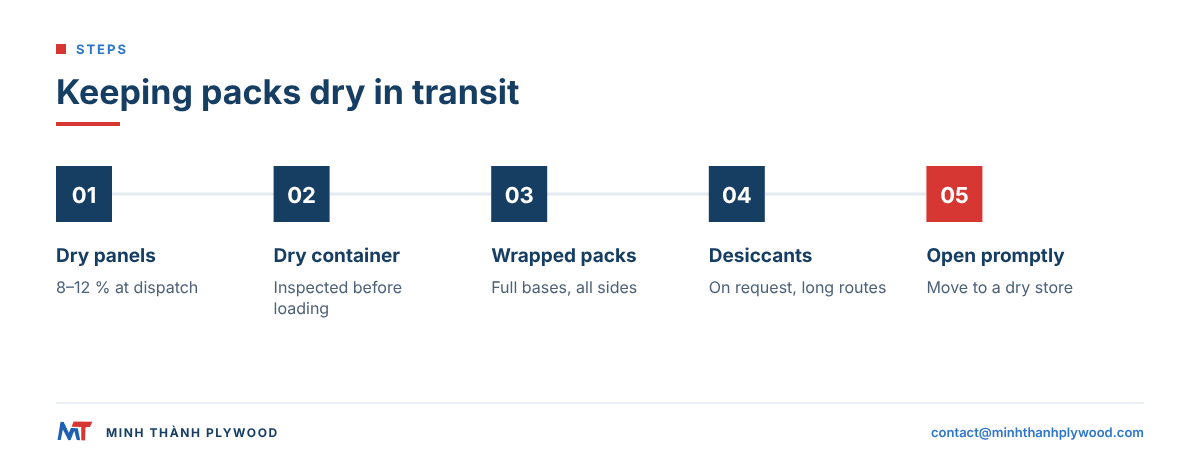
Plywood can take up moisture in a container when warm, humid air cools and condenses on the roof and walls, then drips onto the packs; this is called container rain. Dry panels in sound packs, a dry container and good loading keep the risk low.
What raises the risk:
- A long route through changing climates, such as tropical ports to a European winter. Typical days at sea from Hai Phong are 25–35 to the Mediterranean and 30–40 to Northern Europe, by carrier and route.
- Wet dunnage or a damp container floor, which adds water inside the sealed box.
- Packs left open or damaged, so drips reach the faces.
What lowers it:
- Panels dispatched dry, at 8–12 %.
- A clean, dry container, inspected before loading.
- Packs wrapped on all sides on full timber bases, with edge protection under the straps.
- Desiccant bags or strips hung in the container, which buyers can request for long winter routes.
- Opening the container promptly on arrival and moving the packs into a dry store.
The timber bases and bearers under the packs are solid wood and fall inside ISPM 15, the international wood packaging standard, while plywood itself is processed wood outside its scope.
Check the top layer of each pack first on arrival: condensation damage shows as water marks on the wrap and the outer sheets.
How can buyers verify moisture content before shipment and on arrival?
Buyers verify moisture content by agreeing the range and the method on the order, then reading sheets from several packs before loading and again on arrival. A shared method turns a moisture complaint into a measurement.
- Write the range and method into the contract: for example, 8–12 % by calibrated meter, oven-dry as the reference.
- Before loading, ask for meter readings on sheets from the top, middle and bottom of several packs, with photos showing the meter and pack labels, or send an inspector.
- On arrival, photograph the container and packs before opening, then read moisture at the same points.
- Let the panels condition in the closed pack in the workshop before cutting, and read again before finishing.
- If readings disagree, cut samples for an oven-dry test.
Every shipment we load is photographed and filmed before loading, and buyers get the photos and video, so arrival readings can be compared with the condition at loading. Our guide on plywood quality claims lists the rest of the evidence for a dispute.
What moisture line should you write on a plywood order?
Write the moisture range, the method and where it is measured, alongside the rest of the panel specification. A moisture line without a method cannot be checked by either side.
| Order line | Example |
|---|---|
| Moisture range | 8–12 % at dispatch |
| Method | Calibrated meter on faces; oven-dry (EN 322 or ASTM D4442) as reference |
| Sampling | Sheets from top, middle and bottom of several packs |
| Packing | Wrapped on all sides, full timber base, edge protection |
| Container | Clean and dry; desiccant on request for long routes |
| Records | Photos and video before loading |
A complete spec line reads: Furniture plywood, 1220 × 2440 × 18 mm, Styrax core, poplar face/back A/B, UF glue at E0 emission, moisture content 8–12 % at dispatch (meter, oven-dry reference), tolerance ±0.2 mm, faces sanded and UV-ready. Send it with your quantity and port through our furniture plywood page, and we will reply within hours with a quotation and free samples. Our plywood thickness guide helps choose the thickness.
Buyer questions, answered
What is the acceptable moisture content for export plywood?
Furniture and interior plywood for export is normally dried to 8–12 % moisture content at dispatch. That range sits close to the level the panel reaches in heated or air-conditioned buildings, so it moves very little after delivery.
How is the moisture content of plywood calculated?
Moisture content is the weight of water divided by the oven-dry weight of the wood, times 100. A sample weighing 110 g that dries to 100 g has a moisture content of 10 %.
How do plywood factories test moisture content?
Mills use handheld meters on veneer and finished panels for fast checks, and the oven-dry method on cut samples as the reference. The oven-dry test dries a sample at about 103 °C until its weight stops falling.
What problems does high moisture content cause in plywood?
Panels shipped wet shrink and warp as they dry, take finishes badly, can weaken the glue bond if the veneer was wet at pressing, and grow mould when they stay damp in a closed pack.
Can buyers verify moisture content before shipment?
Yes. Ask for meter readings on sheets from several packs before loading, or appoint an inspector to take them. For a dispute, the oven-dry test on cut samples is the reference method.
Are pin or pinless moisture meters better for plywood?
Pinless meters are better for sanded or finished faces because they leave no holes and read a broad area. Pin meters read at a known depth and suit veneer and raw edges. Both need the right species setting.
Does moisture content affect glue performance?
Yes. Veneer that is too wet at pressing turns to steam in the hot press and can cause blisters and weak glue lines. Veneer dried to the right level before lay-up bonds evenly.
Do moisture meters work on plywood?
Yes, with care. Meters are calibrated for solid wood, so readings on plywood are close but not exact. Use the species setting of the face or core, read several points, and compare with an oven-dry sample when the number matters.