
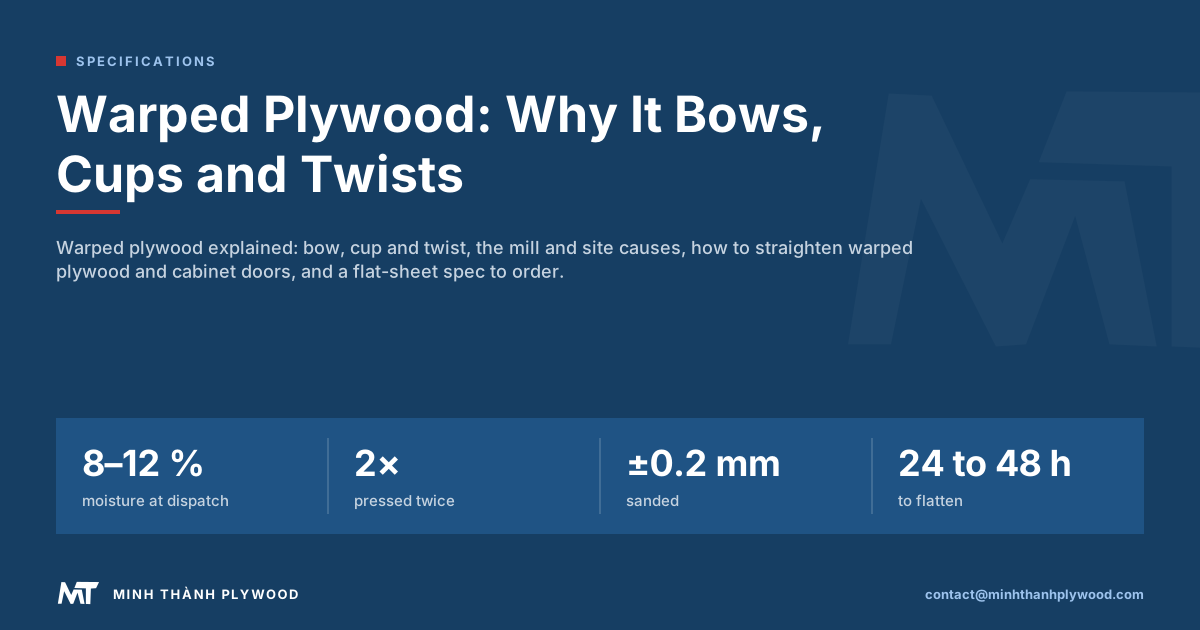
Warped plywood is a panel that no longer lies in one plane: it bows along its length, cups across its width or twists at the corners. The cause is always an imbalance, in moisture, construction or support, between one face and the other. Some of that imbalance is built in at the mill and some is added on site, and the two need different fixes. This guide covers both, with the steps to straighten a warped sheet and the specification that keeps furniture panels flat. Minh Thanh Plywood is a furniture plywood manufacturer in Phu Tho, Vietnam.
What is warped plywood?
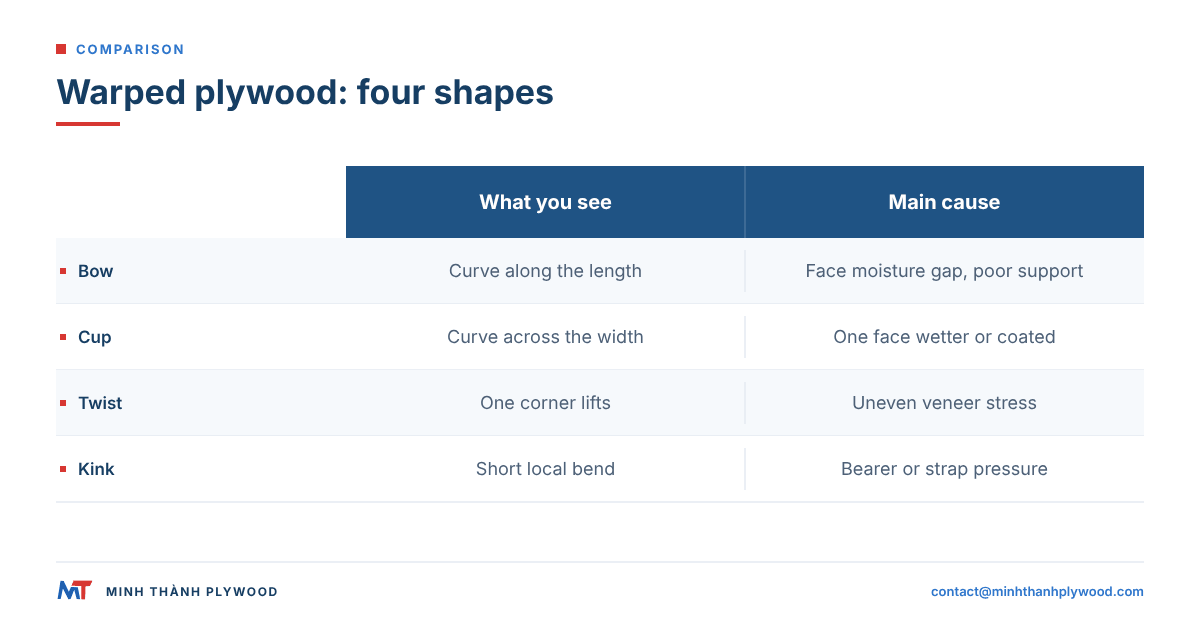
Warped plywood is a sheet that has lost its flat plane because one side of the panel has grown or shrunk more than the other. Four shapes cover almost every case, and naming the right one is the first step to finding the cause.
| Warp shape | What you see | Most common cause |
|---|---|---|
| Bow | A curve along the length; the ends or the middle lift off a flat table | Moisture difference between face and back, unsupported storage |
| Cup | A curve across the width; the long edges rise or fall | One face wetter or drier than the other, one-sided finish |
| Twist | One corner lifts while the other three sit flat | Uneven veneer stress, uneven support in the pack |
| Kink or local wave | A short bend or ripple in one area | Core overlap, crushed bearer, strap pressure |
A sheet can show more than one shape at once: a bowed panel often twists after it is cut into parts. Record the dominant shape, which face is concave and how far the sheet sits off a flat surface. That record decides both the fix and, on an import order, who is responsible.
Why does plywood warp even though the veneers are cross-laminated?
Plywood warps when its two faces change size by different amounts; cross lamination limits that movement but cannot cancel an imbalance. Wood swells and shrinks with moisture, mostly across the grain and very little along it. In plywood each layer is glued with its grain at right angles to the next, so every layer is held by its neighbours.
That restraint works only when the construction is symmetrical about the centre line. A balanced panel has the same species, veneer thickness, grain direction and moisture on matching layers either side of the core. Change any one of those on one side and the forces no longer cancel:
- Moisture: a face several points wetter than the back swells more, and the panel cups away from the wet side.
- Thickness: a face sanded through to a thinner veneer than the back pulls less, and the thicker side wins.
- Species: a dense face over a light back moves by a different amount for the same change in humidity.
- Finish: a lacquer or laminate on one face slows moisture exchange there, so the open face reacts first.
The result is the same in every case: one face becomes longer than the other and the panel curves to make room. This is why the cure for warp always starts with finding the imbalance, not with weights.
What causes plywood to warp at the mill?
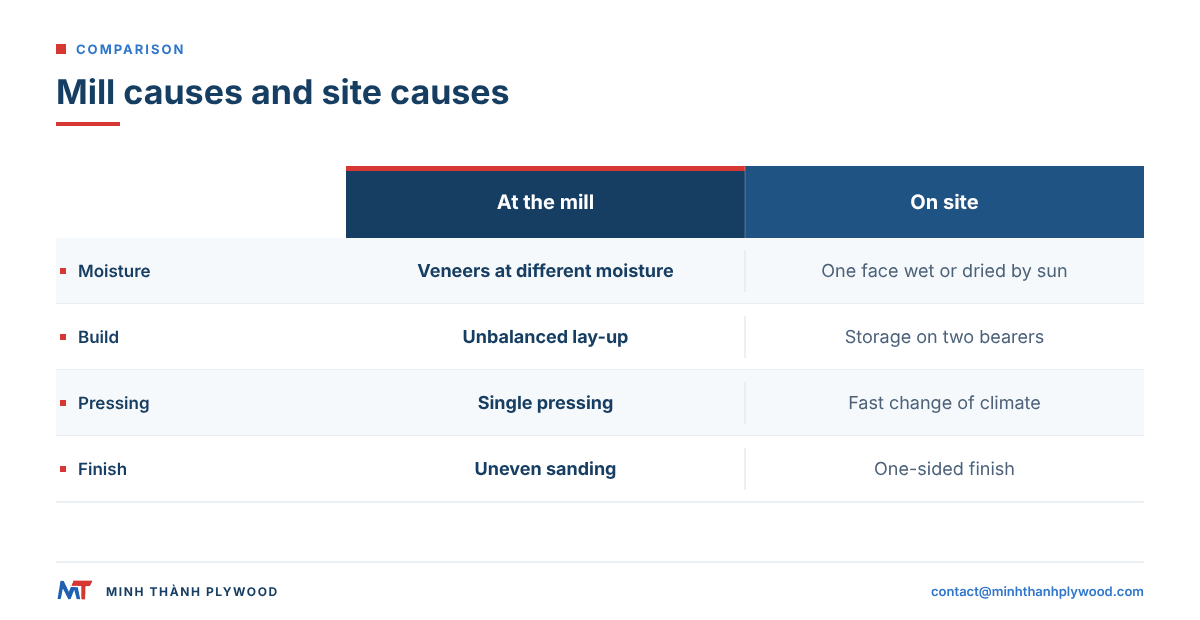
At the mill, warp comes from four controllable causes: an unbalanced lay-up, veneers of different moisture, a single pressing that locks in stress, and uneven sanding. Each one is invisible when the panel leaves the press and appears days or weeks later.
- Unbalanced lay-up. An odd number of layers is needed so the outer layers run the same way and match each other. A decorative face over a cheap, thin or different-species back, or a core veneer placed off-centre, leaves the panel asymmetric from the start.
- Moisture gap between veneers. Veneers dried to different moisture and pressed together equalise after pressing. The wetter layers shrink, and the panel bows toward them. Drying and sorting veneer by moisture before lay-up removes this cause.
- Single pressing of thick, decorated panels. Pressing core and faces in one cycle can trap uneven stress and leaves the core thickness uncalibrated, so the faces go onto a surface that is not flat.
- Uneven sanding or calibration. Taking more off one face than the other thins that face and shifts the balance.
Our furniture panels are made against each of these causes. Veneers and finished panels are dried to 8–12 % moisture content at dispatch, the normal range for furniture plywood. Furniture-grade panels are pressed twice as standard: the core board is pressed and calibrated, then face and back are pressed on. The core layers are stitched both horizontally and vertically, which keeps the inner plies closed and even. Faces are sanded to a thickness tolerance down to ±0.2 mm, and both faces are made UV-ready, so a buyer can finish the panel the same on both sides.
What causes plywood to warp after delivery?
After delivery, warp comes from storage, one-sided finishing and fast changes in climate. These causes act on panels that were flat when they left the factory, which is why a flatness dispute needs the storage story as much as the production record.
- Storage without full support. Packs set on two bearers sag in the middle; bearers out of line between stacked packs press a bend into the lower pack; sheets leaned against a wall for days take a permanent bow.
- One face exposed. Sun through a window, a heater, a damp concrete floor or rain on an open pack dries or wets one face only.
- One-sided finish. Lacquer, paint, laminate or veneer on the front face only, with the back left raw, seals one side and leaves the other free to take up or lose moisture.
- Unsealed cut edges. Fresh edges expose end grain and glue lines that take up moisture much faster than a sanded face.
- Opening a cold or wet pack straight into a warm, dry workshop. The outer sheets dry quickly on their exposed face while the stack stays as it was.
- Cutting the sheet into parts. Ripping a sheet can release stress locked in during pressing and drying, and the cut parts may bow more than the sheet did. Woodworkers in a Woodweb thread report that a rip down the centre of a flat sheet sometimes makes it worse. Cut the longest parts first from the flattest sheet and stack the parts flat.
A building that is heated in winter and humid in summer moves a sheet through several percent of moisture every year. Panels used in that room should reach its condition, lying flat and supported, before they are cut and finished.
Room humidity and plywood moisture
The air in the room sets the moisture the panel ends up at. A winter house at about 30 % relative humidity holds wood at about 6 %, which is why decorative plywood for the US market is often made at 6–8 %. Our 8–12 % dispatch range suits most rooms; the table shows where a sheet settles.
| Room relative humidity at about 21 °C | Moisture content the sheet settles at |
|---|---|
| 30 % | about 6 % |
| 50 % | about 9 % |
| 65 % | about 12 % |
| 85 % | about 18 % |
Equilibrium values for wood from the USDA Forest Products Laboratory Wood Handbook (2021). Above 80 % humidity tools rust and a cooler surface collects condensation, so a reading that high deserves a second instrument.
Condition the pack flat in the room where the panels will be used for several days before cutting, so the whole sheet moves to the room’s level together. Our guide to moisture content of plywood shows the levels by use.
Why do thin plywood sheets warp more than thick ones?
Thin plywood warps more because its stiffness falls with the cube of its thickness, so the same face imbalance bends a 6 mm sheet far more than an 18 mm sheet. Halving the thickness cuts bending stiffness to about one eighth.
Three practical rules follow for thin panels:
| Thickness | Warp risk | What helps most |
|---|---|---|
| 3–6 mm | High; shows any face, moisture or storage imbalance | Balanced 5-ply (3–5 mm) build, flat storage on a full board, same finish on both faces |
| 9–12 mm | Moderate; bows if stored on two bearers or finished one side | Bearers close together, back sealed when the front is coated |
| 15–18 mm | Low for a balanced panel; still cups with a wet face | Moisture checked on arrival, faces finished alike |
| 21 mm and thicker | Lowest; warp usually means a build or storage fault | Lay-up and pressing records |
Our thin plywood of 3–5 mm is always 5-ply. A 3 mm sheet has one core veneer, two cross-band veneers and two face veneers; 4 and 5 mm sheets have three core veneers and two faces, with the core veneer thickness adjusted to the panel. Five layers in a thin panel give it a balanced centre and two matching outer pairs, which is the build that resists bow best at those thicknesses. Our thin plywood page lists the builds.
How to straighten warped plywood: step by step
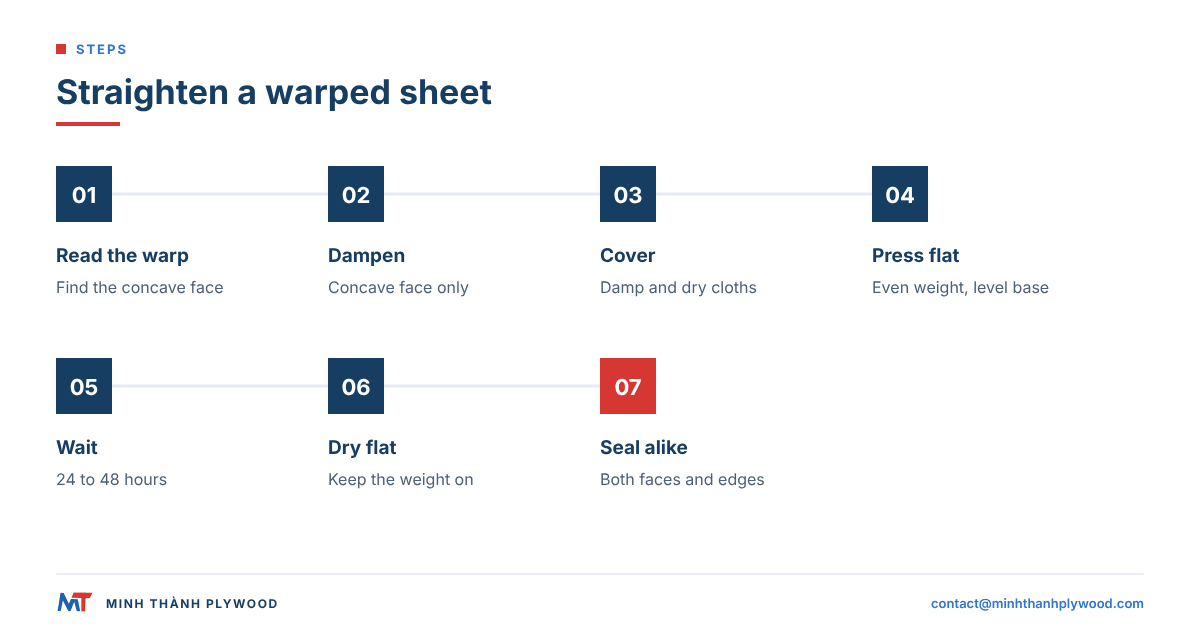
To straighten warped plywood, give the concave face back the moisture it lacks and hold the whole sheet flat while the two faces even out. This works for bow and cup caused by moisture; it does not cure an unbalanced build.
- Read the warp. Lay the sheet on a flat floor or bench. Find the concave face, the inside of the curve. That face is the drier, shorter one.
- Dampen the concave face only. Mist it lightly and evenly with clean water, or lay a damp cloth over it. Do not soak it and keep water off the convex face.
- Cover both faces. A damp cloth or plastic sheet on the concave face holds moisture in; a dry cloth on the convex face cushions it.
- Press it flat on a level surface. Spread weight over the whole sheet, or clamp it between two flat boards along the edges and the middle. Uneven pressure creates a new bend.
- Wait 24 to 48 hours. Check once or twice a day by lifting the weights and sighting along the edge. Repeat the light misting if the curve remains.
- Let it dry flat. Remove the damp cloth, keep the weight on, and let the sheet reach room condition before releasing it.
- Seal both faces and the edges alike. A straightened sheet that is then finished on one face only warps again.
Gentle heat, such as a warm iron over a damp cloth on the concave face, speeds stubborn sheets. Keep the iron moving and the cloth damp: dry heat on bare veneer can raise the grain, open glue lines or crack the face.
How do you straighten bent plywood that was stored badly?
Bent plywood that took its shape from bad storage usually recovers by lying flat on full, level support under even weight for a few days at room condition. No water is needed when both faces are at the same moisture; the sheet only needs time to relax back into the plane it was pressed in.
How do you straighten warped painted plywood?
Painted plywood straightens slowly because the paint blocks moisture on that face. If the painted face is concave, lightly sand or score the paint only where the panel will be refinished, then dampen and press as above. If the painted face is convex, finish the raw back with the same number of coats, which often pulls the panel flat on its own.
How to fix warped plywood cabinet doors
A warped plywood cabinet door is fixed in three ways, in this order: condition it flat in its room, counter-bend it, or stiffen it. Most door warp starts with a door finished on the front and left bare on the back, so check that first.
- Condition and finish both faces. Take the door off, lay it flat for two to three days in the room where it hangs, then coat the back and the edges with the same finish as the front.
- Counter-bend a small bow. Clamp the door flat over a slight overbend with a spacer under the middle for a day or two, then release it. Small bows often stay out once the finish is balanced.
- Add a concealed stiffener. Rout a shallow groove along the back of a tall door and fit a flat steel or aluminium bar, or fit an adjustable door straightener. This holds doors flat in rooms with wide seasonal changes.
- Adjust the hinges for a twist. A slight twist can be hidden by setting the hinge depth and the catch so all four corners meet the carcase.
- Replace the panel when the door springs back after two cycles: the build itself is unbalanced.
For new doors, order panels with matching face and back species and grades, and finish all faces and edges at the same time.
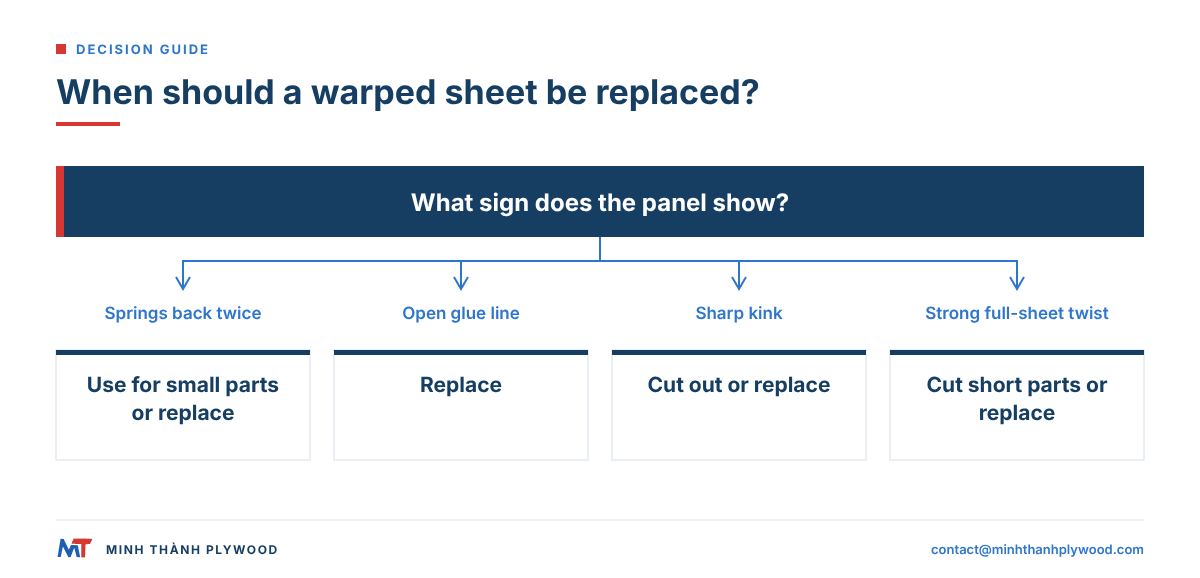
When can warped plywood not be corrected?
Warped plywood cannot be corrected for good when the warp comes from the panel’s own build, when the plies have separated, or when the sheet has taken a permanent set. In these cases flattening only hides the shape until the load or the weather changes.
| Sign | Likely cause | Decision |
|---|---|---|
| Sheet springs back after two flattening cycles | Unbalanced lay-up or locked-in stress | Use for small parts or replace |
| Bubble, hollow sound or open glue line | Delamination | Replace |
| Sharp kink or crease | Crushed fibres from a bearer or strap | Cut the area out or replace |
| Strong twist across the full sheet | Uneven veneer stress | Cut into short parts or replace |
| Mould or a musty smell | Panel stored wet for a long time | Dry, inspect, usually replace |
Clamping a warped panel into a cabinet or a floor does not make it flat; it moves the stress into the joints and screws, and the finish often cracks later. Use warped sheets for short components, where a small curve disappears over a short length.
Which core stays flattest: plywood, MDF core or combi core?
For a door or panel that must stay dead flat, an MDF-core or combi-core panel is the usual cabinetmaker’s choice, and plywood is the choice when weight, screw holding and strength matter more. A cabinetmaker in the Woodweb thread uses MDF core on about 90 % of veneered panels, keeping plywood for jobs where weight or linear strength decide.
| Core | Flatness | Weight and strength | Best for |
|---|---|---|---|
| Plywood, balanced lay-up | Flat when both faces match and moisture is even | Light, strong along the sheet | Carcases, shelves, floors, load-bearing parts |
| MDF core, veneered | Very flat when both faces are veneered alike | Heavy, weaker along its length | Cabinet doors, wide painted fronts |
| Combi core (plywood with MDF or fibre layers) | Flat, lighter than full MDF | Between the two | Doors that need both |
Whatever the core, veneer or laminate both faces alike and seal the edges.
Warping wood and warped timber: why solid wood moves more than plywood
Solid wood warps more than plywood because a board shrinks very differently along and across its grain, while plywood crosses the grain in every layer. Warped timber is the normal result of that uneven shrinkage as a board dries.
According to the USDA Forest Products Laboratory’s Wood Handbook (2021), wood shrinks only about 0.1 to 0.2 % along the grain from green to oven-dry, while tangential shrinkage, around the growth rings, is roughly twice the radial shrinkage across them. A flat-sawn board therefore cups away from the heart as it dries, a board with spiral grain twists, and a board with reaction wood bows.
Which type of wood expands the least?
Wood expands least along the grain, in every species. Across the grain, species with low total shrinkage and a small difference between tangential and radial movement are the most stable: teak, mahogany and western red cedar are well-known examples. Plywood beats any single species on stability because each layer’s long-grain direction restrains the cross-grain movement of the next.
| Material | Movement along length | Movement across width | Typical warp |
|---|---|---|---|
| Flat-sawn solid board | Very small | Large, uneven | Cup, twist, bow |
| Quarter-sawn solid board | Very small | Moderate | Less cup, still bows |
| Balanced plywood | Very small | Very small | Only from an imbalance or storage |
How to store plywood so it stays flat
Plywood stays flat when it lies on level, aligned support, off the ground, covered and away from heat on one face. The pack is the panel’s best protection: keep it closed until the sheets are needed.
- Lie packs flat on at least three level bearers, the same thickness, set in line across the width, with the end bearers close to the ends.
- Line up the bearers from pack to pack in a stack, so each load passes straight down.
- Raise the packs off concrete and keep them out of rain and direct sun.
- Keep the wrap on until use, and re-cover part-used packs with a full board on top.
- Store full sheets flat, not on edge for long periods; if racks are used, support the full face.
- Let panels reach the room’s condition in the closed pack, then open and use them.
Our panels leave the mill in packs on full timber bases, strapped over edge protection, and every shipment is photographed and filmed before loading, so buyers see how the packs were stowed. Packs are about one metre high on a 40HC plan; our export packing page shows the pack build.
How to measure and document warped plywood
Measure warped plywood on a flat reference surface, separating bow, cup and twist, and record where and how each reading was taken. A reading without the support condition and the panel’s identity is weak evidence in a claim.
- Photograph the pack before opening: labels, wrap, straps, bearers and any water marks.
- Set the sheet on a flat floor or table with the concave face up.
- Measure the gap under a straightedge or taut string at the middle of each edge and across both diagonals, and lift one corner to read twist.
- Read moisture at several points on both faces with a calibrated meter, and note room temperature and humidity.
- Record the sheet’s position in the pack and how many sheets show the same shape.
- Keep a few affected sheets unused until the supplier has seen the evidence.
How much bow is acceptable?
Measure the gap between the straightedge and the concave face over the full 2440 mm length, and write the largest gap you accept into the purchase order. A limit on paper beats a dispute later: trade woodworkers in a Woodweb thread call a bow of 1/2 inch (about 13 mm) on a three-quarter-inch panel average for decorative plywood, so a tighter limit is worth stating. Our furniture panels back that limit with a balanced lay-up, two pressings and a calibrated core, and a thickness tolerance down to ±0.2 mm sanded.
If the faces read differently on the meter, the warp is moisture-driven and likely to recover. If the faces read the same and the sheet still bows, look at the build. Our guide on plywood quality claims explains how to present the evidence.
What does a flat-sheet plywood specification look like?
A flat-sheet specification names the build, the moisture, the tolerance and the packing, because flatness is the result of all four. Writing only “no warp” gives neither side a way to measure.
| Specification line | What to write | Minh Thanh standard for furniture panels |
|---|---|---|
| Build | Odd number of layers, matching face and back species and grade | Balanced lay-up; matched face/back pairs such as birch D+/D or poplar A/B |
| Core | Species and construction | White Styrax or Eucalyptus core, stitched both horizontally and vertically |
| Pressing | Number of pressings | Pressed twice: core calibrated, then face and back |
| Moisture | Range at dispatch | 8–12 % |
| Thickness tolerance | Plus or minus mm | Down to ±0.2 mm sanded (±0.2–0.3 mm) |
| Faces | Finish readiness | Both faces sanded and UV-ready |
| Packing | Base, protection, records | Full timber base, edge protection, photos and film before loading |
For European use, name the service class and the bond class as well. The BSI record for BS EN 636:2012+A1:2015 covers plywood for structural and general-purpose use in dry, humid or exterior conditions.
The bonding quality is set separately: the BSI record for BS EN 314-2:1993 identifies the requirements standard for it.
A ready spec line reads: Furniture plywood, 1220 × 2440 × 18 mm, Styrax core stitched, pressed twice, poplar face/back A/B, UF glue at E0 emission, MC 8–12 %, tolerance ±0.2 mm, faces sanded and UV-ready, packed flat on full bases. Send it through our furniture plywood page with your quantity and port, and we will reply within hours with a quotation and free samples. For thickness choices, our plywood thickness guide compares the sizes.
Buyer questions, answered
Can warped plywood be corrected?
Mild bow or cup caused by a moisture difference between the faces can usually be corrected by evening out the moisture and holding the sheet flat for one to two days. Twist, kinks, delamination and warp built in by an unbalanced lay-up rarely come out for good.
Why does plywood warp even though the veneers are cross laminated?
Cross lamination restrains movement but cannot cancel an imbalance. If one face is wetter, sanded thinner, coated on one side or made from a different veneer than the other, the two faces move by different amounts and the panel curves.
Can warped plywood be flattened with water and weight?
Yes, for mild bow or cup caused by moisture. Lightly dampen the concave face, cover it, and press the sheet flat under even weight for 24 to 48 hours, then let it dry flat. Warp built in by an unbalanced lay-up will not come out.
How do you flatten warped plywood fast?
Lay the sheet concave side up, dampen that face lightly, cover it, and press it flat under even weight on a level surface. Most sheets that will recover do so within 24 to 48 hours; forcing it faster with heat risks blisters and new distortion.
How do you fix warped plywood cabinet doors?
Remove the door, condition it flat in the room where it hangs, and correct small bows with a counter-bend or a concealed steel or aluminium stiffener in a routed groove. A door that warps again after flattening needs a new panel with both faces finished the same way.
Is thin plywood more likely to warp?
Yes. A 3 to 6 mm panel has little stiffness to resist an imbalance between its faces, so storage, one-sided finishes and moisture changes show up as bow faster than on 18 mm panels.
Which wood expands the least?
All wood moves least along the grain, about 0.1 to 0.2 % from green to oven-dry, and most across it. Among species, teak, mahogany and western red cedar are known for low shrinkage; plywood gains its stability by crossing the grain of each layer.
Can you straighten painted plywood?
Only partly. Paint slows moisture exchange on the painted face, so the trick of dampening the concave face works slowly or not at all. Remove the panel, finish the unpainted back to match, and hold it flat while the faces reach the same moisture.
How should plywood be stored to stop warping?
Store it flat on three or more level bearers, raised off the floor, covered against rain and sun, with the bearers lined up from pack to pack. Never lean full sheets against a wall for days, and keep the wrap on until the panels are needed.