
A plywood quality claim is settled on evidence: photos of the seal and the packs, pack labels, measurements against the agreed specification and the approved sample. Many disputes are not about bad faith but about a specification nobody wrote down, or a difference that turns out to be within tolerance. This guide shows what to collect, how to judge what you found and how to write the order so claims rarely arise. Minh Thanh Plywood is a furniture plywood manufacturer in Phu Tho.
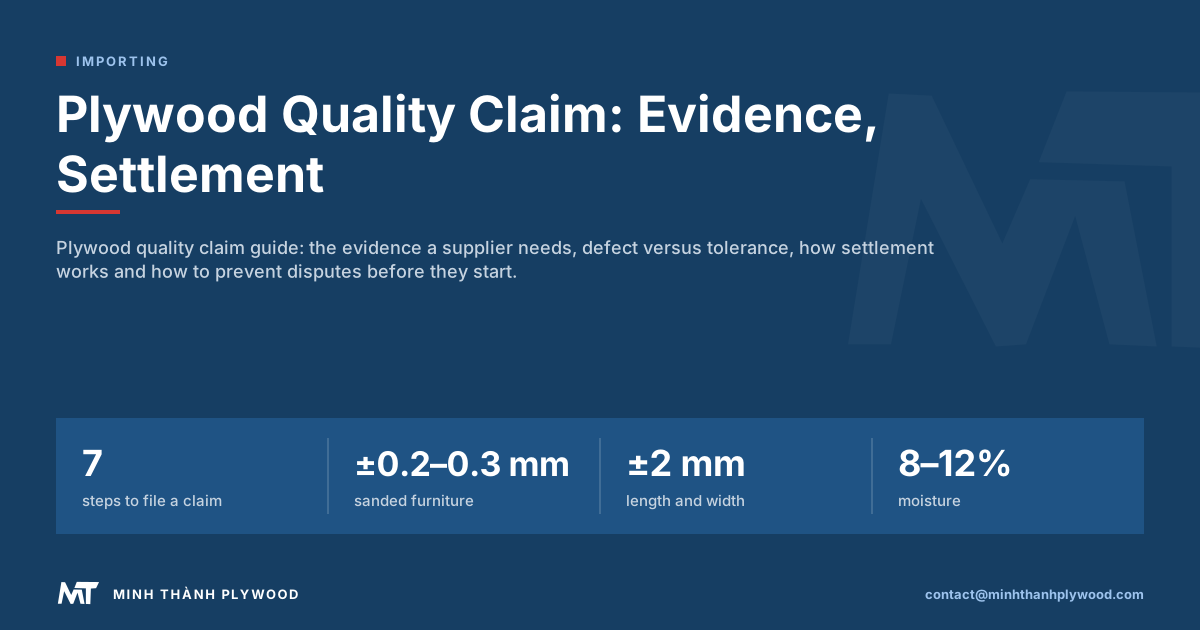
Plywood quality claim: what settles it
A plywood quality claim is settled on evidence, compared with what was agreed. The supplier needs to see what you found, where, on how many sheets, and which line of the order it fails, ideally while the goods are untouched and with the written specification and approved sample beside the photos.
Four things decide most claims:
- The written specification: size, thickness and tolerance, core, plies, glue, emission class, face and back grades, moisture, packing.
- The approved sample: a signed piece kept by both sides.
- The evidence from arrival: seal, doors, pack labels, measurements and photos.
- Speed: a claim raised while the goods are untouched is far easier to verify than one raised after processing.
Name the standards in the order so both sides test the same thing: bonding quality under BS EN 314-2, the plywood classes under BS EN 636, and for US cargo the 0.05 ppm formaldehyde limit for veneer-core hardwood plywood in EPA’s TSCA Title VI emission standards.
When all four are in place, many claims settle in days. When the specification is vague and the sample is lost, the same fault becomes an argument.
How do you file a claim for defective plywood?
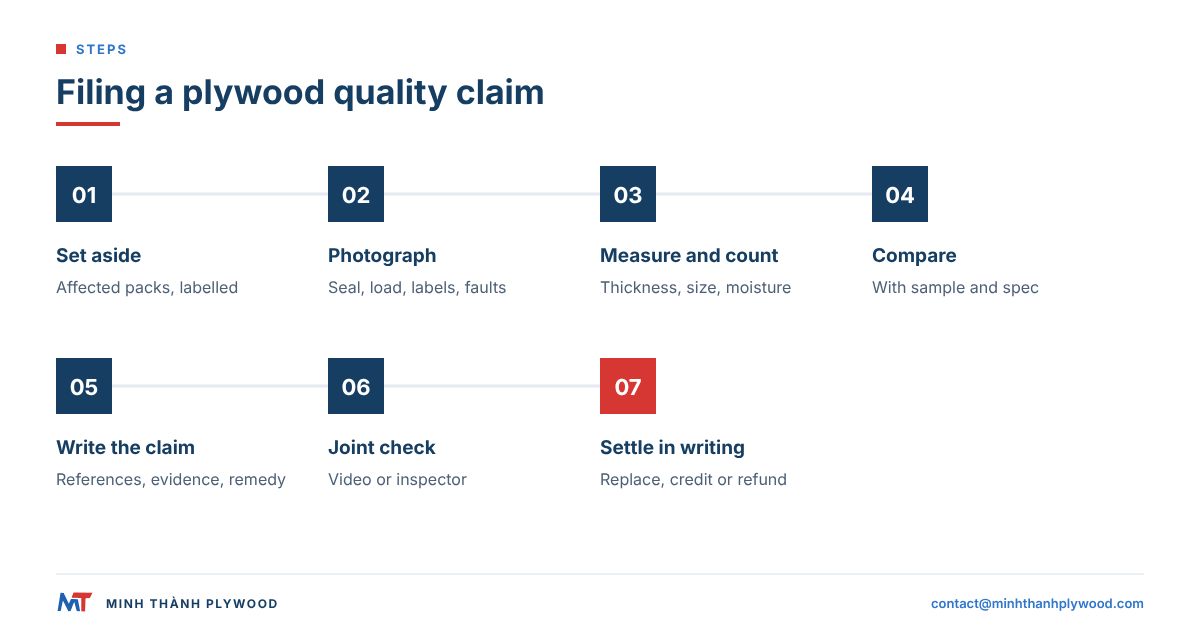
File the claim in writing, with the evidence attached, as soon as the arrival check shows a problem. Set the affected packs aside, record the evidence, name the order line the goods fail, and propose a remedy. A short, factual claim gets a faster answer than a long complaint.
- Stop and set aside the affected packs, unused and labelled.
- Photograph the evidence: seal, doors, load, pack labels, then each fault with a ruler or caliper in the frame.
- Measure and count: thickness, size, moisture and the number of affected sheets per pack.
- Compare with the sample and the specification: name the line the goods fail.
- Write the claim: order number, container number, packs and sheets affected, the fault, the evidence, the clause or sample, and the remedy you propose.
- Agree a joint check by video or a third-party inspector if the facts are disputed.
- Settle in writing: replacement, credit, price adjustment or refund.
| Claim letter section | What to include |
|---|---|
| Reference | Order and proforma number, container and seal number, date of arrival |
| Goods affected | Product line, specification, pack labels, number of packs and sheets |
| Fault | What you found, with measurements and the tool used |
| Standard | The contract line or approved sample the goods do not meet |
| Evidence | Photos, video, measurement sheet, inspector’s report if any |
| Remedy proposed | Replacement, credit, price adjustment or refund, with your reasoning |
| Status of goods | Where the affected packs are held and that they are unused |
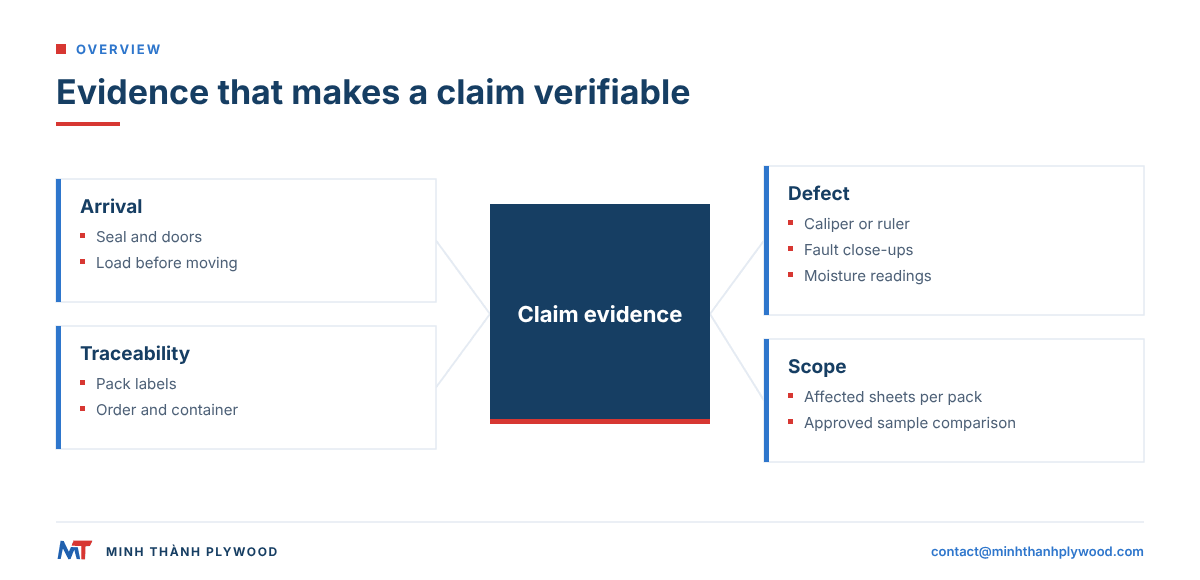
What evidence does a plywood supplier need for a claim?
A supplier needs evidence that links the fault to its production and to the order. Without that link, it cannot tell a production fault from transit damage or storage.
| Evidence | Why the supplier needs it | How to capture it |
|---|---|---|
| Seal and door photos | Proves the container arrived as it left | Before the seal is cut, then doors opening |
| Load photos | Shows pack position and transit damage | Before anything moves |
| Pack labels or marks | Ties faults to a production batch | Close photo of each affected pack’s label |
| Measurements | Turns a complaint into a fact | Caliper and tape in the photo, readings on a sheet |
| Fault close-ups | Shows the defect type | Several angles, with a ruler for scale |
| Comparison with the sample | Shows the gap from what was approved | Sample and sheet side by side in the same light |
| Share affected | Sets the size of the claim | Count by pack: how many sheets of how many |
| Moisture readings | Separates production from storage causes | Meter readings on arrival, several points per sheet |
Video helps when a fault is hard to photograph, such as delamination when a sheet is flexed, or a core gap felt through the face.
How many sheets should you measure?
Measure enough to show the pattern: several sheets from the top, middle and bottom of each affected pack, and a few packs that look fine for comparison. If faults appear in every pack, say so; if they sit in one batch, the pack labels will show it.
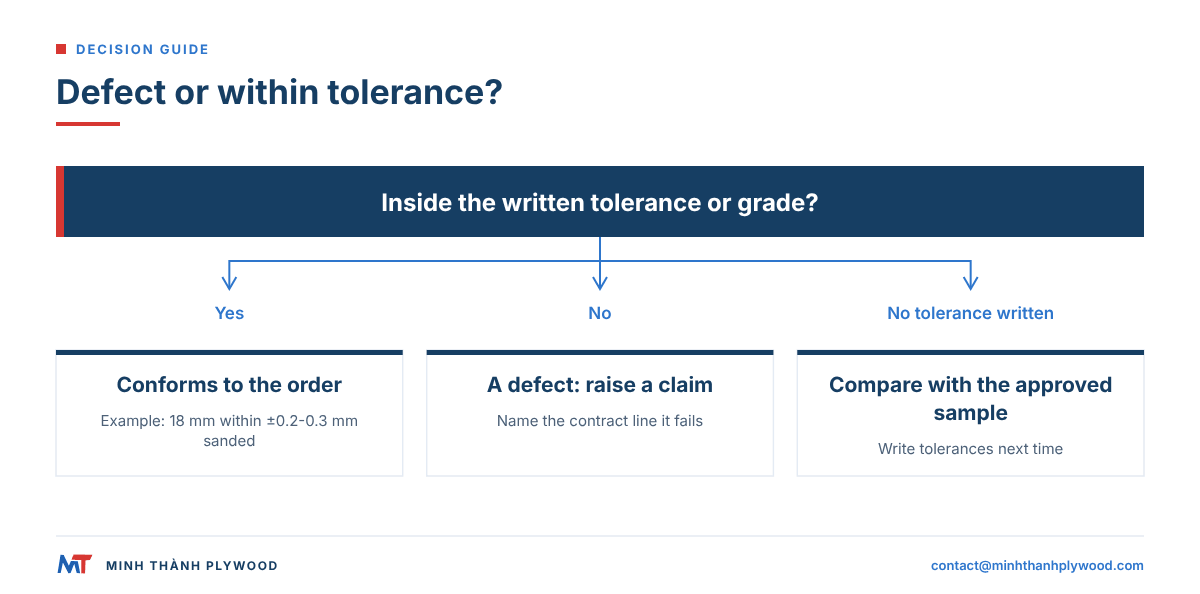
Defect or within tolerance: how do you judge what you found?
Not every difference is a defect. A difference within the written tolerance or the approved grade conforms to the order; a difference outside it does not. Checking this first saves both sides time.
| What you found | Within the order when | A defect when |
|---|---|---|
| Thickness variation | Readings within the written tolerance | Readings outside it, or no tolerance and readings far from nominal |
| Size variation | Within ±2 mm on length and width | Outside ±2 mm |
| Face features (knots, patches, colour) | Matching the approved grade and sample | Clearly below the sample |
| Moisture | Within the agreed range, for example 8–12% | Outside the range on arrival |
| Slight bow on a single sheet | Flattens under its own weight in a stack | Pronounced warp across a pack |
| Core gaps | Small, within the grade agreed for the core | Open gaps or overlaps beyond the grade, telegraphing through the face |
| Glue bond | Passes the agreed bond test | Delamination, or failure in the agreed test |
Our tolerances, by product line, are ±0.2–0.3 mm on sanded furniture panels, down to ±0.2 mm; ±0.5 mm on commercial and film-faced panels; ±0.5–1.0 mm on packing panels; and ±2 mm on length and width.
Why does the approved sample decide face-grade claims?
Grade names such as A/B or B/B differ from mill to mill. Poplar, eucalyptus and pine faces are quoted as face/back pairs A/A, A/B and B/B, and birch faces as D+, D and E in Vietnam, but the approved sample fixes what each name means for your order. A face claim without the sample is one opinion against another; with the sample, it is a side-by-side photo.
Plywood claim settlement: how are claims usually settled?
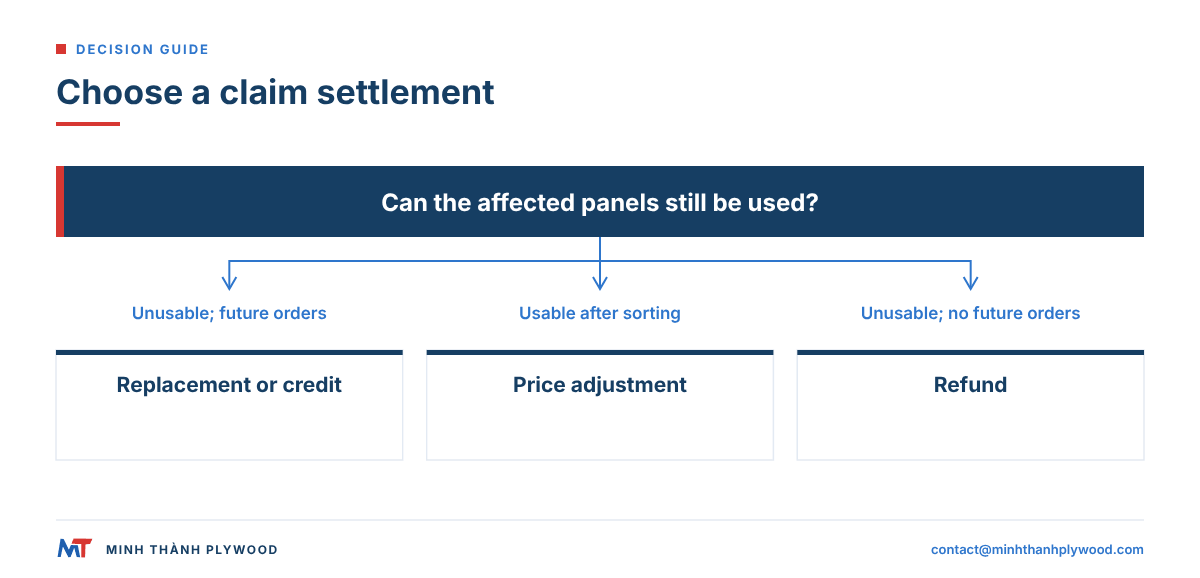
Plywood claim settlement follows the evidence and the share of the goods affected. The usual remedies are four, and the right one depends on whether the panels can still be used.
| Remedy | When it fits | How it works |
|---|---|---|
| Replacement | Goods unusable for the intended use | Replacement sheets on the next container |
| Credit note | Goods partly affected, buyer continues ordering | Value credited against the next invoice |
| Price adjustment | Goods usable after sorting or for a lower use | Agreed discount on the affected sheets |
| Refund | Goods unusable and no further orders planned | Payment back for the affected share |
Settlement also covers the cost of sorting, where the buyer sorts the goods, and the treatment of the affected sheets: held for the supplier, sold on at a lower grade, or disposed of.
What makes a settlement fair to both sides?
A fair settlement prices the actual loss: the affected sheets, the sorting work and any direct cost the fault caused. It does not price a whole container for a fault in a few packs, and it does not ignore a fault that runs through the whole order. Evidence by pack and sheet makes the share clear to both sides.
Is there a plywood warranty?
A plywood warranty in the consumer sense, a fixed period during which any fault is covered, is rare in export plywood. Export panels are sold against a written specification and an approved sample, and the contract sets how a nonconformity is claimed and settled.
What gives a buyer real protection instead:
- A specification with tolerances, so conformity can be measured.
- A signed approved sample, so grades can be compared.
- A claim clause in the contract: how a claim is raised, what evidence it needs and the remedies.
- Inspection before loading, so most faults are found while correction costs only time.
- Test results for the build, such as emission and bond tests, so performance claims can be checked.
Agree the claim clause before the first order, when both sides are calm, not after a problem.
Why do import plywood claims happen so often?
Most plywood claims start before production. The goods leave the mill matching what was written, and the buyer expected something that was never written down.
The common roots:
- A specification without tolerances: “18 mm” with no tolerance leaves the real thickness open.
- Grades described in words: “good face” or “BB” without a signed sample.
- A sample nobody kept: the reference is gone when the dispute starts.
- Packing left to the mill: no edge protection, no covers, no sheets-per-pack count.
- No inspection before loading: faults are found only at the buyer’s warehouse.
- Storage after arrival: panels stored on uneven ground or in damp conditions warp or take up moisture.
Each root has a simple fix, and together they prevent most claims. Our guide on is Vietnamese plywood good quality covers the defects by product line and how mills prevent them.
How do the specification, sample and pre-shipment records prevent disputes?
Three records prevent most disputes: a full specification, a signed sample and photos or video from before loading. Together they show what was agreed and what left the mill.
| Record | What it fixes | Who keeps it |
|---|---|---|
| Specification on the proforma and contract | Build, tolerances, moisture, packing | Both sides |
| Signed approved sample | Face and back grades, core look, ply count | Both sides, one piece each |
| Pre-shipment inspection report | Measurements and faces before loading | Buyer, copy to mill |
| Pre-loading photos and video | Packs, faces and the container before loading | Sent to the buyer |
| Pack labels | Specification and batch per pack | On every pack |
The buyer signs the approved sample and production is graded against it; free samples are available on request. Third-party inspectors are welcome before loading.
What should a pre-shipment inspection cover?
An inspection checks the goods against the order while they are still at the mill:
- Thickness, size and squareness on sampled sheets from several packs.
- Moisture on several points per sheet.
- Faces, backs and edges against the approved sample.
- Bond, with a cut or soak test if the glue is in doubt.
- Sheet count per pack against the packing list.
- Packing and labels, and photos of loading and the seal.
Our guide on moving from a trial order to long-term supply explains how to set inspection up for repeat containers.
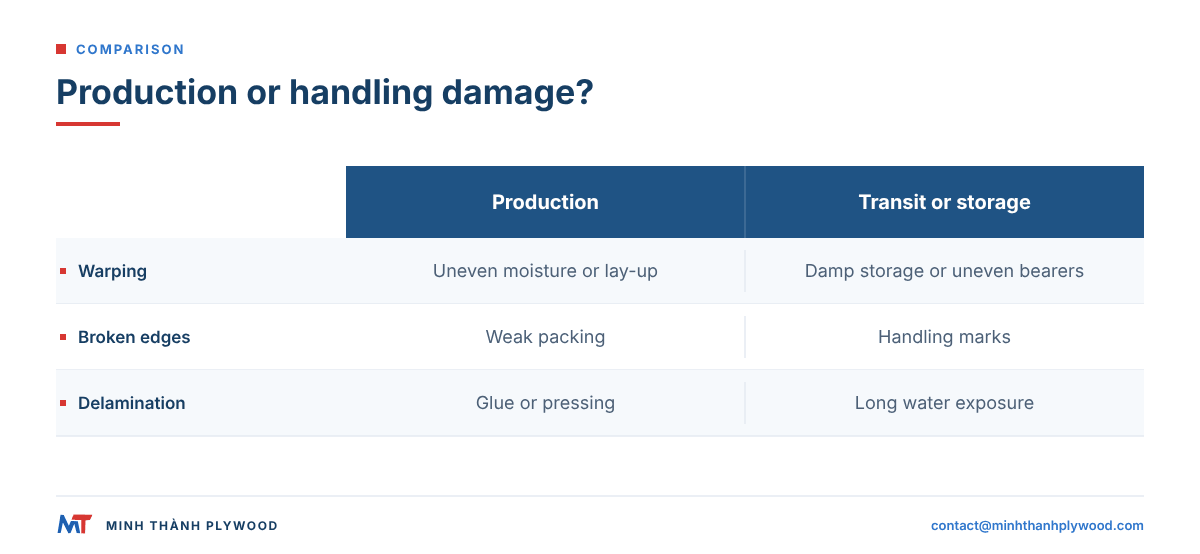
Which faults come from transit or storage, not production?
Some faults appear after the panels leave the mill. Telling them apart protects both sides, and the right evidence makes the cause clear.
| Fault | Likely production cause | Likely transit or storage cause | Evidence that separates them |
|---|---|---|---|
| Water stains, mould | Panels packed wet | Water entry in the container or the warehouse | Seal and door photos, moisture readings on arrival, which packs are affected |
| Warping | Uneven moisture, poor lay-up | Uneven bearers, damp storage, partial unwrapping | Moisture on arrival, storage photos, pattern across packs |
| Broken corners and edges | Weak packing | Handling during loading or unloading | Load photos, pack position, forklift damage marks |
| Crushed pack bases | Weak pallet | Overloading or rough handling | Load plan, photos before unloading |
| Delamination | Glue or pressing | Long exposure to water | Bond test on dry sheets from the same pack |
Store plywood flat on even bearers, covered, off the floor and away from damp. A container packed beyond its limit can break pack bases and leave the receiver unloading by hand; agree the load plan before loading.
How does a supplier review a claim?
A mill reviews a claim by comparing your evidence with what was agreed and shipped for that order. The clearer the evidence, the faster it can answer.
What a manufacturer compares on its side:
- The specification on the proforma and contract.
- The signed approved sample for the order.
- The photos and video taken before loading.
- Test results for the build, such as emission and bond tests; third-party testing through SGS on request.
When the seller is a trader or broker, this evidence sits with the mill that pressed the panels. Ask your seller which mill made the goods; a claim is easiest to settle with the company that made the panels. Our guide on factory or trading company shows how to check.
What should the claim clause in the contract say?
The claim clause sets the rules before anyone needs them. Agree it with the first order, and keep it the same for repeat containers.
A good claim clause states:
- How a claim is raised: in writing, to a named contact, with the order and container reference.
- The evidence required: seal and door photos, load photos, pack labels, measurements, fault close-ups, comparison with the sample, the share affected and moisture readings.
- The period for raising a claim: agreed between buyer and seller for the product and the route.
- How facts are confirmed: joint video check or a named third-party inspector, and who pays if the claim is upheld or rejected.
- The remedies: replacement, credit, price adjustment or refund.
- The treatment of affected goods: held, sold at a lower grade or disposed of.
Write the specification, the tolerances and the sample reference into the same contract, so the clause has something to measure against. Our RFQ checklist gives the specification fields.
How does Minh Thanh Plywood handle quality questions?
Each order starts from a full specification and a signed approved sample; every shipment is photographed and filmed before loading, and buyers get the photos and video.
| Stage | What you get |
|---|---|
| Quote and proforma | Full specification with tolerances, moisture and packing |
| Sample | Free samples on request; production graded against the approved, signed sample |
| Production | Double pressing for furniture panels, calibrated thickness, 8–12% moisture at dispatch |
| Inspection | Third-party inspectors welcome before loading |
| Loading | Photos and film before loading |
| Emission | UF glue at E0 emission; CARB P2 / TSCA Title VI as ICTT mill no. 23024 |
If you find a problem on arrival, send us the evidence and we will answer in writing. To start an order with the specification written in full, send your requirements through the furniture plywood page.
Buyer questions, answered
How do I file a claim for defective plywood?
Hold the affected packs aside, photograph the seal, doors, pack labels and faults, measure against the contract specification, and send a written claim to the supplier with the evidence, the clause or sample the goods fail and the remedy you propose.
What evidence does a plywood supplier need for a claim?
Container and seal photos, pack labels or marks, the number of affected packs and sheets, measurements with the tool visible, close photos of each fault, a comparison with the approved sample, and the specification line the goods do not meet.
Is there a warranty on plywood?
Export plywood is usually sold against a written specification and an approved sample, not under a time-based product warranty. The contract sets how a claim is raised and settled; agree that clause before ordering.
How are plywood claims usually settled?
By replacement, a credit on the next container, a price adjustment for goods that can be used after sorting, or a refund for goods that cannot. The remedy follows from the evidence and the share of the order affected.
Why do import plywood claims happen so often?
Most claims start before production: a specification without tolerances, a sample nobody kept, a grade described in words instead of a signed piece, or packing left to the mill. Goods can then be within what was written and still not what the buyer expected.
Is a thickness difference always a defect?
No. A difference within the agreed tolerance conforms to the order. Our sanded furniture panels are made to ±0.2–0.3 mm and commercial and film-faced panels to ±0.5 mm; a reading outside the written tolerance is a defect.
Why does origin clarity matter in claim prevention?
A claim is easiest to settle with the company that pressed the panel. When the seller is a trader or broker, ask which mill made the goods, so the specification, the approved sample and the pre-loading photos and video can be checked.
Can a claim be raised for warping found months after delivery?
Warping that appears after months in storage often comes from storage conditions rather than production. Keep panels flat on even bearers, covered and away from damp, and check moisture on arrival so the starting point is on record.
Should I stop using the panels when I find a fault?
Set the affected packs aside unused until the supplier has seen the evidence. Panels that have been cut or processed are much harder to assess, and the supplier may need to inspect them.