
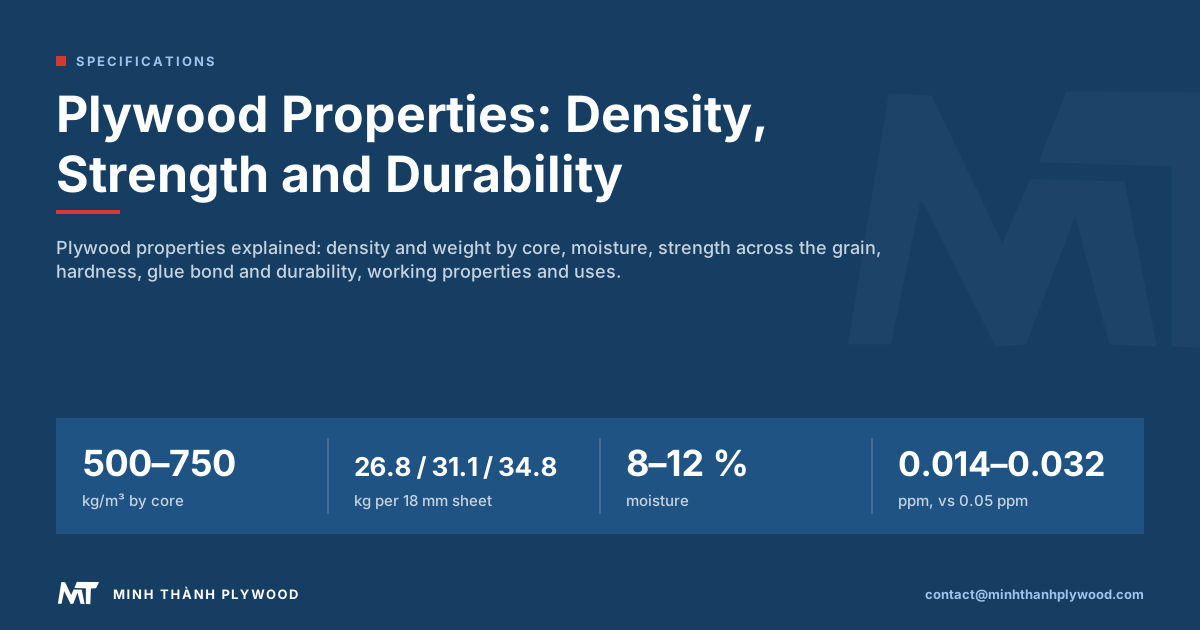
Plywood properties come from three choices: the core species, the glue bond and the way the veneers cross. Density runs from about 500 kg/m³ on a white Styrax core to 650–750 kg/m³ on Eucalyptus. Finished panels leave the mill at 8–12 % moisture content, and the glue sets how the panel copes with water. Minh Thanh Plywood shows each property, what sets it and how to write it on an order.
What are the properties of plywood?
Plywood is a panel of thin veneers glued with each layer’s grain at 90 degrees to the next, and its properties come from three choices: the core species, the glue bond and the ply layout. Density, weight, stiffness, hardness and screw holding follow the core; water resistance follows the glue; flatness and stability follow the crossed, balanced layup.
| Property | What sets it | Typical value or rule at Minh Thanh Plywood |
|---|---|---|
| Density | Core species | Styrax 500, Acacia 580, Eucalyptus 650–750 kg/m³ |
| Weight per sheet | Density × volume | 18 mm, 1220 × 2440 mm: 26.8, 31.1, 34.8 kg |
| Moisture content | Drying | 8–12 % at dispatch |
| Bending strength and stiffness | Face grain direction, ply count, core | Typical hardwood plywood, EN 310: bending strength 68–104 N/mm² along and 44–61 N/mm² across the face grain; stiffness 7,160–11,737 N/mm² along and 4,366–5,575 N/mm² across |
| Dimensional stability | Crossed, balanced layup | Little movement in length and width |
| Hardness and screw holding | Core density, face species | Rises with density |
| Bond durability | Glue type | UF for dry use; melamine-fortified for humid; phenolic (WBP) for exterior |
| Formaldehyde emission | Glue and emission class | UF glue at E0 emission; CARB P2 / TSCA Title VI certified |
| Thickness accuracy | Calibration and sanding | ±0.2–0.3 mm on sanded furniture panels |
The rest of this guide takes each property in turn, with the numbers a buyer can write on an order.
Physical properties of plywood: density, weight and moisture
The physical properties of plywood that a buyer measures first are density, sheet weight and moisture content. At Minh Thanh Plywood, reference densities are 500 kg/m³ for a white Styrax core, 580 kg/m³ for Acacia and 650 kg/m³ for Eucalyptus, which runs 650–750 kg/m³ in practice.
| Core | Reference density | 9 mm sheet, 1220 × 2440 mm | 18 mm sheet, 1220 × 2440 mm | 18 mm sheets per 40HC |
|---|---|---|---|---|
| White Styrax | 500 kg/m³ | 13.4 kg | 26.8 kg | 990 sheets |
| Acacia | 580 kg/m³ | 15.5 kg | 31.1 kg | 880 sheets |
| Eucalyptus | 650 kg/m³ | 17.4 kg | 34.8 kg | 795 sheets |
Sheet weight is length × width × thickness × density, and the thin face veneer does not change it. Container counts are capped by weight inside a 28,000 kg planning payload, so a lighter core puts more cubic metres in each box. Veneers and finished panels are dried to 8–12 % moisture content at dispatch, the normal range for furniture plywood, so the panel neither swells nor shrinks much once it reaches a heated plant.
Characteristics of plywood that come from cross-lamination
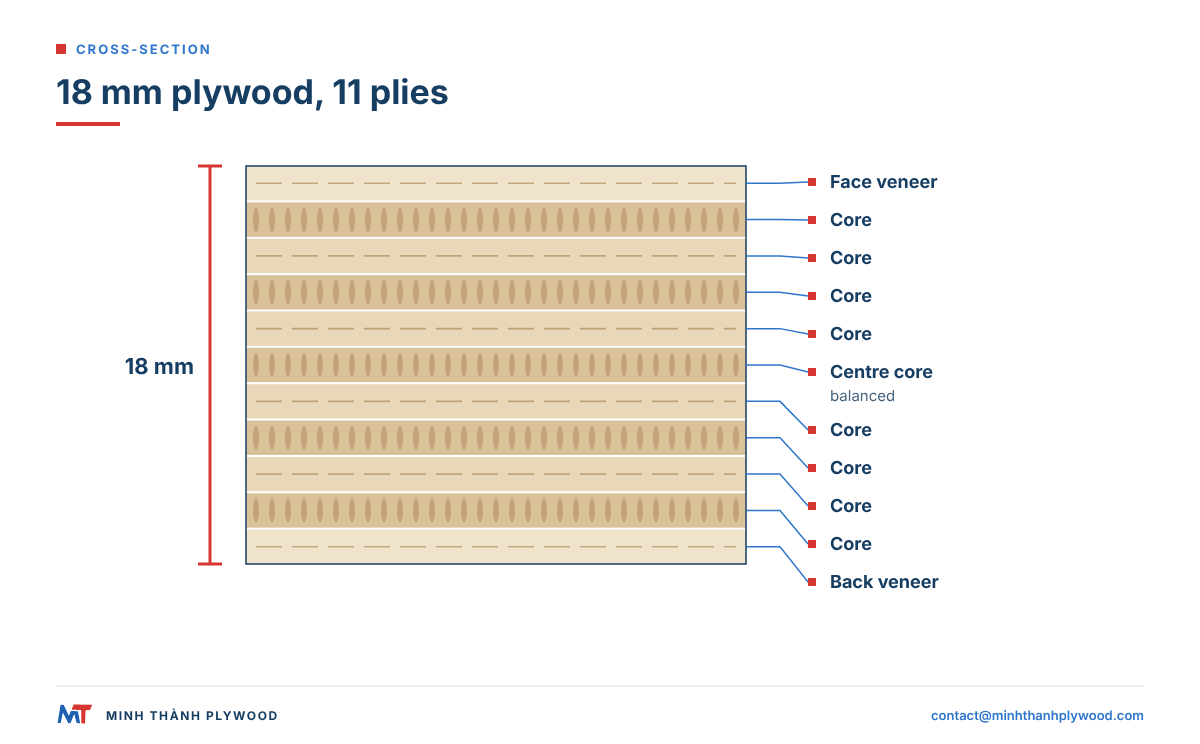
The characteristics of plywood that set it apart from solid wood come from cross-lamination: each veneer is turned 90 degrees to the next. The panel resists splitting, stays stable in length and width, and spreads strength in both directions. An odd number of plies keeps the layup balanced around the centre, so the panel stays flat.
Four characteristics follow:
- Stability. Wood moves most across its grain. Crossed veneers hold each other, so a plywood panel changes far less in width than a solid board as humidity changes.
- Split resistance. A screw or nail near the edge of solid wood can split it along the grain; the crossed layers of plywood stop the split.
- Strength in two directions. Solid wood is weak across the grain; plywood carries load in both directions, with more strength along the face grain.
- Flatness. A balanced layup, with matching layers either side of the centre, resists cupping and twist.
The ply count rises with thickness. At Minh Thanh Plywood, thin panels from 3 to 5 mm are always 5-ply, and an 18 mm panel usually has 11–13 plies. Core layers are stitched both horizontally and vertically, so no gap opens inside the panel.
Mechanical properties: strength and stiffness
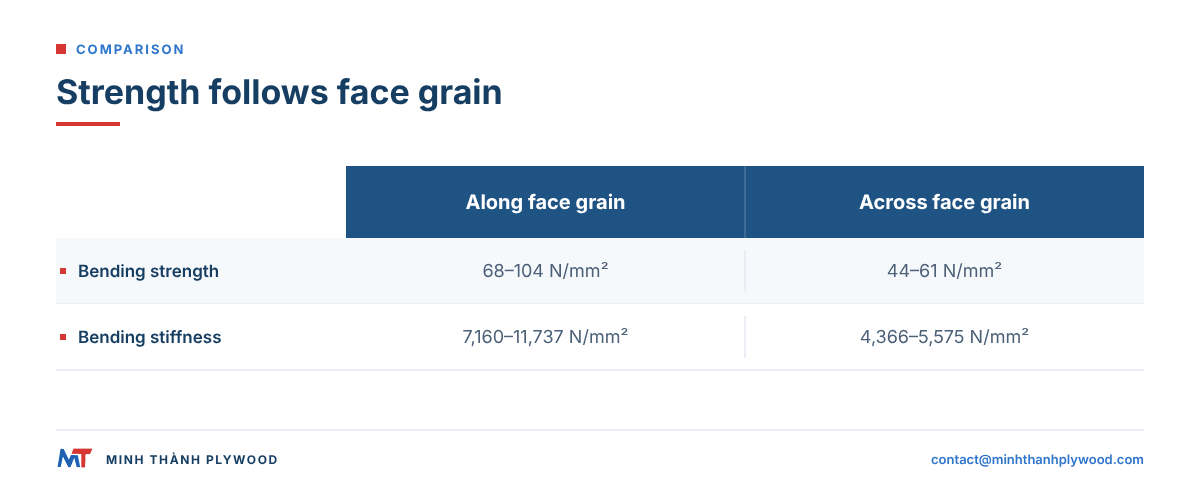
The mechanical properties of plywood, bending strength and stiffness, are highest along the face grain and lower across it, because more of the panel’s veneer runs that way. A shelf or floor panel should span with its face grain running across the supports.
Bending strength (modulus of rupture, MOR) says how much load breaks a panel; bending stiffness (modulus of elasticity, MOE) says how much it sags before it breaks. Both are tested by three-point bending, in Europe under EN 310, and they rise with core density and ply count. That is why Eucalyptus and Acacia cores go into formwork and site panels, and the lighter Styrax core into furniture carcasses where stiffness needs are modest.
Published EN 310 tests on hardwood plywood (eucalyptus, beech and poplar veneers) show how large the grain effect is. Bending strength runs 68–104 N/mm² when the face grain runs along the span and 44–61 N/mm² across it; stiffness runs 7,160–11,737 N/mm² along and 4,366–5,575 N/mm² across. Treat these as typical ranges, not a guarantee: a sample of the buyer’s own build, tested to EN 310, gives the figure that goes on the order.
APA, the US engineered wood association, grades and stamps plywood by span ratings and species groups under PS 1 and PS 2 instead; a European or Asian buyer works from MOR and MOE under EN 310 and the declared values under EN 13986.
Three rules from the mechanics help a designer:
- Thickness matters most. Stiffness rises with the cube of thickness: an 18 mm shelf is about 1.7 times as stiff as a 15 mm shelf of the same build ((18/15)³ = 1.73).
- Span the face grain. Turn a long shelf so the face grain runs along its length.
- Choose a denser core for long spans. A denser core raises both MOR and MOE.
European structural uses rely on declared values under EN 13986, the harmonised standard for wood-based panels in construction. CE marking for such panels is a legal requirement under the Construction Products Regulation (EU) No 305/2011. For furniture, a sample panel tested to the buyer’s method settles the numbers; third-party testing (for example EN 717-1 for emission) is arranged through SGS on request. Our guide to how much weight plywood can hold works through shelf spans.
Hardness and screw holding: what is the hardest plywood?
The hardest plywood is a dense hardwood-core panel with a hard face: a Eucalyptus core at 650–750 kg/m³ under a birch or eucalyptus face, or a film-faced panel whose resin film gives the hardest-wearing surface. Hardness and screw holding both rise with density.
| Panel | Core density | Face hardness | Screw holding | Typical use |
|---|---|---|---|---|
| Eucalyptus core, eucalyptus or birch face | 650–750 kg/m³ | High | Highest | Worktops, floors, heavy shelving |
| Acacia core, film face | 580 kg/m³ | Film gives a hard-wearing surface | High | Concrete formwork |
| Styrax core, birch, poplar or EV face | 500 kg/m³ | Set by the face | Good in the face | Cabinets, wardrobes, light furniture |
Screw holding in the face of plywood is strong because each crossed veneer grips the thread. In the edge, a screw runs between plies: drill a pilot hole, keep screws at least 15 mm from a corner and use a coarse-thread confirmat or cabinet screw. A denser core and more plies at the same thickness hold an edge screw better, which is why furniture buyers ask for the ply count.
Thermal, acoustic and fire properties of plywood
Plywood insulates modestly, deadens sound by mass and burns slowly for a wood product. For heat, EN 13986 gives a design conductivity of 0.13 W/(m·K) at 500 kg/m³ and 0.17 W/(m·K) at 700 kg/m³. An 18 mm panel has a thermal resistance of about 0.14 m²·K/W at the lower density and 0.11 m²·K/W at the higher. That is the layer’s resistance only; walls and roofs get their insulation from the cavity. Our plywood thermal insulation guide works through the R-value arithmetic.
| Property | Typical value | Governed by |
|---|---|---|
| Thermal conductivity | 0.13 W/(m·K) at 500 kg/m³; 0.17 W/(m·K) at 700 kg/m³ | EN 13986 and EN ISO 10456 |
| Thermal resistance, 18 mm | about 0.14 m²·K/W at 500 kg/m³ | thickness ÷ conductivity |
| Reaction to fire, untreated | Euroclass D-s2,d0 for panels of at least 9 mm and 400 kg/m³ | EN 13986, EN 13501-1 |
| Sound insulation | Rises with mass per square metre, so thicker and denser panels block more | measured per assembly |
Fire behaviour is classed per product: untreated plywood of at least 9 mm and 400 kg/m³ is declared Euroclass D-s2,d0. Fire-retardant treated panels reach higher classes on test; see our guide to fire-rated plywood. For sound, a single panel is a mass layer: the heavier the sheet, the more airborne sound it stops. A decoupled or filled cavity does more than extra thickness. Sustainability claims such as FSC are chain-of-custody statements about the supply chain, not a property of the board; our guide to plywood FSC certification explains what a buyer can ask for.
Plywood durability: what decides it?
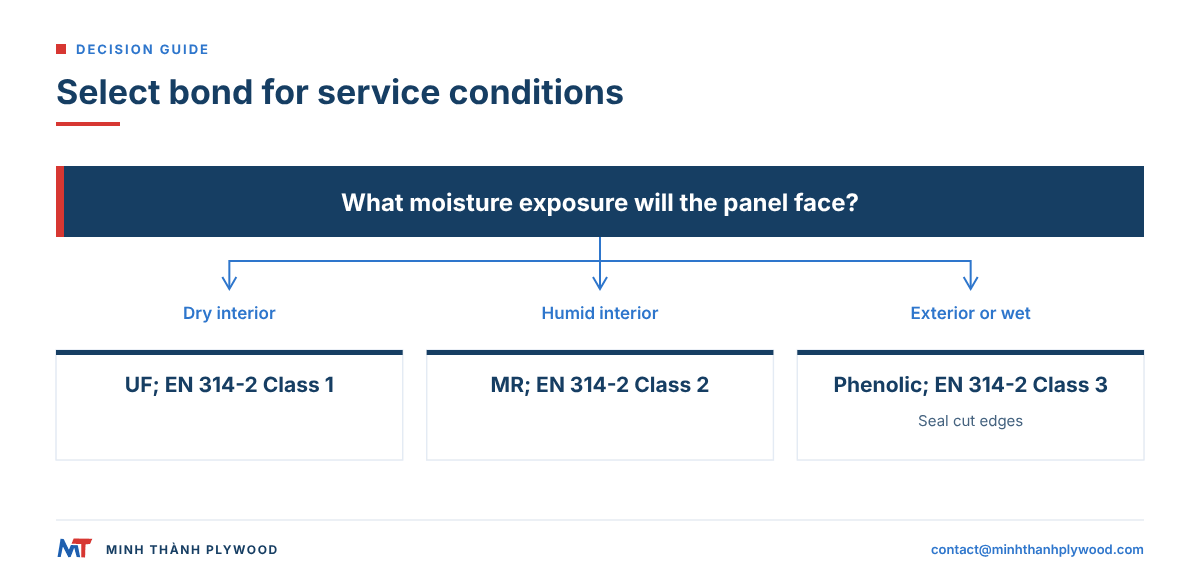
Plywood durability is decided by the glue bond more than by the wood: a UF bond is for dry interiors, a melamine-fortified bond for humid rooms, and a phenolic (WBP) bond for exterior use. The species, the edge sealing and the finish then decide how long the wood itself lasts.
| Glue bond | Service conditions | Usual European class |
|---|---|---|
| UF glue at E0 emission | Dry interiors: furniture, cabinets, wall panels | EN 314-2 Class 1; EN 636-1 dry use |
| MR, melamine-fortified | Humid interiors: kitchens, bathrooms, protected exterior | EN 314-2 Class 2; EN 636-2 humid use |
| Phenolic (WBP) | Exterior and wet use: formwork, exterior joinery | EN 314-2 Class 3; EN 636-3 exterior use |
Bond class and emission class are two separate specifications: UF glue is the resin, E0 is the emission level. Bond tests soak or boil samples to check the glue line; they say nothing about emission. A buyer who needs a humid-use kitchen carcass writes “melamine-fortified, EN 314-2 Class 2” on the order; a dry wardrobe needs only UF glue at E0 emission. BSI lists BS EN 314-2 as the standard for plywood bonding-quality requirements.
How long does plywood last?
Furniture plywood in a dry interior lasts as long as the furniture, often decades; exterior plywood with a phenolic bond and sealed edges lasts years outdoors. Film-faced formwork is counted in pours: about 12–15 with a melamine bond and up to about 25 with phenolic, with proper handling, release agent and edge sealing.
| Use | Bond | What shortens its life | What lengthens it |
|---|---|---|---|
| Furniture, cabinets, wardrobes | UF glue at E0 emission | Standing water, leaks under sinks | Lacquer or laminate, sealed cut edges |
| Kitchens and bathrooms | Melamine-fortified | Unsealed edges at sinks and floors | Edge banding, sealed holes |
| Exterior joinery, stair treads, sheathing | Phenolic (WBP) | End-grain water, ground contact | Sealed edges, paint, drainage gaps |
| Concrete formwork | Melamine or phenolic, film-faced | Dropped panels, nail damage, no release agent | Edge sealing, release agent, careful stacking |
Water at the end grain ends most panels early, not the face. Seal every cut edge on a part that will see water, and keep panels off the ground on site. Our guide to plywood service life covers each use in more detail.
Is plywood durable compared with MDF, particleboard and solid wood?
Plywood is more durable than MDF and particleboard in water and under screws, and more stable than solid wood, because its crossed veneers resist swelling, splitting and pull-out. MDF and particleboard give a smoother, cheaper surface for painted or laminated parts that stay dry.
| Point | Plywood | MDF | Particleboard | Solid wood |
|---|---|---|---|---|
| Screw holding in the face | High | Medium | Lower | High |
| Screw holding in the edge | Good with pilot hole | Weak | Weak | High along grain |
| Swelling when wet | Low with the right bond | High at edges | High | Moves across grain |
| Strength for weight | High | Lower | Lower | High along grain |
| Machined edge | Shows plies | Smooth, solid | Rough | Solid |
| Splitting | Resists | Does not split, crumbles | Crumbles | Splits along grain |
Choose plywood for shelves, carcasses that carry load, drawers, kitchen units near water and anything screwed and unscrewed. Our comparison of plywood or MDF works through cabinet parts one by one.
Working properties of plywood: cutting, edges, fixing and finishing
The working properties of plywood are what a plant feels on the saw, the CNC and the finishing line: it cuts cleanly, routes well, takes edge banding and paint, and holds screws, dowels and cam fittings. A calibrated, sanded panel makes every groove and joint fit.
- Cutting. Use a sharp fine-tooth or scoring blade with the good face up on a table saw, or down on a track saw, to stop tear-out on the face veneer.
- Routing and CNC. Even ply thickness and a stitched, gap-free core give clean grooves; a tolerance of ±0.2–0.3 mm on sanded furniture panels keeps a 6 mm groove right for a 6 mm back.
- Edges. Plywood edges can be shown as a design detail, banded with veneer or ABS, or lipped with solid wood.
- Fixing. Pilot-drill edge screws; use dowels, confirmats or cam fittings for knock-down furniture.
- Finishing. Sanded and polished faces take lacquer, stain and paint. Both faces can be made UV-ready, to the standard buyers need to apply their own UV coating.
Double pressing, the core board pressed and calibrated before face and back go on, gives the flat panel that CNC nesting and laminating lines need.
Emission properties: formaldehyde and the glue
Formaldehyde emission is a property of the glue and the panel. Minh Thanh Plywood furniture panels use UF glue at E0 emission. Six ASTM D6007 chamber tests between April 2025 and June 2026, on 9, 15 and 18 mm panels, averaged 0.014–0.032 ppm against the 0.05 ppm limit of CARB Phase 2 / TSCA Title VI for hardwood plywood with a veneer core.
Three were run by Shanghai Hongjun and three by ICTT Vietnam. The US limit for hardwood plywood with a veneer core is 0.05 ppm under 40 CFR 770.10. The panels are CARB P2 / TSCA Title VI certified, ICTT mill no. 23024. These are results on the test samples, reported with their method. Panels meet the emission and quality requirements European and US furniture buyers ask for, and testing to the buyer’s own method is arranged through SGS on request. Our page on E0 and E1 emission explains the classes.
Properties and uses of plywood: matching the panel to the job
Match plywood properties to the job by starting from the part: a dry furniture carcass needs a light, flat, calibrated panel with low emission. Formwork needs a dense core and a water-resistant bond. Packing needs strength at the lowest cost per cubic metre.
| Use | Property that matters most | Panel to order |
|---|---|---|
| Cabinets and wardrobes | Flatness, thickness accuracy, low emission | Styrax core, UF glue at E0 emission, sanded faces, ±0.2–0.3 mm |
| Worktops and heavy shelves | Stiffness, hardness | Eucalyptus core, 18–25 mm |
| Kitchens and bathrooms | Humid-use bond | Melamine-fortified bond, sealed edges |
| Concrete formwork | Bond and surface wear | Acacia or Eucalyptus core, film face, melamine or phenolic bond, ±0.5 mm |
| Exterior stair treads, sheathing | Exterior bond | C/D faces, melamine-fortified or phenolic (WBP) glue |
| Crates and pallets | Cost per m³, nail holding | Packing plywood, ±0.5–1.0 mm |
The furniture plywood from Vietnam range lists builds for interior uses, and the exterior plywood grades guide covers outdoor panels.
How to specify plywood properties on an order
Specify plywood properties as six lines on the order, so the mill builds the property you need instead of guessing it: application, core, glue and emission, face, size and tolerance, packing.
- Application: the part and where it lives: dry, humid or exterior.
- Core: Styrax for light flat panels, Eucalyptus for stiffness, Acacia for formwork; stitched layers if needed.
- Glue and emission: UF glue at E0 emission, melamine-fortified or phenolic (WBP); CARB P2 / TSCA Title VI for US orders.
- Face and back: species and grade pair, sanded, polished or UV-ready.
- Thickness, size and tolerance: for example 18 mm ±0.2 mm, 1220 × 2440 or 1250 × 2500 mm.
- Packing and quantity: containers, destination port, FOB Hai Phong, CFR or CIF.
Free samples let the plant test the property that matters on its own line. Write to contact@minhthanhplywood.com or WhatsApp +84 988 586 601 (Lisa); we reply within hours.
Buyer questions, answered
What are the main properties of plywood?
The main properties of plywood are its density and weight, moisture content, bending strength and stiffness along and across the grain, dimensional stability, surface hardness and screw holding, glue bond durability and formaldehyde emission. Core species, glue and ply layout set most of them.
Is plywood durable?
Yes. Plywood is durable when its glue bond matches the conditions: UF glue at E0 emission for dry interiors, melamine-fortified bonds for humid rooms and phenolic (WBP) bonds for exterior use. Sealed edges and a finish keep water out of the end grain.
How long does plywood last?
Furniture plywood in a dry interior lasts as long as the furniture, often decades. Exterior plywood lasts years outdoors when the bond is phenolic and the edges are sealed. Film-faced formwork plywood is counted in pours: about 12–15 with a melamine bond and up to about 25 with phenolic, with proper handling, release agent and edge sealing.
What is the hardest plywood?
The hardest plywood is a dense hardwood-core panel with a hard face: a Eucalyptus core at 650–750 kg/m³ with a birch or eucalyptus face, or a film-faced panel whose resin film gives the hardest-wearing surface. A Styrax core is lighter and softer.
What is the density of plywood?
Plywood density depends on the core: about 500 kg/m³ for white Styrax, 580 kg/m³ for Acacia and 650–750 kg/m³ for Eucalyptus at Minh Thanh Plywood. An 18 mm sheet of 1220 × 2440 mm weighs about 26.8, 31.1 and 34.8 kg on those cores.
Is plywood waterproof?
No plywood is waterproof, but the bond can be water-resistant. A phenolic (WBP) bond survives boiling tests and outdoor exposure, a melamine-fortified bond resists humid conditions, and a UF bond is for dry interiors. Edges and faces still need sealing outdoors.
Why is plywood stronger than solid wood of the same thickness?
Plywood is not stronger along the grain than clear solid wood, but it is far stronger across the grain and does not split. Crossing each veneer at 90 degrees spreads strength in both directions and keeps the panel stable when humidity changes.
What moisture content should plywood have?
Furniture plywood should arrive at about 8–12 % moisture content, the range Minh Thanh Plywood dries veneers and finished panels to before dispatch. Let panels settle to the plant's humidity before machining.
Does plywood hold screws well?
Plywood holds screws well in the face because the crossed veneers grip the thread. In the edge, use a pilot hole and keep screws away from the corners; a denser core and more plies at the same thickness hold an edge screw better.
What are the working properties of plywood?
Plywood cuts cleanly with a sharp fine-tooth or scoring blade, routes well on CNC, takes edge banding, paint, lacquer and UV coating, and holds screws, dowels and cam fittings. A calibrated sanded panel at ±0.2–0.3 mm makes grooves and joints fit.