
Plywood samples are small pieces or full sheets of the exact panel you plan to order, sent before the order so you can measure, test and approve it. At Minh Thanh Plywood samples are free: send the specification, and the sample comes back built to it. The approved sample then becomes the standard for production and inspection. This guide covers how to request plywood samples from Vietnam, how they ship, the tests worth running on them and the mistakes that make a good sample useless.
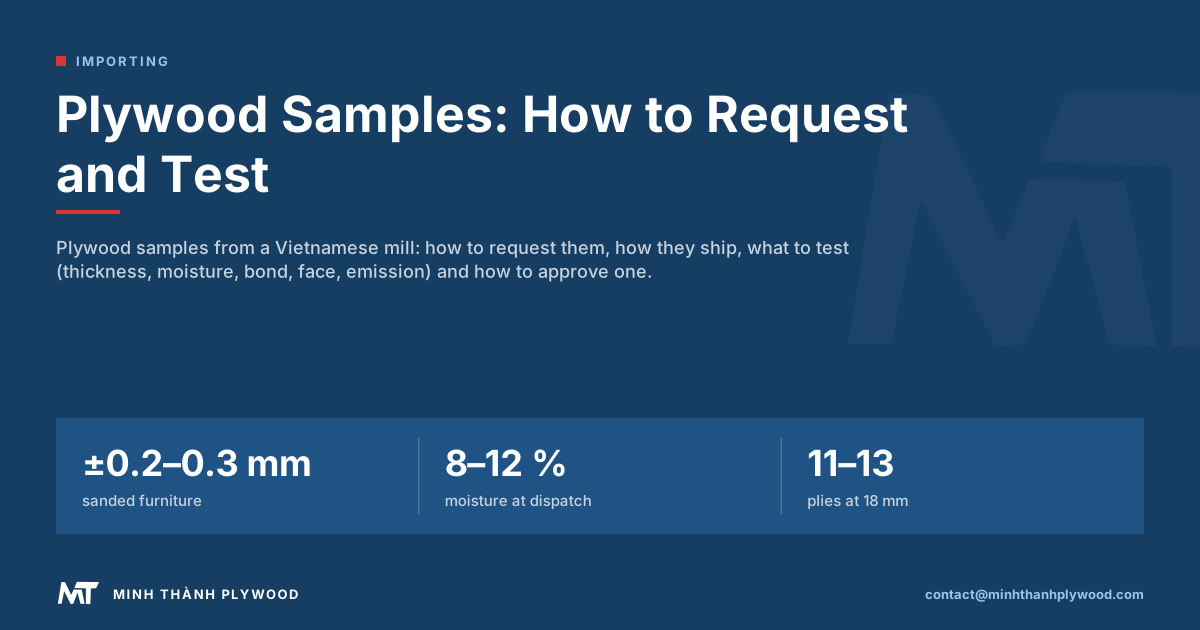
Plywood samples: the short answer
Plywood samples let you test the exact panel before you pay for a container of it. Ask for them early, test them against the specification, and approve one in writing so it becomes the reference for the order.
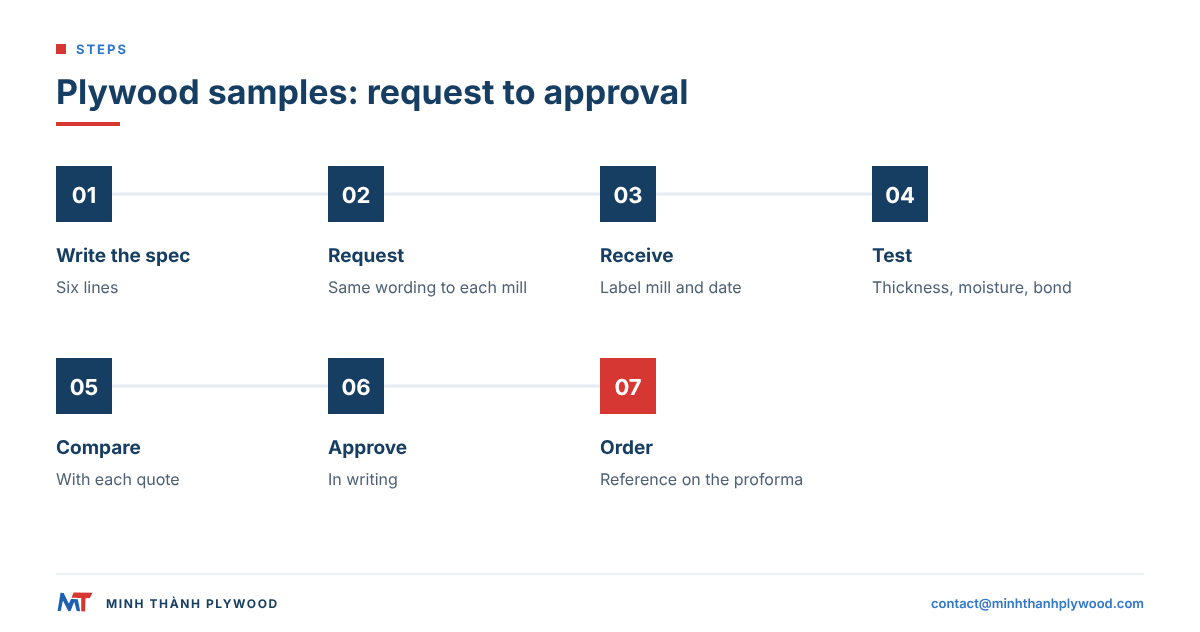
- Write the specification you plan to order, line by line.
- Request the samples from each mill on your shortlist, with the same wording.
- Receive them by courier and label each with the mill and the date.
- Test them for thickness, moisture, build, bond, face and emission.
- Compare them with the quotes that came with them.
- Approve one in writing and keep a piece as your counter-sample.
- Quote the sample reference on the proforma invoice.
At Minh Thanh Plywood, samples are free.
Are plywood samples free?
Plywood samples from Minh Thanh Plywood are free. Many Vietnamese mills offer free samples to buyers who send a real specification, because a panel approved before the order prevents most quality disputes after it. Send the specification first: the sample is built to it, not taken from stock.
A sample is worth more to the mill than it costs. It shows that the buyer is serious, it fixes the face grade and build in writing, and it gives the mill’s quality control a physical standard to work to.
What a buyer should expect from any free sample:
- It is built to the specification you sent, not taken from whatever is in stock.
- It carries a label with the specification or a reference number.
- It arrives with the quote it belongs to, so price and panel can be compared together.
What size is a plywood sample, and how does a mill sample compare with a shop sample?
A mill hand sample is a cut piece of the panel, ideally about A4 size, so you can measure thickness at several points, test the bond and judge the face; a shop sample is a small swatch priced per piece or per pack. The two answer different questions, and most US sellers of “plywood samples” offer the second kind.
| Source (US, October 2026) | What you get | Price |
|---|---|---|
| Berta Store | One Baltic birch sample, chosen by thickness and grade (3/16, 1/2 or 3/4 inch; BB/BB, B/BB, prefinished) | US$24.99 |
| Vintage Plywood | Sample pack of five 8 × 10 inch pieces of decorative panels, shipping included | US$27.50 |
| Minh Thanh Plywood | Hand sample built to your written specification, with the quote it belongs to | Free |
A shop sample shows a finished look for a project. A mill sample is the panel you intend to import, so it carries more proof: the build, the core, the glue and the thickness tolerance.
What to ask for so a free sample tells you the most:
- One piece per face/back grade pair you are considering, for example D+/D, D/D and D/E, so you see the grade ladder side by side.
- One piece per core (Styrax, Eucalyptus) if you are comparing weight and price.
- A full-sheet sample when flatness or the face across a whole sheet matters.
- A written date for when the sample ships, and a tracking number when it does. Courier arrangements (the mill’s courier or your own account) are agreed in the request email, and the date is confirmed in the reply.
Which types of plywood samples are there?
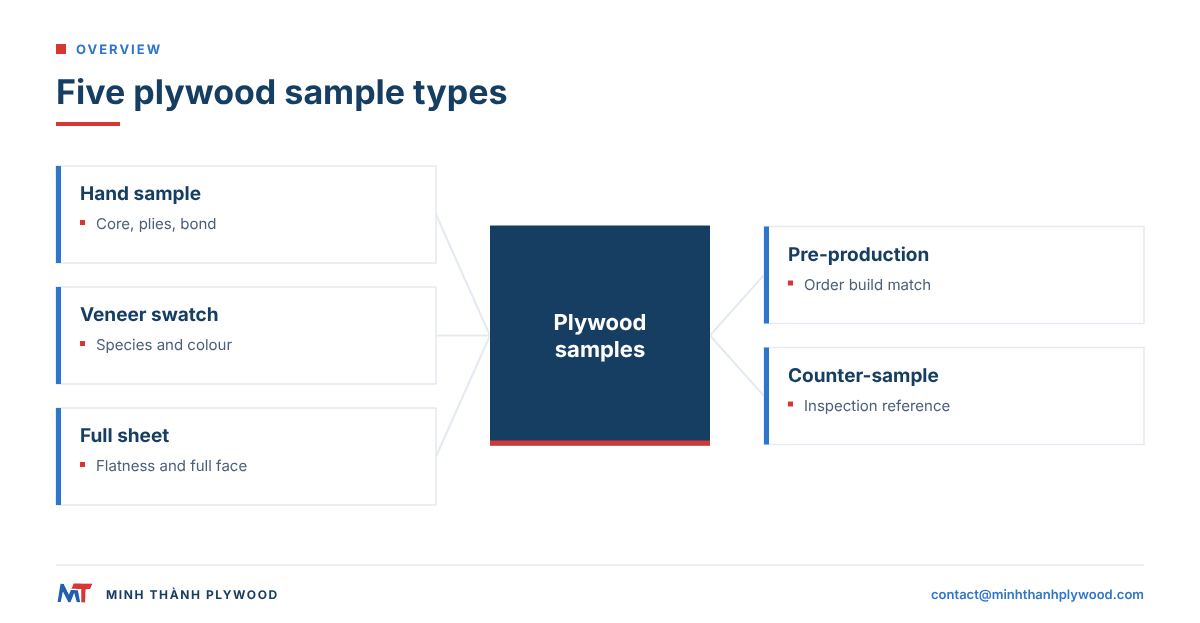
There are five kinds of plywood samples, and each answers a different question. Ask for the one that matches the stage you are at.
| Sample type | What it is | When to ask for it | What it proves |
|---|---|---|---|
| Hand sample | A small cut piece of the panel | First contact, several mills | Core, plies, glue, face, thickness |
| Veneer sample | A swatch of face veneer | Choosing species and colour | Face look only |
| Full-sheet sample | One whole sheet | Large or exacting orders | Flatness, face across the sheet, edges |
| Pre-production sample | Built from the order’s materials | After the deposit, before the run | That the order build matches the approved sample |
| Counter-sample | A piece of the approved sample kept by the buyer | Every order | A reference for inspection and any claim |
Most first orders need only a hand sample per specification and a counter-sample. A full sheet is worth the freight when flatness or the face across a whole sheet matters, as it does for high-gloss lacquered furniture.
How do you get plywood samples from Vietnam?
Getting plywood samples from Vietnam takes one email with the full specification and a delivery address. The mill builds the sample, ships it by express courier and sends the tracking number.
- Shortlist the mills. Check each one is a real manufacturer with its own press line and certificates.
- Send one request to each mill, with the same specification, so the samples compare.
- Give a delivery address and a contact who will receive and test the samples.
- Agree the courier and the date by email.
- Ask for the quote with the sample, so the price is tied to the panel you are testing.
- Log each sample on arrival: mill, date, specification and label.
Buyers often send the request before they have a project date. That is fine: a tested, approved sample on file shortens the first real order by weeks.
What should a plywood sample request say?
A plywood sample request should say what the panel is for and how it is built, in six lines. The same six lines later go on the order, so write them once.
| Line | Example | Why the mill needs it |
|---|---|---|
| Application | Kitchen carcasses, banded edges | Decides the core, glue and face grade |
| Core | White Styrax, stitched | Weight, flatness and machining |
| Glue and emission | UF glue at E0 emission, CARB P2 | Bond class and market access |
| Face and back | Birch D/D, sanded, UV-ready | Appearance and finishing |
| Sheet | 18 mm, ±0.2 mm, 1220 × 2440 mm | Fit, tolerance and yield |
| Packing and quantity | Export packs, 1×40HC, CIF port | Price basis for the quote |
A request that names only “18 mm birch plywood” gets a sample of whatever the mill makes most. A request with all six lines gets the panel you will actually buy.
How are plywood samples shipped?
Plywood samples ship by international express courier, as small cut pieces packed flat between card or board. Door-to-door transit from northern Vietnam to Europe or the US usually takes a few working days.
- Packing: pieces are wrapped against knocks and moisture, with the label on the outside piece.
- Customs: the courier needs a short invoice describing the goods as plywood samples, with the HS heading 4412.
- Plant health: plywood is a processed wood product and is outside the scope of ISPM 15, the IPPC treatment standard for wood packaging. Any solid-wood crate around a full-sheet sample does need ISPM 15 marking.
- Full sheets: a full-sheet sample is heavy and large, so it often travels with a consolidated sea shipment or as air freight.
The courier arrangements for a sample are agreed by email when you request it.
What to test on a plywood sample?
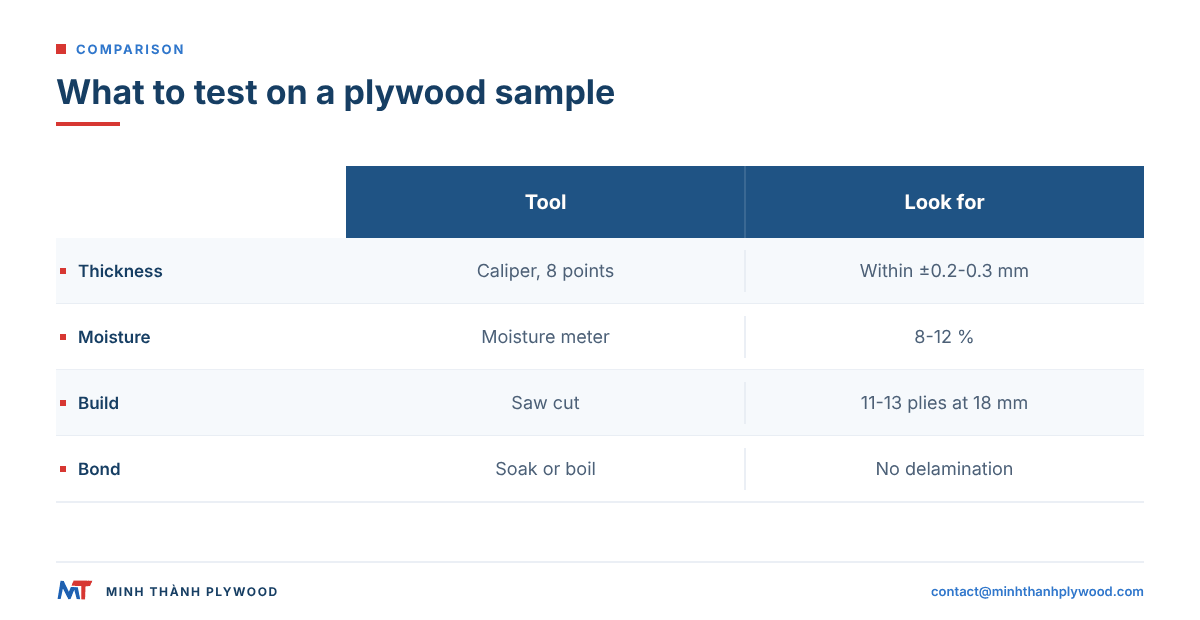
Test a plywood sample on seven points: thickness, moisture, build, bond, face, finish and emission. The table is a buyer’s test plan with the tool for each check and the result to look for on a furniture panel.
| Check | Tool | What to look for |
|---|---|---|
| Thickness | Digital caliper | Within the written tolerance, such as ±0.2–0.3 mm for sanded furniture panels |
| Moisture | Pin or pinless moisture meter | 8–12 % for furniture plywood at dispatch |
| Ply count and build | Saw cut, magnifier | 11–13 plies at 18 mm, even plies, no overlaps |
| Core gaps | Fresh cross-cut | No open gaps under the face |
| Bond | Soak or boil test matched to the glue | No delamination after the test for the stated bond class |
| Face grade | Daylight, against the grade ladder | Matches the grade quoted, such as birch D/D |
| Finish and sanding | Hand, light, test coat | Even sanding, takes your lacquer or UV coat |
| Emission | Certificate and test report | Build matches the certified product |
For a US-bound sample, read the emission report against the limit for hardwood plywood with a veneer core, 0.05 ppm under 40 CFR 770.10.
Run the same tests on every sample, in the same order, and record the results in one sheet. The quote comparison guide shows how to put those results beside the prices.
How do you measure thickness and moisture on a sample?
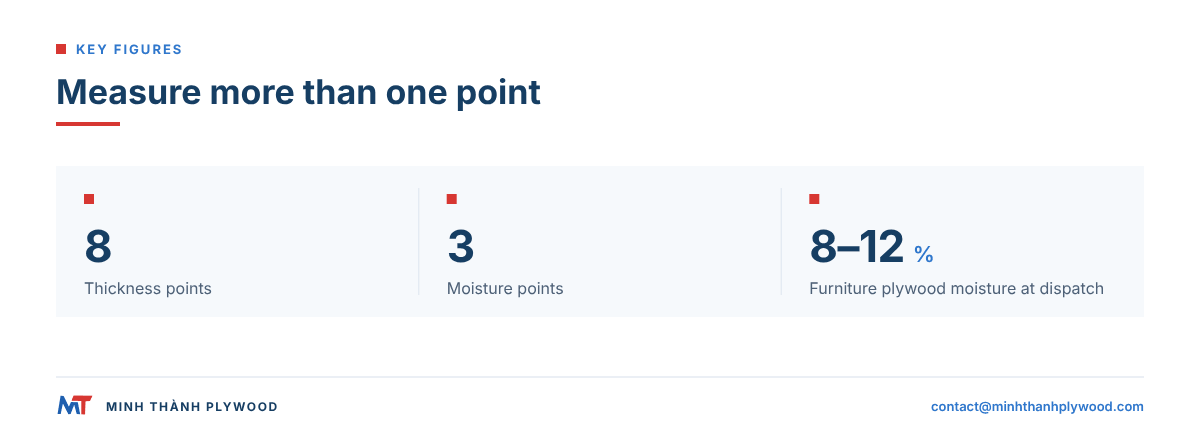
Measure thickness at eight points with a caliper and moisture at three points with a meter. Single readings hide the variation that causes problems in production.
- Let the sample settle indoors for a day after it arrives.
- Measure thickness at the four corners and the four mid-edges, a hand’s width in from the edge.
- Write all eight readings down and compare the highest and lowest with the tolerance on the quote.
- Measure moisture at the centre and at two edges, with the meter set for hardwood.
- Compare moisture with the 8–12 % range of furniture plywood at dispatch.
Thickness tolerance depends on the product line. Our sanded furniture panels are held to ±0.2–0.3 mm, down to ±0.2 mm; commercial and film-faced panels to ±0.5 mm; packing plywood to ±0.5–1.0 mm; length and width to ±2 mm.
How do you check the bond on a plywood sample?
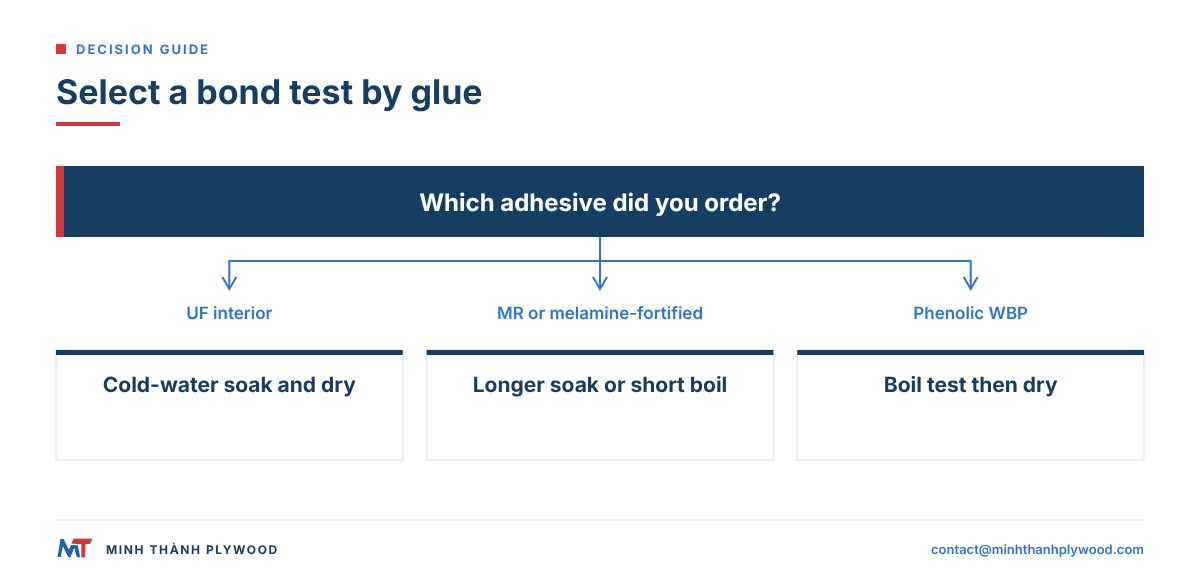
Check the bond with a soak or boil test that matches the glue, then try to split the plies with a chisel. The test must match the bond class you ordered, or the result means nothing.
- UF glue for interior furniture: a cold-water soak followed by drying shows whether the plies hold in normal indoor conditions. A boil test is too severe for this glue and will fail by design.
- MR or melamine-fortified glue: a longer soak or a short boil shows the improved moisture resistance.
- Phenolic (WBP) glue: a boil test, followed by drying, is the usual workshop check for exterior and film-faced panels.
For a formal result, a laboratory tests the bond to EN 314-1 and classes it under EN 314-2 (Class 1 dry, Class 2 humid, Class 3 exterior). Glue type and emission class are two separate specifications: UF glue at E0 emission is the bond and the emission of a furniture panel, not one combined grade.
How do you judge face grade on a sample?
Judge face grade in daylight, at arm’s length and close up, against the grade the quote names. Each face species has its own ladder.
| Face | Grades used by Vietnamese mills | Notes |
|---|---|---|
| Birch | D+, D, E, quoted as pairs such as D+/D or D/E | Comparable to B, BB and CP/C |
| Eucalyptus | A/A, A/B, B/B | Two show faces, one show face, or paint and overlay |
| Poplar | A/A, A/B, B/B | Also ordered by the codes B/BB, BB/CC and CP |
| Pine | A/A, A/B, B/B, B/C | Comparable to European classes I to IV and US A to D |
A small piece shows the grade only roughly, because knots, patches and colour change across a sheet. Ask for photos of the full face of a sheet in the same grade, taken in daylight, beside your hand sample.
What can a small plywood sample not show?
A small sample cannot show flatness over a full sheet, the face across 2.98 m² of veneer, or consistency from the first sheet to the last. Those need a full sheet, photos or an inspection.
- Flatness and warp: visible only on a full sheet, laid flat or stood on edge.
- Face variation: colour and patches change across the width of a sheet.
- Pack consistency: thickness and face grade need checking across several sheets in a pack.
- Packing: pallets, covers, straps and labels show only on the real shipment.
Close the gap with a full-sheet photo set at the sample stage and a pre-loading check on the order. Every Minh Thanh shipment is photographed and filmed before loading, and buyers receive the photos and video.
How is a sample matched to production?
The approved sample becomes the standard the order is built and checked against. Its reference goes on the proforma invoice, and the mill’s quality control compares production with it.
- Approve in writing: an email that names the sample reference and the specification.
- Keep a counter-sample: cut a labelled piece of the approved sample and store it flat and dry.
- Write it into the order: the proforma invoice repeats the specification and the sample reference.
- Build to it: face grade and appearance are matched to the approved sample.
- Check before loading: photos and video of the packed order go to the buyer before the container leaves.
Order appearance at Minh Thanh is fixed by the approved sample. That is why the sample stage matters more than the price talk before it.
How do veneer samples and wood panel samples help you choose a face?
Veneer samples and wood panel samples help you choose the face species and colour before you settle the build. A furniture brand choosing between birch, poplar, engineered veneer and okoume can compare them side by side.
Minh Thanh presses 10+ face veneers. The most produced are EV (engineered veneer), poplar, birch, okoume and pine; bintangor, eucalyptus, gurjan and sapele are supplied on request.
- Veneer swatches show the species, grain and colour of the face.
- Wood panel samples show the face on the finished panel, sanded, with the core in the edge.
- Finished samples with your own lacquer or UV coat show the final look.
Pick the face on veneer or panel samples, then test the full build on a hand sample made to the complete specification.
What mistakes make plywood samples useless?
Most sample mistakes come from testing something other than the panel you will buy. These are the ones that cost buyers the most:
- No specification sent: the mill sends its best stock panel, not your build.
- Different specifications to different mills: the samples cannot be compared.
- No counter-sample kept: there is nothing to measure the order against.
- Approval by phone: no written reference reaches the proforma invoice.
- Testing only the face: the core, glue and thickness decide most claims.
- Testing a UF panel with a boil test: the panel fails a test it was never built for.
- Ignoring the quote that came with it: a good sample at a price for a different build proves little.
What does this mean for your order with Minh Thanh Plywood?
We send free samples built to your specification, and we build the order to the sample you approve. The factory in Ha Hoa, Phu Tho makes top-grade furniture and interior plywood for Europe as its main market, with commercial, packing and film-faced plywood alongside.
- Builds: white Styrax or Eucalyptus cores, stitched horizontally and vertically, pressed twice for furniture grades.
- Faces: 10+ face veneers, sanded and polished, UV-ready.
- Tolerance: down to ±0.2 mm on sanded furniture panels.
- Emission: UF glue at E0 emission; CARB P2 / TSCA Title VI under ICTT mill no. 23024; SGS testing to your method on request.
- Terms: MOQ 1×40HC, mixed specifications by agreement, production 15–45 days after deposit, 30% deposit and 70% against the scanned B/L, FOB Hai Phong, CFR or CIF.
Read our trade terms for the order steps after the sample, and see furniture plywood from Vietnam for the panels we build most.
How should you request your plywood samples from Vietnam?
Request plywood samples from Vietnam with the same six lines you will put on the order. Here is a sample request you can copy:
Samples for: wardrobe carcasses · Core: white Styrax, stitched · Glue: UF glue at E0 emission, CARB P2 / TSCA Title VI · Face: birch D/D, sanded, UV-ready · Sheet: 18 mm, ±0.2 mm, 1250 × 2500 mm · Planned order: 1×40HC, CIF your port · Delivery address and contact
Email it to [email protected], or message Lisa on WhatsApp at +84 988 586 601. We reply within hours, Monday to Friday, 08:00–17:00 Vietnam time (UTC+7).
Buyer questions, answered
Are plywood samples free?
At Minh Thanh Plywood, yes: samples are free. Many Vietnamese mills offer free samples to serious buyers, because a sample approved before the order saves both sides a dispute later.
How are plywood samples shipped from Vietnam?
By international express courier, as small cut pieces packed flat. Plywood is a processed wood product, so the panel itself does not need ISPM 15 treatment; the courier details are agreed by email when the sample is requested.
What should I test on a plywood sample?
Measure thickness with a caliper, check moisture with a meter, count the plies and look for core gaps on a cut edge, judge the face grade in daylight, run a soak or boil bond test that matches the glue, and read the emission report for the build.
How do I get plywood samples from a Vietnamese factory?
Send the specification: application, core, glue and emission, face species and grade, thickness and size, packing and quantity. The mill builds a sample to that line and ships it by courier; you test it, approve it in writing and quote its reference on the order.
How many samples should I ask for?
Ask for one sample per specification you plan to order, plus a second sample of the face grade you are unsure about. Two or three specifications are usually enough to cover a first container.
What is an approved sample?
An approved sample is the sample the buyer accepts in writing as the standard for the order. Its reference goes on the proforma invoice, and production and inspection are matched to it.
Can a small sample show the quality of a whole container?
A small sample shows the build: core, plies, glue, face grade, thickness and moisture. It cannot show flatness over a full sheet or consistency across 990 sheets, so add full-sheet photos and the pre-loading photos and video of your shipment.
What are veneer samples?
Veneer samples are thin sheets or swatches of face veneer, used to choose the species and colour before ordering a panel. They show the face only, so the panel sample is still needed to test the build.
How long does a plywood sample take?
A sample cut from a standard panel ships quickly; a sample built to a new specification needs a press run. Agree the date when you send the request, and send the full specification at once so the mill builds it right first time.
Do I need an emission test on a sample?
Read the mill's emission certificate and chamber test reports first. Minh Thanh panels are certified CARB P2 / TSCA Title VI, and third-party testing to your own method, for example EN 717-1, is arranged through SGS on request.