
Buy plywood FOB if you have a forwarder or your own freight rate, and CIF or CFR if you want one price to your port. Under all three Incoterms the risk passes to you when the container is on board at the port of loading; only the freight and insurance bills change hands. Minh Thanh Plywood quotes FOB Hai Phong, CFR or CIF.
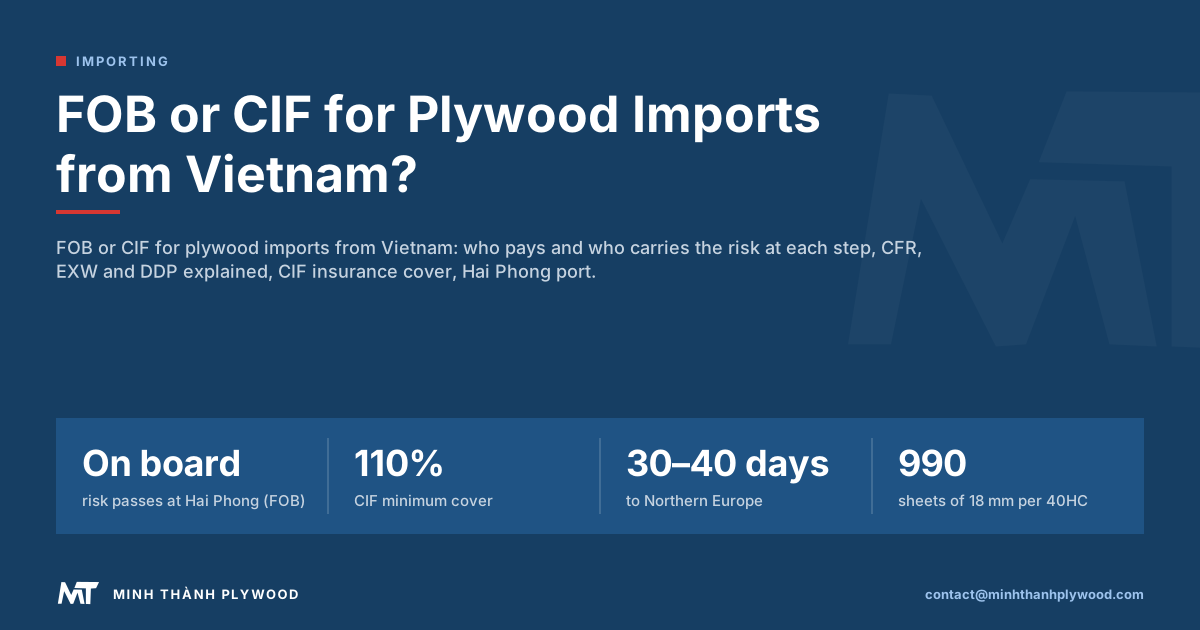
FOB or CIF for plywood imports?
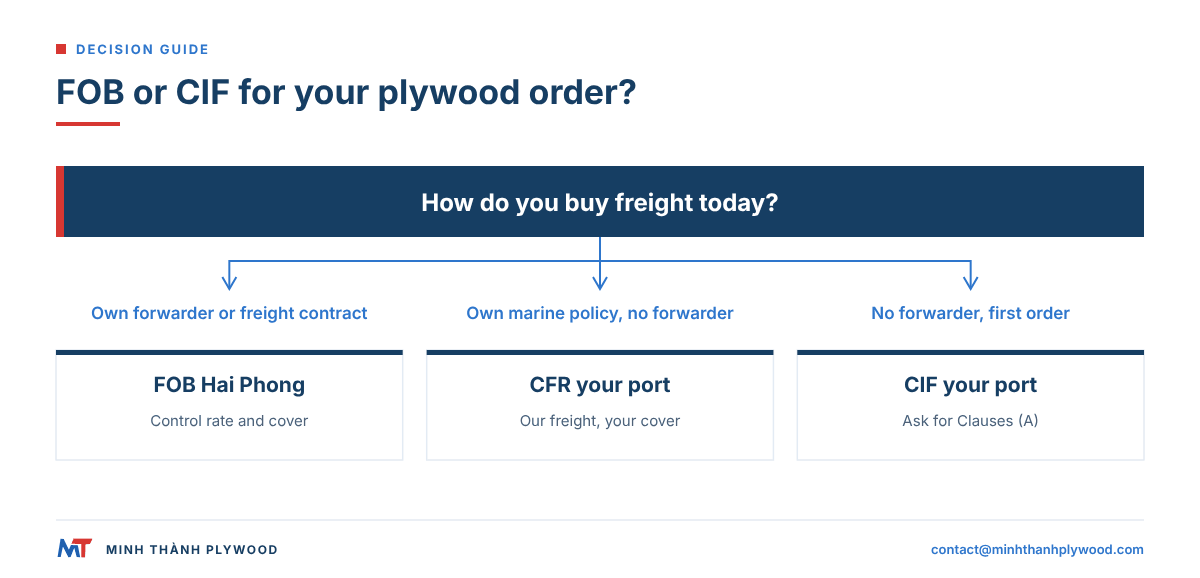
Buy FOB if you already have a freight forwarder or a freight contract; buy CIF or CFR if you want one price delivered to your port. That is the whole decision for most plywood importers, because the choice settles who books the ship and who pays the freight.
The Incoterm does not change who carries the risk at sea. Under Incoterms 2020, published by the International Chamber of Commerce, the risk passes from seller to buyer when the goods are on board the vessel at the port of loading under FOB, CFR and CIF alike. What changes is who books the ship, who pays the freight, and who buys the insurance.
| Term | Seller pays up to | Buyer pays from | Risk passes | Minh Thanh quotes it |
|---|---|---|---|---|
| EXW (Ex Works) | Goods ready at the mill | Loading at the mill | At the mill | No |
| FOB (Free On Board) Hai Phong | Goods on board at Hai Phong | Sea freight | On board at Hai Phong | Yes |
| CFR (Cost and Freight) your port | Sea freight to your port | Insurance, destination charges | On board at Hai Phong | Yes |
| CIF (Cost, Insurance and Freight) your port | Sea freight and minimum insurance | Destination charges | On board at Hai Phong | Yes |
| DDP (Delivered Duty Paid) | Delivery to your door, duty paid | Unloading | At your door | No |
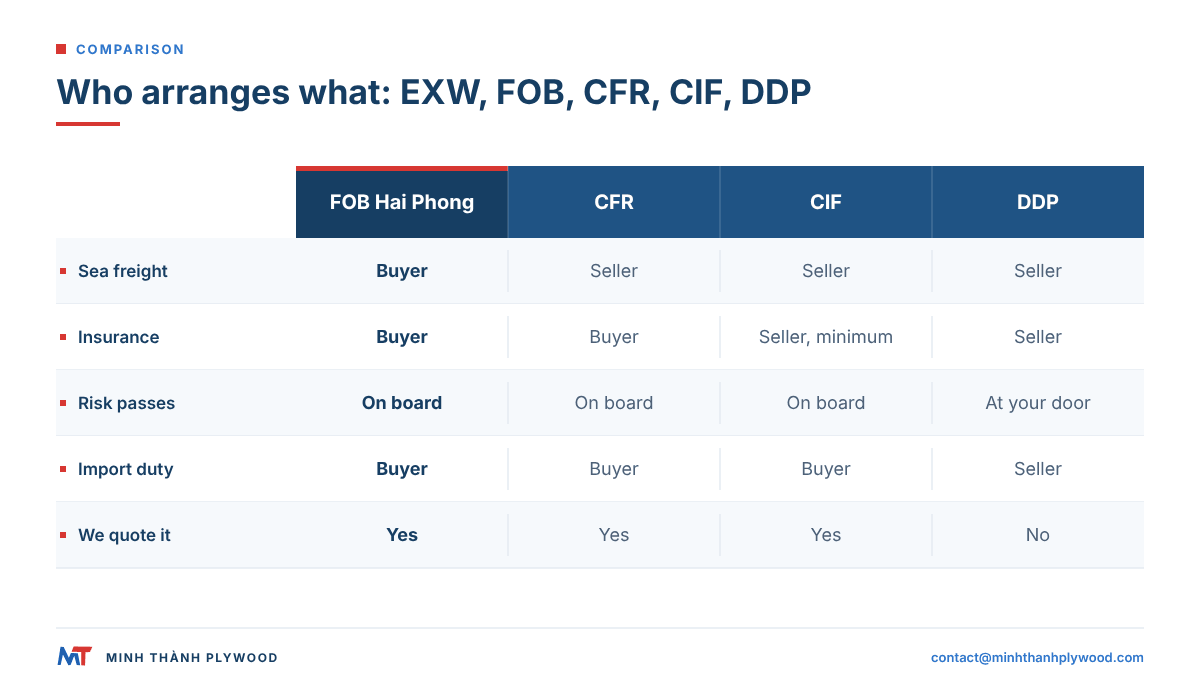
Who pays what from the factory gate to your warehouse?
A plywood container from Minh Thanh goes through ten steps between our press and your warehouse. This is who pays for each one under each term:
| Step | EXW | FOB Hai Phong | CFR | CIF | DDP |
|---|---|---|---|---|---|
| Export packing | Seller | Seller | Seller | Seller | Seller |
| Container loading at the mill | Buyer | Seller | Seller | Seller | Seller |
| Haulage to Hai Phong | Buyer | Seller | Seller | Seller | Seller |
| Vietnamese export customs | Buyer | Seller | Seller | Seller | Seller |
| Origin terminal charges and loading on board | Buyer | Seller | Seller | Seller | Seller |
| Sea freight | Buyer | Buyer | Seller | Seller | Seller |
| Marine insurance | Buyer’s choice | Buyer’s choice | Buyer’s choice | Seller, minimum cover | Seller |
| Destination terminal charges | Buyer | Buyer | Buyer, unless agreed | Buyer, unless agreed | Seller |
| Import clearance and duty | Buyer | Buyer | Buyer | Buyer | Seller |
| Delivery to your warehouse | Buyer | Buyer | Buyer | Buyer | Seller |
Destination terminal charges sit with the buyer under CFR and CIF unless the freight contract includes them; ask the seller to state it in the quote. The cost lines after the port of arrival never change between FOB, CFR and CIF: budget them the same way for every supplier you compare.
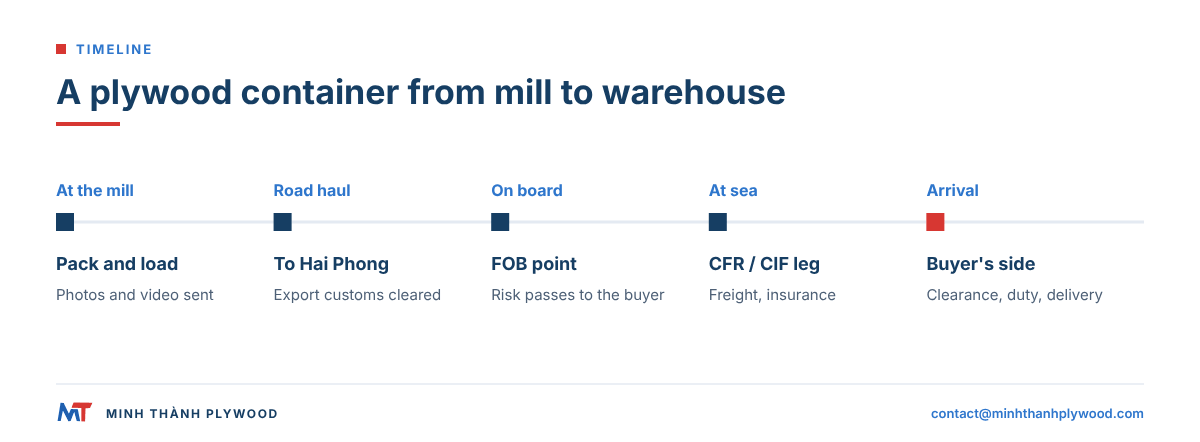
What does FOB Hai Phong include for plywood?
FOB Hai Phong means the plywood price includes everything up to the container on board your vessel at Hai Phong. At Minh Thanh that is:
- Production and export packing of the order.
- Photos and video of the container before loading, sent to you.
- Container loading at our factory in Ha Hoa, Phu Tho.
- Haulage of the loaded container by road to Hai Phong.
- Vietnamese export customs and the export documents.
- Origin terminal handling and delivery to your vessel before the cut-off.
Your forwarder books the vessel and gives us the cut-off date; we deliver the container and the documents on time. From the moment the container is on board, it is yours: freight, insurance, arrival, clearance and delivery are on your side.
What do CFR and CIF add?
CFR and CIF add the sea leg to the FOB price. Under both, Minh Thanh books the sailing, pays the carrier, and names the destination port in the quote.
- CFR (Cost and Freight), also written CNF or C&F: FOB plus sea freight to your port. No insurance from the seller.
- CIF (Cost, Insurance and Freight): CFR plus a marine insurance policy bought by the seller, in your favour, with the certificate in the shipping documents.
A CIF or CFR quote names the destination: CIF Rotterdam, CFR Jebel Ali, CIF Felixstowe. The price is valid for that port and the sailing period in the quote; freight rates change by season, so a quote carries a date.
Who carries the risk at sea under FOB, CFR and CIF?
The buyer, under all three. Risk passes when the container is on board the vessel at Hai Phong. If the container is damaged at sea, the buyer claims on the insurance, whether the buyer or the seller bought it.
This is the point most first-time importers miss. CIF does not mean the seller is responsible until your port; it means the seller has paid the freight and the minimum insurance on your behalf. The claim, if one is needed, is made by you, with the insurance certificate the seller sends.
The Incoterms rules also note that FOB, CFR and CIF were written for goods handed over at the ship. Container cargo is handed to the carrier at a terminal before it goes on board, so the ICC suggests FCA, CPT and CIP for containers. Plywood trade still uses FOB, CFR and CIF by long practice; what matters is that the contract names the term, the port and the Incoterms edition, for example “FOB Hai Phong, Incoterms 2020”.
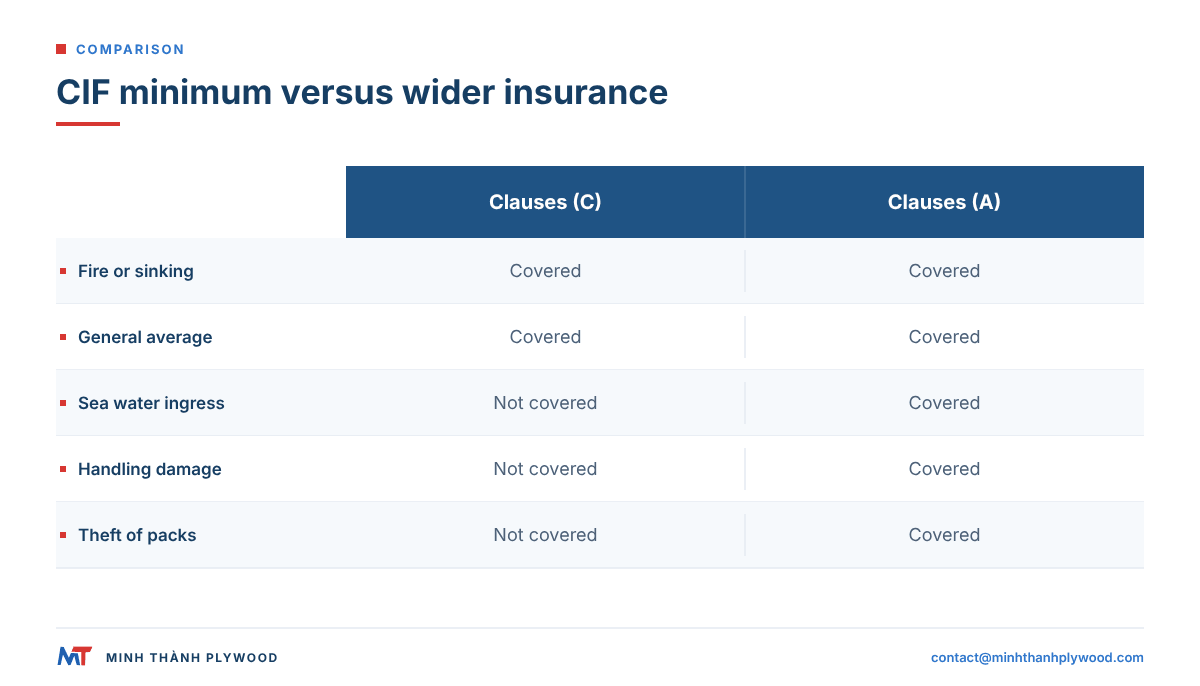
How much insurance does CIF give a plywood container?
Minimum cover. Incoterms 2020 asks the CIF seller for Institute Cargo Clauses (C), for at least 110% of the contract value. Clauses (C) pay for major casualties, such as fire, sinking, stranding or collision, and general average. They do not pay for most of what actually hurts a plywood container:
| Loss | Clauses (C), CIF minimum | Clauses (A), all risks |
|---|---|---|
| Vessel sinks, fire, collision | Covered | Covered |
| General average contribution | Covered | Covered |
| Sea water or rain entering the container | Not covered | Covered |
| Handling damage, packs dropped at transshipment | Not covered | Covered |
| Theft of packs | Not covered | Covered |
For plywood, ask for Clauses (A) in the CIF quote, or buy CFR and insure the cargo under your own policy. Either way, insure from the moment the container is on board at Hai Phong.
When is FOB the better choice?
FOB suits an importer who already buys freight. Choose FOB Hai Phong when:
- You have a forwarder who knows your customs broker and your warehouse.
- You have a freight contract with a carrier, often better than a single-container rate.
- You buy from several mills or countries and consolidate bookings.
- You want to choose the carrier and routing, for example a direct service over a transshipment.
- You want full cost visibility, with freight and insurance as separate lines.
- You insure under your own policy, with Clauses (A) cover.
When is CIF or CFR the better choice?
CIF or CFR suits a buyer who wants one price to the port. Choose it when:
- It is your first order from Vietnam and you do not yet have a forwarder there.
- You import one or two containers a year, too few for a freight contract.
- You want to compare delivered prices from several origins at the same port.
- Your bank or customer asks for a delivered price on the contract or the L/C.
Choose CFR over CIF when you already hold an open marine policy: you get the freight from us and the insurance from your own insurer, at the cover you choose.
How do you compare an FOB quote with a CIF quote?
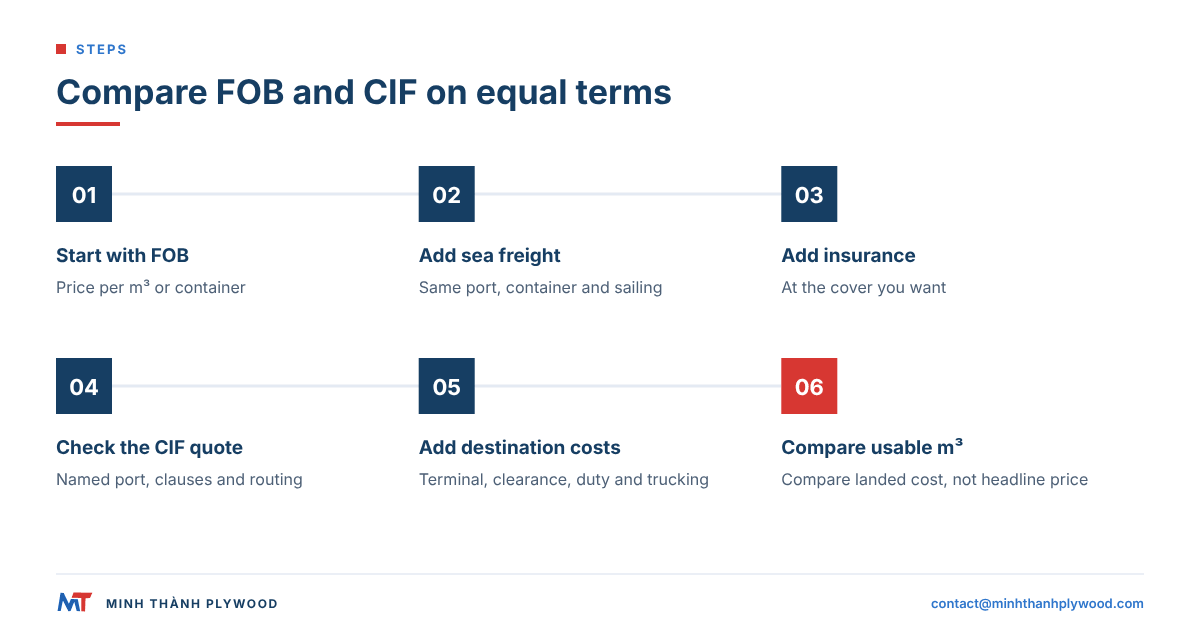
Bring both quotes to the same point, your port, before you compare them:
- Take the FOB price per m³ or per container.
- Add your forwarder’s sea freight to the same port, for the same container and sailing period.
- Add your insurance, at the cover you want.
- Compare with the CIF price, and check the CIF quote’s insurance cover and named port.
- Check the routing: a cheaper CIF price may use a slower transshipment.
- Add the same destination costs to both: terminal handling, clearance, duty, trucking.
If the CIF price is lower than FOB plus a fair freight, ask which sailing and which insurance clauses it uses. The comparison is about the delivered cost per usable m³, not the headline price.
How much does CIF add to the FOB price per m³ from Hai Phong?
CIF adds the sea freight per container divided by the cubic metres in it, plus insurance. A Minh Thanh 40HC on Styrax core carries about 53 m³, so every US$530 of freight per container adds US$10/m³ to the price.
Worked example with a public benchmark: Drewry’s World Container Index put Shanghai to Rotterdam at US$3,522 per 40ft container on 15 October 2026. Divided by 53 m³ that is about US$66/m³ of freight on top of the FOB price. Hai Phong quotes differ by carrier, sailing and season, so treat it as the order of magnitude and ask your forwarder for the live Hai Phong rate.
The same arithmetic gives the volume rule. With one or two containers a year, a CIF or CFR quote is competitive because a mill books many containers and buys freight at a better rate than one importer. Once you ship several containers a year or have a forwarder contract, FOB plus your own rate usually wins, because you see freight and insurance as separate lines and can re-tender them each season.
Which CIF and CFR traps should you check at the destination port?
The trap is not the Incoterm but who controls the cargo after arrival. Under CIF and CFR the seller’s carrier issues the bill of lading, and the destination agent named on it handles release. Destination terminal handling, documentation and release fees are the buyer’s under both terms, and a buyer who has not agreed them in advance has little room to negotiate when the agent invoices them at arrival.
Before you accept a CIF or CFR quote, ask for four things:
- The carrier and the destination agent named in the quote, not “freight forwarder to be advised”.
- A written list of destination charges: terminal handling, documentation and release fee, or a statement that they are included.
- A draft bill of lading before sailing, with you or your bank named as consignee.
- The free days at the destination terminal and the detention rate after them.
Minh Thanh states the carrier and destination charges in the CIF or CFR quote. If you prefer to control the arrival side completely, buy FOB Hai Phong and let your own forwarder handle the destination.
What about FCA, CIP, DAP and customs value?
FCA, CPT and CIP are the ICC’s container-era versions of FOB, CFR and CIF: the risk passes when the goods are handed to the carrier at a terminal instead of on board the ship. DAP delivers to a named place in the buyer’s country, unloaded by the buyer and cleared by the buyer. Minh Thanh quotes FOB Hai Phong, CFR or CIF; if your bank, contract or customer requires FCA, CIP or DAP wording, tell us in the request and we will say whether we can match it.
| Term | Passes risk | Freight | Typical use |
|---|---|---|---|
| FCA Hai Phong terminal | At the terminal | Buyer | Container buyers who want the container handed over before loading |
| CIP your port | At the terminal | Seller | CIF equivalent for containers, with Clauses (A) cover |
| DAP your warehouse | At the named place | Seller | Delivered price; the buyer clears import |
The Incoterm also changes the invoice value your customs broker sees. The EU values imports on a CIF basis, so freight and insurance to the EU border are part of the customs value. Canada and the United States generally value goods without the international freight and insurance if the invoice shows them separately. A Canadian importer who buys CIF should ask for an invoice with the freight and insurance on their own lines, so the declared value stays at the FOB figure; confirm the rule for your tariff line with your customs broker.
FOB Hai Phong vs Ho Chi Minh City for plywood: which port?
Hai Phong, because it is the nearest deep-water container port to our factory in Ha Hoa, Phu Tho, in northern Vietnam. A loaded container goes to Hai Phong by road; export customs is cleared there; the main carriers call there each week with direct and transshipment services to Europe, the Americas, the Middle East and Asia.
Ho Chi Minh City and Cai Mep in the south serve the southern mills. For a northern factory, FOB Ho Chi Minh City would add a long domestic haul to every container, which raises cost and time without changing the panel. That is why we quote FOB Hai Phong, and CFR or CIF from Hai Phong to your port.
Typical days at sea from Hai Phong, by carrier and route: South-East Asia 5–12, Middle East 15–25, US West Coast 20–30, Mediterranean 25–35, Northern Europe 30–40, US East Coast 35–45 and West Africa 35–50; Japan and Korea about 2–3 weeks.
Vietnam plywood Incoterms and container loading: what changes?
The Incoterm does not change how the container is loaded. Under FOB, CFR and CIF alike, Minh Thanh loads the container at the factory, photographs and films it, seals it and trucks it to Hai Phong. The pack plan is the same:
- 40HC with Styrax core: 18 packs, 990 sheets of 18 mm, about 53 m³.
- 40HC with Eucalyptus core: 15 packs, 795 sheets of 18 mm, about 43 m³, because the heavier core reaches the weight limit first.
What the term changes is who books the container. Under FOB your forwarder books it and tells us the payload the booking allows; under CFR and CIF we book it. If your booking caps the payload below our 28,000 kg planning figure, the pack plan follows the lower figure. Mixed specifications in one container follow the same rule.
Which documents come with each term?
The core set is the same under every term: commercial invoice, packing list, bill of lading and certificate of origin (EUR.1 for the EU), with phytosanitary and fumigation papers for the packing. CIF adds the insurance certificate.
| Document | FOB Hai Phong | CFR | CIF |
|---|---|---|---|
| Commercial invoice and packing list | Yes | Yes | Yes |
| Bill of lading | Issued by your forwarder’s carrier | Issued by our carrier, freight prepaid | Issued by our carrier, freight prepaid |
| Certificate of origin | Yes | Yes | Yes |
| Phytosanitary and fumigation | Yes | Yes | Yes |
| Insurance certificate | Your own policy | Your own policy | Yes, from the seller |
Compliance files are agreed before you confirm the order: CARB P2 / TSCA Title VI reports, the EUDR compliance dossier for EU orders, and the SGS PPWR packaging test.
What do Minh Thanh’s terms look like on each Incoterm?
Payment and production stay the same whatever term you choose:
- MOQ: one 40HC, with mixed specifications by agreement.
- Production: 15–45 days after the 30% deposit.
- Balance: 70% against the scanned bill of lading, by T/T, or an irrevocable L/C at sight.
- Delivery terms: FOB Hai Phong, CFR or CIF to your port.
- Samples: free samples before the order.
Indicative starting prices, October 2026: commercial plywood from US$250/m³ and furniture/interior plywood from US$350/m³. Ask for FOB and CIF in the same quote, and we show the freight and insurance lines on their own, so you can compare them with your forwarder’s rate.
Buyer questions, answered
Is FOB or CIF better for plywood imports?
FOB is better when you have a forwarder or your own freight contract, because you control the carrier, the rate and the insurance. CIF or CFR is better for a first order or a low volume, when one price to your port is simpler.
What is the difference between FOB and CIF for Vietnam plywood?
Under FOB Hai Phong the buyer books and pays the sea freight and insurance. Under CIF the seller books the freight to the buyer's port and buys minimum marine insurance. In both, the risk passes to the buyer once the container is on board at Hai Phong.
What is the difference between CFR and CIF for plywood?
CFR, also written CNF or C&F, includes the sea freight to your port but no insurance. CIF adds a marine insurance policy bought by the seller, at minimum cover under Incoterms 2020.
Does CIF insurance cover plywood fully?
No. Incoterms 2020 asks the CIF seller for minimum cover only, Institute Cargo Clauses (C), for 110% of the contract value. For water damage, theft or handling damage, ask for Clauses (A) in the quote or insure the cargo under your own policy.
What is FOB plywood?
FOB plywood is plywood priced free on board at the named port: the price covers the panels, export packing, haulage to the port, export customs and loading on the vessel your forwarder books. Minh Thanh quotes FOB Hai Phong.
What is EXW plywood?
EXW plywood is priced at the mill gate: the buyer arranges loading, trucking, Vietnamese export customs and everything after. Foreign buyers rarely can clear exports in Vietnam themselves, so Minh Thanh does not quote EXW.
Can I buy plywood DDP from Vietnam?
DDP puts import duty, clearance and delivery to your door on the seller. Minh Thanh does not quote DDP; buy CIF or CFR to your port and let your customs broker clear the goods, so you stay the importer of record.
Should a first-time plywood importer buy FOB or CIF?
CIF or CFR, unless you already have a forwarder. One price to your port makes the first order simpler; after the first containers, compare the CIF price with FOB plus your own freight quote.
Why FOB Hai Phong and not FOB Ho Chi Minh City?
Minh Thanh's factory is in Ha Hoa, Phu Tho, in northern Vietnam, and Hai Phong is the nearest deep-water container port. A south Vietnamese port would add a long domestic haul to every container.
What does CIF Jebel Ali or CFR Jebel Ali mean for plywood?
It is a price that includes sea freight from Hai Phong to Jebel Ali in Dubai, with insurance under CIF and without under CFR. Import clearance, duty and delivery in the UAE stay with the buyer.
Who pays terminal handling charges under FOB and CIF?
Origin charges at Hai Phong up to loading are the seller's under FOB and CIF. Destination terminal handling, clearance and duties are the buyer's under both terms.
How much does CIF add to the FOB price of plywood per m³?
Divide the sea freight per container by the cubic metres in it, then add insurance. A Minh Thanh 40HC holds about 53 m³, so a freight rate of US$3,522 per container adds about US$66/m³ before insurance.
What are the hidden costs of buying plywood CIF?
Destination terminal handling, documentation and release fees are the buyer's under CIF, and the seller's carrier and agent control release. Ask for the carrier, the destination charges and a draft bill of lading before you accept the quote.
When does the buyer pay the balance under FOB or CIF?
With Minh Thanh, the same way under every term: 30% deposit, then the 70% balance against the scanned bill of lading, or an irrevocable L/C at sight.