
Alibaba plywood listings, sourcing agents, traders and mills all sell the same panels, but each adds a layer of margin, control and risk. For a full container of a fixed specification, buying direct from the mill gives the shortest chain and the clearest documents. Minh Thanh Plywood explains what each channel does and how to tell a real factory.
Which channel should you use to buy plywood?
Buy direct from the mill when you order a full container of a fixed specification; use a marketplace, an agent or a trader when you need something a single mill does not give. Every channel sells panels made in a plywood mill. What changes is how many hands sit between that mill and you, what each one adds, and who answers when a pack arrives wrong.
There are five common ways to buy plywood across borders:
- Retail and builder’s merchant websites, by the sheet or the pallet.
- B2B marketplaces such as Alibaba, where mills, traders and agents list side by side.
- Sourcing agents and brokers, who find and manage mills for you.
- Traders and trading companies, who buy from mills and resell.
- The mill itself, selling factory-direct by the container.
The right answer depends on your volume, how fixed your specification is, and how much local follow-up you need. The sections below take each channel, then show how to check that a seller is the factory it claims to be.
Plywood purchase online: retail and merchant websites
Retail websites and builder’s merchants are the way to order wood online in small quantities: a few sheets for a job, a pallet for a workshop. Delivery is local, the stock is already in the country, and duty and freight are in the price.
The trade-off is choice and depth of data. Retail sheets come in a few standard builds; the listing rarely names the core species, the glue class, the emission test or the mill. For a cabinet shop that wants the same panel every month, a retail plywood purchase online is a test or a stopgap, not a supply chain.
What a UK buyer pays on the shelf, checked on 21 October 2026: at B&Q, 18 mm hardwood plywood in 2440 × 1220 mm costs £15.97 to £35.80 per sheet depending on grade and face, with home delivery at £15 and free delivery over £500 (B&Q plywood range). Specialist wholesalers list the same way, per sheet, ex VAT and inc VAT side by side; a 3 mm flexible plywood sheet, for example, is £17.59 ex VAT and £21.11 inc VAT (Sheet Materials Wholesale). For exterior jobs, that retailer points to EN 636 Class 3 plywood with an EN 314-2 Class 3 bond.
Retail also covers the “order plywood” searches of homeowners. Importers and factories buy upstream, by the container, which is where the other four channels sit.
Alibaba plywood and other B2B marketplaces
A B2B marketplace lists plywood from mills, traders and agents on the same page, with the same badges and photo layouts. Searching for Alibaba plywood gives thousands of offers, many with low headline prices and a fast chat reply.
What a marketplace does well:
- Discovery: many sellers in one place, filterable by product and country.
- Speed: quotes in hours.
- Payment tools: some platforms hold the payment until the buyer confirms delivery.
What a listing does not show:
- Who makes the panel. A seller’s profile may describe a factory it buys from.
- The real build. “18 mm plywood” can hide a different core, fewer plies or another glue.
- The price basis. A low price per sheet may be for a thinner real thickness or a lower face grade.
What Alibaba listings quote for 18 mm plywood in 1220 × 2440 mm, by listing type (October 2026, supplier list prices, before freight and duty):
| Listing type | Quoted price per sheet | Minimum order | What to check |
|---|---|---|---|
| Melamine-faced board, Guangdong supplier | US$26.90 (200–999 pcs), US$10.90 (1,000+ pcs) | 100 pieces | Which price tier the sample was quoted on |
| Birch-faced sheet, Jiangsu supplier | US$20 (400–899 sheets), US$15 (900+) | 400 sheets | Real face grade and core |
| Commercial board, E0 listing | US$10.80–13 | 2 pieces | Real thickness and glue class |
| Lowest-priced birch or okoume faced listings | US$4.98–6.57 | 50 pieces | Almost always a thinner panel or a lower grade |
Sources: melamine, birch-faced and 18 mm okoume listings. The spread of more than four times between the lowest and the highest listing for the same nominal size is the point: the headline number tells you the panel is called “18 mm”, not what is inside it.
A marketplace is a starting point. Treat each seller as unverified until it passes the checks in the factory section below.
Marketplace timber vs factory-direct: what changes?
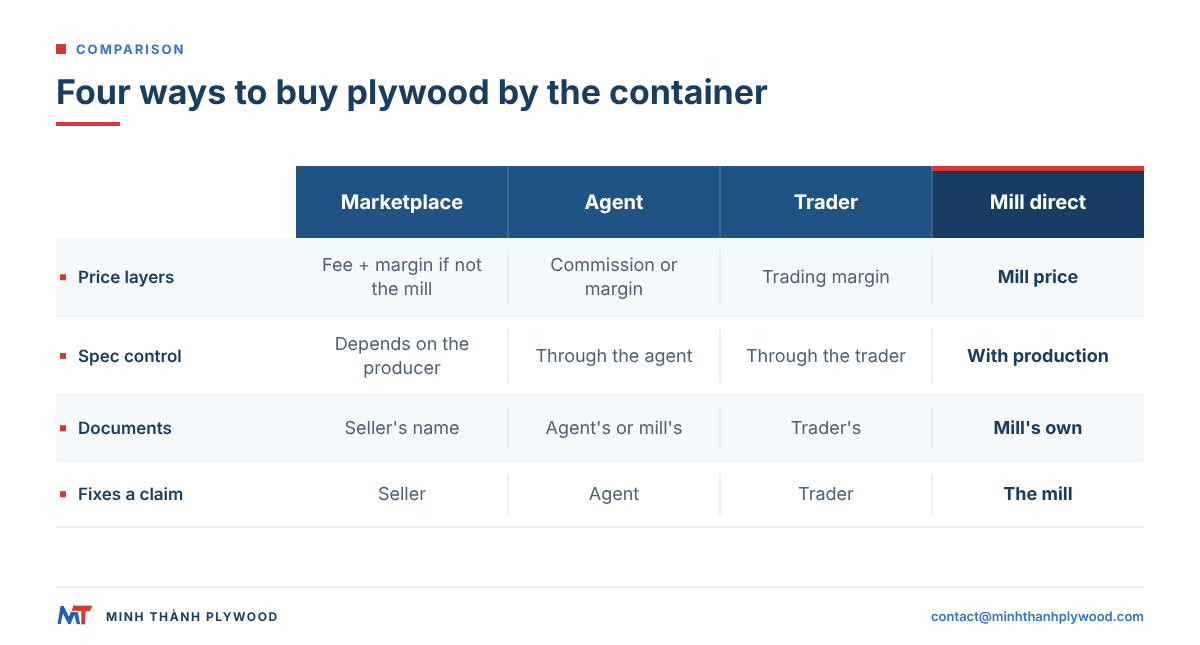
Marketplace timber offers and factory-direct offers can quote the same panel; the difference is in control, not in the wood. This table compares the channels on the points that matter for a container order:
| Point | Retail online | Marketplace seller | Sourcing agent | Trader | Mill direct |
|---|---|---|---|---|---|
| Typical order | Sheets, pallets | One container upwards | One container upwards | Mixed products | One 40HC upwards |
| Price layers | Retail margin, local stock | Platform fee, plus trader margin if the seller is not the mill | Commission or margin | Trading margin | Mill price |
| Specification control | Fixed builds | Depends on the real producer | Through the agent | Through the trader | Direct with production |
| Technical answers | General | Varies | Second-hand | Second-hand | From the people who press the panels |
| Documents | Local invoice | Seller’s name, not always the mill’s | Agent’s or mill’s | Trader’s | Mill’s own certificates and origin |
| Who fixes a claim | Retailer | Seller, through the platform | Agent | Trader | The mill |
The more layers, the more people who must pass your specification correctly. A missed line, such as the glue class or the core species, is the usual reason a container arrives “not as ordered”.
Plywood trading agency or sourcing agent: what does a broker in Vietnam actually do?
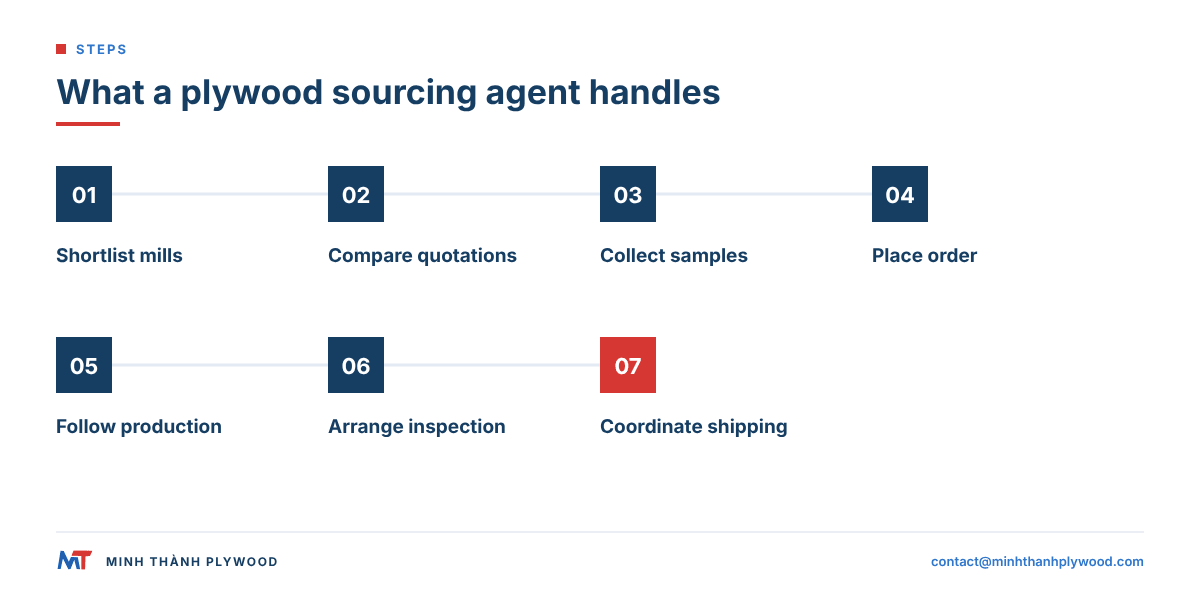
A plywood broker or sourcing agent in Vietnam finds mills, collects and compares quotes, places the order, follows production, books inspection and helps with shipping. A plywood trading agency does the same, or buys the panels and resells them under its own name.
The work, step by step:
- Shortlisting mills for the product and the market.
- Quoting the buyer’s specification at several mills.
- Sampling: collecting and sending samples.
- Ordering: placing the order, in the buyer’s name or its own.
- Follow-up: checking progress and production photos.
- Inspection: arranging a pre-shipment check.
- Shipping: coordinating booking, documents and payment.
Agents are paid by commission on the order or by a margin on the price. The fee is fair pay for real work when the buyer has no team in Vietnam. The cost to watch is not the fee itself but distance: questions about the core, the glue or a defect go through one more person before they reach the press.
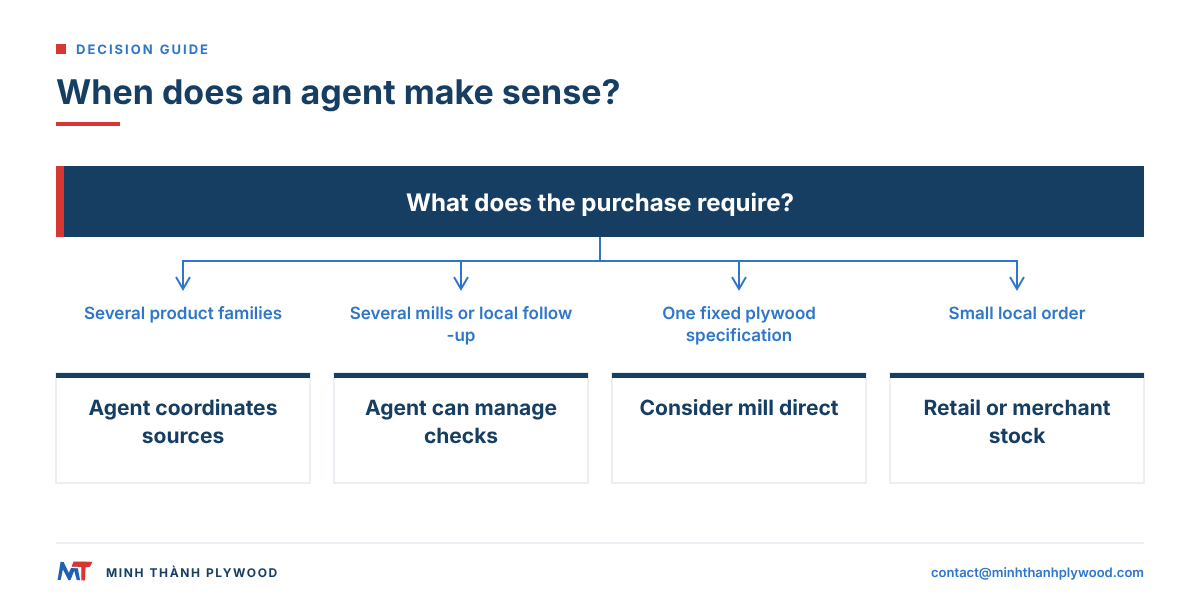
When is a sourcing agent worth the commission?
An agent pays for itself when the job is coordination across many sources, not when you buy one product from one mill. Typical cases:
- Many product families at once, such as plywood, MDF, hardware and furniture parts, from different factories.
- Several mills for one product, to split volume or compare.
- No buyer travel and no local staff, with a need for someone on the floor every week.
- First entry into a country, while you learn which mills fit.
An agent adds less when you already know your specification, buy one or two plywood products by the container, and the mill gives you production photos, loading video and its own documents. Then the mill can do directly what the agent would relay.
Plywood trader or manufacturer: what is the difference?
A manufacturer makes the panel; a trader buys it from a manufacturer and resells it. Both can be good partners, but they answer different questions.
A trader can combine panels from several mills in one offer and carry stock in some markets. A manufacturer controls the parts of the panel that decide its quality: the core veneer, the stitching, the glue, the pressing and the sanding. At Minh Thanh, for example, furniture-grade panels are pressed twice as standard, the core board first, then calibrated, then the face and back. That build step is what keeps a sanded panel within ±0.2–0.3 mm, down to ±0.2 mm.
Our article on telling a factory from a trading company goes deeper into the signs on a website and in a quote.
How can you verify a seller is the factory?
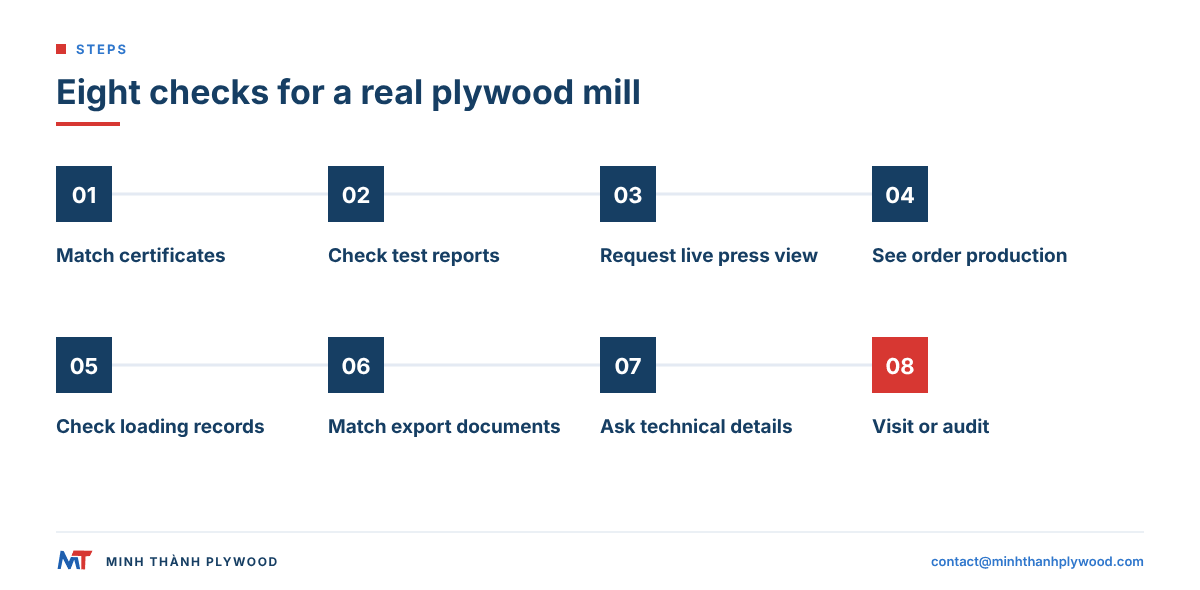
Verify a plywood seller by documents in its own name, live views of its own production, and answers only a producer gives. Eight checks cover most cases:
- Certificates in the seller’s name. A CARB P2 / TSCA Title VI certificate names the mill and covers the 0.05 ppm limit for veneer-core hardwood plywood under 40 CFR 770.10. Minh Thanh’s is ICTT mill no. 23024. ISO 9001 and product certificates should name the same company.
- Test reports with the lab’s report number, such as an ASTM D6007 chamber test, linked to the mill.
- A live video call from the press line, at a time you choose.
- Production photos and video of your own order, not catalogue images.
- Loading photos and video of your container, with your packs and labels.
- The exporter on the bill of lading and the certificate of origin, which should be the company you paid.
- Technical answers at once: core species, plies per thickness, glue class, pressing temperature, moisture.
- A factory visit or third-party audit, before a large or long-term order.
A mill passes these in a day. Our plywood factory audit checklist lists what to see on a visit.
What does it cost to buy through each channel?
Every channel adds its cost to the mill price, and the order of size is easy to read even without exact numbers: each layer between you and the press adds a margin, a commission or a fee.
- Retail online: the highest price per cubic metre, because local stock, small lots and delivery are included.
- Marketplace: the mill price plus any trader margin, and sometimes a platform fee.
- Sourcing agent: the mill price plus a commission or margin.
- Trader: the mill price plus a trading margin.
- Mill direct: the mill price. Minh Thanh’s indicative starting prices in October 2026 are from US$250/m³ for commercial plywood and from US$350/m³ for furniture and interior plywood, FOB Hai Phong.
To compare with the sheet prices above, convert the cubic-metre price to a sheet. An 18 mm sheet of 1220 × 2440 mm is 0.0536 m³ (1.22 × 2.44 × 0.018), so the mill prices work out to:
| Channel | 18 mm sheet, 1220 × 2440 mm | Basis |
|---|---|---|
| UK builder’s merchant (B&Q) | £15.97–35.80 | Retail, delivery £15 |
| Alibaba listings | US$4.98–26.90 | List price, depends on MOQ tier |
| Minh Thanh, commercial plywood | from US$13.40 | From US$250/m³, FOB Hai Phong |
| Minh Thanh, furniture plywood | from US$18.75 | From US$350/m³, FOB Hai Phong |
The mill price is a container price: freight, duty and VAT come on top, and the panel is the build you specified. The marketplace low end is not a like-for-like offer, and the retail price carries local stock and delivery.
The cheapest quote is not always the lowest cost. A panel that is thinner than ordered, or with a different core, costs more in rework than any price saving.
Which risks come with each channel?
The main risk in any channel is a gap between the specification you sent and the panel you receive. The causes differ by channel:
| Channel | Most common risk | How to reduce it |
|---|---|---|
| Retail online | Build not stated | Ask for the data sheet; buy one sheet first |
| Marketplace | Seller is not the producer | Run the factory checks; pay against documents |
| Agent | Specification passed on incompletely | Send the full spec sheet to the mill too |
| Trader | Mill changes between orders | Ask which mill made each lot |
| Mill direct | You manage freight and customs yourself | Use a forwarder and a customs broker |
The mistakes buyers make when importing plywood from Vietnam shows how these risks play out in practice.
How does buying direct from a Vietnamese mill work?
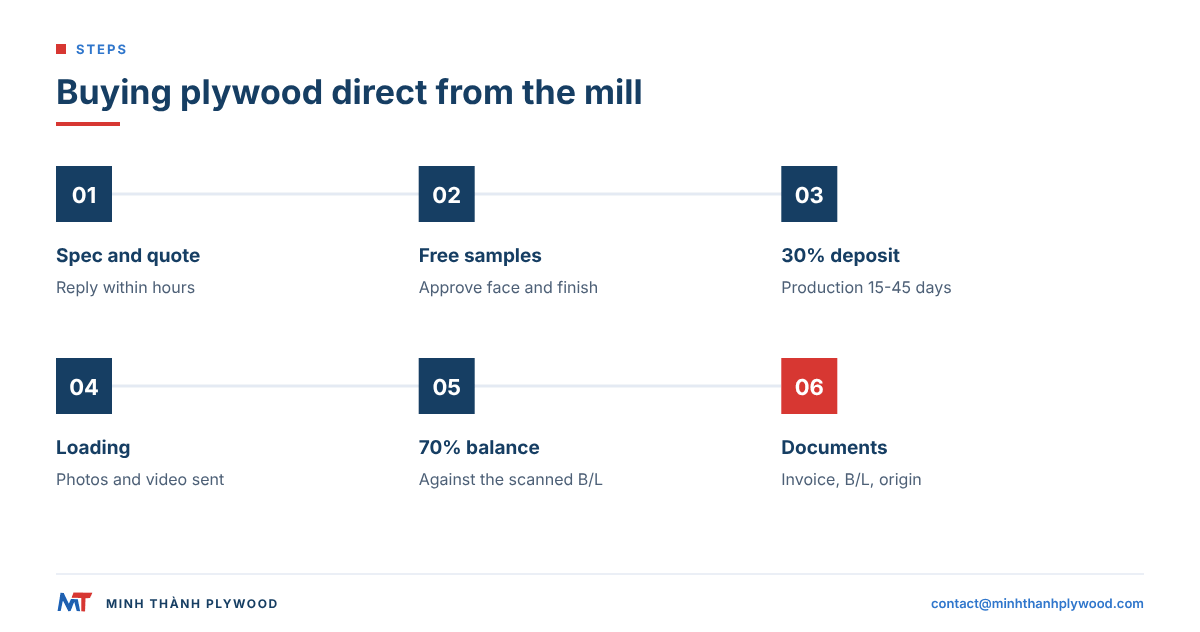
Buying direct from a Vietnamese mill follows a short, fixed path from specification to bill of lading. At Minh Thanh:
- Specification and quote: you send application, core, glue, face, size and quantity; we reply within hours.
- Free samples for approval; the approved sample sets face grade and finish.
- Proforma and 30% deposit.
- Production in 15–45 days after the deposit.
- Photos and video of your panels and your container before loading.
- Shipping: FOB Hai Phong, CFR or CIF.
- Balance of 70% against the scanned bill of lading, or an irrevocable L/C at sight.
- Documents: commercial invoice, packing list, bill of lading, certificate of origin and the certificate files your market needs.
The minimum order is one 40HC, with mixed specifications by agreement. Typical days at sea from Hai Phong run 5–12 to South-East Asia, 30–40 to Northern Europe and 20–30 to the US West Coast.
What should you send a mill to order plywood direct?
To order plywood direct, send the specification lines a mill needs to quote one panel exactly:
- Application: furniture, cabinets, interior, packing, construction.
- Core: Styrax or Eucalyptus for furniture panels.
- Glue and emission: UF glue at E0 emission, MR or phenolic (WBP).
- Face and grade: poplar A/B, birch D+/D, EV, okoume or pine.
- Thickness and size: 3–40 mm; 1220 × 2440 mm, 1250 × 2500 mm or custom.
- Packing and quantity: packs, labels, container count.
- Destination port and the documents your customs asks for.
Our plywood RFQ checklist has a full template. Send your lines to contact@minhthanhplywood.com, or ask for free samples first.
Buyer questions, answered
Is it safe to buy plywood on Alibaba?
It can be, if you check that the seller is the producer, pay against shipping documents and inspect before loading. A listing alone does not show who makes the panels, so ask for the certificates in the mill's own name and a live video of the press line.
What does a plywood broker in Vietnam actually do?
A broker or sourcing agent finds mills, collects quotes, places the order in the buyer's name or its own, follows production and arranges inspection and shipping. It is paid by commission or by a margin on the price.
Is it cheaper to buy plywood direct from the factory?
For a full container of a defined specification, usually yes, because no trading margin or commission sits between you and the mill. An agent can still pay its fee where you need local follow-up the mill does not give.
How can I tell if a plywood supplier is a real factory?
Ask for certificates issued in the supplier's own name, such as a CARB P2 / TSCA Title VI mill number, a live video call from the press line and loading photos of real shipments. A factory answers technical questions about cores, glue and pressing at once.
Can I order plywood online in small quantities?
Yes, from retail and builder's merchant websites, by the sheet or the pallet. Export mills sell by the container: Minh Thanh's minimum order is one 40HC with mixed specifications by agreement.
What is the minimum order for plywood from a Vietnamese mill?
Usually one container. At Minh Thanh the minimum is one 40HC, and one container can carry mixed specifications by agreement.
How do I pay a plywood mill safely?
Use terms tied to shipping documents: Minh Thanh works with a 30% deposit and the 70% balance against the scanned bill of lading, or an irrevocable letter of credit at sight.
Do I need an agent to import plywood from Vietnam?
No. Most container buyers order direct and use a forwarder for freight and a customs broker at home. An agent helps when you buy from several mills or several product families at once and want one local office to manage them.
Can a mill send samples before I order?
Yes. Minh Thanh sends free samples, and the approved sample sets the face grade and finish for production.
What is a plywood trading agency?
A company that buys plywood from mills and resells it, or arranges sales for a commission, without making the panels. It can combine products from several mills in one offer.