
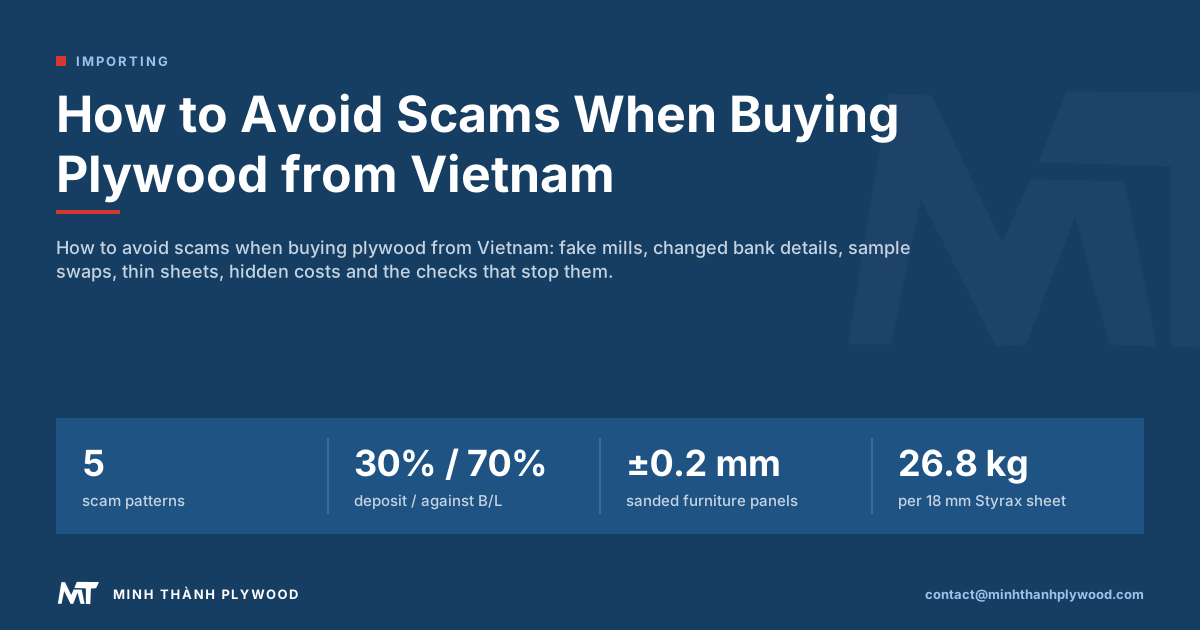
Most plywood scams in Vietnam follow five patterns: a fake mill, changed bank details, a swapped sample, thin or short sheets, and a price that hides a lower-cost build. Each one has a check that stops it before you pay. This guide lists the patterns, the hidden costs that turn a low-cost quote into an expensive container, and the steps Minh Thanh Plywood, a manufacturer in Phu Tho, walks new buyers through.
How to avoid scams when buying plywood from Vietnam: the short answer
How to avoid scams when buying plywood from Vietnam comes down to checking the company before the deposit, controlling where the money goes, and tying the goods to a written sample before the balance. Ten steps cover nearly every case we see.
- Verify the company on Vietnam’s national business registry and its tax code on the tax portal.
- See the factory on a live video call, from the veneer yard to the press and the packing line.
- Match the names: contract, proforma invoice, certificates and bank account must all carry the same company.
- Confirm bank details by phone on a number you already hold, and treat any change of account as a stop signal.
- Write the build into the contract: core species, ply count, glue and emission class, face and back grades, thickness tolerance, moisture and packing.
- Keep a signed piece of the approved sample and name it in the contract.
- Pay a deposit, not the whole order: 30% to start production, 70% against the bill of lading, or an irrevocable letter of credit at sight.
- Inspect before loading with your own inspector or a third party, against the sample and the specification.
- Budget every cost to your door, including destination charges, duties and the time a container waits.
- Check on arrival and send a documented claim at once if anything is wrong.
The rest of this guide explains each scam pattern, the hidden costs that surprise new importers, and the checks that stop them.
What scams do plywood buyers meet in Vietnam?
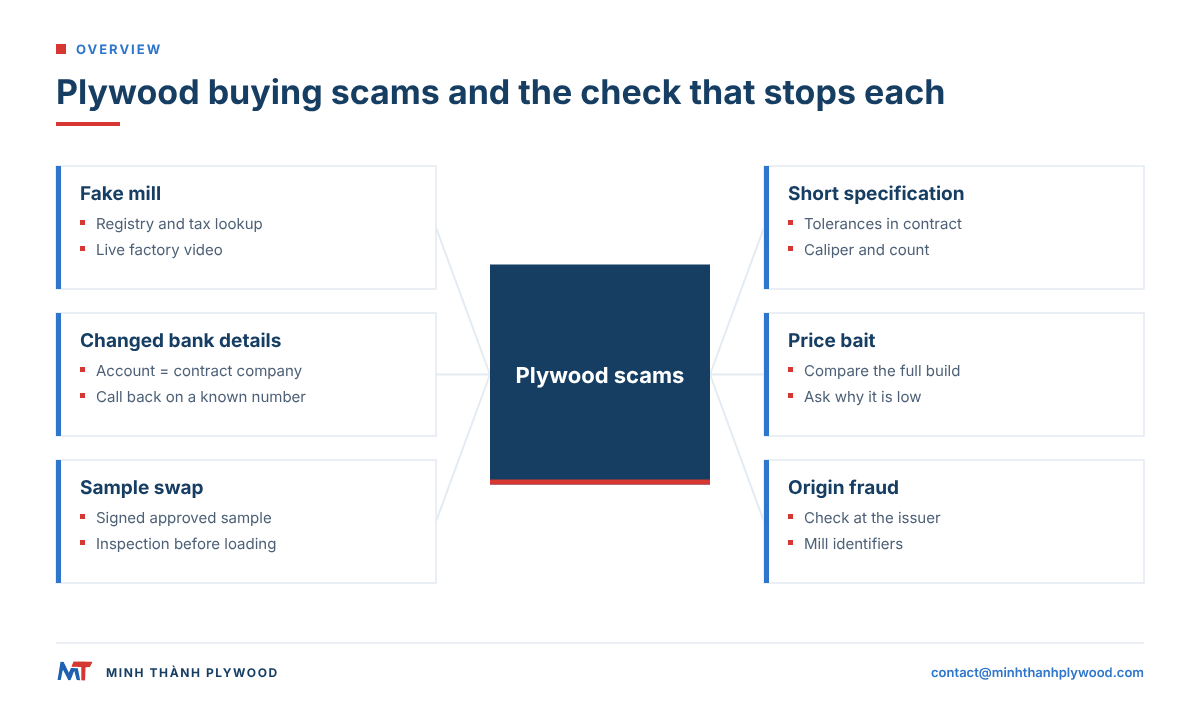
Five patterns account for most losses, and a sixth, origin fraud, matters wherever trade measures apply. Each has a simple check. The table below lists them with what they look like and what stops them.
| Scam pattern | What it looks like | The check that stops it |
|---|---|---|
| Fake mill | A website, a marketplace shop or a trader that calls itself a factory | Registry and tax lookup, live factory video, name match on all documents |
| Changed bank details | An email, often from a look-alike address, asking you to pay a “new” account | Account holder must equal the contract company; call back on a known number |
| Sample swap | A perfect sample, then production with a weaker core, glue or face | Signed retained sample, written specification, inspection before loading |
| Short specification | Sheets thinner than ordered, short sizes, fewer sheets per pack | Tolerances in the contract; caliper, tape and count at inspection and arrival |
| Price bait | A quote far below the market for the “same” panel | Compare the full written build; ask why the price is low |
| Origin and paperwork fraud | Panels from another country sold as Vietnamese, or invented certificates | Certificates checked at the issuer; mill identifiers on the documents |
None of these needs special skill to detect. They work because a buyer is in a hurry, trusts a good sample, or pays before checking the account.
Who carries out these scams?
Most scams come from three kinds of seller. Some are not in the plywood business at all and only want the deposit. Others are real traders who claim to be the factory to win the order, then buy whatever is lowest-cost. Occasionally a real mill changes the build after the first container, once the buyer stops checking.
The checks differ for each. Registry, video and bank checks stop the first group. Name matching and direct questions about the mill stop the second. A written specification, a retained sample and inspection on every container stop the third.
Fake mills: how does a trader or a website pose as a factory?
A fake mill borrows a real factory’s photos, certificates or name, and sells under them. The aim may be to take a deposit and disappear, or to win an order at a factory price and then buy from any mill.
The usual signs:
- Photos without people or detail: wide shots of a press line that also appear on other websites, no close views of the yard, the dryer or the packing.
- Certificates in another company’s name, or with the company name cropped out.
- A city-centre address with no production branch, while the website talks about “our factory”.
- Every product at once: plywood, MDF, flooring, doors and furniture, all “made in our plant”.
- Pressure to pay quickly, with a discount that expires within a day or two.
- Free email accounts or a domain registered only weeks ago.
A real factory does not mind showing itself. It knows its press count, its core species and its packing method, and it can switch on a camera in the production hall during working hours.
How does a live video call prove a factory?
Ask for a call during Vietnamese working hours and say what you want to see, in order. A walk from the log or veneer yard through drying, core lay-up, pressing, sanding, grading and packing takes about twenty minutes. Ask the person holding the phone to show today’s production, a pack label and the edge of a sheet you name.
A trader can show a mill, but it will struggle to answer detail questions on the spot. Ask who runs the press, what core is on the line today, and how many sheets go in a pack of 18 mm. Our answer is 55 sheets, about a metre high.
How do you verify that a Vietnamese plywood company exists?
Two free public portals confirm that a company exists, what it is called and whether it is active. Together they take about fifteen minutes and should come before any deposit.
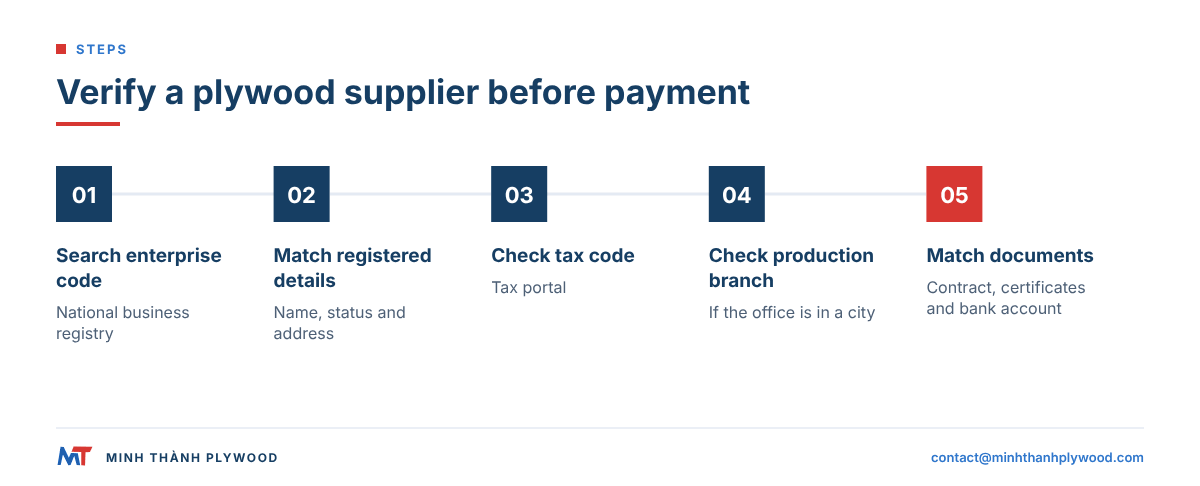
- Open the National Business Registration Portal at dangkykinhdoanh.gov.vn and search by the enterprise code, which is the most reliable key.
- Note the registered name, code, status and head-office address, and compare them with the contract and proforma invoice.
- Check the same code on the tax portal at tracuunnt.gdt.gov.vn: in Vietnam the enterprise code is also the tax code.
- Look for a production branch if the head office is in a city; a factory in a province is often registered as a branch with its own code.
- Match the names on certificates, test reports and the bank account to the registered company.
A company that does not appear, appears under a different name, or shows a suspended code ends the conversation. A company that exists is not proven honest, but it can now be held to its documents.
Our guide on telling a factory from a trading company shows each portal screen and the business lines that point to a mill.
What do the business lines tell you?
A plywood factory registers the manufacture of veneer sheets and plywood among its lines and usually has a production address in a wood-processing area. A trader registers wholesale lines. Neither is wrong, but a company that registers only wholesale and still calls itself a factory has already told you something untrue.
Changed bank details: how does payment fraud work, and how do you stop it?
Payment fraud is hard to reverse because the money goes to a third party, and neither the buyer nor the real supplier gets it back easily. It usually starts with a compromised or imitated email account, not with the supplier.
The pattern is the same every time:
- The fraudster reads or imitates the mail thread between buyer and supplier, often for weeks.
- At payment time, a message arrives from the supplier’s address or a near copy, with one letter changed or a different domain ending.
- It gives a reason for a new account: an audit, a tax issue, a bank change, a currency problem.
- The new account is abroad or in another name, sometimes in a country the supplier has no link to.
- The buyer pays, and the real supplier asks for payment a few days later.
The supplier’s own systems may be secure. A look-alike domain is enough when nobody checks.
Which rules stop payment fraud?
Five rules stop almost every case, and they cost nothing.
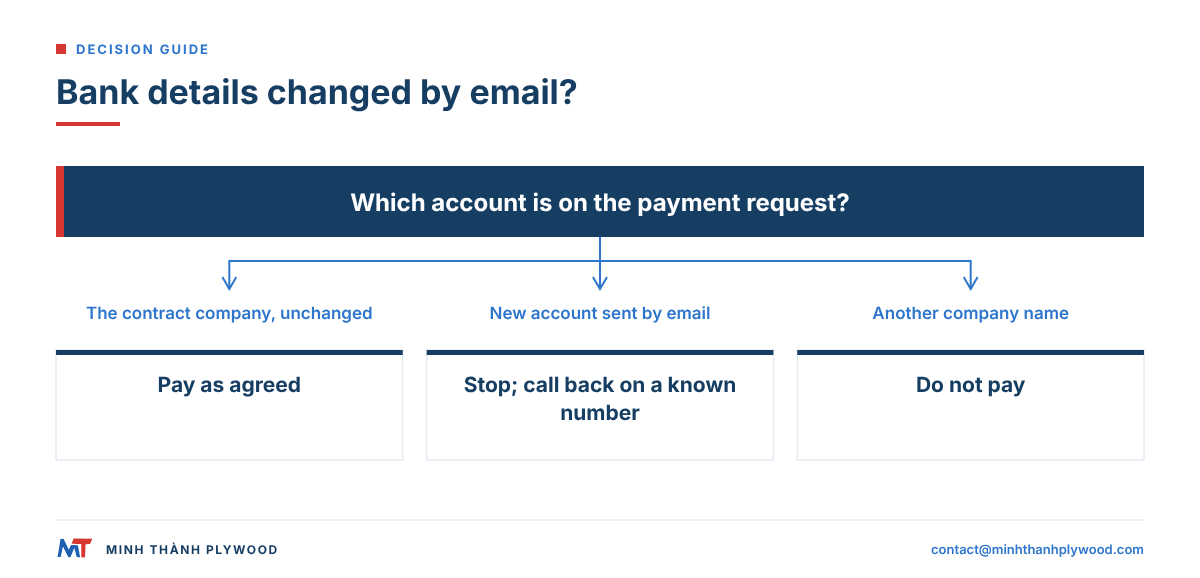
- The account holder must be the contracting company, the same name as on the registry, the contract and the invoice. A personal account or a different company is a stop signal.
- Bank details live in the contract or the first signed proforma invoice, and do not change during an order.
- Any change is confirmed by phone, using a number you had before the change request. Never call a number given in the email that asks for the change.
- Read the sender address in full, not the display name.
- Send a small test payment first on a new account, and confirm receipt by phone before the main transfer.
Our bank account is in the name of the company that signs your contract, and it is printed on the proforma invoice. We will never ask you to pay a different account by email.
What if you have already paid the wrong account?
Call your bank at once and ask it to recall the transfer; the first hours matter most. Then tell the real supplier and report the fraud to the police in your country. Keep the emails with their full headers, because the bank and the police will need them.
Check who is asking, too. Some brokers and trading-company staff quote under a mill’s name from a Gmail or other personal address, using the mill’s own documents. A real mill quotes and takes deposits from its company domain; Minh Thanh Plywood uses only [email protected] for quotations, orders and deposits.
Is a 30% deposit safe, and which payment terms protect you?
A 30% deposit with the 70% balance against the bill of lading is the normal term for a new buyer, and it shares the risk fairly. The mill buys veneer and glue with the deposit; you pay the balance only when the goods are loaded and shipped.
| Payment term | How it works | Risk for the buyer | Risk for the mill | When to use it |
|---|---|---|---|---|
| Full payment in advance | Whole order paid before production | Highest: nothing left to hold back | Lowest | Avoid with a new supplier |
| 30% deposit, 70% against copy B/L | Balance paid when the scanned bill of lading shows the goods are on board | Moderate: deposit at risk until loading | Moderate | Standard first and repeat orders |
| 30% deposit, 70% before loading after inspection | Balance paid after a passed pre-shipment inspection | Lower | Higher | When you inspect every container |
| Irrevocable L/C at sight | Bank pays when compliant documents are presented | Low if the L/C is written well | Low | Larger orders, new relationships |
| Open account | Payment after arrival | Lowest | Highest | Long relationships only |
The term matters less than two habits: the deposit goes only to the contracting manufacturer’s own account, and the balance is tied to a document or an inspection, never to a promise.
How do you write a letter of credit that protects you?
An L/C protects a buyer only when it names the documents that prove the right goods were shipped. List the commercial invoice, packing list, bill of lading and certificate of origin, plus an inspection certificate from an inspector you choose. Describe the goods by the contract specification. A vague L/C pays against vague documents.
Sample swap: how is a good sample used to sell a weaker panel?
In a sample swap, the buyer approves a sample made with care, often from a better core or a higher face grade, and the production order is made to a lower-cost build. The sheets look similar on the face; the difference sits in the core, the glue or the grade.
What changes most often between sample and production:
- Core species: a lighter, lower-cost core instead of the one in the sample.
- Ply count: fewer, thicker core veneers, which hide gaps more easily and weaken screw holding.
- Glue: a lower-grade or lower-dose resin, which shows up later as delamination or a higher emission result.
- Face grade: more patches, splits or colour variation than the approved face.
- Thickness: production calibrated at the bottom of the tolerance, or below it.
A swap is easy to catch when the sample is tied to the contract, and almost impossible to argue when it is not.
How do you lock the sample to the order?
Treat the approved sample as part of the contract, not as a reference picture.
- Ask for two identical pieces, cut from the same sheet, with the edge and both faces visible.
- Sign and date both, keep one, and send one back to the mill or hand it to your inspector.
- Write the build into the contract: core species, ply count, glue type and emission class, face and back grades, thickness and tolerance, moisture and size.
- Refer to the sample by its label in the contract: “production to match approved sample MT-xx dated …”.
- Have the inspector cut or measure production sheets against the retained piece before loading.
We ship free samples on request, and the approved sample fixes the grade for production and for every later order on the same build.
Under-thickness and short sizes: how are buyers short-changed on spec?
Under-thickness is the most common quiet loss. A panel sold as 18 mm that measures 17 mm saves the seller a ply of veneer and some glue on every sheet, and the buyer may not notice until a CNC programme or a hinge cup goes wrong.
The tricks are simple:
- Nominal versus actual: the quote says 18 mm, the contract says nothing about tolerance, and the sheets arrive at 17 mm.
- Tolerance at one end only: every sheet at the lowest edge of the tolerance, never in the middle.
- Short sizes: 1220 × 2440 mm quoted, sheets a few millimetres short on length or width.
- Short packs: fewer sheets per pack than the packing list says.
Our sanded furniture panels are calibrated to ±0.2–0.3 mm and down to ±0.2 mm, commercial and film-faced panels to ±0.5 mm, and length and width to ±2 mm. Write the tolerance you need into the contract, or you have nothing to hold a seller to.
How do you measure thickness correctly?
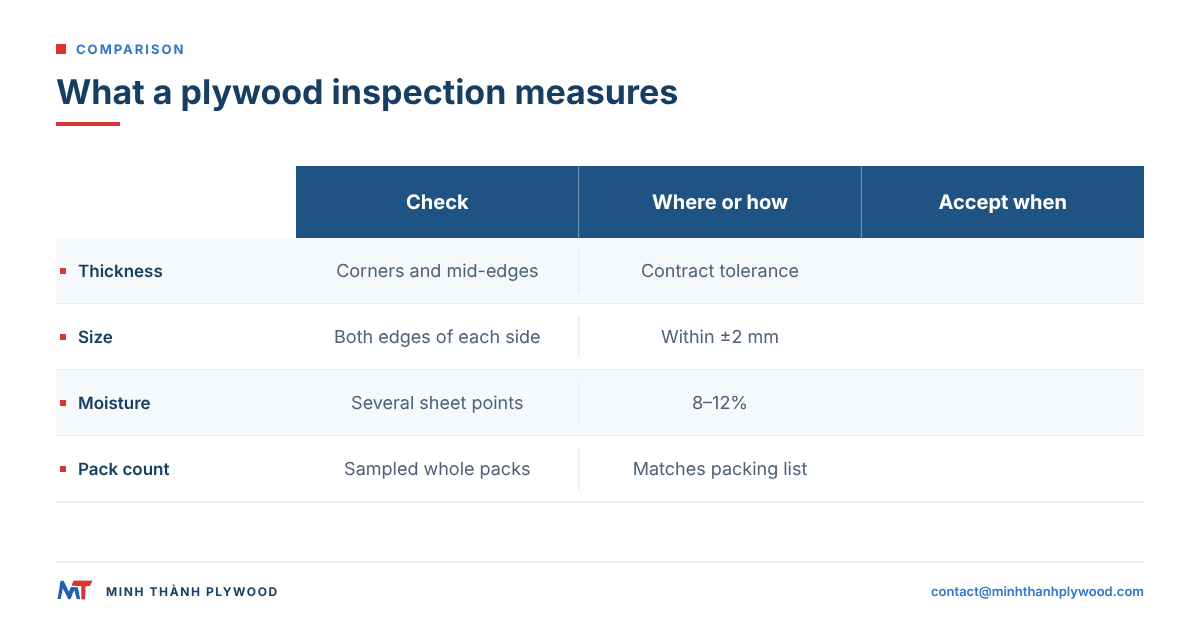
Measure each sample sheet with a caliper at the four corners and the centre of each long edge, at least a hand’s width in from the edge. Record every reading. Look at the spread as well as the average: wide variation within one sheet points to poor core calibration, even when the average is right.
| Check | Tool | Where to measure | What a good result looks like |
|---|---|---|---|
| Thickness | Digital caliper | Four corners and mid-edges, in from the edge | Every reading within the contract tolerance |
| Length and width | Steel tape | Both edges of each side | Within ±2 mm of the nominal size |
| Squareness | Tape across both diagonals | Corner to corner | Diagonals equal within the agreed limit |
| Sheet count | Hand count of sampled packs | Whole pack | Equals the packing list |
| Moisture | Pin or pinless meter | Several points per sheet | Within 8–12% |
Core substitution and mixed cores: what happens inside the sheet?
Core substitution means the panel’s inner veneers are a lower-cost or weaker species than the one agreed, or a mix of species. It is hard to see from the face and easy to see from the edge, if you look.
The core decides weight, screw holding, flatness and how the panel machines. A furniture plant that ordered a light, even core and receives a heavier or mixed one will see it in CNC tooling, edge banding and finishing.
Weight is a fast first check. An 18 mm sheet of 1220 × 2440 mm on a Styrax core weighs about 26.8 kg; an acacia core about 31.1 kg; a eucalyptus core about 34.8 kg. A batch that weighs clearly more or less than the agreed core suggests a different build, and an inspector should cut a sheet.
How do you check the core on site?
- Read the edge: count the plies, look for gaps and overlaps, and compare the colour with the retained sample.
- Weigh several sheets and compare with the expected weight for the core and thickness.
- Cut one sheet across its width when the edge or weight looks wrong; a cut shows core gaps that an edge can hide.
- Check ply count against the contract: our 18 mm furniture panels are built with 11–13 plies depending on the build.
A mill that is confident in its core will cut a sheet for you on a video call without hesitation.
Glue, emission and certificates: how are buyers misled on paper?
Glue and emission claims are the easiest to invent, because the buyer sees a document, not the glue. The usual tricks are a certificate in another mill’s name, an expired certificate, a certificate for a different product, or a vague claim such as “E0 glue” with no test behind it.
Glue type and emission class are two different specifications. Furniture plywood uses UF glue at E0 emission; a panel can use the right resin and still fail an emission test if the dose or pressing is wrong. Ask for both in writing.
What to check on any certificate:
- The holder’s name and identifier match the company on your contract.
- The scope covers the product you are buying, such as hardwood plywood with a veneer core.
- The dates are current.
- The certificate can be checked at the issuer or the official register.
For the United States, composite wood products need certification under CARB Phase 2 and the EPA’s TSCA Title VI formaldehyde standards. Our panels are certified CARB P2 / TSCA Title VI as ICTT mill no. 23024. Our quality system is ISO 9001 certified (certificate KAC25/0185), and our TCVN conformity is certified by VietCert (141.1-VNC-HC).
Which test results should you ask for?
Ask for a recent chamber result for the product line, not a generic one. Our six ASTM D6007 chamber tests ran from April 2025 to June 2026 on 9, 15 and 18 mm panels, three by Shanghai Hongjun and three by ICTT Vietnam. They averaged 0.014–0.032 ppm against the 0.05 ppm CARB Phase 2 / TSCA Title VI limit. For the EU, the REACH formaldehyde restriction applies to furniture and wood-based articles from 6 August 2026 under Regulation (EU) 2023/1464; ask for a test to the method your market uses, and do not convert a ppm result into another unit.
FSC and CE are available* for the panels that need them.
*Supplied directly or through qualified partner mills.
Prices far below the market: what does a low quote hide?
A quote far below the market for the same written build rarely means a better deal. It usually means a different build, a short count, or a seller who does not plan to ship at all.
Plywood prices follow the cost of veneer, glue and pressing, and those costs are similar across mills in the same region. When one offer is much lower, ask what is different, in writing. Typical answers, when a seller is honest, are a lower-cost core, fewer plies, a lower face grade, a thinner actual thickness or a looser tolerance.
| What the low quote changes | How it saves money | How you see it |
|---|---|---|
| Core species | Lower-cost, lighter or mixed veneers | Weight, edge colour, a cut sheet |
| Ply count | Fewer, thicker veneers | Edge count against the contract |
| Glue | Lower-grade resin or less of it | Boil or soak test, emission test |
| Face grade | More patches and defects | Face against the retained sample |
| Actual thickness | Less veneer per sheet | Caliper readings |
| Packing | Fewer sheets per pack, weaker protection | Count, pack condition on arrival |
Our prices start from US$350/m³ for furniture plywood and US$250/m³ for commercial plywood, as of October 2026. A written quote states the build it covers, so two offers can be compared line by line.
Our guide on comparing plywood quotations walks through that comparison.
Origin fraud and transshipment: who really made the panel?
Origin fraud means panels made, or partly made, in another country and sold as Vietnamese. It matters because trade measures and buyers’ own sourcing rules depend on where a panel was actually produced.
Two examples show the risk. The EU applies anti-dumping duties to hardwood plywood from China under Regulation (EU) 2025/2333. In the United States, the 2023 circumvention rulings in cases A-570-051 and C-570-052 treat panels finished in Vietnam with Chinese core components (core platforms or core veneers, with or without Chinese faces) as Chinese for duty purposes, and other Vietnamese panels need importer and exporter certifications.
A buyer who imports relabelled panels can face the duties, the penalties and the delay, whatever the seller promised. The protection is to buy from a mill that makes its own core and can show it.
How do you confirm the origin of the panel?
- See the core being made: veneer peeling or drying, core lay-up and pressing on site.
- Ask where the face veneer comes from: imported birch or okoume faces are normal, but they should be stated.
- Check the certificate of origin is issued for the exporting company and the goods on your invoice.
- For the EU from 30 December 2026 (large and medium operators, and micro and small operators already under the EUTR; other micro and small operators from 30 June 2027), the EUDR needs geolocation of the plots where the wood was produced; a mill that buys and mixes panels from unknown sources will struggle to provide it. Vietnam is classed as low risk under Implementing Regulation (EU) 2025/1093, which allows simplified due diligence only when every commodity in the product comes from low-risk countries; it does not remove due diligence.
What hidden costs catch plywood importers?
Hidden costs are the second way a low-priced container turns expensive, and many of them are legal charges that a new importer simply did not budget. A few are padding by a forwarder or a seller.
| Cost | Who usually pays | When it surprises buyers | How to control it |
|---|---|---|---|
| Destination terminal handling (THC) | Buyer, under FOB and CIF | Buyers who think CIF means “to my door” | Ask your forwarder for a full destination quote before ordering |
| Delivery order and document fees | Buyer | Charged by the carrier’s agent on release | Include in the forwarder’s quote |
| Customs clearance and broker fee | Buyer | First import, new HS classification | Agree the HS code and broker fee in advance |
| Import duty and VAT | Buyer | Wrong code, missing certificate of origin | Classify the product before ordering |
| Demurrage and detention | Buyer | Container waits at port or at the warehouse | Have documents and payment ready before arrival |
| Fumigation and phytosanitary papers | Buyer or as agreed | Required by some importing countries for the shipment | Ask which items the treatment covers; solid-wood packing is inside ISPM 15 |
| Pre-shipment inspection | Buyer, usually | Added late as a “requirement” | Book your own inspector and agree it in the contract |
| Re-grading and sorting | Buyer, unless claimed | Goods do not match the sample | Inspect before loading; claim with evidence |
| Bank charges | Shared or buyer | L/C fees and intermediary bank fees | Agree who pays which charges in the contract |
| Inland haulage | Buyer | Port far from the warehouse | Quote door delivery with the freight |
Ask the forwarder for an all-in landed cost per cubic metre before you compare suppliers. A small price difference between mills is often smaller than the difference between two forwarders.
What does a fumigation charge on a plywood shipment cover?
Plywood is made from veneers that have been dried and pressed with heat and glue, so it is outside ISPM 15, the international standard for wood packaging. Solid-wood pallets, battens and dunnage packed with the plywood are inside ISPM 15 and must be heat-treated or fumigated and marked. Some importing countries still ask for fumigation and phytosanitary certificates with the shipment, and mills supply them on request. Ask which items the treatment covers and what your port requires, so the charge matches a real requirement.
How do demurrage and detention add up?
Demurrage is charged while a full container stays in the port beyond the carrier’s free time; detention is charged while you keep the container outside the port. Both are charged per day and rise with time. The usual causes are late documents, an unpaid balance that blocks the original bill of lading, and a customs query. Paying the balance on time against the scanned B/L, and having the HS code agreed, avoids most of it.
Incoterms mistakes: what does FOB or CIF really cover?
Most cost disputes start with a misunderstood Incoterm. FOB, CFR and CIF all hand the risk to the buyer when the goods are loaded on board in Vietnam; they differ only in who books and pays the sea freight and insurance.
| Term | Mill arranges | Buyer arranges | Risk passes to buyer |
|---|---|---|---|
| FOB Hai Phong | Export clearance, loading on board | Sea freight, insurance, everything at destination | On board at the port of loading |
| CFR | FOB plus sea freight | Insurance, everything at destination | On board at the port of loading |
| CIF | CFR plus minimum insurance | Everything at destination | On board at the port of loading |
Three mistakes repeat:
- Thinking CIF includes destination charges. It does not: terminal handling, delivery order fees, customs and haulage at your end stay with you.
- Relying on minimum CIF insurance. It covers less than many buyers assume; ask for the cover you need, or insure yourself.
- Letting the seller’s forwarder control the bill of lading when you buy FOB. Book your own forwarder so the documents come to you.
We sell FOB Hai Phong, CFR or CIF, and we will quote whichever term your forwarder prefers.
Common mistakes in the specification and the contract
Most quality disputes trace back to a vague order, not to bad faith. A seller can only be held to what is written, and a short email saying “18 mm furniture plywood, good quality” holds nobody to anything.
What a plywood specification should state:
- Product and use: furniture, interior, packing, formwork.
- Size and thickness, with tolerances for each.
- Core species and ply count.
- Glue type and emission class, and the test method.
- Face and back species and grades, with the approved sample named.
- Moisture range, for example 8–12%.
- Packing: sheets per pack, pallet type, covers, edge protection, labels.
- Inspection: who inspects, when, against which sample, and what happens on failure.
- Payment, Incoterm and shipment window.
- Claim procedure: how quickly a claim must be raised and what evidence it needs.
Our RFQ checklist gives a template you can copy into your enquiry.
Which mistakes do importers make most often?
From the buyer’s side, the same mistakes recur across countries:
- Choosing by price alone, before the build is fixed.
- Skipping the sample stage, or approving a photo instead of a panel.
- Ordering too much on the first container: one 40HC is the usual first order.
- Packing a container beyond its limit: an overfilled container can break pack bases and leave the receiver unloading by hand.
- Leaving packing unspecified, so packs arrive without edge protection.
- Treating every order as new, changing supplier on each container and losing the history that makes claims easy.
How do you use inspection to catch a swap before loading?
A pre-shipment inspection is the last point where a problem costs only time. Once the container is sealed and the balance paid, every correction becomes a claim.
- Book the inspector before production ends, and send them the contract specification and a copy of the approved sample label.
- Agree the sampling plan: how many packs to open, how many sheets per pack to measure.
- Check thickness, size and squareness with caliper and tape on every sampled sheet.
- Check moisture on several points per sheet.
- Compare faces and edges with the retained sample: grade, colour, core and ply count.
- Cut or soak a sheet if the glue or core is in doubt.
- Count sheets in sampled packs against the packing list.
- Photograph pack labels and the loading, and record the seal number.
- Release the balance only on a passed report, or on the scanned B/L if that is your term.
We welcome third-party inspectors in the factory and at loading. Our guide on moving from a trial order to long-term supply explains how to set up inspection for repeat containers.
What should you check when the container arrives?
The arrival check confirms that what left the mill is what reached you, and it collects the evidence for any claim. Do it before the goods are mixed with stock.
- Photograph the seal before it is cut, and compare its number with the bill of lading.
- Photograph the doors opening and the load before anything moves.
- Check pack condition: broken bases, torn covers, wet patches.
- Read pack labels against the packing list.
- Count and measure sheets from several packs, as at inspection.
- Check moisture and flatness on sheets from the top, middle and bottom of a pack.
- Record faults by pack and sheet, with photos that show a ruler or caliper.
| Finding | Likely cause | Evidence to keep |
|---|---|---|
| Wet or stained packs | Water entry in transit or storage | Photos of seal, doors, pack covers; moisture readings |
| Warped sheets | Uneven packing, moisture change | Photos with a straight edge; moisture readings |
| Thin sheets | Calibration or build | Caliper readings by sheet and pack |
| Core gaps or delamination | Lay-up or glue | Edge photos, a cut or soaked sample |
| Face grade below sample | Grading | Side-by-side photos with the retained sample |
| Short count | Packing | Pack count against packing list |
How do you make a quality claim if something goes wrong?
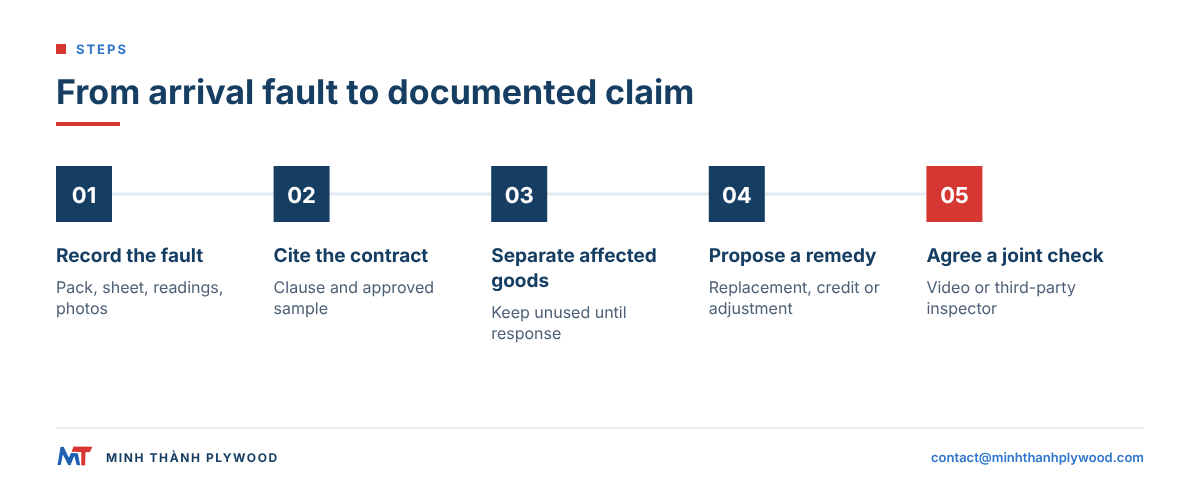
A claim succeeds when it is fast, specific and backed by the contract. Write it as soon as the arrival check shows a problem, and send the evidence with it.
- State the fault by pack and sheet, with the readings and photos.
- Quote the contract clause and the approved sample the goods fail.
- Hold the affected goods separately, unused, until the supplier answers.
- Propose a remedy: replacement, credit on the next container, or a price adjustment for sorted goods.
- Agree a joint check by video or a third-party inspector if the supplier disputes the facts.
A supplier who answers a documented claim quickly is worth keeping, even after a fault. One who disputes every reading, or stops replying once the balance is paid, has shown you what the next container would bring.
Our guide on plywood quality claims covers the evidence, the remedies and how to write the claim clause before you order.
Red flags: which warning signs should stop an order?
Some signs are enough on their own to stop an order until they are explained. Others are weaker and only count together.
| Warning sign | Strength | What to do |
|---|---|---|
| Request to pay a personal account or a different company | Stop | Do not pay; call the supplier on a known number |
| Bank details changed by email | Stop | Confirm by phone on a number you already hold |
| Company not on the registry, or a different name | Stop | End the conversation |
| Refuses a live factory video | Stop | Ask why; treat as a trader at best |
| Certificates in another company’s name | Strong | Ask which mill holds them and verify at the issuer |
| Price far below others for the same written build | Strong | Ask what is different, in writing |
| Will not put tolerances or build in the contract | Strong | Do not order until it does |
| Demands full payment before production | Strong | Offer a deposit and B/L balance, or an L/C |
| Pressure to decide within hours | Medium | Slow down; scammers depend on haste |
| Free email address only | Medium | Ask for a company domain and check it |
| Every product type “made in our factory” | Medium | Ask which mill makes each line |
Two medium signs together deserve the same care as one strong sign.
How does Minh Thanh Plywood work with new buyers?
We are a manufacturer in Ha Hoa, Phu Tho, built for top-grade furniture and interior plywood with Europe as our main market. Our capacity is 50,000+ m³ a year, and we press our own cores.
What a new buyer can expect from us:
- Free samples on request; the approved sample fixes the grade.
- A live video walk through the factory on request, during working hours.
- One company on every document: the contract, the proforma invoice, the certificates and the bank account.
- Minimum order of one 40HC, with several specifications on one container by agreement.
- Production in 15–45 days after the 30% deposit; the 70% balance against the scanned B/L, or an irrevocable L/C at sight.
- FOB Hai Phong, CFR or CIF.
- Third-party inspection welcome before loading.
- Written specifications: core, ply count, UF glue at E0 emission or the glue your market needs, face grade, tolerances, moisture and packing.
A typical first container of 18 mm furniture panels, 1220 × 2440 mm on a Styrax core, holds 990 sheets in packs of 55 sheets, about 53 m³ within a 28,000 kg payload.
If you are comparing suppliers, our guide on how to choose a plywood supplier in Vietnam lists the questions to ask each one, and the furniture plywood page shows the builds we make. Send us your specification and we will reply with a written quote and a sample plan.
Buyer questions, answered
How do I avoid plywood scams when importing from Vietnam?
Verify the company on the national business registry and the tax portal, and see the factory on a live video. Pay only to a bank account in the contract company's name, and confirm bank details by phone on a number you already hold. Inspect the goods against the approved sample before the balance is paid.
What are the most common plywood import scams in Vietnam?
A trader or a website posing as a factory, an email with changed bank details, a good sample followed by a weaker production panel, sheets thinner or shorter than ordered, and a price far below the market that hides a lower-cost core or glue.
Is a 30% deposit safe when buying plywood from Vietnam?
A 30% deposit is the normal term for a new buyer and a fair one, provided you pay it to the contracting manufacturer's own account after checking the company. Keep the 70% balance tied to the bill of lading, or use an irrevocable letter of credit at sight.
What is the minimum order quantity when buying plywood from Vietnam?
Mills usually ship by the full container. At Minh Thanh Plywood the minimum is one 40HC, and several thicknesses or face grades can share it by agreement.
What is the difference between FOB and CIF when buying plywood from Vietnam?
Under FOB the mill delivers the goods on board at the Vietnamese port, and you book and pay the sea freight and insurance. Under CIF the mill books freight and insurance to your port; the risk still passes to you at loading, and destination charges remain yours either way.
What are common quality issues when importing plywood from Vietnam?
Core gaps and overlaps, thickness outside the agreed tolerance, delamination from weak glue or wet veneer, a face grade below the approved sample, moisture outside 8–12%, and warped sheets from poor packing or storage.
Do I need fumigation for plywood from Vietnam?
Plywood itself is a processed wood product and falls outside ISPM 15. Solid-wood pallets, battens or dunnage packed with it are inside ISPM 15 and must be treated and marked, and some importing countries ask for fumigation and phytosanitary certificates with the shipment. Ask your broker what your port requires.
How do I check that a plywood supplier's bank account is genuine?
The account holder must be the same company that signs the contract and issues the invoice. Any change of account after the contract is a stop signal: call the supplier on a number from your earlier records, never one in the new email, before paying anything.
Can a plywood sample be different from the production?
It can if the sample is not tied to the contract. Keep a signed, labelled piece of the approved sample, write its core, glue, face grade and tolerances into the contract, and have the inspector compare production against it before loading.
How do I know if a very low plywood price from Vietnam is a scam?
Compare the full build, not the price: core species, ply count, glue and emission class, face grade, thickness tolerance and packing. A price far below others for the same written build usually means a different build, a short count or a supplier that does not intend to ship.
What hidden costs should I budget for when importing plywood?
Destination terminal handling, delivery order and document fees, customs clearance, duties and import VAT, inland haulage, demurrage and detention if the container waits, inspection fees, bank charges, and the cost of re-grading or sorting if the goods do not match.
What should I do if the plywood I received is not what I ordered?
Stop unloading where you can, photograph the seal, the doors, the pack labels and the faults, measure and count with the inspector or a witness, and send a written claim with the evidence to the supplier quickly. A claim backed by the approved sample and the contract specification is far easier to settle.