
Plywood quality standards differ by market but test the same four things: the glue bond, formaldehyde emission, structural strength and face appearance. ISO 12465 is the international reference; Europe uses EN 636, the US PS 1 and TSCA Title VI, India IS 303, China GB/T 9846. Minh Thanh Plywood maps each to the test a mill runs and the document a buyer should request.
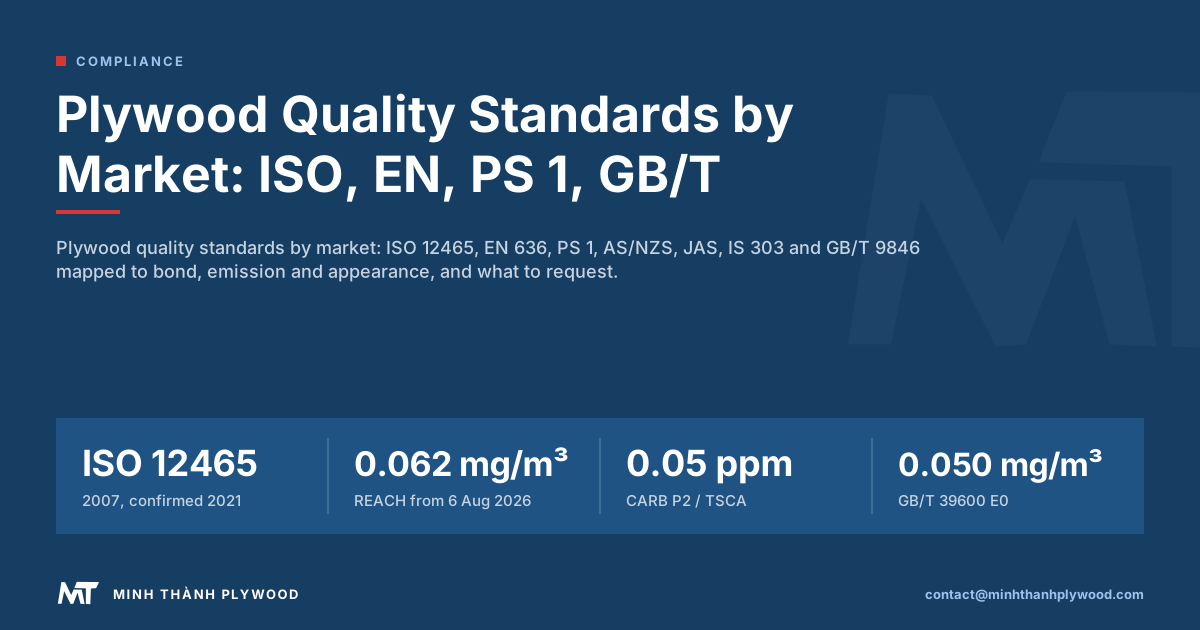
Plywood quality standards: the short answer
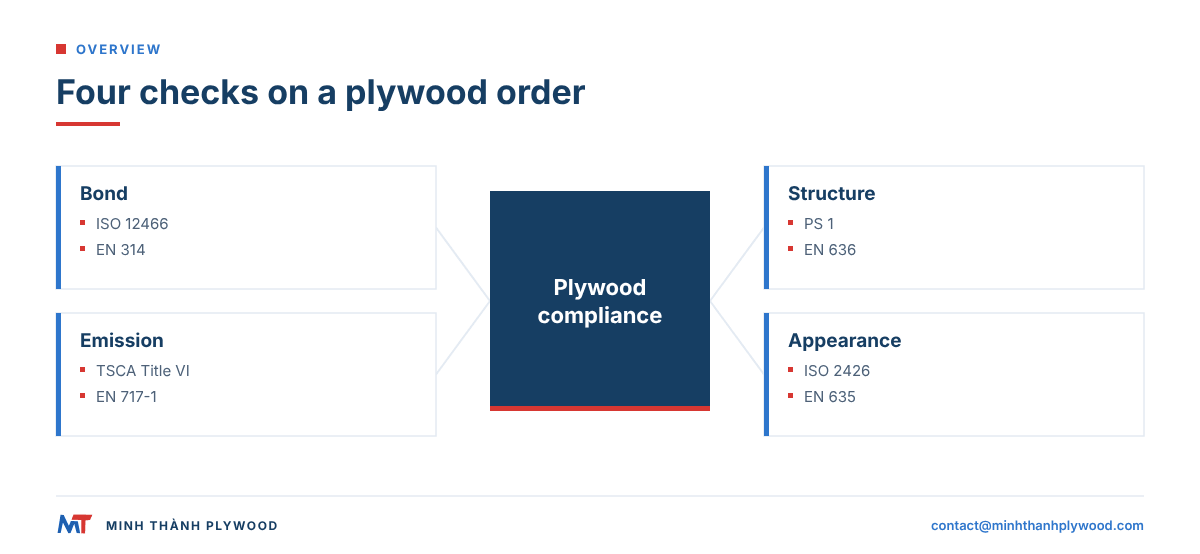
Plywood quality standards answer four questions in every market: does the glue bond survive the exposure, how much formaldehyde does the panel release, how strong is it, and what does the face look like. The names change by market; the four questions do not.
- Bond: ISO 12466, EN 314, the PS 1 exposure classes, the IS 303 and IS 710 grades, the JAS bond types.
- Emission: CARB Phase 2 / TSCA Title VI in the US, EN 717-1 and REACH in Europe, GB/T 39600 in China, the JAS F-star classes in Japan.
- Structure: PS 1, AS/NZS 2269, EN 636 with EN 13986, the structural part of ISO 12465.
- Appearance: ISO 2426, EN 635, HP-1 face grades, and the face grades agreed with the buyer.
The matrix below lines them up by market, then each section names the document that proves each line.
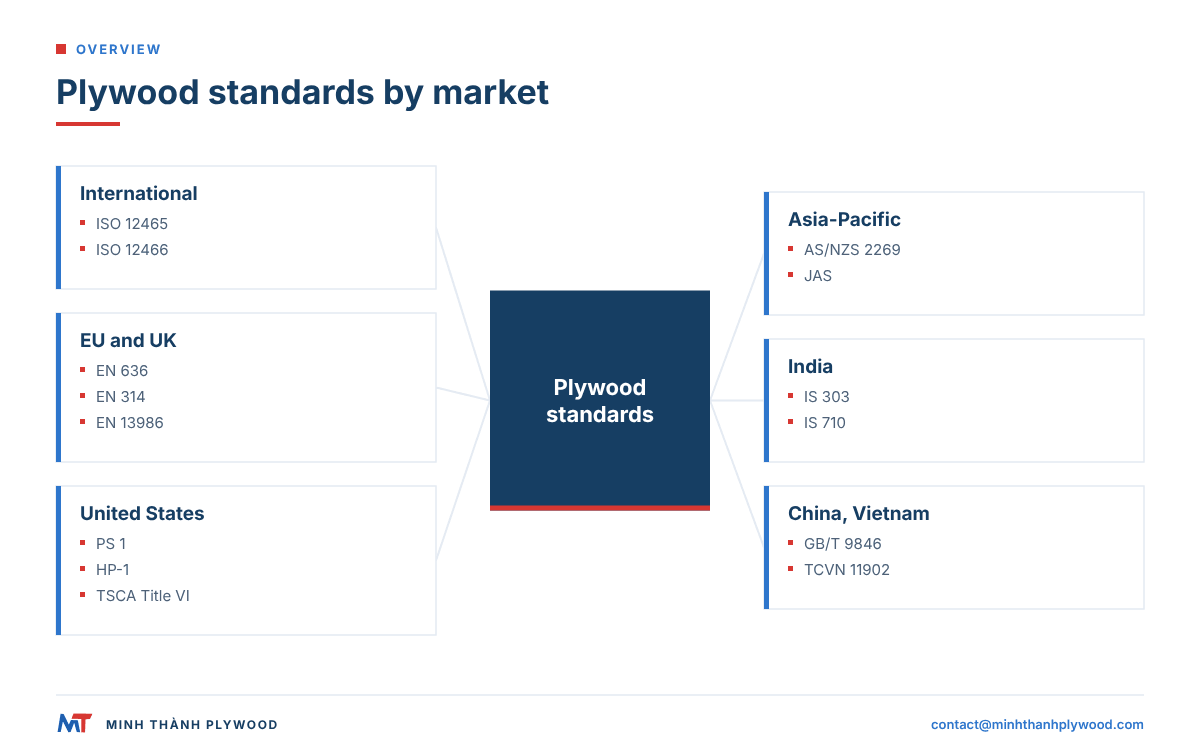
Which plywood standard applies in each market?
Each market names its own plywood standard, but the matrix maps them all to the same four tests a mill runs: bond, emission, structure and appearance. Read across a row for one market’s standards, or down a column to compare one test across markets.
| Market | Product standard | Bond | Emission | Structural | Appearance |
|---|---|---|---|---|---|
| International | ISO 12465 | ISO 12466 | Buyer’s method | ISO 12465 structural | ISO 2426 |
| European Union | EN 636 | EN 314 | EN 717-1, REACH | EN 636 + EN 13986 (CE) | EN 635 |
| United Kingdom | BS EN 636 | BS EN 314 | BS EN 717-1 | BS EN 13986 (UKCA) | BS EN 635 |
| United States | PS 1, HP-1 | PS 1 exposure classes | TSCA Title VI, CARB P2 | PS 1, PS 2 | PS 1, HP-1 grades |
| Australia, New Zealand | AS/NZS 2269–2272 | Bond types A to D | E0, E1 classes | AS/NZS 2269 | AS/NZS face grades |
| Japan | JAS for plywood | Special, Type 1, Type 2 | F-star classes | JAS structural plywood | JAS grades |
| India | IS 303, IS 710 | MR, BWR, BWP grades | Buyer’s method | IS 303 grades | IS 303 grades |
| China | GB/T 9846 | GB/T 9846 bond classes | GB/T 39600 | GB/T 9846 | GB/T 9846 grades |
| Vietnam | TCVN 11902 | TCVN 11902 | Buyer’s method | TCVN 11902 | TCVN 11902 |
The cells are working equivalents, not legal ones: a project that names one standard needs that standard’s mark or report, not a “similar” one.
US plywood standards: PS 1, PS 2, HP-1 and TSCA Title VI
US plywood standards split by use: PS 1 and PS 2 for structural and performance panels, ANSI/HPVA HP-1 for hardwood and decorative plywood, and TSCA Title VI for formaldehyde. North American specifications cite these rather than ISO because building codes reference the US Voluntary Product Standards, and a US buyer reads plywood by grade letters, species group, bond class and a span rating stamped on the panel.
| Use | Standard | Proof |
|---|---|---|
| Structural plywood | PS 1-22 | Grading agency stamp |
| Performance panels | PS 2, APA PRP-108 | Grading agency stamp |
| Hardwood and decorative plywood | ANSI/HPVA HP-1 | Face and back grades by agreement |
| Formaldehyde emission | TSCA Title VI, CARB Phase 2 | Certifier number on the label |
NIST lists PS 1-22 as the current structural plywood standard (read 20 October 2026). The emission limit for veneer-core hardwood plywood is 0.05 ppm under 40 CFR 770.10 (checked on 20 October 2026). We hold CARB P2 / TSCA Title VI certification (ICTT mill no. 23024, hardwood plywood veneer core, 3–50 mm); see our CARB P2 and TSCA Title VI page.
Softwood veneer grades: A, B, C, C-plugged and D
Under PS 1, softwood plywood is graded on both sides: the first letter is the face veneer, the second the back, so an AC panel has an A face and a C back. Grades run from A, a smooth paintable veneer, down to D, a utility veneer, and a letter pair such as AC, BC or CDX tells the buyer what the face allows.
| Veneer grade | What it allows | Typical use |
|---|---|---|
| A | Smooth, sanded, repairs only | Paintable faces, cabinets |
| B | Solid surface, small repairs and plugs | Painted and utility faces |
| C-plugged | Plugged knotholes, sanded | Underlayment, floors |
| C | Sound but visually flawed, knotholes up to 1.5 in | Structural, not decorative |
| D | Unrepaired knots up to 2.5 in | Inner plies, backs, formwork, covered sheathing |
The two-letter codes combine them: AC for one good face, BC for a painted face, CDX for sheathing with an Exposure 1 bond. Grade moves price: one US retailer puts the gap between two sheets that look alike at about US$40 per panel (Forest Plywood, checked on 21 October 2026).
Hardwood plywood grades: HP-1 faces and backs
ANSI/HPVA HP-1 grades hardwood and decorative plywood by face and back separately. The 2024 edition lists face grades AA, A, B, C and E, plus Rustic (R) and Specialty (SP) grades, and number backs 1 to 4 with 1 the best (HP-1-2024, read 21 October 2026). A panel written A1 has a premium face and a closed back, the furniture and casework choice; the lowest pair is the economy panel. For a painted finish, ask for B faces and a lower back; for a clear finish, keep A faces.
Species groups and bond classes: Group 1 to Group 5, Exterior and Exposure 1
PS 1 sorts more than 70 species into five strength groups, with Group 1 the strongest, and rates each panel Exterior or Exposure 1 by veneer grade and glue (APA, checked on 21 October 2026).
- Exterior: withstands repeated wetting and drying and long-term weather exposure.
- Exposure 1: resists construction moisture, including the CDX panel, and is not for permanent outdoor exposure.
Hardwood plywood for furniture is graded to HP-1 and the buyer’s face agreement rather than to the softwood species groups.
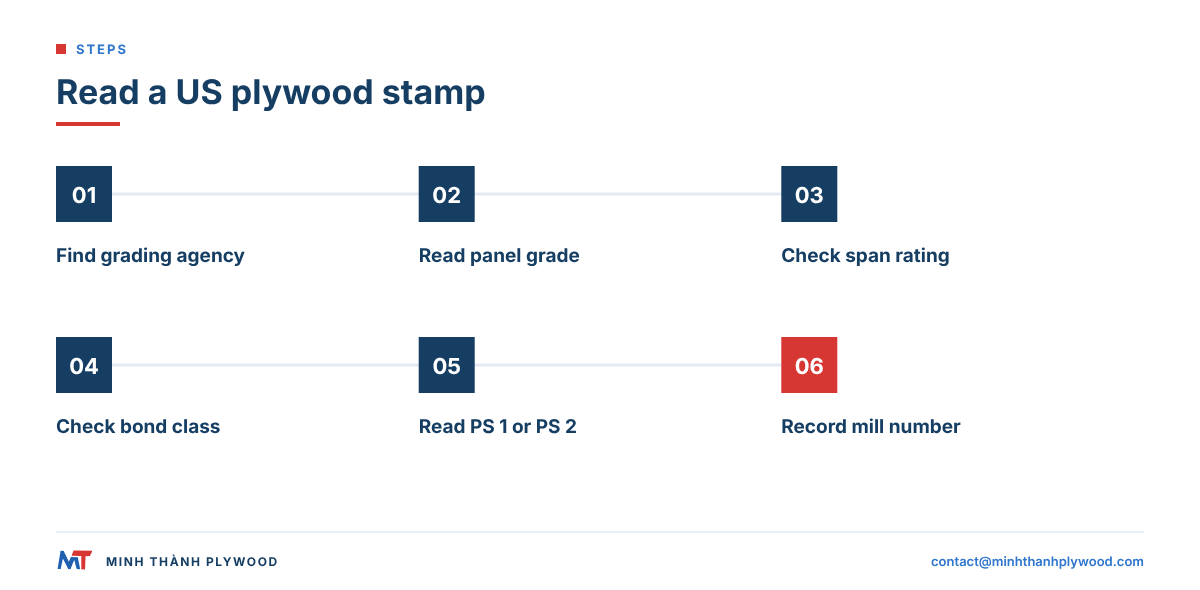
Span ratings and how to read an APA trademark stamp
A span rating shows the largest support spacing a panel is recommended for: roof and subfloor sheathing show two numbers such as 32/16, single floor panels show one, and wall sheathing is typically marked W24. Our guide to plywood span ratings explains each rating. Read a grading-agency stamp in this order:
- Agency: the APA mark, or the mark of another accredited agency.
- Grade: the face and back letters, or the Performance Category and grade name.
- Span rating: 32/16, a single number, or W24.
- Bond classification: Exterior or Exposure 1.
- Standard: PS 1 or PS 2 (APA PRP-108).
- Mill number: the producing mill, as on the label that carries a TSCA Title VI certifier number.
ISO plywood standards: 1096, 12465, 12466 and 2426
ISO plywood standards come from ISO technical committee TC 89 on wood-based panels and form one set: classification, specification, bond quality and appearance. They are voluntary and widely cited in international tenders.
| Standard | Covers | Use on an order |
|---|---|---|
| ISO 1096 | Classification of plywood | Naming the panel type |
| ISO 12465 | Specifications for general and structural use | The product specification |
| ISO 12466-1 and -2 | Bonding quality: test methods and requirements | The bond class and its test |
| ISO 2426 | Classification by surface appearance | Face and back grades |
| ISO 12460-4 | Formaldehyde release, desiccator method | Emission test on small samples when a buyer names it |
Where a tender cites ISO, ask for test reports to the cited part, not for an “ISO certificate”. ISO 9001:2015 is different: it certifies a quality management system, and ours is KAC25/0185, for plywood manufacturing.
What is ISO 12465?
ISO 12465 is the international specification for plywood for general and structural use: ISO 12465:2007, last reviewed and confirmed by ISO in 2021, so the 2007 edition is current. It sets requirements for veneer quality, glue bond, lay-up, dimensions and tolerances, conformity checks and marking, for three service conditions.
- Dry conditions: interior use.
- Tropical dry or humid conditions: protected use with humidity.
- High humidity or exterior conditions: exposure to weather.
The ISO 12465 page on iso.org (read 20 October 2026) states the scope. The values it lists describe product properties and are not design values for structural calculation. Gulf standards bodies adopt it as GSO ISO 12465:2015, which is why Middle East tenders often cite it next to EN 636.
Is ISO 12466 the same as EN 314?
ISO 12466 and EN 314 are close counterparts: both test the glue bond of plywood after a pre-treatment, a soak or a boil, and both grade the result for dry, humid and exterior use. They are separate documents, so a tender that names one should get a report to that one.
| Line | ISO 12466 | EN 314 |
|---|---|---|
| Part 1 | Test methods | Test methods |
| Part 2 | Requirements | Requirements, Class 1 to 3 |
| Pre-treatments | Soak, boil and cyclic boil | Soak, boil and cyclic boil |
| Linked spec | ISO 12465 | EN 636 |
A boil test on its own is a bond check on samples. A 72-hour boil is the traditional WBP test; it does not by itself prove EN 314-2 Class 3 or a marine grade.
European plywood standards: EN 636, EN 314, EN 13986 and REACH
European plywood standards pair a specification, EN 636, with a bond test, EN 314, and a CE marking route for construction panels, EN 13986.
Construction products marketed in the EU fall under the Construction Products Regulation (EU) No 305/2011 (read 20 October 2026).
- EN 636-1, -2, -3: plywood for dry, humid and exterior conditions.
- EN 314-2: bond classes 1, 2 and 3.
- EN 635: face appearance classes.
- EN 13986: the harmonised standard for wood-based panels in construction, with CE marking and a declaration of performance.
- EN 717-1: chamber method behind the E1 emission class.
- REACH Annex XVII entry 77 (Regulation (EU) 2023/1464, read 20 October 2026): from 6 August 2026, furniture and wood-based articles may not exceed 0.062 mg/m³ formaldehyde under the regulation’s chamber conditions; articles for outdoor use only are exempt.
The same set answers buyers in Bulgaria, Poland, Italy or any other member state. CE marking is available* for construction panels. Our guide to EN 13986 and CE marking explains the declaration of performance.
*Supplied directly or through qualified partner mills.
UK plywood standards: BS EN, BS 1088 and UKCA
UK plywood standards are the European EN set published as BS EN, plus the British marine standard BS 1088. A UK specification reads BS EN 636 for the panel, BS EN 314 for the bond and BS EN 13986 for construction marking.
- BS EN 636: the plywood specification, same classes as EN 636.
- BS 1088: marine plywood, which fixes the face species, defects and bond.
- Construction marking: UKCA for Great Britain, under the same BS EN 13986 route.
Our guide to WBP plywood explains what the old British WBP label means against today’s bond classes.
Australia, New Zealand and Japan: AS/NZS and JAS
Australia and New Zealand split plywood across separate AS/NZS documents, and Japan uses the Japanese Agricultural Standard (JAS) for plywood. Both grade the bond by type and the emission by class.
- AS/NZS 2269: structural plywood, with stress grades such as F11 and F14.
- AS/NZS 2270 and 2271: interior and exterior plywood.
- AS/NZS 2272: marine plywood.
- AS 6669: plywood for formwork, where formply is graded.
- JAS for plywood: bond types (Special, Type 1, Type 2), face grades and the F-star emission classes, with F★★★★ the lowest.
A Japanese or Australian order that names a grade needs the mark of that grade; a non-structural interior order can be specified line by line.
India: IS 303, IS 710 and the quality control order
India’s plywood standards are IS 303 for general purpose plywood and IS 710 for marine plywood, and the Plywood and Wooden Flush Door Shutters (Quality Control) Order makes ISI-marked certification under them mandatory, for imports too. A buyer in India checks the ISI mark, the grade and the licence number.
| Standard | Covers | Grades |
|---|---|---|
| IS 303 | Plywood for general purposes | MR (moisture resistant), BWR (boiling water resistant) |
| IS 710 | Marine plywood | BWP (boiling water proof) |
| IS 4990 | Concrete shuttering plywood | BWP bond |
The licence number on the sheet can be checked with the Bureau of Indian Standards. A Vietnamese mill exporting to India needs that licence for the product; a test report alone does not replace it.
GB/T plywood standards and GB/T 39600 emission classes
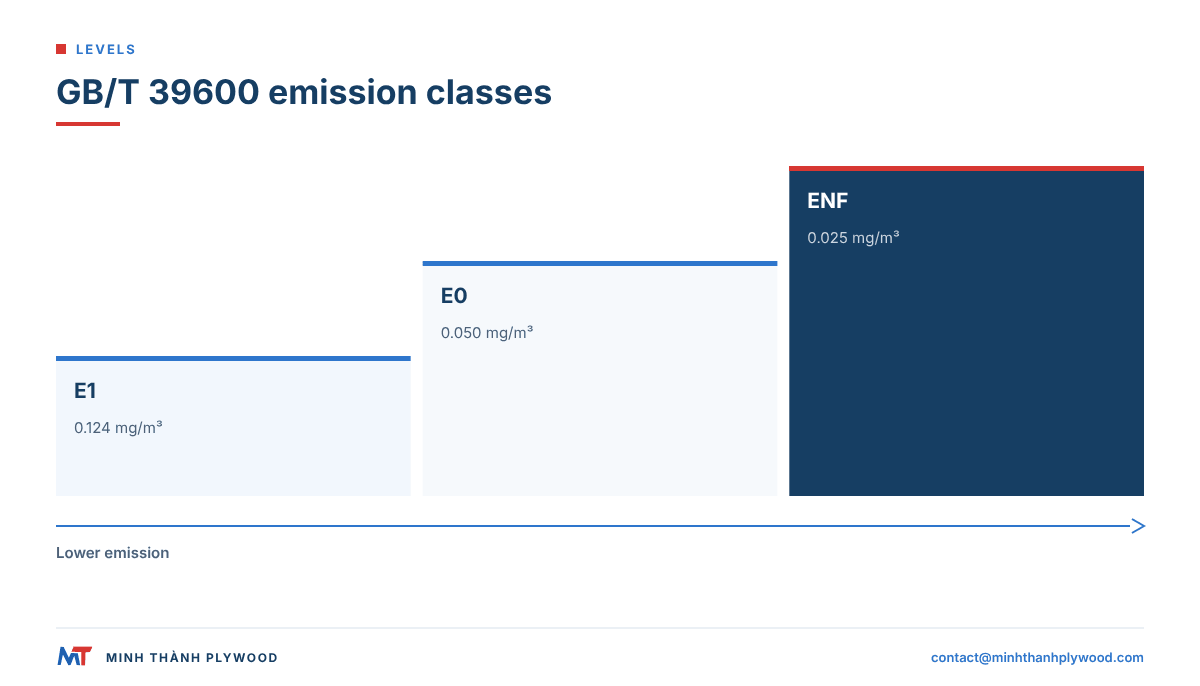
The GB/T plywood standard is GB/T 9846-2015, China’s specification for plywood for general use; indoor emission classes come from GB/T 39600-2021. GB/T 39600 sets three classes, measured in a chamber in mg/m³.
| Class | Limit (GB/T 39600-2021) |
|---|---|
| E1 | 0.124 mg/m³ |
| E0 | 0.050 mg/m³ |
| ENF | 0.025 mg/m³ |
These limits are not converted to ppm or to EN classes: each sits on its own method. A buyer who writes “E0” should add “to GB/T 39600” or “CARB P2 / TSCA Title VI” so the mill tests to the right rule. Our formaldehyde emission E0 and E1 page sets out how we state each class.
Vietnam: TCVN 11902 and what a Vietnamese mill holds
Vietnam’s plywood standard for veneer-faced panels is TCVN 11902:2017, and certification to it is held by product, not by country. We hold TCVN 11902:2017 certification (VietCert 141.1-VNC-HC), next to our CARB P2 / TSCA Title VI and ISO 9001:2015 certificates.
- TCVN 11902:2017: VietCert 141.1-VNC-HC.
- CARB P2 / TSCA Title VI: ICTT mill no. 23024.
- ISO 9001:2015: KAC25/0185.
- Emission tests: six ASTM D6007 reports, averages 0.014–0.032 ppm against 0.05 ppm.
- Available*: FSC and CE.
Our quality page lists each certificate with its scope.
Which document should a buyer request for each market?
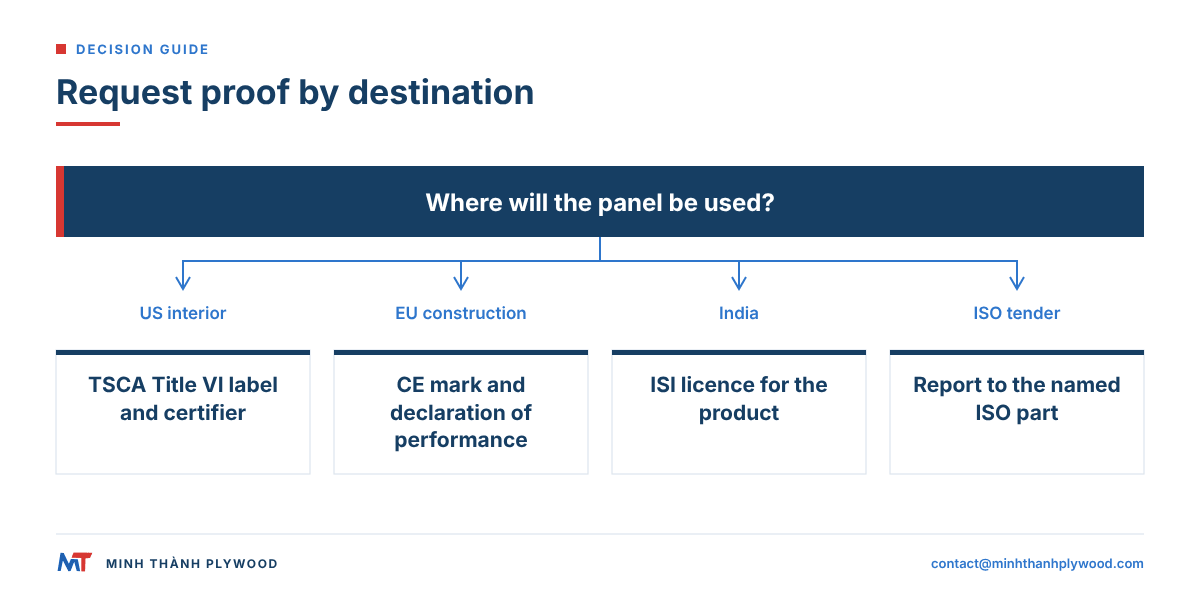
A buyer should request the document that the destination’s rule names: a label and certifier number in the US, a declaration of performance for CE-marked construction panels in the EU, an ISI licence in India. A general certificate folder is not a substitute.
| Destination | Request | We supply |
|---|---|---|
| United States, furniture and interior | CARB P2 / TSCA Title VI certificate, label, chamber reports | Certificate, TPC-43 label, six reports |
| European Union, furniture | Emission proof accepted by the buyer | CARB P2 / TSCA reports; SGS test to EN 717-1 on request |
| European Union, construction | Declaration of performance, CE mark | CE available* |
| European Union, timber origin | EUDR due-diligence information | EUDR compliance dossier with geolocation files |
| Middle East tenders | Reports to ISO 12466 or EN 314 | Third-party testing through SGS on request |
| India | ISI licence under IS 303 or IS 710 | Licence number for the product, checked on the public register |
| Any market | Quality management certificate | ISO 9001:2015, KAC25/0185 |
*Supplied directly or through qualified partner mills.
How to write the standard on a plywood order
Write each standard on the order as one line per test, with the method, not as a single “meets international standards”. Four lines translate any market’s standard into something a mill can build and prove.
- Bond: the class and method, for example EN 314-2 Class 2, or a stated boil test.
- Emission: the class and its rule, for example CARB P2 / TSCA Title VI, or E0 to GB/T 39600.
- Structure: a stress grade only if the design needs one, with the standard that defines it.
- Appearance: face and back grade pair, matched to the approved sample.
Our furniture panels use UF glue at E0 emission; glue type and emission class are separate lines on the specification. Our plywood strength values guide explains the structural tests behind a stress grade.
What this means for your order
An order that names its market’s standards gets the right reports first time. Send these lines with your request:
- Application and market: furniture, interior or construction; destination country.
- Core: white Styrax or Eucalyptus.
- Glue and emission: UF glue at E0 emission, and the rule (CARB P2 / TSCA Title VI, EN 717-1, GB/T 39600).
- Face: species and grade pair against the approved sample.
- Size and tolerance: 1220 × 2440 mm or 1250 × 2500 mm; down to ±0.2 mm on sanded furniture panels.
- Packing and quantity: from one 40HC; destination port and the documents your market needs.
We reply within hours, with the matching certificates and free samples, from FOB Hai Phong, CFR or CIF.
Buyer questions, answered
Which plywood standard applies in each market?
Europe uses EN 636 with CE marking under EN 13986, the US uses PS 1 for structural panels, HP-1 for hardwood panels and TSCA Title VI for emission, India IS 303 and IS 710, China GB/T 9846, Japan the JAS for plywood, Australia AS/NZS 2269 to 2272.
What is ISO 12465?
ISO 12465:2007 is the international specification for plywood for general and structural use. It sets veneer quality, bond, lay-up, tolerance and marking requirements for dry, humid and exterior conditions, and was last confirmed in 2021.
Is ISO 12466 the same as EN 314?
They are close counterparts: both define bond quality tests and requirements after soak or boil pre-treatments. A strict tender may still require the citation it names, so put the standard on the order.
Does ISO certified mean a panel has third-party certification?
No. ISO product standards for plywood are voluntary specifications; there is no general ISO product certificate. ISO 9001 certifies a quality management system, not a panel. Ask for the test report to the ISO method.
Which ISO standard governs plywood for concrete formwork?
ISO 12465 for exterior conditions sets the specification, and ISO 12466 sets the bond test behind it. Many formwork tenders cite EN 636-3 or a stated boil test instead.
Why don't North American specs cite ISO directly?
US building codes reference the US Voluntary Product Standards, PS 1 for structural plywood and PS 2 for performance panels, and grading agencies certify to them. ISO appears only as a secondary reference.
What is the GB/T plywood standard?
GB/T 9846-2015 is China's standard for plywood for general use. Emission classes for indoor panels come from GB/T 39600-2021: E1, E0 and ENF.
Do plywood standards in India apply to imports?
Yes. The Quality Control Order for plywood makes ISI-marked certification under IS 303 and IS 710 mandatory, for domestic and imported panels alike.
Which plywood standard does Vietnam use?
TCVN 11902:2017 covers veneer-faced plywood in Vietnam. We hold certification to it, VietCert 141.1-VNC-HC.
Is E0 the same in every market?
No. E0 has no single global limit: China defines it in GB/T 39600, Europe uses it as an industry term below E1, and the US uses CARB Phase 2 / TSCA Title VI limits in ppm. Write the method with the class.
What plywood standards apply in Bulgaria and the rest of the EU?
The EU-wide set: EN 636 for the plywood specification, EN 314 for bond quality and EN 13986 for CE marking of panels used in construction, plus the REACH formaldehyde limit for wood-based articles.