
WBP plywood (weather and boil proof) is plywood whose glue bond survives boiling water and outdoor exposure, normally a phenolic resin bond tested to EN 314 class 3. Minh Thanh Plywood makes WBP-bonded panels to the buyer's specification for exterior, film-faced and heavy-duty uses; furniture panels stay on UF glue at E0.
What does WBP mean in plywood?
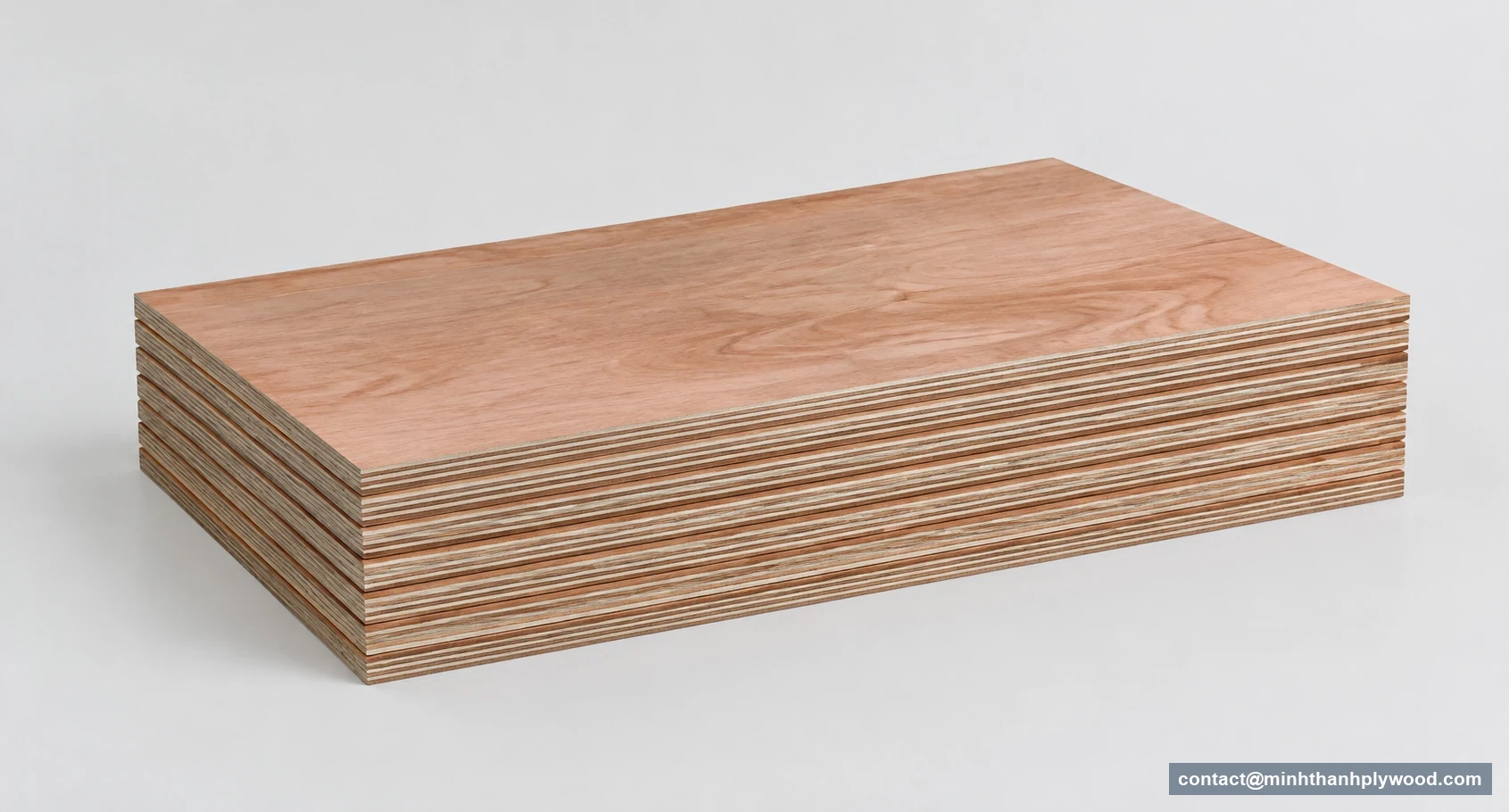
WBP means weather and boil proof: the glue bond between the veneers keeps its strength after boiling in water and after years of outdoor weather. It is a statement about the glue line, not about the wood, the face grade or the panel’s strength. In trade language “WBP plywood” almost always means a panel bonded with phenol-formaldehyde (phenolic) resin, which is the usual plywood WBP meaning.
The term comes from British Standard BS 1203, which classed plywood adhesives as INT, MR, BR and WBP; bond quality of the finished plywood was later set out in BS 6566-8. Both have given way in Europe to EN 314, and buyers who still write “WBP” are asking for what EN 314-2 now calls bond class 3, exterior. Writing both on the order removes any doubt: “WBP (EN 314-2 class 3)”. EN 314 is published by CEN, the European Committee for Standardization (CEN standards search, checked October 2026).
How is a WBP bond tested?
A bond earns its class by surviving water pretreatments and then a shear test, as set out in EN 314-1 (test methods) and EN 314-2 (requirements). Small test pieces are cut from the panel, notched so that the shear acts on one glue line, conditioned in water, then pulled apart in a testing machine while still wet.
| Bond class (EN 314-2) | Intended use | Pretreatment before the shear test |
|---|---|---|
| Class 1 | Dry interior | 24 hours soaking in cold water |
| Class 2 | Humid interior, covered exterior | Class 1, plus 6 hours in boiling water and 1 hour cooling |
| Class 3 (WBP) | Exterior | Class 2, plus either 4 hours boiling, 16–20 hours drying at 60 °C and 4 more hours boiling, or 72 hours of continuous boiling |
The pieces then have to reach a minimum shear strength, or show enough wood failure (the wood breaks instead of the glue). EN 314-2 sets the wood-failure share by strength band: at least 80 % wood failure for a mean shear strength of 0.2–0.4 N/mm², at least 60 % for 0.4–0.6 N/mm², at least 40 % for 0.6–1.0 N/mm², and no wood-failure requirement from 1.0 N/mm² up.
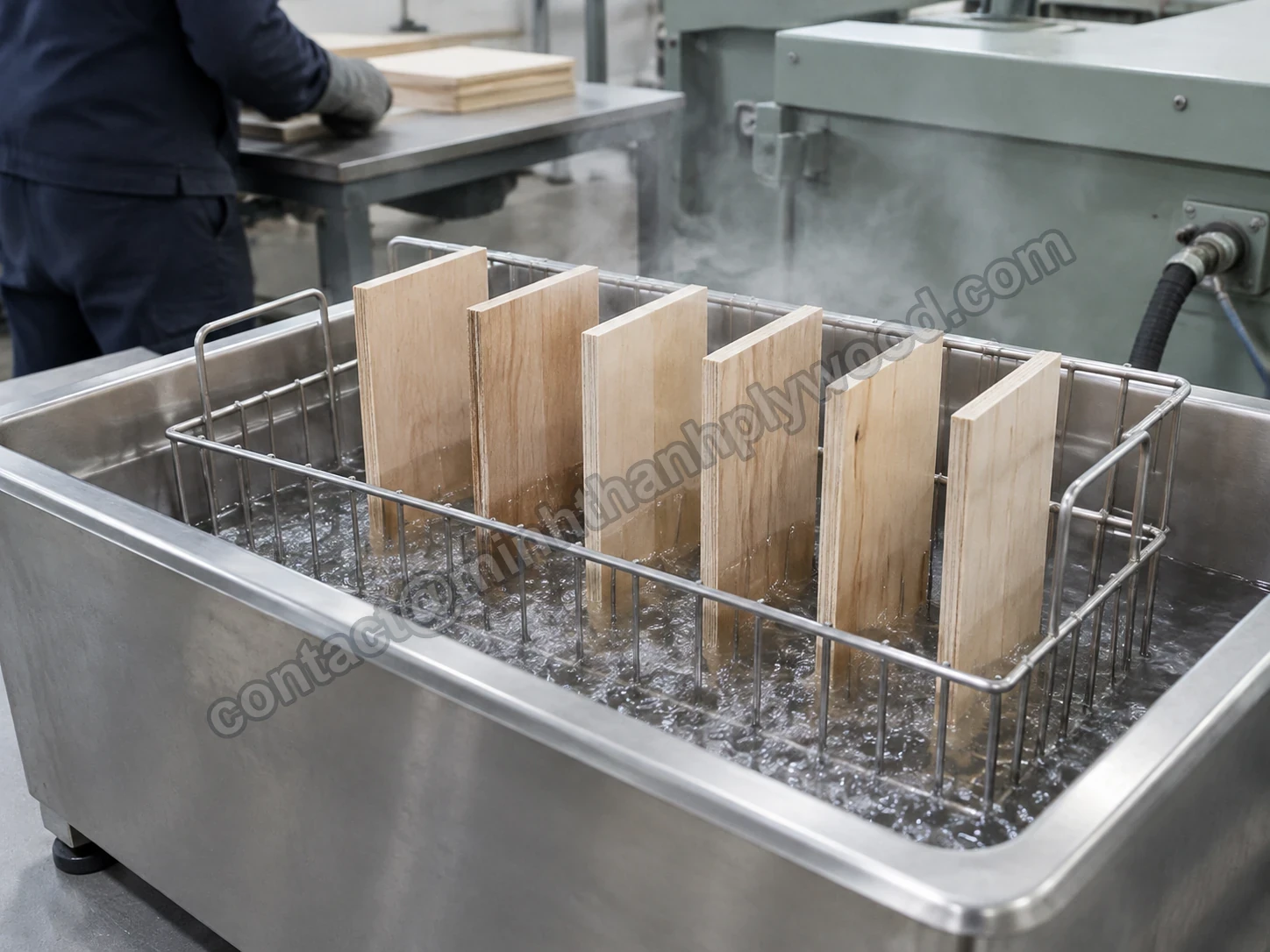
The 72-hour boil is the test buyers remember, and it is the one that separates a real phenolic bond from a melamine-fortified bond sold as “WBP”: melamine bonds pass class 2 but tend to fail the long boil.
How is WBP different from marine, MR and exterior plywood?
Four labels get mixed up in quotations. They describe different things:
| Label | What it fixes | Glue | What it does not promise |
|---|---|---|---|
| MR (moisture resistant) | Bond survives humidity and short wetting | Melamine-fortified UF (MUF) | Boiling, long outdoor exposure |
| WBP / EN 314-2 class 3 | Bond survives boiling and weather | Phenolic (PF) | Durable wood, gap-free core, face grade |
| Exterior plywood / EN 636-3 | Whole panel for exterior conditions | Class 3 bond | Marine species or marine core quality |
| Marine plywood (BS 1088) | Bond, durable species, gap-free core, tight face defects | WBP-type phenolic | Decay protection without coating |
So every marine panel is WBP-bonded, but a WBP panel is not marine unless the species, core and face also meet BS 1088. Minh Thanh does not sell its okoume furniture panels as marine plywood; the marine plywood buying guide explains what a real BS 1088 order needs.
What does a WBP bond look like on the edge?
Phenolic resin cures dark: on a sawn edge each glue line shows as a thin dark brown or black seam between the veneers. UF and melamine glue lines are pale, almost invisible on a white Styrax core.
The colour is a useful first look when a sample arrives. Some melamine resins are tinted dark, and a phenolic line can be pale under a heavy sanding dust. The proof is a bond test: an EN 314-2 class 3 report, or your own boil test on pieces cut from the sample.
A quick test you can run yourself: cut three strips about 25 × 100 mm, boil them for 72 hours (top up the water), let them cool, and try to split each glue line with a chisel. A WBP bond tears wood fibres; a weak bond opens cleanly along the glue.
Which WBP ply board does Minh Thanh make?
Minh Thanh’s standard furniture and interior panels use UF glue at E0 emission: that is the right bond for cabinets and furniture that live indoors. WBP (phenolic) and MR (melamine-fortified) bonds are made to the buyer’s specification, and WBP ply board comes in three families:
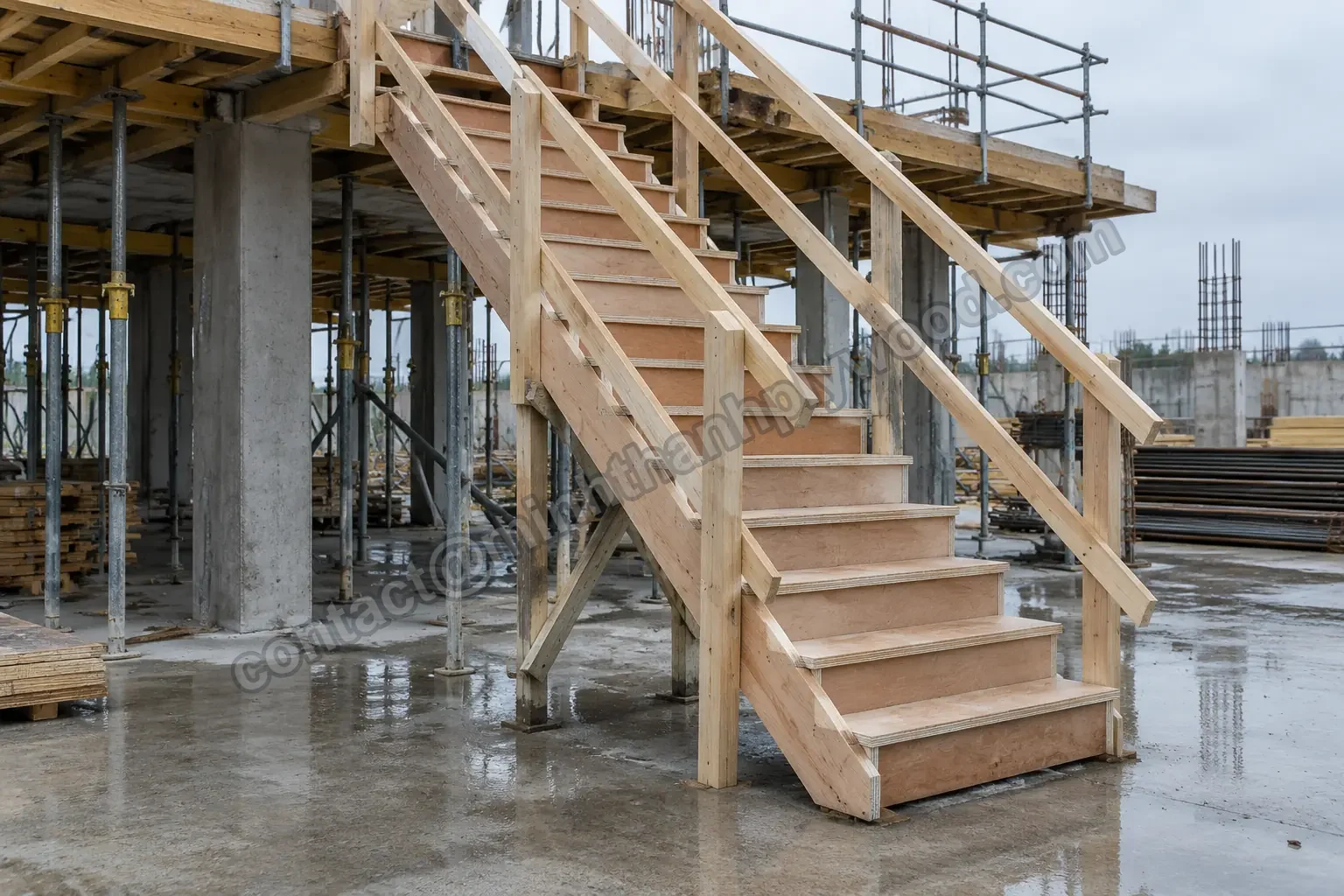
- Exterior / CDX-type plywood with utility C/D faces, for stair treads, wall sheathing and hoardings. See exterior plywood.
- Film-faced plywood for concrete formwork, where the phenolic film and a WBP bond work together. See film-faced plywood.
- Anti-slip and packing panels that meet water: trailer and vehicle floors on anti-slip plywood, crates and pallets of packing plywood stored in the yard.
The bond is chosen per order line: one container can carry UF furniture panels and WBP exterior panels side by side, with mixed specifications by agreement.
What does WBP plywood cost compared with MR or UF?
Phenolic resin costs more than UF or melamine-fortified resin, and a phenolic bond needs a hotter, longer press cycle: about 130–145 °C for WBP against 110–120 °C for MR. So a WBP line is priced above the same panel with MR or UF glue. Plywood is priced per cubic metre; Minh Thanh’s indicative starting prices in October 2026 are US$250/m³ for commercial plywood and US$350/m³ for furniture and interior plywood, and the bond, face, core, thickness, size, quantity and delivery term set the final price.
Save in the specification: ask for WBP only where the panel meets weather or boiling water. For a kitchen carcass, an MR or UF bond is the correct and cheaper choice.
What is WBP plywood used for, and which uses really need WBP?
WBP plywood is used where panels meet rain, sun or boiling water: exposed exterior work such as stair treads, hoardings and sheathing, concrete formwork with a phenolic film, and vehicle and trailer floors. Indoor furniture and sheltered exterior use can take UF or MR bonds, and boats and docks need marine plywood.
| Use | Bond to order | Why |
|---|---|---|
| Kitchen and bathroom cabinets, furniture | UF at E0, or MR for bathrooms | Indoor; emission matters more than boil resistance |
| Covered exterior (soffits, sheltered cladding) | MR or WBP | Humidity and occasional wetting |
| Exposed exterior (stair treads, hoardings, sheathing) | WBP (EN 314-2 class 3) | Rain, sun and wet-dry cycles |
| Concrete formwork | WBP with phenolic film | Wet concrete, repeated pours, cleaning |
| Vehicle and trailer floors | WBP, often with anti-slip film | Water, cleaning and wheel loads |
| Boats, docks, permanently wet structures | Marine (BS 1088) | Durable species and gap-free core as well as the bond |
Can a WBP bond be made with a light-coloured glue?
Sometimes buyers want an exterior bond without the dark glue line, for a visible edge on outdoor furniture or a pale face that will be stained. A phenolic bond stays dark; melamine-fortified (MUF) bonds are pale, and most are rated class 2 (some high-melamine MUF bonds do reach class 3, which their test report shows). The practical choices:
- Accept the dark line and band or paint the edge: the standard WBP route.
- Use an MR (MUF) bond for covered or sheltered exterior uses where class 2 is enough, and keep the pale edge.
- Order a film face or a painted finish, so the colour of the glue line no longer matters.
Tell us the use and the finish, and we will quote the bond that meets the exposure.
Is WBP plywood waterproof once it is installed?
The bond will not delaminate in water; the wood will still absorb it. Cut edges drink water fastest, swell, and let the outer veneers check and grey in the sun. An exposed WBP panel lasts when you:
- Seal every cut edge with an edge sealer or paint before installation.
- Coat the faces with an exterior paint or stain system, or order a phenolic film face.
- Keep end grain off standing water: leave a drip gap at the bottom of cladding and treads.
- Ventilate the back so the panel can dry after rain.
For how water affects the wood itself, see is plywood waterproof?.
How do you write a WBP order so you get what you asked for?
“WBP plywood 18 mm” is not enough: it fixes the bond and the thickness and leaves the rest to the mill. Write one line per specification, in this order:
- Use: exterior sheathing, formwork, trailer floor.
- Bond: WBP, phenolic, EN 314-2 class 3.
- Core species: eucalyptus or a mixed hardwood core; core veneer stitched.
- Face and back: species and grade, for example utility C/D, or a phenolic film on both faces for formwork.
- Thickness and tolerance: 18 mm ±0.5 mm.
- Size: 1220 × 2440 mm or 1250 × 2500 mm.
- Edges: sealed, and the colour if you want one.
- Emission line, if your market needs one, written separately from the bond.
- Evidence: bond test report for the lot, or a boil test on the pre-shipment sample.
- Packing and quantity: export packing, sheets per pack, 1×40HC.
An example line: WBP exterior plywood, phenolic bond EN 314-2 class 3, eucalyptus core, C/D faces, 18 mm ±0.5 mm, 1220 × 2440 mm, edges sealed, export packing, 1×40HC, CIF Felixstowe.
Why keep the bond and the emission class apart?
Bond class and formaldehyde emission are two different specifications, and orders that mix them get quoted wrong. WBP (or MR, or UF) says how the glue line behaves in water. E0, E1, CARB P2 and TSCA Title VI say how much formaldehyde the finished panel releases into a room.
For Minh Thanh’s furniture panels the two lines read “UF glue at E0 emission”. Our furniture panels are certified to CARB P2 / TSCA Title VI (ICTT mill no. 23024) under the California Air Resources Board and US EPA TSCA Title VI rules (checked October 2026).
The chamber test results behind that certificate are on our CARB P2 / TSCA Title VI page; they belong to the UF furniture line, and a WBP order states its own emission requirement if the market sets one. Formaldehyde emission classes explains E0 and E1.
What do other markets call a WBP bond?
Buyers outside the UK rarely write “WBP”. The same exterior, boil-proof bond appears under each market’s own standard, and quoting the local name avoids a second round of emails:
| Market | Standard and name for an exterior, boil-proof bond | Note |
|---|---|---|
| UK and EU | EN 314-2 bond class 3; whole panel EN 636-3 | “WBP” survives as trade shorthand for class 3 |
| United States | PS 1 “Exterior” bond | Exposure 1 is a lesser, temporary-weather bond |
| Australia and New Zealand | AS/NZS 2754 / AS/NZS 2269 “A bond” | A-bond is the phenolic exterior bond, also used in formply |
| India | IS 303 BWP or BWR; IS 710 for marine | BWR (boiling water resistant) sits below BWP |
| Japan | JAS Special (Tokurui) and Type 1 bonds | Type 2 is the humid-interior bond |
| Middle East | Usually EN 314-2 class 3 or “WBP” on the order | Film-faced formwork panels are the main WBP line |
When a buyer’s market uses its own standard, the order line names it, and the test report must follow the same method.
Which WBP problems should you watch for?
Most complaints about WBP plywood are not bond failures. They come from the wood, the core or the installation:
- Edge swelling and veneer lifting at cut edges. Water enters through unsealed end grain. Seal edges before installation, and after every site cut.
- Face checking. Fine cracks open in the face veneer after sun and rain cycles. A paint system or a film face stops it; a clear finish alone does not.
- Core voids. A gap in the core leaves a weak spot under the face and a path for water. On the cut edge of the sample you should see no voids and no overlapping core veneers.
- A “WBP” label on a melamine bond. It passes a short soak and fails the long boil. The 72-hour boil test on the sample catches it before the order.
- Wrong tolerance for the use. Formwork and exterior panels are made to ±0.5 mm; if the job needs a tighter fit, say so on the order.
How do you check a WBP delivery when it arrives?
Open packs from different positions in the container and check five sheets from each:
- Glue lines on a fresh cut: dark and continuous, no dry spots or open seams.
- Boil test: three strips from one sheet per specification, 72 hours, then a chisel on each glue line.
- Thickness at four points with a caliper, 50 mm in from the edge: within ±0.5 mm.
- Core: no voids or overlapping core veneers on the cut edge.
- Moisture: a pin meter on the face should read 8–12 %, the range panels leave the factory with.
- Edges and faces: sealed edges intact, faces as the approved sample.
Note the pack numbers of any sheet that fails, so the question can be traced to its production lot.
What to send for a WBP quotation
Send the use, the bond class, the face and core, the thickness and tolerance, the size, the quantity and the port. WBP lines can share a 40HC with furniture panels by agreement, and a free sample lets you run the 72-hour boil before you order. Production takes 15–45 days after the 30% deposit, FOB Hai Phong, CFR or CIF.
If you are not sure WBP is the right bond for your use, send the use and the exposure: we will tell you whether MR, WBP or a film-faced panel fits, and why.
Buyer questions, answered
What does WBP stand for in plywood?
WBP stands for weather and boil proof. It describes the glue bond between the veneers: the bond must hold after boiling in water and long outdoor exposure, which in practice means a phenolic resin bond.
Is WBP plywood waterproof?
WBP plywood has a waterproof glue bond, but the wood itself still takes up water: faces and cut edges swell and weather. Outdoors it needs sealed edges and a coating or film to last.
What standard replaced the old WBP grade?
The British Standard BS 1203 that defined type WBP has been replaced in Europe by EN 314. EN 314-2 bond class 3 (exterior) is the modern equivalent of WBP, and EN 636-3 covers the whole panel for exterior conditions.
Is WBP plywood the same as marine plywood?
No. Marine plywood to BS 1088 has a WBP-type bond too, but it also fixes durable face and core species, gap-free cores and tight face defects. Every marine panel is WBP-bonded; most WBP panels are not marine.
Is WBP the same as MR plywood?
No. MR (moisture resistant) usually means a melamine-fortified bond that resists humidity and short wetting but is not boil proof. WBP is the higher exterior class.
How can I tell WBP glue by looking at the edge?
Phenolic glue lines are dark brown to black; UF and melamine lines are pale. Colour is a hint only: ask for a bond test report to EN 314-2 class 3 or the boil test result for your lot.
Does WBP plywood emit formaldehyde?
Phenolic resin bonds emit very little formaldehyde once cured, but WBP describes the bond, not the emission class. If your market sets an emission limit, write it on the order as its own line.
What thicknesses and sizes can Minh Thanh make with a WBP bond?
WBP bonds are made to order in the factory range of 3–40 mm, on 1220 × 2440 mm and 1250 × 2500 mm sheets or custom sizes such as 1220 × 2500 mm.
What is WBP plywood used for?
Exterior joinery, stair treads, wall sheathing, hoardings, vehicle and trailer floors, packing for outdoor storage and, with a phenolic film, concrete formwork.
What tolerance does WBP exterior plywood have?
Exterior and film-faced panels are made to ±0.5 mm on thickness and ±2 mm on length and width; sanded furniture panels are tighter at ±0.2–0.3 mm.