
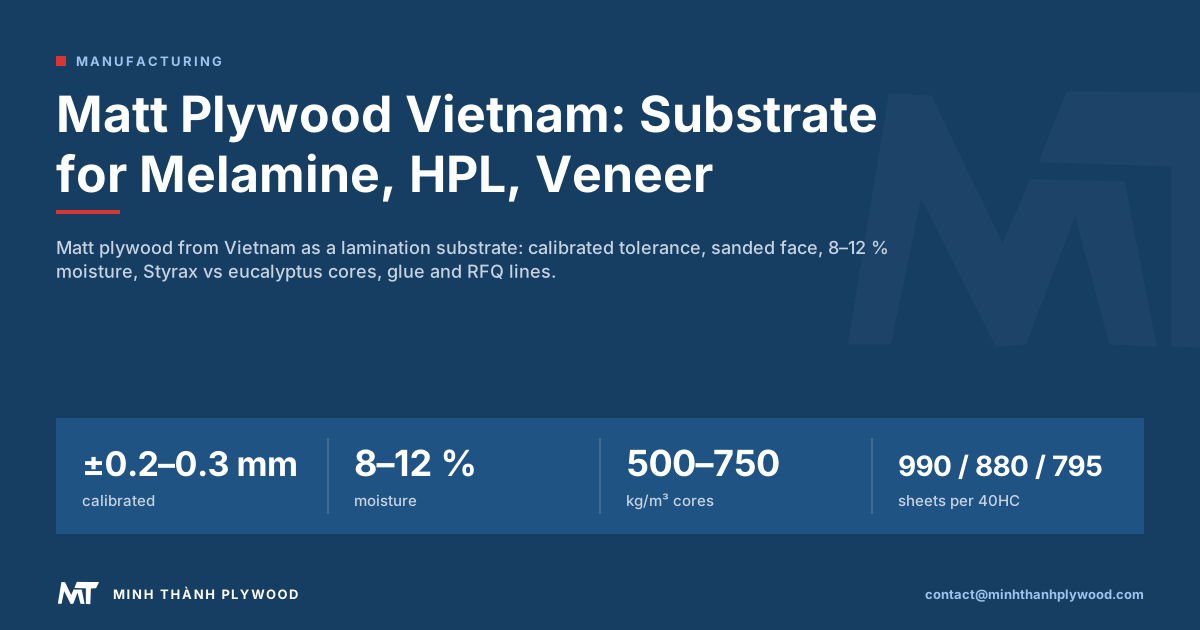
Matt plywood is plain, sanded and calibrated plywood bought as a base for melamine paper, HPL, veneer or PVC, not for its own face. A good substrate holds a tight thickness tolerance, a flat sanded surface, 8–12 % moisture and a closed core. Minh Thanh Plywood makes this board in Ha Hoa, Vietnam, on white Styrax or Eucalyptus cores pressed twice and sanded to ±0.2–0.3 mm.
What is matt plywood in Vietnam?
Matt plywood is plain, sanded plywood made to be laminated, not to be seen. Its face is an even, non-decorative surface, either a low-cost veneer or the calibrated core board itself, and its job is to give the laminate a flat, stable, closed base.
The name is trade shorthand in Vietnam and in buyers’ RFQs. It does not mean a matt-finish laminate. What a buyer of matt plywood is paying for:
- Calibrated thickness, so press pressure is even across the sheet.
- A flat, sanded surface, so the overlay does not show bumps.
- A closed core, so there are no voids to telegraph or sink.
- Controlled moisture, so the panel does not move after lamination.
- Glue and emission suited to the finished product.
Laminating plants press melamine decor paper, HPL, natural or engineered veneer, PVC or foil onto the board. The finished panel goes into cabinets, wardrobes, doors, wall panels and shop fittings.
Why laminating plants buy a substrate instead of finished boards
Laminating plants buy a plain substrate because they want to apply their own surface: their decors, their colours, their brand. Buying a board with a decorative wood face would mean paying for a face that is covered anyway.
Buying the substrate also lets the plant:
- Hold its own decor stock and laminate to order instead of stocking finished boards in every colour.
- Match surfaces across products, using the same paper on plywood, MDF and particleboard.
- Choose the core per product: light Styrax for wall units, dense Eucalyptus for doors and worktops.
- Control quality at its own press, where most surface faults are decided.
A plywood substrate goes where chipboard and MDF struggle: kitchens and bathrooms, caravans and boats, furniture shipped assembled and parts with screws in the edge. See laminated plywood for the finished boards these plants make.
What makes a good lamination substrate?
A good lamination substrate is flat, calibrated, evenly sanded, dry to the right band and closed in the core. The table sets each property against the value Minh Thanh works to for sanded furniture panels.
| Property | What the laminator needs | Minh Thanh furniture panel |
|---|---|---|
| Thickness tolerance | Even pressure across the sheet | ±0.2–0.3 mm, down to ±0.2 mm |
| Surface | Even sanding, no marks or steps | Sanded and polished faces |
| Core | No voids or overlaps to telegraph | Core layers stitched both horizontally and vertically |
| Build | Flat before and after pressing | Pressed twice: calibrated core, then face and back |
| Moisture content | Stable after lamination | 8–12 % at dispatch |
| Glue | Suited to the finished use | UF glue at E0 emission standard; MR or WBP to order |
| Sizes | Press size and trim allowance | 1220 × 2440 mm, 1250 × 2500 mm, custom sizes |
| Thickness range | Door skins to worktops | 3–40 mm |
Of these, calibrated thickness and a closed core decide most results. A board that varies in thickness gets more pressure at its thick spots and less at its thin spots, and a void under thin decor paper shows as a dent.
Vietnam plywood as a lamination substrate: which core?
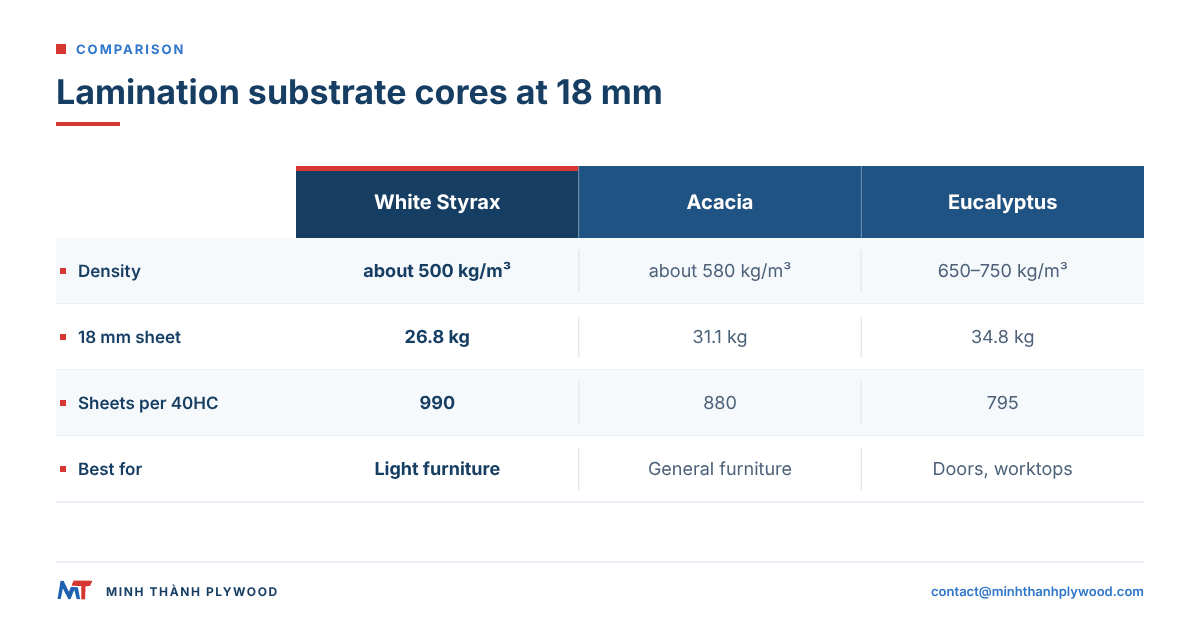
Vietnamese plywood cores come from plantation timber, and the core species decides the weight, screw holding and price of the substrate. Furniture panels at Minh Thanh use white Styrax or Eucalyptus cores as standard; Acacia is made on order.
| Core | Reference density | 18 mm sheet, 1220 × 2440 mm | Sheets per 40HC at 18 mm | Best for |
|---|---|---|---|---|
| White Styrax | about 500 kg/m³ | 26.8 kg | 990 | Light furniture and wall panels, European orders |
| Acacia (on order) | about 580 kg/m³ | 31.1 kg | 880 | General furniture at mid weight |
| Eucalyptus | about 650–750 kg/m³ | 34.8 kg | 795 | Doors, worktops, heavy parts, screw holding |
Sheet weights use the reference densities of 500, 580 and 650 kg/m³; the container counts are planned against a 28,000 kg payload. Many European furniture buyers choose Styrax for its light weight and pale, even surface. Ha Hoa, where Minh Thanh’s factory stands, is surrounded by the plantations that supply these cores.
Can eucalyptus plywood be used as a lamination base?
Yes, eucalyptus plywood is a good lamination base wherever weight is not the first concern. Its density, about 650–750 kg/m³, makes a stiff, hard board that holds screws and hinges well, resists dents under a thin overlay and carries loads on shelves and worktops.
Points to plan for:
- Weight. An 18 mm eucalyptus sheet weighs about 34.8 kg against 26.8 kg for Styrax, and a 40HC carries 795 sheets instead of 990.
- Face grade. Eucalyptus faces are quoted A/A, A/B or B/B; B/B is the grade for painted or overlaid panels.
- Colour. Eucalyptus is darker than Styrax; under opaque decor paper or HPL the colour does not show, under thin light veneers it can.
- Machining. The hard core gives clean edges for edge banding and holds dowels and cam fittings firmly.
For doors, worktops, bathroom and kitchen parts, a eucalyptus core with MR glue is a common choice; for wall panels and wardrobes, Styrax keeps the panel light.
Calibrated thickness: why it decides the laminate result
Calibrated thickness decides the laminate result because a laminating press squeezes the overlay onto the board with even pressure only if the board is even. Thick spots take too much pressure and can crush or glaze the decor; thin spots take too little, and the paper does not bond fully.
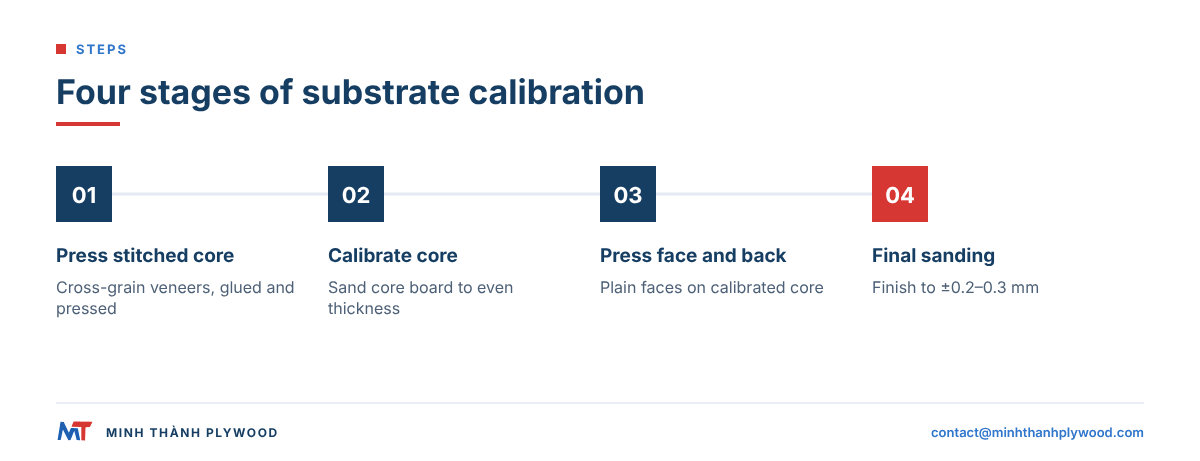
Minh Thanh makes calibrated substrate in two pressings:
- Core board. Core veneers are laid cross-grain, stitched, glued and pressed.
- Calibration. The core board is sanded to an even, calibrated thickness.
- Face and back. A plain face and back are pressed onto the calibrated core.
- Final sanding. Both faces are sanded to the final tolerance.
The result is a sanded furniture panel at ±0.2–0.3 mm, down to ±0.2 mm. Commercial plywood at ±0.5 mm is acceptable under thick HPL or where the panel is hidden, but not under thin melamine paper or high-gloss foil. More on tolerance in calibrated plywood.
Surface: which face grade goes under the laminate?
The surface a laminator needs is even and clean, not beautiful. Two face grades cover most orders:
| Surface | What it is | Best under |
|---|---|---|
| Plain sanded face (B/B) | Low-cost poplar or eucalyptus face veneer, sanded | Melamine paper, HPL, paint, PVC |
| Better face (A/B) | Clean face where an edge or back may stay visible | Thin veneers and light decors |
Poplar faces are pale and even, which helps under light decors; see poplar plywood. Eucalyptus faces are harder; see eucalyptus plywood. Ask for the face and back in the same grade when both sides are laminated, so the panel stays balanced.
Faces are sanded and polished as standard, and both faces can be supplied UV-ready, to the standard customers need to apply their own UV coating.
Moisture and flatness before hot pressing
The substrate should reach the laminating press at the moisture of your hall and lying flat. Minh Thanh dispatches furniture plywood at 8–12 % moisture content; on arrival, panels settle toward local conditions over days to weeks.
Good practice at the laminating plant:
- Store packs flat on level bearers, off the floor, in the hall where they will be pressed.
- Leave packs wrapped until use, then let opened sheets rest before pressing.
- Check moisture with a meter on a few sheets per pack.
- Laminate both faces, or use a balancing paper on the back, so the panel does not cup.
A substrate that arrives flat stays flat when both faces are pressed with matched layers; an overlay on one face only pulls the panel toward that side as the decor shrinks after pressing.
Glue and emission for laminated furniture
Specify the glue for the finished use and the emission class for the finished market, as two separate lines. The laminate does not change the glue line inside the plywood.
| Use of the laminated panel | Glue in the substrate | Emission line |
|---|---|---|
| Dry-room furniture, wardrobes, offices | UF glue at E0 emission | E0, with chamber test evidence |
| Kitchens, bathrooms, damp interiors | Melamine-fortified (MR) glue | Emission class stated separately |
| Wet areas, exterior parts | Phenolic (WBP) glue | Emission class stated separately |
The glue line itself is classed separately from emission: BS EN 314-2 sets the bonding-quality requirements, and BS EN 636 covers plywood for dry, humid or exterior conditions, so name the class that matches the laminated use.
Minh Thanh’s evidence for the plywood is CARB P2 / TSCA Title VI certification (ICTT mill no. 23024). Six ASTM D6007 chamber tests between April 2025 and June 2026 on 9, 15 and 18 mm panels averaged 0.014–0.032 ppm. The limit for veneer-core hardwood plywood is 0.05 ppm under 40 CFR 770.10. Three tests were run by Shanghai Hongjun and three by ICTT Vietnam. Third-party testing to EN 717-1 or another buyer method is arranged through SGS on request.
The laminated product needs its own record from the laminating plant for the finished board.
Melamine, HPL, veneer and PVC: what each needs from the substrate
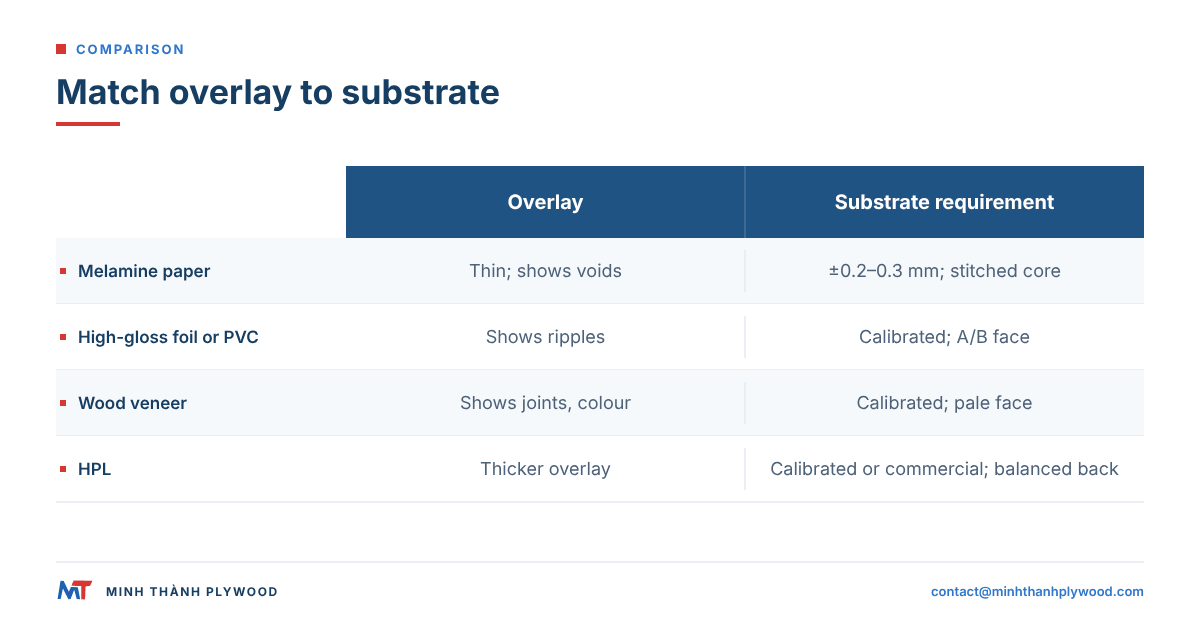
Each overlay asks something different of the substrate. Thin, glossy overlays are the most demanding; thick HPL is the most forgiving.
| Overlay | Thickness | What it shows from below | Substrate to order |
|---|---|---|---|
| Melamine decor paper | Very thin | Every step, void and sanding mark | Calibrated ±0.2–0.3 mm, B/B or better face, stitched core |
| High-gloss foil, PVC | Thin | Ripples and dents in reflected light | Calibrated, A/B face, dense core where possible |
| Natural or engineered veneer | Thin wood | Open joints, glue bleed, colour under light veneers | Calibrated, pale face such as poplar |
| HPL (high-pressure laminate) | Thicker sheet | Large steps and warping | Calibrated or commercial tolerance, balanced back |
| Paint and UV coating | Coating only | Grain, patches, sanding marks | A/B face, UV-ready, sanded and polished |
For HPL boards in detail, see HPL plywood.
Thin substrates for doors and panels
Thin plywood of 3–5 mm is the substrate for door skins, drawer bottoms, cabinet backs and wall panels. At Minh Thanh, thin plywood is always 5-ply: 3 mm has one core veneer, two cross-band veneers and two faces; 4 and 5 mm have three core veneers and two faces.
A 4 mm furniture panel uses three core veneers of about 1.3 mm Styrax. Premium thin veneer is scarce, so 4 mm can take longer to produce; the standard is not lowered to go faster. See thin plywood for sizes and builds, and door blanks and door core plywood for door makers.
Lamination faults that start in the substrate
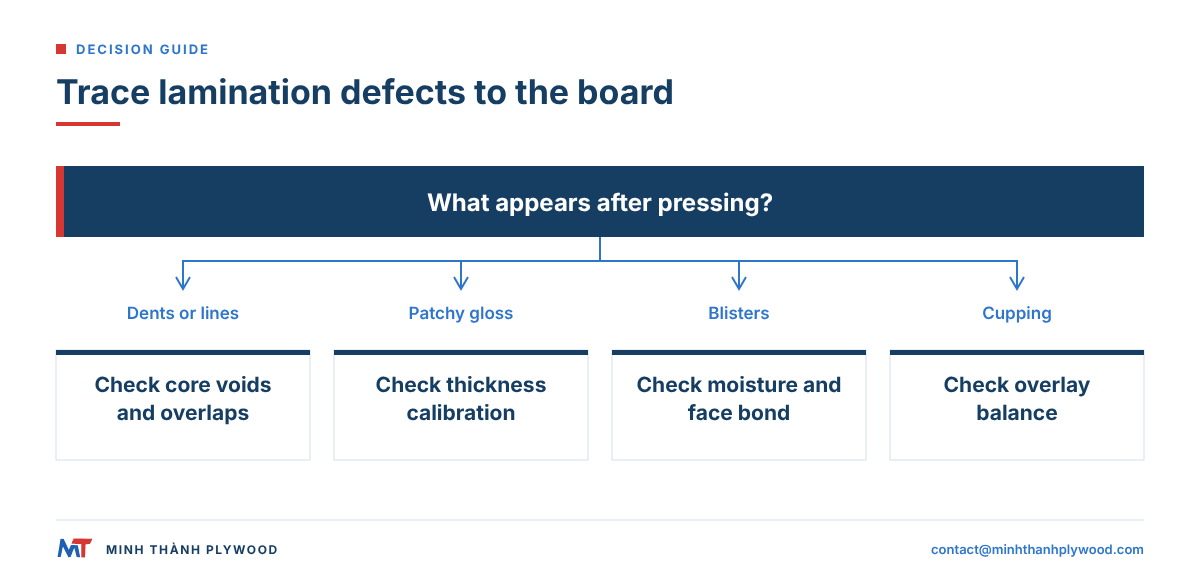
Most lamination faults that appear at the press start in the board underneath, so the substrate specification is the cheapest place to prevent them. The table links each fault a laminating plant sees to its cause in the plywood and the line in the order that prevents it.
| Fault on the laminated panel | Cause in the substrate | Prevention in the order |
|---|---|---|
| Dents or lines showing through decor paper | Core voids, overlaps or open joints under the face | Stitched core, pressed twice |
| Patchy gloss or pressure marks | Thickness varies across the sheet | Calibrated ±0.2–0.3 mm |
| Blisters after pressing | Wet spots in the board, or a weak face bond | 8–12 % moisture, sound glue line |
| Cupping after lamination | Unbalanced overlay or uneven board moisture | Same grade face and back, balancing layer |
| Sanding marks under high gloss | Coarse or uneven sanding | Sanded and polished faces |
| Edge swelling in kitchens | Interior glue in a damp room | MR glue for kitchens and bathrooms |
| Chipping when panels are cut | Loose, brittle face over a weak core | Dense, closed core and a sound face |
A useful habit is to laminate a few sheets from the first container as a trial, before the full run, and to keep one laminated sample as the reference for later orders. That trial shows how the board behaves with your decor, glue and press settings, and it turns the approved sample into a reference both sides can check against.
When a fault appears, keep the sheet with its pack label and photograph the panel edge as well as the face; the edge shows the core build, which is where most substrate faults can be traced. For defects of the plywood itself, see common plywood defects.
Choosing a matt plywood substrate supplier in Vietnam
Choose a matt plywood substrate supplier in Vietnam by the evidence behind each property that matters to your press, not by the price per cubic metre alone. Ask every supplier for the same eight things:
- Own production. A manufacturer, with factory photos and videos of its own line.
- Calibration. The tolerance by product line, and whether the core is calibrated before the faces go on.
- Core build. Core species and whether core layers are stitched.
- Moisture. The dispatch moisture band, with readings on request.
- Glue and emission. Glue type and emission class as separate lines, with chamber test reports naming the laboratory and method.
- Certificates. For example CARB P2 / TSCA Title VI and ISO 9001:2015.
- Documents for Europe. The EUDR compliance dossier (origin records and geolocation files).
- Loading evidence. Photos and video of every shipment before loading.
Minh Thanh Plywood answers all eight: a manufacturer in Ha Hoa, Phu Tho, with annual capacity of 50,000+ m³ and Europe as its main market and ISO 9001:2015 certification for plywood manufacturing (KAC25/0185).
Sizes, packing and container loads
Substrate is ordered by size, thickness and core, and shipped by the full container. Standard sizes are 1220 × 2440 mm and 1250 × 2500 mm, with custom sizes such as 1220 × 2500 mm and 1220 × 2280 mm when the press needs trim allowance; length and width tolerance is ±2 mm.
At 18 mm, a 40HC carries 990 Styrax-core sheets (about 53 m³), 880 Acacia (about 47 m³) or 795 Eucalyptus (about 43 m³), planned against a 28,000 kg payload unless the booking is lower. Packs are about one metre high.
MOQ is one 40HC, and mixed specifications in one container are possible by agreement: for example 18 mm carcass board and 6 mm backs for the same furniture line. Every shipment is photographed and filmed before loading. See container loading for pack plans.
Matt plywood price and sizes: per m³ and per sheet
Marketplace listings quote matt and commercial plywood per piece, so a per-m³ price cannot be compared with them directly. The table converts the starting price for Minh Thanh furniture plywood, US$350/m³ FOB Hai Phong (October 2026), into a raw FOB figure for one 1220 × 2440 mm sheet at each thickness. It is a worked example of the arithmetic, not a sheet price: the core (Styrax, Eucalyptus or Acacia), face grade, glue and thickness class move the per-m³ rate, and the quotation fixes it.
| Thickness | Volume of one 1220 × 2440 mm sheet | Raw FOB example at US$350/m³ |
|---|---|---|
| 3 mm | 0.0089 m³ | US$3.13 |
| 6 mm | 0.0179 m³ | US$6.25 |
| 9 mm | 0.0268 m³ | US$9.38 |
| 12 mm | 0.0357 m³ | US$12.50 |
| 15 mm | 0.0447 m³ | US$15.63 |
| 18 mm | 0.0536 m³ | US$18.75 |
| 21 mm | 0.0625 m³ | US$21.88 |
| 25 mm | 0.0744 m³ | US$26.05 |
For comparison, one Vietnam-origin plywood listing on a marketplace shows US$15.80 per piece at 100–399 pieces with a 100-piece minimum, for 9–21 mm boards in 1220 × 2440 mm (Boardsmdf listing, accessed 21 October 2026). That sits between the 15 mm and 18 mm rows above. A trader’s piece price covers a small lot, and a container buyer working from the per-m³ rate sees the same thickness at a figure set by the core and the grade.
At 18 mm, one 40HC holds 990 Styrax-core, 880 Acacia or 795 Eucalyptus sheets. MOQ is one 40HC with mixed thicknesses by agreement, so a 6 mm back and an 18 mm carcass board can travel in one container.
What to send for a quote
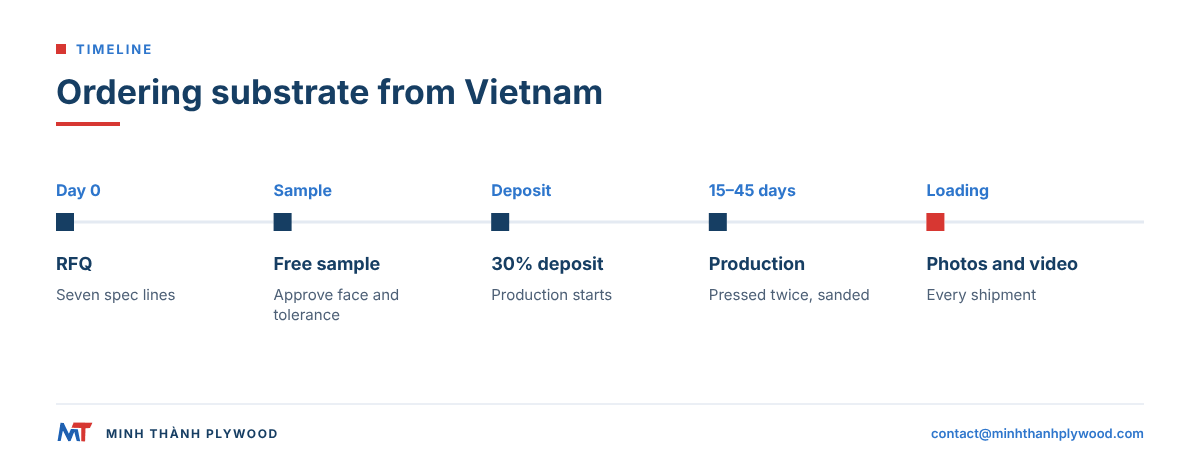
Send the substrate specification in seven lines, and the quotation comes back on the same basis as your current board:
- Use: overlay type (melamine, HPL, veneer, PVC, paint) and the finished product.
- Core: white Styrax or Eucalyptus (Acacia on order), stitched, pressed twice.
- Glue and emission: for example UF glue at E0 emission; MR or WBP for damp use.
- Surface: face and back grade, for example B/B, sanded; UV-ready if painted.
- Size and thickness: for example 1220 × 2440 mm, 18 mm, ±0.2–0.3 mm.
- Moisture content: 8–12 % at dispatch.
- Packing and quantity: sheets per pack, sheets or m³ per order, destination port.
Production takes 15–45 days after the 30% deposit; payment is 70% against the scanned B/L or by irrevocable L/C at sight; terms are FOB Hai Phong, CFR or CIF. Furniture plywood starts from US$350/m³ (October 2026), and samples are free. Send your specification to contact@minhthanhplywood.com or WhatsApp +84 988 586 601; replies within hours. Product details: furniture plywood from Minh Thanh.
Buyer questions, answered
What is matt plywood?
Matt plywood is plain plywood with a sanded, non-decorative surface, made as a base for lamination. Laminating plants press melamine paper, HPL, veneer or PVC film onto it, so they buy flatness, calibrated thickness and a closed core rather than a face.
Can eucalyptus plywood be used as a lamination base?
Yes. Eucalyptus plywood makes a dense, stiff lamination base with good screw holding, well suited to doors, worktops and heavy parts. It is heavier than a Styrax core, so weigh freight and handling; a B/B eucalyptus face is the usual grade for overlays.
What moisture content should a lamination substrate have?
Minh Thanh dispatches furniture plywood at 8–12 % moisture content. Let the panels settle in the laminating hall before pressing, and check them with a moisture meter so they match the conditions of your line.
What thickness tolerance does a lamination substrate need?
For melamine and thin overlays, a calibrated sanded board at ±0.2–0.3 mm, down to ±0.2 mm, keeps the press pressure even across the sheet. Commercial plywood at ±0.5 mm suits thicker HPL and less critical parts.
Which core is best for a laminated furniture panel?
White Styrax is the lightest core at about 500 kg/m³ and is the usual choice for European furniture. Eucalyptus, about 650–750 kg/m³, is denser and holds screws better. Acacia, about 580 kg/m³, sits between them and is made on order.
Is matt plywood the same as melamine plywood?
No. Matt plywood is the plain base board; melamine plywood is that board after decor paper soaked in melamine resin has been pressed onto it. Laminating plants buy the first and make the second.
Why do laminating plants buy plywood instead of particleboard or MDF?
Plywood is lighter than MDF, holds screws in the edge, swells less when wet and survives transport better. Plants choose a plywood substrate for kitchens, bathrooms, caravans, doors and furniture shipped assembled.
What glue should a lamination substrate have?
UF glue at E0 emission for dry-room furniture, melamine-fortified (MR) glue for kitchens and bathrooms, phenolic (WBP) for wet or exterior parts. Order glue type and emission class as two separate lines.
Can I order oversize sheets for trimming after lamination?
Minh Thanh makes 1220 × 2440 mm and 1250 × 2500 mm as standard and custom sizes such as 1220 × 2500 mm and 1220 × 2280 mm. Name the trim allowance your press needs in the RFQ.
Why does a laminated panel show bumps or dents?
Thin overlays such as melamine paper and high-gloss foils telegraph whatever is under them: core gaps, overlaps, sanding marks and thickness steps. A stitched, calibrated core with an evenly sanded surface keeps the laminated face smooth.
Do you supply thin plywood for lamination?
Yes. Thin plywood of 3–5 mm is always 5-ply at Minh Thanh, used for door skins, drawer bottoms, back panels and wall panels after lamination.