
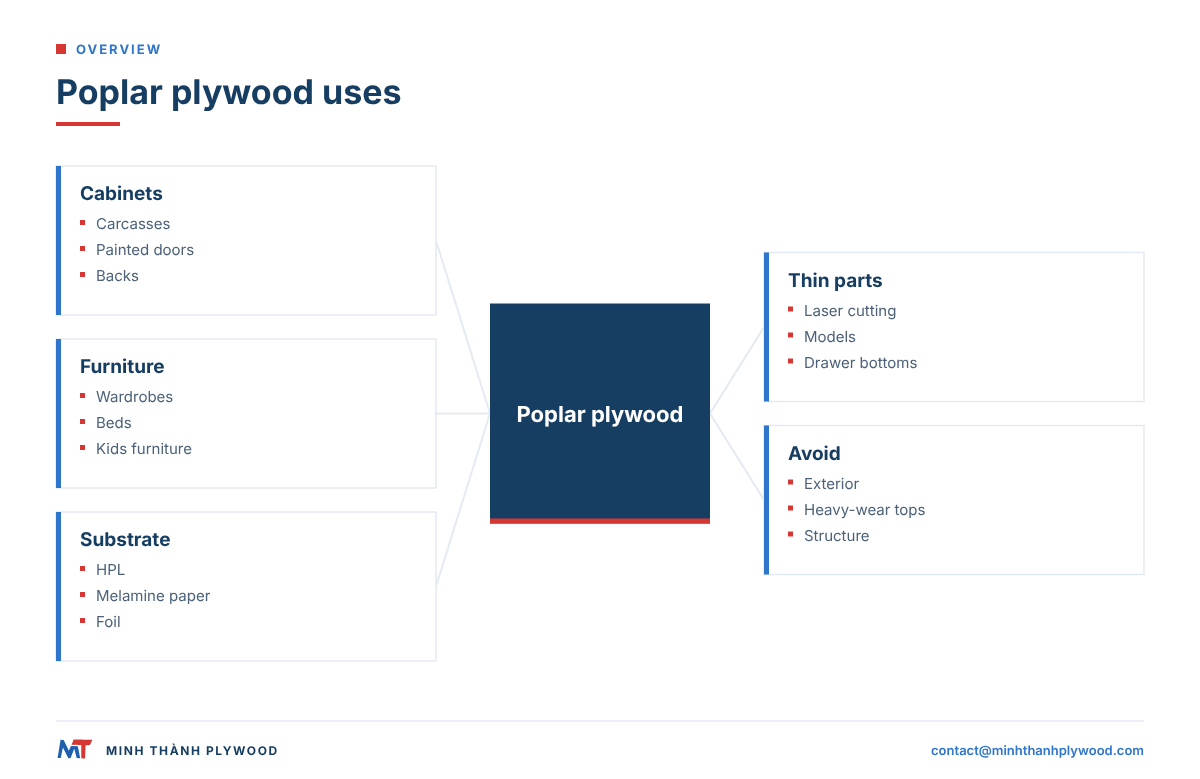
Poplar plywood is plywood with a pale, plain-grained poplar veneer face, and it is used mostly where the surface will be painted, foiled or laminated: kitchen and bathroom cabinets, wardrobes, drawer boxes, shelving, children's furniture, laminate substrate and thin laser-cut parts. It is light, cuts cleanly and takes paint evenly. Minh Thanh Plywood presses poplar faces on white Styrax or Eucalyptus cores for European furniture makers.
What is poplar plywood used for? The short answer
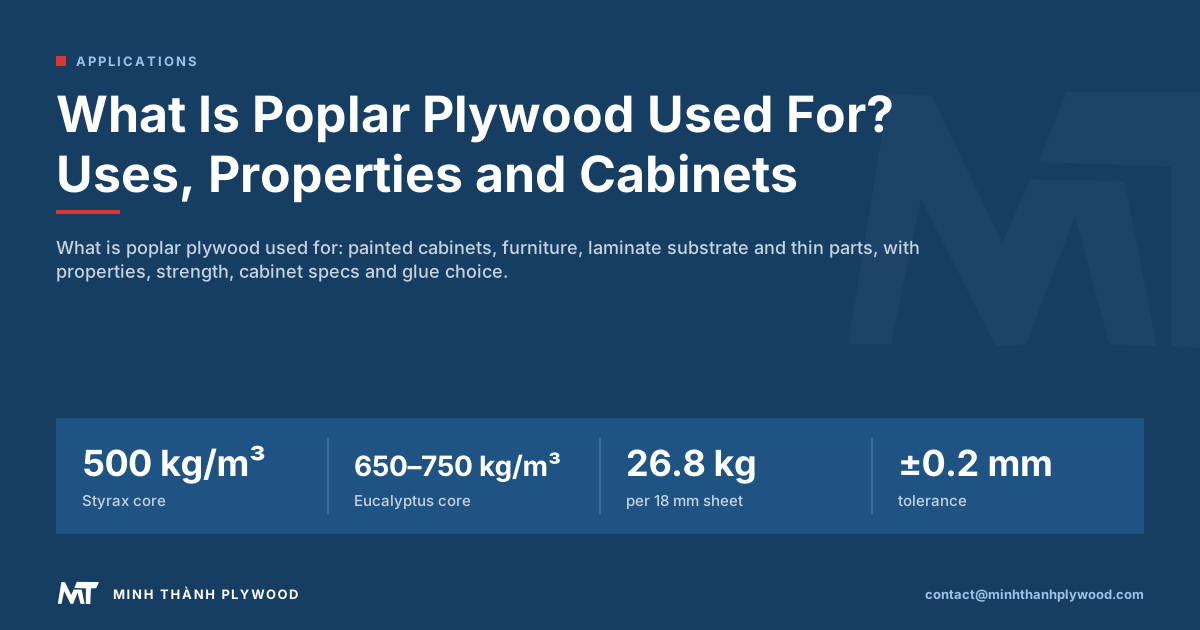
Poplar plywood used for furniture and interior panels is chosen where the surface will be painted, foiled or laminated. Its pale, even, almost grain-free face is the easiest wood surface to paint, and the panel is light and machines cleanly. That makes it the everyday panel for cabinet carcasses, wardrobes, drawer parts, shelving and children’s furniture.
| Use | Thickness | Why poplar plywood fits |
|---|---|---|
| Kitchen and bathroom cabinets | 15–18 mm carcass, 3–6 mm backs | Takes paint and laminate evenly, light to handle |
| Wardrobes and closets | 15–18 mm | Flat, light, good value per sheet |
| Drawer boxes and bottoms | 12–15 mm sides, 3–6 mm bottoms | Machines cleanly, light |
| Shelving and bookcases | 18 mm and more | Paints well; core sets stiffness |
| Children’s furniture and toys | 9–18 mm | Smooth paintable face, light weight |
| Laminate substrate (HPL, melamine, foil) | 9–18 mm | Flat, even surface under the overlay |
| Laser-cut parts, models, signs | 3–6 mm | Clean cut, even thin panel |
| Caravan, boat and shopfitting interiors | 9–15 mm | Light panel under paint or laminate |
| Ceiling lining and wall panelling | 6–12 mm | Light enough to lift overhead, takes paint without grain showing |
What is poplar plywood?
Poplar plywood is plywood whose face and back are poplar veneer, a cream to pale-yellow hardwood with a fine, straight, plain grain. What sits inside depends on where it is made, and the core decides the weight, the edge colour and much of the strength.
- All-poplar plywood: poplar in every ply. This is the usual build in China and Europe, and it gives a very light panel.
- Poplar-faced plywood on a hardwood core: a poplar face and back over another species. Vietnamese poplar plywood is this type, because Vietnam has no poplar core; ours uses white Styrax or Eucalyptus.
- Combi or mixed core: poplar face with a mix of species inside, common in commercial grades.
The face veneer is thin, typically 0.2–0.5 mm, and European buyers often ask for about 0.3 mm. For the build differences between origins, see Vietnamese vs European poplar plywood.
What is poplar plywood good for?
Poplar plywood is good for four groups of work: painted furniture, laminated panels, thin parts and light-weight interiors. In all four the poplar face is a base for something else, paint, overlay or a cut shape, rather than the finished look.
- Painted furniture. Cabinets, wardrobes, beds, desks and shelving finished in lacquer or paint. The even face needs little filling.
- Laminated and foiled panels. HPL, melamine paper and PVC or PET foil need a flat, even substrate; a poplar face gives it without the grain showing through.
- Thin parts. Backs, drawer bottoms, door skins, laser-cut parts, models, toys and craft panels in 3–6 mm.
- Light interiors. Caravans, boats, shopfitting and exhibition stands where weight counts.
It is less suited to surfaces that stay natural under a clear coat in high-end furniture, where birch or decorative veneer shows more figure, and to heavy-wear or exterior jobs.
Poplar plywood price in Australia: retail per sheet and the container route
Retail poplar plywood in Australia costs about A$97 for a 3 mm sheet, A$172 for 12 mm and A$223 for 18 mm in the 2440 × 1220 mm size. Plyco lists A/B face, B back, interior bond and E0 emission for these sheets, and names commercial and residential fit-outs, ceiling lining, furniture, caravans and laser cutting as their uses.
| Thickness, 2440 × 1220 mm | Retail price per sheet (A$) |
|---|---|
| 3 mm | 97.48 |
| 6 mm | 138.70 |
| 9 mm | 155.02 |
| 12 mm | 172.10 |
| 15 mm | 205.39 |
| 18 mm | 222.56 |
| 25 mm | 280.85 |
| 30 mm | 347.96 |
Prices are the Plyco listing read on 21 October 2026 and move with stock and sales. For a fit-out firm or cabinet maker buying by the container, the route is different: our furniture and interior plywood starts from US$350/m³ FOB, so a raw 18 mm sheet works out at about US$19 (0.0536 m³ × US$350) and a 12 mm sheet at about US$12.5 (0.0357 m³ × US$350).
Those are raw FOB examples for a full container, not a sheet price for a small lot; sea freight, import GST and the importer’s margin come on top, and the price depends on face, core and glue. Compare the retail row with your landed cost before you decide.
Poplar plywood properties
Poplar plywood properties come from two sources: the poplar face, which is pale, soft, smooth and easy to paint, and the core, which sets the weight, stiffness and screw holding. Read the two together when you compare offers.
| Property | Poplar face on Styrax core | Poplar face on Eucalyptus core |
|---|---|---|
| Panel density | About 500 kg/m³ | 650–750 kg/m³ |
| All-poplar plywood for comparison | About 426 kg/m³ (PlyOnline) | Not applicable |
| 18 mm sheet, 1220 × 2440 mm | About 26.8 kg | About 34.8 kg |
| Edge colour | Pale cream | Pinkish brown |
| Face hardness | Soft, dents more easily | Soft face, firmer under it |
| Screw holding | Good with pre-drilling | Higher |
| Paintability | Excellent | Excellent |
| Machining | Clean cut, light on tools | Clean cut, harder core |
| Plies at 18 mm | 11–13 plies | 11–13 plies |
The weight follows the density: a 1220 × 2440 × 18 mm sheet at 500 kg/m³ weighs about 26.8 kg. Our panels are sanded to ±0.2 mm and dried to 8–12 % moisture at dispatch. Lighter all-poplar panels are compared in our guide to lightweight plywood.
Is poplar plywood strong?
Poplar plywood is strong enough for cabinets, wardrobes, shelving and furniture frames, because cross-laid veneers give plywood its strength whatever the species. Poplar itself is a soft, light hardwood, so a poplar panel is less stiff and less dent-resistant than the same thickness of birch.
What changes the answer is the core. An all-poplar panel is the lightest and the least stiff; a poplar face on a Eucalyptus core is denser and holds screws better; a Styrax core sits between the two and stays light. For long shelves, choose 18 mm or more, a denser core or a front lipping, and keep the span short. For loads such as floors, worktops and structural parts, poplar plywood is not the panel to choose.
Is poplar plywood good for cabinets?
Yes. Poplar plywood is good for cabinets that will be painted or laminated, and that is why it is a standard cabinet panel for European furniture makers. It is flat, light to lift into place, machines cleanly for hinge and shelf-pin holes and gives paint an even base.
Three points make a poplar cabinet panel work in a kitchen or bathroom:
- Glue: melamine-fortified MR glue for kitchens and bathrooms, UF glue at E0 emission for dry rooms.
- Thickness tolerance: ±0.2 mm keeps hinge holes and drawer runners in line across the run of cabinets.
- Face pair: an A face on visible doors and sides, B on hidden faces.
For a clear-finished natural wood cabinet, birch or EV gives a more decorative face. For the full comparison of cabinet panels, see our plywood for kitchen cabinets guide.
Poplar plywood for cabinets: what to order
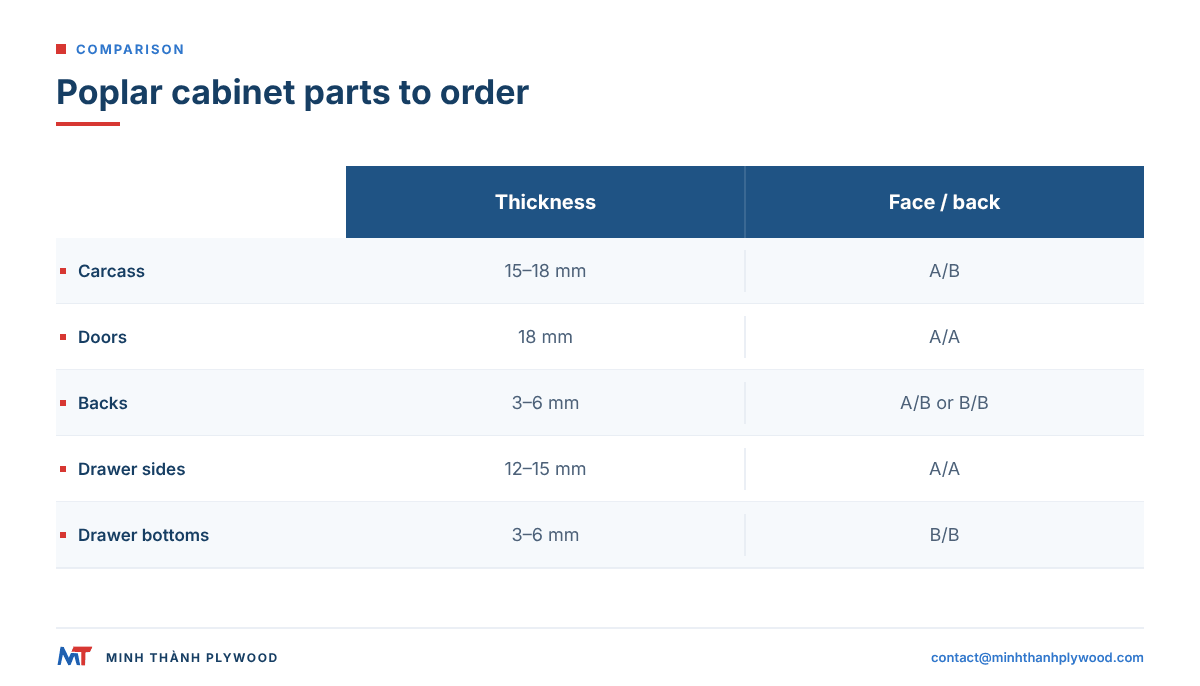
Order poplar plywood for cabinets by part: carcass, doors, backs and drawers each need their own thickness and face pair. One sheet type for everything costs more than it should.
| Cabinet part | Thickness | Face / back | Glue |
|---|---|---|---|
| Carcass sides, top, bottom | 15–18 mm | A/B | MR for kitchens, UF at E0 for dry rooms |
| Painted doors and drawer fronts | 18 mm | A/A | MR or UF at E0 |
| Shelves | 18 mm | A/B | As the carcass |
| Backs | 3–6 mm | A/B or B/B | As the carcass |
| Drawer sides | 12–15 mm | A/A | As the carcass |
| Drawer bottoms | 3–6 mm | B/B | As the carcass |
| Laminated or HPL-faced parts | 15–18 mm | B/B | As the carcass |
All thin panels of 3–5 mm are made with five plies. Cut-to-size parts, one sheet cut into 4, 6 or 8 pieces, can arrive ready for the edge bander; see our cut-to-size plywood page.
Is poplar plywood good for furniture?
Yes. Poplar plywood is good for furniture with painted, lacquered or laminated surfaces: wardrobes, beds, desks, shelving, TV units and children’s furniture. It is light, so flat-packed furniture is easier to ship and assemble, and its pale face hides nothing under white or coloured paint.
For upholstered furniture, poplar plywood makes seat boards, backs and arm profiles cut from a sheet. For children’s furniture it gives a smooth face for low-emission paints. Where the wood will be seen under a clear finish, choose the face by the look: poplar is plain and creamy, birch is harder and more figured, and EV gives a repeatable decorative grain.
Painting, laminating and finishing poplar plywood
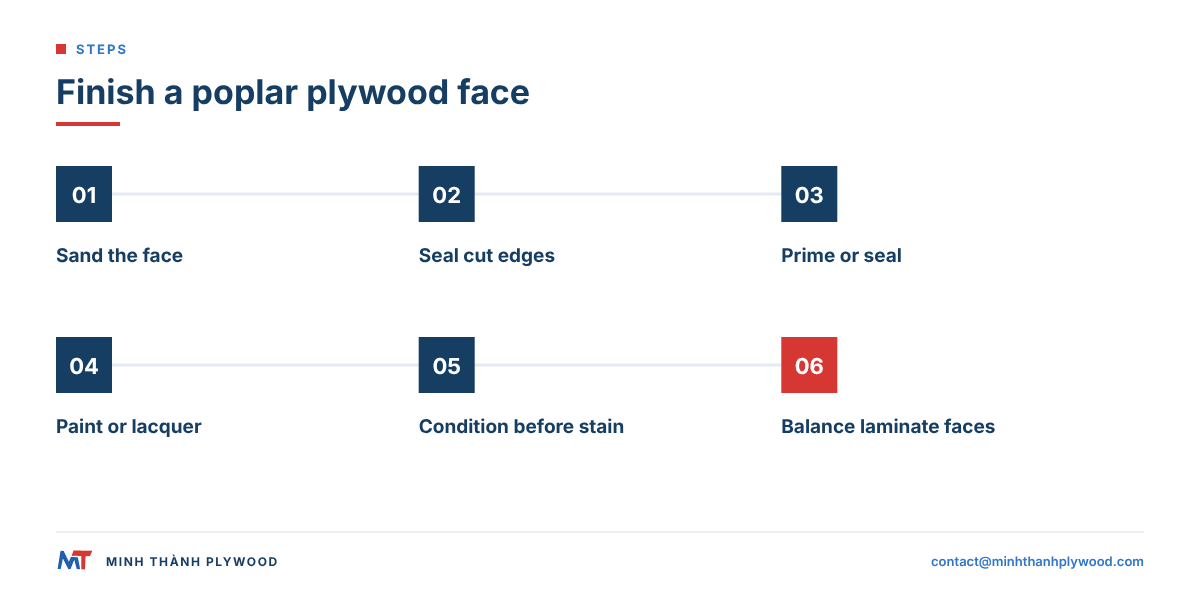
Poplar plywood takes paint and lacquer evenly with light sanding and a primer, and it is a flat base for HPL, melamine paper and foil. Stain is the one finish to handle with care, because poplar absorbs it unevenly.
- Sand the face lightly with fine grit; our faces arrive sanded and polished, and both faces are UV-ready for a factory UV line.
- Seal the edges with filler or edge banding before painting.
- Prime with a sanding sealer or primer suited to the topcoat.
- Paint or lacquer, sanding lightly between coats.
- For stain, use a pre-stain conditioner or a gel stain to avoid blotching.
- For laminates, press HPL or melamine paper with the adhesive the overlay supplier names, and balance both faces to keep the panel flat.
Thin poplar plywood for laser cutting, models and backs
Thin poplar plywood, 3–6 mm, is used for cabinet backs, drawer bottoms, door skins, laser-cut parts, architectural models, toys, signs and craft kits. It cuts cleanly, the face takes print and paint, and the panel is light.
Our 3–5 mm panels are always five plies; the 6 mm ply count is set per order. At 3 mm that is one core veneer, two cross-bands and two faces; at 4 and 5 mm it is three core veneers and two faces, with the core veneer thickness set to the panel. For laser work, ask for a calibrated thickness and a core with few voids, because an air gap stops the beam. Premium thin face veneer is scarce, so 4 mm can take longer to produce; we keep the grade rather than shorten the time. The range is on our thin plywood page.
What is white core poplar plywood?
White core poplar plywood is a poplar-faced panel on a pale core, so the cut edge shows cream layers instead of brown ones. Ours uses white Styrax core veneers at about 500 kg/m³, which give a clean light edge, a light panel and up to 18 packs in a 40HC.
The white core matters when an edge stays visible, for example a clear-lacquered shelf edge or a laser-cut part. It also lowers weight: a 40HC with Styrax core carries about 990 sheets of 18 mm, about 53 m³, against 795 sheets, about 43 m³, with Eucalyptus core, because the denser core reaches the payload first. White-faced and bleached panels are a different product, covered in our guide to white plywood.
When is poplar plywood the wrong choice?
Poplar plywood is the wrong choice for exterior use without a phenolic WBP glue and a full finish, for floors and worktops that take heavy wear, for structural parts, and for high-end furniture where the natural face stays visible under a clear coat.
| Job | Why poplar struggles | Better choice |
|---|---|---|
| Exterior cladding, outdoor furniture | Poplar has little natural decay resistance | Exterior plywood with WBP glue |
| Floors, worktops, heavy-wear tops | Soft face dents | Birch or a hard overlay |
| Structural decks and beams | Not a structural grade | Structural plywood or LVL |
| Clear-finished show faces | Plain grain, stains unevenly | Birch, EV or decorative veneer |
| Wet areas without sealed edges | Edges take up water | MR glue plus sealed edges and finish |
Which glue for poplar-faced plywood in Europe and Australia?
For dry indoor furniture in Europe, specify UF glue at E0 emission; for kitchens, bathrooms and humid rooms, melamine-fortified MR glue; for outdoor parts, phenolic WBP. The glue sets the bond class, from EN 314-2 class 1 for dry use to class 3 for exterior, and the emission class is a second line on the order. In Australia the same panels are bought as interior-bond plywood under AS/NZS 2270 (plywood and blockboard for interior use) with E0 emission, as Plyco lists; EN 314-2 class 1 to 3 is the export equivalent to quote on an importer’s order.
The emission line matters more from 6 August 2026, when Commission Regulation (EU) 2023/1464 limits formaldehyde released by furniture and wood-based articles placed on the EU market to 0.062 mg/m³ in a test chamber (read 20 October 2026).
Our panels meet the emission and quality requirements European furniture buyers ask for. They carry CARB P2 / TSCA Title VI certification under ICTT mill no. 23024. Six ASTM D6007 chamber tests between April 2025 and June 2026 averaged 0.014–0.032 ppm. The limit for veneer-core hardwood plywood is 0.05 ppm under 40 CFR 770.10, part of the US EPA formaldehyde standards for composite wood products. SGS tests to EN 717-1 or another method on request.
Poplar face grades and how to order them
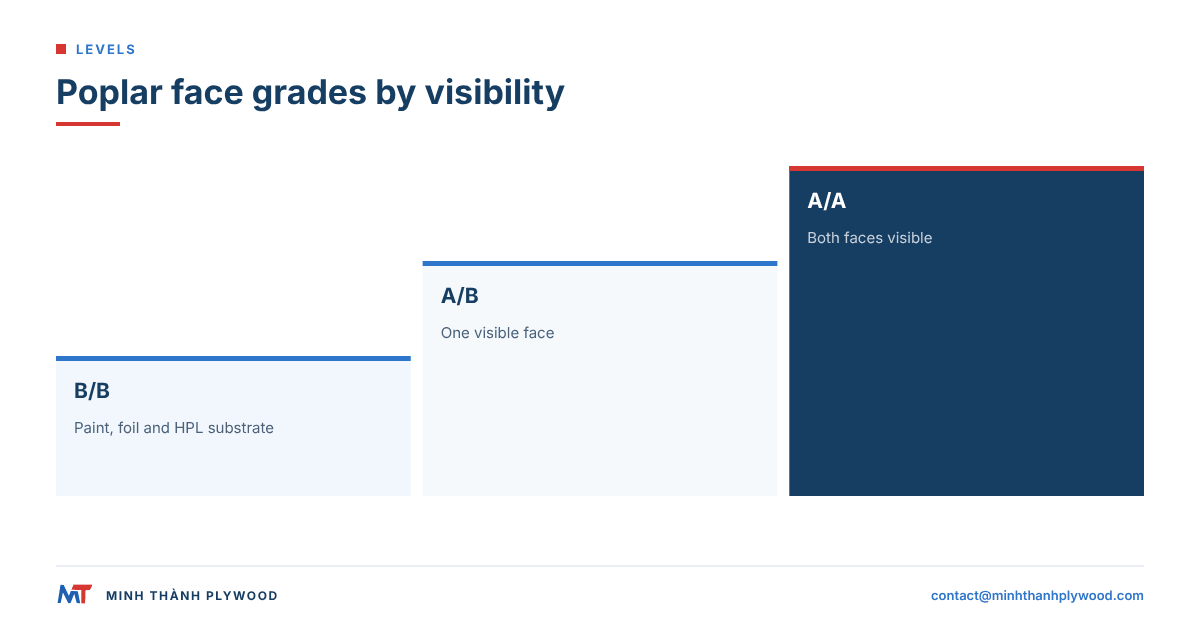
Poplar-faced plywood is quoted as a face/back pair: A/A for a clean cream face on both sides, A/B for one visible side and B/B for paint, foil and HPL. Buyers who order by Chinese codes use B/BB, BB/CC and CP, which map onto the same ladder.
| Grade pair | Face | Typical use |
|---|---|---|
| A/A | Clean, even cream face both sides | Doors, open shelving, drawer sides |
| A/B | One clean face, one with small marks | Carcass sides, shelves, one-side-visible parts |
| B/B | Small knots, colour streaks, repairs | Painted parts, HPL, melamine and foil substrate |
Every pair is graded against a sample sheet you approve before production, and the sample is the reference on arrival. Our poplar plywood page shows the faces and the full specification.
What to send for a poplar plywood quote
Send the application first, then one line per panel: we can quote, sample and produce from that without further questions.
| Line | Example: painted kitchen cabinets |
|---|---|
| Application | Painted kitchen carcasses and doors |
| Core | White Styrax, stitched |
| Glue and emission | MR glue; emission class as your market requires |
| Face / back | A/B carcass, A/A doors |
| Thickness and size | 18 mm and 3 mm, 1250 × 2500 mm |
| Tolerance | ±0.2 mm |
| Packing and quantity | Sheets per thickness, one 40HC, destination port |
Minimum order is one 40HC, which can mix thicknesses and grade pairs by agreement. Production takes 15–45 days after the 30% deposit, with the 70% balance against the scanned B/L, and samples are free. Send your list through the poplar plywood page; we reply within hours.
Buyer questions, answered
What is poplar plywood used for?
Poplar plywood is used mainly for painted and laminated furniture: kitchen and bathroom cabinets, wardrobes, drawer boxes, shelving and children's furniture. It is also a substrate for HPL, melamine paper and foil, and in 3–6 mm thicknesses it is used for backs, drawer bottoms, laser-cut parts and models.
Is poplar plywood good for cabinets?
Yes. Poplar plywood is one of the best-value panels for painted or laminated cabinets: it is light, flat and takes paint evenly. Use 15–18 mm for carcasses and doors and 3–6 mm for backs, with melamine-fortified glue for kitchens and bathrooms.
Is poplar plywood strong?
Poplar plywood is strong enough for furniture and cabinets, but poplar is a soft wood, so the face dents more easily than birch. A poplar face on a Eucalyptus core gives a harder, denser panel; on a Styrax core it is lighter.
Is poplar plywood good for furniture?
Yes, for painted, lacquered and laminated furniture. It is a standard panel for wardrobes, beds, shelving, desks and children's furniture. For a natural wood look under a clear finish, birch or oak veneer usually suits better.
What is white core poplar plywood?
White core poplar plywood is a poplar-faced panel on a pale core, so the cut edge looks light. Ours uses white Styrax core veneers, about 500 kg/m³, which give a cream edge and a light sheet.
Is poplar plywood waterproof?
No. Moisture resistance comes from the glue: UF glue at E0 emission is for dry interiors, melamine-fortified MR glue for humid rooms and phenolic WBP for outdoor exposure. Any panel near water also needs sealed edges and a finish.
How heavy is an 18 mm poplar plywood sheet?
An 18 mm sheet of 1220 × 2440 mm weighs about 26.8 kg on a Styrax core and about 34.8 kg on a Eucalyptus core. The core sets the weight, not the face.
Can poplar plywood be stained?
It can, but poplar takes stain unevenly and can blotch. Use a pre-stain conditioner or a gel stain, or choose poplar for paint and a birch or EV face for stain and clear finishes.
Is poplar plywood good for laser cutting?
Yes. Thin poplar plywood of 3–6 mm cuts cleanly and is a standard laser and CNC material for models, toys, signs and craft parts. Ask for a calibrated thickness so the cut depth stays the same.
Which glue should I specify for poplar furniture plywood in Italy?
For dry indoor furniture, specify UF glue at E0 emission. For kitchens, bathrooms and humid rooms, specify melamine-fortified MR glue; phenolic WBP is for outdoor parts. State the emission class as a separate line from the glue.