
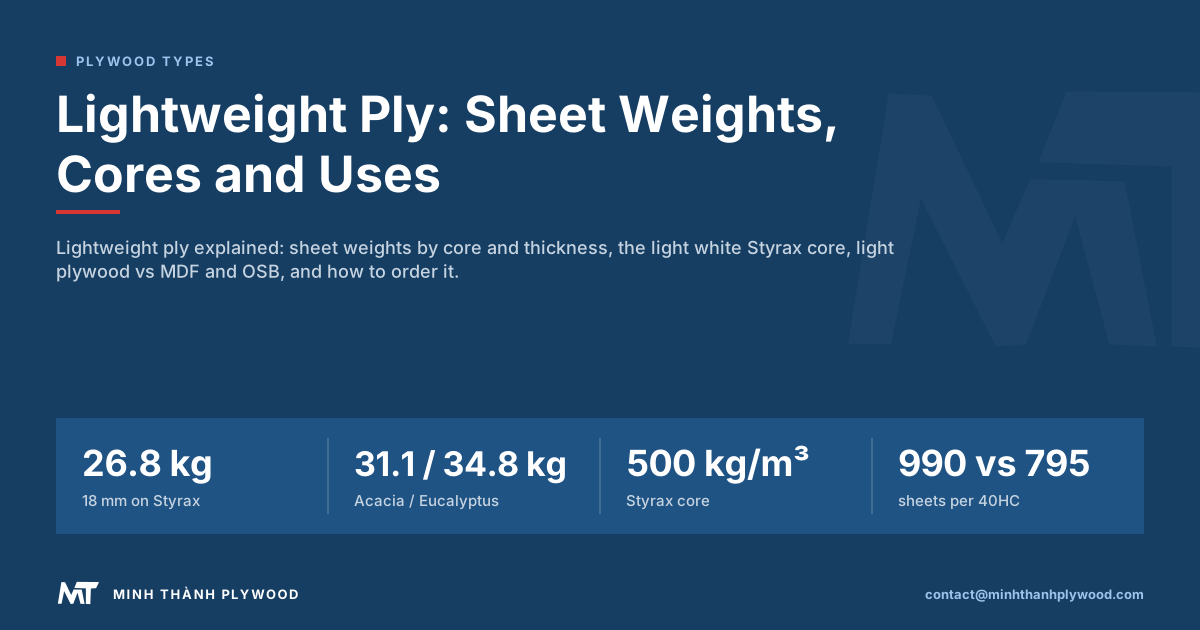
Lightweight ply is plywood built from low-density veneers so a full sheet is easier to lift, ship and fix. The weight comes from the core species: a white Styrax core at about 500 kg/m³ gives an 18 mm sheet of 26.8 kg, against 34.8 kg on Eucalyptus. Minh Thanh Plywood makes Styrax-core furniture panels with poplar, EV, birch, okoume and pine faces.
What is lightweight ply?
Lightweight ply is plywood made from low-density veneers so that a full sheet weighs noticeably less than standard plywood of the same thickness. There is no formal weight class in the plywood standards; buyers use the term for panels whose core species is light.
Two levers make a panel light:
- The core species. The core is most of the panel’s volume, so its density sets most of the weight.
- The construction. Honeycomb, foam or hollow cores replace solid wood with air. These are composite panels rather than plywood in the usual sense.
For furniture, cabinets and interiors, lightweight ply board almost always means the first lever: a light solid-veneer core under a good face. That is the panel this guide is about, with the composite options covered further down.
What does lightweight ply cost in the UK?
UK shops sell lightweight ply as decor-faced boards for vans and caravans, priced per full 2440 × 1220 mm sheet. In October 2026 the ranges looked like this:
| Board | Typical UK shop price per sheet | Weight |
|---|---|---|
| 15 mm lightweight furniture board, matt or gloss (DeadSound) | from £67.99 | about 25 kg |
| 15 mm Italian matt, roughcast or gloss illomba board (UK Leisure Parts) | £136.80 to £193.54 | not listed |
| 3 mm gloss lightweight illomba board (UK Leisure Parts) | £90.00 | not listed |
These are finished boards with a laminate on both faces. Sample packs start at £4.99 at DeadSound, and full sheets are collection only because of their size. DeadSound prices include VAT, and UK Leisure Parts shows trade prices only after login.
The cheapest route to a lower price per sheet is to buy the panel itself, not the finished board. A raw 15 mm Styrax-core sheet at our US$350/m³ FOB is about 0.045 m³, so about US$15.6 FOB before any laminating, a raw FOB example and not a sheet price. Freight, duty, laminate and margin come on top. A conversion workshop that presses its own decor face onto an undecorated panel keeps the spread between that cost and the £68 to £194 shelf price.
Which plywood is the lightest?
The lightest solid-veneer plywood is made from very low-density species such as balsa, paulownia and falcata. These ultralight panels serve model making, boat and surfboard cores and bonded vehicle parts, where weight matters more than screw-holding.
Light furniture plywood sits one step heavier. Its core must machine cleanly, take hinges and confirmat screws, and stay flat under a sanded face. In Vietnam that core is white Styrax, a plantation species grown in the north of the country, around the factory region of Phu Tho.
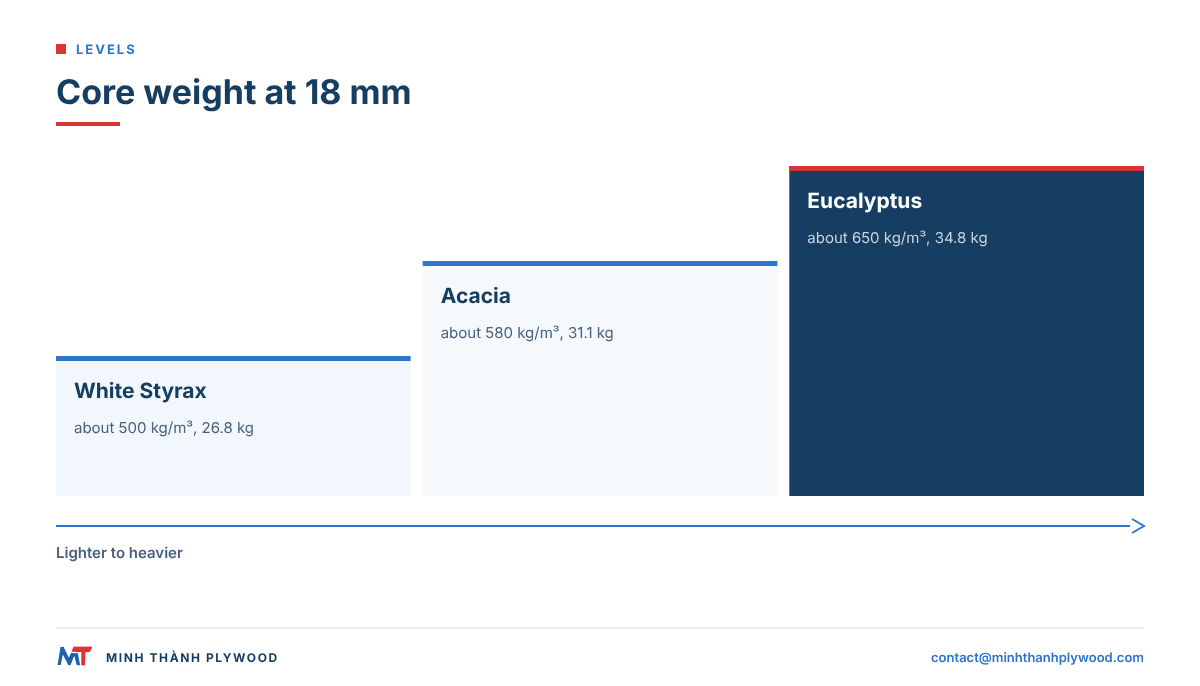
The order of the common furniture cores, light to heavy:
| Core | Reference density | 18 mm sheet, 1220 × 2440 mm | Typical use |
|---|---|---|---|
| White Styrax | about 500 kg/m³ | 26.8 kg | Light furniture, cabinets, van interiors, shopfitting |
| Acacia | about 580 kg/m³ | 31.1 kg | Commercial plywood, packing, general use |
| Eucalyptus | about 650 kg/m³ | 34.8 kg | Furniture where a dense, hard core is wanted; film-faced |
Densities are the planning references we use for container loads. We weigh real sheets of the order before the load plan is fixed.
How much does a sheet of lightweight plywood weigh?
A sheet’s weight is its volume times its density. A 1220 × 2440 mm sheet has an area of 2.98 m², so each millimetre of thickness adds about 1.5 kg on a Styrax core, 1.7 kg on Acacia and 1.9 kg on Eucalyptus.
| Thickness | Styrax core (500 kg/m³) | Acacia core (580 kg/m³) | Eucalyptus core (650 kg/m³) |
|---|---|---|---|
| 3 mm | 4.5 kg | 5.2 kg | 5.8 kg |
| 6 mm | 8.9 kg | 10.4 kg | 11.6 kg |
| 9 mm | 13.4 kg | 15.5 kg | 17.4 kg |
| 12 mm | 17.9 kg | 20.7 kg | 23.2 kg |
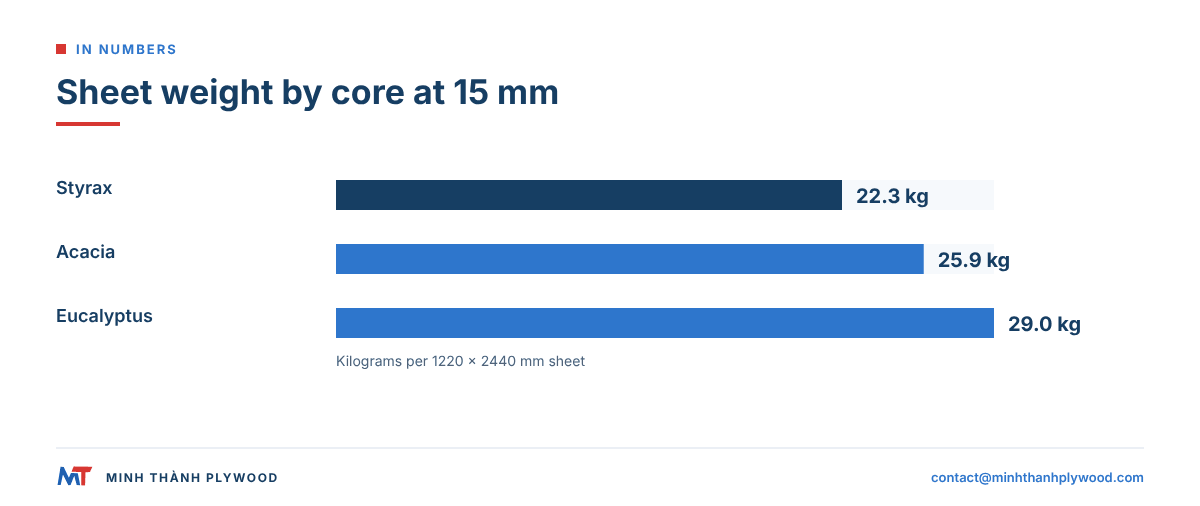
| 15 mm | 22.3 kg | 25.9 kg | 29.0 kg |
| 18 mm | 26.8 kg | 31.1 kg | 34.8 kg |
| 21 mm | 31.3 kg | 36.3 kg | 40.6 kg |
| 25 mm | 37.2 kg | 43.2 kg | 48.4 kg |
All weights are for 1220 × 2440 mm sheets at the reference densities above. A 1250 × 2500 mm sheet is about 5 % heavier because its area is about 5 % larger.
Lightweight plywood 15 mm is a common request from van and camper builders. At 22.3 kg on a Styrax core it is 6.7 kg lighter than the same sheet on Eucalyptus, which a fitter feels on every sheet carried. The 15 mm 9-ply poplar board sold in UK shops is listed at about 25 kg per sheet, so a Styrax core is about 2.7 kg lighter again before any laminate.
Why is white Styrax the light core from Vietnam?
White Styrax is the light core because it is the lowest-density plantation species Vietnamese furniture mills peel at scale. At about 500 kg/m³ it is roughly 14 % lighter than Acacia and 23 % lighter than Eucalyptus.
It also has qualities a furniture buyer wants beyond weight:
- A pale, even core that does not shadow through thin faces or show dark lines on a machined edge.
- Consistent veneer from plantation logs, which helps the core lay flat and press evenly.
- Good machining: it routes, drills and edge-bands cleanly at furniture tolerances.
Many European furniture buyers choose a Styrax core for exactly this mix: a light sheet and a good-looking panel. Styrax grows only in the north of Vietnam, so mills near the plantations, such as ours in Ha Hoa, Phu Tho, peel it fresh from local timber.
One point often confuses buyers: Vietnam has no poplar core. Poplar on a Vietnamese panel is a face veneer, imported or local, laid over a Styrax, Eucalyptus or Acacia core. A “lightweight poplar plywood” from Vietnam is therefore a poplar face on a Styrax core. Our guide to Vietnamese vs European poplar plywood explains the difference in build.
Is lightweight plywood as strong as standard plywood?
Lightweight plywood is strong enough for furniture and interiors, but it is not as hard or as screw-firm as a dense core. Lower density means softer wood, so the trade-offs are predictable.
What you give up as the core gets lighter:
- Screw-holding in the edge. Light wood grips a screw less firmly. Use confirmat screws, cam fittings or inserts sized for the panel, and pre-drill.
- Surface hardness. A light panel dents more easily under point loads. For worktops and floors, a denser core or a hard laminate face is the better choice.
- Bending stiffness at long spans. Shelves over long spans sag sooner; shorten the span or go up a thickness.
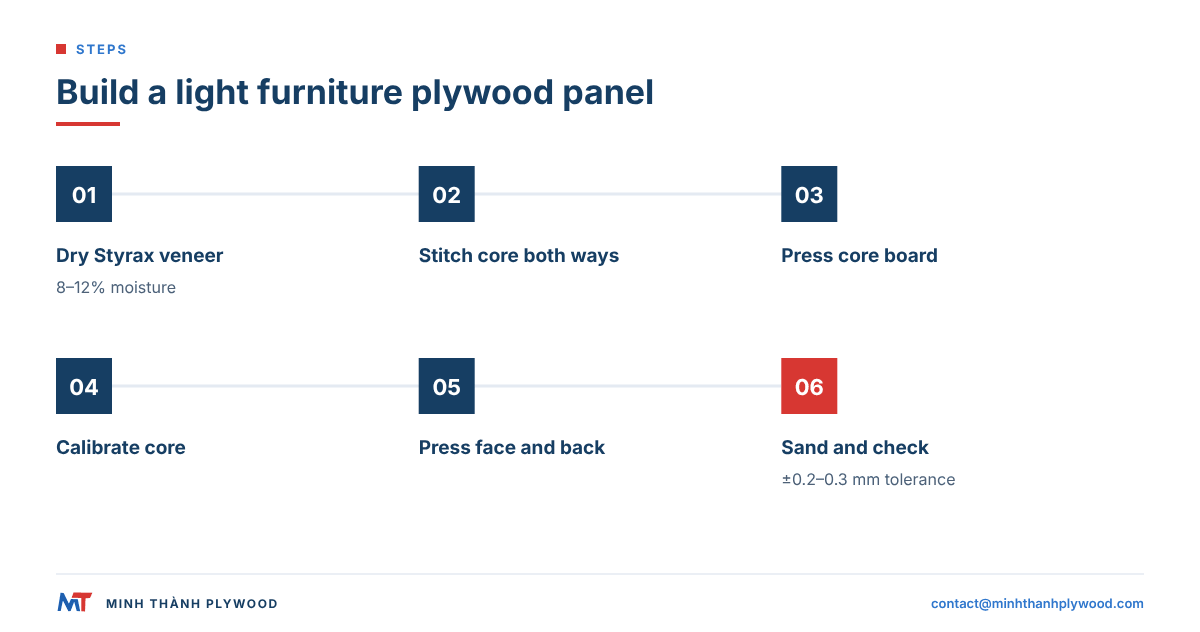
What keeps a light panel stable and flat is the build, not the species alone. Our furniture panels have core layers stitched both horizontally and vertically, so veneers do not open or overlap in the press, and they are pressed twice: the core board is pressed and calibrated, then the face and back are pressed on. Sanded furniture panels are held to ±0.2–0.3 mm thickness tolerance, down to ±0.2 mm. Our guide to stitched core plywood shows how stitching works.
Lightweight ply board vs MDF, OSB and particleboard
A light-core plywood is lighter than standard MDF, particleboard or OSB of the same thickness, and it holds screws better than all three. The table compares them for furniture work.
| Property | Styrax-core plywood | Standard MDF | Particleboard | OSB |
|---|---|---|---|---|
| Weight at the same thickness | Lightest of the four | Heavier | Heavier | Similar to or heavier than plywood |
| Screw-holding in the edge | Good with the right fixing | Weak | Weak | Fair |
| Painted face | Needs a smooth face or primer | Best | Good with laminate | Poor |
| Veneered face | Natural veneer, sanded, UV-ready | Needs veneering | Needs veneering | Not used |
| Moisture tolerance | Good, glue-dependent | Poor at the edge | Poor | Fair |
| Typical role | Carcasses, doors, van furniture | Painted doors and panels | Low-cost carcasses | Sheathing and subfloors |
Lightweight MDF exists and closes some of the weight gap, but it keeps MDF’s weak edge. For a carcass that is moved, assembled on site or fixed into a vehicle, plywood keeps its fixings better per kilogram.
Which faces go on a lightweight core?
Any of our face veneers can go on a light Styrax core; the face changes the look, not the weight. A face veneer is 0.2–0.5 mm thick, so it adds very little mass.
The faces buyers pair most often with a light core:
- Poplar: pale and even, for painted or white furniture. See our white plywood guide.
- EV (engineered veneer): a uniform reconstituted face in oak, walnut or other looks, matched across a whole order.
- Birch: imported birch face veneer, graded D+, D and E and quoted in pairs such as D+/D, matched to the approved sample. It is a birch-faced panel, not an all-birch board.
- Okoume: a warm pink-brown face for interior joinery.
- Pine: for a softwood look, graded A/A, A/B and B/B.
Both faces can be made UV-ready, sanded to the standard customers need to apply their own UV coating.
What are decor-faced lightweight boards for vans and caravans?
A decor-faced lightweight board is a light plywood core with a laminate already pressed on each face, so the fitter cuts and fixes it with no finishing. UK campervan and caravan builders order them in 3 mm for linings and 15 mm for cabinets, wardrobes and beds.
- Finishes: gloss, matt, roughcast texture and wood-effect or stripe patterns, usually with a plain matt reverse.
- Core: poplar or illomba-type hardwood plies, 9 plies at 15 mm in the DeadSound listing.
- Buying: sample packs first, because colour looks different under vehicle lighting, then full sheets.
For the trade, the undecorated panel is the starting point. Importers and conversion workshops buy a white Styrax-core panel with a poplar face by the 40HC, then laminate or lacquer it in the UK in the colours their customers choose. We supply the undecorated panel, sanded to ±0.2–0.3 mm and UV-ready, and free samples so a workshop can weigh and press a sheet before ordering a container.
Honeycomb, foam-core and ultralight panels: when plywood is not the answer
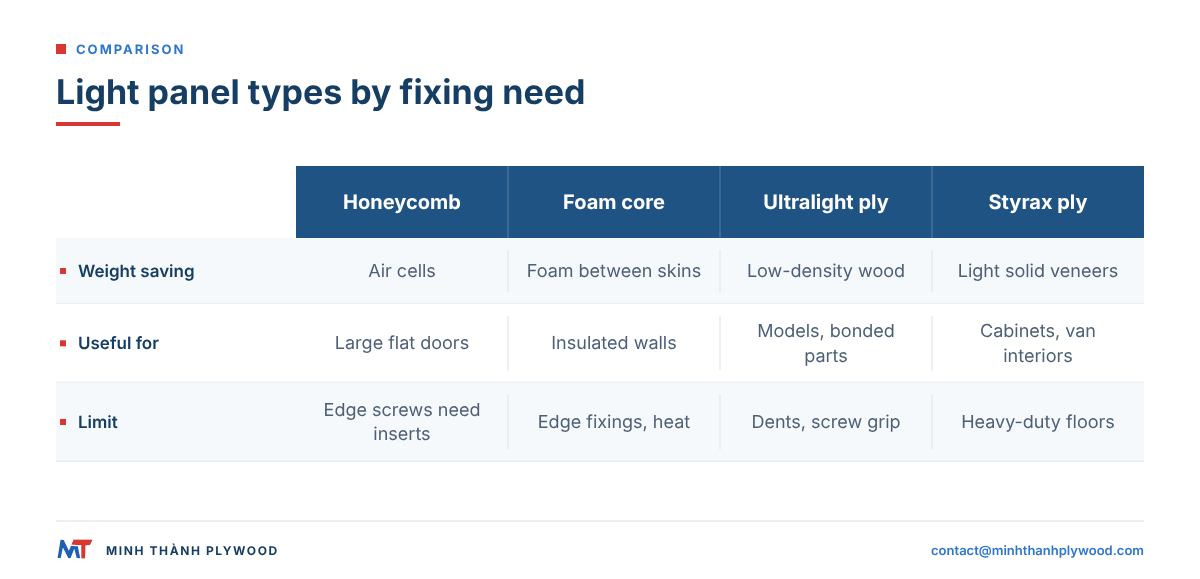
Honeycomb and foam-core panels are lighter than any solid-veneer plywood, but they are composites with a different purpose. They suit large flat parts with spread loads; they suit poorly anything that needs fixings in the edge.
| Panel | How it saves weight | Where it works | Where it fails |
|---|---|---|---|
| Honeycomb core | Paper or aluminium cells between thin skins | Large doors, table tops, exhibition walls | Edge screws without solid inserts |
| Foam core | Polystyrene or polyurethane between skins | Marine bulkheads, insulated walls | Cost, edge fixings, heat |
| Ultralight species plywood (balsa, paulownia, falcata) | Very low-density veneers | Models, bonded vehicle parts, boards | Screw-holding, dents |
| Styrax-core plywood | Light plantation core, solid veneer | Furniture, cabinets, van interiors, shopfitting | Heavy-duty floors and worktops |
If a part needs hinges, drawer runners and edge banding, solid-veneer plywood on a light core is the practical lightweight choice. If a part is a large flat plane bonded into a frame, a honeycomb panel saves more.
Where is lightweight plywood used?
Lightweight plywood is used wherever someone carries, installs or ships the panel and the weight costs time or money. The main uses:
- Van and camper conversions: cabinets, wardrobes, bed frames and wall linings, where every kilogram counts against the vehicle’s payload.
- Kitchen and bedroom furniture: carcasses and shelves on a light core, doors on the same or a denser board. A light carcass is easier to hang and fix.
- Flat-pack and knock-down furniture: lighter cartons mean lower handling and parcel costs for the furniture maker.
- Shopfitting and exhibition stands: panels carried by hand, built and taken down repeatedly.
- Cut-to-size parts: one panel cut into 4, 6 or 8 pieces for furniture factories, shipped regularly to Italy and other European markets.
Our guide to poplar plywood uses covers furniture and cabinet uses in more detail.
How does a lighter core change your container and freight?
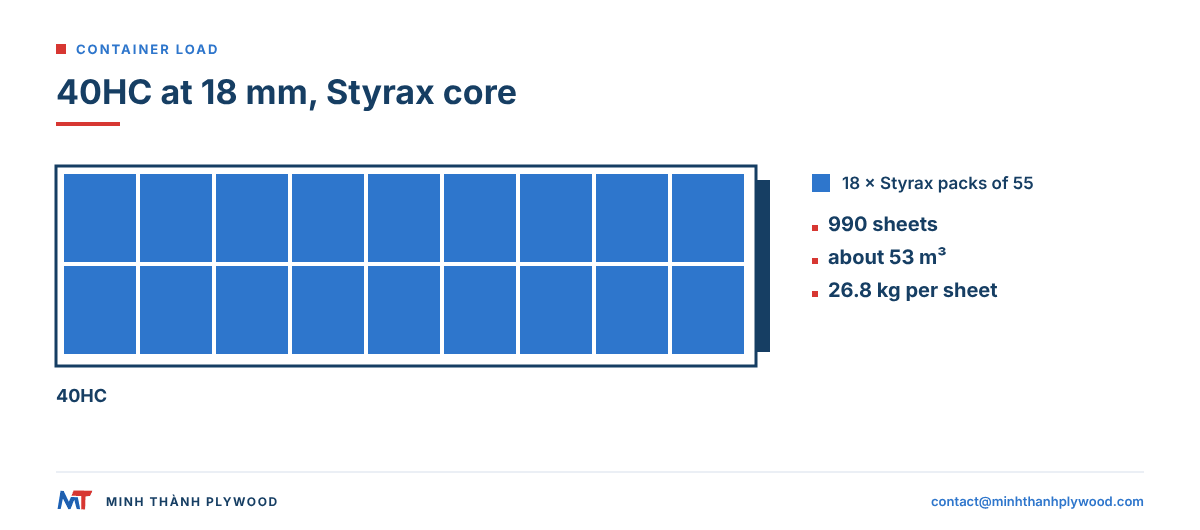
A lighter core lets more panel volume fit under the container’s weight limit. At 18 mm, a 40HC plan on 1220 × 2440 mm sheets with a planning payload of 28,000 kg carries:
| Core | Sheets per 40HC at 18 mm | Packs | Volume | Weight per sheet |
|---|---|---|---|---|
| White Styrax | 990 sheets | 18 packs of 55 | about 53 m³ | 26.8 kg |
| Acacia | 880 sheets | 16 packs of 55 | about 47 m³ | 31.1 kg |
| Eucalyptus | 795 sheets | 15 packs of 53 | about 43 m³ | 34.8 kg |
Each pack is about 1,000 mm high, so the sheet count per pack is 1,000 ÷ thickness, rounded down, then capped by weight. The Styrax plan carries about 10 m³ more panel than the Eucalyptus plan in the same container, so the freight cost per cubic metre falls.
If your booking has a lower payload than 28,000 kg, the plan is recalculated at that limit. Our page on container loading shows how packs are stowed.
How to specify lightweight ply on an order
Specify a lightweight panel by its core and build, not by the word “lightweight”. A weight per sheet only means something when the core, thickness and size are fixed.
- Application: furniture carcass, door, van interior, shopfitting, packing.
- Core species: white Styrax for the lightest furniture panel; state “no Acacia or mixed core” if weight matters.
- Construction: stitched core, double pressed, number of plies (18 mm is usually 11–13 plies).
- Glue and emission: UF glue at E0 emission for interiors; MR/melamine-fortified or phenolic (WBP) bonds to your specification.
- Face and back: species, grade pair, sanded, UV-ready if you coat.
- Size and thickness: 1220 × 2440 or 1250 × 2500 mm, or custom sizes such as 1220 × 2500; thickness and tolerance.
- Moisture: 8–12 % at dispatch, the normal range for furniture plywood.
- Packing and quantity: pack size, number of containers, destination port.
A spec line for a van-conversion panel reads: 15 mm, 1220 × 2440 mm, white Styrax core, stitched, double pressed, UF glue at E0 emission, poplar A/B faces, sanded, ±0.3 mm, moisture 8–12 %.
How do UK builders import lightweight plywood from Vietnam?
A UK importer or conversion workshop buys the undecorated panel by the container and finishes it at home. The order is FOB Hai Phong, CFR or CIF to Felixstowe or another UK port, and the duty rate depends on the face and the proof of origin. The container, duty, standards and documents are set out below.
- Minimum: one 40HC, with mixed specifications by agreement (usually one or two, three to six by agreement). An 18 mm Styrax plan is 990 sheets.
- Production: 15–45 days after the 30 % deposit; balance 70 % against the scanned bill of lading, or irrevocable L/C at sight.
- Delivery terms: FOB Hai Phong, CFR or CIF to Felixstowe or another UK port; Hai Phong to Felixstowe takes about 30–40 days at sea, by carrier and route.
- Duty: the UK Global Tariff is 6 % on most hardwood-faced plywood under heading 4412, and 10 % where the face is tropical wood other than okoume; Vietnamese goods enter at 0 % under the UK-Vietnam free trade agreement with proof of origin (UK Trade Tariff, checked 21 October 2026). The importer confirms the exact 10-digit code with its broker.
- Standards: UK buyers order plywood to BS EN 636.
- Marking: panels are marked under BS EN 13986.
- Due diligence: timber imports need due diligence under the UK Timber Regulation.
- Documents: commercial invoice, packing list, bill of lading, certificate of origin, phytosanitary and fumigation certificates, insurance with CIF.
- Price: furniture and interior plywood from US$350/m³ (October 2026); the final price depends on face, core, glue, thickness, size, quantity and delivery term.
Buyers in Australia, New Zealand, Canada and South Africa order on the same terms, FOB Hai Phong, CFR or CIF to their port. For the US, panels carry CARB P2 / TSCA Title VI certification (ICTT mill no. 23024). The limit for veneer-core hardwood plywood is 0.05 ppm under 40 CFR 770.10.
How does Minh Thanh Plywood make light furniture panels?
We build light furniture panels on a white Styrax core from local plantation timber, with the same construction as our premium furniture plywood. Every step aims at a light sheet that still lies flat and machines cleanly.
| Step | What we do |
|---|---|
| Core | White Styrax veneer, dried to 8–12 % moisture |
| Core build | Core layers stitched both horizontally and vertically |
| Pressing | Pressed twice: core board pressed and calibrated, then face and back pressed on |
| Glue | UF glue at E0 emission as standard for furniture and interior panels |
| Faces | Poplar, EV, birch, okoume, pine and more, sanded and polished, both faces UV-ready |
| Tolerance | ±0.2–0.3 mm on sanded furniture panels, down to ±0.2 mm |
| Emission proof | Six ASTM D6007 chamber tests (April 2025 – June 2026) on 9, 15 and 18 mm panels averaged 0.014–0.032 ppm, against the 0.05 ppm CARB Phase 2 limit |
| Loading | Every shipment photographed and filmed before loading |
Free samples let you weigh and machine a sheet before the first container. To get a quote, send your thickness, face and quantity through the poplar plywood page or the furniture plywood page.
Buyer questions, answered
What is the lightest plywood?
Among solid-veneer panels, plywood made from very low-density species such as paulownia, falcata or balsa is the lightest. For furniture plywood that still machines and holds fittings well, a white Styrax core at about 500 kg/m³ is the light option from Vietnam.
Is plywood light?
Plywood is light for its strength, and the core species decides how light. An 18 mm sheet of 1220 × 2440 mm weighs about 26.8 kg on a Styrax core and about 34.8 kg on a Eucalyptus core.
Is MDF lighter than plywood?
Standard MDF is usually heavier than a light-core plywood of the same thickness. A Styrax-core plywood at about 500 kg/m³ is lighter than standard MDF and also holds screws in its edge better.
Is OSB lighter than plywood?
OSB is usually similar to or heavier than plywood of the same thickness, and much heavier than a light Styrax-core panel. OSB is a construction board, not a furniture face board.
How much does an 18 mm plywood sheet weigh?
An 18 mm sheet of 1220 × 2440 mm weighs about 26.8 kg on a Styrax core (500 kg/m³), 31.1 kg on Acacia (580 kg/m³) and 34.8 kg on Eucalyptus (650 kg/m³).
How much does 15 mm lightweight plywood weigh?
A 15 mm Styrax-core sheet of 1220 × 2440 mm weighs about 22.3 kg, against 25.9 kg on Acacia and 29.0 kg on Eucalyptus.
Is lightweight plywood as strong as standard plywood?
A lighter core gives up some screw-holding and surface hardness compared with a dense core. For furniture, cabinets and van interiors a stitched, double-pressed Styrax core is strong enough, and fixings are chosen for the lighter wood.
Does Vietnam make poplar-core plywood?
No. Vietnamese mills use Styrax, Eucalyptus, Acacia and mixed cores; poplar is used as a face veneer. The light Vietnamese option is a white Styrax core with a poplar or EV face.
How much does lightweight ply cost in the UK?
UK shops list 15 mm decor-faced lightweight boards at about £68 to £194 per 2440 × 1220 mm sheet, and 3 mm boards at about £90 (October 2026). An undecorated Styrax-core panel bought by the container from Vietnam starts at US$350/m³ FOB, and the buyer laminates it locally.
Can you ship lightweight plywood to the UK, Australia, Canada or South Africa?
Yes. We quote FOB Hai Phong, CFR or CIF to the buyer's port, with a minimum of one 40HC that can mix specifications by agreement. Hai Phong to Felixstowe takes about 30–40 days at sea, by carrier and route.
What should I write on an order for lightweight plywood?
Write the core species and its reference density, face and back veneer and grade, thickness and tolerance, glue and emission class, size, and the target weight per sheet if it matters to you.