
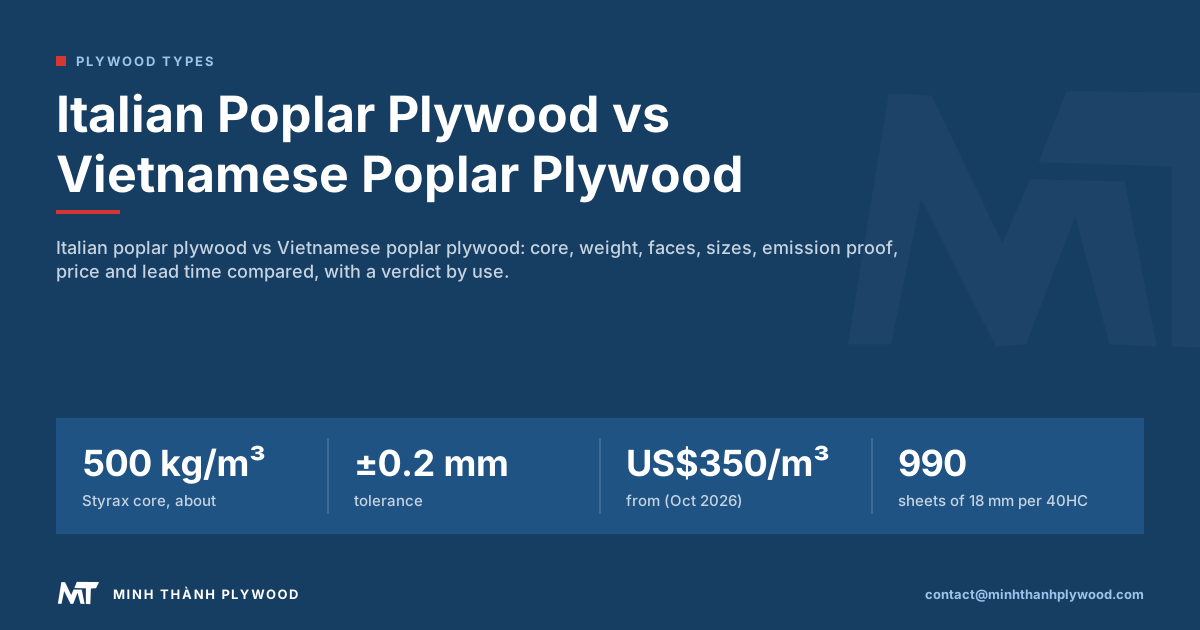
Italian poplar plywood is an all-poplar panel: poplar veneers in every ply, very light, bought from European mills and stockists. Vietnamese poplar plywood has a poplar face and back over a white Styrax or Eucalyptus core, stitched and pressed twice, and costs less per cubic metre. Minh Thanh Plywood makes the Vietnamese build for painted, lacquered and laminated furniture sold in Europe.
What is the difference between Italian and Vietnamese poplar plywood?
The difference is the inside of the panel. Italian poplar plywood is poplar from face to face: every veneer comes from European poplar plantations. Vietnamese poplar plywood is poplar-faced: a poplar face and back pressed over a core of Vietnamese plantation wood, white Styrax or Eucalyptus.
That one fact sets everything else: weight, edge colour, stiffness, screw holding, price and how the panel ships. The face you see after sanding looks alike, a pale cream wood with a plain, straight grain that takes paint and laminates evenly.
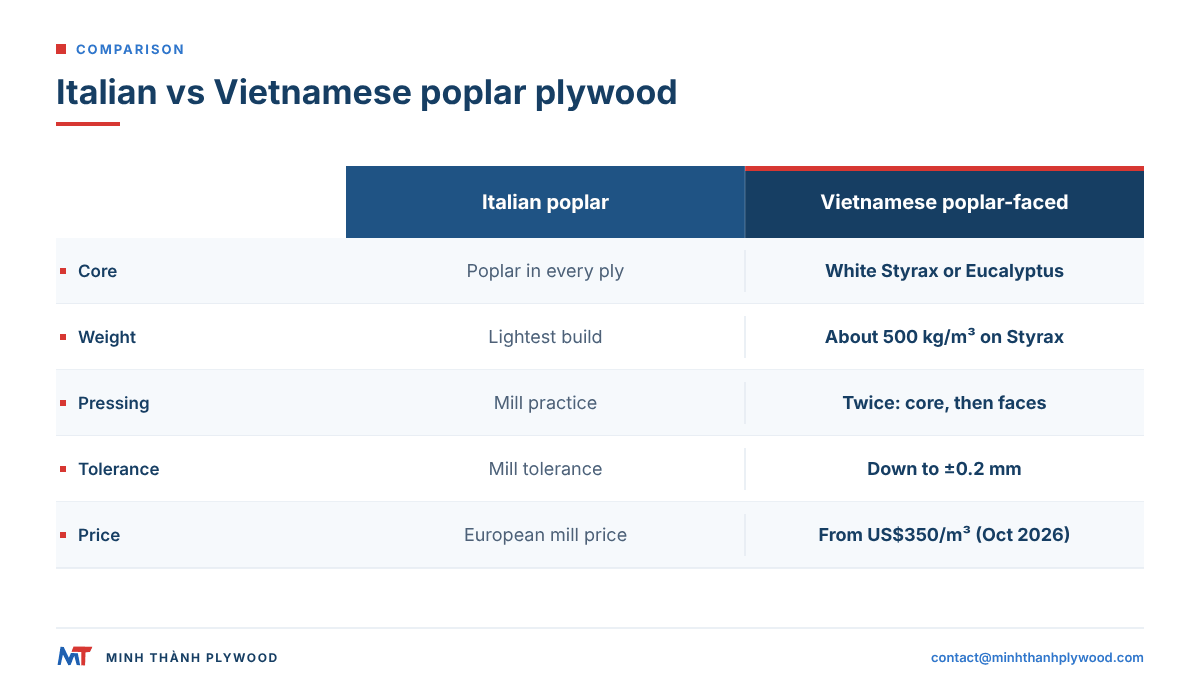
| Point | Italian poplar plywood | Vietnamese poplar plywood (Minh Thanh) |
|---|---|---|
| Face and back | Poplar | Poplar, graded A/A, A/B or B/B |
| Core veneers | Poplar | White Styrax or Eucalyptus, stitched both ways |
| Panel weight | Very light, all poplar | About 500 kg/m³ on Styrax; 650–750 kg/m³ on Eucalyptus |
| Edge colour | Pale, even | Pale on Styrax; light brown on Eucalyptus |
| Pressing | Mill practice varies | Pressed twice: core pressed and calibrated, then faces |
| Thickness tolerance | Mill tolerance | Down to ±0.2 mm on sanded furniture panels |
| Emission proof | European testing | CARB P2 / TSCA Title VI; six chamber tests at 0.014–0.032 ppm |
| Formats | European formats | 1220 × 2440 and 1250 × 2500 mm, custom and cut-to-size |
| Buying route | European mill or stockist | Factory-direct, MOQ one 40HC, mixed loads by agreement |
| Price | European mill price | From US$350/m³ for furniture plywood (October 2026) |
Read the table by use, not by origin. A caravan builder who counts every kilo reads the weight row first. A cabinet plant that paints its fronts reads the face, the tolerance and the price rows.
What is Italian poplar plywood?
Italian poplar plywood is a light, all-poplar panel made by mills in northern Italy, where poplar is grown in plantations along the river plains. Buyers know it under its Italian name, compensato di pioppo, and use it for furniture carcasses, shopfitting, caravan and boat interiors, and display work.
Three features made it the European reference for light furniture plywood:
- Weight. Poplar in every ply gives one of the lightest hardwood plywood panels on the market.
- Machining. Poplar cuts, routs and drills cleanly; the plain face sands smooth for paint.
- Specials. Italian mills also make bending poplar, thin flexible panels whose plies run mostly one way, sold as barrel-bend or column-bend sheets.
The other side of the picture is cost and supply. European poplar is a regional resource, and an all-poplar panel uses face-quality wood for the inside plies too. That is the gap a poplar-faced panel from Vietnam fills.
What are the characteristics of European poplar plywood?
European poplar plywood, from Italy, France or Spain, shares the same build: poplar veneers throughout, glued with a urea-formaldehyde or melamine-fortified resin, sanded on both faces. Its typical traits:
- Light weight, the main reason designers specify it.
- Pale, even edge, because every ply is poplar.
- Soft face: poplar dents more easily than birch, so it is mostly painted, foiled or laminated rather than left natural.
- Lower screw holding than a dense core, which matters for heavy hinges and wall cabinets.
- European grading, matched to each mill’s own grade names.
These traits are the benchmark the Vietnamese panel has to meet or beat for each part of a piece of furniture.
What are the characteristics of Vietnamese poplar plywood?
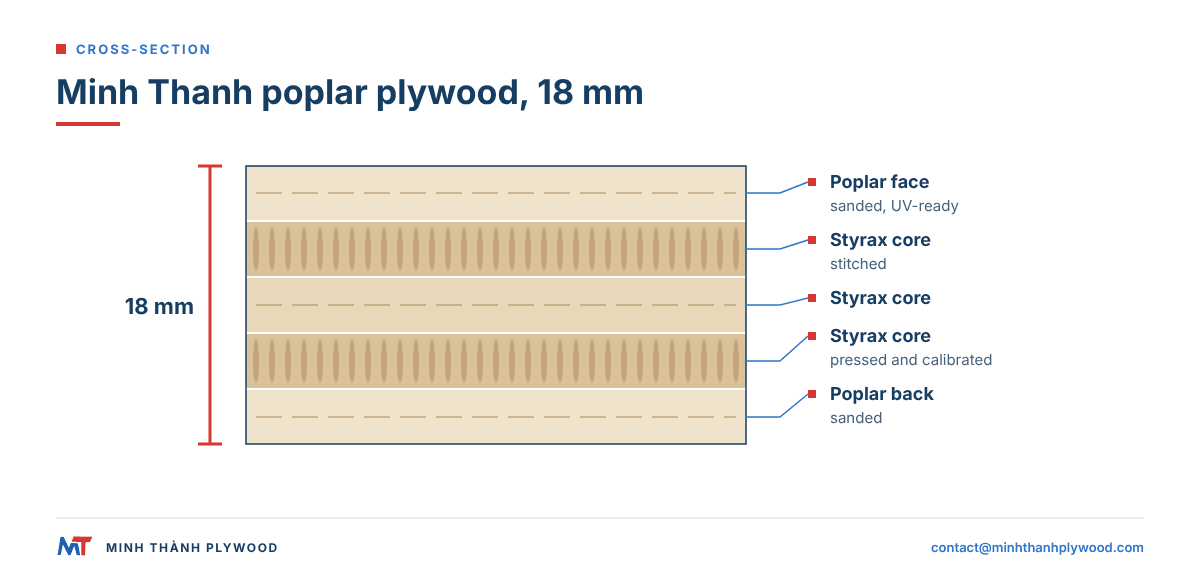
Vietnamese poplar plywood is a poplar-faced panel on a Vietnamese plantation core. Vietnam does not grow poplar for core veneer, so mills press imported or selected poplar faces over their own cores. At Minh Thanh the build is:
| Layer | Minh Thanh poplar plywood |
|---|---|
| Face and back | Poplar veneer, sanded and polished, both faces UV-ready |
| Core | White Styrax (about 500 kg/m³) or Eucalyptus (650–750 kg/m³); Acacia and Pine cores on order |
| Core joining | Core layers stitched horizontally and vertically |
| Pressing | Twice: core board pressed and calibrated, then face and back |
| Glue | UF glue at E0 emission as standard; MR/melamine-fortified and WBP to order |
| Thickness | 3–40 mm; thin 3–5 mm panels are always 5-ply |
| Tolerance | ±0.2–0.3 mm on sanded furniture panels, down to ±0.2 mm |
| Moisture | 8–12 % at dispatch |
The double pressing is the step a buyer feels in the workshop. The core is pressed and calibrated before the faces go on, so the poplar face sits on a flat, even board. That gives flatter panels for lacquer and fewer telegraphed core joints under a high-gloss finish.
How do core, weight and stiffness compare?
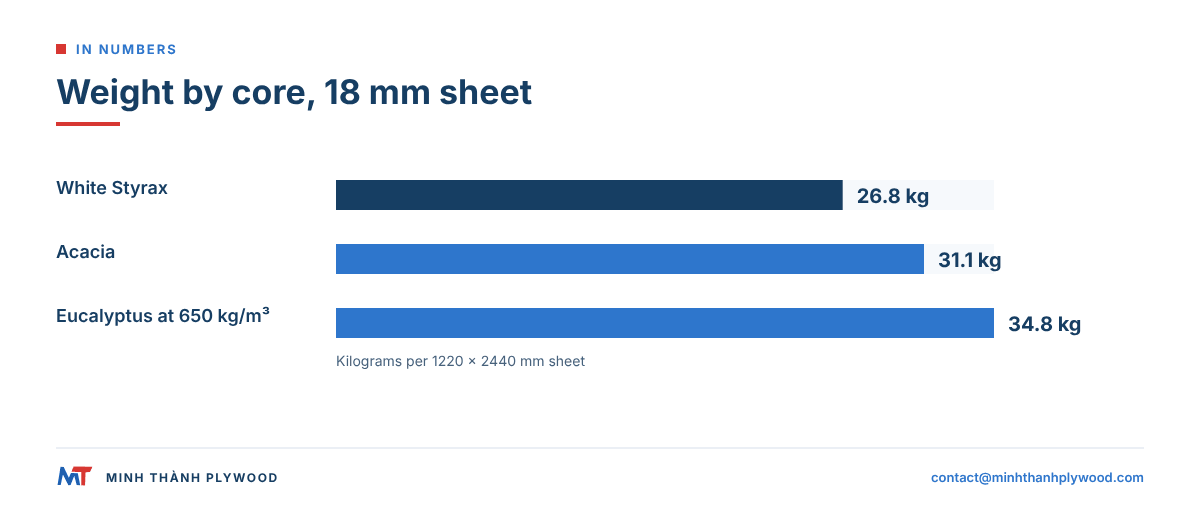
The core decides the weight. An all-poplar Italian panel is the lightest option; a Vietnamese panel matches it closely only with a Styrax core.
| Core | Reference density | 18 mm sheet, 1220 × 2440 mm | Best for |
|---|---|---|---|
| White Styrax (Vietnam) | About 500 kg/m³ | 26.8 kg | Light furniture, pale edges, the most m³ per container |
| Acacia (Vietnam, on order) | About 580 kg/m³ | 31.1 kg | A firmer carcass at moderate weight |
| Eucalyptus (Vietnam) | 650–750 kg/m³ | 34.8 kg at 650 kg/m³ | Dense carcasses, screw holding, heavy doors |
Sheet weight is density times volume: 1.22 × 2.44 × 0.018 m is 0.0536 m³, so a Styrax sheet at 500 kg/m³ weighs 26.8 kg. Weigh real sheets of your order before you plan a truck or a crane; the reference densities are planning values.
A heavier core is not a defect. Eucalyptus gives a stiffer panel and better screw holding, which many cabinet plants want for wall units and wardrobe doors. Styrax gives the weight closest to Italian poplar and the pale edge that suits visible edges under clear lacquer.
How do faces, grades and appearance compare?
The visible face is poplar on both panels, so appearance after finishing is close. What differs is how the grade is named and agreed.
Minh Thanh quotes poplar faces as face/back pairs:
- A/A for two clean cream faces, when both sides are seen.
- A/B for one visible face and a sound back, the usual cabinet choice.
- B/B for paint, foil, HPL and melamine paper.
Buyers who order by Chinese codes can use B/BB, BB/CC and CP; they map onto the same ladder. Every grade pair is fixed by a sample sheet the buyer approves, and production is graded against that sheet.
Both faces are sanded, polished and UV-ready, to the level a customer needs to apply its own UV coating line. For a white look without paint, poplar faces can be bleached; the white plywood guide covers that choice.
Which sizes and formats can you order?
European furniture plants cut from the 1250 × 2500 mm format. Minh Thanh presses it as a standard size, beside 1220 × 2440 mm, so a Vietnamese panel drops into the same cutting plans as a European one.
- Standard: 1220 × 2440 mm and 1250 × 2500 mm.
- Custom: for example 1220 × 2500 mm and 1220 × 2280 mm.
- Thickness: 3–40 mm; 3–5 mm thin panels are 5-ply.
- Cut-to-size: one panel cut into 4, 6 or 8 pieces. These orders ship regularly to Italy and other European markets.
Cut-to-size is where a Vietnamese panel often beats stock European poplar on total cost. The parts arrive at the size the line uses, and the offcut stays at the mill.
What do US buyers need: inch sizes, pounds per sheet and fire rating?
US lumberyards and millwork shops work in inches and pounds, so convert before you compare. The Minh Thanh 1220 × 2440 mm sheet is the 4 × 8 ft sheet (48 × 96 in), and 18 mm is the metric match for a 3/4 in nominal panel. Inch sizes use the exact NIST definition of 1 inch = 25.4 mm. Weight per 18 mm sheet, from the densities in the core table:
| Core | 18 mm sheet, 1220 × 2440 mm | In pounds |
|---|---|---|
| White Styrax | 26.8 kg | About 59 lb |
| Acacia (on order) | 31.1 kg | About 69 lb |
| Eucalyptus | 34.8 kg | About 77 lb |
US stockists sell all-poplar Italian panels such as Quattro-Ply in oversize formats (48.5 × 96.5 in and 60.5 × 120.5 in), and one lists a 3/4 in all-poplar sheet at 44 lb. That is the lightest build, about 15 lb under a Styrax-core sheet; the Vietnamese panel trades that weight for a lower price per m³, a flat double-pressed board and the CARB P2 / TSCA Title VI proof US buyers ask for. If your cutting plan needs an oversize format, ask for a custom size in the request and we confirm it against the press.
Fire-rated Italian poplar is a separate treated product: each veneer layer is treated before lay-up to reach ASTM E84 Class A, a flame-spread index of 0 to 25. Minh Thanh’s standard poplar panel is untreated and is not sold as fire-rated. If your project calls for Class A, say so in the request before you order, or buy the treated panel from a US stockist and use the Vietnamese panel for the parts without a fire requirement.
How do emission and documents compare?
Both panels can meet the formaldehyde limits a European furniture buyer works to; the proof is what differs. Minh Thanh panels are made for European and US furniture buyers, and the proof travels with the order:
- CARB P2 / TSCA Title VI certification, ICTT mill no. 23024.
- Six ASTM D6007 chamber tests, April 2025 to June 2026, on 9, 15 and 18 mm panels, averaging 0.014–0.032 ppm against the 0.05 ppm CARB Phase 2 limit. Three were run by Shanghai Hongjun and three by ICTT Vietnam.
- E0 emission testing every 3 months.
- SGS testing to the buyer’s method, EN 717-1 or another, on request.
- EUDR compliance dossier, origin records and geolocation files, with every EU order.
The European rule to know is REACH Annex XVII entry 77, added by Regulation (EU) 2023/1464: from 6 August 2026, furniture and wood-based articles placed on the EU market must not exceed 0.062 mg/m³ formaldehyde under its test conditions. Chamber results in ppm from ASTM D6007 are not converted to that figure; when your customer asks for the EU method, SGS tests the panel to it. The US counterpart is the 0.05 ppm limit for veneer-core hardwood plywood under 40 CFR 770.10.
For EUDR, Vietnam is classed as low risk under Implementing Regulation (EU) 2025/1093, which allows simplified due diligence when every commodity in the product comes from a low-risk country.
How do price and total cost compare?
Vietnamese poplar plywood costs less per cubic metre than an all-poplar European panel, because the core is local plantation wood and the mill sits beside its timber. Minh Thanh’s indicative starting prices, dated October 2026:
- Furniture and interior plywood: from US$350/m³.
- Commercial plywood: from US$250/m³.
The final price depends on face, core, glue, thickness, size, quantity and delivery term: FOB Hai Phong, CFR or CIF. Compare like with like. Put a European stock price next to a Vietnamese CIF price plus your import costs, unloading and storage, and compare per usable part, not per sheet. Cut-to-size orders change the result most, because you stop paying for offcuts.
Our Ha Hoa location gives us locally grown plantation timber for cores and a skilled workforce. That is why a top-grade furniture panel from this mill costs less than the same grade from mills further from their wood.
How do lead time and logistics compare?
A European stockist delivers from stock within days; a Vietnamese mill makes to order and ships by sea. Plan the Vietnamese route as a supply line, not a top-up:
- Sample approval. Free samples of the face pair and core you plan to order.
- Production. 15–45 days after the 30% deposit.
- Loading. Every container is photographed and filmed before loading; you receive the photos and video.
- Sea transit. 25–35 days from Hai Phong to the Mediterranean, 30–40 days to Northern Europe, by carrier and route.
- Balance. 70% against the scanned bill of lading, or an irrevocable L/C at sight.
The minimum order is one 40HC, and one container can mix thicknesses, grade pairs and faces by agreement. With a Styrax core, a 40HC takes 18 packs: 990 sheets of 18 mm, about 53 m³. With Eucalyptus the weight limit stops the load at 15 packs, 795 sheets of 18 mm, about 43 m³.
Which should you choose for each use?
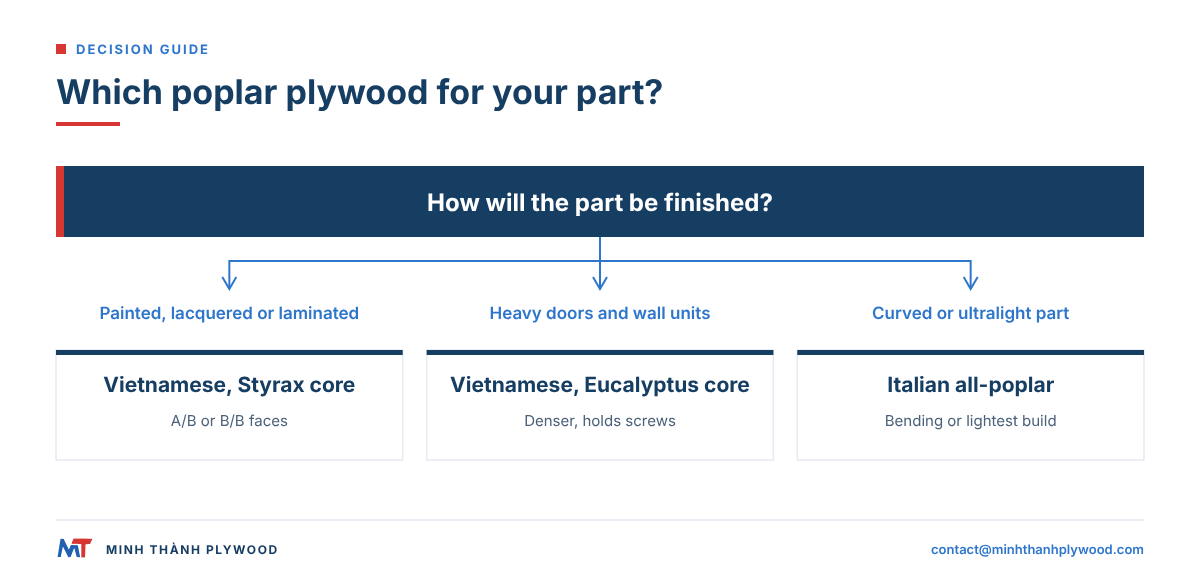
Choose by part and finish, not by flag. Our verdict, use by use:
| Use | Better choice | Why |
|---|---|---|
| Painted or lacquered cabinet carcasses | Vietnamese, Styrax core, A/B | Same cream face, flat double-pressed board, lower cost per m³ |
| Laminated or foiled panels (HPL, melamine paper) | Vietnamese, B/B | Face is covered; core and tolerance matter more than face grade |
| Wall units and heavy doors | Vietnamese, Eucalyptus core | Denser core holds screws and hinges better |
| Visible light edges under clear lacquer | Vietnamese Styrax, or Italian | Both give a pale edge; Styrax at lower cost |
| Caravan, boat and vehicle interiors where every kilo counts | Italian all-poplar | Lightest build |
| Curved parts | Italian bending poplar | A special flexible build; flat panels do not bend |
| Short runs and urgent top-ups | European stockist | Delivery from stock in days |
| Repeat programmes of cut parts | Vietnamese cut-to-size | Parts at line size, one container per order cycle |
Many European plants run both: Italian bending and ultralight panels for special parts, a Vietnamese poplar-faced panel for the volume of carcasses, shelves and drawer parts.
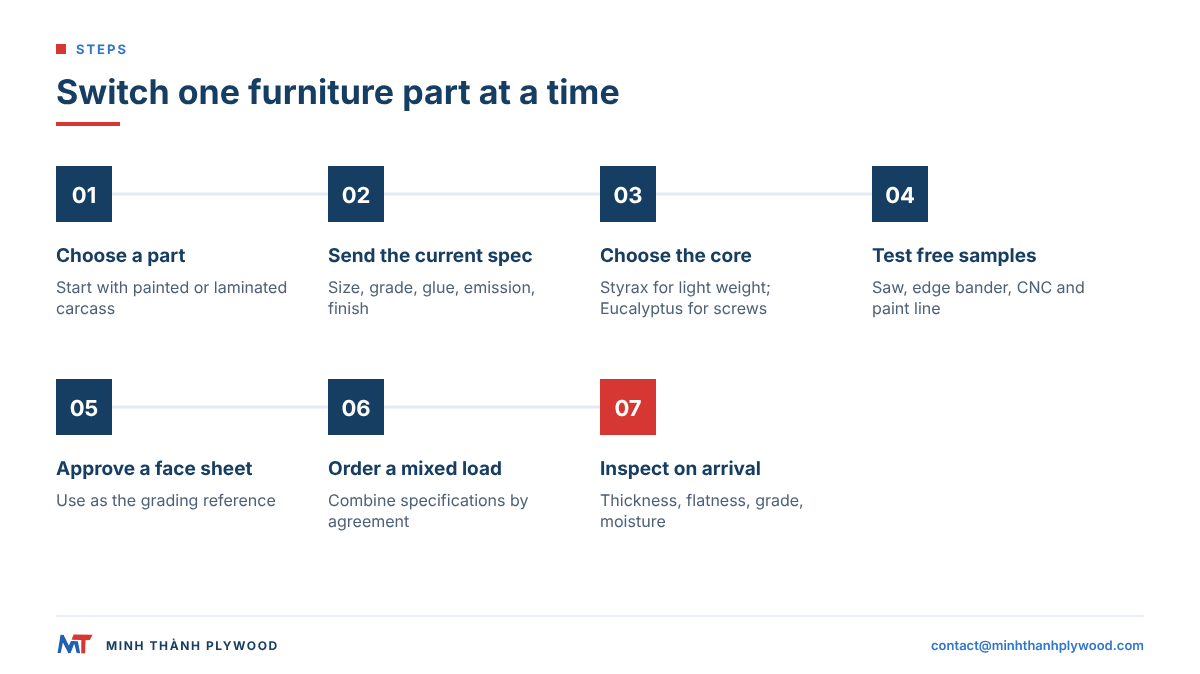
How do you switch from Italian to Vietnamese poplar plywood?
Switch one part family at a time and prove it on your own line. A practical route:
- Pick the part. Start with a painted or laminated carcass part, where the face match is easiest.
- Send your current spec. Thickness, size, face/back grade, glue class, emission requirement and finish.
- Choose the core. Styrax for weight and pale edges; Eucalyptus for screw holding.
- Test free samples. Run them through your saw, edge bander, CNC and paint line.
- Approve the reference sheet. The face pair is graded against it in production.
- Order a mixed first container. Combine the new part with a second thickness or grade by agreement.
- Check on arrival. Thickness with a caliper at several points, flatness, face grade against the reference, moisture.
What does this mean for your order?
A Minh Thanh poplar plywood order is built to the European furniture buyer’s list as normal practice:
- White Styrax or Eucalyptus core, stitched horizontally and vertically.
- Pressed twice, sanded and polished, both faces UV-ready.
- UF glue at E0 emission, with CARB P2 / TSCA Title VI and the chamber test reports.
- Thickness held down to ±0.2 mm, length and width ±2 mm.
- EUDR dossier with EU orders, and the PPWR packaging test by SGS for the packing materials.
- Photos and video of your container before loading.
Our factory is built for top-grade furniture and interior plywood, with Europe as its main market, and has repeat orders into Italy. Send your Italian poplar spec and we answer with the matching Vietnamese build within hours.
Buyer questions, answered
What is Italian poplar plywood?
Italian poplar plywood is plywood made in Italy with poplar veneers in every ply, face, back and core. It is light, pale and easy to machine, and it is sold mainly for furniture, shopfitting, caravans and bending panels.
Is Vietnamese poplar plywood the same as European poplar plywood?
No. The face is the same species family, but the inside differs. European poplar plywood is poplar all through; Vietnamese poplar plywood has a poplar face and back over a white Styrax or Eucalyptus core, because Vietnam has no poplar core.
Which is lighter, Italian or Vietnamese poplar plywood?
An all-poplar Italian panel is the lightest of the two. On the Vietnamese side, a white Styrax core at about 500 kg/m³ comes closest; a Eucalyptus core at 650–750 kg/m³ is clearly heavier and stiffer.
Can Vietnamese poplar plywood replace Italian poplar in furniture?
Yes, for painted, lacquered, foiled and laminated furniture parts. Order a Styrax core for a light panel with a pale edge, A/B faces for one visible side, and the ±0.2 mm tolerance for hardware and edge banding.
Does Vietnamese poplar plywood meet European emission requirements?
Yes. Minh Thanh panels are made for European furniture buyers, with UF glue at E0 emission, CARB P2 / TSCA Title VI under ICTT mill no. 23024, and six ASTM D6007 chamber tests averaging 0.014–0.032 ppm. SGS tests to EN 717-1 on request.
What sizes does Vietnamese poplar plywood come in?
Minh Thanh presses 1220 × 2440 mm and the European 1250 × 2500 mm, plus custom sizes such as 1220 × 2500 and 1220 × 2280 mm, in 3–40 mm. Cut-to-size pieces, one panel cut into 4, 6 or 8, ship regularly to Italy.
How much cheaper is Vietnamese poplar plywood?
Minh Thanh furniture and interior plywood starts from US$350/m³ (October 2026), on FOB Hai Phong, CFR or CIF terms. The final price follows face, core, glue, thickness, size and quantity; compare it with your landed cost of European panels.
Can I bend Vietnamese poplar plywood like Italian bending poplar?
No. Bending poplar is a special thin all-poplar build with long-grain plies; Vietnamese poplar-faced plywood is a flat furniture panel. For curves, keep buying bending plywood and use the Vietnamese panel for the flat parts.
What does an 18 mm Vietnamese poplar plywood sheet weigh in pounds?
A 1220 × 2440 mm (4 × 8 ft) sheet at 18 mm weighs about 59 lb on a white Styrax core, 69 lb on Acacia and 77 lb on Eucalyptus. An all-poplar Italian 3/4 in sheet is lighter, at about 44 lb.
Is Vietnamese poplar plywood fire-rated?
The standard panel is untreated and not sold as fire-rated. Fire-rated Italian poplar is a separate treated product tested to ASTM E84 Class A; state the requirement in the request before ordering.
Which face grades can I order on Vietnamese poplar plywood?
Poplar faces are quoted as face/back pairs A/A, A/B and B/B, matched to the sample you approve. Buyers who use Chinese codes can order B/BB, BB/CC and CP, which map onto the same ladder.
How long does Vietnamese poplar plywood take to reach Italy?
Production runs 15–45 days after the 30% deposit, then 25–35 days at sea from Hai Phong to the Mediterranean. Plan on 40–80 days from deposit to a Mediterranean port.