
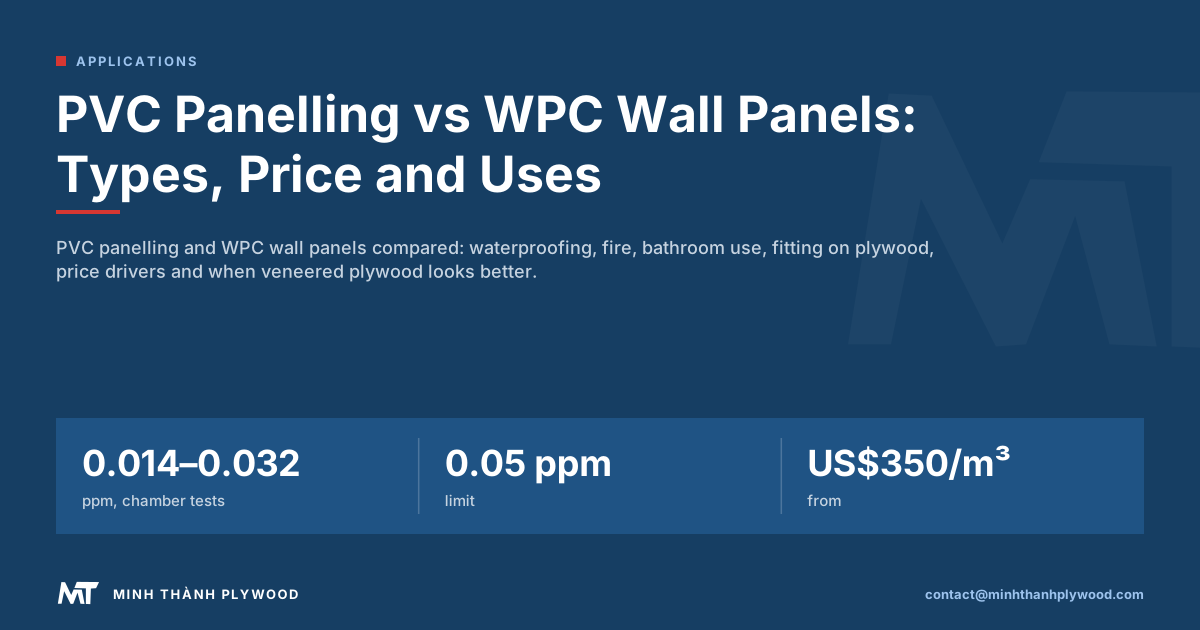
PVC panelling is a hollow or foamed plastic wall board that stays waterproof and wipes clean, so it suits bathrooms, kitchens and utility rooms. WPC wall panels mix wood fibre with plastic and are thicker and more rigid, often fluted, for feature walls. Real-wood veneered plywood panels are the third choice where the wall should look like timber. Minh Thanh Plywood makes veneered and interior plywood in Vietnam.
PVC panelling and WPC wall panels: the short answer
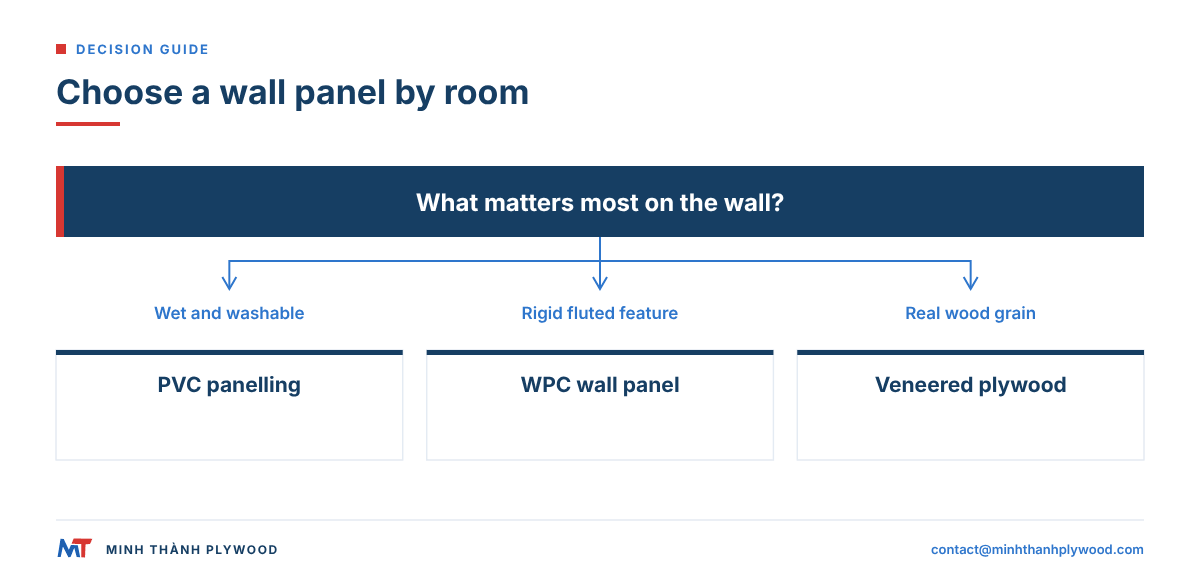
Choose PVC panelling for wet rooms and easy-clean walls, WPC wall panels for rigid, fluted feature walls, and veneered plywood panels where the wall must look and feel like real wood. All three go up faster than tiles or plaster.
- PVC panelling: plastic, light, waterproof face, wide range of prints and gloss finishes.
- WPC wall panel: wood-plastic composite, thicker and heavier, often fluted or slatted, matt wood-look film.
- Veneered plywood panel: real wood face on a stable cross-laid core, finished on site or before delivery.
In the US, PVC panelling also lines garages, barns, wash bays, car washes, basements and utility rooms, where interlocking liner panels give a washable, rot-free wall; the size and price table below shows what each type costs per panel. The sections below compare them on water, fire, fitting, price and look.
What is PVC panelling?
PVC panelling is a wall or ceiling cladding made from polyvinyl chloride, extruded as hollow boards with internal ribs or as solid foamed sheets, with a printed, foiled or laminated face. The panels lock together with tongue-and-groove joints and are fixed with adhesive, clips or screws.
- Hollow-core PVC panels: light, cheapest, can dent under a knock.
- Foamed or solid PVC sheets: heavier and more impact-resistant, used in commercial washrooms and kitchens.
- Laminated PVC panels: a decorative film or high-gloss layer bonded to the face, for tile, marble or wood looks.
PVC wall board is also sold as large flat sheets for hygienic walls. Its strengths are a waterproof face, easy cleaning and no grout lines.
What is a WPC wall panel?
A WPC wall panel is a wood-plastic composite board made by extruding wood fibre or wood flour with PVC or polyethylene and additives, usually as a fluted or slatted profile with a wood-look film. WPC panels are thicker, more rigid and heavier than PVC panels.
- Fluted WPC panels: grooves that copy timber slats, used on feature walls and ceilings.
- Flat WPC boards: plain panels for wainscoting and partitions.
- Co-extruded WPC: a harder outer cap layer over the composite core, for better scratch and stain resistance.
WPC wall panelling uses clips, adhesive or battens, and the profiles are cut with ordinary wood saws. They are mostly interior products; outdoor WPC is a separate, thicker decking and cladding range.
WPC vs PVC wall panels: comparison table
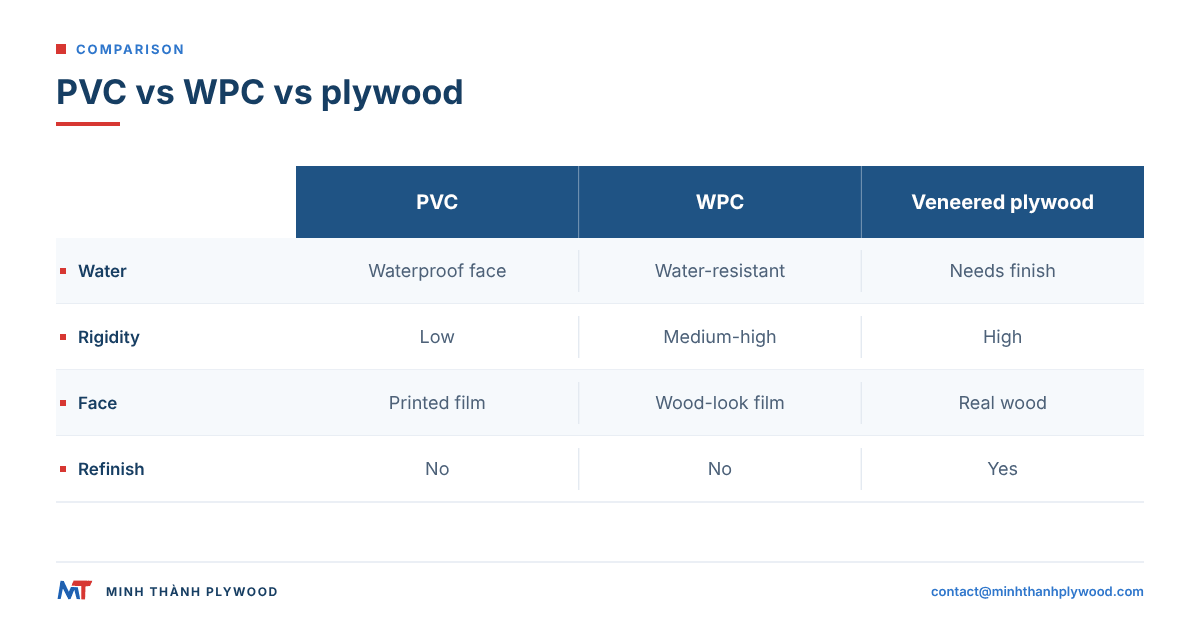
WPC wall panels are more rigid and look more like timber; PVC panels are lighter, cheaper and fully waterproof. Veneered plywood adds a real wood face. The table compares the three on one property per row.
| Property | PVC panelling | WPC wall panel | Veneered plywood panel |
|---|---|---|---|
| Material | PVC plastic | Wood fibre and plastic | Real wood veneers and glue |
| Face | Printed, foiled or gloss film | Wood-look film or co-extruded cap | Real wood grain, lacquered or oiled |
| Water | Waterproof face | Water-resistant | Needs a finish and a moisture-resistant bond in damp rooms |
| Rigidity | Low to medium | Medium to high | High |
| Impact | Dents if hollow | Good | Good, repairable |
| Weight | Lightest | Heavier | Medium |
| Fitting | Adhesive, clips, screws | Clips, adhesive, battens | Screws, clips, adhesive, battens |
| Refinishing | Not possible | Not possible | Sand and refinish |
| Best rooms | Bathrooms, kitchens, utility rooms | Living rooms, bedrooms, hotels, shops | Offices, hotels, shops, homes |
For a plywood-only view of wall cladding, see our plywood wall panels guide.
Are PVC wall panels waterproof?
PVC wall panels are waterproof on their face because PVC does not absorb water, but a panelled wall is only watertight when every joint, edge and penetration is sealed. Water that gets behind the panels at a badly sealed corner can stay there.
- Joints: tongue-and-groove joints shed water when the panels run vertically and are fitted tight.
- Edges and corners: use the system’s trims and a bead of sanitary silicone.
- Penetrations: seal round taps, pipes and shower fittings.
- Backing: fix to a sound, dry substrate; a damp wall must be fixed first.
WPC panels are water-resistant rather than inert: the wood fibre is wrapped in plastic, so surface water does no harm, but cut ends are best sealed. Plywood panels need a finish and, in damp rooms, an MR or WBP bond; our is plywood waterproof guide explains the bond classes.
PVC bathroom wall panels: what works in wet rooms
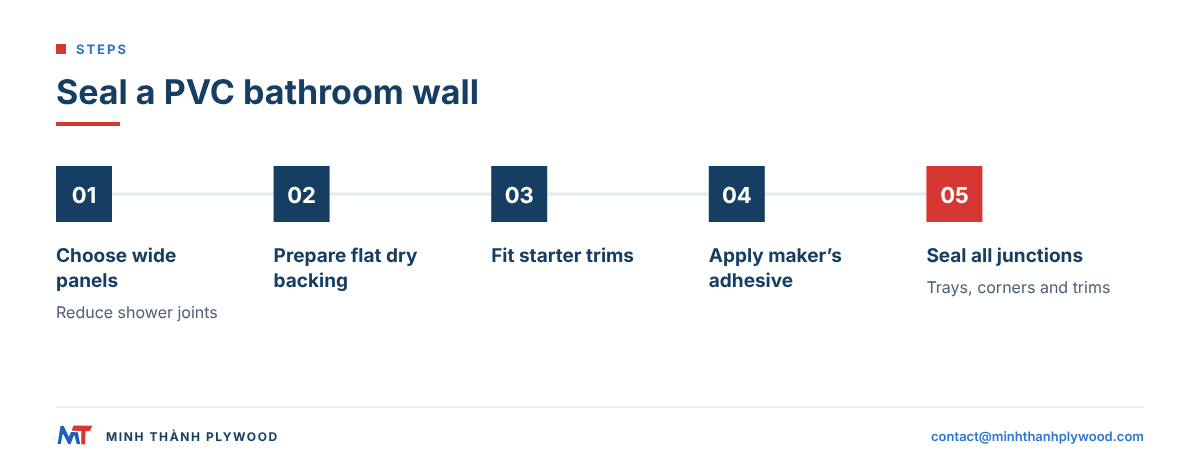
PVC bathroom wall panels work well around baths and showers when they are wide-format, fitted on a flat backing and sealed at every edge. They replace tiles with fewer joints and no grout to clean.
- Choose wide panels for shower areas: fewer joints mean fewer places for water to enter.
- Prepare the backing: flat, dry and fixed; plasterboard for wet areas, moisture-resistant boards or plywood with a water-resistant bond.
- Fit the starter trim at the base and corners.
- Fix the panels with the maker’s adhesive, working from one corner.
- Seal the tray or bath junction and all trims with sanitary silicone.
Keep PVC away from direct heat such as a sauna heater or a hot flue, which can soften it. In steam rooms and saunas, timber or tiles remain the normal choice.
Fire behaviour of PVC, WPC and wood panels
PVC is hard to ignite and tends to self-extinguish, WPC burns more like wood because of its wood content, and plywood burns at a steady, predictable rate. What decides use in a building is the panel’s declared reaction-to-fire class, not the material name.
- In Europe, construction products declare reaction to fire in Euroclasses (A1 to F, with smoke and droplet ratings) under the Construction Products Regulation (Regulation (EU) No 305/2011, EUR-Lex, read 20 October 2026).
- PVC panels often meet a better class than wood, but give off dense smoke when they do burn.
- Plywood without fire-retardant treatment is commonly classed as a combustible panel; untreated plywood of at least 9 mm and 400 kg/m³ is classed D-s2,d0 without further testing under Commission Decision 2007/348/EC, which amends Decision 2003/593/EC (see EN 13986, Table 8). Fire-retardant plywood is a separate product.
- Escape routes and public buildings have stricter rules than homes.
Ask the panel maker for the declared class and the test it is based on, and match it to the room.
Flat, fluted and laminated panel types
Wall panels come in three looks: flat panels for a plain or tiled look, fluted panels for a slatted timber look, and laminated panels for gloss, stone or wood prints. The type changes the price, the fitting and how the wall is cleaned.
| Panel type | Common material | Look | Cleaning |
|---|---|---|---|
| Flat panel | PVC, WPC, veneered plywood | Plain, tile or wood print | Wipe clean |
| Fluted or slatted panel | WPC, veneered MDF or plywood | Timber slats | Dust gathers in the grooves |
| Laminated or gloss panel | PVC with film, HPL on board | Marble, gloss colour, wood print | Wipe clean, scratches show on gloss |
| Acoustic slat panel | Veneered slats on felt | Timber slats with felt gaps | Vacuum the felt |
Fluted panels in real wood are often made as veneered MDF or plywood strips; plywood gives the lighter, stronger version for ceilings and doors.
How to install PVC wall panels on plywood
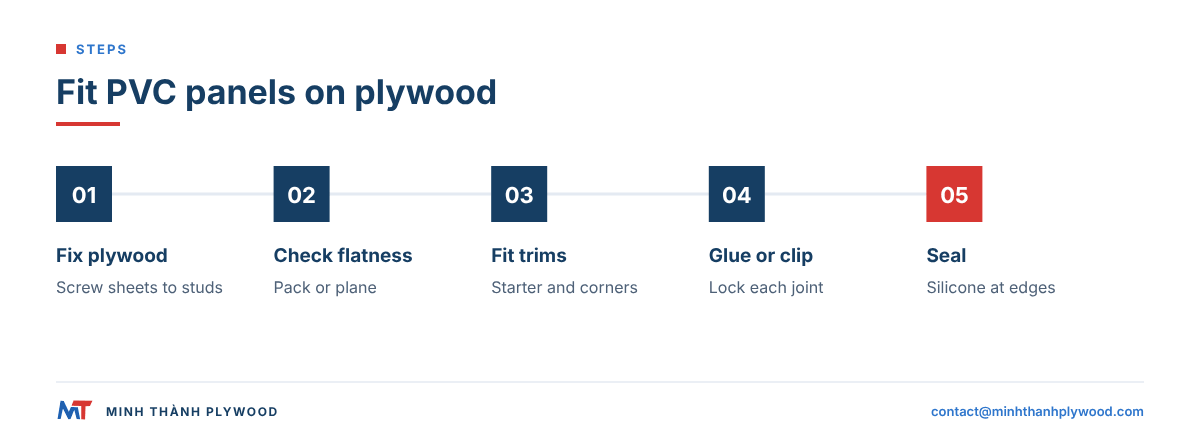
To install PVC wall panels on plywood, fix the plywood flat to the studs or wall, let it reach room moisture, then glue or clip the panels on from one corner and seal the edges. Plywood is a good backing because it holds screws and stays flat.
- Fix the plywood: screw 9–12 mm sheets to the studs or battens; use a water-resistant bond in bathrooms.
- Check flatness: plane or pack high and low spots; panels show every bump.
- Clean and prime if the adhesive maker asks for it.
- Fit trims: starter, corner and end trims first.
- Apply adhesive in vertical beads on the panel back, or fix clips or screws through the tongue.
- Slide in the next panel and lock the joint fully.
- Cut the last panel to width and fit it into the end trim.
- Seal the base, corners and penetrations with silicone.
The same method suits PVC bathroom panels on plywood, as long as the plywood behind wet areas has an MR or WBP bond and the panel joints are sealed.
PVC wall panelling price: what drives the cost
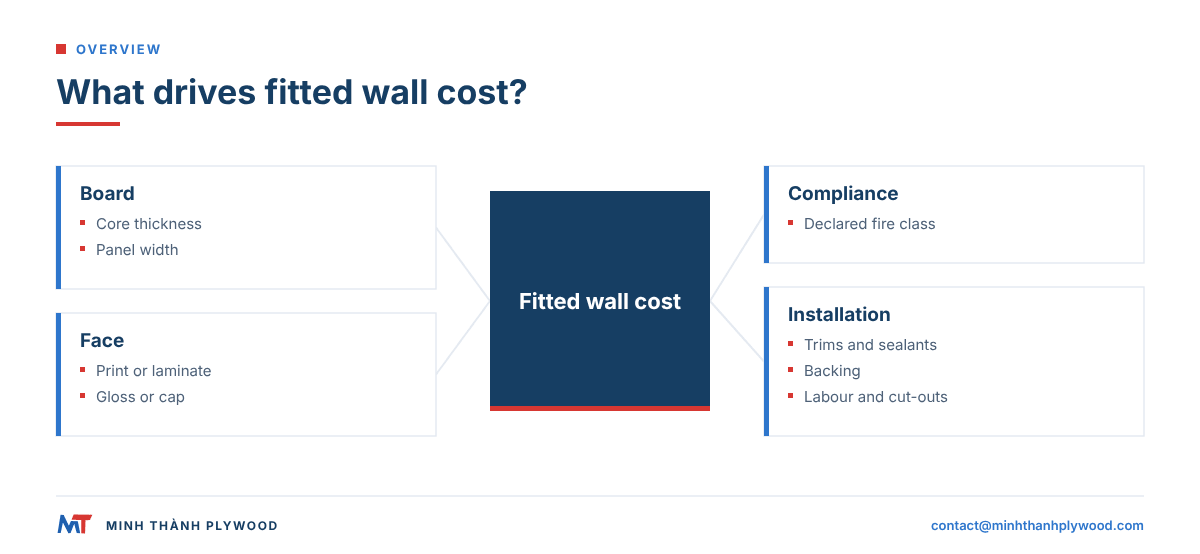
PVC wall panelling price is set by thickness, core type, face finish, panel width, fire class and trims, and the fitted cost adds the backing and labour. A cheap thin hollow panel and a thick laminated panel can differ several times in price for the same area.
| Price driver | Lower cost | Higher cost |
|---|---|---|
| Core | Thin hollow PVC | Thick foamed or solid PVC, WPC |
| Face | Simple print | Laminated, gloss, co-extruded cap |
| Width | Narrow strips | Wide shower panels |
| Fire class | Standard | Better declared class for public buildings |
| Trims and sealants | Basic plastic trims | Matching system trims, aluminium |
| Backing | Existing flat wall | New plywood or board backing |
| Labour | DIY on a flat wall | Wet areas, many cut-outs |
Price per square metre also depends on the market and order size, so compare full quotes. For real-wood panels, our furniture and interior plywood starts from US$350/m³ (October 2026); see the plywood price guide for what changes it.
US PVC panel sizes and prices
PVC panelling in the US is sold as interlocking liner panels, tongue-and-groove wainscoting, plastic sheets, shower panels and 3D decorative tiles, and a single panel costs from about US$34 to US$114 for the liner type. The table lists the common retail formats with their sizes, taken from two US retailers’ pages (read 21 October 2026).
| Format | Typical size | Price seen | Typical use |
|---|---|---|---|
| Interlocking liner panel, 16 in wide | 16 in × 3/8 in × 96 in (5-pack at Home Depot) | $33.62–$100.86 per panel at Duralight | Garages, barns, wash bays, basements |
| Interlocking liner panel, 18 in wide | 18 in wide, 8 ft and longer | $37.83–$114.36 per panel, by colour and length | Same, wider coverage per panel |
| Tongue-and-groove wainscoting | 1/4 in × 7-1/4 in × 96 in (3-pack) | See Home Depot PVC paneling | Lower walls, hallways, bathrooms |
| Beadboard or shiplap wainscoting kit | 5/8 in × 96 in, for heights up to 41-5/8 in or 57-5/8 in | See Home Depot | Dado-height wall panelling |
| Plastic sheet (FRP-type) | 1/16 in × 4 ft × 8 ft | See Home Depot | Commercial kitchens, wash walls |
| Waterproof shower or wall panel | 4 ft × 9 ft | See Flexstone | Showers, tub surrounds, feature walls |
| 3D decorative tile | 24 in × 24 in (30-pack) or 19.7 in × 19.7 in (12-pack) | See Home Depot | Feature walls |
Liner panels are the budget route for utility spaces: a 16 in or 18 in panel covers 1.3 to 1.5 ft of wall width per piece. Prices rise with length, colour and the number of panels per order.
Against plywood, a 4 × 8 ft sheet (1220 × 2440 mm, about 32 sq ft) of veneered plywood is one rigid, refinishable panel with real wood grain, while the same area in 96 in liner panels takes three 16 in panels, about US$100 to US$300 at the prices above, plus trims. As a raw FOB example, 9 mm furniture plywood from US$350/m³ works out at about US$9.4 per sheet before freight, duty and importer margin (sheet area × 9 mm thickness × US$350/m³), so at import volume a wood-look wall in plywood starts from a low material cost per square foot.
When plywood or veneered panels look better
Veneered plywood panels look better than PVC or WPC wherever the wall should show real wood: offices, hotel rooms, shops, restaurants and homes with timber furniture. Real veneer has depth and varied grain that a printed film copies only from a distance.
- Real grain and warmth: oak, walnut, birch, okoume and EV faces in matched sheets.
- Refinishing: sand and recoat after wear, which plastic panels cannot do.
- Matching furniture: the same veneer on walls, doors and joinery.
- Strength: plywood panels take shelves, hooks and screws.
Our interior plywood comes with both faces UV-ready, to the standard customers need to apply their own UV coating, and with sanded and polished faces. See melamine board for a low-cost decorative face on a board.
Indoor air: PVC, WPC and plywood panels
For indoor air, check the formaldehyde emission of wood-based panels and the declared emissions of plastic panels. Plywood for interiors should carry its emission class; ours uses UF glue at E0 emission for furniture and interior panels.
- Plywood: CARB P2 / TSCA Title VI is the accepted proof in the US market; our panels hold it (ICTT mill no. 23024).
- Test results: six ASTM D6007 chamber tests on 9, 15 and 18 mm panels averaged 0.014–0.032 ppm against the US limit. The limit for veneer-core hardwood plywood is 0.05 ppm under 40 CFR 770.10.
- PVC and WPC: ask for the maker’s indoor-air or emissions declaration.
Third-party testing to the buyer’s method, for example EN 717-1, is arranged through SGS on request.
What this means for your wall panel order
If you choose veneered plywood for wall panels, the specification sets the look, the flatness and the moisture resistance, so send these lines:
- Application: wall panels, ceiling, fluted strips or joinery.
- Face: oak, birch, poplar, EV, okoume or other veneer, with the face/back grade.
- Core: white Styrax for a light panel, or Eucalyptus.
- Glue and emission: UF glue at E0 emission; MR or WBP for damp areas.
- Thickness and size: for example 9–18 mm in 1220 × 2440 or 1250 × 2500 mm, or cut-to-size.
- Finish: sanded and polished, UV-ready faces.
- Quantity and packing: from one 40HC, mixed specifications by agreement.
Production takes 15–45 days after the deposit, and free samples are available. See furniture and interior plywood, or compare boards in plywood vs chipboard and plastic plywood.
Buyer questions, answered
Are PVC wall panels waterproof?
Yes, the PVC itself does not absorb water, so PVC wall panels are waterproof on their face. The wall behind stays dry only if the joints, edges and corners are sealed and the trims are fitted correctly.
What is the difference between WPC and PVC wall panels?
PVC wall panels are made from plastic alone and are light, thin and fully waterproof. WPC wall panels mix wood fibre or flour with plastic, so they are thicker, heavier and more rigid, and are often made as fluted feature panels.
Can PVC panels be fitted directly onto plywood?
Yes. A flat, dry, fixed plywood backing is a good base for PVC panels, fitted with panel adhesive or clipped and screwed through the tongue. Use a moisture-resistant plywood in wet rooms.
How much do PVC wall panels cost in the US?
Interlocking PVC liner panels 16 in and 18 in wide cost about $34 to $114 per panel at one US plastics supplier in October 2026, depending on length and colour. Wainscoting kits, 4 × 8 ft plastic sheets and 4 × 9 ft shower panels are priced by the pack or sheet.
Are WPC panels waterproof?
WPC panels resist water far better than wood or MDF panels, because the plastic surrounds the wood fibre. They are water-resistant rather than fully inert, so cut ends are best sealed or hidden in trims.
Is PVC panelling cheaper than tiles?
PVC panelling usually costs less than tiling a wall once labour is counted, because it goes up quickly without grout or a tiler. Quality and thickness change the material price a lot.
Do PVC wall panels catch fire?
PVC is harder to ignite than wood and tends to self-extinguish, but it gives off dense smoke when it burns. Check the panel's declared fire class against the building rules for the room.
How long do PVC wall panels last?
Good PVC wall panels last many years indoors when they are kept away from direct heat and fitted on a flat backing. Thin, cheap panels can dent and fade sooner.
Can you put PVC panels over tiles?
Yes, PVC panels can usually be fixed over sound, flat tiles with a suitable adhesive. Loose tiles must be removed first and any damp problem fixed.
Are WPC wall panels good for bedrooms and living rooms?
Yes. Fluted WPC panels are popular for feature walls in living rooms, bedrooms and hotels because they look like slatted timber and need no painting.
When is veneered plywood better than PVC or WPC panels?
Veneered plywood is better where the wall should show real wood grain, take a lacquer or oil finish, and be repaired or refinished later, such as offices, hotels and shops.