
Plastic plywood is a sheet sold as a plywood substitute but made wholly or partly of plastic: hollow or solid polypropylene formwork boards, HDPE and PVC sheets, fibreglass-foam boards such as Coosa, and wood plywood with a plastic face. They resist water and clean easily, but cost more per sheet and flex more. Minh Thanh Plywood, a Vietnamese film-faced plywood maker, compares them with wood.
What is plastic plywood?
Plastic plywood is any sheet sold as a plywood substitute that is made wholly or partly of plastic. The name is used loosely, so it covers solid plastic boards, hollow plastic formwork panels, foam-and-fibreglass boards and real wood plywood with a plastic face.
The products sold under the name fall into five groups:
- Hollow polypropylene (PP) formwork boards: extruded panels with internal ribs, light, for concrete forms.
- Solid or foamed PP and HDPE sheets: dense plastic boards for formwork, marine, food and chemical uses.
- PVC foam and PVC-wood composite boards: light boards for signs, cabinets in wet rooms and interiors.
- Composite marine boards: polyurethane foam with fibreglass, such as Coosa, and marine HDPE such as Starboard.
- Plastic-faced plywood: wood plywood with a PP or similar plastic film on the faces.
Only the last group is plywood in the strict sense, with cross-laminated wood veneers. The others are plastic sheets that do plywood’s jobs.
Plastic ply sheet types compared
Each plastic ply sheet type has a clear best use. The table compares them on one property per row, against film-faced plywood as the wood reference.
| Sheet | Core | Weight | Stiffness | Water | Main use |
|---|---|---|---|---|---|
| Hollow PP formwork board | Ribbed PP | Light | Low | Does not absorb | Wall and slab forms |
| Solid PP or HDPE sheet | Solid plastic | Heavy | Low to medium | Does not absorb | Forms, marine, food, chemical |
| PVC foam board | Foamed PVC | Light | Low | Does not absorb | Signs, wet-room panels |
| Coosa-type composite | PU foam and fibreglass | Light | Medium | Does not absorb | Boat decks and transoms |
| PP-faced plywood | Wood veneers | Medium | High | Faces sealed, edges vulnerable | Formwork, vehicle floors |
| Film-faced plywood | Wood veneers | Medium | High | Faces sealed, edges sealed | Concrete formwork |
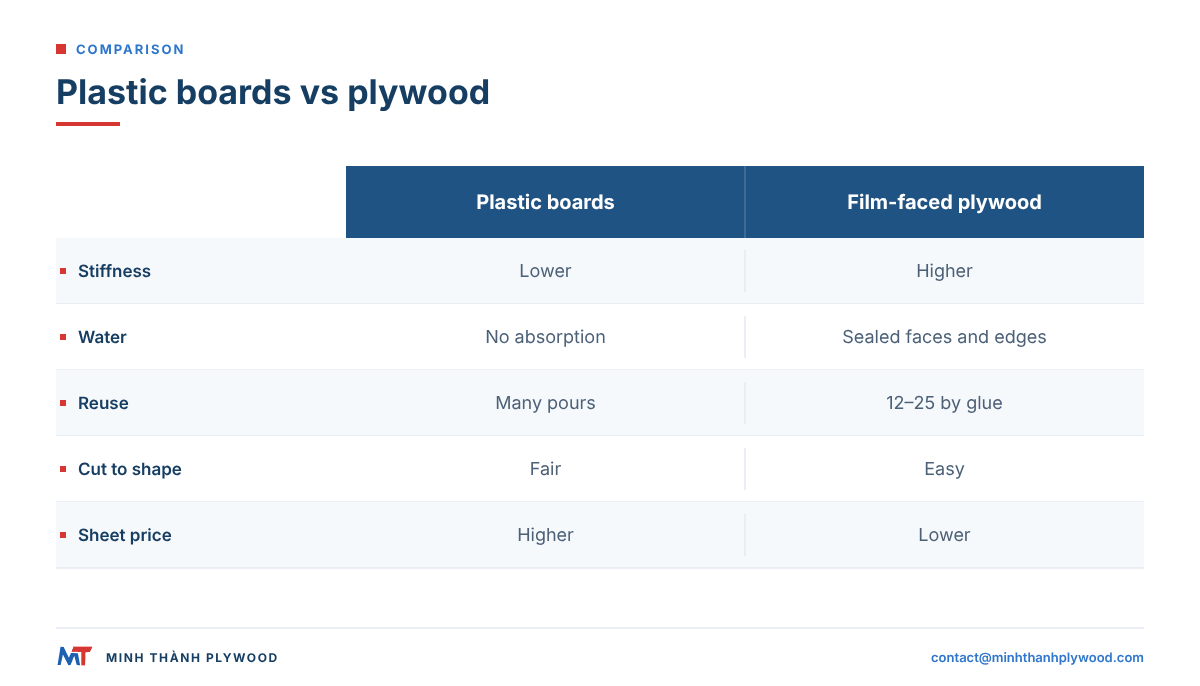
The pattern is simple: plastic resists water better, wood carries load better. The right sheet depends on which of those your job needs more.
Plastic ply wood: PP-faced plywood
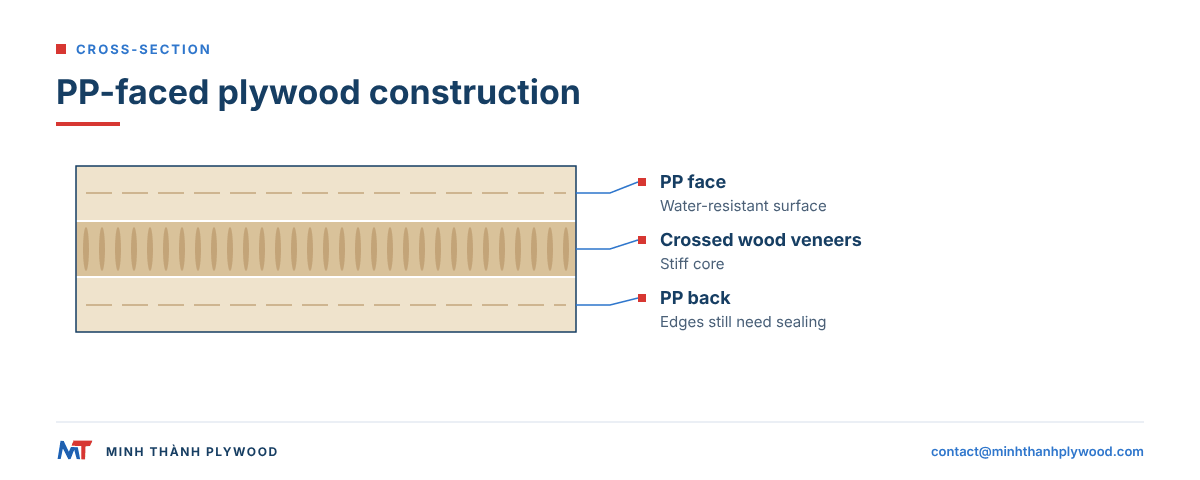
Plastic ply wood, sold as PP plywood or plastic-faced plywood, is wood plywood with a polypropylene film or sheet bonded to its faces. The wood core gives stiffness; the plastic face gives a smooth, release-friendly, water-resistant surface.
It sits between film-faced plywood and solid plastic boards:
- Face: thicker and more abrasion-resistant than a phenolic film, with a smooth or textured finish.
- Core: hardwood veneers, so it spans supports like plywood.
- Edges: wood, so they must be sealed after every cut.
- Reuse: more pours than standard film-faced plywood when the edges are kept sealed.
The weak point of any plastic-faced wood panel is the edge. Once water reaches the core at a cut, a hole or a damaged corner, the wood swells under the plastic face.
Synthetic plywood boards for marine and wet use: Coosa, HDPE and PVC
Synthetic plywood boards are used in boats, wet rooms and food plants because they cannot rot. Each type trades stiffness, weight and fixing strength in a different way. For food plants in the EU, plastic materials meant to touch food fall under Commission Regulation (EU) No 10/2011, so ask the board maker for its food-contact declaration.
- Coosa board: high-density polyurethane foam reinforced with fibreglass layers. Light and rot-proof, used for transoms, stringers and decks instead of marine plywood.
- Marine HDPE (Starboard-type): solid, UV-stabilised polyethylene for hatches, cabinets, steps and fittings on boats. Heavy and flexible; it cannot be glued like wood.
- PVC foam board: light, easy to cut, used for signs and wet-room cladding; low stiffness.
- WPC boards: wood fibre in a plastic matrix; heavier than plywood, used for wet-area cabinets.
For a boat interior where weight and stiffness count, marine plywood with phenolic glue is still the standard; our marine plywood buying guide explains how to specify it.
Non-wood fibre boards: rice husk, wheat straw and hemp
Non-wood fibre boards are pressed from agricultural fibres such as rice husk, wheat straw or hemp, bound with resin or a plastic. They are sold as alternatives to particle board and MDF, not to structural plywood.
| Board | Fibre | Typical use | Limit |
|---|---|---|---|
| Rice husk board | Rice husk with plastic or resin | Decking, wall panels, furniture parts | Lower stiffness than plywood |
| Wheat straw board | Straw fibre with resin | Furniture and shelving | Interior only |
| Hemp board | Hemp hurd or fibre with resin | Interior panels | Limited sizes and supply |
They suit buyers who want a board from crop waste for interior furniture. For spans, screws and formwork, they do not replace plywood. Our guide to particle board vs plywood compares pressed boards with veneer panels.
Is plastic plywood stronger than plywood?
No, plastic plywood is usually not stronger than wood plywood in the way that matters most for panels: stiffness between supports. Wood veneers carry load along their grain, and cross-lamination spreads it both ways; plastic sheets of the same thickness bend more under the same load.
Where each wins:
| Property | Plastic sheets | Wood plywood |
|---|---|---|
| Stiffness over a span | Lower; needs closer supports | Higher |
| Impact without cracking | Good, flexes back | Good; face can dent |
| Screw and nail holding | Fair; plastic creeps under load | Good |
| Water absorption | None | Low with sealed faces and edges |
| Rot and insects | Immune | Protected by glue, faces and treatment |
| Heat | Softens and moves | Stable |
So plastic is stronger against water and rot, and wood is stronger against load. For forms, choose plastic when a light, washable panel on a close-spaced frame suits the job, and plywood when spans and stiffness matter.
Reuse: plastic formwork vs film-faced plywood
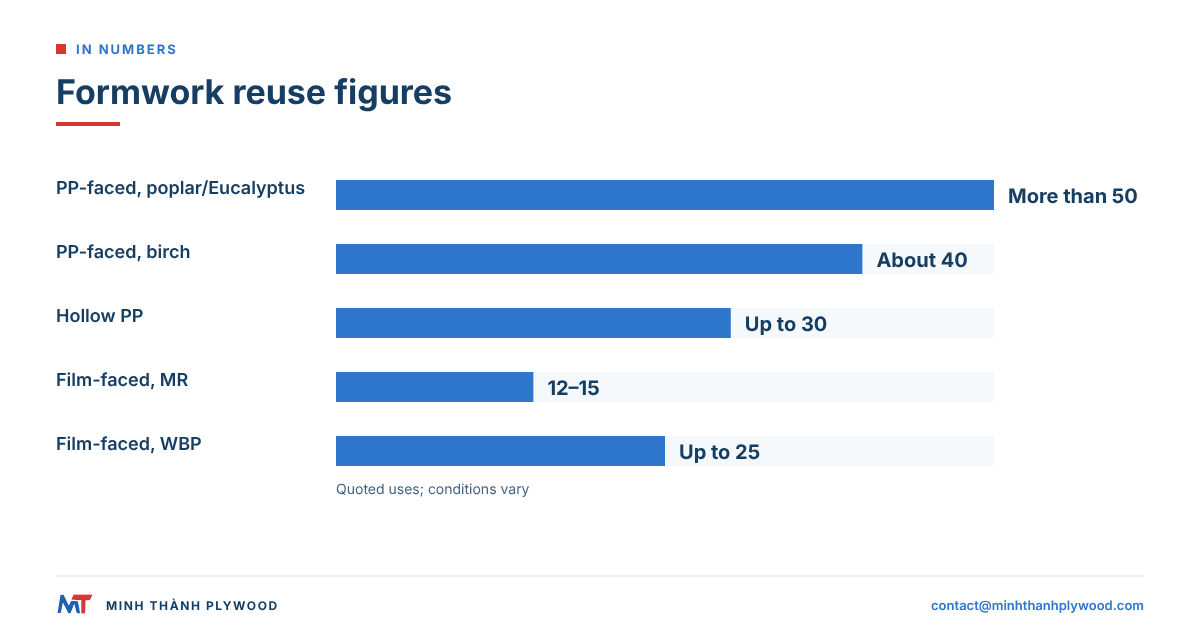
Plastic formwork boards are sold for many more pours than film-faced plywood, because they do not take up water; film-faced plywood gives about 12–15 uses with melamine glue and up to about 25 with phenolic (WBP) glue, with proper handling, release agent and edge sealing.
Published reuse counts differ by system and core, so compare like with like:
| Board | Reuse quoted | Source type |
|---|---|---|
| PP-faced plastic plywood, poplar or eucalyptus core, in steel or aluminium frames | More than 50 times | Maker page (Wellmade) |
| PP-faced plastic plywood, birch core | About 40 times | Maker page (Wellmade) |
| Hollow PP formwork board | Up to 30 times | Philippine seller listing |
| Film-faced plywood, melamine glue | About 12–15 times | Our industry figure |
| Film-faced plywood, phenolic (WBP) glue | Up to about 25 times | Our industry figure |
Plastic-faced boards win on count, but the plastic-faced types are built on poplar, eucalyptus or birch cores, and birch is imported, so it costs more. Maker counts assume steel or aluminium frames and trained crews.
What decides reuse on site:
- Edge care: sealed edges on plywood after every cut.
- Release agent: applied before every pour, on plastic and on plywood.
- Cleaning: plastic washes clean; plywood film should be scraped gently, never hacked.
- Storage: flat, off the ground and covered.
- Heat: plastic boards move and soften in hot sun; plywood stays flat.
Our film-faced plywood is pressed with melamine-fortified or phenolic (WBP) glue to your specification and held to a ±0.5 mm thickness tolerance.
8x4 plastic plywood sheets: sizes and thickness
8x4 plastic plywood sheets measure 1220 × 2440 mm, the same as standard plywood, so they fit existing frames and cutting plans. Hollow and solid plastic formwork boards are also made in other sizes, set by each maker’s extrusion line or mould.
- Standard plywood size: 1220 × 2440 mm; also 1250 × 2500 mm for European frames.
- Plywood thickness: film-faced plywood for forms is usually 12, 15 or 18 mm; our range runs 3–40 mm.
- Tolerance: our commercial and film-faced plywood is held to ±0.5 mm in thickness and ±2 mm in length and width.
When mixing plastic and wood boards on the same system, check that the thicknesses match, or the joints will show on the concrete.
8x4 plastic plywood sheets price: what drives it
The price of 8x4 plastic plywood sheets is set by the polymer, the sheet’s mass and the build, and per sheet it is higher than film-faced or commercial plywood. What matters for a buyer is the cost per use.
| Price driver | Plastic boards | Film-faced plywood |
|---|---|---|
| Raw material | Polymer by weight; recycled content lowers it | Core species, film weight, glue |
| Build | Hollow, solid or foamed | Ply count, double pressing |
| Thickness | More plastic per sheet | More veneer per sheet |
| Reuse | Many pours | About 12–25 by glue |
| Repairs | Weld or patch | Seal edges, replace sheet |
| End of life | Ground and recycled by maker | Used as packing or fuel |
Plastic board prices in the Philippines
Hollow PP formwork boards are a common local buy in the Philippines, sold in 12, 15 and 18 mm thickness, 4 x 8 ft. In October 2026, a Metro Manila hardware supplier lists the MC brand at ₱1,650 per sheet and a second supplier lists ₱1,600 for all three thicknesses.
Phenolic board in 18 mm is listed at about ₱1,525. Marine plywood, 1/2 inch, is quoted at roughly ₱800–1,200 per 4 x 8 sheet, so a plastic board costs more per sheet than wood plywood. Container buyers in Manila can quote film-faced plywood from us per m³ FOB or CIF Manila and compare it with these shelf prices per pour.
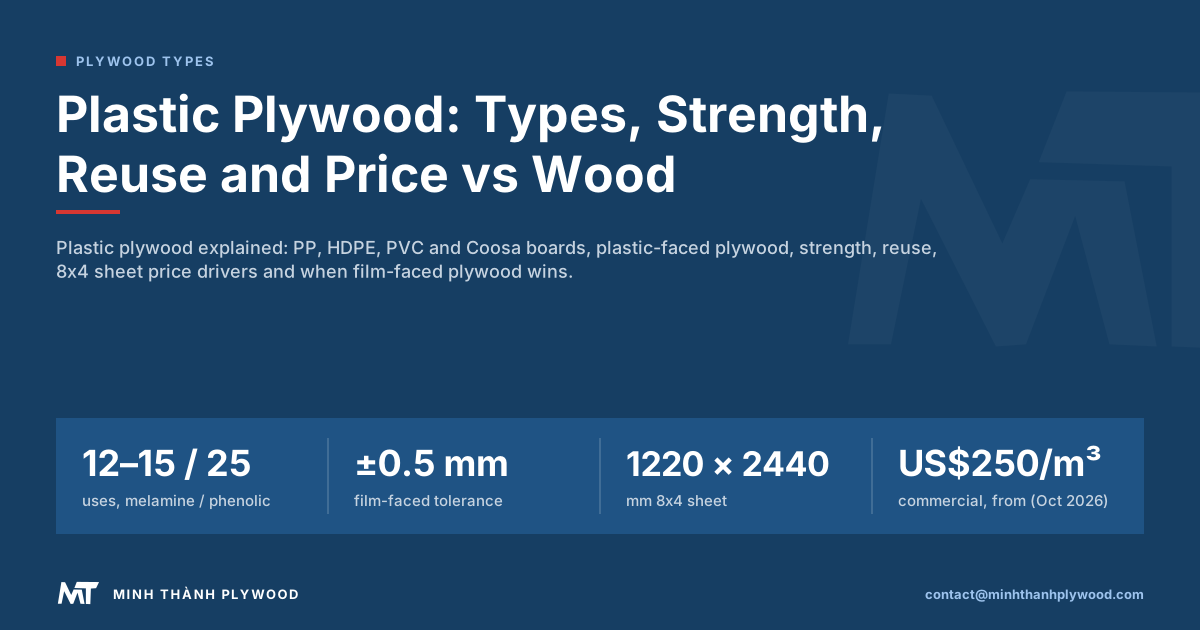
Divide the delivered sheet price by the number of pours you really get on your site. On short projects or jobs where boards are cut to many shapes, film-faced plywood usually wins. As of October 2026, our commercial plywood starts from US$250/m³; the final price depends on face, core, glue, thickness, size, quantity and delivery term.
Weight, cutting and fixing on site
Plastic boards and wood plywood behave differently in the hands of a site crew. Hollow PP boards are light to carry, solid HDPE boards are heavy, and wood plywood sits in between with the best stiffness for its weight.
| Site task | Plastic boards | Wood plywood |
|---|---|---|
| Carrying | Hollow PP light; solid HDPE heavy | Medium; 18 mm Acacia-core film-faced about 31.1 kg |
| Cutting | Standard saws; dust is plastic chips | Standard saws; seal cut edges |
| Nailing | Poor in hollow boards; use screws or clips | Nails and screws hold well |
| Holes and repairs | Plug or weld with a hot-air tool | Fill and seal, or replace the sheet |
| Hot weather | Softens and expands | Stays flat |
| Cold weather | Can turn brittle | Unchanged |
Our 18 mm reference sheet masses come from planning densities times sheet volume: 26.8 kg on Styrax, 31.1 kg on Acacia and 34.8 kg on Eucalyptus core, at 1220 × 2440 mm. For film-faced formwork the core is Acacia or Eucalyptus.
Plastic boards also expand and contract with temperature far more than wood. On long wall forms in hot climates, leave the gaps the board maker specifies, or joints will open and close between morning and afternoon pours.
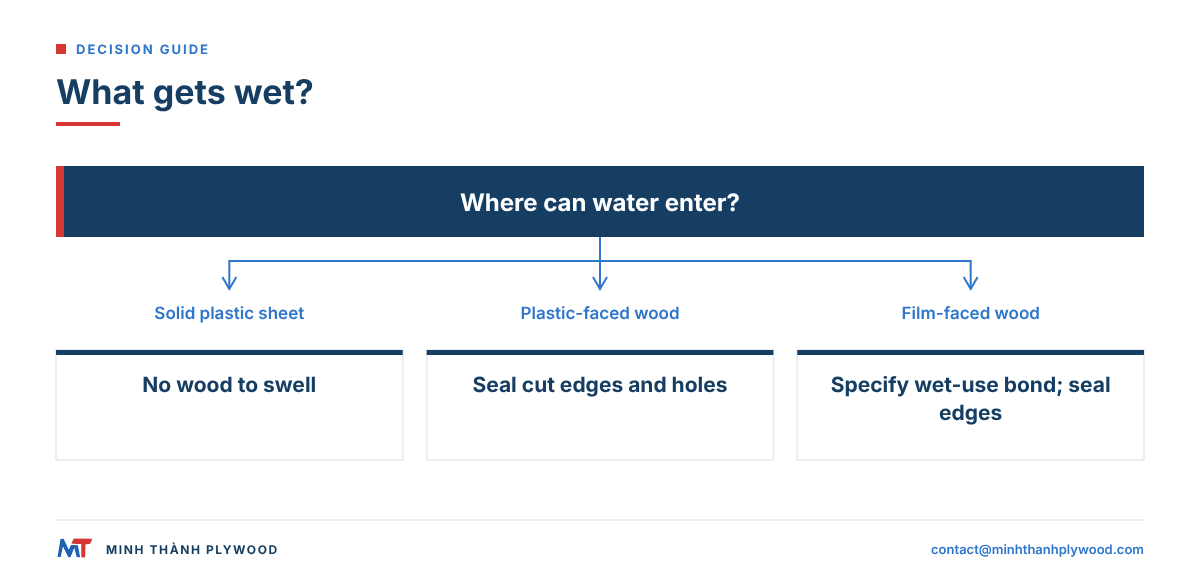
Is plastic plywood waterproof?
Solid plastic boards are waterproof: they do not absorb water, swell or rot. Plastic-faced wood plywood is waterproof on the face only, and its cut edges and holes let water into the wood unless they are sealed.
Wood plywood resists water through its glue and its faces. Phenolic (WBP) glue keeps plies bonded through wetting and drying; a film or plastic face sheds water; sealed edges stop water entering the core. Our guide is plywood waterproof? explains what each glue survives.
Can you plaster over plywood?
You cannot plaster directly over plywood and expect a lasting finish: plywood moves with humidity and its smooth face gives plaster nothing to grip, so the plaster cracks or comes away. Fix plasterboard or a lath over the plywood, or use a bonding primer and reinforcing mesh made for plastering onto timber boards.
The related question, whether plywood can replace plasterboard, has a split answer:
- Strength and fixings: plywood is better; shelves and cabinets fix anywhere.
- Fire resistance: plasterboard is better; plywood is a combustible panel.
- Finish: plasterboard takes skim and paint; plywood is painted, clear-finished or lined.
Check the fire rating your building rules require before replacing plasterboard with plywood. In Europe, standard gypsum boards are usually classed A2-s1,d0 (limited combustibility), while untreated plywood above a minimum thickness and density is classed D-s2,d0 without further testing under Commission Decision 2003/43/EC as amended by 2007/348/EC, using the classes of Commission Delegated Regulation (EU) 2016/364. Our guide to plywood wall panels covers thickness and fixing.
Recycled content and end of life
Many PP and HDPE boards contain recycled plastic and can be ground and remade into new boards at the end of their life, which is the main environmental case made for them. Plastic-faced wood plywood is harder to recycle, because the plastic and wood are bonded together.
Wood plywood’s case is different: it is made from plantation timber. Our panels use Vietnamese plantation species for cores, and we supply the EUDR compliance dossier (origin records and geolocation files) with orders under Regulation (EU) 2023/1115. Ask each board maker for its recycled content and take-back terms in writing.
When to choose plastic, and when wood plywood
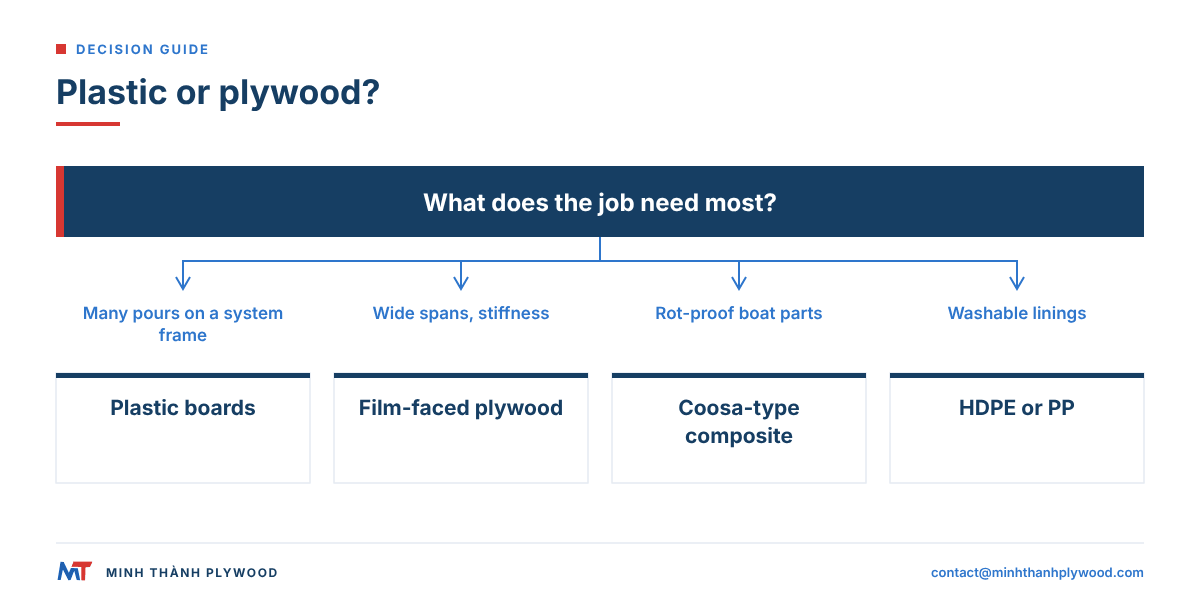
Choose plastic sheets for washable, rot-proof parts in wet places and for formwork systems built for them; choose wood plywood for spans, screws, cut-to-shape forms and cost. The matrix gives the verdict by use.
| Use | Choose | Why |
|---|---|---|
| Repetitive wall forms on a system frame | Plastic or film-faced | Plastic for many pours; plywood for lower start cost |
| Slab forms over wide spans | Film-faced plywood | Stiffness |
| Shaped, one-off forms | Film-faced plywood | Cuts and fixes easily |
| Boat transoms and stringers | Coosa-type composite or marine plywood | Rot-proof vs stiffness and cost |
| Food plant and chemical linings | HDPE or PP | Washable, no absorption |
| Signs | PVC foam or MDO-type plywood | Light vs outdoor stiffness |
| Vehicle floors | Plastic-faced or anti-slip plywood | Wear face on a stiff core |
| Furniture and cabinets | Furniture plywood | Screws, flatness, faces |
For vehicle floors and walkways, our anti-slip plywood is accepted on order.
What this means for your order
If your job needs plywood’s stiffness with a water-resistant face, specify film-faced or anti-slip plywood fully. Send these lines with your request:
- Application: wall forms, slab forms, vehicle floors or packing.
- Core: Acacia or Eucalyptus for film-faced and anti-slip panels.
- Glue: melamine-fortified or phenolic (WBP), to your specification.
- Face: film colour and weight, or an anti-slip pattern.
- Size and thickness: 1220 × 2440 or 1250 × 2500 mm, held to ±0.5 mm.
- Packing and quantity: from one 40HC, mixed specifications by agreement.
Production takes 15–45 days after the 30% deposit, and free samples are available, so you can run a trial pour beside your plastic boards before you order. Read our film-faced plywood price guide for the cost side.
Buyer questions, answered
What is plastic plywood?
Plastic plywood is a sheet sold as an alternative to wood plywood and made wholly or partly of plastic, such as polypropylene, HDPE or PVC. The name also covers wood plywood with a plastic face, often called PP plywood.
Is plastic plywood stronger than plywood?
Usually not in stiffness. Wood plywood of the same thickness is stiffer and carries more load between supports; plastic sheets flex more and need closer supports. Plastic wins on water resistance and on not rotting.
How many times can plastic formwork be reused?
Plastic-faced plywood is quoted at more than 50 uses in steel or aluminium frames (birch core about 40), and hollow PP boards up to 30. Film-faced plywood gives about 12–15 uses with melamine glue and up to about 25 with phenolic (WBP) glue, with proper handling, release agent and edge sealing.
Is plastic plywood waterproof?
Solid plastic sheets do not absorb water, so they do not swell or rot. Plastic-faced wood plywood is waterproof on the face only; water entering cut edges or holes can still reach the wood core.
What size are 8x4 plastic plywood sheets?
An 8x4 sheet is 1220 × 2440 mm, the same as standard plywood. Plastic formwork boards are also sold in other sizes set by each maker's moulds or extrusion lines.
Can you plaster over plywood?
Not directly as a finished wall. Plywood moves with humidity and is too smooth for plaster to key into, so plaster cracks or lets go. Fix plasterboard or a lath over it, or use a bonding primer and mesh made for the purpose.
Can I use plywood instead of plasterboard?
Plywood can line walls and ceilings and is stronger for fixings, but it does not give plasterboard's fire resistance. Check the fire rating your building rules require before replacing plasterboard.
What is Coosa board?
Coosa board is a composite panel of high-density polyurethane foam reinforced with layers of fibreglass. It is used in boat building as a rot-proof replacement for marine plywood in decks, transoms and stringers.
Is plastic plywood cheaper than wood plywood?
No, per sheet plastic boards cost more than film-faced or commercial plywood. They can cost less per use when they reach many more pours, so compare cost per use on your own project.
Can plastic plywood be recycled?
Polypropylene and HDPE boards can be ground and recycled into new boards by their makers, and many contain recycled plastic. Plastic-faced wood plywood is harder to recycle because plastic and wood are bonded together.