
Radiata pine plywood is plywood made with veneers of Pinus radiata, a fast-growing plantation pine, on the faces and often in the core. It is light, pale and easy to work, and is sold for furniture, lining, packing and sheathing. This guide compares it with the other pines used for plywood. Minh Thanh Plywood makes pine-faced panels on hardwood cores in Vietnam.
What is radiata pine plywood?
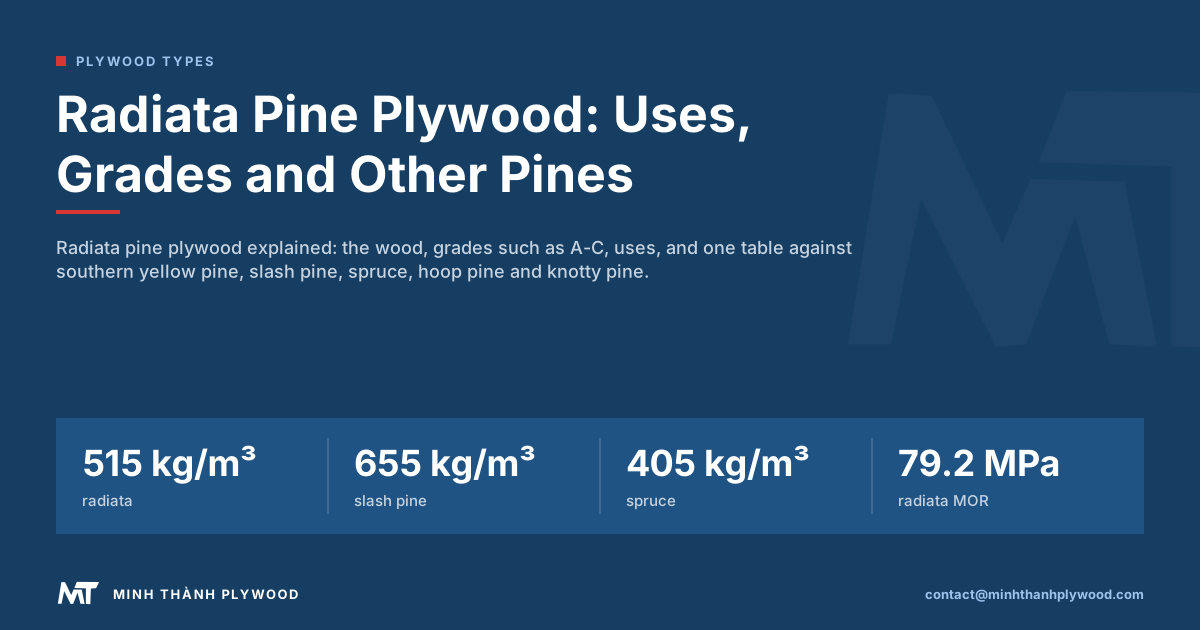
Radiata pine plywood is softwood plywood made with veneers of radiata pine, also called Monterey pine or insignis pine, on its faces and often in its core. It is light, pale, easy to cut and cost-effective, and it is sold mainly for furniture parts, interior lining, packing and, with exterior glue, sheathing.
- Species: Pinus radiata, native to coastal California and planted widely across the southern hemisphere.
- Look: pale cream to light yellow, with visible growth rings and knots by grade.
- Weight: dried radiata pine averages about 515 kg/m³.
- Grades: sanded A-C and B-C grades in the US market; A/A to B/C face/back pairs elsewhere.
- Uses: furniture carcasses, shelving, lining, crates and packing, sheathing.
A buyer comparing radiata with other pines should ask three things: which species is on the face, which is in the core, and which glue bonds them.
Radiata pine plywood in the UK: sizes, grades and shelf prices
UK buyers meet radiata pine plywood as 8 × 4 ft sheets (2440 × 1220 mm), sold by letter pair and CE class, with a sheet weighing about 14 to 40 kg by thickness (Sheet Materials Wholesale). The prices below were checked on 21 October 2026. Stockists also call the cheap grade “shuttering ply” and name the build “radiata pine faced, poplar core”. The table lists what UK shelves charged.
| Panel, 2440 × 1220 mm | Grade and marking | Price per sheet ex VAT |
|---|---|---|
| 9 mm radiata-faced, poplar core | C+/C, CE2+, FSC | £12.25 (£14.70 inc VAT) |
| 12 mm Uruguayan pine throughout | B/C, CE2+, FSC | £20.39 (£24.47 inc VAT) |
| 12 mm radiata-faced, poplar core, pack of 75 | C+/C, CE2+, FSC | £14.52 in the pack, £17.08 single |
| 18 mm Arauco Chilean radiata, Class 3 | EN 314-2 Class 3, BS 5268-2, BBA structural, FSC | £38.00 (£45.60 inc VAT) |
Sources: Sheet Materials Wholesale and Country Supplies.
The 75-sheet pack price is about 15 % below the single-sheet price.
What this means for an importer: furniture and interior plywood from Minh Thanh starts from US$350/m³ (October 2026), and an 18 mm sheet of 1220 × 2440 mm is 0.0536 m³, so the raw FOB example is about US$18.8 per sheet before sea freight, UK duty and margin, against £38.00 ex VAT for a structural 18 mm sheet on a UK shelf.
Sea days from Hai Phong to Northern Europe run 30 to 40. UK duty on plywood lines is set per commodity code on the UK Trade Tariff (third-country rates for heading 4412 are 6 % to 10 %), and the UK-Vietnam trade agreement gives Vietnam a preference, so confirm the code and the origin proof before you quote a landed price.
UK specifiers read the grade as an EN 635 face class and the bond as an EN 314-2 class: Class 1 is dry, Class 2 humid and Class 3 exterior. Ask for the EN 636 line on the data sheet (the BSI listing for BS EN 636:2012+A1:2015 covers plywood for structural and general-purpose use in dry, humid or exterior conditions), and for CE or UKCA marking, an FSC or PEFC chain of custody and UK Timber Regulation due-diligence papers when the panel goes into a building. We supply the EUDR dossier and origin records with orders, which cover the same ground.
What is radiata wood?
Radiata wood is the timber of Pinus radiata, a fast-growing pine native to central and southern coastal California and widely planted throughout the southern hemisphere (The Wood Database, radiata pine, read 20 October 2026). Forest Research identifies it as Pinus radiata, also called Monterey pine. Plantations in New Zealand, Chile and Australia supply most radiata timber and veneer on the world market.
Radiata wood has an even texture, wide growth rings from fast growth, and pale colour. Its sapwood band is wide, which makes it take preservatives well. As solid wood it is a medium-density pine:
| Property (solid wood) | Radiata pine |
|---|---|
| Average dried density | 515 kg/m³ |
| Janka hardness | 710 lbf |
| Modulus of rupture | 79.2 MPa |
| Elastic modulus | 10.06 GPa |
These are clear-wood values for the species, read from The Wood Database; a plywood panel’s figures also depend on its build, core and glue.
How radiata pine plywood is made
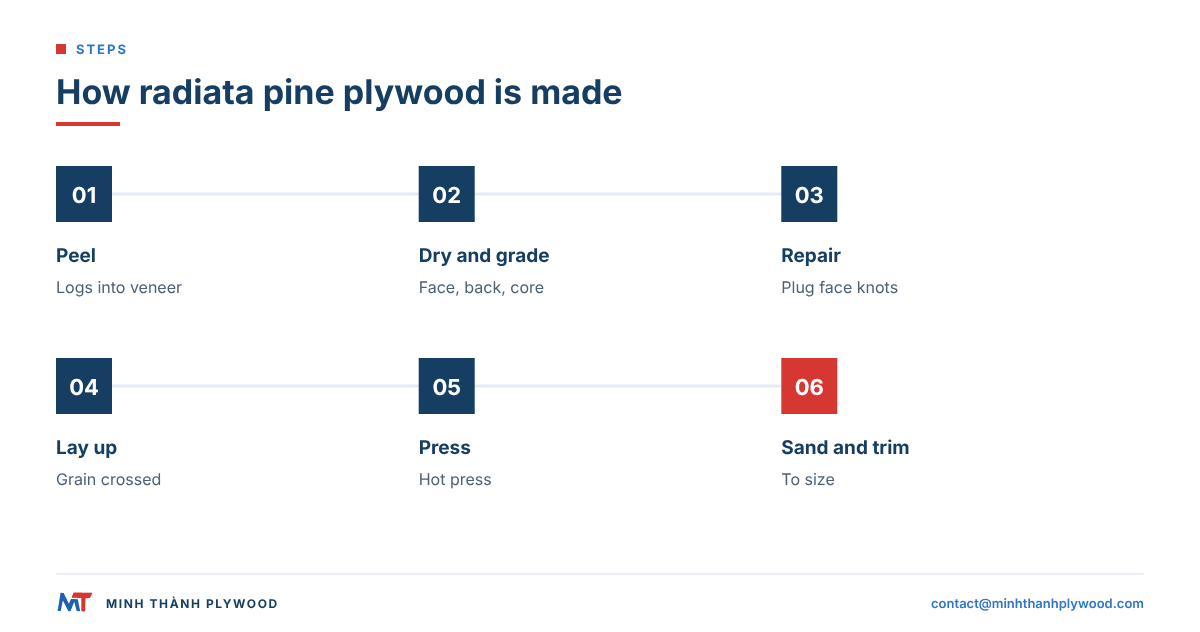
Radiata pine plywood is made like other plywood: logs are peeled into veneer, dried, graded, glued in crossed layers and hot-pressed. Grading the veneers sets the face grade and the core quality.
- Peeling: logs are rotary-peeled into continuous sheets of veneer.
- Drying and grading: veneers are dried, then sorted into face, back and core grades by knots, splits and colour.
- Repair: face veneers in the better grades have knots plugged or patched.
- Lay-up: plies are laid with grain crossed, face and back on the outside.
- Pressing: glued plies are hot-pressed; melamine-fortified glue presses at about 110–120 °C and phenolic (WBP) at about 130–145 °C.
- Sanding and trimming: the panel is trimmed to size and, for sanded grades, sanded on both faces.
A pine-faced panel on a hardwood core follows the same steps with hardwood core veneers. Our furniture-grade panels are pressed twice as standard: the core board is pressed and calibrated, then face and back are pressed on.
Pine species used for plywood: one table
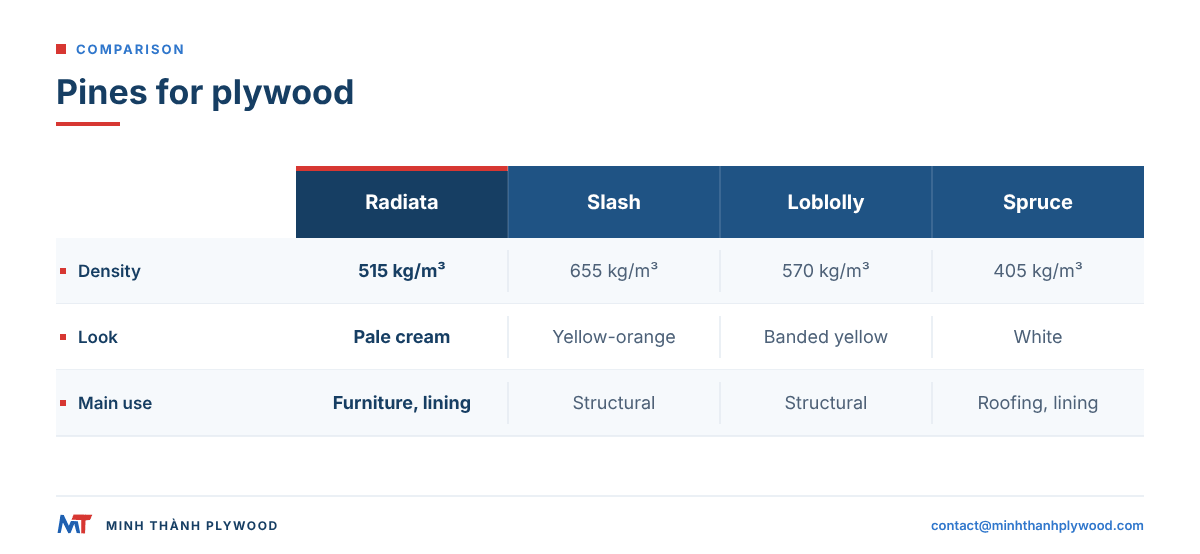
Radiata pine is one of several softwoods used for plywood; the table compares the species buyers meet most, with density, look, typical grade and origin. Density figures are average dried values for solid wood.
| Species | Density | Look | Typical plywood grade | Main origin |
|---|---|---|---|---|
| Radiata pine | 515 kg/m³ | Pale cream to yellow, wide rings | A-C, B-C sanded; A/A to B/C | New Zealand, Chile, Australia |
| Slash pine (elliottii) | 655 kg/m³ | Yellow to orange-brown, resinous | Structural and sanded faces | US Southeast; plantations elsewhere |
| Southern yellow pine (loblolly) | 570 kg/m³ | Yellow, strong latewood bands | Structural grades, CDX | US South |
| Norway spruce | 405 kg/m³ | White to pale yellow, small knots | Structural and lining grades | Europe, Nordic countries |
| Hoop pine | 500 kg/m³ | Pale cream, fine and even | Clear faces, marine and furniture | Australia, Papua New Guinea |
| Knotty pine (a look, any pine) | By species | Many sound knots, rustic | Knotty face grades | Any pine region |
Sources: The Wood Database species pages for slash pine, loblolly pine, Norway spruce and hoop pine, read 20 October 2026.
Radiata sits in the middle: lighter than slash and southern yellow pine, heavier than spruce, close to hoop pine. That balance of weight, stiffness and pale colour is why it is common in furniture and lining.
Southern yellow pine plywood vs radiata
Southern yellow pine plywood is denser, stronger and more resinous than radiata pine plywood, and it is mainly a US structural panel for sheathing, subfloors and roof decks. Radiata pine plywood is lighter and paler, and more of it is sold sanded for furniture and interiors.
| Point | Southern yellow pine plywood | Radiata pine plywood |
|---|---|---|
| Species | Loblolly, longleaf, shortleaf, slash | Pinus radiata |
| Solid-wood density | 570 kg/m³ (loblolly) | 515 kg/m³ |
| Modulus of rupture | 88.3 MPa (loblolly) | 79.2 MPa |
| Look | Strong yellow and dark latewood bands | Even, pale |
| Main market use | Structural sheathing, CDX | Sanded panels, lining, packing |
| Resin | High; can bleed through paint | Lower |
For a painted or clear interior panel, radiata’s paler and more even face is easier to finish. For a structural roof or floor deck to US codes, southern yellow pine plywood is the usual specification.
Slash pine and elliotis plywood
Elliotis plywood is plywood made from slash pine, Pinus elliottii, often spelt “elliotis” or “elliottis” in trade offers. Slash pine is a dense, resinous pine with a solid-wood density of about 655 kg/m³ and a modulus of rupture of about 112.4 MPa, the strongest of the pines in our table.
- Look: yellow to orange-brown, with marked latewood bands.
- Strength: higher than radiata; used for structural and dense faces.
- Weight: heavier than radiata for the same thickness.
- Origin: native to the US Southeast and planted in other warm regions.
Elliotis faces suit buyers who want a stronger and darker pine look; radiata suits buyers who want a lighter, paler panel.
Spruce ply and hoop pine plywood
Spruce ply is softwood plywood made from spruce, mainly Norway spruce in Europe; it is the lightest panel in the group at about 405 kg/m³ for the solid wood. It is white to pale yellow, with small knots, and is a common structural and roofing panel in Europe.
Hoop pine plywood is made from Araucaria cunninghamii, which is not a true pine but is traded as one. It is pale and even, about 500 kg/m³ as solid wood, and is known for clear faces used in furniture and boatbuilding panels in Australia.
| Panel | Strength of the species | Best fit |
|---|---|---|
| Spruce ply | Lower; light | Roofing, lining, structural grades in Europe |
| Hoop pine plywood | Medium; fine texture | Clear faces, furniture, boat interiors |
| Radiata pine plywood | Medium | Furniture parts, lining, packing |
Our sibling guide to Douglas fir and spruce plywood covers spruce and fir in more depth.
Knotty pine plywood
Knotty pine plywood is pine plywood with a face full of sound, tight knots chosen for a rustic look; it is a face grade and a style, not a species. It can be made with radiata or any other pine face.
- Uses: cabin and chalet walls, ceilings, rustic furniture, wainscoting.
- Grade: knots are sound and tight on the face; loose knots are filled or plugged.
- Finish: clear oil or lacquer keeps the warm look; a stain-blocking primer stops knots bleeding through paint.
Knotty pine plywood sells on looks, so the approved sample matters even more than for a clear face. Order it against a sample that shows the knot size and spacing you want.
Radiata pine plywood grades: AC, ACX and face/back pairs
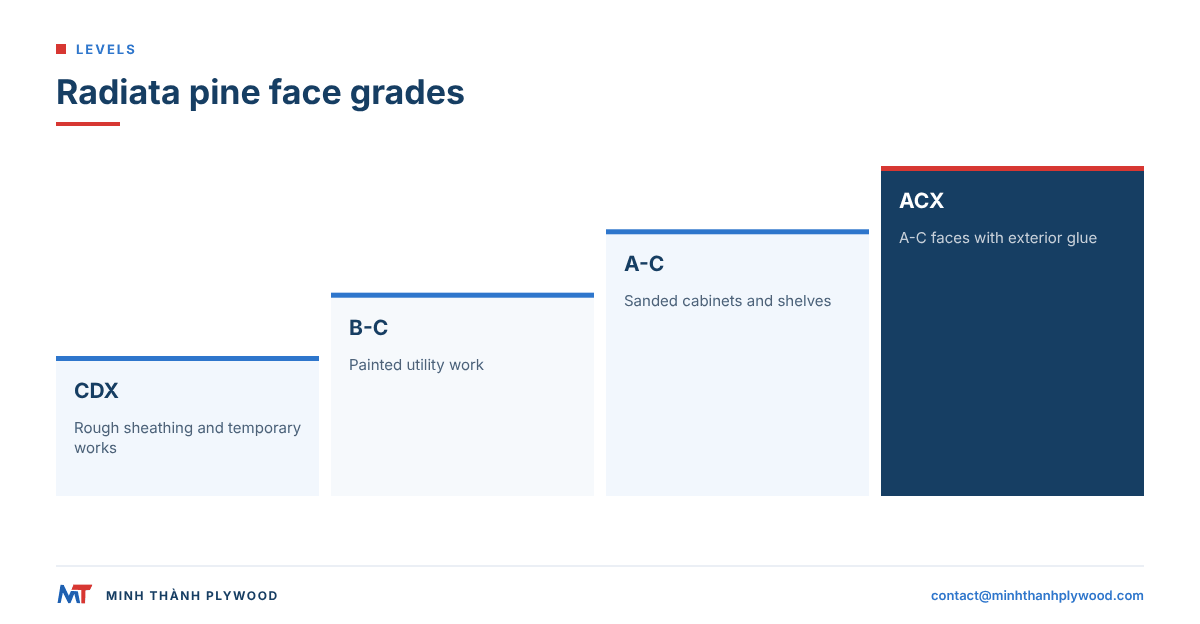
AC radiata pine plywood has an A-grade face and a C-grade back; ACX is the same with exterior glue. The A face is sanded and smooth, with small neat repairs; the C back allows tight knots and some open defects. BC and CDX follow the same letters for lower faces.
| Grade | Face | Back | Typical use |
|---|---|---|---|
| A-C (AC) | Sanded, smooth, small repairs | Knots and small open defects | Cabinets, shelving, DIY |
| ACX | As A-C | As A-C | Exterior glue for damp uses |
| B-C | Knots and repairs on the face | As A-C | Painted and utility work |
| CDX | Knots and open defects | Rough | Sheathing, temporary works |
UK stockists sell the same ladder as letter pairs such as B/BB, BB/CC, C+/C and B/C, and Europe grades softwood faces I to IV under EN 635. We quote pine-faced panels as face/back pairs A/A, A/B and B/B, with B/C for utility parts, matched to the buyer’s approved sample, and a UK order maps one to the other on the sample. The ladder is comparable to the European softwood face classes I to IV and the US A to D grades. Our guide to CDX vs ACX and BCX plywood compares the US letter grades in detail.
What is radiata pine plywood used for?
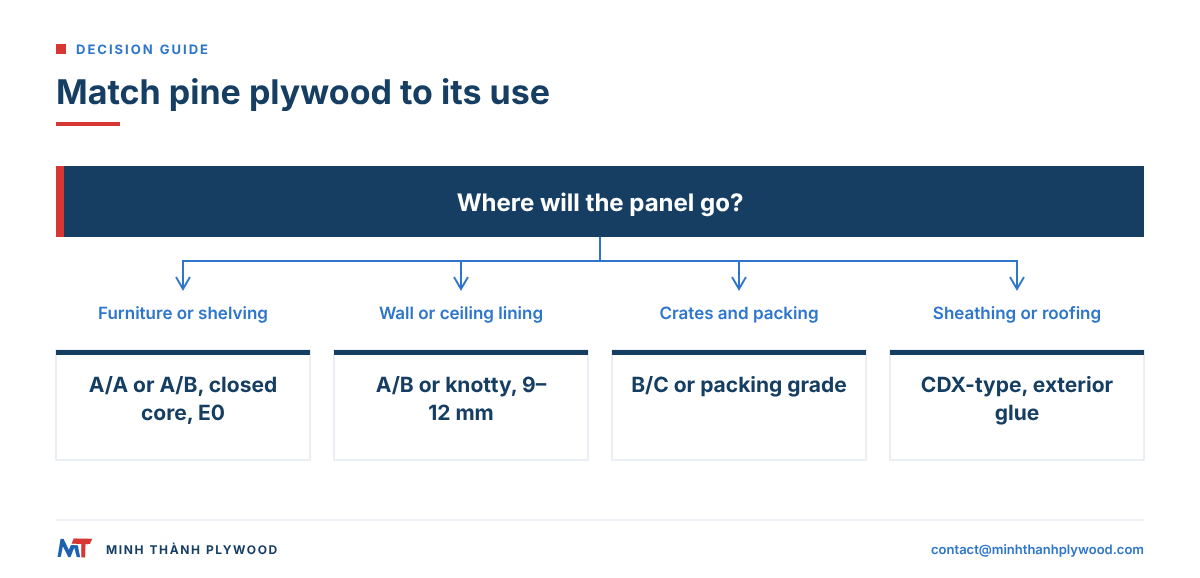
Radiata pine plywood is used for furniture carcasses and shelving, interior lining, shopfitting, crates and packing, and, with exterior glue, roof and wall sheathing. Its light weight and pale face make it a cost-effective panel for indoor work.
| Use | Grade and build |
|---|---|
| Furniture carcasses and shelving | A/A or A/B face, closed core, E0 |
| Wall and ceiling lining | A/B or knotty face, 9–12 mm |
| Cabinets and DIY | AC sanded |
| Shopfitting and displays | A/A, sanded |
| Crates and packing | B/C or packing grade |
| Sheathing and roofing | CDX-type, exterior glue |
Where the face takes hard wear, such as tabletops and floors, a harder face species lasts better. Our guide to pine plywood properties and uses ranks these uses by fit.
Strengths and limits of radiata pine plywood
Radiata pine plywood is light, stiff for its weight, easy to cut and nail, and takes paint and lacquer well; its limits are a soft face, uneven stain take-up and low natural durability outdoors.
| Strength | Limit |
|---|---|
| Light: 515 kg/m³ solid-wood density | Soft face dents: Janka about 710 lbf |
| Pale, even colour | Stains blotchy without a conditioner |
| Machines cleanly with sharp tools | Resin can gum blades |
| Takes preservative treatment well | Not durable outdoors untreated |
| Cost-effective | Lower stiffness than southern yellow pine |
Most limits are met by choosing the right grade, glue and finish: a lacquered face for furniture, a sealer coat before stain, and exterior glue plus paint or treatment outdoors.
Where pine-faced plywood from Vietnam fits
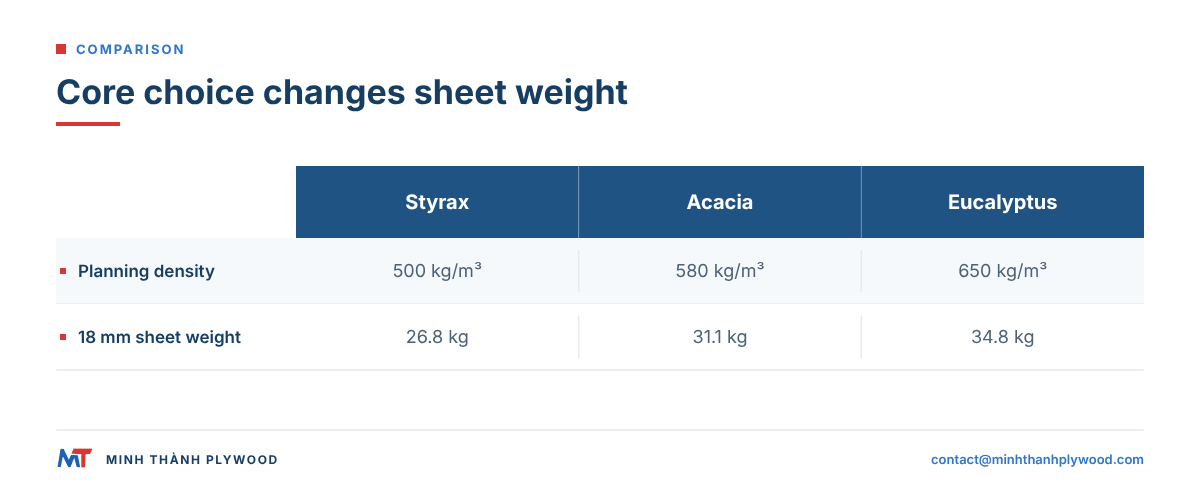
Pine-faced plywood from Vietnam pairs a pine face with a plantation hardwood core, with weight and screw holding set by the selected core and panel build. It suits furniture and interior buyers who want the pine look with a specified core.
| Build | Planning density | 18 mm sheet, 1220 × 2440 mm |
|---|---|---|
| Pine face on white Styrax core | 500 kg/m³ | 26.8 kg |
| Pine face on Acacia core | 580 kg/m³ | 31.1 kg |
| Pine face on Eucalyptus core | 650 kg/m³ | 34.8 kg |
Our furniture panels use white Styrax or Eucalyptus cores as standard; Acacia and Pine cores are made on order. Core layers are stitched both horizontally and vertically, the panel is sanded to ±0.2–0.3 mm, down to ±0.2 mm, and both faces are UV-ready for customers who apply their own UV coating.
A white Styrax core keeps a pine-faced panel close to radiata in weight, while a Eucalyptus core adds stiffness for cabinets and shelving.
Emissions, documents and buying radiata pine plywood
When you buy radiata or any pine-faced plywood for furniture, ask for the emission certificate and test reports first. The US TSCA Title VI limit for veneer-core hardwood plywood is 0.05 ppm formaldehyde (EPA’s TSCA Title VI guidance).
We hold CARB P2 / TSCA Title VI certification as ICTT mill no. 23024. Six ASTM D6007 chamber tests between April 2025 and June 2026, on 9, 15 and 18 mm panels, averaged 0.014–0.032 ppm; three were run by Shanghai Hongjun and three by ICTT Vietnam.
Buyer checklist:
- Species on face and core: radiata, other pine, or a hardwood core.
- Grade pair: A/A, A/B, B/B or B/C, against a signed sample.
- Glue and emission: UF glue at E0 emission, or MR or phenolic (WBP).
- Thickness tolerance: sanded panels to ±0.2–0.3 mm.
- Documents: CARB P2 / TSCA Title VI certificate, test reports, and the EUDR compliance dossier (origin records and geolocation files) for Europe. For the UK, add the EN 636 class on the data sheet, CE or UKCA marking for structural use, and UK Timber Regulation due-diligence papers.
What this means for your order
If you want the radiata look on a furniture panel, order pine-faced plywood on a hardwood core and fix the face on a sample. Send these lines:
- Application: furniture, lining, shelving or packing.
- Core: white Styrax or Eucalyptus as standard; Acacia or Pine on order.
- Glue and emission: UF glue at E0 emission; melamine-fortified or phenolic (WBP) to your specification.
- Face: pine A/A, A/B, B/B or B/C, clear or knotty, matched to your sample.
- Size and thickness: 1220 × 2440 mm or 1250 × 2500 mm, 3–40 mm.
- Packing and quantity: from one 40HC, mixed specifications by agreement; FOB Hai Phong, CFR or CIF.
Production takes 15–45 days after the deposit, and free samples are available. See our pine plywood page to request a quote, or compare pine board vs plywood for solid-board alternatives.
Buyer questions, answered
What is radiata pine plywood?
Radiata pine plywood is plywood with veneers of radiata pine (Pinus radiata) on the faces and often in the core. It is a light, pale softwood plywood used for furniture, interior lining, packing and sheathing.
What is radiata pine plywood used for?
Furniture carcasses, shelving, wall and ceiling lining, shopfitting, crates and packing, and, with exterior glue, roof and wall sheathing. Sanded A-C grades are sold for cabinets, shelving and DIY work.
Is radiata pine plywood good quality?
Yes, in the right grade. Sanded radiata pine plywood with a clear face and a closed core is a good furniture and lining panel; lower grades with knots and open defects suit packing and utility work.
What does AC radiata pine plywood mean?
AC means an A-grade face and a C-grade back. The A face is sanded and smooth with small repairs; the C back allows knots and some open defects. ACX adds exterior glue.
Is radiata pine hard or soft?
Radiata pine is a softwood with medium hardness for a pine: its Janka hardness is about 710 lbf. It dents more easily than birch or Eucalyptus faces.
What is the density of radiata pine?
Dried radiata pine averages about 515 kg/m³, lighter than slash pine and the southern yellow pines and heavier than Norway spruce.
What is the difference between radiata pine and southern yellow pine plywood?
Southern yellow pine plywood is denser, stronger and more resinous, and is mostly a US structural panel. Radiata pine plywood is lighter and paler, and is used more for furniture, lining and packing.
Is spruce ply the same as pine plywood?
No. Spruce ply is made from spruce, a lighter and whiter softwood with small knots; pine plywood is made from pine. Both are softwood plywoods and are often sold for similar building uses.
Is radiata pine plywood waterproof?
No. Radiata pine plywood with phenolic (WBP) or melamine-fortified glue resists water, but the pine is not naturally durable outdoors, so faces and edges need sealing.
What colour is radiata pine timber?
Radiata pine sapwood is pale cream to light yellow and its heartwood light brown; the timber darkens towards honey with light and age.