
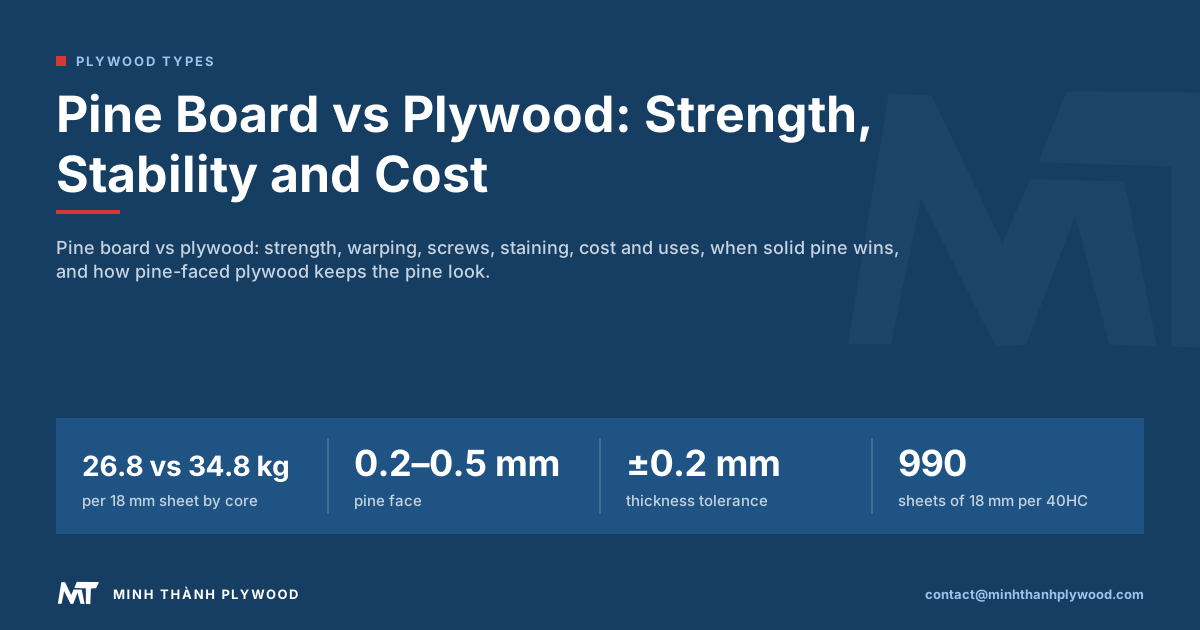
Pine board vs plywood is solid wood against cross-laminated veneers. Plywood is stronger across its width, stays flat and comes in wide sheets; pine board is easier to shape, shows solid wood at every edge and suits narrow parts. Pine-faced plywood joins the two: a pine face on a stable core. Minh Thanh Plywood makes it in Vietnam.
Pine board vs plywood: the short answer
Plywood is the stronger, flatter and more stable choice for wide panels; pine board is the better choice for narrow parts, shaped edges and the look of solid wood. The difference comes from structure: a pine board is one direction of grain, plywood is many thin layers laid crosswise.
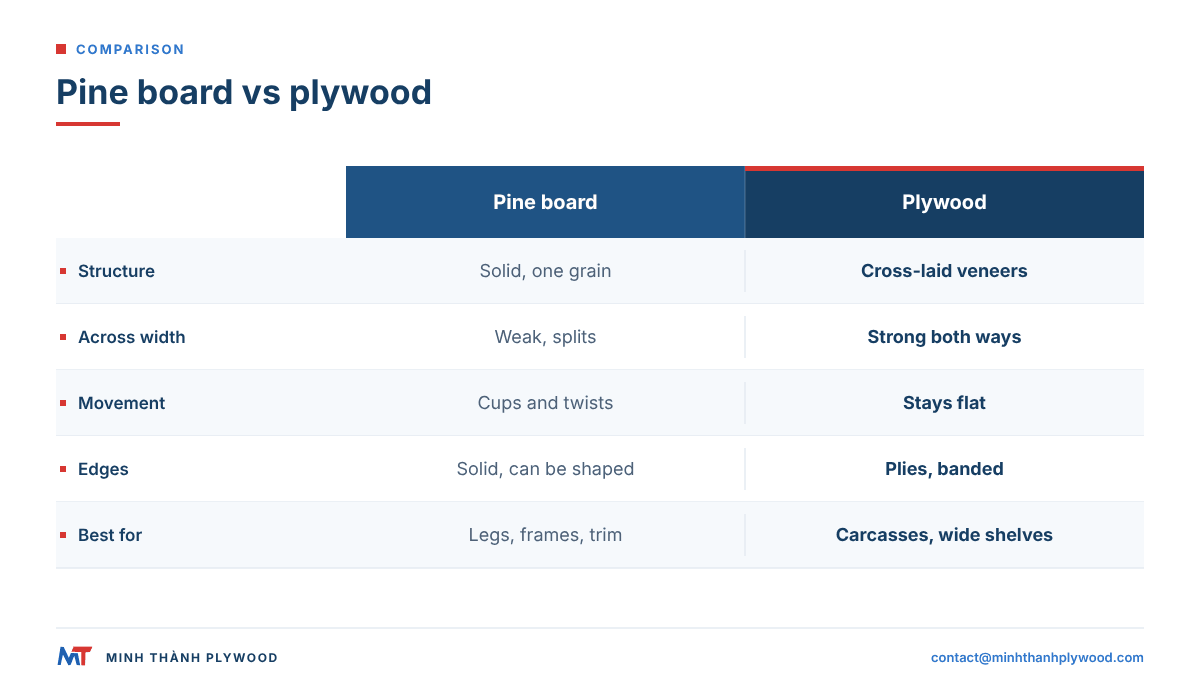
| Metric | Pine board (solid or edge-glued) | Plywood |
|---|---|---|
| Structure | Solid pine, grain in one direction | Cross-laminated veneers, odd number of plies |
| Strength along the length | High in clear boards | High |
| Strength across the width | Low, splits along the grain | High, similar both ways |
| Warping and cupping | Moves with humidity, can cup or twist | Stays flat |
| Widths available | Narrow boards, or edge-glued panels | Full sheets, 1220 × 2440 mm or 1250 × 2500 mm |
| Screw holding near edges | Splits near ends and edges | Holds in every edge |
| Edges | Solid wood, can be shaped | Visible plies, banded or shown |
| Thickness accuracy | Planed, varies by mill | Sanded to ±0.2–0.3 mm on furniture panels |
| Best for | Legs, frames, rails, mouldings, rustic shelves | Carcasses, doors, wide shelves, floors, sheathing |
Verdict by use: plywood for any wide or flat part, anything fixed at the edges and anything that must stay flat; solid pine for narrow, shaped and visible solid-wood parts.
What is a pine board?
A pine board is a length of solid pine sawn from the log and planed, or a wider panel made by gluing narrow pine strips edge to edge. The grain runs one way through the whole board.
- Solid pine board: one piece of sawn and planed pine, common in narrow widths for shelving, trim and framing.
- Edge-glued pine panel: strips glued side by side into a wide board, also sold as laminated pine or pine furniture board.
- Finger-jointed pine: short pieces joined end to end with interlocking fingers, then often edge-glued.
Every pine board keeps the habits of solid wood: it moves across the grain with humidity, it can split near ends, and its strength depends on knots and grain direction. The US Forest Products Laboratory’s Wood Handbook covers wood moisture, lumber and plywood in one reference.
What is plywood, and is plywood pine?
Plywood is a panel of thin wood veneers glued with the grain of each layer at right angles to the next. Some plywood is pine, but much is not: plywood is named by its veneers.
- All-pine plywood: pine in every ply; common as softwood construction plywood, such as CDX sheathing.
- Pine-faced plywood: pine face and back over a core of another timber; Minh Thanh presses pine faces on white Styrax or Eucalyptus cores.
- Hardwood plywood: birch, eucalyptus, poplar, Styrax and other species with no pine at all.
Cross-lamination gives plywood its main traits: similar strength along and across the sheet, little movement with humidity and screw holding in every edge. The plywood vs solid wood guide covers the wider comparison.
Pine board vs plywood strength: which is stronger?
Plywood is stronger than pine board across its width and at its edges; a clear pine board is strong only along its grain. That is why wide, flat parts use plywood and long, narrow parts can use solid pine.
- Bending along the length: a clear pine board and plywood of the same thickness are both stiff; knots in the board lower its strength.
- Bending across the width: plywood wins clearly, because half its layers run across the sheet.
- Splitting: pine splits along the grain when nailed or screwed near an end; plywood resists splitting.
- Point loads and impact: plywood spreads a load across layers; a board can crack along a knot or grain line.
- Racking: a plywood back or sheathing panel stiffens a cabinet or wall frame far better than boards.
Strength also depends on the core: a pine-faced panel on a Eucalyptus core is denser and holds screws harder than one on white Styrax.
Stability: warping, cupping and seasonal movement
Plywood stays flat through changes in humidity; pine boards swell and shrink across their width and can cup, bow or twist. For wide panels, stability is the main reason to choose plywood.
| Movement | Pine board | Plywood |
|---|---|---|
| Across the width | Swells and shrinks with the seasons | Very little |
| Along the length | Very little | Very little |
| Cupping | Common in wide boards | Rare in balanced panels |
| Twist | Possible with spiral grain | Rare |
| Gaps in panelling | Open and close with the seasons | Stay steady |
Panels leave Minh Thanh at 8–12 % moisture content, the normal range for furniture plywood, so they stay flat in heated rooms. Solid pine needs room to move: slotted screw holes, floating panels and gaps in cladding.
Screw holding, nailing and joints
Plywood holds screws in every edge and resists splitting at nails; pine board holds screws well in its face and side grain but splits near ends and holds poorly in end grain.
- Edge screws in carcasses: plywood is reliable; pine end grain is weak.
- Nails near edges: plywood takes them; pine splits without pilot holes.
- Cabinet hinges: plywood holds hinge screws in a thin door; pine doors need thicker stock or frames.
- Traditional joinery: solid pine takes mortise-and-tenon, dovetails and moulded edges; plywood needs biscuits, dowels, dominoes or screws.
- Glue joints: both glue well; plywood’s edges glue best to a solid lipping.
For a cabinet, the usual answer is both: plywood for the carcass and panels, solid pine for face frames and mouldings.
Appearance: grain, knots and edges
A pine board shows solid wood all round, including the edges; plywood shows a pine face only on its two faces and layered plies at the edge. Knots, colour and grain look alike on both when the face is pine.
- Faces: both show pine’s pale honey tone, ring figure and knots, set by the grade.
- Edges: a board edge can be rounded, chamfered or moulded; a plywood edge is banded with pine tape, lipped with solid pine or left showing its plies.
- Widths: a wide pine panel shows glue lines between strips; a pine-faced sheet shows one continuous face.
- Colour over time: pine faces darken toward amber under light on both.
Pine faces on Minh Thanh panels come as pale and even, pin-knot, or strong figure with sound knots, matched to the buyer’s approved sample.
Can you stain pine plywood and pine boards?
Yes, both take stain, and both can blotch, because pine soaks up stain unevenly between soft earlywood and hard latewood. Preparation is the same for both.
- Sand: sand pine faces with 150-grit; on plywood, sand lightly so the thin face is not cut through.
- Condition: apply a wash coat or pre-stain conditioner to even out absorption.
- Stain: use gel or light stains for an even tone; test on an offcut first.
- Seal knots: before paint, seal knots with a shellac-based primer so resin cannot bleed through.
- Topcoat: clear lacquer or oil shows the honey tone best.
Both faces of Minh Thanh pine plywood arrive sanded and polished, UV-ready for the buyer’s own UV coating line.
Which is cheaper, pine board or plywood?
Narrow, knotty pine boards are usually cheaper per metre than cutting the same parts from plywood. For wide parts, plywood is usually cheaper per square metre than an edge-glued pine panel, which needs clear strips, gluing and planing.
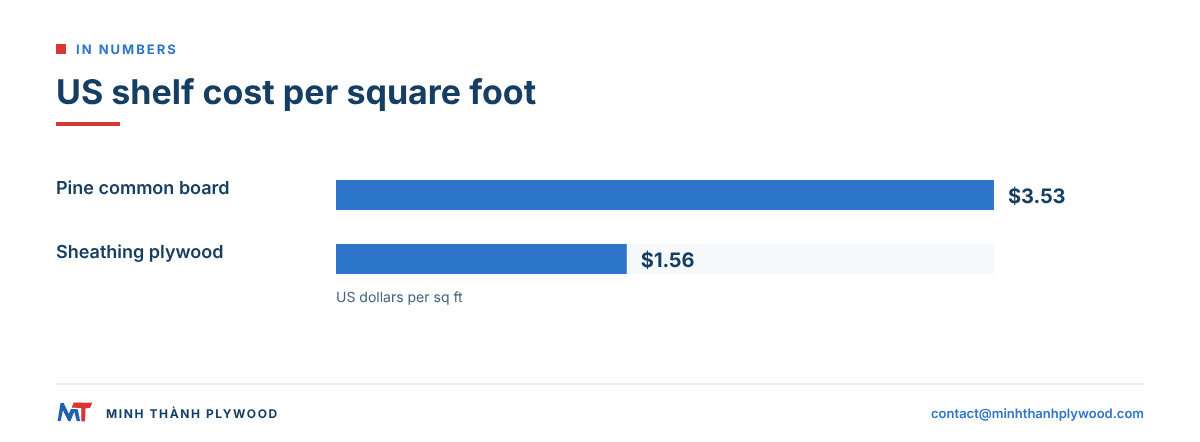
US shelf prices (October 2026). A 1 × 12 × 8 ft pine common board at Home Depot lists at $26.48. Its real size is 3/4 in. × 11-1/4 in. × 8 ft, 7.5 sq ft, so the board costs $3.53 per sq ft, or $3.31 per linear foot. A 3/4 in. 4 × 8 ft sheet of sheathing plywood, 32 sq ft, sells for about $50, which is $1.56 per sq ft. The pine board costs about 2.3 times more per sq ft than the plywood at the same 3/4 in. thickness.
| 3/4 in. thick, US retail | Price | Per sq ft | Per linear foot |
|---|---|---|---|
| 1 × 12 × 8 ft pine common board | $26.48 | $3.53 | $3.31 |
| 4 × 8 ft sheathing plywood | about $50 | $1.56 | sold by the sheet |
The plywood row is the sheathing grade. Sanded pine-faced plywood costs more per sheet but still covers a wide panel with no glue-up. Importers work from the container price instead: the FOB figures below are per m³ and are not shelf prices.
- Narrow trim and framing: pine board usually costs less.
- Wide panels and carcasses: plywood usually costs less and wastes less.
- Waste: knots and splits in boards are cut out; plywood sheets yield more usable area.
- Labour: plywood needs no edge-gluing or flattening.
Minh Thanh’s indicative starting prices are from US$250/m³ for commercial plywood and from US$350/m³ for furniture and interior plywood (October 2026); the final price depends on face, core, glue, thickness, size, quantity and delivery term.
When does solid pine win?
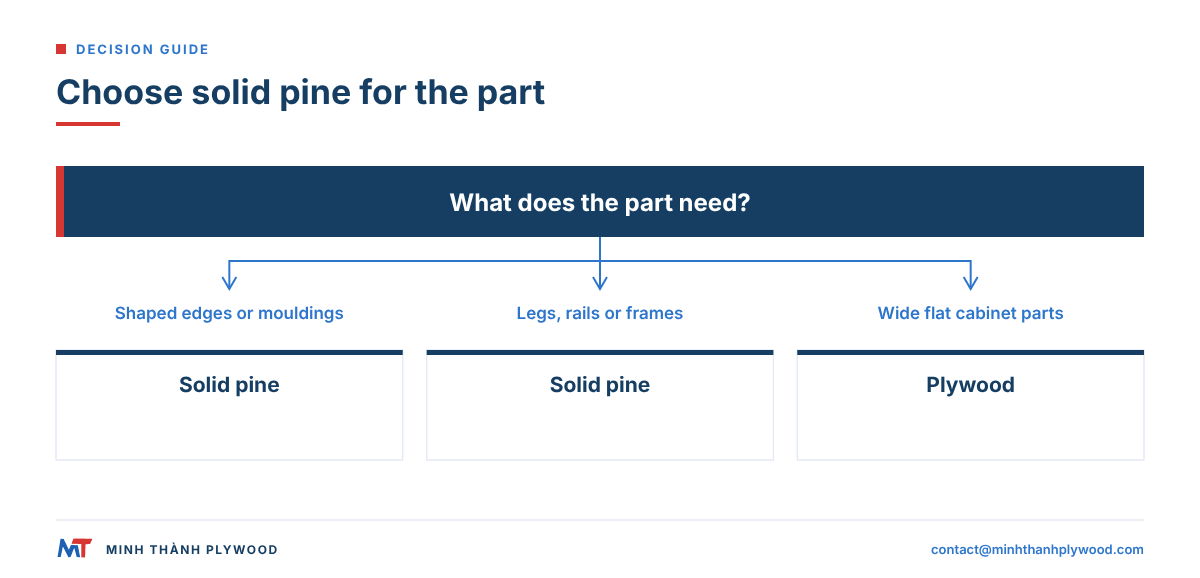
Solid pine wins where a part is narrow, shaped or meant to show solid wood at every edge. These are the jobs to keep in pine boards.
- Legs, rails and frames: solid sections, turned or profiled.
- Mouldings, skirting and trim: routed profiles on solid wood.
- Face frames and lippings: solid edges on plywood carcasses.
- Rustic shelves and benches: thick boards with the look of solid wood.
- Tongue-and-groove cladding: narrow boards that interlock and move freely.
- Small boxes and toys: joinery cut straight into solid wood.
When does plywood win?
Plywood wins for wide, flat parts, parts fixed at the edges and anything that must keep its size through the seasons.
| Use | Plywood choice | Why plywood |
|---|---|---|
| Cabinet and wardrobe carcasses | 15–18 mm furniture plywood | Flat, edge screws, wide parts |
| Cabinet backs and drawer bottoms | 3–6 mm thin plywood | Stable, light, one piece |
| Doors | 18 mm plywood, faced to match | Stays flat |
| Wide shelves | 18 mm plywood on a dense core | No cupping, less sag |
| Wall and roof sheathing | Exterior plywood with water-resistant glue | Racking strength, nail holding |
| Floors and underlay | Plywood, screwed at close centres | Strength both ways |
| Crates and packing | Commercial or packing plywood | Wide, light, nail holding |
Minh Thanh’s thin 3–5 mm plywood is always 5-ply, which keeps backs and drawer bottoms flat.
Pine-faced plywood: the pine look with plywood stability
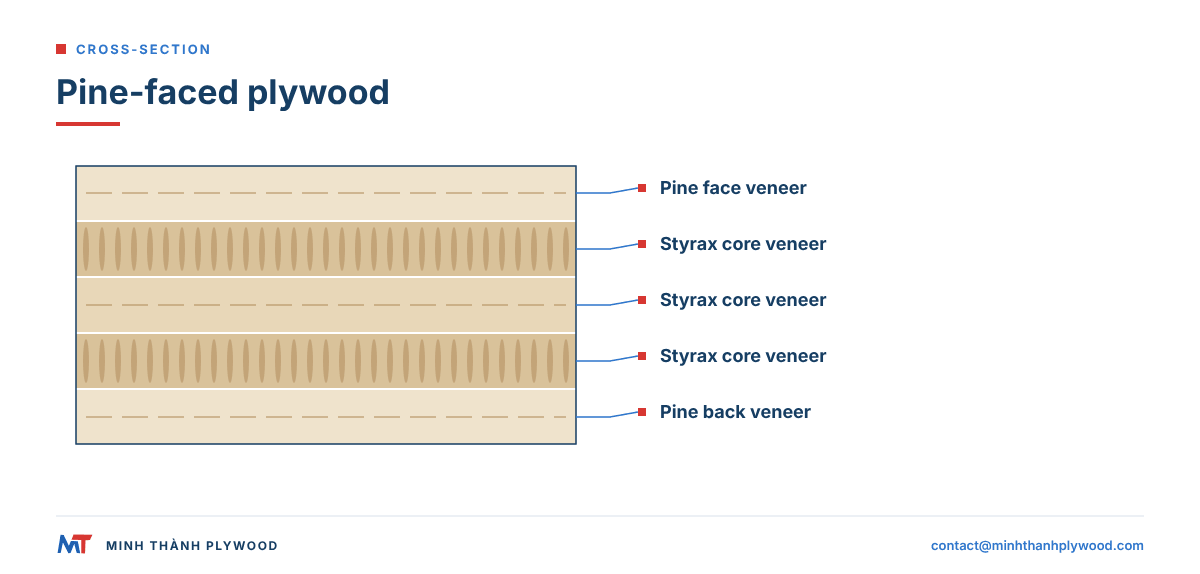
Pine-faced plywood is a pine face and back over a stable plywood core, so it looks like pine and behaves like plywood. Minh Thanh Plywood presses pine faces 0.2–0.5 mm thick, before pressing, on white Styrax or Eucalyptus cores.
| Line | Minh Thanh pine-faced plywood |
|---|---|
| Face and back | Pine veneer, A/A, A/B, B/B or B/C |
| Core | White Styrax (about 500 kg/m³) or Eucalyptus (650–750 kg/m³), stitched both ways |
| Build | Pressed twice: core pressed and calibrated, then face and back |
| Glue | UF glue at E0 emission; MR or phenolic WBP to order |
| Tolerance | Down to ±0.2 mm thickness |
| Sizes | 1250 × 2500 mm and 1220 × 2440 mm, 3–40 mm |
| Weight, 18 mm sheet | 26.8 kg on Styrax, 34.8 kg on Eucalyptus at 650 kg/m³ |
Emission proof is CARB P2 / TSCA Title VI certification, ICTT mill no. 23024, with six ASTM D6007 chamber tests averaging 0.014–0.032 ppm. Under the EPA formaldehyde standard, the limit for veneer-core hardwood plywood is 0.05 ppm (EPA formaldehyde emission standards).
What is radiata pine plywood?
Radiata pine plywood has a face, or every ply, of radiata pine, a fast-growing plantation softwood with a pale cream face and soft ring figure. It is one of several pine looks used on plywood faces, next to elliottis and southern pines and European pine. Forest Research lists the tree as radiata pine, also called Monterey pine.
- All-radiata plywood: a softwood panel, common for construction and packaging.
- Radiata-faced plywood: radiata pine on the faces over another core, for furniture and joinery.
- Look: pale, even, with soft growth rings and few knots in upper grades.
We match pine faces to the sample the buyer approves; send a photo or a sample of the look you want. The radiata pine plywood guide compares the species.
Which grade of pine-faced plywood for construction and packaging?
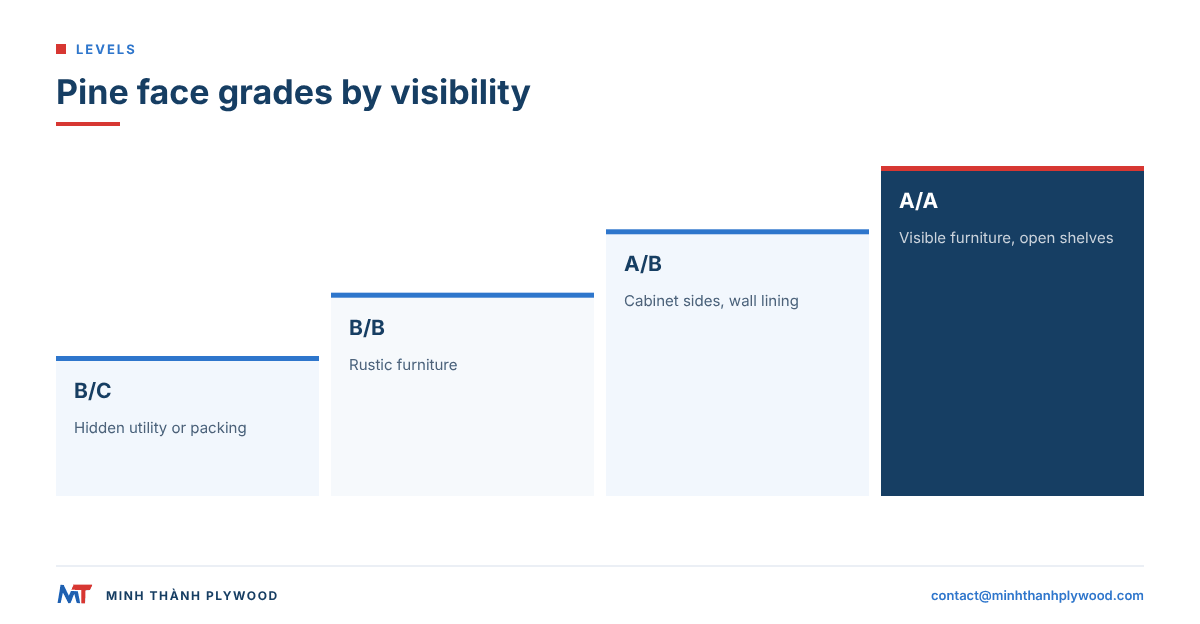
Choose the face grade by what the customer sees. Pine faces are quoted as face/back pairs A/A, A/B, B/B and B/C, comparable to the European softwood face classes I to IV and the US A to D grades.
| Grade pair | Face | Use |
|---|---|---|
| A/A | Cleanest, pale and even, both sides | Visible furniture, open shelving |
| A/B | Pale pin-knot face, quieter back | Cabinet sides, wall lining |
| B/B | Strong figure, sound knots, resin streaks | Rustic furniture, shop fixtures |
| B/C | Sound but plainer face | Hidden parts, utility, packing |
For construction work such as sheathing or flooring, order a panel made for that job, with water-resistant glue; B/C faces keep cost down where appearance does not matter. For packaging, commercial plywood with packing tolerance of ±0.5–1.0 mm is the cost-effective choice. Buyers in Australia and elsewhere order the same ladder by these grade pairs.
How to order pine-faced plywood instead of pine boards
Send six lines, and Minh Thanh Plywood replies within hours with a quotation and a free sample offer.
- Application: carcasses, doors, shelving, wall lining or packing.
- Core: white Styrax for a light panel, Eucalyptus for a dense one.
- Glue and emission: UF glue at E0 emission, MR or phenolic WBP.
- Face and back: pine grade pair, such as A/B, and the look from the sample.
- Size and thickness: 1250 × 2500 mm or 1220 × 2440 mm, 3–40 mm, custom sizes or cut-to-size into 4, 6 or 8 pieces.
- Packing and quantity: sheets per pack, total sheets or m³, and the destination port.
The minimum order is one 40HC, with mixed thicknesses and face looks by agreement; a 40HC carries 990 Styrax-core sheets of 18 mm. Production takes 15–45 days after the 30% deposit. Send the lines to contact@minhthanhplywood.com or see pine plywood from Minh Thanh.
Buyer questions, answered
Is pine board stronger than plywood?
Along the grain, a clear pine board is strong and stiff. Across the grain it is weak and splits, while plywood is strong in both directions. For wide panels, shelves fixed at the edges and anything screwed near an edge, plywood is the stronger choice.
Is plywood pine?
Some plywood is pine, but not all. Plywood is named by its veneers: all-pine plywood is pine throughout, pine-faced plywood has pine only on the faces, and much plywood uses hardwoods such as birch, eucalyptus or Styrax.
Is pine plywood strong?
Yes. Cross-laid veneers give pine plywood strength in both directions, and 15–18 mm pine-faced panels carry carcasses, shelves and doors in normal use. A Eucalyptus core gives a denser panel that holds screws harder.
Which warps more, pine board or plywood?
Pine board. Solid wood swells and shrinks across its grain with humidity and can cup or twist, while plywood's alternating layers hold each other flat.
Can you stain pine plywood?
Yes. Sand with 150-grit and use a wash coat or pre-stain conditioner before stain to stop blotching. Clear lacquer and oil show pine's honey tone best.
Is pine board cheaper than plywood?
Narrow, low-grade pine boards are often cheaper per metre. Per square foot, a US 1 × 12 pine board at $26.48 costs about $3.53, while a 3/4 in. sheathing plywood sheet at about $50 costs $1.56 (October 2026). Edge-glued pine panels cost more again, because they need clear stock and gluing.
What is radiata pine plywood?
Radiata pine plywood has a face, or all plies, of radiata pine, a fast-growing plantation softwood with a pale cream face and soft ring figure. It is one of several pine looks used on plywood faces.
Should I use pine boards or plywood for shelves?
For short, narrow shelves, solid pine looks good and is easy to work. For wide shelves, shelves in cabinets and anything fixed by edge screws, 18 mm plywood is flatter and stronger across the width.
Which is better for furniture, pine boards or plywood?
Plywood for carcasses, backs, drawer bottoms, doors and wide panels; solid pine for legs, frames, rails, mouldings and parts shaped with a router or lathe.