
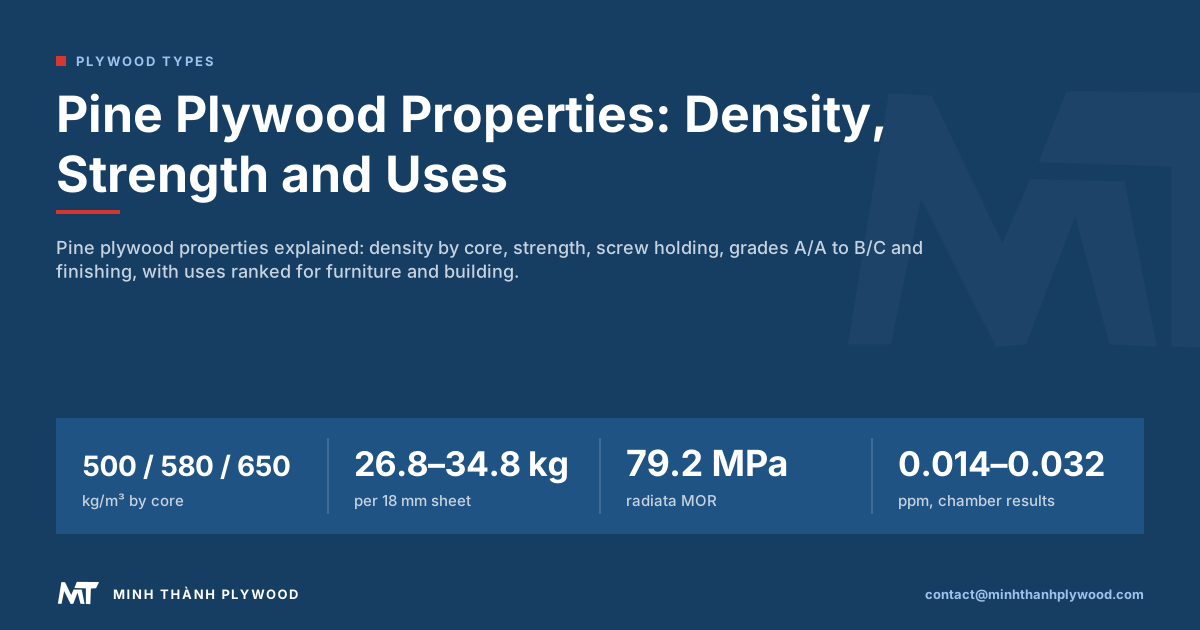
Pine plywood properties come from two parts: a pine face that sets the look, and a core that sets weight, strength and flatness. A pine-faced panel on a hardwood core is heavier, flatter and holds screws better than pine throughout; an all-pine panel is lighter and cheaper. Minh Thanh Plywood makes pine-faced panels in Vietnam, and this guide gives the numbers and the uses that suit each build.
Pine plywood properties in one table
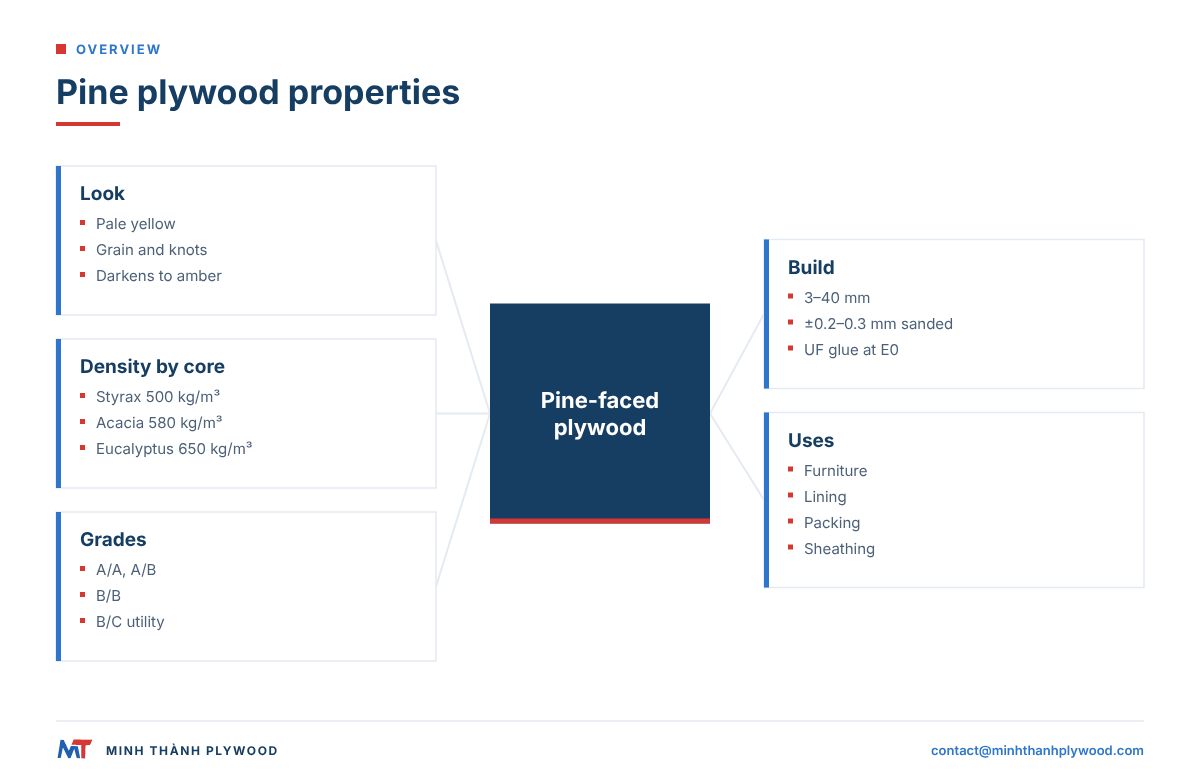
Pine plywood properties are set by the face and the core together: a pine face gives a light, warm look with visible grain and knots, and the core decides density, stiffness, flatness and screw holding. The table below lists the properties a buyer compares, with the value or rating for pine-faced panels.
| Property | Pine-faced plywood | What decides it |
|---|---|---|
| Look | Pale yellow to light brown, visible grain, knots by grade | Face veneer and grade |
| Face grades | A/A, A/B, B/B; B/C for utility parts | Approved sample |
| Planning density | About 500–650 kg/m³ by core | Core species |
| 18 mm sheet mass | 26.8–34.8 kg at 1220 × 2440 mm | Core species |
| Stiffness | Good in both directions | Cross-laminated build |
| Face hardness | Soft; dents more easily than birch | Pine as a species |
| Screw holding | Good on a hardwood core | Core species and calibration |
| Thickness range | 3–40 mm | Ply count |
| Thickness tolerance | ±0.2–0.3 mm sanded, down to ±0.2 mm | Calibration and sanding |
| Glue and emission | UF glue at E0 emission; MR or phenolic (WBP) on order | Glue line |
| Chemical resistance | Unaffected by moderate acid and alkali, pH 2 to pH 10 | Wood and cured glue (Australply) |
| Thermal conductivity | About 0.13 W/mK at 500 kg/m³; higher as density rises | Core density |
| Sound insulation | Modest alone; mass and a cavity do the work | Thickness and build-up |
| Sustainability | Plantation-grown veneer; EUDR dossier with orders | Origin records |
The last four rows are the ones competing guides skip. Plywood is relatively unaffected by moderately acidic and alkaline conditions between pH 2 and pH 10 at normal temperatures (Australply, checked on 21 October 2026). Thermal conductivity rises with density and moisture: a published test of wood-based panels measured 0.158–0.173 W/mK for beech plywood at 747–777 kg/m³ (Wood Science and Technology, 2008, checked on 21 October 2026), so a lighter pine panel on a Styrax core sits lower, near the 0.13 W/mK that European design tables use for 500 kg/m³ plywood.
A single plywood sheet does little for sound by itself; wall build-ups gain from mass and an air cavity. On sustainability, the veneer comes from plantation timber, and for EU orders we supply the EUDR dossier with origin records and geolocation files.
Two panels sold as “pine plywood” can differ widely on the lower rows. Ask for the core species before you compare prices.
What is pine plywood?
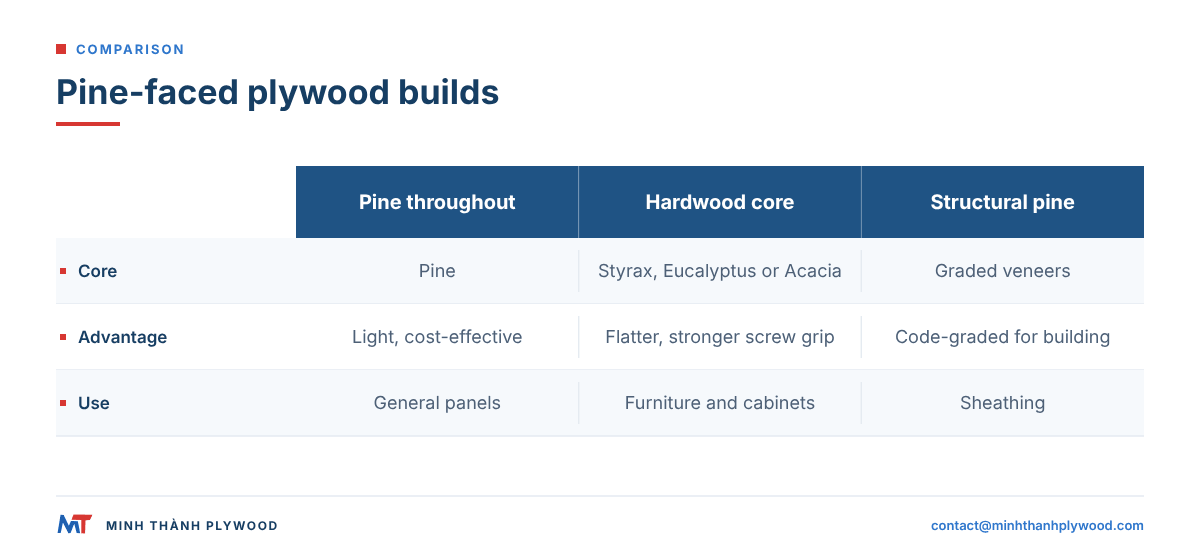
Pine plywood is plywood with pine veneer on the face and back, laid over a core of crossed veneers. The core can be pine as well, or a hardwood such as white Styrax, Eucalyptus or Acacia.
- Pine throughout: pine face and pine core. Common in softwood plywood from pine-growing regions; light and cost-effective.
- Pine-faced on a hardwood core: a pine face on a plantation hardwood core. Heavier, flatter after calibration, and better at holding screws in the face.
- Structural pine plywood: graded and stamped for building codes, usually with exterior glue and C or D faces.
Our pine-faced furniture panels use white Styrax or Eucalyptus cores as standard; Acacia and Pine cores are made on order. Our pine plywood page lists the build, sizes and grades.
Pine plywood density by core
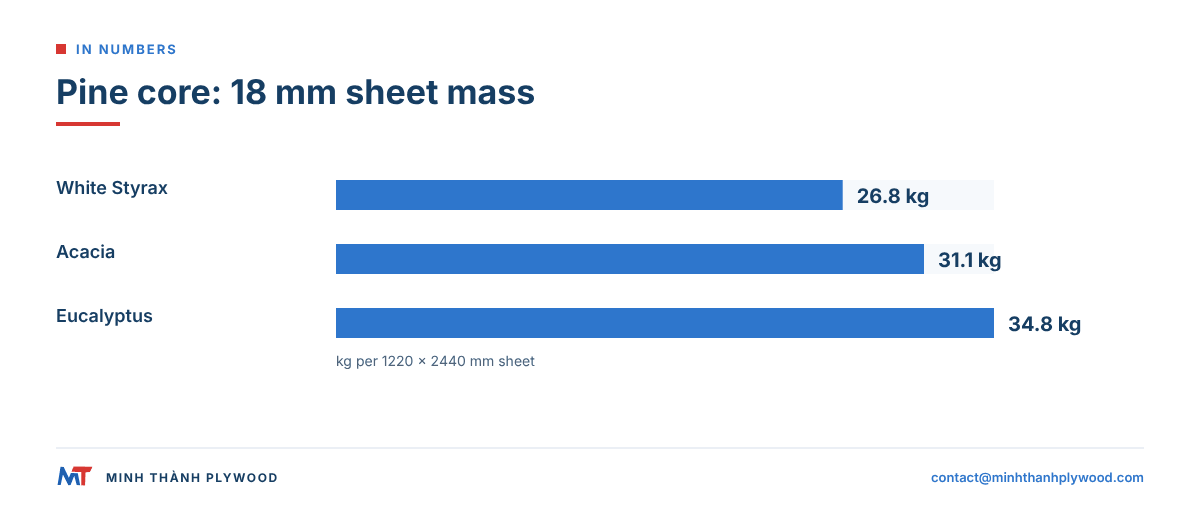
Pine plywood density depends mainly on the core, because the core makes up almost the whole thickness and the face veneer is thin. On our planning figures, a pine-faced panel weighs about 500 kg/m³ on a white Styrax core, 580 kg/m³ on Acacia and 650 kg/m³ on Eucalyptus.
| Core under the pine face | Planning density | 18 mm sheet, 1220 × 2440 mm |
|---|---|---|
| White Styrax | 500 kg/m³ | 26.8 kg |
| Acacia | 580 kg/m³ | 31.1 kg |
| Eucalyptus | 650 kg/m³ | 34.8 kg |
The sheet mass is density times volume: 1.22 m × 2.44 m × 0.018 m = 0.0535824 m³. Eucalyptus cores in practice run 650–750 kg/m³, so weigh real sheets before you plan a container load.
For comparison, solid radiata pine averages about 515 kg/m³ dried (The Wood Database, radiata pine, read 20 October 2026). A pine-throughout panel therefore sits close to a Styrax-core panel in weight, and below Acacia and Eucalyptus. Our plywood weight calculator works out the mass for other sizes and thicknesses.
Strength and stiffness of pine plywood
Pine plywood is strong for its weight because its veneers are crossed, so it carries load and resists splitting in both directions. The core species adds or takes away stiffness: a denser hardwood core makes a stiffer pine-faced panel.
Solid-wood figures show where pine species sit. The values are for clear, dry wood, not for plywood, and serve to compare species:
| Species (solid wood) | Modulus of rupture | Elastic modulus |
|---|---|---|
| Radiata pine | 79.2 MPa | 10.06 GPa |
| Scots pine | 83.3 MPa | 10.08 GPa |
| Loblolly pine (a southern yellow pine) | 88.3 MPa | 12.30 GPa |
Source: The Wood Database species pages for radiata, Scots and loblolly pine, read 20 October 2026.
What changes a panel’s strength in use:
- Ply count: more, thinner plies give a more even panel; 18 mm furniture panels are usually 11–13 plies.
- Core grade and joints: a closed core without gaps carries load across the whole sheet; our core layers are stitched both horizontally and vertically.
- Glue line: UF glue for interiors, melamine-fortified or phenolic (WBP) for damp and outdoor use.
- Thickness and span: shelf sag falls fast as thickness rises.
For shelf loads by thickness and span, see our guide to how much weight plywood can hold.
Radiata pine plywood strength compared with other pines
Radiata pine plywood strength sits in the middle of the pine group: radiata as solid wood has a lower modulus of rupture than the southern yellow pines and slash pine, and a similar value to Scots pine. Plywood built from radiata is still stiff and strong enough for furniture, sheathing and packing, because cross-lamination evens out the wood.
| Pine | Average dried density | Modulus of rupture | Typical plywood role |
|---|---|---|---|
| Radiata pine | 515 kg/m³ | 79.2 MPa | Faces and cores, furniture and packing |
| Scots pine | 550 kg/m³ | 83.3 MPa | European faces and structural plywood |
| Loblolly pine | 570 kg/m³ | 88.3 MPa | US structural plywood |
| Slash pine (elliottii) | 655 kg/m³ | 112.4 MPa | Structural plywood, dense faces |
Source: The Wood Database species pages, including slash pine, read 20 October 2026.
Density follows strength closely in pines: the denser species are stronger and harder, and heavier. Our sibling guide to radiata pine plywood compares the species, origins and grades in more detail.
Screw holding, hardness and machining
A pine-faced panel on a hardwood core holds screws better than pine throughout, because the screw thread bites into the denser core veneers. The face itself is soft, so pine plywood dents more easily than birch or Eucalyptus-faced panels.
- Face screws: good on Eucalyptus and Acacia cores; good on Styrax with the right pilot hole.
- Edge screws: use pilot holes and coarse-thread screws; crossed veneers grip better than solid pine, which splits along the grain.
- Hardness: radiata pine has a Janka hardness of about 710 lbf, softer than most hardwood faces; tabletops need a hard lacquer.
- Cutting and CNC: pine cuts cleanly with sharp carbide tools; resin pockets can gum blades.
- Edges: the plies show on cut edges; edge-band or fill for a finished look.
For cabinets with hinges and cam fittings, the core matters more than the face. Ask for a calibrated hardwood core under the pine face.
How pine plywood looks: grain, knots and colour
Pine plywood looks pale yellow to light honey-brown, with clear growth rings and knots whose number and size depend on the grade. Pine darkens towards amber with light and age.
- Grain: rotary-cut pine shows wide, wavy grain figures; sliced faces are straighter.
- Knots: sound, tight knots in the better grades; more and larger knots, and filled knots, in the lower grades.
- Colour variation: heartwood and sapwood can differ; a good face is matched for colour across the sheet.
- Resin: pine contains resin, which can bleed through some finishes; seal before painting.
Buyers who want the knotty look choose it on purpose for interiors, cabins and rustic furniture. Buyers who want a clean face choose a higher grade or a different face species.
Pine plywood grades: A/A to B/C
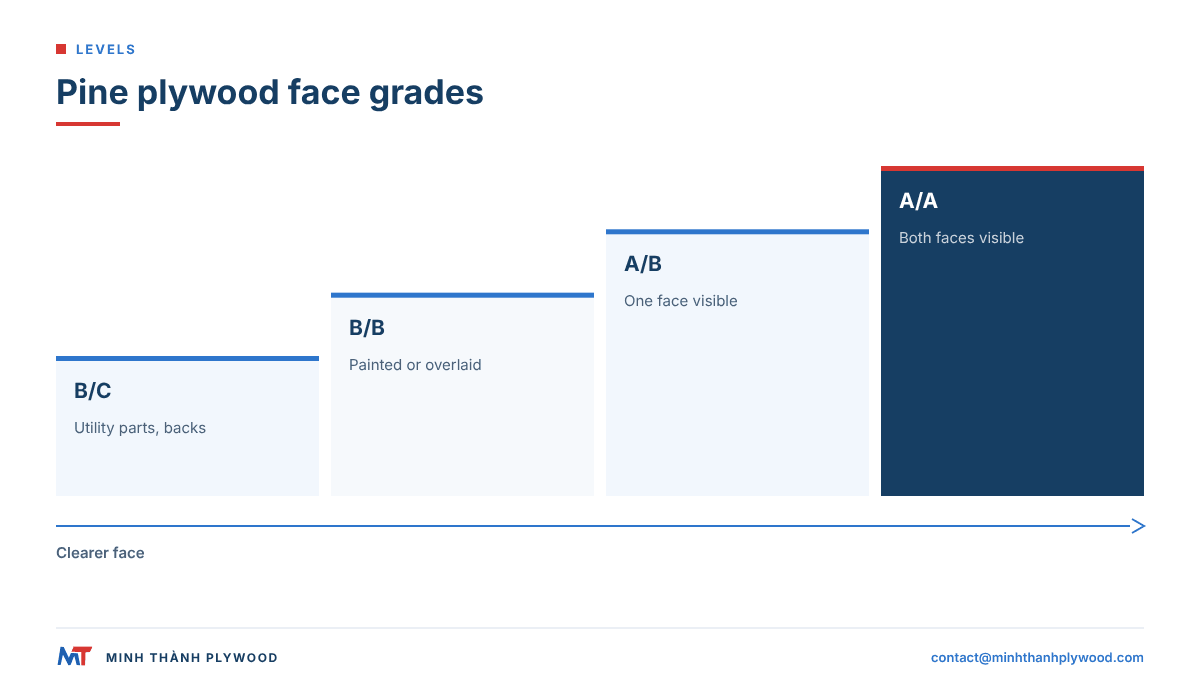
We quote pine-faced panels as face/back grade pairs A/A, A/B and B/B, with B/C for utility parts, matched to the buyer’s approved sample. The ladder is comparable to the European softwood face classes I to IV and the US A to D grades.
| Grade pair | Face | Back | Typical use |
|---|---|---|---|
| A/A | Clear, few small sound knots | Same | Both faces visible: shelves, doors, open units |
| A/B | Clear | Small knots and repairs allowed | One face visible: carcass sides, wall lining |
| B/B | Small knots and repairs | Same | Painted or overlaid parts |
| B/C | Knots and repairs | Open defects allowed | Utility parts, backs, packing |
The approved sample fixes the look of the order, so that every pack matches what the buyer signed off. Our guide to exterior plywood grades covers the C and D faces used for sheathing and outdoor work.
Is pine plywood good for furniture? Furniture grade explained
Yes, pine plywood is good for furniture when it is built as furniture-grade plywood: an A/A or A/B pine face on a calibrated hardwood core, sanded flat, with UF glue at E0 emission. That build stays flat, takes finish evenly and holds hinges and fittings.
What a pine plywood furniture grade means in practice:
- Core: white Styrax or Eucalyptus, stitched both horizontally and vertically, so no gaps show at the edge.
- Pressing: pressed twice as standard: the core board is pressed and calibrated, then face and back are pressed on.
- Thickness: sanded to ±0.2–0.3 mm, down to ±0.2 mm, so that parts fit in a CNC line.
- Faces: sanded and polished, and UV-ready on both sides, so that customers can apply their own UV coating.
- Moisture: dried to 8–12 % moisture content at dispatch, the normal range for furniture plywood.
Pine-faced furniture panels suit children’s furniture, bunk beds, bookcases, shelving, wardrobes and display units. For a harder face on tabletops, compare our guide to birch plywood vs pine plywood.
What is pine plywood good for? Uses ranked by fit
Pine plywood is good for furniture, interior lining, shelving, crates and sheathing: light, stiff, easy to work and cost-effective. The table ranks common uses by how well pine fits and which build to order.
| Use | Fit | Build to order |
|---|---|---|
| Children’s furniture and bunk beds | Very good | A/A or A/B face, hardwood core, E0 |
| Shelving and bookcases | Very good | A/B, 18 mm or more, hardwood core |
| Wall and ceiling lining | Very good | A/B or B/B, 9–12 mm, Styrax core for low weight |
| Cabinet carcasses | Good | A/B, Eucalyptus core for screws |
| Display and shopfitting | Good | A/A, sanded and UV-ready |
| Crates and packing | Good | B/C, commercial or packing build |
| Roof and wall sheathing | Good | C/D face, exterior glue |
| Tabletops and flooring | Fair | Needs a hard lacquer; birch or hardwood faces wear better |
| Boats and marine work | Not suited | Marine-specified panels instead |
The best fits use pine’s light weight and warm look indoors. Where wear and water are the main loads, a harder face or an exterior build serves better.
Pine plywood for building and sheathing
Pine plywood is a standard building panel for roof and wall sheathing, subfloors and temporary works, when it is made with exterior glue. In those uses the look does not matter, so faces are C or D grade.
- Glue: phenolic (WBP) or melamine-fortified bond; interior UF glue is not for building envelopes.
- Faces: utility C/D face/back appearance, matched to the order sample.
- Thickness: thicker panels for floors and roofs with wider joist spacing.
- Edges: keep panels dry on site and seal cut edges.
Our exterior plywood uses low-grade faces with water-resistant melamine-fortified or phenolic (WBP) glue, for outdoor uses such as stair treads and wall sheathing.
Moisture, durability and outdoor use
Pine plywood resists water only as well as its glue and its finish: interior UF glue is for dry rooms, while melamine-fortified and phenolic (WBP) glue keep the plies bonded in damp and outdoor conditions. Pine itself is not naturally durable outdoors, so exposed panels need paint or a sealer.
- Choose the glue for the room: UF glue indoors, MR or WBP in kitchens, bathrooms and outdoors.
- Seal every edge: water enters plywood mainly through cut edges and screw holes.
- Finish both faces: a balanced finish keeps the panel flat.
- Keep it off the ground: store flat and dry on bearers before use.
Our guide is plywood waterproof? explains what each glue survives and how the bond tests differ.
Finishing pine plywood: paint, stain and lacquer
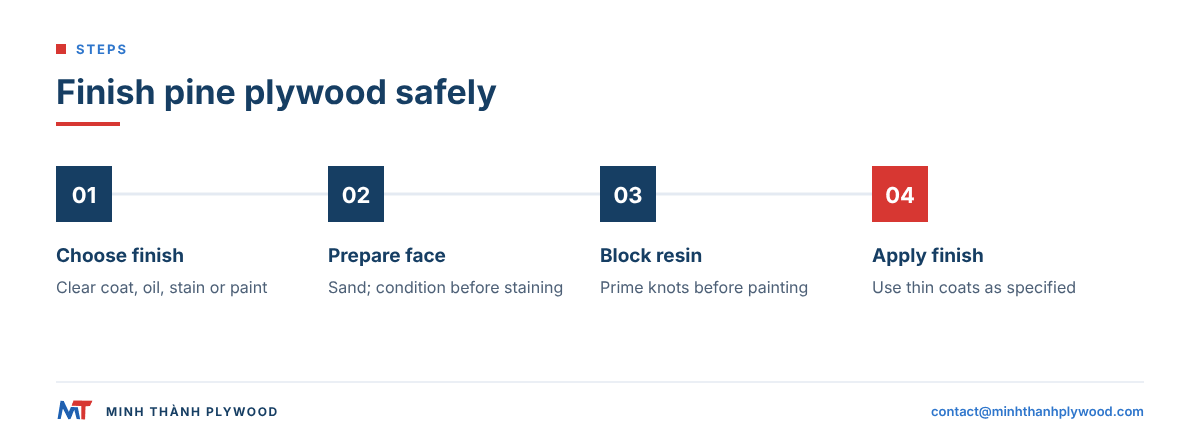
Pine plywood takes paint, lacquer and oil well, and takes stain unevenly unless the face is conditioned first. The resin and the soft earlywood bands absorb finish at different rates.
| Finish | Result on pine | Tip |
|---|---|---|
| Clear lacquer or UV coat | Warm, natural look; darkens to amber | Sand to fine grit; UV-ready faces take it directly |
| Oil or hardwax oil | Natural, matte | Two thin coats |
| Stain | Can look blotchy | Use a conditioner or sealer coat first |
| Paint | Covers well | Use a stain-blocking primer over knots |
For factory UV lines, order both faces UV-ready and sanded to the same grit, so that the coating line runs without extra sanding.
Standards for UK and EU buyers: EN 636 and EN 13986
UK and EU specifiers buy plywood by European standards. EN 636 sets three service classes: EN 636-1 for dry conditions, EN 636-2 for humid conditions and EN 636-3 for exterior conditions (Trada wood-based panels guide, read 21 October 2026). Panels used structurally in buildings must also be CE marked to EN 13986, or UKCA marked in Great Britain.
In the EU, CE marking is set by the Construction Products Regulation (EU) 2024/3110, which has applied since 8 January 2026; plywood to EN 13986 stays CE-marked under the transitional rules carried over from (EU) No 305/2011.
For pine-faced panels this maps as follows: UF glue at E0 emission fits EN 636-1 for dry interiors; melamine-fortified glue fits EN 636-2 for humid rooms; phenolic (WBP) glue is the route to EN 636-3 for exterior use. Name the class on the enquiry, and we confirm the glue line that meets it. Third-party testing to the buyer’s method is arranged through SGS on request.
Emissions and certificates for pine-faced panels
The US TSCA Title VI limit for veneer-core hardwood plywood is 0.05 ppm formaldehyde under 40 CFR 770.10.
Our pine-faced furniture panels use UF glue at E0 emission and are covered by our CARB P2 / TSCA Title VI certification as ICTT mill no. 23024.
Six ASTM D6007 chamber tests between April 2025 and June 2026, on 9, 15 and 18 mm panels, averaged 0.014–0.032 ppm against that 0.05 ppm limit. Three were run by Shanghai Hongjun and three by ICTT Vietnam.
- Europe: panels meet the emission and quality requirements European furniture buyers ask for; third-party testing to the buyer’s method, for example EN 717-1, is arranged through SGS on request.
- EUDR: we supply the EUDR compliance dossier (origin records and geolocation files) with orders. Large and medium operators apply the regulation from 30 December 2026, under Regulation (EU) 2025/2650.
- Quality system: ISO 9001:2015 for plywood manufacturing.
What this means for your order
To order pine-faced plywood, specify the face grade, the core and the glue first, then size and packing. Send these lines with your request:
- Application: furniture, lining, shelving, packing or sheathing.
- Core: white Styrax or Eucalyptus as standard; Acacia or Pine on order.
- Glue and emission: UF glue at E0 emission for interiors; melamine-fortified or phenolic (WBP) bonds to your specification.
- Face: pine A/A, A/B, B/B or B/C, matched to your approved sample.
- Size and thickness: 1220 × 2440 mm or 1250 × 2500 mm, 3–40 mm, sanded to ±0.2–0.3 mm.
- Packing and quantity: from one 40HC, mixed specifications by agreement.
Production takes 15–45 days after the deposit, and free samples are available. Indicative prices for furniture and interior plywood start from US$350/m³ (October 2026); face, core, glue, thickness, size and quantity set the final price. Request a quote on our pine plywood page, or read our sibling guides on radiata pine plywood, Douglas fir and spruce plywood and pine board vs plywood.
Buyer questions, answered
What is pine plywood?
Pine plywood is plywood with pine veneer on its faces, and sometimes pine veneers in the core as well. The face gives the light, knotty or clear pine look; the core species sets the panel's weight and strength.
What is the density of pine plywood?
The density of a pine-faced panel is set mainly by its core. On our planning figures it is about 500 kg/m³ on a white Styrax core, 580 kg/m³ on Acacia and 650 kg/m³ on Eucalyptus.
How much does an 18 mm pine plywood sheet weigh?
A 1220 × 2440 × 18 mm pine-faced sheet weighs about 26.8 kg on a Styrax core, 31.1 kg on Acacia and 34.8 kg on Eucalyptus, from the core's planning density times the sheet volume.
Is pine plywood strong?
Yes. Cross-laminated pine plywood is strong for its weight and stiff in both directions. Radiata pine as solid wood has a modulus of rupture of about 79.2 MPa, and a hardwood core adds stiffness and screw holding to a pine-faced panel.
Is pine plywood good for furniture?
Yes, in a furniture grade. Choose an A/A or A/B pine face on a calibrated hardwood core, sanded flat, so that the panel stays flat, takes finish evenly and holds hinges and cam fittings.
Is pine plywood waterproof?
No plywood is waterproof, pine included. Pine plywood made with phenolic (WBP) or melamine-fortified glue resists water and humidity, but its faces and edges still need sealing outdoors.
Is pine plywood softer than birch plywood?
Yes. Pine faces dent more easily than birch because pine is a softer wood. For tabletops and parts that take knocks, a harder face such as birch, or a lacquered pine face, lasts better.
Can pine plywood be stained?
Yes, but pine absorbs stain unevenly, so the face can look blotchy. A wood conditioner or a sealer coat before the stain gives a more even colour.
What grades does pine plywood come in?
We quote pine-faced panels as face/back pairs A/A, A/B and B/B, with B/C for utility parts, matched to the buyer's approved sample. The ladder is comparable to the European softwood classes I to IV and US A to D grades.
What is pine plywood used for?
Furniture carcasses and shelving, wall and ceiling lining, children's furniture, display units, crates and packing, roof and wall sheathing, and light structural work, chosen by grade and glue.