
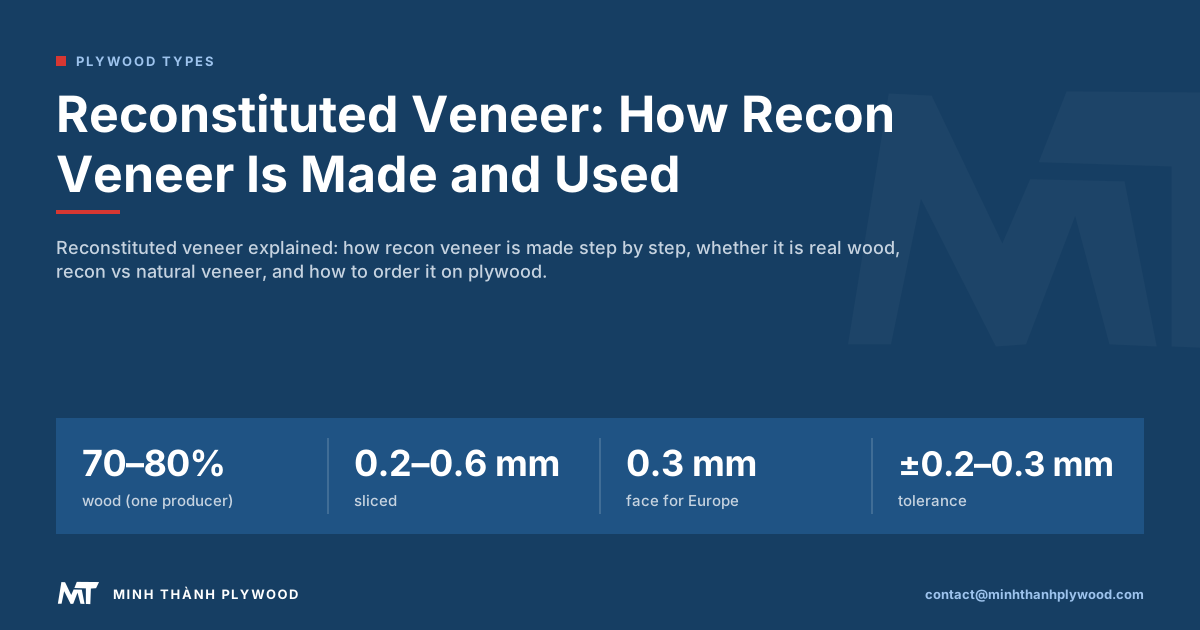
Reconstituted veneer is real wood veneer rebuilt from fast-growing plantation logs: the logs are peeled, the sheets dyed, glued into a block and sliced again, so every sheet repeats the same colour and grain. Minh Thanh Plywood presses recon veneer, sold as EV or engineered veneer, on its own plywood cores, and this guide sets out the process and the checks.
Reconstituted veneer: the short answer
Reconstituted veneer is real wood veneer made in a factory process instead of sliced straight from one tree: fast-growing logs are peeled, dyed, glued into a block and sliced again to a designed pattern. Every sheet from a block has the same colour and grain, with no knots or mineral streaks.
- Also called: recon veneer, engineered veneer, recomposed veneer, EV.
- Made from: plantation species such as poplar and ayous.
- Why buyers choose it: matching sheets, no defect sorting, any colour or pattern.
- Where it goes: on plywood, MDF and particleboard for furniture, doors and wall panels.
The numbered process below shows how a block of recon veneer is made and how it becomes a plywood face.
What is reconstituted wood veneer?
Reconstituted wood veneer is a decorative veneer rebuilt from many thin sheets of real wood: the sheets are dyed, stacked and bonded into a block, and the block is sliced across its layers so each slice shows a wood grain made by the stack. The grain is designed, not grown.
The idea solves the oldest problem in natural veneer: no two trees, and no two sheets, look the same. A designer can choose oak, walnut, teak or wenge looks, straight or crown patterns, and any colour, and get the same face across a whole project.
Recon veneer is a wood product, not a print or a plastic film. It takes clear coats and UV lacquers like natural veneer and is pressed on a substrate the same way. Our EV plywood is plywood faced with this veneer.
Is recon veneer real wood?
Yes: recon veneer is mostly real wood, with resin from the block glue and a small share of dye. One leading Italian recon producer publishes the composition of its range as 70–80% poplar, ayous or basswood fibre, 16–20% resins, under 1% dyes and 4–14% moisture content.
| Component | Share (one producer’s published range) | Role |
|---|---|---|
| Wood (poplar, ayous, basswood) | 70–80% | The veneer itself |
| Resins | 16–20% | Glue lines of the block |
| Dyes | Under 1% | Colour |
| Moisture | 4–14% | Natural water in the wood |
So recon veneer is “real wood” in the way plywood is real wood: wood bonded with glue. It is not pure wood, and it is not a single tree.
How reconstituted veneer is made, step by step
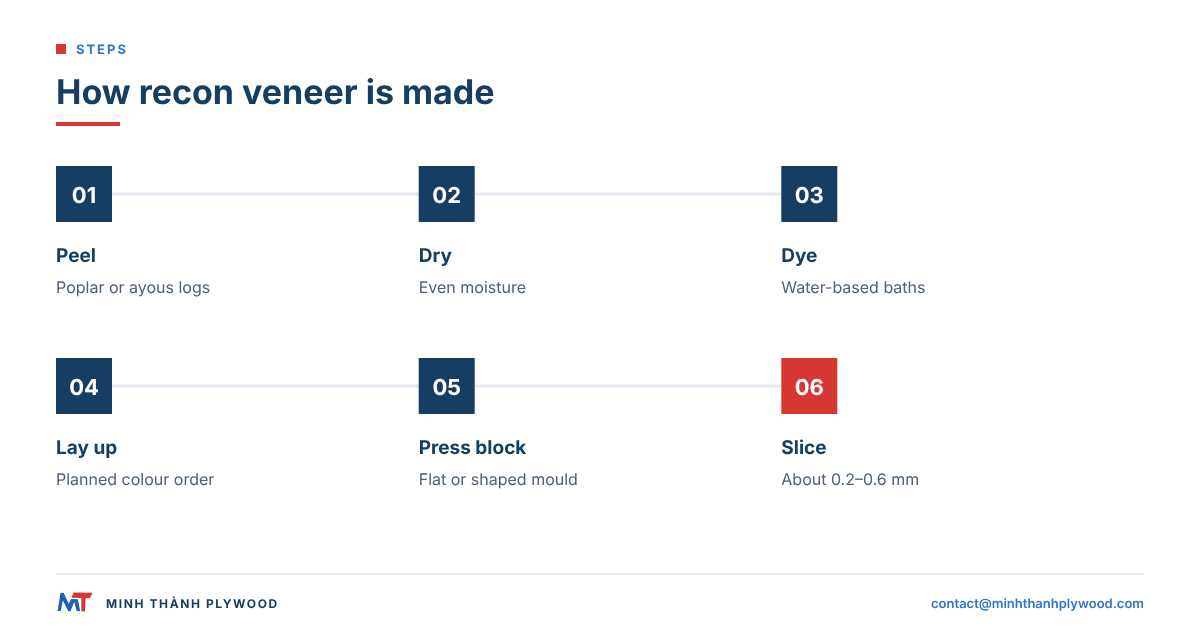
Reconstituted veneer is made in eight steps, from a plantation log to a sheet ready to press. The process is the same in principle at every recon mill; the dyes, block shapes and slicing angle create the pattern.
- Choose the log. Fast-growing plantation species with pale, even wood: poplar, ayous (obeche) or basswood.
- Peel. Rotary-cut the log into thin, continuous sheets, then cut them to width.
- Dry. Bring the sheets to an even moisture content so the dye takes evenly.
- Dye. Soak the sheets in water-based dye baths at a set temperature and concentration until the colour goes through the wood.
- Lay up. Stack dyed sheets in a planned order of colours and thicknesses; this sequence becomes the grain lines.
- Glue and press the block. Coat each sheet with glue and press the stack in a mould; flat moulds give straight grain, shaped moulds give crown or wavy figures.
- Saw and condition. Square the block into a rectangular “log” and rest it so the glue cures fully.
- Slice. Slice the block across its layers into veneer about 0.2–0.6 mm thick; quarter slicing gives straight grain, flat slicing gives a cathedral pattern.
The sheets are then spliced edge to edge into full-size faces, ready for pressing on a panel.
How recon veneer becomes a plywood face
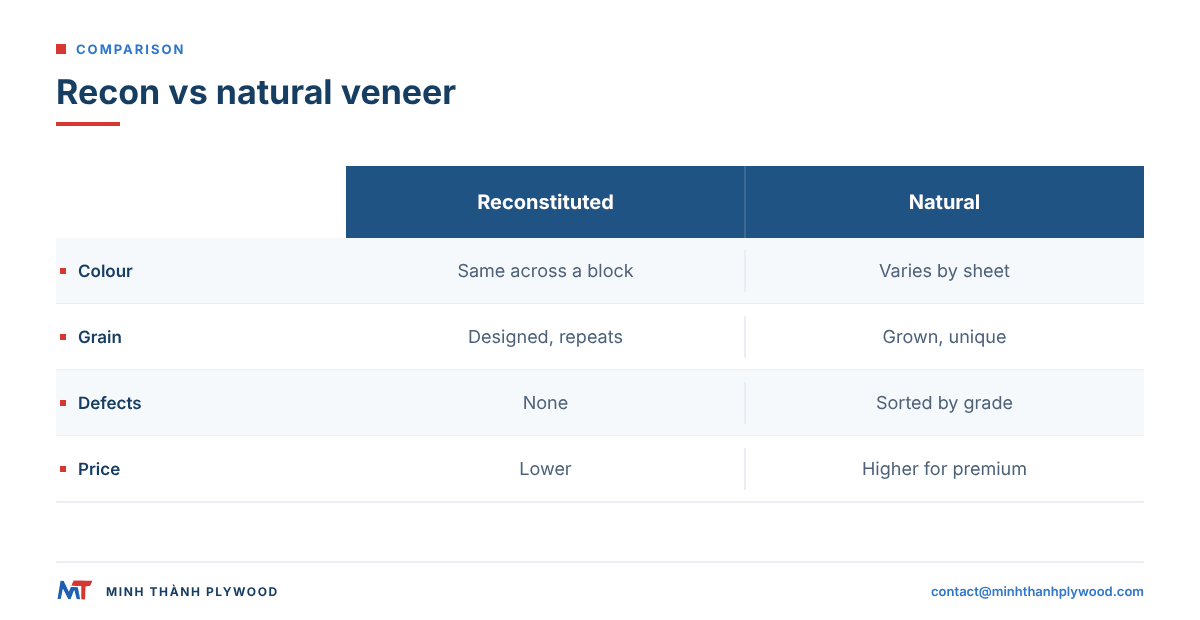
A recon veneer face goes onto plywood in a second pressing, after the core board itself has been pressed and calibrated. That is how our furniture panels are made: two pressings, so the thin face sits on a flat, even core.
- Core pressing. Styrax or Eucalyptus core veneers, stitched horizontally and vertically, are glued and pressed into a core board.
- Calibration. The core board is sanded to an even thickness.
- Face pressing. Recon face and back veneers, 0.2–0.5 mm and usually 0.3 mm for Europe, are pressed on with UF glue at E0 emission or the bond the buyer specifies.
- Sanding and polishing. The faces are sanded and polished; both faces leave UV-ready for the buyer’s own coating.
- Inspection. Face colour against the approved sample, thickness, flatness and edges are checked before packing.
Sanded furniture panels hold a thickness tolerance of ±0.2–0.3 mm, down to ±0.2 mm, which matters for a face this thin: an uneven core would show through or be sanded through.
Reconstituted veneer vs natural veneer
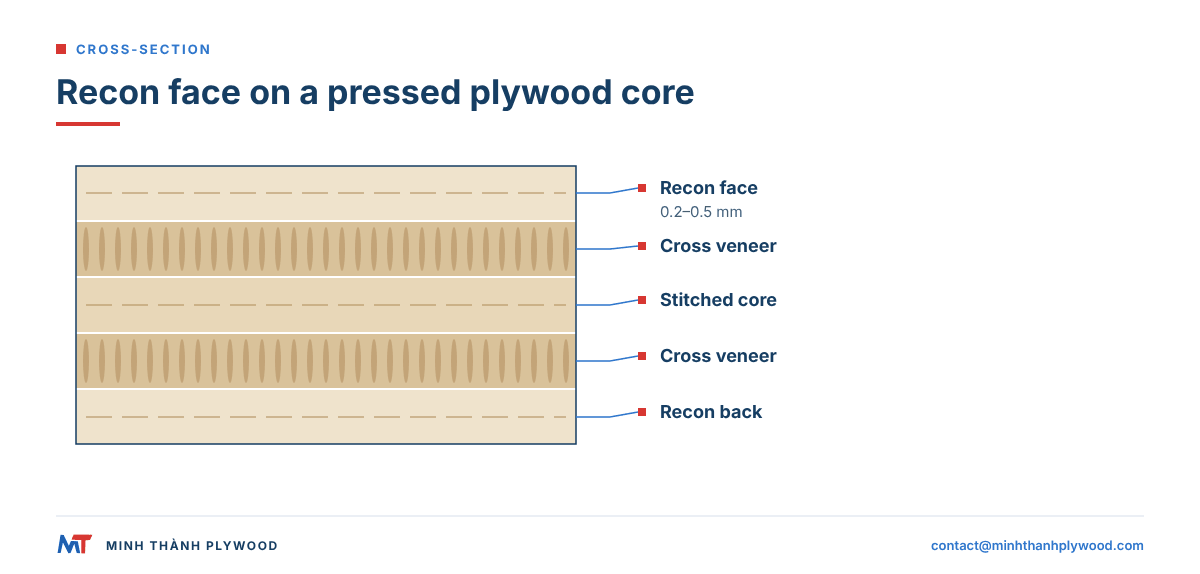
Reconstituted veneer wins on consistency, yield and price; natural veneer wins on authentic figure and character. Recon veneer is real wood, built from dyed fast-growing sheets glued into a block and re-sliced, so every sheet matches and has no knots. Natural veneer is sliced from one tree, so colour and figure change from sheet to sheet.
The table compares them line by line.
| Line | Reconstituted veneer | Natural veneer |
|---|---|---|
| Source | Plantation poplar, ayous, basswood | One tree of the named species |
| Colour | Designed; the same across a block | Varies by tree and sheet |
| Grain | Designed pattern, repeats | Grown figure, unique |
| Defects | No knots, splits or mineral streaks | Knots and streaks sorted out by grade |
| Sheet width | Set by the block | Set by the log, often narrow |
| Matching | Simple: sheets are alike | Book or slip matching by hand |
| Yield | Near-total use of the block | Rejects for defects and colour |
| Price | Lower than premium natural faces | Higher for oak, walnut, teak |
| Look up close | Even, can read as repeated | Natural depth and variation |
| Best for | Long runs, large fit-outs | Feature pieces, natural character |
Choose recon veneer when many parts must look the same. Choose natural veneer when the tree’s own figure is the design. Our guide to veneer vs laminate vs melamine vs solid wood compares the wider choice of surfaces.
Colour consistency: why buy recon veneer by batch
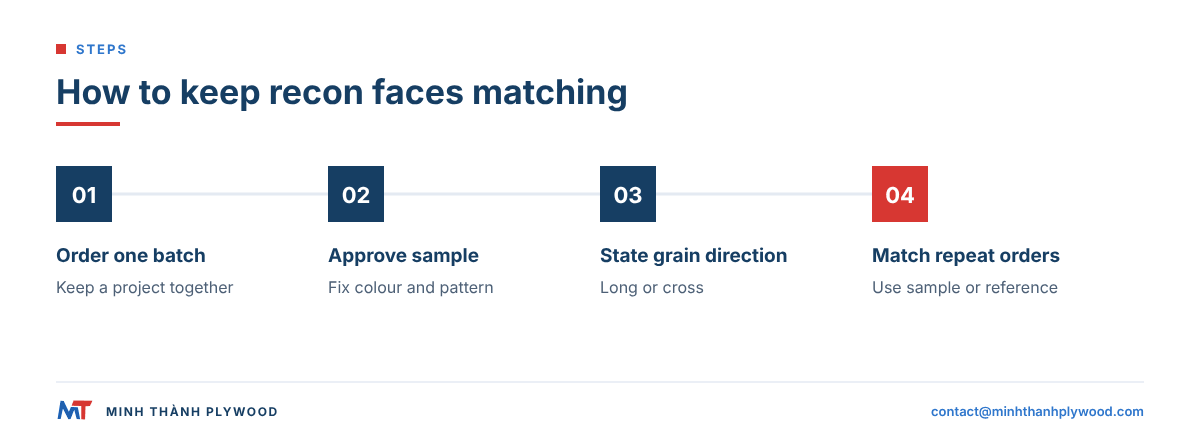
Recon veneer gives the same colour within one block and one dye batch, so a project that must match should be ordered and pressed from one batch. Between batches, dye and wood vary slightly, as with paint.
- One project, one batch: order all the panels of a kitchen, a hotel floor or a shop chain in one go where you can.
- Approved sample: fix the colour with a sample panel and keep it as the reference.
- Repeat orders: send the sample or the pattern reference; the face is matched to it.
- Grain direction: state the grain direction on the panel, long or cross, so doors and sides line up.
We match the face to the buyer’s approved sample on every order and write the pattern, colour, core and grade on the quotation.
Price and waste: why recon veneer costs less
Recon veneer costs less than premium natural faces because it is made from fast-growing plantation wood and almost the whole block becomes usable veneer. Natural oak, walnut or teak faces lose a share of every log to knots, colour sorting and narrow sheets.
| Cost driver | Reconstituted veneer | Premium natural veneer |
|---|---|---|
| Log | Plantation poplar or ayous | Slow-grown hardwood log |
| Sorting | No defect grading | Graded and sorted by sheet |
| Waste | Low | Higher |
| Matching labour | Low | Hand matching for runs |
| Rejects at the furniture plant | Few colour mismatches | More parts set aside |
For a furniture maker the saving is not only the face price. Matching sheets mean fewer rejected doors, less sorting and a faster line. Our furniture and interior plywood starts from US$350/m³ (October 2026, indicative); the final price depends on face, core, glue, thickness, size, quantity and delivery term.
Patterns and looks: what recon veneer can copy
Recon veneer can copy almost any wood look, and make looks no tree grows. The block design sets the pattern.
- Straight grain (quarter look): oak, walnut, teak, wenge, ebony looks with even stripes.
- Crown (flat-cut look): cathedral arches, as in crown-cut oak.
- Figured looks: burrs, curls and exotic stripes such as zebrano.
- Colours: white, grey, black and coloured faces with a wood grain.
- Designer patterns: geometric and abstract grains for retail and hospitality.
Reconstituted white oak veneer and walnut-look recon are two of the classic recon looks for furniture. Our veneer species guide compares the natural woods these patterns imitate.
When recon veneer on plywood beats a natural face
Recon veneer on plywood beats a natural face when the job has many matching parts, a fixed colour, a tight budget for a premium look, or a long life of repeat orders. Natural faces still win where the figure is the point.
| Project | Better face | Why |
|---|---|---|
| Kitchen and wardrobe runs | Recon | Doors and sides match |
| Hotel rooms, offices, retail chains | Recon | Same look across sites and years |
| Wall panelling over large areas | Recon | No colour jumps between panels |
| Walnut or teak look on a budget | Recon | Premium look at lower cost |
| Feature table, one-off cabinet | Natural | Unique figure |
| Restoration and antiques | Natural | Authentic species |
| Painted furniture | Neither; poplar or okoume face | Plain face under paint |
Where reconstituted veneer falls short
Reconstituted veneer is the wrong choice where buyers expect the depth and variation of a single tree, or where a design calls for heavy sanding. Plan around three points.
- Repetition: a very large wall can show the repeat of the block pattern; mix sheet orientation or choose a busier pattern.
- Sanding: the face is thin; light sanding only, and coat the factory-polished surface directly.
- Sunlight: dyed faces change colour in strong sun, as natural woods do; use a lacquer with UV absorbers.
None of these stops recon veneer from being one of our main face options; they decide where it goes.
How to check recon veneer plywood on delivery
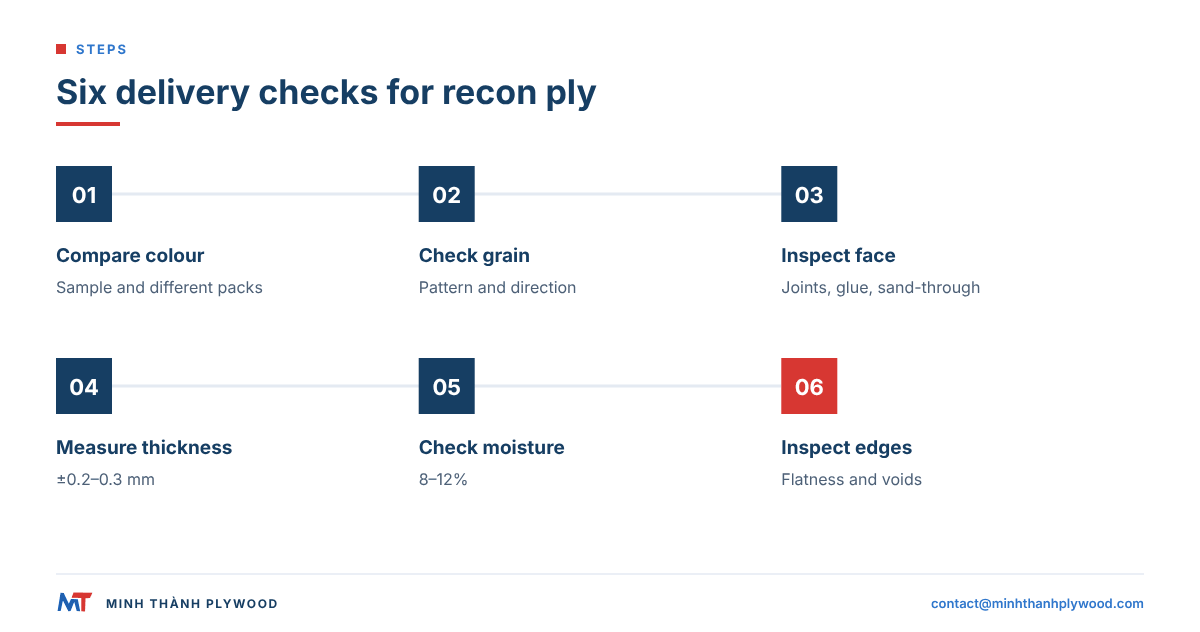
Check recon veneer plywood on delivery in six steps, against the approved sample and the order lines.
- Colour: compare several sheets from different packs with the approved sample in daylight.
- Pattern and grain direction: check the pattern and that grain runs as ordered.
- Face: look for sand-through, glue spots, splits and open joints at low light angles.
- Thickness: measure with a caliper at several points; sanded panels should hold ±0.2–0.3 mm.
- Moisture: veneers and finished panels are dried to 8–12 % moisture content at dispatch.
- Flatness and edges: lay a sheet flat and check the edges for voids and the stitched core.
Every shipment is photographed and filmed before loading, and the buyer receives the photos and video, so most of these checks can start before the container arrives.
What this means for your recon veneer plywood order
A recon veneer plywood order works when the face and the panel are both specified. Send these lines:
- Application: kitchen, wardrobe, door, wall panel or fit-out; grain direction.
- Face: recon pattern and colour, with a sample or reference; face and back grade.
- Core: white Styrax at about 500 kg/m³ for light panels, or Eucalyptus at 650–750 kg/m³ for denser ones.
- Glue and emission: UF glue at E0 emission for dry interiors; MR or WBP to your specification.
- Size and thickness: 1220 × 2440 mm or 1250 × 2500 mm, 3–40 mm; cut-to-size into 4, 6 or 8 pieces.
- Packing and quantity: from one 40HC, mixed specifications by agreement; destination port.
Our panels are CARB P2 / TSCA Title VI certified (ICTT mill no. 23024), and six third-party ASTM D6007 chamber tests averaged 0.014–0.032 ppm. The US limit for hardwood plywood with a veneer core is 0.05 ppm under 40 CFR 770.10.
Production is 15–45 days after the deposit, FOB Hai Phong, CFR or CIF, with free samples. UK buyers should check the product, species and origin against the GOV.UK guidance on importing wood, wood products or bark, including its separate Northern Ireland guidance. Your customs broker reads the current preferential rate for your 10-digit TARIC code on the European Commission’s Access2Markets portal. For other faces, see veneered plywood and the wood veneer sheets guide.
Buyer questions, answered
What is reconstituted veneer?
Reconstituted veneer is a decorative veneer made by peeling fast-growing logs, dyeing the sheets, gluing them into a block and slicing the block again. The result is real wood with a designed, repeatable colour and grain.
Is recon veneer real wood?
Yes. Recon veneer is mostly real wood, usually poplar or ayous, with resin from the block glue and a small share of dye. One producer publishes 70–80% wood fibre, 16–20% resins and under 1% dyes.
What is the difference between reconstituted and natural veneer?
Natural veneer is sliced from one tree, so colour and figure change from sheet to sheet. Reconstituted veneer is built from dyed sheets in a block, so every sheet looks the same and has no knots.
Is recon veneer the same as engineered veneer?
Yes. Reconstituted, recon, engineered, recomposed and EV veneer are names for the same product. Plywood faced with it is sold as EV plywood or recon veneer plywood.
Is reconstituted veneer cheaper than natural veneer?
Usually, yes, against oak, walnut, teak and other premium natural faces, because it uses fast-growing logs and almost no sheet is rejected for defects. Against plain natural faces such as poplar the price gap is small.
How thick is reconstituted veneer?
Reconstituted veneer is sliced in a thickness range of about 0.2–0.6 mm. Faces pressed on plywood are 0.2–0.5 mm, and 0.3 mm is the usual European furniture choice.
Does reconstituted veneer fade?
Dyed veneers can change colour under strong sunlight, as natural woods do. A lacquer with UV absorbers and keeping panels out of direct sun protect the colour.
Can reconstituted veneer be stained or sanded?
It can be clear-coated, lacquered or UV-coated directly. Sand only lightly with fine grit, because the face is thin and the dye is in the wood, not on top.
Where can I buy reconstituted veneer plywood from Vietnam?
Minh Thanh Plywood in Ha Hoa, Phu Tho presses recon veneer (EV) faces on white Styrax or Eucalyptus cores and exports factory-direct from one 40HC. Panels are CARB P2 / TSCA Title VI certified.
What is reconstituted wood veneer used for?
Reconstituted wood veneer is used for kitchen and wardrobe runs, interior doors, wall panelling, hotel and office fit-outs and retail furniture, wherever many parts must match.