
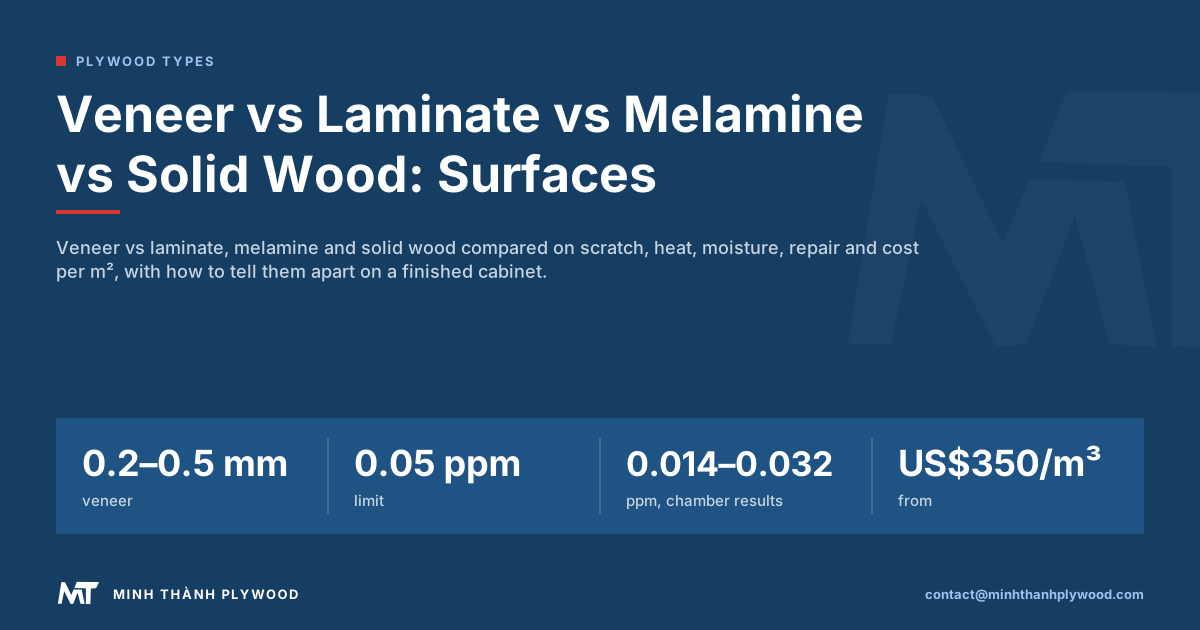
Veneer is a thin slice of real wood on a panel; laminate is a printed decor paper under a hard resin layer; melamine is a thinner resin-paper face pressed straight onto the board; solid wood is wood all the way through. Minh Thanh Plywood, a maker of veneered plywood for furniture, compares the four on wear, water, heat, repair and cost.
Veneer vs laminate: the short answer
Veneer is real wood, cut thin; laminate is a picture of wood under a hard plastic layer. Choose veneer when the look, feel and repairability of wood matter, and laminate when the surface must take daily abuse, water and cleaning chemicals with no upkeep.
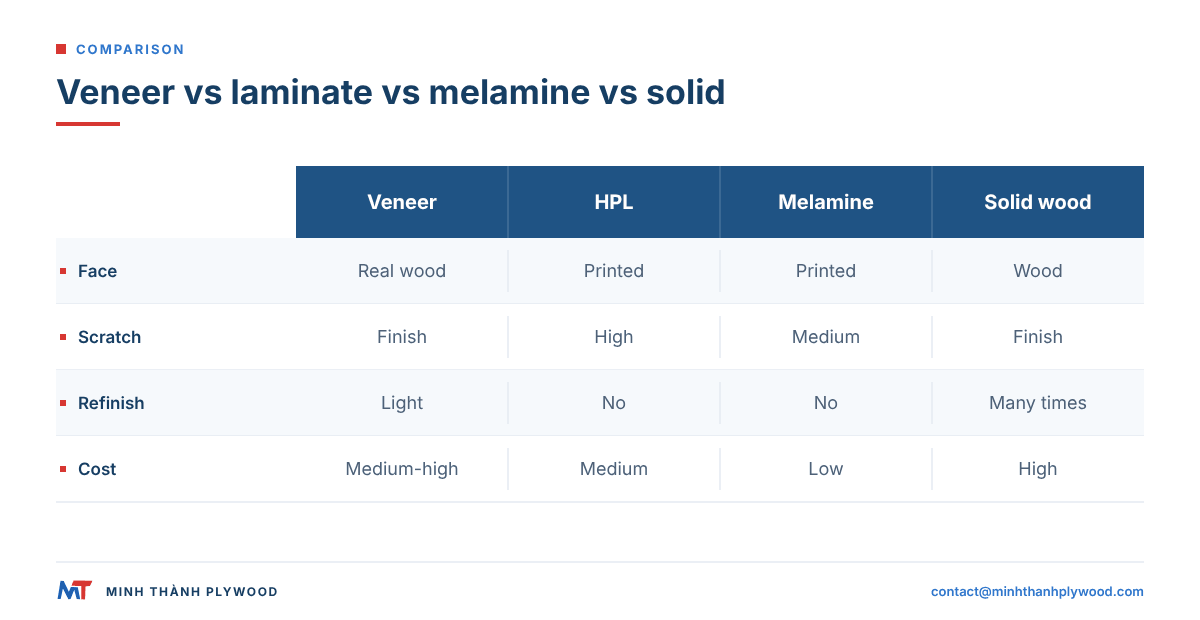
Two more surfaces sit in the same buying decision. Melamine is a cheaper, thinner resin-paper face pressed straight onto the board. Solid wood is the original that veneer imitates, wood all the way through. The table below scores all four on the points a furniture buyer pays for.
| Metric | Wood veneer | High-pressure laminate (HPL) | Melamine (low-pressure) | Solid wood |
|---|---|---|---|---|
| What the face is | Real wood slice on a core | Printed paper under hard resin, glued on | Resin-soaked decor paper pressed onto board | Wood throughout |
| Look | Real grain, each panel unique | Printed grain, repeats | Printed grain, repeats | Real grain, unique |
| Scratch resistance | Depends on finish | High | Medium | Depends on finish |
| Heat resistance | Medium, finish dependent | High | Medium | Medium |
| Moisture on the face | Good when finished | Very good | Good | Good when finished |
| Edge water risk | Low on plywood core | Depends on core | High on particleboard core | Low |
| Repair and refinish | Light sanding, refinish | Not refinishable | Not refinishable | Sand and refinish many times |
| Relative cost per m² | Medium to high | Medium | Low | High |
| Weight | Set by core | Set by core | Set by core | Set by species |
| Best for | Doors, fronts, wall panels | Worktops, desks, counters | Carcasses, shelving, flat-pack | Tabletops, frames, heirloom pieces |
What is wood veneer?
Wood veneer is a thin leaf of real wood, sliced or peeled from a log and glued onto a stable core such as plywood, MDF or particleboard. On plywood, the decorative face is 0.2–0.5 mm thick, and European furniture plywood usually takes about 0.3 mm.
Because it is wood, veneer has the grain, colour shift and touch of the species: oak, walnut, ash, birch, okoume and others. Each leaf is different, so two veneered doors from the same log look related but never identical. That variation is what buyers pay for.
Veneer also comes as engineered veneer, EV, made from plantation wood that is dyed and re-sliced to give a designed grain with even colour. EV is still real wood but repeats its pattern closely, which suits large fit-out projects. The wood veneer sheets guide covers species and formats.
What is laminate?
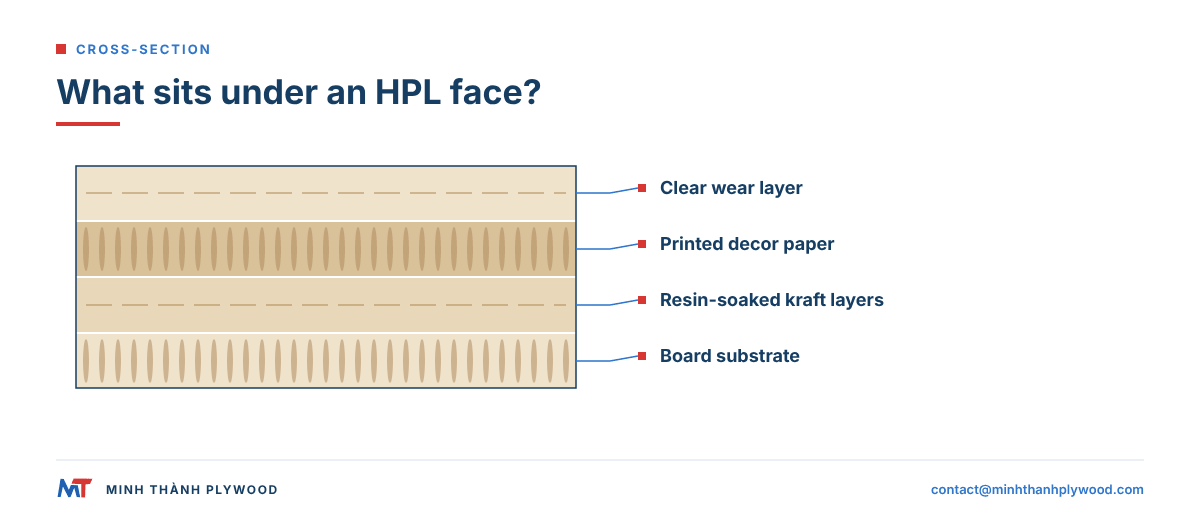
Laminate, or high-pressure laminate (HPL), is a thin sheet made by pressing layers of resin-soaked kraft paper under a printed decor paper and a clear wear layer, at high pressure and heat. The finished sheet is then glued onto a board such as MDF, particleboard or plywood. The product family is defined in BS EN 438-1, the standard for high-pressure decorative laminates.
The print can copy any wood, stone or plain colour. The top resin layer gives HPL its hardness against scratches, heat, stains and water. That is why it covers kitchen worktops, office desks, lab benches and shop counters.
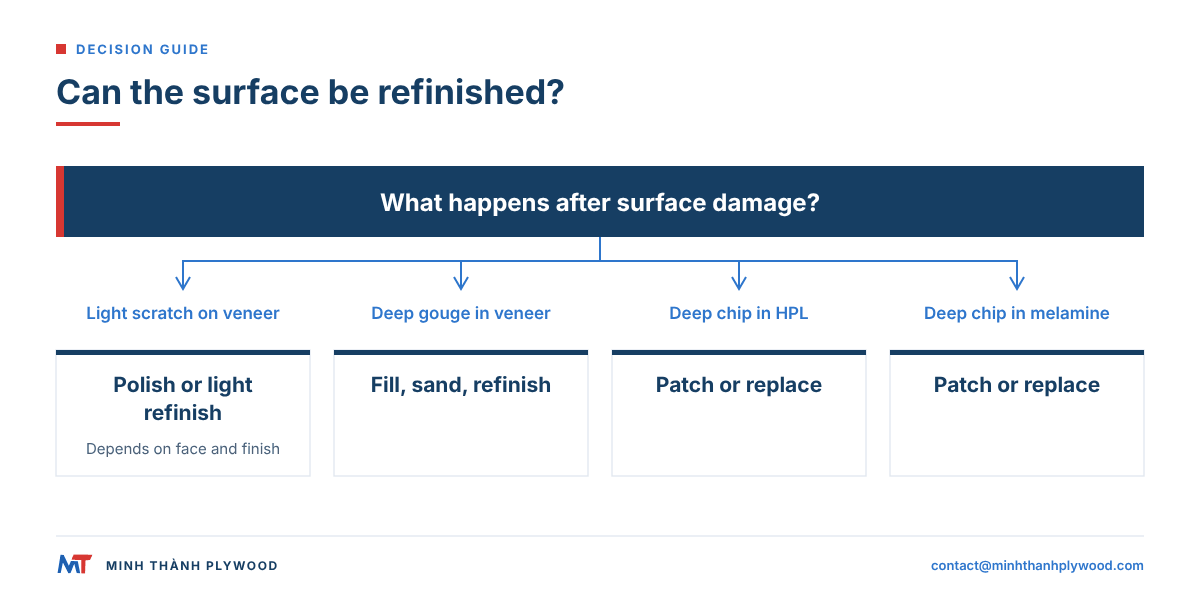
The weakness of laminate is repair. A deep scratch or chip cuts through the print, and there is no wood underneath to sand back. The damaged sheet has to be patched or replaced. The edge is also visible: either a dark line where the paper layers show, or an edge band.
HPL also comes as compact laminate, a thick, self-supporting sheet used for toilet cubicles and lab tops, and as postformed laminate wrapped around a rounded worktop edge. Both are the same material family: printed decor, resin layers, high pressure. None of them contains wood you can see.
What is melamine, and how is it different from laminate?
Melamine is a single decor paper soaked in melamine resin and pressed directly onto the board at low pressure; it is also called low-pressure laminate. HPL is a separate, thicker sheet glued on later. Melamine is cheaper and thinner, and less resistant to impact. Melamine-faced boards for interior use are defined in BS EN 14322.
The answer to “laminate vs melamine” is mostly about where the surface works:
- Melamine suits the inside of cabinets, shelving, wardrobes and flat-pack furniture, where the surface sees light wear.
- HPL suits horizontal work surfaces and high-traffic fronts that take knocks and cleaning. Keep hot pans off the surface; see Polytec’s laminate care guide.
Melamine is usually pressed on particleboard or MDF. Melamine-faced plywood also exists: the same decor paper pressed on a plywood core, giving better screw holding and lower weight. The melamine vs plywood comparison covers that choice in detail.
Solid wood versus veneer: when the real thing is worth it
Solid wood is the right choice when a part will be sanded and refinished many times or shaped on every edge; veneer is the right choice for wide, flat panels that must stay flat. Solid wood versus veneer is not a quality ranking but a question of the part.
Solid wood moves with humidity across its width. A wide solid-wood door or panel can cup, crack or open its joints as seasons change. A veneer on a cross-laminated plywood core does not, because the crossed layers hold the panel still. That is why high-end furniture makers use veneered panels for doors, sides and backs, and solid wood for frames, legs and edges.
Solid wood also uses much more of the species. One walnut log sliced into veneer covers far more furniture area than the same log sawn into boards. The plywood vs solid wood comparison gives the full picture.
Veneer wood vs solid wood: can you tell the difference?
On the face, a well-made veneer looks the same as solid wood of the same species. The difference shows at the edges, the ends and the back.
| Check | Veneer panel | Solid wood |
|---|---|---|
| Edge of a door or shelf | Thin banding, solid lipping, or visible plywood layers | Grain continues around the edge |
| End grain | None on panel faces | End grain at board ends |
| Grain across the width | Joined leaves, often matched | Boards glued edge to edge, grain differs |
| Back of the panel | Often a different species or grade | Same wood |
| Weight of a large panel | Lighter on a Styrax plywood core | Heavier in dense species |
Check the edge of a drawer front or the cut-out for a hinge. On veneered plywood you see the core layers; on veneered MDF a uniform fibre core; on solid wood the same grain all the way through.
Hardwood vs laminate: wear, heat and water compared
Laminate outlasts hardwood veneer on daily wear and water; hardwood veneer outlasts laminate in how it ages and how it is repaired. The finish on the veneer decides most of its resistance, so specify the finish with the panel.
| Test a buyer cares about | Hardwood veneer, lacquered | HPL | Melamine |
|---|---|---|---|
| Keys and daily scratches | Marks in the finish, polish out | Resists | Resists light marks |
| Hot cup or pan | Cups fine with good lacquer; pans mark | Do not place hot pans directly on it | Marks under a hot pan |
| Water spill wiped in minutes | No harm when finished | No harm | No harm on the face |
| Standing water at a cut edge | Plywood core holds up | Core decides | Particleboard core swells |
| Sunlight over years | Wood colour changes, evens out | Stable print | Stable print |
| Deep gouge | Fill, sand, refinish | Patch or replace | Patch or replace |
Light changes wood. Cherry and walnut darken or lighten over years; oak ambers under some finishes. Laminate keeps its printed colour. Buyers who want a surface that ages, choose wood; buyers who want a surface that never changes, choose laminate.
The finish on veneer is the part buyers forget to specify. A sanded veneer face straight from the mill is bare wood; its resistance comes from the lacquer, oil or UV coating applied in your plant. A hard UV coat on oak veneer closes much of the scratch gap with laminate for doors and fronts. That is why Minh Thanh sands both faces to a UV-ready standard: the coating is where veneer earns its durability.
Veneer in furniture: where each surface belongs
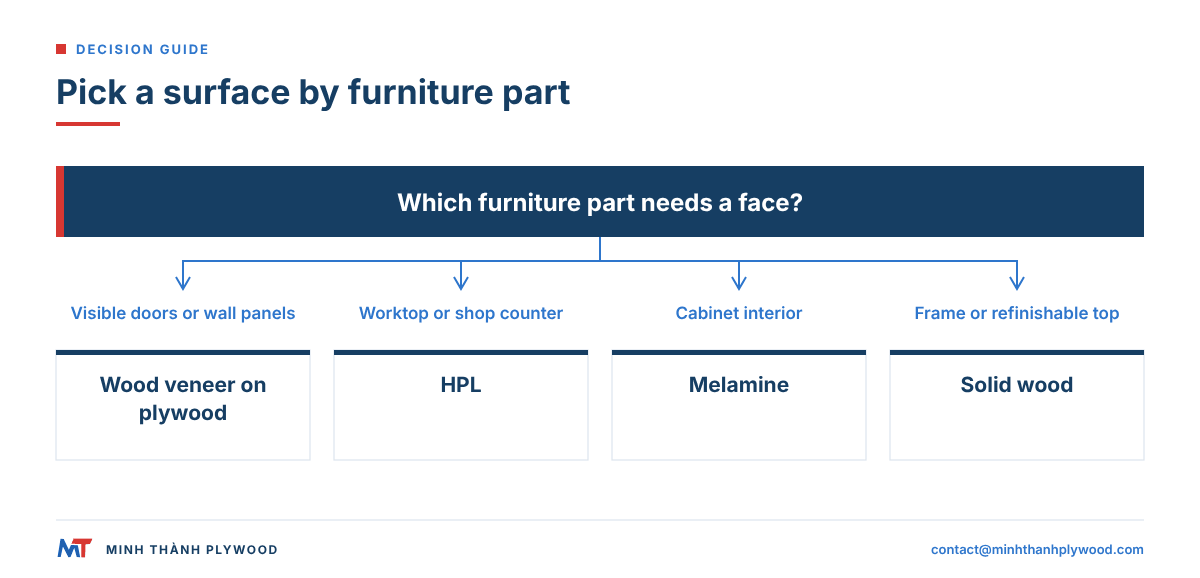
Veneer in furniture belongs on the faces people see and touch; laminate and melamine belong on the faces that work. Most well-built furniture combines them.
| Furniture part | Best surface | Why |
|---|---|---|
| Kitchen doors and drawer fronts | Wood veneer on plywood | Real wood look, screw hold for hinges |
| Kitchen worktop | HPL or solid surface | Easy cleaning |
| Cabinet carcass inside | Melamine | Clean, cheap, wipeable |
| Wardrobe doors and sides | Veneer or EV on plywood | Wide panels stay flat |
| Office desk tops | HPL or lacquered veneer | Daily wear |
| Hotel room furniture | EV veneer on plywood | Repeatable colour across many rooms |
| Wall panelling | Veneer panels | Real wood across large areas |
| Shop counters | HPL | Abuse and cleaning |
| Dining tables | Solid wood or thick veneer with solid lipping | Refinishing over years |
The core under the surface matters as much as the surface. A veneer or melamine face on plywood holds screws in the edge and resists damp far better than the same face on particleboard. The guide to veneered panels compares the cores.
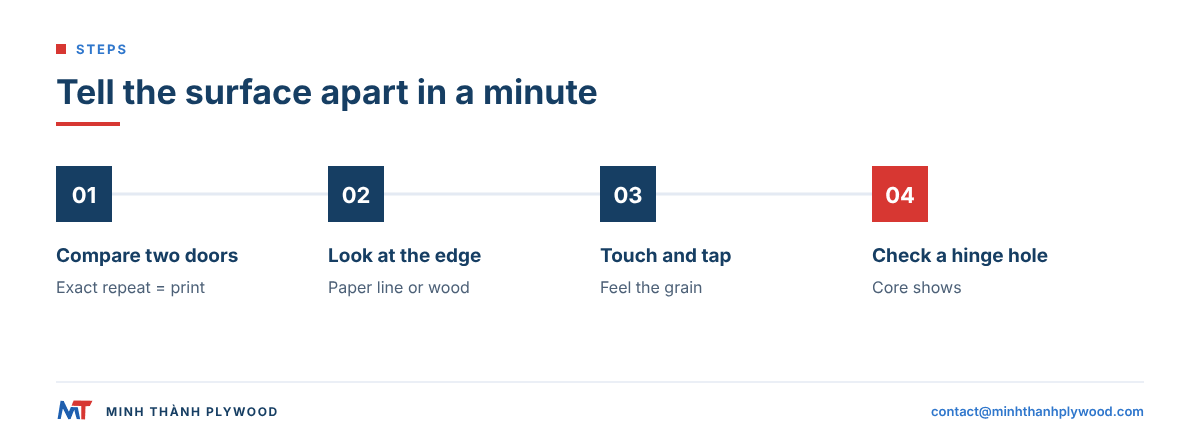
How to tell veneer, laminate, melamine and solid wood apart on a cabinet
Four checks identify the surface in under a minute: grain repeat, edge, touch and a hidden spot.
- Compare two doors. If the grain pattern repeats exactly, with the same knot in the same place, it is a print: laminate or melamine. Real veneer never repeats exactly.
- Look at the edge. A dark line of layered paper means HPL glued on. A plastic edge band over a fibre or chip core suggests melamine. Thin plywood layers or a solid lipping with real grain suggests veneer.
- Touch and tap. Laminate and melamine feel cool, smooth and uniform; open-pore veneers like oak or walnut feel the grain under the finish.
- Check a hinge cut-out or the back. Drill and hinge holes show the core: chips, fibres or plywood layers. Solid wood shows the same wood all the way.
A fifth check is the price tag. A full kitchen of matching “oak” doors at the price of flat-pack shelving is printed melamine, not veneer.
Cost per m² of veneer, laminate, melamine and solid wood
Melamine is the cheapest surface per square metre, then HPL, then wood veneer, with solid wood highest. The core and the finish then add more than the face itself.
Relative cost of a finished square metre of furniture surface, lowest to highest:
- Melamine-faced particleboard.
- Melamine-faced MDF or plywood.
- HPL on MDF or particleboard.
- EV veneer on plywood, lacquered.
- Natural veneer on plywood, lacquered (oak, ash, birch).
- Figured or rare natural veneer (walnut, European species).
- Solid wood of the same species.
Veneer cost rises with species, cut and matching. On a pressed plywood panel, core species, glue and emission class, calibration and sanding are a large share of the price. Minh Thanh’s furniture and interior plywood starts from US$350/m³ (October 2026); the face, core and size set the final price.
Cost per square metre is only part of the bill. Veneered fronts are usually lacquered or UV-coated in the buyer’s plant, which adds finishing cost that laminate and melamine do not need. In return, veneer furniture sells at a higher price and can be refinished instead of replaced. Compare the finished part, not the raw board.
Laminated veneer lumber is not laminate
Laminated veneer lumber, LVL, is an engineered wood product made of veneers glued with their grain mainly along its length; it is separate from decorative laminate. Plywood crosses the grain of alternate layers to make a stable sheet. Some LVL panel grades include crosswise veneers, as the Metsä Wood Kerto LVL Q-panel specification shows.
| Point | Plywood | LVL |
|---|---|---|
| Veneer direction | Alternate layers crossed | Mainly parallel; some grades include crosswise veneers |
| Shape | Sheets | Beams, battens, boards and panels |
| Strength | Depends on loading direction | High along the length |
| Uses | Furniture panels, floors, formwork, packing | Beams, frames, door frames, shelf boards, packing frames |
Minh Thanh supplies LVL alongside plywood. The LVL product page lists uses and sizes.
Emissions: does the surface change formaldehyde?
The surface changes emissions less than the core and glue under it. A veneered panel, a laminate panel and a melamine panel all emit mainly from the board glue; the face slows the release but does not remove it.
Specify the emission class of the core board for every surface type. For European and US furniture buyers, Minh Thanh’s furniture plywood uses UF glue at E0 emission and holds CARB P2 / TSCA Title VI certification (ICTT mill no. 23024). Six ASTM D6007 chamber tests between April 2025 and June 2026, by Shanghai Hongjun and ICTT Vietnam, averaged 0.014–0.032 ppm against the 0.05 ppm limit for veneer-core hardwood plywood.
The limit is set under TSCA Title VI, in 40 CFR 770.10. Laminated products made from certified panels can carry the TSCA Title VI label of the laminator.
Veneered plywood from Minh Thanh: what you get
Minh Thanh is a Vietnamese manufacturer of veneered furniture and interior plywood, with Europe as its main market. Our panels are the core that takes veneer, laminate or melamine in your plant, or arrive already faced with veneer.
- Faces: 10+ face veneers, most produced EV, Poplar, Birch, Okoume and Pine; Bintangor, Eucalyptus, Gurjan, Sapele and others on request.
- Cores: white Styrax or Eucalyptus, stitched horizontally and vertically.
- Pressing: double pressed as standard: core pressed and calibrated, then face and back pressed on.
- Tolerance: sanded panels ±0.2–0.3 mm, down to ±0.2 mm, so HPL and melamine lay flat without telegraphing.
- Finish ready: both faces sanded and UV-ready for your own UV coating or lacquer.
- Sizes: 1220 × 2440 and 1250 × 2500 mm, custom sizes, cut-to-size into 4, 6 or 8 pieces.
The furniture plywood page has the full specification, and the EV plywood page shows the engineered faces.
What to write in your RFQ for a veneered or laminate-ready panel
State the surface, then the core under it, then the finish. A quote for “veneer board” without those three can come back as anything from melamine particleboard to walnut plywood.
- Application: cabinet doors, carcasses, wardrobes, wall panels or worktops.
- Core: Styrax or Eucalyptus plywood, stitched; or plain plywood to laminate in your plant.
- Glue and emission: UF glue at E0 emission; CARB P2 / TSCA Title VI for the US.
- Face: species and cut, EV colour code, or sanded plain face for HPL or melamine.
- Panel: thickness, size, tolerance, sanded and UV-ready.
- Packing and quantity: pallet packs, number of panels, destination port.
A filled line reads: “18 mm plywood, Styrax core stitched, UF glue at E0 emission, oak veneer face crown cut, poplar back, 1220 × 2440 mm, ±0.3 mm, sanded and UV-ready, one 40HC, CIF Rotterdam.”
Send it through the quote form or to contact@minhthanhplywood.com. We reply within hours and send free samples of the faces you are comparing.
If you will press HPL or melamine in your own plant, say so. A laminate-ready panel needs a flat, calibrated, sanded face with no core voids that could telegraph through the thin decor; the face species matters less than its flatness.
Buyer questions, answered
What is the difference between veneer and laminate?
Veneer is a thin slice of real wood glued to a panel, so every face has its own grain. Laminate is a printed paper sealed under hard resin; it copies wood grain with a repeating print and resists scratches better, but it cannot be sanded or refinished.
Is veneer better than laminate for furniture?
Veneer is better when the furniture should look and age like real wood and may be refinished. Laminate is better on surfaces that take hard daily wear and water, such as kitchen worktops, office desks and shop counters.
Is melamine the same as laminate?
No. Melamine is a resin-soaked decor paper pressed directly onto the board at low pressure. High-pressure laminate is a thicker, separately made sheet of several resin papers, glued on afterwards, and it resists impact and wear better.
Is melamine cheaper than plywood?
Melamine-faced particleboard is usually the cheapest cabinet board. Plain plywood costs more per sheet but holds screws better and resists water better; melamine-faced plywood combines the two at a higher price.
Does melamine swell when it gets wet?
The melamine face itself does not swell, but water that reaches a particleboard or MDF core through a cut edge or screw hole makes the core swell. A plywood core with sealed edges handles damp far better.
Does melamine plywood exist?
Yes. Melamine-faced plywood has melamine decor paper pressed onto a plywood core. It gives the hard printed face of melamine with the screw holding and lower weight of plywood.
Can you sand and refinish wood veneer?
Yes, lightly. A plywood face veneer is 0.2–0.5 mm thick, so it takes a light sanding and a new finish, but not repeated deep sanding like solid wood.
How can you tell veneer from laminate on a cabinet?
Look for the grain repeat and the edge. Laminate repeats the same print pattern across doors and its edge shows a dark line or banding; veneer grain never repeats exactly and ends with wood fibres at the edge.
Is solid wood better than veneer?
Solid wood can be sanded many times and repaired deeply, but it moves with humidity and costs more. Veneer on plywood stays flat across wide panels and uses far less hardwood for the same look.
What is the difference between plywood and laminated veneer lumber?
Plywood crosses veneer grain between layers, while laminated veneer lumber, LVL, has grain mainly along its length. LVL is supplied as beams, planks or panels, and some panel grades include crosswise veneers.
Which surface is best for kitchen cabinets?
For doors that should look like wood, veneer on plywood; for the inside of carcasses, melamine-faced board; for worktops and splash zones, high-pressure laminate or stone. Many kitchens use all three.