
Teak veneer is a golden-brown, oily face sliced from Tectona grandis, used where furniture should look warm and rich; mahogany gives a red-brown ribbon stripe, maple and sycamore a near-white face. Each species differs in colour, figure, cut, price band and whether it is pressed on plywood or sold as loose veneer. Minh Thanh Plywood presses faces on plywood and maps them here.
Teak veneer and the main species: the short answer
Teak veneer is the warm golden-brown choice, mahogany and sapele the red-brown ones, and maple and sycamore the near-white ones; oak and walnut sit between them as the two most ordered natural faces. For plywood bought by the container, the species question also has a supply side: some faces are pressed on panels every day, others are sold mainly as loose veneer.
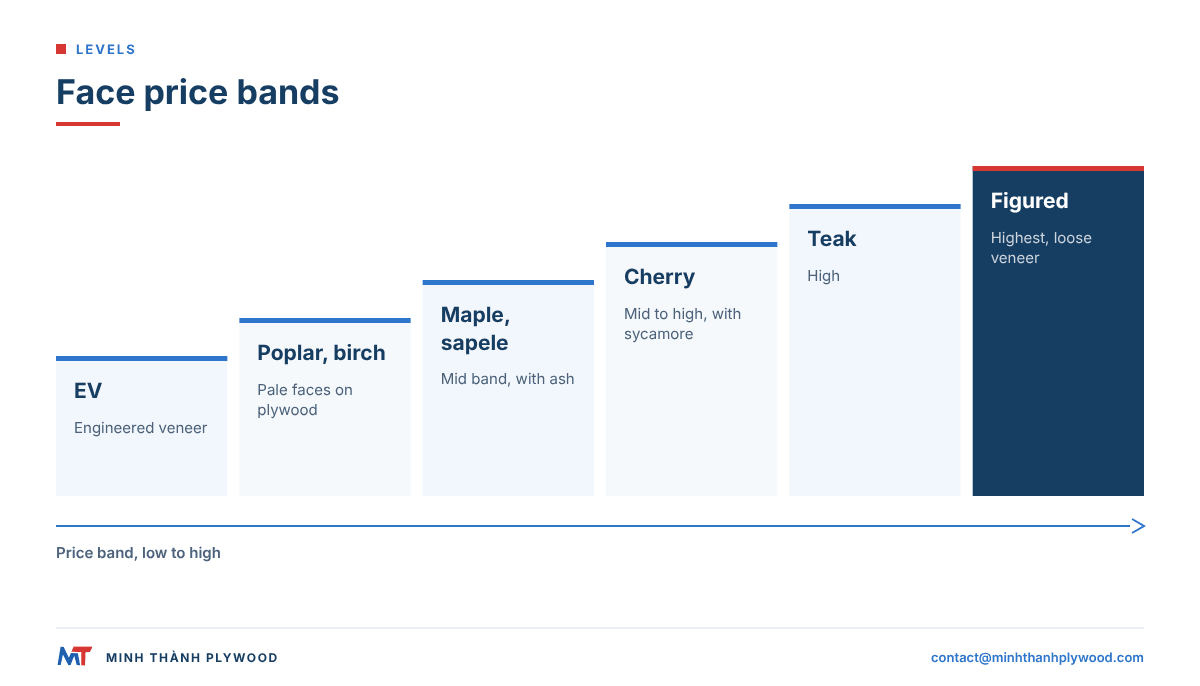
| Group | Colour | Price band | Pressed on plywood in Vietnam |
|---|---|---|---|
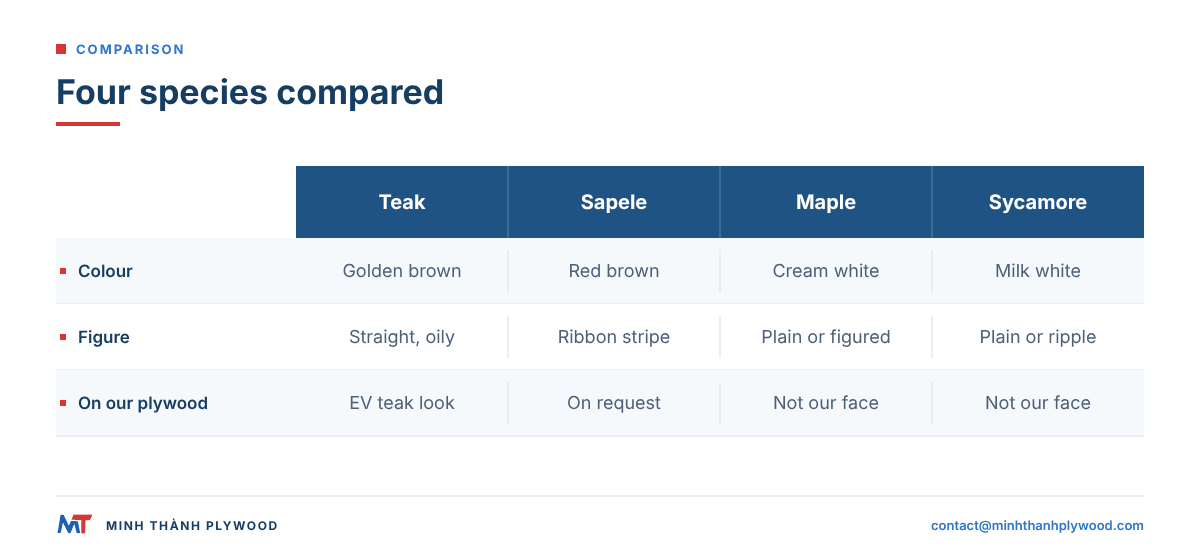
| Teak | Golden to mid brown | High | Mostly as teak-look engineered veneer |
| Mahogany and sapele | Red brown | Mid to high | Sapele on request |
| Maple | Cream white | Mid | Rarely; loose veneer |
| Sycamore and white veneers | Near white | Mid to high | White faces via birch and poplar |
| Cherry | Pink brown, darkens | Mid to high | Rarely; loose veneer |
| Ash | Pale, bold grain | Mid | Rarely; loose veneer |
| Exotic and figured | Varied | Highest | Loose veneer |
| Engineered (EV) | Any colour, repeat grain | Low to mid | Yes, the most produced face |
Each group has its own table further down with figure, cuts, uses and what to write on the order.
What is a veneer species, and why does the cut matter?
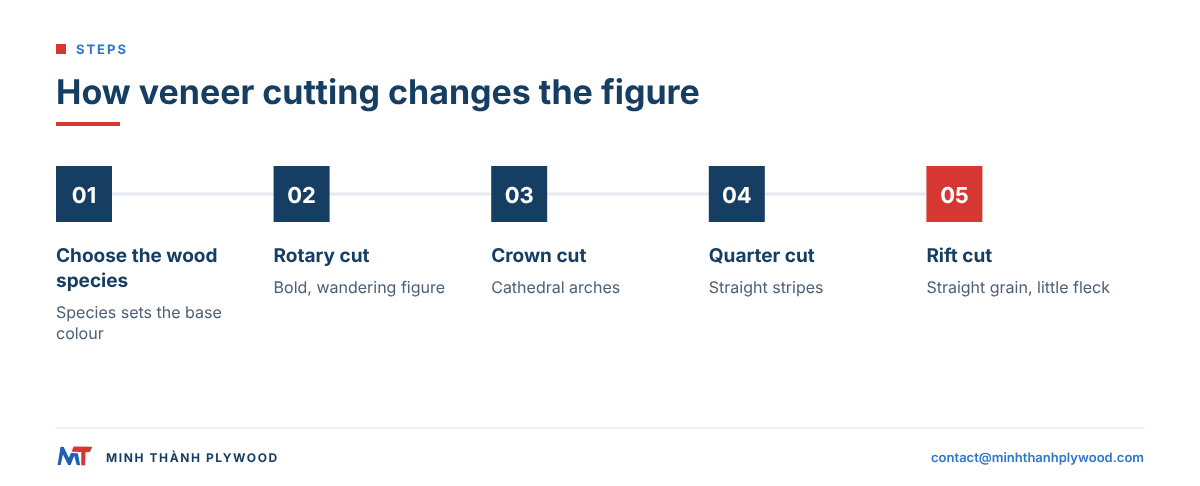
A veneer species is the tree the face is sliced from, and the cut is the way the log is sliced; together they set colour, figure and price. The same oak log gives a cathedral grain when crown cut and straight lines when quarter cut.
- Rotary cut: the log turns against a knife; wide sheets with a bold, wandering figure; birch, poplar, okoume.
- Crown (flat) cut: slices parallel to the log centre; cathedral arches.
- Quarter cut: slices across the growth rings; straight stripes, ribbon figure in sapele.
- Rift cut: angled to the rays; straightest grain, little fleck, mainly oak.
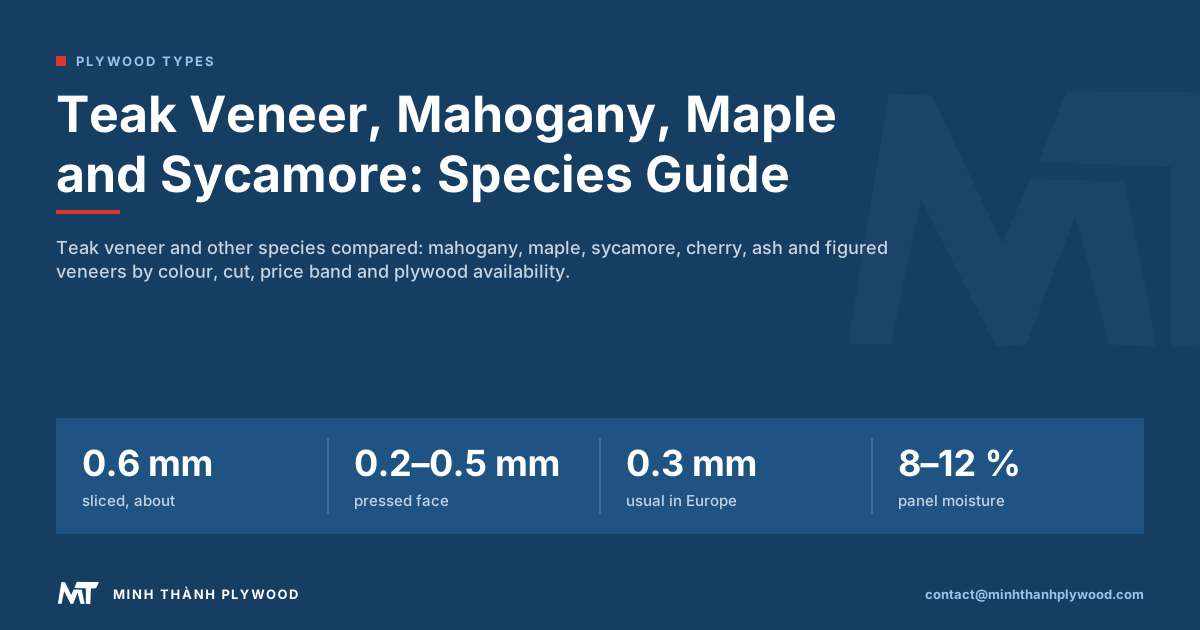
Loose decorative veneer is usually sliced about 0.6 mm thick; faces pressed on plywood are 0.2–0.5 mm; European furniture buyers most often ask for 0.3 mm. Our sibling guide to veneer thickness explains face and core thickness in plywood.
Teak wood veneer: colour, figure and grades
Teak veneer is sliced from Tectona grandis, a tropical hardwood with a golden to mid-brown heartwood, a straight to slightly wavy grain and a natural oil that gives a soft lustre. It darkens to a warm brown with light and age.
| Line | Teak veneer |
|---|---|
| Botanical name | Tectona grandis |
| Colour | Golden to mid brown, darker streaks |
| Figure | Straight grain crown cut; fine stripe quarter cut |
| Cuts | Crown, quarter, rotary for plywood faces |
| Origin | Plantation teak from South and South-East Asia, Africa and Latin America |
| Price band | High; old-growth teak highest |
| Plywood availability | Teak-faced plywood is a specialist product; teak-look engineered veneer is common |
| Typical use | Furniture, yacht interiors, doors, wall panels |
Teak wood veneer is oily, so it needs degreasing before gluing and some finishes. Plantation teak has a paler, more even colour than old-growth logs; specify which look you want with a sample. Teak plywood, teak ply and teak veneer plywood all mean the same panel: a teak face on a plywood core.
How do US buyers buy teak veneer?
In the US, “teak veneer” is searched by people who want sheets or edge banding for a single project, and the shops that rank sell it in a few set formats. WiseWood Veneer, a Michigan maker, lists the range below with starting prices read on 21 October 2026.
| Format | Size and backer | Cut | Starting price | Fits |
|---|---|---|---|---|
| Teak wood veneer sheet | 4 × 8 ft (32 sq ft), FlexVen 10 or 20, or a PSA peel-and-stick backer | Flat or quarter | US$5.29 per sq ft flat; US$6.79 quarter | Cabinet doors, tops, built-ins |
| Reconstituted teak sheet | 4 × 8 ft, same backers | Flat or quarter | US$3.99 per sq ft flat; US$3.19 quarter | Matched runs, lower cost |
| Pre-glued edge banding | 7/8 in rolls of 250 ft and 500 ft | Flat | US$48.95 a roll, per the page | Plywood edges, shelves |
| Raw leaf | About 0.6 mm | Crown or quarter | Quoted by the supplier | Workshop pressing |
| Wood-on-wood, two layers | About 3/64 in | Flat | Quoted by the supplier | Large flat panels |
At those prices one 4 × 8 ft flat-cut natural teak sheet costs about US$169 (32 × 5.29) and a quarter-cut one about US$217 (32 × 6.79), before glue, substrate and labour. Quarter cut gives the straight stripe and flat cut the cathedral figure. Peel-and-stick suits one job; for a run of fifty doors, a pressed panel is faster. For backers, see our backed veneer sheets guide.
Teak look on plywood by the container
For hotel, apartment and office runs, the teak look comes pressed on the panel. Teak-look EV plywood is made at 1220 × 2440 mm in 3–40 mm thickness; furniture and interior plywood starts from US$350/m³ (indicative, October 2026), and the EV pattern, thickness and glue set the final quote. Panels carry the CARB P2 / TSCA Title VI label (ICTT mill no. 23024), and six ASTM D6007 chamber tests averaged 0.014–0.032 ppm against the 0.05 ppm limit. Every sheet matches the last, which natural teak cannot promise. Send a sample and we match its colour and grain.
Our factory does not press natural teak leaf as a standard face, so a natural teak order is sourced as loose veneer; the teak-look EV panel is the container product.
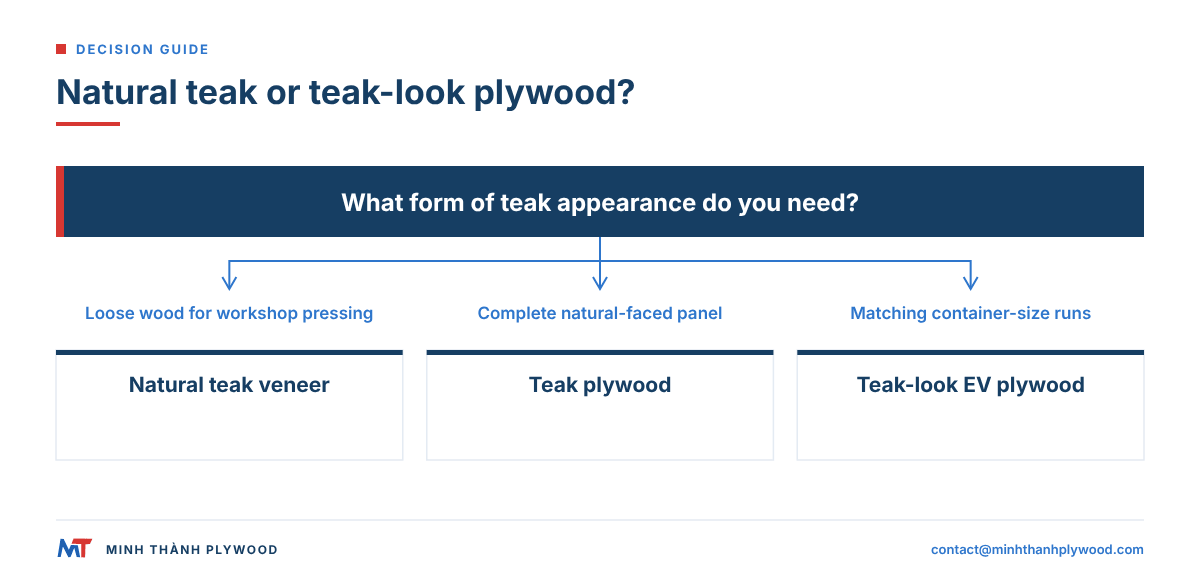
Teak plywood vs teak veneer: what is the difference?
Teak veneer is the thin face; teak plywood is a complete panel with that face pressed on a plywood core. A buyer of teak plywood pays mainly for the teak face, because the core is ordinary hardwood plywood.
- Teak veneer (loose): thin sheets for a workshop to press on its own substrate.
- Teak plywood: a finished panel, teak face and a balancing back, ready to cut.
- Teak-look EV plywood: engineered veneer dyed and re-sliced to teak’s colour and grain, pressed on plywood; even from sheet to sheet.
When the brief is “teak furniture” for a hotel or apartment run, the decision is natural teak with its colour variation, or teak-look engineered veneer with every sheet the same. Our engineered veneer (EV) plywood is quoted by pattern and colour against the buyer’s sample.
Mahogany veneer and sapele
Mahogany veneer is a red-brown face with a fine texture and, when quarter cut, a ribbon stripe; in trade the name covers genuine mahogany (Swietenia), African mahogany (Khaya) and the related sapele (Entandrophragma). Sapele is the most available of the three for plywood faces.
| Line | Genuine mahogany | African mahogany (khaya) | Sapele |
|---|---|---|---|
| Colour | Red brown, golden lustre | Pink to red brown | Red brown, darker than khaya |
| Figure | Straight to interlocked | Interlocked, mild stripe | Strong ribbon stripe quarter cut |
| Cuts | Crown, quarter | Crown, quarter | Quarter, crown |
| Price band | High; supply restricted | Mid | Mid |
| Plywood availability | Rare | Loose veneer and some panels | Sapele-faced plywood on request |
| Use | Fine furniture, restoration | Furniture, doors | Doors, furniture, panelling |
Genuine mahogany is listed under CITES, so trade in it needs permits; sapele and khaya are the usual mahogany-look faces. We press sapele-faced plywood on request on Styrax or Eucalyptus cores.
Maple veneer
Maple veneer is a cream-white, fine and even face from hard maple (Acer saccharum), stiff enough to take clear coats and stains well. Plain flat-cut maple is a cabinet face; figured maple is a feature face.
| Line | Maple veneer |
|---|---|
| Colour | Cream white, slight red tinge |
| Figure | Plain, birdseye, curly, fiddleback, quilted |
| Cuts | Flat, quarter, rotary |
| Price band | Mid; figured maple high |
| Plywood availability | Mostly loose veneer and North American panels |
| Use | Kitchen cabinets, white interiors, instruments |
Wood veneer maple yellows slightly under clear finishes; a water-white lacquer keeps it pale. Birch-faced plywood is the cost-effective alternative where a pale, fine face is the goal and figure is not.
Sycamore and white veneers
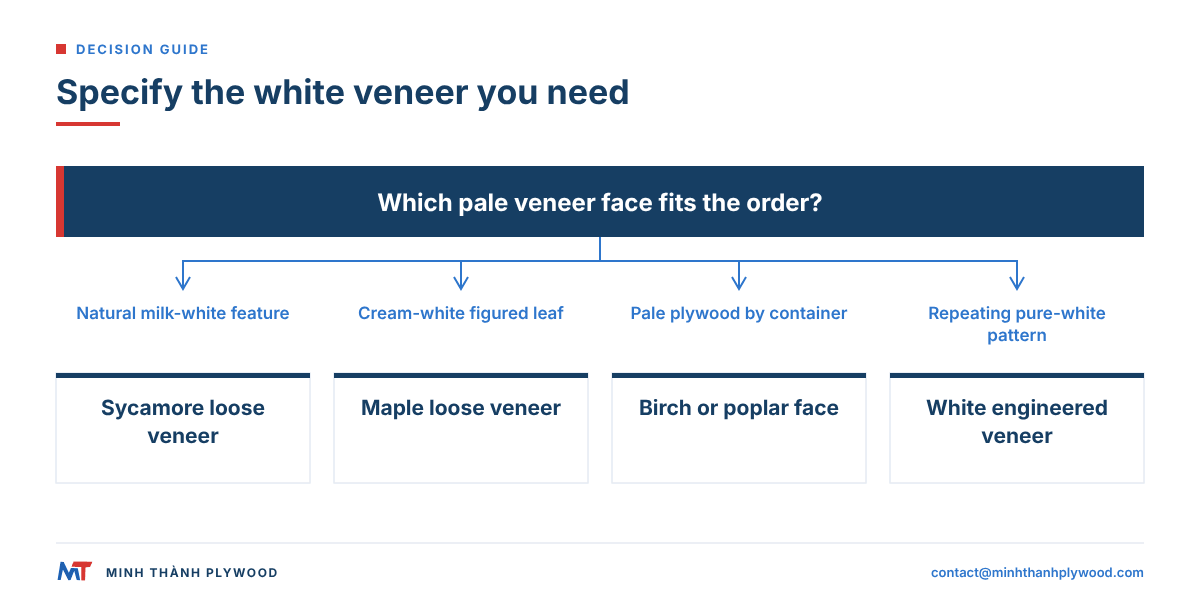
Sycamore veneer is the whitest natural face: European sycamore (Acer pseudoplatanus) gives a milk-white, fine face, often with a fiddleback ripple when quarter cut. White sycamore veneer is the classic background for marquetry and the face for light, Scandinavian-style furniture.
| White face | Colour | Figure | Pressed on plywood |
|---|---|---|---|
| Sycamore | Milk white | Plain or fiddleback | Rarely; loose veneer |
| Maple | Cream white | Plain or figured | Rarely; loose veneer |
| Birch | Pale cream | Soft rotary figure | Yes, birch-faced plywood |
| Poplar | Pale cream to light grey | Plain, even | Yes, poplar-faced plywood |
| White engineered veneer | Pure white or bleached | Even, repeating | Yes, EV plywood |
For white furniture by the container, birch and poplar faces carry the job. Our poplar faces are quoted as face/back grade pairs A/A, A/B and B/B, matched to the approved sample. Our guide to birch plywood colour compares natural and white birch faces.
Cherry and ash veneer
Cherry veneer is a pink-brown face that darkens to rich red-brown within months of light; ash veneer is pale with a bold, open grain similar to oak. Both are favourites for solid-looking furniture and are traded mostly as loose veneer.
| Line | Cherry | Ash |
|---|---|---|
| Colour | Pink brown, darkens | Pale cream to light brown |
| Figure | Fine, even, occasional gum flecks | Bold cathedral or straight |
| Cuts | Flat, quarter | Crown, quarter |
| Price band | Mid to high | Mid |
| Plywood availability | Loose veneer; some North American panels | Loose veneer; European panels |
| Use | Furniture, joinery | Furniture, panelling, stained finishes |
Ash takes stain deeply because of its open pores, which makes it a common base for black, grey and white-washed finishes.
Exotic and figured veneers
Exotic and figured veneers are the high end of the market: burrs, crotches, curls and rare species chosen for a single feature. They are sold as loose veneer in sequence-matched bundles, not pressed on plywood by the container.
| Veneer | Look | Use |
|---|---|---|
| Burr (burl) | Swirling eyes and knots | Table tops, car interiors, boxes |
| Crotch | Flame-shaped figure | Doors, feature panels |
| Birdseye maple | Small eye pattern | Luxury furniture |
| Fiddleback | Cross ripple | Instruments, feature panels |
| Zebrano | Bold stripes | Accent panels |
| Wenge | Near-black, coarse | Contrast panels |
| Ebony | Black | Inlays, small parts |
Many exotic looks are also made as engineered veneer, which gives the pattern at a lower price and in matching sheets. Rare natural species may carry CITES or other trade documents; ask for them with the offer. In the EU, CITES is applied through Council Regulation (EC) No 338/97 (read October 2026).
What is marquetry veneer?
Marquetry veneer is thin veneer in many species and dyed colours, cut into shapes and fitted together like a puzzle to make a picture or pattern. Marquetry wood veneer is sold in small leaves; sycamore, maple, dyed veneers and burrs are the usual woods.
- Woods: sycamore and maple for light tones, walnut and wenge for dark, dyed veneers for colour.
- Thickness: thin and even, so pieces sit flush.
- Method: cut by knife, fret saw or laser, taped into a sheet, then pressed onto a panel.
- Decorative veneers: dyed, marbled, metallic-look and coloured engineered faces fill the same role at panel scale.
Panel makers do not press marquetry by the container; they press plain or engineered faces that a workshop can inlay.
Which veneer is best for furniture?
For furniture that must match across many parts, engineered veneer or a pale even species such as birch or poplar is the usual choice. For a rich, natural look, oak, walnut, teak and sapele are the common faces. Choose by colour, figure, price band and whether the face is available pressed on plywood.
The table gives the decision by furniture part.
| Furniture part | Best face | Why |
|---|---|---|
| Kitchen and wardrobe runs | Engineered veneer or birch | Every sheet matches |
| Carcass sides and shelves | Poplar or birch | Cost-effective, pale, even |
| Cabinet doors, natural look | Oak, walnut, teak-look EV | Rich colour, matched in batches |
| Feature doors and table tops | Figured or exotic veneer | One-off look |
| White furniture | Birch, poplar, white EV; sycamore for premium | Pale face |
| Red-brown furniture | Sapele | Ribbon stripe, available on plywood |
| Painted furniture | Poplar or okoume | Smooth, plain face |
For any face, ask for the moisture content at dispatch: our veneers and finished panels are dried to 8–12 %, the normal range for furniture plywood.
Which species does Vietnam press on plywood?
Vietnamese plywood mills press a short list of faces by the container: engineered veneer, poplar, birch, okoume and pine are the most common, with bintangor, eucalyptus, gurjan and sapele on request. Teak, maple, sycamore, cherry, ash and the exotic woods are traded mainly as loose veneer.
| Face | Pressed by Minh Thanh | Notes |
|---|---|---|
| Engineered veneer (EV) | Yes, most produced | Any colour or pattern from the sample |
| Poplar | Yes | A/A, A/B, B/B grade pairs |
| Birch | Yes | D+, D and E grades, pairs such as D+/D |
| Okoume | Yes | Warm pinkish face |
| Pine | Yes | A/A, A/B, B/B grade pairs |
| Bintangor, eucalyptus, gurjan | On request | Plain hardwood faces |
| Sapele | On request | Mahogany-look face |
| Teak, maple, sycamore, cherry, ash | Not our faces; EV for the look | Loose veneer trade |
All faces go on white Styrax or Eucalyptus cores, stitched horizontally and vertically and pressed twice. Our guide to plywood face veneers and colours shows each face by look.
What to write on a veneered plywood order
A veneered plywood order names the face exactly, because “teak” or “white” alone can mean several products. Send these lines:
- Application: furniture part, door, wall panel or fit-out.
- Face: species or EV pattern and colour; cut; face and back grade pair; sample reference.
- Core: white Styrax or Eucalyptus.
- Glue and emission: UF glue at E0 emission for dry interiors; MR or WBP to your specification.
- Size and thickness: 1220 × 2440 mm or 1250 × 2500 mm, 3–40 mm, down to ±0.2 mm on sanded panels.
- Packing and quantity: from one 40HC, mixed specifications by agreement; destination port.
Our panels are CARB P2 / TSCA Title VI certified (ICTT mill no. 23024), with production 15–45 days after the deposit and free samples. The US limit for hardwood plywood with a veneer core is 0.05 ppm under 40 CFR 770.10. Veneer sheets count as regulated wood for UK imports, so UK buyers should read the GOV.UK guidance on importing wood, wood products or bark. The wood veneer sheets guide and our guides to oak veneer and walnut veneer cover the two most ordered natural faces.
Buyer questions, answered
Which veneer is best for furniture?
For furniture that must match across many parts, engineered veneer or a pale even species such as birch or poplar is best. For a rich, natural look, oak, walnut, teak and sapele lead. Choose by colour, figure, price band and whether the face is available pressed on plywood.
What is the difference between teak ply and veneer ply?
Teak ply is plywood with a teak veneer face; veneer ply is any plywood with a decorative veneer face, teak or another species. The core of both is ordinary plywood, so the face species is what you pay for.
Is teak veneer real teak?
Natural teak veneer is sliced from teak logs, so it is real teak about 0.6 mm thick or less. Teak-look engineered veneer is real wood too, but from a faster-growing species dyed and re-sliced to copy teak's grain.
What is the difference between mahogany and sapele veneer?
Genuine mahogany is Swietenia; African mahogany is Khaya; sapele is Entandrophragma, a related African species often sold as a mahogany substitute. Sapele has the sharper ribbon stripe when quarter cut.
What is sycamore veneer used for?
Sycamore veneer is a near-white face used for light furniture, marquetry backgrounds, musical instruments and interiors where a pale, fine, even surface is wanted. Quarter-cut sycamore often shows a fiddleback ripple.
What is marquetry veneer?
Marquetry veneer is thin decorative veneer in many species and colours, cut into pieces and fitted together to make a picture or pattern on a panel. Sycamore, maple, dyed veneers and burrs are the common marquetry woods.
Which veneer species are pressed on plywood in Vietnam?
Vietnamese mills press engineered veneer, poplar, birch, okoume and pine most often, with bintangor, eucalyptus, gurjan and sapele on request. Teak, maple, sycamore, cherry and ash are traded mostly as loose veneer.
What is white veneer?
White veneer is any near-white face: sycamore, maple, birch, poplar or a bleached or white-dyed engineered veneer. Sycamore and maple are the classic whites; birch and poplar are the cost-effective whites pressed on plywood.
Is maple veneer good for kitchen cabinets?
Yes. Maple is hard, fine and pale, and takes clear coats and stains evenly. Figured maple is kept for feature doors; plain flat-cut maple is the cabinet choice.
What moisture content should veneered panels have?
Veneers and finished panels for furniture are dried to 8–12 % moisture content, the normal range for furniture plywood. Store them flat in the room they will be used in before machining.