
A veneer log is a straight, sound log graded to be cut into thin sheets, either peeled on a rotary lathe or sliced from a flitch. Rotary peeling gives the wide, continuous sheets plywood is built from; slicing gives the matched figure of decorative faces. Minh Thanh Plywood explains each cut, its figure and yield, and which cut goes on which plywood face.
What is a veneer log?
A veneer log is a straight, round and sound log, with few knots and little taper, that is graded to be cut into thin sheets of wood instead of being sawn into boards. The sheets, called veneers, are either peeled from the turning log on a rotary lathe or sliced from a block called a flitch.
What makes a log a veneer log is its shape and its wood, not its species. A peeler log needs to be round and straight so the lathe can turn it evenly from bark to core. A slicer log needs a clear, decorative grain, because each leaf it gives will be seen on a finished face. Both need to be free of rot, splits and metal, which would tear the veneer or damage the knife.
Veneer logs fall into two broad groups:
- Peeler logs, usually plantation hardwoods or softwoods, peeled whole on a rotary lathe into continuous sheets for plywood cores and faces.
- Slicer logs, usually high-value hardwoods such as oak, walnut or sapele, cut lengthwise into flitches and sliced into decorative leaves.
The rest of this guide follows a veneer log from the yard to a plywood face: how it is graded, how each cut works, what figure and yield each cut gives, and which veneer belongs on which panel.
What makes a veneer-grade log for US hardwoods?
A US hardwood veneer log is a straight, clear, fresh-cut log of 14 to 20 inches or more across the small end, in a species a veneer mill pays a premium for, cut at least 8 feet long and free of metal. The logs a landowner sells to a veneer buyer are a different raw material from the plantation logs that become plywood veneer.
| Buyer spec | What US veneer buyers ask for |
|---|---|
| Species | Black walnut, white oak and red oak most often; also cherry, hard (sugar) maple and yellow birch for slicing |
| Size | Trunks at least 16 in diameter at breast height are candidates (M. Bohlke); at the small end inside the bark, 16 in for slicer grade and 14 in for rotary grade (Stillwater Forestry); 18 to 20 in preferred for the best price (University of Tennessee) |
| Clear faces | 4, 3 or 2 sides clear; slicer logs are clear on all four sides |
| Length | At least 8 ft; 10 to 12 ft for the top price |
| Straightness | Little sweep: crook and sweep are exterior defects that signal degrade inside |
| Metal and freshness | No nails, wire or embedded metal; cut fresh so the log does not check |
| Stand | Forest-grown timber, generally on 20+ acres |
| Scale and price | Sold by the board foot on the Doyle scale, with a premium over sawlog price that rises with diameter and clear faces |
Slicer logs (cut for sliced decorative veneer) have the tightest limits, and rotary logs (peeled) allow a smaller diameter. A landowner usually sells veneer logs through a forester, who cruises the stand, grades the logs and invites bids from mills. That grading is why a veneer tree is worth much more than the same tree sold as a sawlog.
Plywood veneer in Vietnam comes from plantation peeler logs of Acacia, Eucalyptus and Styrax, not from veneer-grade hardwood like this. The rotary and sliced sections below explain how the two cuts differ and which one goes on a plywood face.
How veneer logs are graded and chosen
Veneer logs are graded by straightness, roundness, knots, defects at the ends and freshness, because each of these decides how much usable veneer the log gives. A buyer sees the result as the grade of the face; a mill decides it at the log yard.
| What the grader looks at | Why it matters for veneer |
|---|---|
| Straightness and taper | A bent or tapered log peels into broken, short sheets |
| Roundness | An oval log gives a ragged ribbon until the lathe reaches a round core |
| Knots | Each knot becomes a hole or a patch in the sheet |
| End splits and heart cracks | Splits run into the veneer and break it |
| Freshness | Dry logs crack and peel rough; fresh logs peel smooth |
| Grain and colour | Decides whether the sheet can be a face or only a core veneer |
Plantation logs in northern Vietnam are graded mostly for straightness and freshness. They are young and of small diameter, so the lathe peels them fast, close to the core, and the mill sorts the sheets afterwards: clear, wide sheets to face-adjacent layers, the rest to the core.
High-value slicer logs follow a stricter route. They are bought one by one, cut into flitches to show a chosen figure, and the leaves are kept in their cutting order so they can be matched on the panel.
Two supply routes feed a Vietnamese plywood mill, and they explain why the same panel can carry veneers from very different logs:
| Veneer | Where the log comes from | How it is cut | Where it goes in the panel |
|---|---|---|---|
| Core and cross-band | Local plantation Styrax, Eucalyptus and Acacia | Rotary peeled at or near the mill | Every inner layer |
| Plantation faces | Local Eucalyptus and similar species | Rotary peeled | Face and back of commercial and furniture panels |
| Imported faces | Birch, okoume and other species | Rotary peeled abroad, bought as face veneer | Face and back of furniture panels |
| Decorative faces | Slicer logs of oak, walnut, sapele | Sliced abroad, bought as bundles | Face of decorative panels |
| EV faces | Plain species, rebuilt into blocks | Sliced from the block | Face of furniture panels |
So a single birch-faced panel from Vietnam combines two veneer logs: an imported birch peeler log for the face and back, and local plantation logs for every layer in between.
Rotary veneer: how peeling wood veneer works
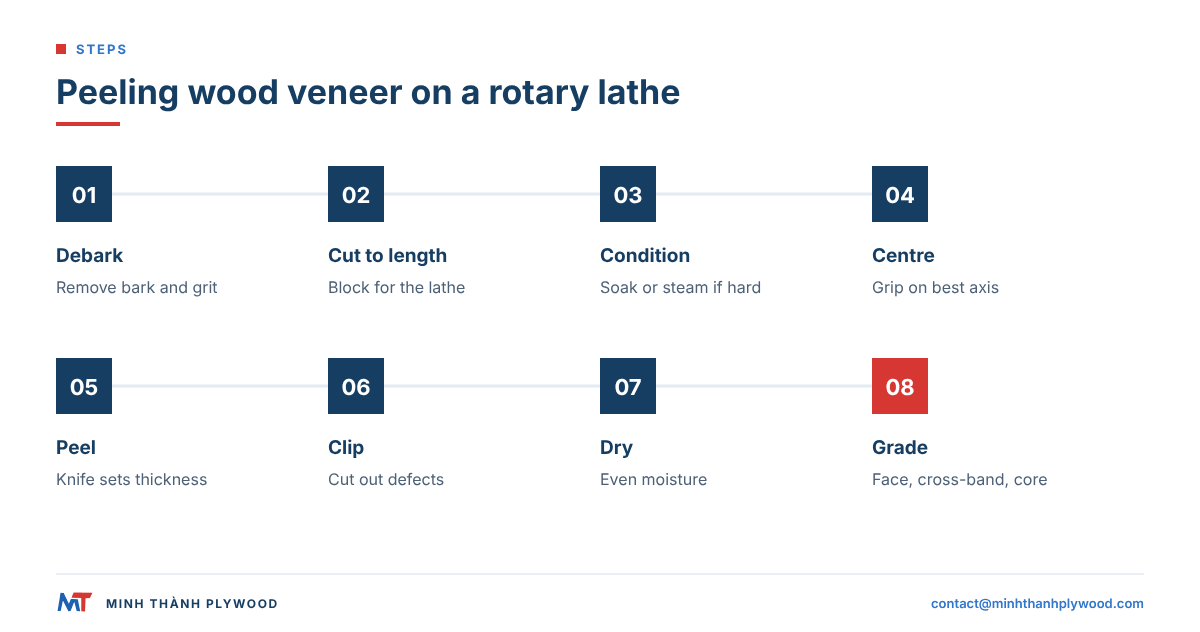
Rotary veneer is peeled from a log that turns against a long knife, which cuts one continuous sheet, like unrolling a roll of paper. It is the cut that makes almost all plywood, cores and faces alike. Peeling wood veneer follows the same steps in every plywood mill:
- Debark. The bark is stripped so sand and stones do not dull the knife.
- Cut to block length. The log is cross-cut to the length of the lathe, slightly longer than the panel it will make.
- Condition. Hard species are soaked or steamed so the wood cuts cleanly; soft plantation species often peel fresh without it.
- Centre. The block is gripped at both ends on its best axis, so the lathe takes a round sheet from the first turns.
- Peel. The block turns against the knife and a pressure bar; the knife moves in at a set rate, which sets the veneer thickness.
- Clip. The ribbon is cut into sheets, and splits, holes and ragged parts are clipped out.
- Dry. The wet sheets are dried to a set moisture content before grading.
- Grade and sort. Each sheet is graded for its layer: face, cross-band or core.
The knife and the pressure bar decide the quality. Set right, they give a smooth sheet with fine checks on the knife side, called the loose side, and a tight side facing the log. The tight side goes outwards on a face, because it takes sanding and finish better.
Three lathe faults show up later in the panel. A blunt or badly angled knife tears the fibres and leaves rough grain that needs heavy sanding. A pressure bar set too loose lets the veneer split deeply on the loose side, which weakens the glue line. An uneven feed gives veneer that is thicker at one end of the sheet than the other, and a core built from it presses unevenly. Mills check veneer thickness off the lathe with a caliper during the shift, because a thickness error found after pressing cannot be corrected.
Rotary peeled veneer has a wide, wavy, irregular grain, because the knife follows the growth rings round the log. On species such as birch, poplar and okoume that pattern is the familiar plywood look. On oak or walnut it looks wild, which is why decorative faces of those species are sliced.
Sliced veneer: how slicing veneer works
Sliced veneer is cut in flat leaves from a flitch, a part of a log, that moves up and down against a fixed knife, so each pass cuts one leaf the size of the flitch. Slicing veneer is slower than peeling, but it lets the mill choose the figure by choosing how the log is split before cutting.
The steps differ from peeling at the start and at the end:
- Saw into flitches. The log is sawn lengthwise into halves or quarters; the angle of the cut sets the figure.
- Condition. Flitches are steamed or boiled until soft enough to slice.
- Slice. The flitch is clamped to a moving bed and passes a fixed knife; each stroke cuts one leaf.
- Keep the order. Leaves are stacked in the order they came off the flitch, as a bundle.
- Dry and bundle. The bundle is dried, kept together and sold as a flitch, so the buyer can match the leaves.
The bundle is the point of slicing. Neighbouring leaves are almost identical, so they can be laid side by side or opened like a book to make a face with a planned, repeating pattern. A peeled sheet cannot be matched that way, because no two parts of a ribbon show the same figure.
Sliced leaves are narrower than the log is round, because each leaf is only as wide as the flitch. For a full plywood face, several leaves are spliced edge to edge.
Rotary vs plain sliced veneer: the comparison
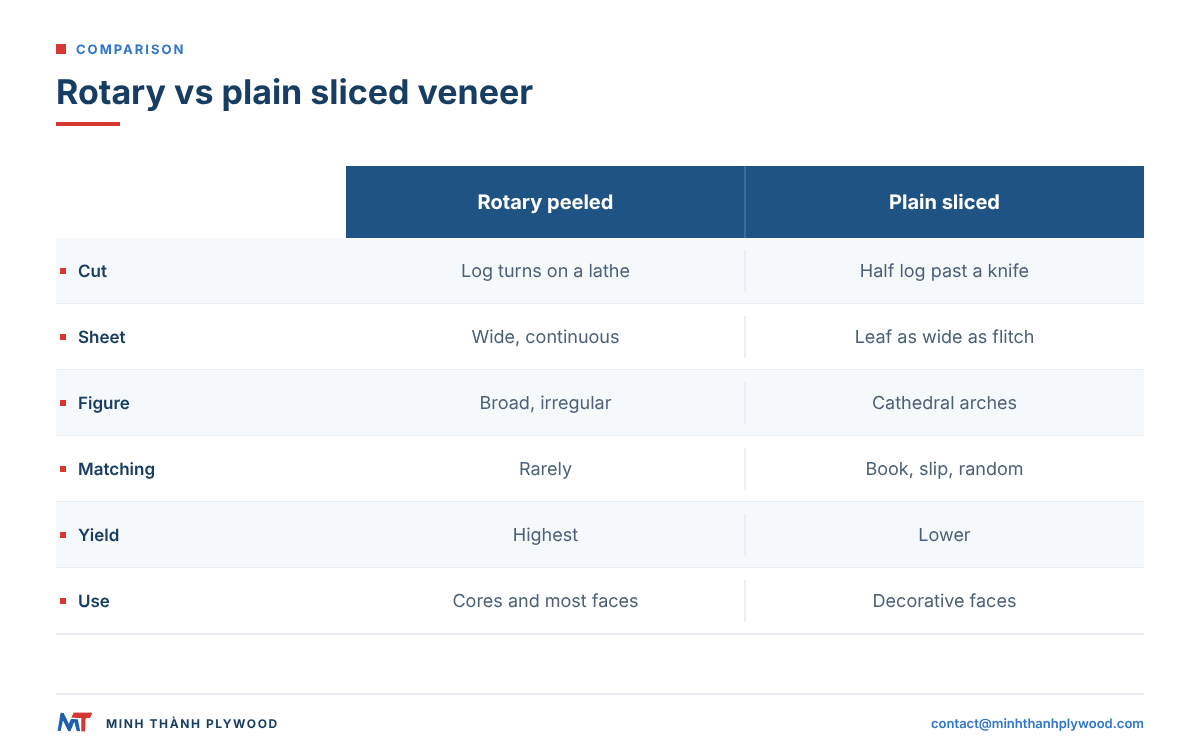
Rotary veneer is peeled as one wide, continuous sheet with a broad, irregular grain and the highest yield; plain sliced veneer is cut in matched leaves from a half log and shows the cathedral figure of flat-sawn timber at a higher cost. The table compares them metric by metric.
| Metric | Rotary peeled veneer | Plain sliced veneer |
|---|---|---|
| How it is cut | Log turns against a knife, one continuous sheet | Half log moves past a fixed knife, one leaf per stroke |
| Sheet width | Up to the full panel width in one piece | Width of the flitch; leaves spliced for a full face |
| Figure | Broad, wavy, irregular grain | Cathedral arches in the centre, straight grain at the edges |
| Repeat from leaf to leaf | None; each part of the ribbon differs | Neighbouring leaves almost identical |
| Matching | Rarely matched; laid as whole sheets | Book, slip and other matches |
| Yield from the log | Highest; peeled almost to a small core | Lower; sawing and trimming waste |
| Speed | Fast | Slow |
| Typical thickness use | Faces and cores alike | Decorative faces only |
| Typical species | Birch, poplar, okoume, pine, eucalyptus, plantation hardwoods | Oak, walnut, ash, cherry, sapele |
| Cost per square metre | Lower | Higher |
| Best use on plywood | Every core, most commercial and furniture faces | Decorative faces for visible furniture parts and panelling |
Verdict by use: rotary peeled veneer is the practical choice for plywood cores because it gives wide, continuous sheets at the required yield and cost; for the face, rotary or plain sliced veneer is chosen according to the required figure, match, grade and budget. Rotary vs plain sliced veneer is therefore primarily a face-appearance decision, while core construction normally calls for rotary peeling.
Rotary sliced veneer, quarter and rift: the other cuts
Besides rotary and plain slicing there are three more cuts, each chosen for the figure it gives: half-round (also called rotary sliced veneer), quarter sliced and rift cut. All three are made from flitches, so all three give leaves that can be matched.
Half-round, or rotary sliced veneer. A flitch is mounted off-centre on a stay-log, a beam that turns on a lathe. The knife cuts a shallow arc through the flitch, flatter than in rotary peeling. The leaves are wider than plain sliced leaves and show a figure close to plain sliced, with broad cathedrals. It is a way to get wide decorative leaves from a smaller log.
Quarter sliced veneer. The log is sawn into quarters, and each quarter is sliced at right angles to the growth rings. The leaves show straight, parallel grain lines. In oak the knife crosses the medullary rays and shows them as flakes, known as ray fleck. In sapele and some mahoganies, quarter slicing gives a ribbon stripe.
Rift cut veneer. The quarter is sliced at a slight angle to the rays, about 15 degrees off the quarter, so the ray fleck of oak disappears and only straight, tight grain is left. Rift oak is the calm, linear look used in modern cabinetry.
| Cut | How the knife meets the rings | Figure | Leaf width | Typical use |
|---|---|---|---|---|
| Rotary peeled | Follows the rings round the log | Broad, irregular | Widest, continuous | Plywood cores and faces |
| Half-round (rotary sliced) | Shallow arc across the rings | Cathedrals, close to plain sliced | Wide | Wide decorative leaves |
| Plain sliced | Parallel to the centre of a half log | Cathedrals and straight edges | Medium | Decorative faces |
| Quarter sliced | At right angles to the rings | Straight grain, ray fleck in oak, ribbon in sapele | Narrow | Furniture, panelling |
| Rift cut | At an angle to the rays | Straight, tight, no fleck | Narrow | Modern cabinetry |
Each cut moving down the table gives a straighter, more uniform figure from fewer leaves per log. That is why quarter and rift leaves cost more than plain sliced leaves of the same species.
Figure and grain pattern per cut
The figure of a veneer is set by the angle at which the knife crosses the growth rings, so the same log can look calm or wild depending on the cut. Buyers who order by photograph should know which cut the photograph shows.
- Rotary peeled: the knife runs along the rings for long distances, so the sheet shows broad, flowing patches of early and late wood. Birch shows a soft, even sheen; pine shows bold, wide flame figure with knots; okoume shows a pinkish, even face.
- Plain sliced: the knife cuts through the rings at the centre of the flitch, giving the arched cathedral figure, and runs nearly parallel at the edges, giving straight grain there.
- Quarter sliced: the knife meets the rings at right angles, giving parallel lines; species with strong rays show fleck.
- Rift: straight, close lines with no fleck.
- Half-round: broad cathedrals, wider than plain sliced.
On plywood faces the figure also depends on how the leaves are spliced. A rotary face is usually one sheet or two sheets jointed. A sliced face is three to six leaves spliced, so the match decides what the buyer sees across the panel.
Veneer colour comes from the species, the part of the log and the drying. Heartwood and sapwood in one sheet are graded as a colour difference, and the face grade sets how much is accepted.
Yield per cut: why rotary costs less
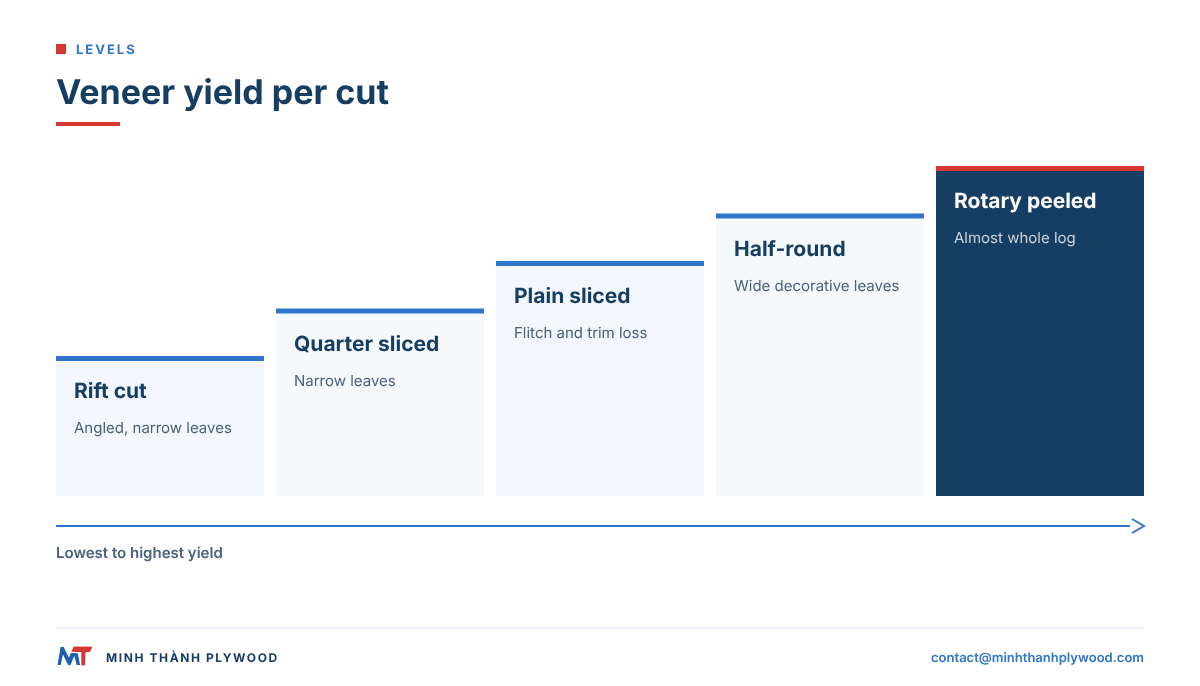
Rotary peeling gives the highest yield of usable veneer from a log, because the lathe turns almost the whole round of wood into one sheet and leaves only a slim core behind. Slicing loses wood at every step: sawing the log into flitches, squaring them and trimming the leaves to width.
What decides the yield, cut by cut:
| Cut | Where the wood is lost | Yield from the log |
|---|---|---|
| Rotary peeled | Rounding the log at the start, the peeler core at the end, clipping defects | Highest |
| Half-round | Sawing into flitches, the stay-log clamping part | High for a decorative cut |
| Plain sliced | Sawing into flitches, squaring, trimming leaves | Medium |
| Quarter sliced | Sawing into quarters, narrow leaves, more trimming | Lower |
| Rift cut | Angled sawing, narrow leaves | Lowest |
Speed adds to the gap. A lathe produces veneer continuously, while a slicer cuts one leaf per stroke and needs the flitch to be kept, dried and bundled in order. The result shows in price: per square metre, rotary veneer of a plantation species costs a fraction of a sliced face of a decorative hardwood.
The peeler core left after peeling is not waste. In plantation mills it is sawn into small battens or sold as fuel, and the clipped pieces of veneer are used inside the panel where size does not matter.
Why plywood uses rotary peeled veneer
Plywood uses rotary peeled veneer because peeling gives wide, continuous sheets of even thickness from small plantation logs, at the speed and cost a panel mill needs. A plywood panel is built from many layers, and every one of them must cover the full panel.
Four reasons decide it:
- Size. A peeled sheet can cover the full panel width in one piece, so cores need little jointing.
- Even thickness. The lathe sets the thickness by the knife feed, so every sheet in a layer is the same, which keeps the panel flat after pressing.
- Yield from small logs. Plantation logs are young and narrow; only peeling turns them into veneer at a usable yield.
- Cost. Peeling is fast and continuous, so the core, which is most of the panel, stays affordable.
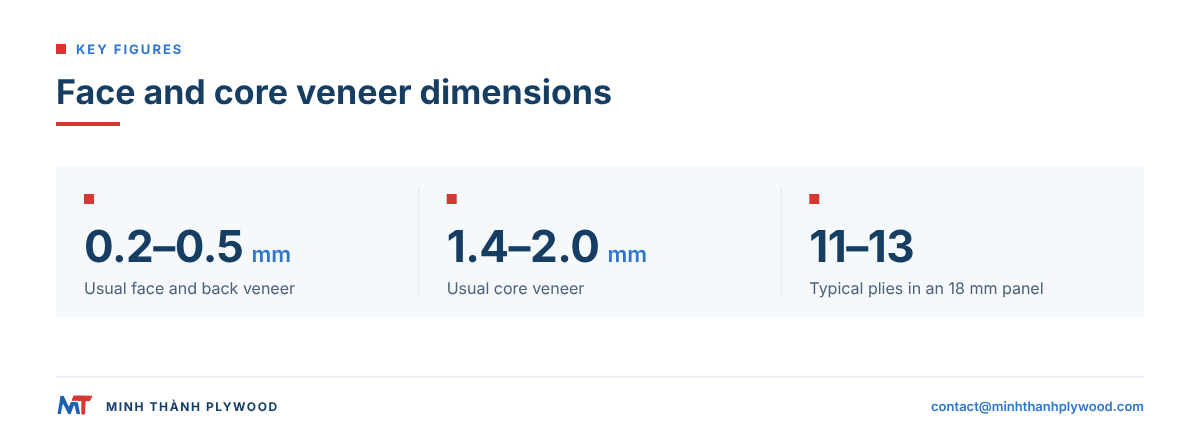
A typical 18 mm panel has 11 to 13 plies, most often 11. Only the face and back are seen; all the plies between are rotary peeled core and cross-band veneers. Even when the face is sliced, the panel under it is rotary veneer.
Veneer thickness: face and core
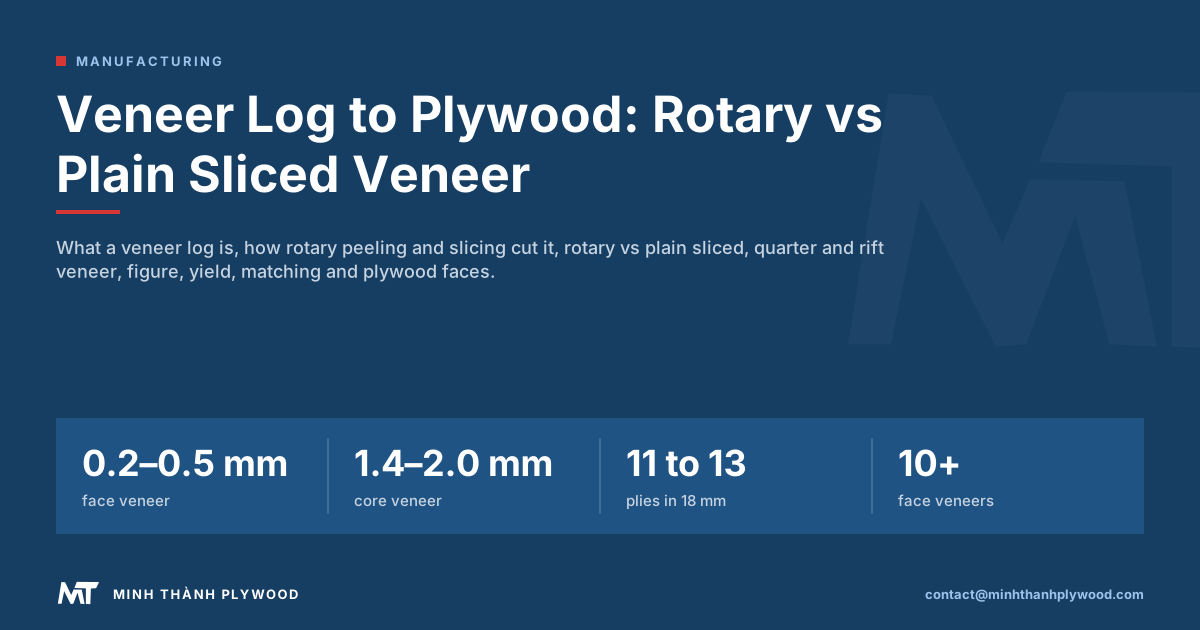
Face veneers on plywood are usually 0.2–0.5 mm thick, often 0.3 mm on panels for Europe, while core veneers are usually 1.4–2.0 mm. The thin face carries the look; the thicker core veneers carry the thickness and the strength.
| Layer | Usual thickness | Cut | Job in the panel |
|---|---|---|---|
| Face and back | 0.2–0.5 mm | Rotary or sliced | Look, sanding allowance |
| Cross-band | Close to the core veneers | Rotary | Locks the panel across |
| Core | 1.4–2.0 mm | Rotary | Thickness, stiffness, fixing hold |
| Thin-panel core | Adjusted to the panel, for example 1.3 mm | Rotary | Builds a 5-ply panel from 4 to 5 mm |
Minh Thanh’s thin plywood from 3 to 5 mm is always 5-ply. A 3 mm panel is one core veneer, two cross-band veneers and two faces; 4 and 5 mm panels are three core veneers and two faces, with the core veneer thickness adjusted to the panel. A 4 mm furniture panel, for example, uses three 1.3 mm Styrax core veneers. Premium thin veneer is scarce, so 4 mm can take longer; Minh Thanh does not lower the standard to go faster.
A thin face has one practical consequence: sanding. A face of 0.3 mm leaves room for factory sanding and polishing, but not for heavy sanding later. Buyers who plan to sand panels hard after delivery should say so on the order.
Book, slip and rotary veneer with slip matching
Matching is how leaves of veneer are laid side by side on a face, and it is possible only when neighbouring leaves are close to identical, which is why it belongs mostly to sliced veneer. Rotary veneer with slip matching exists too, when a peeled ribbon is clipped into leaves and laid in sequence.
| Match | How leaves are laid | Look | Usual veneer |
|---|---|---|---|
| Book match | Every second leaf flipped over, like pages of a book | Mirror image at each joint | Sliced |
| Slip match | Leaves slid side by side in the same order and side up | Repeating figure across the face | Sliced, sometimes rotary |
| Random match | Leaves mixed on purpose | Board-like, varied | Sliced |
| Whole piece | One sheet across the face | No joints | Rotary |
| Running match | Leaves laid as they come, trimmed to fit | Uneven repeat | Rotary or sliced |
Book matching shows a mirror image at each joint and can show the light and dark “barber pole” effect, because every second leaf has its tight and loose sides reversed. Slip matching keeps all leaves the same side up, so colour stays even and the figure repeats.
For most plywood faces, the face is a whole rotary sheet or two jointed sheets, and matching is not specified. Where a buyer needs a matched face, the order should name the match and the cut together, for example “oak, plain sliced, book matched”.
Which cut goes on which plywood face
Most plywood faces are rotary peeled; sliced faces are used where a decorative hardwood figure is the reason for buying the panel. Minh Thanh makes more than ten face veneers, most often EV (engineered veneer), poplar, birch, okoume and pine, with bintangor, eucalyptus, gurjan and sapele on request.
| Face | Usual cut | What the face looks like | Product page |
|---|---|---|---|
| Birch | Rotary peeled, imported veneer | Pale, even, fine grain | Birch plywood |
| Poplar | Rotary peeled | Light, plain, smooth for paint and overlay | Poplar plywood |
| Okoume | Rotary peeled, imported veneer | Pinkish, even, light | Okoume plywood |
| Pine | Rotary peeled | Bold flame figure, knots by grade | Pine plywood |
| Eucalyptus | Rotary peeled, plantation | Light brown, straight to wavy grain | Eucalyptus-faced plywood |
| Bintangor | Rotary peeled | Reddish brown, interlocked grain | Bintangor plywood |
| Gurjan | Rotary peeled | Reddish brown, coarse, firm | Gurjan plywood |
| EV, engineered veneer | Sliced from a rebuilt block of rotary veneer | Uniform figure and colour, many designs | EV plywood |
| Sapele | Sliced, often quarter | Ribbon stripe, deep red brown | On request |
A birch face from Vietnam is imported birch veneer pressed on a Vietnamese core. Write “birch-faced plywood” on the order when that is what you need; the panel is not birch through its thickness.
Engineered veneer (EV): rotary veneer rebuilt and sliced
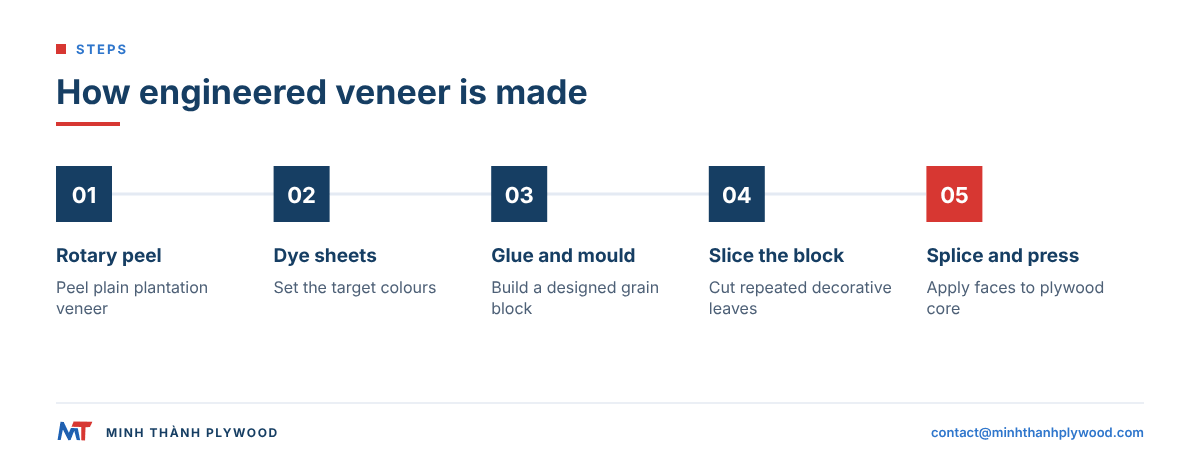
Engineered veneer, also called EV or recon veneer, is made by peeling a plain plantation species on a rotary lathe, dyeing the sheets, gluing them into a block in a mould and slicing the block again, so the slice shows a designed grain. It joins both cuts: rotary for the raw sheets, slicing for the finished leaf.
How EV is made, in order:
- Peel. A light, even species is peeled into rotary veneer.
- Dye. The sheets are dyed to the target colours.
- Lay up and mould. The dyed sheets are glued in a set order and pressed in a shaped mould, which forms the grain pattern.
- Slice. The cured block is sliced into leaves, like a flitch.
- Splice and press. The leaves are spliced into a face and pressed onto the plywood core.
Because the block is designed, every leaf is the same, and a buyer can reorder the same look months later. EV designs are ordered by the maker’s design code, so the code, not a photograph, goes on the order; a reorder with the same code matches the first shipment.
EV has one handling rule: the colour is dyed into the veneer, so the face is sanded lightly at the factory and should not be sanded hard afterwards. A light finishing sand and lacquer are fine. EV gives oak, walnut, teak and other designs at a lower price than the natural sliced face, with no colour variation between panels. It is one of the faces Minh Thanh produces most; see EV plywood.
Face veneer grades and what the cut does to them
Face veneer grade measures defects on the visible face, such as knots, patches, colour streaks and splits, and the cut affects the grade because a rotary sheet shows every knot that the knife passes through. Grades are quoted as face/back pairs and matched to the buyer’s approved sample.
| Face | Grade names | How they are quoted |
|---|---|---|
| Birch | D+, D and E, low to high E, D, D+ | Face/back pairs such as D+/D or D/E; D+/D is about B/BB on the European ladder |
| Poplar | A/A, A/B, B/B | Also ordered by the codes B/BB, BB/CC and CP, which map onto the same ladder |
| Pine | A/A, A/B, B/B, B/C for utility parts | Comparable to the European softwood classes I to IV and US A to D |
| Eucalyptus | A/A, A/B, B/B | A/A two visible faces, A/B one, B/B for paint or overlay |
| Exterior and CDX type | C/D | Utility faces, water-resistant glue |
A sliced decorative face is graded differently: by the evenness of the match, the colour of the leaves and the width of the leaves, not by knots alone. That is one more reason sliced faces are ordered by sample.
The common veneer defects, and how each cut shows them:
| Defect | Where it comes from | On a rotary face | On a sliced face |
|---|---|---|---|
| Sound knots | Branches in the log | Spread out as ovals, more visible | Cut across, smaller |
| Open knots and holes | Dead branches, insects | Patched or graded down | Leaf rejected or trimmed |
| Splits | Log end cracks, drying | Joined or patched | Leaf trimmed to width |
| Lathe checks | Knife bending the veneer on the loose side | Fine cracks, hidden by facing tight side out | Fewer, the knife cuts straight |
| Colour streaks | Mineral, sapwood, heartwood mix | Graded by face class | Sorted by leaf in the bundle |
| Rough grain | Dull knife, dry log | Raised fibres, more sanding | Rare when conditioned |
The face grade on the order sets how many of these are allowed and how they may be repaired. Matching the order to an approved sample is the only way two buyers mean the same thing by A/B or D+/D.
The veneer grading page shows how Minh Thanh sorts sheets for each layer, from face-adjacent to core.
Does the face veneer change density, weight and price?
The face veneer changes the price of a panel a lot and its density very little, because the face is a fraction of a millimetre while the core makes up almost all of the thickness. The core species sets the weight.
| Core | Reference density | 18 mm sheet, 1220 × 2440 mm |
|---|---|---|
| Styrax | 500 kg/m³ | 26.8 kg |
| Acacia | 580 kg/m³ | 31.1 kg |
| Eucalyptus | 650 kg/m³ | 34.8 kg |
What sets the face part of the price, in order of weight:
- Species. Imported birch and okoume cost more than plantation faces; decorative sliced species cost more again.
- Cut. Sliced, quarter and rift leaves cost more than rotary sheets of the same species.
- Grade. Fewer defects means more sorting and fewer sheets per log that qualify.
- Thickness. A thicker face uses more veneer.
Prices start from US$250/m³ for commercial plywood and from US$350/m³ for furniture and interior plywood (October 2026). The final price depends on face, core, glue, thickness, size, quantity and delivery term.
Different faces can share one container. A 40HC usually carries one or two specifications, and three to six can be mixed by agreement, so a buyer can take birch, poplar and EV faces together.
The face does not change how a container is loaded; the core does. On 1220 × 2440 mm sheets at 18 mm, a 40HC holds 990 sheets on a Styrax core in 18 packs, 880 on Acacia in 16 packs and 795 on Eucalyptus in 15 packs, with a 28,000 kg planning payload unless the booking is lower. A birch face and a poplar face on the same Styrax core load the same way.
The face and the core are chosen together, though. A pale, thin face such as birch or poplar shows any shadow from a dark or uneven core, so furniture panels for Europe pair light faces with the white Styrax core. A darker or opaque face, such as EV in a walnut design or a face that will be painted, can sit on Eucalyptus without the core showing through.
Sanded and unsanded faces
Furniture faces are sanded and often polished, while faces that will be covered by phenolic film, melamine paper or another overlay are prepared for that overlay rather than polished. Whether a face is sanded depends on what happens to it next.
- Sanded and polished: birch, poplar, okoume, pine, eucalyptus and EV faces for furniture, cabinets and interiors. Minh Thanh sands and polishes these faces, and both faces are UV-ready, to the standard customers need to apply their own UV coating.
- Calibrated for overlay: panels for film-faced or melamine-faced production are sanded to an even thickness so the overlay lies flat.
- Unsanded: packing and some commercial grades, where the face is not seen.
Sanding also sets thickness tolerance. Sanded furniture panels are held to ±0.2–0.3 mm, down to ±0.2 mm; commercial and film-faced panels to ±0.5 mm; packing panels to ±0.5–1.0 mm. A thin rotary face leaves the sander little margin, so the core board under it must already be flat.
Drying peeled veneer before it becomes plywood
Peeled veneer comes off the lathe wet and must be dried to an even moisture content before gluing, because wet veneer weakens the glue line and makes the panel move after pressing. Minh Thanh dries veneers and finished panels to 8–12 % moisture content at dispatch, the normal range for furniture plywood.
Drying problems show up later as panel defects:
| Drying fault | What the buyer sees |
|---|---|
| Veneer too wet at gluing | Blisters, weak bond, panel that warps after delivery |
| Uneven drying within a sheet | Waviness and buckles under the face |
| Over-dried veneer | Brittle sheets, splits, poor glue wetting |
| Wet and dry sheets mixed in one panel | Twist and cupping |
Sliced veneer is dried in its bundle and kept in order; rotary veneer is dried sheet by sheet and sorted after. Dried veneer is stacked flat and covered until it goes to the glue line, so it does not take up moisture again in the humid air of northern Vietnam. Sheets are checked with a moisture meter before lay-up, and a sheet out of range goes back to the dryer. The sibling guide to veneer drying goes into dryer types and target moisture.
How Minh Thanh turns peeled veneer into a panel
At Minh Thanh, rotary peeled core veneers from plantation Styrax, Eucalyptus and Acacia are dried, sorted, stitched into closed layers, pressed into a core board, calibrated, and then pressed again with the chosen face and back. The steps that decide quality come after the cut:
- Sort. Sheets are graded for face-adjacent, cross-band and core layers.
- Stitch the core. Core layers are stitched both horizontally and vertically, so there are no gaps or overlaps inside the panel.
- Glue. UF glue at E0 emission for furniture and interior panels; melamine-fortified MR and phenolic (WBP) bonds to the customer’s specification.
- Press the core board. The core is pressed and then calibrated to an even thickness.
- Press face and back. The face veneer is pressed onto the calibrated core; this double pressing is standard for furniture-grade panels.
- Sand and polish. Faces are sanded, polished and made UV-ready.
- Check. Thickness, flatness, face grade and bond are checked before packing; see quality control.
Ha Hoa, Phu Tho, where the factory stands, has plantation timber for cores grown locally and a skilled workforce, which is why a high-grade panel costs less here than at comparable mills. Capacity is 50,000+ m³ per year.
The glue and the emission class are chosen after the veneer and are written separately from it. The face species says nothing about formaldehyde emission: a birch face can sit on a panel glued with UF glue at E0 emission, a melamine-fortified MR bond or a phenolic (WBP) bond.
Minh Thanh holds CARB P2 / TSCA Title VI through ICTT, mill no. 23024. Six ASTM D6007 chamber tests between April 2025 and June 2026, on 9, 15 and 18 mm panels, averaged 0.014–0.032 ppm. The US limit for hardwood plywood with a veneer core is 0.05 ppm under EPA’s TSCA Title VI requirements.
Which face veneer suits which market
The right face veneer depends on what the buyer’s market uses the panel for and how it judges the look, so the same factory ships different faces to different regions. A quick reference by market:
| Market | Faces most asked for | What buyers there check | Core usually paired |
|---|---|---|---|
| Europe | Birch, poplar, okoume, pine, EV | Even, pale face, tight tolerance, low emission, origin files | Styrax |
| United States | Birch, poplar, EV, pine | CARB P2 / TSCA Title VI label and scope | Styrax or Eucalyptus |
| India and other Asian markets | Gurjan and other hardwood faces | Weight, firmness, price; emission named on the order | Eucalyptus |
Europe is Minh Thanh’s strongest market, with regular shipments to European buyers and repeat orders into Italy, where cut-to-size panels are cut from one sheet into 4, 6 or 8 pieces. For European buyers, the origin files follow the EU deforestation regulation: Regulation (EU) 2023/1115 covers plywood. Its application dates were amended by Regulation (EU) 2025/2650. Buyers in every market do best when they start from the application, not the face name: the use sets the core and the glue, and the face follows.
What to write about veneer on a plywood order
Write the face species, the cut, the grade pair, the face thickness where it matters and the core species on the order, because these five lines decide what arrives. A face named only by species leaves the cut and the grade to the mill.
A checklist for the veneer part of an RFQ:
- Face and back species, for example birch face, poplar back.
- Cut, where it is not rotary: plain sliced, quarter, rift, half-round, or EV with its design code.
- Grade pair, such as D+/D for birch or A/B for poplar, matched to an approved sample.
- Match, for sliced faces: book, slip or random.
- Core species: Styrax or Eucalyptus as standard, Acacia or Pine on order.
- Sanding: sanded and polished, UV-ready, or calibrated for overlay.
A complete line looks like this:
18 mm × 1220 × 2440 mm; face: birch, rotary, D+/D, sanded and polished, UV-ready; core: Styrax, stitched, double pressed; UF glue at E0 emission; thickness ±0.2 mm; 1×40HC, mixed with 12 mm EV faces by agreement; CIF your port.
Production takes 15–45 days after the 30% deposit. Minh Thanh sends free samples of the faces you are comparing and replies within hours: contact@minhthanhplywood.com or WhatsApp +84 988 586 601.
Buyer questions, answered
What is a veneer log?
A veneer log is a straight, round, sound log with few knots, graded to be peeled or sliced into thin sheets of wood rather than sawn into boards. Peeler logs go to a rotary lathe; higher-grade slicer logs are cut into flitches and sliced.
What is the difference between rotary and plain sliced veneer?
Rotary veneer is peeled from a turning log as one continuous sheet and shows a wide, irregular grain. Plain sliced veneer is cut in flat leaves from a half log and shows the cathedral figure of flat-sawn timber, in narrower, matched leaves.
Why does plywood use rotary peeled veneer?
Rotary peeling turns almost the whole log into wide, continuous sheets of even thickness, which is what a plywood core and a full-size face need. Slicing is slower, gives narrower leaves and costs more per square metre.
What is rotary sliced veneer?
Rotary sliced or half-round veneer is cut from a flitch mounted off-centre on a stay-log lathe. The knife cuts a wide arc, so the leaves are wider than plain sliced veneer and show a figure close to plain sliced.
What is rotary veneer with slip matching?
It is rotary peeled veneer cut into leaves that are laid side by side in the same order and orientation, so the grain repeats across the face. Slip matching is more often used with sliced veneer, whose leaves come off the flitch in sequence.
How thick is the face veneer on plywood?
Face veneers on plywood are usually 0.2–0.5 mm thick, often 0.3 mm on panels for Europe. Core veneers are thicker, usually 1.4–2.0 mm, so the face is a small part of the panel's weight.
Is quarter sliced veneer more stable than plain sliced?
A quarter sliced leaf is cut at right angles to the growth rings, so it shrinks and swells less across its width than a plain sliced leaf. On a cross-laminated plywood panel the core controls movement, so the difference shows mainly in the look.
Does the face veneer change the price of plywood?
Yes. The face species, its grade and how it was cut set much of the price difference between two panels of the same core and thickness. A sliced decorative face costs more than a rotary face of the same species.
Can different face veneers be mixed in one container?
Yes, by agreement. A container usually carries one or two specifications, and three to six can be mixed by agreement, so buyers can combine birch, poplar and EV faces in one 40HC.
Which face veneers are sanded and which are left unsanded?
Furniture faces such as birch, poplar, okoume, pine and EV are sanded and can be polished. Faces that are covered later, such as the faces under phenolic film or melamine paper, are prepared for the overlay rather than polished.
Which face veneer suits buyers in India?
Buyers in India often ask for heavier, firmer panels or a sharp price, so dense cores with gurjan or other hardwood faces are common requests. The emission class has to be asked for and written on the order.
Where does the veneer for Minh Thanh's plywood come from?
Core veneers are peeled from plantation Styrax, Eucalyptus and Acacia grown around Ha Hoa in Phu Tho. Faces are chosen for the look the buyer orders, including imported birch and okoume.