
Film-faced plywood is made by building a plywood core from rotary peeled Acacia or Eucalyptus veneer, pressing and calibrating it, then hot pressing a phenolic resin film onto both faces and sealing the edges. Minh Thanh Plywood shows the production process step by step, the film weights in g/m², the glue choices, and which steps decide how many times a panel can be reused.
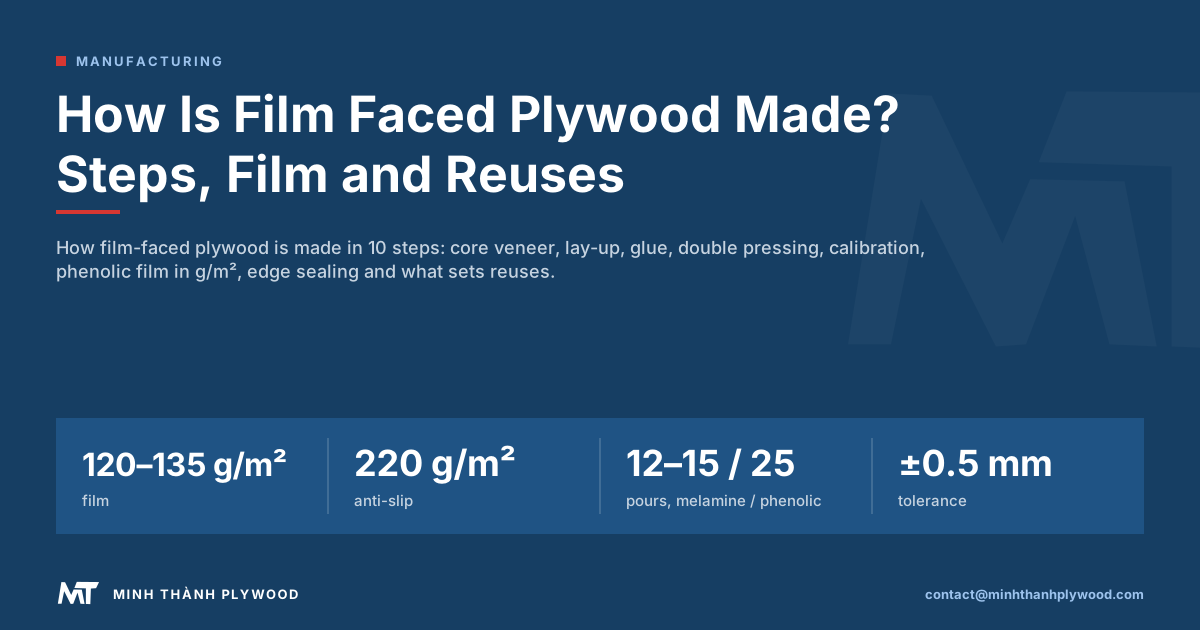
How film-faced plywood is made, in short
Film-faced plywood is made in two stages: a plywood core is built and pressed from rotary peeled veneer, then a phenolic resin film is hot pressed onto both faces and the edges are sealed. The first stage is the same as for any plywood; the second stage is what makes it a formwork panel.
The two stages in one view:
- Core stage. Peel, dry and grade veneer; lay up the plies; glue; press into a core board; calibrate it flat.
- Film stage. Lay the film on both faces; hot press it on; trim the panel; seal the edges; inspect and pack.
The film gives the smooth, water-resistant surface that releases concrete. The core gives the stiffness that holds wet concrete flat between supports. Both stages decide how many pours a panel lasts, which is why buyers who compare film-faced plywood by price alone often compare two different panels.
Minh Thanh Plywood produces film-faced plywood alongside its furniture, commercial and packing panels; see the film-faced plywood page.
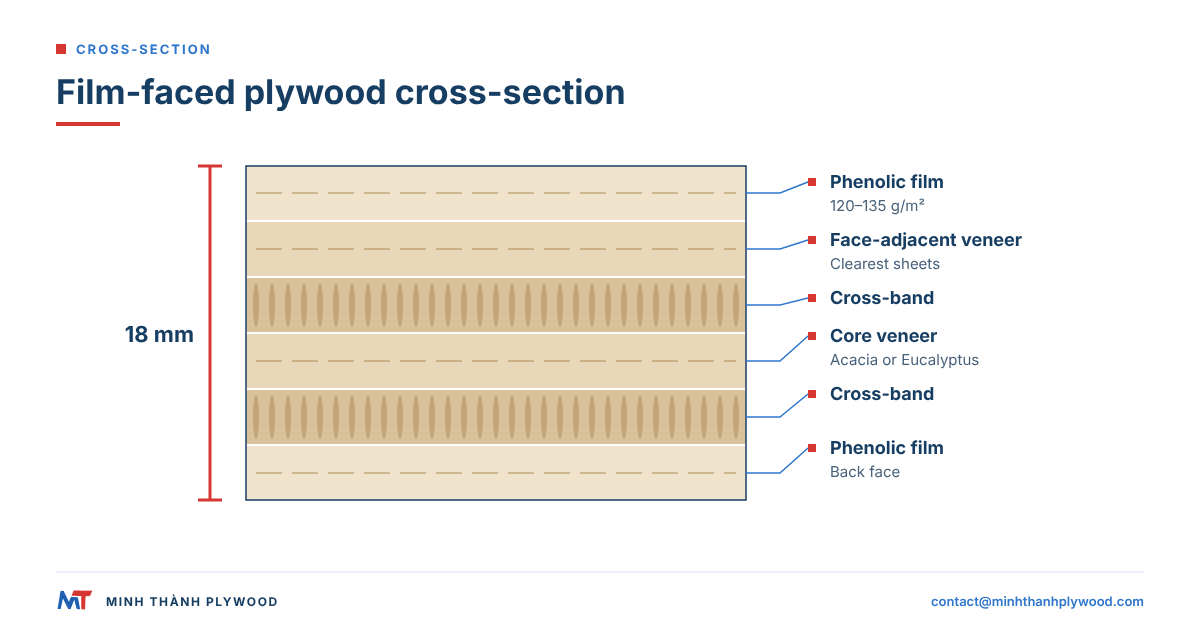
The film faced plywood manufacturing process, step by step
The film faced plywood manufacturing process runs in ten steps, from the log to a packed, sealed panel. Each step has one job and one check:
- Peel the logs. Acacia or Eucalyptus plantation logs are debarked, cut to block length and peeled on a rotary lathe into continuous veneer.
- Dry and grade. Veneer is dried to an even moisture content and sorted for core, cross-band and face-adjacent layers.
- Joint the core. Narrow strips are joined into full sheets; gaps and overlaps are taken out.
- Spread glue. Rollers spread a melamine-fortified or phenolic glue on the veneers.
- Lay up. Plies are stacked with grain crossing at right angles, to the ply count for the thickness.
- Pre-press. A cold press consolidates the stack so it can be handled.
- Hot press the core. The stack is pressed under heat until the glue cures, forming the core board.
- Calibrate. The core board is trimmed and sanded to an even thickness, and surface defects are repaired.
- Press the film. Phenolic film is laid on both faces and hot pressed onto the calibrated core.
- Trim, seal and pack. The panel is cut to size, edges are sealed with paint, and the panel is inspected and packed.
The film faced plywood production process is the same in outline at every mill. The difference between a panel that lasts a few pours and one that lasts many comes from how well each step is done, as the next table shows.
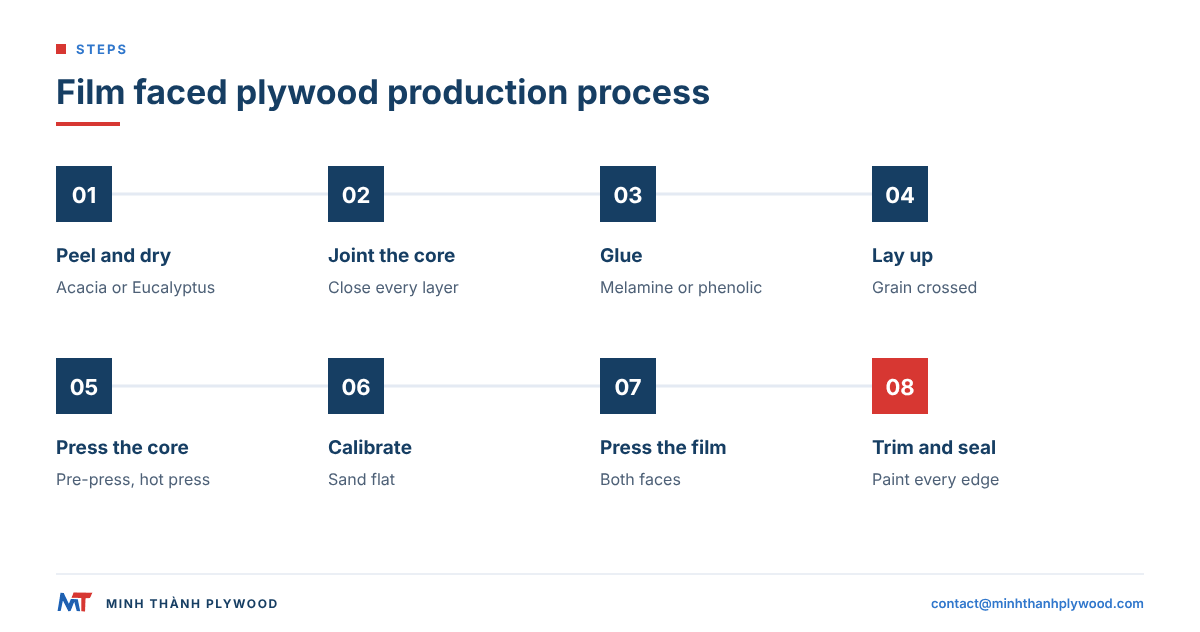
Film faced plywood production process: what each step does to reuses
Every production step either adds to or takes away from the number of times a film-faced panel can be reused, and the core steps matter as much as the film. This table links each step to what a buyer sees on site.
| Step | Done well | Done badly | What it does to reuses |
|---|---|---|---|
| Core species and grade | Acacia or Eucalyptus, A-grade core veneer | Mixed, broken or soft veneer | Sets stiffness and screw hold; weak cores fail early |
| Veneer drying | Even moisture in every sheet | Wet patches | Wet veneer causes blisters and delamination |
| Core jointing | Closed layers, no gaps or overlaps | Gaps under the face | Gaps print through the film and break it at the first pours |
| Glue | Melamine-fortified or phenolic, even spread | Thin or uneven spread | Sets water resistance; phenolic lasts longest |
| Core pressing and calibration | Pressed, then sanded flat | Single press, uneven core | An uneven core gives thin film spots that wear through |
| Film weight | 120–135 g/m², premium from 135 g/m² | Light film | Heavier film wears more slowly |
| Film pressing | Full cure, full contact | Under-cured film | Under-cured film peels and blisters |
| Edge sealing | Two coats, full edge | Thin or missing paint | Water enters at the edge and swells the core |
A cheap panel usually cuts corners at the core: an AB-grade core laid loose, light glue, a single press and a common film. A premium panel uses an A-grade core, more glue, a calibrated core and a heavier film. The two can look alike in a photograph.
Core veneer: species, grade and drying
Film-faced plywood in Vietnam is built on an Acacia or Eucalyptus core, peeled from plantation logs, because these hard, dense species hold screws and stand the pressure of wet concrete. Vietnamese film-faced and anti-slip panels use only these two cores; Styrax, the light white core, is kept for furniture panels.
Core veneers are usually 1.4–2.0 mm thick, peeled on a rotary lathe. The rotary peeled vs sliced veneer guide explains why every plywood core is peeled rather than sliced.
Grading decides which sheets go where:
- Face-adjacent layers: the widest, clearest sheets, because any hole here shows through the film.
- Cross-band layers: sound sheets laid at right angles to lock the panel.
- Inner core: jointed strips and narrower sheets.
Drying comes before grading. Minh Thanh dries veneers and finished panels to 8–12 % moisture content at dispatch, the normal range for its plywood. A wet sheet hidden in the core is the most common cause of a blister that appears weeks later on site.
Core lay-up, jointing and stitching
The core is laid up as an odd number of plies with grain crossing at right angles, and every layer must be closed, with no gaps or overlaps, before the glue goes on. A gap in the core becomes a soft spot under the film; an overlap becomes a hard ridge.
Joining narrow strips into full sheets is done by hand or with a composer machine, which feeds and joins strips edge to edge. A composer helps but does not guarantee a closed core: veneer can shift in pre-pressing, and a sheet that was not dry enough shrinks and opens a gap. Mills check the lay-up by eye on the table and again on the pressed core board.
| Core defect | Cause | What it does on site |
|---|---|---|
| Gap between core strips | Poor jointing, shrinkage | Dent in the film, concrete shows a mark |
| Overlap | Strips laid on top of each other | Ridge, film wears through there first |
| Missing piece | Lay-up error | Soft spot, panel breaks under load |
| Folded veneer | Handling at lay-up | Lump under the film |
Minh Thanh stitches core layers both horizontally and vertically on its furniture panels, which keeps each layer closed. The sibling guide to stitched core plywood explains how stitched and whole-piece cores differ.
Glue for film-faced plywood: melamine or phenolic
Film-faced plywood is glued with a melamine-fortified bond or a phenolic (WBP) bond, and the choice sets water resistance and reuse more than any other single step. Plain UF glue, the standard for indoor furniture panels, is not used for formwork.
| Bond | Hot-press temperature | Water resistance | Typical reuses with proper use |
|---|---|---|---|
| Melamine-fortified (MR, WBP melamine) | About 110–120 °C | Good, for most formwork | About 12–15 |
| Phenolic (WBP) | About 130–145 °C | Highest, boil resistant | Up to about 25 |
Glue spread matters as much as glue type. Too little glue leaves dry areas; too much bleeds and wastes resin. The spread, the time between spreading and pressing, and the veneer moisture are set in the production recipe and checked during the shift.
Bond and emission are two separate specifications. A buyer should write the bond on one line, for example “phenolic WBP”, and the emission class on another. “WBP” on a quotation names a water- and boil-proof bond, not a test result; ask which test the bond is checked to.
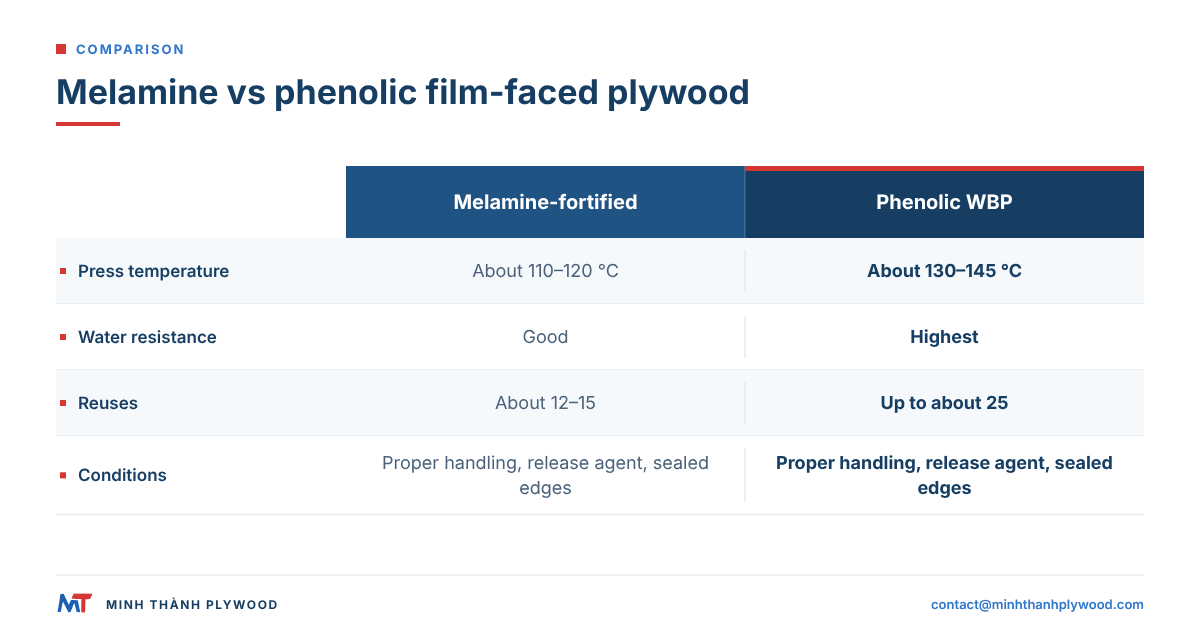
Why film-faced plywood is pressed twice
Film-faced plywood is hot pressed twice because the first press makes the core board and the second press bonds the film onto that core after it has been calibrated flat. Pressing the film onto an uncalibrated core would copy every step and dip of the core onto the face.
The sequence is:
- Pre-press. A cold press consolidates the glued stack.
- First hot press. Heat and pressure cure the glue and form the core board.
- Calibrate. The core board is sanded to an even thickness and repaired where needed.
- Second hot press. The film is laid on both faces and pressed onto the flat core.
Double pressing is the normal route for a premium film-faced panel. Minh Thanh presses its furniture-grade panels twice as standard, core board first and then face and back, and the same logic applies under a film: a calibrated core gives an even film thickness and an even panel. Some low-cost panels are pressed once, with film and veneers together, which is cheaper and shows in shorter life.
Calibration and sanding the core before the film
Calibration sands the pressed core board to an even thickness across the whole sheet, so the film is pressed onto a flat bed and the finished panel meets its tolerance. Film-faced panels are held to ±0.5 mm in thickness and ±2 mm in length and width.
Calibration also cleans the surface. Glue bleed, dust and resin spots left on the core would sit under the film and cause bubbles or rough patches. After sanding, surface defects such as small splits and holes are filled or patched so the film has no hollow to bridge.
What a buyer can check on delivery:
- Measure thickness at the four corners and the centre of sample panels.
- Lay a straightedge across the face and look for hollows.
- Look at the face in low, raking light; core steps and patches show as shadows through the film.
What film weight (g/m²) is pressed on
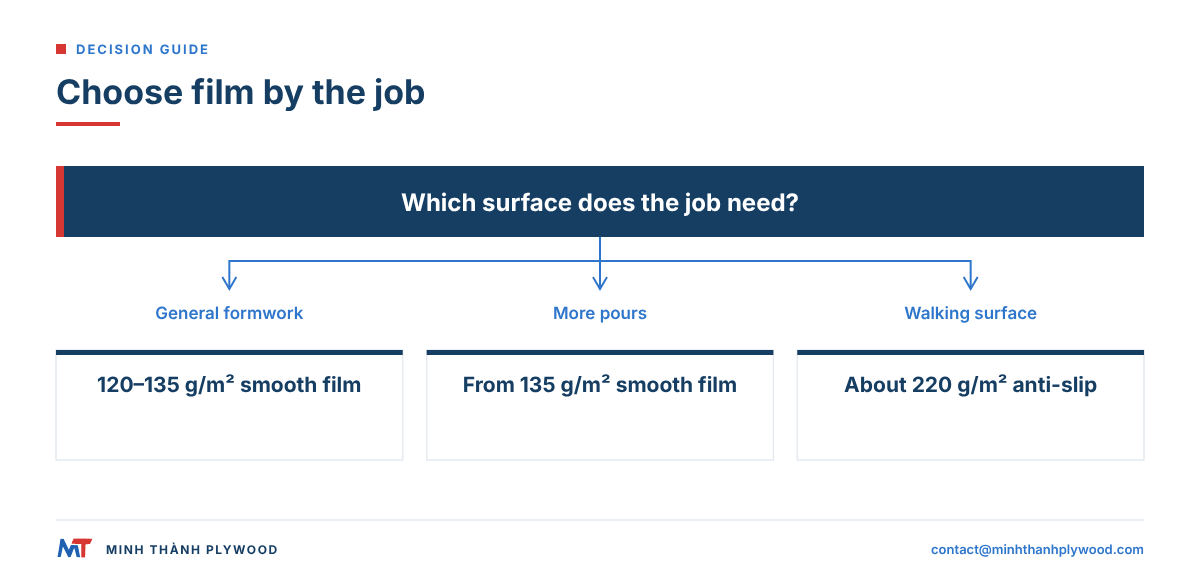
Standard film-faced plywood carries a phenolic film of about 120–135 g/m² on each face, premium grades from 135 g/m², and anti-slip panels about 220 g/m². The film is a paper impregnated with phenolic resin; its weight per square metre is what buyers compare.
| Film | Weight | Surface | Use |
|---|---|---|---|
| Standard | About 120–135 g/m² | Smooth, brown or black | General formwork |
| Premium | From 135 g/m² | Smooth, brown or black | More pours, better concrete finish |
| Anti-slip | About 220 g/m² | Rice grain, hexagon or mesh | Decks, trailer floors, walkways |
A heavier film carries more resin, wears more slowly and releases concrete cleanly for longer. The film maker, the weight and the colour are specifications agreed per order. Write all three on the purchase order, for example “phenolic film 135 g/m², brown, both faces”.
Film colour does not change performance. Brown and black are the common colours; the film-faced plywood page shows the standard faces.
Film pressing and curing
The film is laid dry on both faces of the calibrated core and pressed under heat until the resin flows, wets the core surface and cures into a hard, closed face. Pressing both faces together keeps the panel balanced, so it does not bow.
Three settings decide the result: heat, pressure and time. Too little of any of them leaves the film under-cured, soft and easy to peel; too much makes it brittle. The press recipe is set for the film type and the panel thickness.
After pressing, the panels are stacked to cool evenly. A panel that cools on one face first can bow, so cooling is part of the process, not a pause.
Edge sealing and final trimming
After film pressing, the panel is trimmed to its final size and the four edges are sealed with a water-resistant paint, because the edge is the only part of the core not covered by film. Water that enters at an unsealed edge swells the core, and the panel delaminates from the edge inwards.
Edge sealing done well:
- Two coats of a water-resistant acrylic or similar paint on every edge.
- Full cover, with no dry spots at the corners.
- Clean cut edges, square, without torn veneer.
Panels cut to size on site need their new edges sealed again. A site that skips this loses pours whatever the panel cost, which is why reuse figures are always given with edge sealing.
How many reuses depends on which steps
A film-faced panel’s reuse count depends on four production choices, the bond, the core grade, the film weight and the edge sealing, and on how the site handles it. With proper handling, release agent and edge sealing, a melamine-bonded panel lasts about 12–15 pours and a phenolic-bonded panel up to about 25.
| What sets reuses | Fewer pours | More pours |
|---|---|---|
| Bond | Light melamine | Phenolic WBP |
| Core grade | AB core laid loose | A-grade core, closed layers |
| Pressing | Single press | Core pressed and calibrated, film pressed second |
| Film weight | Light standard film | From 135 g/m² |
| Edge sealing | Thin or none | Two coats, resealed after cutting |
| Site handling | Dropped, dragged, no release agent | Lifted, stacked flat, release agent each pour |
Reuse count is a target for a given build and use, not a fixed property of the panel. A buyer who asks a mill to promise a number without naming the site conditions asks for something no mill can measure. Ask instead for the build that reaches your target and agree it on the order.
What causes film bubbles and other defects
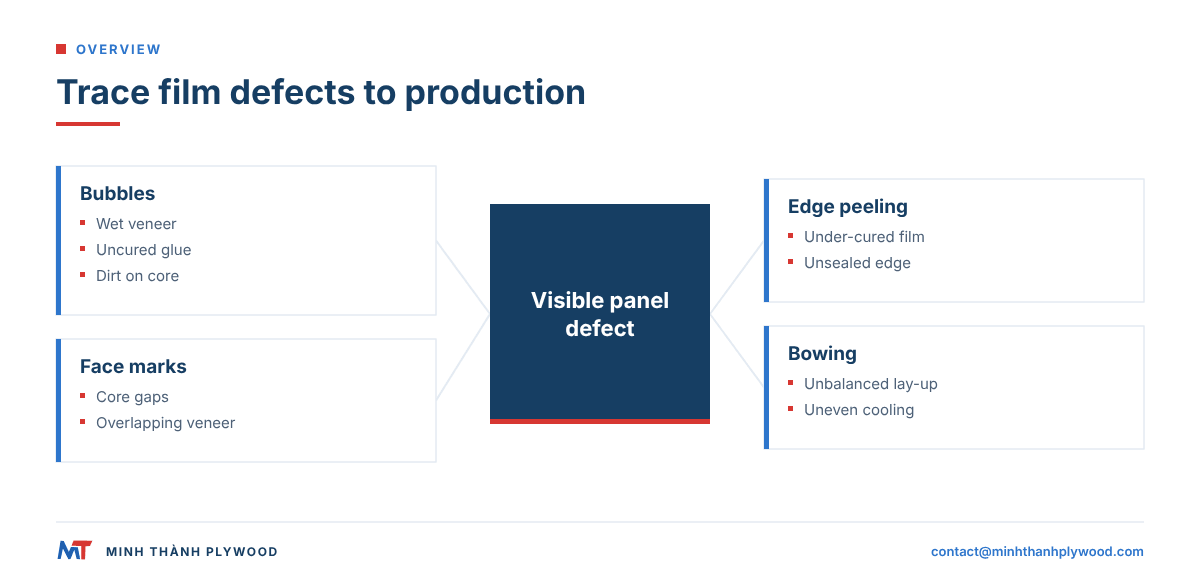
Film bubbles are caused by moisture or gas trapped under the film, from wet veneer, a glue line that did not cure, or dirt on the core surface, and most other film-faced defects also trace back to one production step. The table maps each defect to its usual origin.
| Defect | Usual origin | Step to check |
|---|---|---|
| Bubbles or blisters in the film | Wet veneer, uncured glue, dirt on the core | Drying, pressing, calibration |
| Film peeling at the edge | Under-cured film, unsealed edge | Film pressing, edge sealing |
| Dents and marks in the face | Core gaps, missing pieces | Core jointing, lay-up |
| Ridges in the face | Overlapping core veneer | Lay-up |
| Panel bowing | Unbalanced lay-up, uneven cooling | Lay-up, cooling |
| Delamination in the core | Weak or uneven glue spread | Glue spreading, pressing |
| Thickness out of tolerance | Uncalibrated core | Calibration |
A panel with a bubble straight from the press is rejected at inspection. Bubbles that appear after several pours usually point to the core or the glue, and the site’s handling should be checked too.
Final inspection and quality checks
Every film-faced panel is inspected before packing for thickness, size, flatness, film surface and edge sealing, and sample panels are tested for bond. The checks follow the defects table above.
- Thickness: within ±0.5 mm at corners and centre.
- Size and squareness: length and width within ±2 mm.
- Film surface: no bubbles, scratches, dry spots or core marks.
- Edges: fully sealed, square and clean.
- Bond: sample pieces boiled and checked for delamination, to the bond ordered.
- Count and labels: pack count and marks to the order.
Every shipment is photographed and filmed before loading, and the buyer gets the photos and video. Third-party testing to the buyer’s method is arranged through SGS on request. Bond quality of plywood is classed in EN 314-2. Panels placed on the EU market as construction products need CE marking under the Construction Products Regulation (EU) No 305/2011 (checked 20 October 2026). Their harmonised standard is EN 13986. Buyers name the class they need on the order. The quality control page describes incoming, in-process and final inspection, and the quality and certificates page shows the certificates and test reports Minh Thanh holds.
Anti-slip film-faced plywood: what changes
Anti-slip film-faced plywood is made the same way as smooth film-faced plywood, except that the top film is heavier, about 220 g/m², and is pressed with a patterned plate that leaves a rice-grain, hexagon or mesh texture. The back usually carries a smooth film.
What changes in production:
- Film: heavier phenolic film on the walking face.
- Press plate: a patterned plate replaces the smooth plate for that face.
- Core: Acacia or Eucalyptus, as for smooth film-faced panels.
Anti-slip panels are used for decks, walkways, stages and trailer and truck floors. Minh Thanh makes anti-slip plywood on order.
Black film-faced plywood and other colours
Black film-faced plywood is made exactly like brown: the colour is in the film paper, and it changes nothing in the core, the glue or the pressing. Buyers in some markets prefer black for the look of the panel or because a supplier they trust uses it.
When ordering by colour, write the film weight with it. A black film of a light weight and a brown film of a heavier weight are not the same panel, whatever their colour. Brown and black are the usual stock colours; other colours are agreed per order.
Packing and loading film-faced plywood
Film-faced plywood ships in export packs wrapped against water, and a premium 40HC holds about 43 m³ on a Eucalyptus core or about 47 m³ on an Acacia core. Eucalyptus is denser, so the container reaches its payload sooner.
| Core | Reference density | About per 40HC, premium film-faced |
|---|---|---|
| Eucalyptus | 650 kg/m³ | 43 m³ |
| Acacia | 580 kg/m³ | 47 m³ |
Packs are about one metre high, strapped and wrapped, with corner protection so the film faces are not scratched in handling. Plywood is processed wood and is not subject to ISPM 15, the international standard for wood packaging. Panels leave Ha Hoa by truck for Hai Phong, and terms are FOB Hai Phong, CFR or CIF. See export packing and container loading.
Film-faced plywood sizes, specs and price
Film-faced plywood is made in 1220 × 2440 mm and 1250 × 2500 mm sheets from 9 mm to 21 mm thick, with a thickness tolerance of ±0.5 mm. Other mills also list 915 × 1830 mm and 1500 × 3000 mm sheets and 610 × 2440 mm strips, as on the Okorder film-faced plywood listing (checked on 21 October 2026). Thicker panels carry more plies, from 9 to 13.
| Item | Typical specification |
|---|---|
| Sheet size | 1220 × 2440 mm, 1250 × 2500 mm; 915 × 1830 mm, 1500 × 3000 mm and 610 × 2440 mm from some mills |
| Thickness | 9, 12, 15, 18 and 21 mm |
| Plies | 9 to 13, rising with thickness |
| Thickness tolerance | ±0.5 mm (±0.3 mm on request at some mills) |
| Film | Brown or black, 120–135 g/m²; premium from 135 g/m²; anti-slip about 220 g/m² |
| Bond | Melamine-fortified (about 12–15 reuses) or phenolic WBP (up to about 25) |
| Load per 40HC | About 43 m³ Eucalyptus core, about 47 m³ Acacia core |
| Lead time | 15–45 days after the 30% deposit |
Price depends on the bond, the film weight, the core grade and the thickness, so an exporter quotes per cubic metre against a written specification, and FOB Hai Phong, CFR or CIF terms change the landed figure.
For the UK reader, the shelf is the check: in October 2026 an 18 mm 2440 × 1220 mm film-faced sheet lists at £34.45 ex VAT at The Timber Group, £43.40 at Howarth Timber and £49.69 at Huws Gray, before delivery. A container buyer compares the CIF price per sheet with that shelf and with the reuse count: a phenolic sheet that gives 25 pours costs less per pour than a cheaper sheet that gives 12.
Where film-faced plywood is used
Film-faced plywood is used wherever concrete is poured against a form and the finish matters:
- Wall and slab formwork: the main use, on site-built forms and in system formwork frames.
- Bridges and tunnels: heavy pours with a smooth, repeatable face.
- High-rise cores and industrial plants: repeated floor-to-floor pours that reuse the same panels.
- Trailer floors, walkways and decks: anti-slip film at about 220 g/m².
What to put on a film-faced plywood purchase order
A film-faced plywood purchase order should name the core, the bond, the film weight and colour, the thickness and tolerance, the edge sealing and the reuse target, so the mill quotes the build that reaches it. Six lines cover it:
- Size and thickness: for example 18 mm × 1220 × 2440 mm, ±0.5 mm.
- Core: Eucalyptus or Acacia, A-grade, closed layers.
- Bond: melamine-fortified or phenolic WBP.
- Film: weight in g/m², colour, both faces; anti-slip pattern if needed.
- Edges: sealed, two coats.
- Use and target: concrete walls or slabs, the number of pours wanted.
A complete line:
Film-faced plywood, 18 mm × 1220 × 2440 mm, ±0.5 mm; core: Eucalyptus, A-grade, double pressed; bond: phenolic WBP; film: 135 g/m², brown, both faces; edges sealed; target about 25 pours with release agent; 1×40HC, CIF your port.
Production takes 15–45 days after the 30% deposit, and the MOQ is one 40HC. Minh Thanh sends free samples and replies within hours: contact@minhthanhplywood.com or WhatsApp +84 988 586 601.
Buyer questions, answered
How is film-faced plywood made?
A plywood core is built from rotary peeled Acacia or Eucalyptus veneer, glued with a melamine or phenolic bond, pressed and calibrated. A phenolic resin film is then hot pressed onto both faces, and the panel is trimmed and its edges sealed.
Is film-faced plywood made by coating normal plywood?
No. The film is a paper impregnated with phenolic resin that is pressed onto a calibrated plywood core under heat and pressure, so it bonds into the face. Paint or liquid coating on ordinary plywood does not give the same wear or release.
What film weight is pressed on film-faced plywood?
Standard film is about 120–135 g/m², with premium grades from 135 g/m². Anti-slip panels use a heavier film of about 220 g/m² with a rice-grain, hexagon or mesh pattern.
Why is film-faced plywood hot pressed more than once?
The first press bonds the veneers into a core board, which is then calibrated flat. The second press bonds the film onto that flat core, so the film lies evenly and does not show core gaps or thickness steps.
What causes bubbles in the film?
Bubbles come from moisture or gas trapped under the film: veneer that was too wet, a glue line that did not cure, or dust and resin spots on the core. Each shows as a raised blister after pressing or after the first pours.
How many times can film-faced plywood be reused?
With proper handling, release agent and edge sealing, about 12–15 pours for a melamine bond and up to about 25 for a phenolic bond. The core grade, film weight and edge sealing all move the number.
Which core is used for film-faced plywood in Vietnam?
Acacia or Eucalyptus. Vietnamese film-faced and anti-slip panels use only these two cores, because they are hard and firm enough for concrete pressure and repeated handling.
Does a composer machine guarantee no core gaps?
No. A composer joins veneer strips into full sheets, which helps, but gaps also come from lay-up, shifting during pre-pressing and veneer that shrinks after drying. The core is checked at lay-up and after pressing.
What thickness tolerance does film-faced plywood have?
Film-faced panels are held to ±0.5 mm in thickness, with length and width at ±2 mm. The core is calibrated before the film goes on, so thickness is set before the face is pressed.
What is a film-faced plywood manufacturer?
A mill that peels or buys veneer, builds and presses its own plywood cores and presses film on them in its own presses. A trader buys finished panels; ask to see the core and film presses, by visit or video call.