
Structural ply is plywood made and certified to carry loads in a building: floors, walls, roofs, beams and bracing. What makes it structural is a standard, a permanent exterior-type bond and a stamp from a certified mill, not the look of the face. Minh Thanh Plywood supplies construction and exterior plywood with WBP bonds and explains here what each market's structural grade asks for.
What is structural ply?
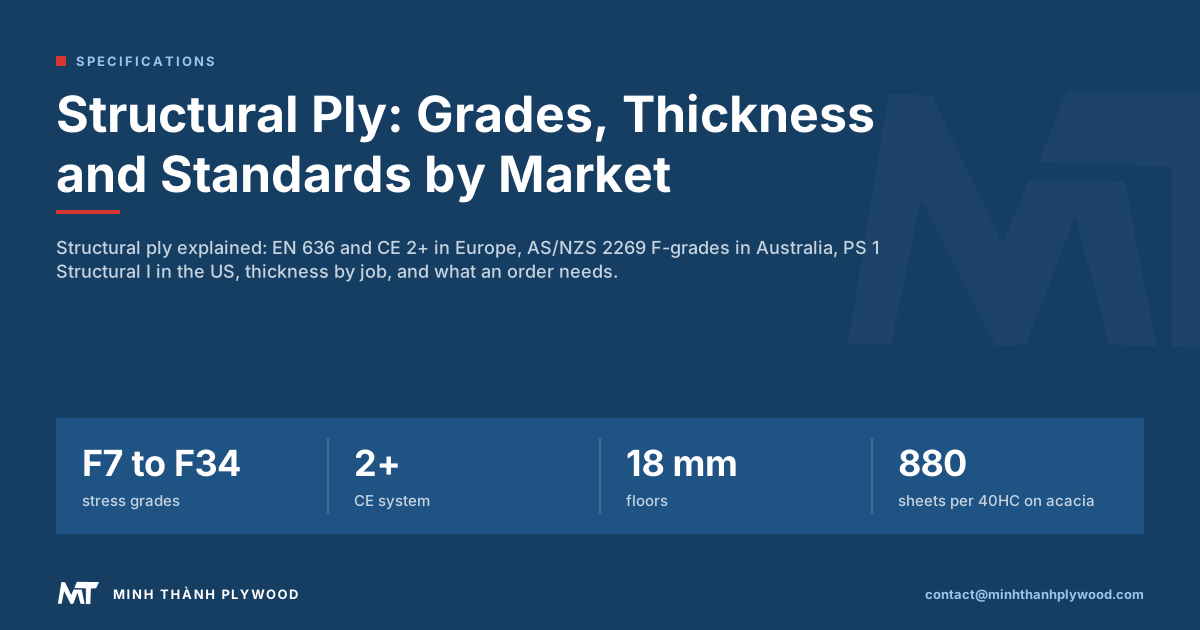
Structural ply is plywood made and certified to a structural standard so that engineers and building codes can rely on its strength. It has a permanent exterior-type bond, a stress or performance grade, and a mark from a mill whose production is checked by a third party.
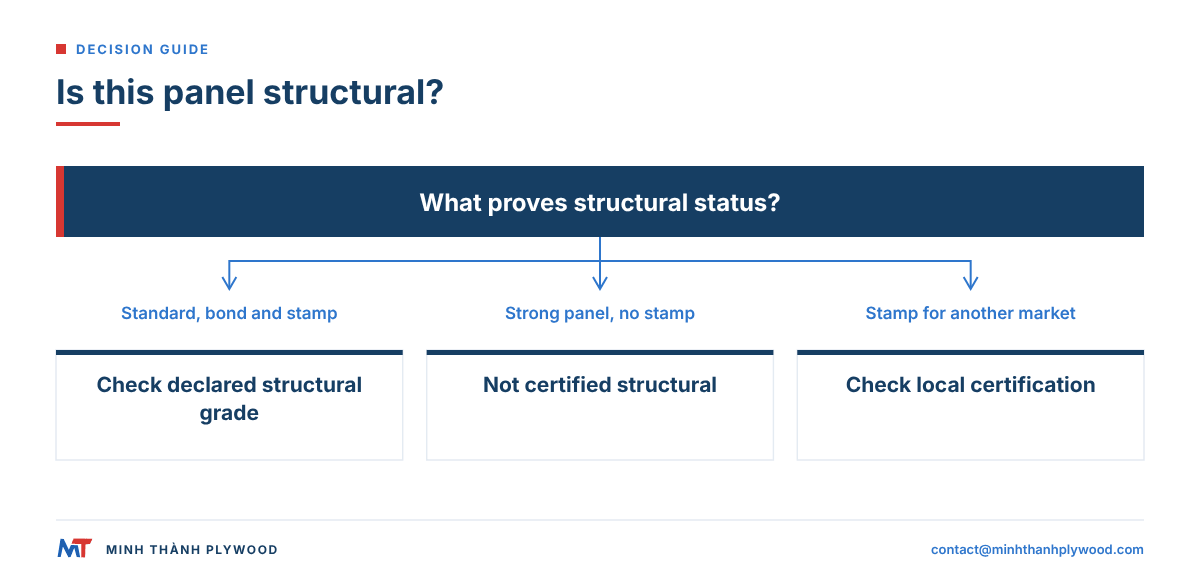
Three things together make a panel structural:
- A structural standard: EN 636 with EN 13986 in Europe, AS/NZS 2269 in Australia and New Zealand, PS 1 and PS 2 in the US, and CSA O121/O151 (plywood) and O325 (sheathing) in Canada.
- A permanent bond: phenolic (WBP) or an equivalent exterior glue, tested by the bond test of that standard.
- Certification and marking: a grade stamp or CE marking backed by factory production control and, where the standard asks, a notified or accredited body.
A panel can be strong and well built and still be non structural, because it lacks the certification. That is a paperwork line as much as a production line, and it is the first thing to settle with any supplier.
Structural ply in Australia: which sizes, grades and prices?
An Australian buyer is looking for sheets graded to AS/NZS 2269 in 2400 × 1200 mm, bond type A, in a stress grade of F11, F14 or F17. Local merchants such as Blacktown Building Supplies stock the standard 2400 × 1200 mm sheet in 7, 9, 12, 17, 18, 19 and 25 mm, with trade and bulk pricing on request.
| Thickness | Typical Australian use | Usual grade | Shelf price per 2400 × 1200 mm sheet (October 2026) |
|---|---|---|---|
| 7 mm and 9 mm | Wall bracing, light sheathing | CD, F8 to F11 | Quote from merchant |
| 12 mm | Roof decks, bracing | CD F11 | A$57.99 to A$59.35 (Geelong Timber Supplies, Warringah Timbers) |
| 17 mm and 19 mm | Floors, often tongue-and-groove | CD F11 or F14 | A$74.29 for 17 mm (Canterbury Timbers, read on 27 October 2026) |
| 25 mm | Heavy floors, decks | F14 to F17 | Quote from merchant |
| Formply | Concrete forming | F17 | Quote from merchant |
Those are single-sheet retail prices with GST. A container buyer works from a different base: our commercial plywood starts from US$250/m³ FOB, which is a raw FOB example of about US$13.40 for one 18 mm sheet of 1220 × 2440 mm before freight, duty, GST and the importer’s margin. The gap between that and the shelf price is the room an Australian importer has, provided the sheet carries the AS/NZS 2269 stamp the local buyer asks for.
Two Australian details change the order. First, the structural sheet uses a Type A (phenolic) glue line; interior non-structural plywood (AS/NZS 2270) commonly uses a Type B bond, while exterior (AS/NZS 2271) and marine (AS/NZS 2272) non-structural plywood need a Type A bond. Second, structural sheets run in 2400 × 1200 mm, while our standard export sizes are 1220 × 2440 mm and 1250 × 2500 mm, so the size goes on the order line. Structural ply is sold from 6 mm to 40 mm; the thickness comes from the span table and engineering design.
Structural vs non structural plywood: what is the difference?
Structural plywood carries a stress grade and design values that a building code accepts; non structural plywood does not. The build can look the same, but only structural plywood may be used where an engineer or a code relies on the panel’s strength.
| Point | Structural plywood | Non structural plywood |
|---|---|---|
| Standard | EN 636-1S, -2S or -3S (dry, humid or exterior) with CE marking, AS/NZS 2269, PS 1 | EN 636 “G” general-purpose classes or the buyer’s specification |
| Bond | Permanent exterior bond, usually phenolic (WBP); Type A glue line in AS/NZS 2269 | UF glue at E0 emission, MR or WBP to the order; Type B glue line for interior panels in Australia, Type A for exterior |
| Grade | Stress grade (F11, F14…) or performance class | Face/back appearance grade (A/B, B/B, C/D…) |
| Marking | Grade stamp or CE marking with Declaration of Performance | Pack label and order documents |
| Typical uses | Floors, wall bracing, roof decks, beams, gussets | Furniture, cabinets, linings, packing, formwork |
| Who checks it | The mill’s certifier plus the building inspector | The buyer, against the approved sample |
Our structural vs non structural plywood guide covers the borderline cases, such as formwork and temporary works.
Which standards define structural plywood in each market?
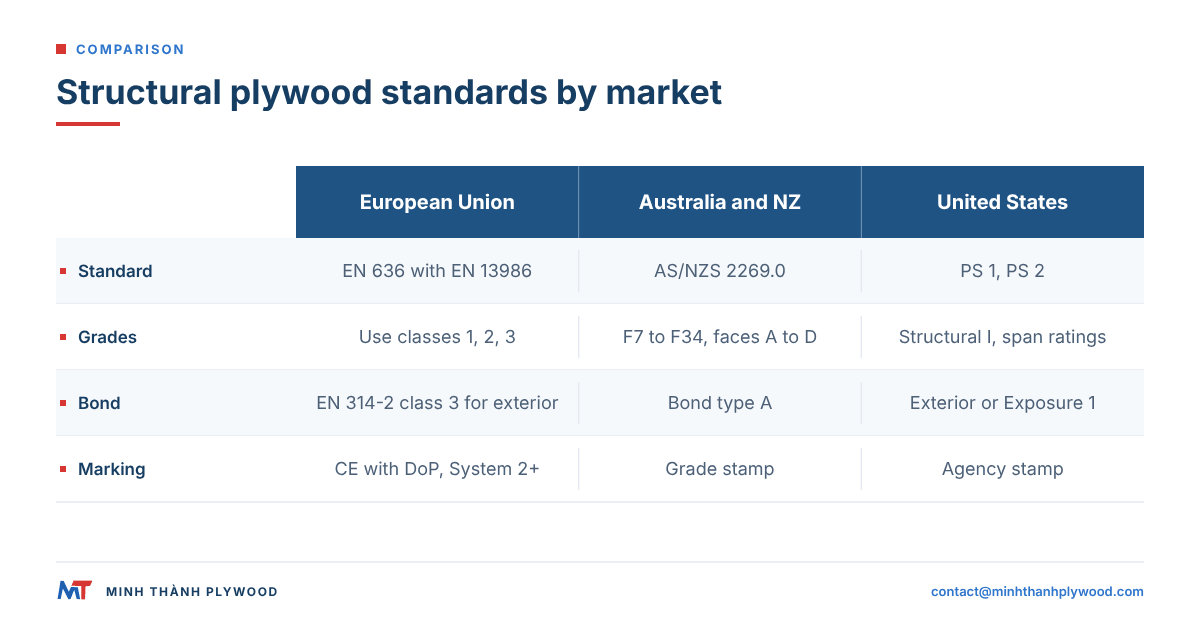
Each market has its own structural plywood standard: Europe uses EN 636 with CE marking under EN 13986, Australia and New Zealand use AS/NZS 2269, and the US uses PS 1 (and PS 2 for performance-rated panels). A stamp from one market does not carry over to another.
| Market | Product standard | Grade names | Marking |
|---|---|---|---|
| European Union | EN 636-1S, -2S or -3S (dry, humid or exterior) for structural use class; EN 13986 for construction products | Use classes 1, 2, 3; bond classes of EN 314-2; strength from EN 789 / EN 12369-2 | CE marking with a Declaration of Performance, System 2+ for structural use |
| United Kingdom | Same EN standards | Same classes | UKCA or CE marking |
| Australia and New Zealand | AS/NZS 2269.0 | Stress grades F7 to F34; face grades A, S, B, C, D; bond type A | Grade stamp from a certified mill, often under the EWPAA scheme |
| United States and Canada | US: PS 1 (veneer plywood), PS 2 (performance-rated panels); Canada: CSA O121/O151 (plywood), O325 (sheathing) | Structural I; Exposure 1 or Exterior; span ratings such as 32/16 | Grade stamp from an accredited agency |
The Construction Products Regulation (EU) No 305/2011 is the legal base for CE marking of structural plywood in the EU. EN 13986 is the harmonised standard it points to. The BSI listing for BS EN 636:2012+A1:2015 covers plywood for structural and general-purpose use in dry, humid or exterior conditions, and the BSI record for BS EN 314-2 defines the bonding-quality requirements.
What are the structural plywood grades?
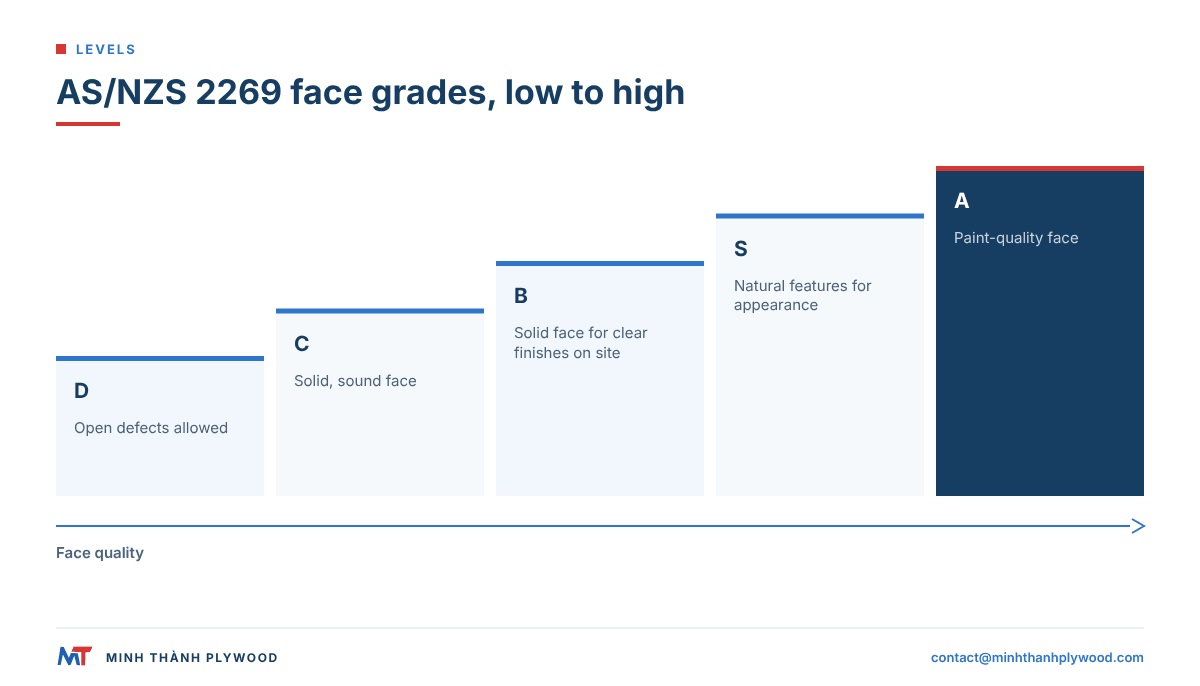
Structural plywood grades combine a strength grade and a face grade. In Australia a panel reads, for example, “CD F14”: face C, back D, stress grade F14. In Europe the strength comes from the declared values of EN 13986; in the US from the Structural I or rated-sheathing label.
How to read the Australian label:
- Stress grade (F7, F8, F11, F14, F17, F22, F27, F34): the higher the number, the higher the design stresses. F11 and F14 are common for bracing, flooring and formwork.
- Face grades (A, S, B, C, D): A is a high-quality appearance face suitable for clear finishing, S allows natural features for appearance, B is a solid face suitable for a high-quality paint finish, C is a solid, sound non-appearance face, D permits open defects. The pair names face and back.
- Bond type A: a permanent phenolic bond.
For Europe, the use class of EN 636 says where the panel can go (dry, humid, exterior), and the Declaration of Performance lists bending strength and stiffness. The appearance grade is set separately, so a structural panel can still have a clean face.
Structural plywood 18mm, 12mm and 9mm: which thickness for which job?
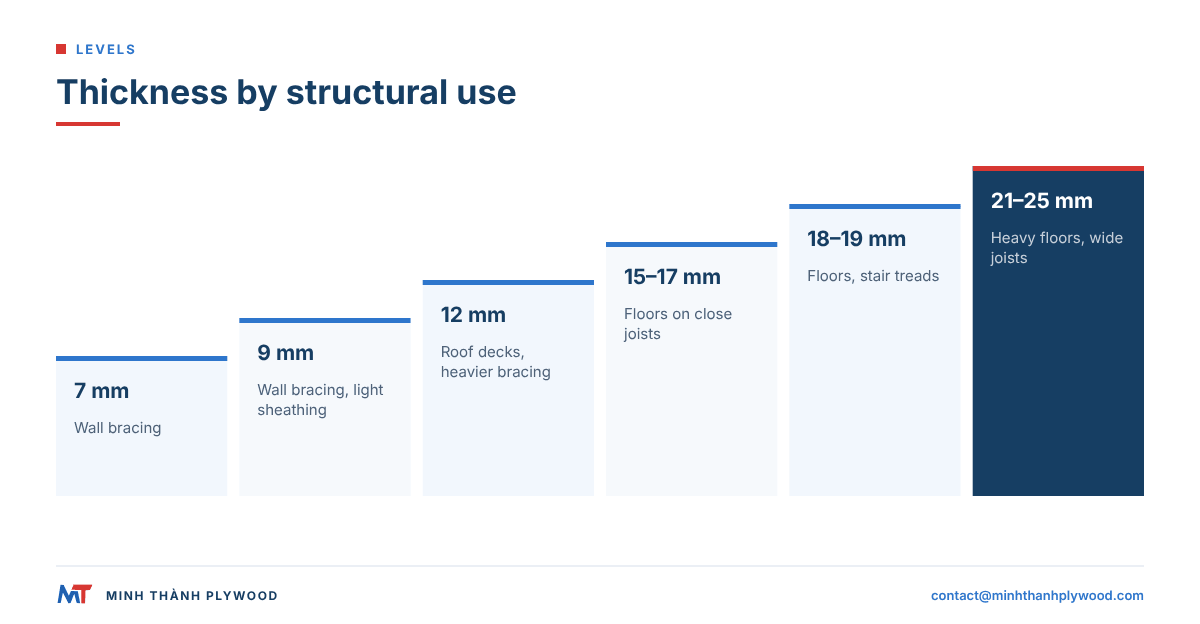
Use 9 mm structural plywood for wall bracing and light sheathing, 12 mm for roof decks and heavier bracing, and 15 to 25 mm, most often 18 mm, for floors, stair treads and decks. The exact thickness comes from the span table of the local standard for your joist or rafter spacing.
| Thickness | Typical structural uses | Notes for the order |
|---|---|---|
| 7 mm | Wall bracing panels | Nailing schedule from the bracing manual |
| 9 mm | Wall bracing, light sheathing, gussets | Common in residential bracing |
| 12 mm | Roof decks, heavier bracing, box beam webs | Check rafter spacing |
| 15–17 mm | Floors on close joists, platforms | Often tongue-and-groove |
| 18–19 mm | Floors, stair treads, mezzanines | The usual flooring thickness |
| 21–25 mm | Heavy floors, wide joist spacing, truck and trailer decks | Often hardwood veneers |
Thickness tolerance matters for flooring. Our commercial and film-faced panels hold ±0.5 mm, sanded furniture panels ±0.2–0.3 mm, and length and width ±2 mm, so tongue-and-groove joints close evenly.
What is structural hardwood ply?
Structural hardwood ply is structural plywood made with hardwood veneers, such as eucalyptus or acacia, instead of softwood like radiata or hoop pine. Denser veneers make a heavier, stiffer and harder panel at the same thickness.
In Vietnam the plantation hardwoods used for construction and film-faced panels are acacia and eucalyptus. Reference densities used in our container plans are 580 kg/m³ for acacia and 650 kg/m³ for eucalyptus, against 500 kg/m³ for the white Styrax core we use for furniture. At 18 mm and 1220 × 2440 mm that is 31.1 kg per acacia-core sheet and 34.8 kg per eucalyptus-core sheet.
Eucalyptus suits heavy floors, stair treads and trailer decks, where hardness and stiffness count. Styrax is a furniture core: light, white and flat, and the wrong choice for a structural order.
Is structural ply waterproof?
The bond in structural ply is waterproof, but the panel itself is not. Structural plywood uses a permanent phenolic (WBP) bond that does not delaminate when wet; the wood still takes up water, swells and can decay, so edges and faces need protection.
What this means on site:
- Seal cut edges, where water enters fastest.
- Cover roof decks and floors before the building is closed in.
- Use preservative-treated plywood where the panel stays damp or touches the ground.
- Keep panels stacked flat, off the ground and covered during storage.
The difference between a WBP bond and a waterproof panel is the most common mix-up in structural orders. A boil test proves the bond on a sample; it says nothing about how long an unprotected panel lasts outdoors.
What glue does structural plywood need?
Structural plywood needs a permanent exterior bond, which in practice means phenolic resin (WBP). The bond must pass the test of the structural standard: EN 314-2 class 3 for EN 636-3 exterior use, bond type A for AS/NZS 2269, Exterior or Exposure 1 bonds for PS 1.
Glue type and emission class are two separate lines on the specification. A phenolic bond describes durability in water; E0, E1 or CARB P2 describe formaldehyde emission. Our furniture panels use UF glue at E0 emission; MR (melamine-fortified) and phenolic (WBP) bonds are made to the customer’s specification. Hot pressing runs at about 110–120 °C for MR bonds and 130–145 °C for WBP.
How is structural plywood used for gussets and box beams?
Plywood gusset plates join timber members in trusses and portal frames, and plywood webs with timber flanges form box beams and I-beams. Both rely on the cross-laid veneers, which give plywood strength in two directions and resist splitting at nails and bolts.
For a plywood gusset plate, the designer sets thickness, face grain direction and the nailing or bolting pattern from the panel’s design values. For a box beam, the plywood webs carry shear and the flanges carry bending. Both need structural plywood with published values; an ungraded panel gives the engineer nothing to calculate with. For long spans, LVL laminated veneer lumber is the usual flange or beam material.
Is there a structural plywood design guide?
Yes. In Australia the Engineered Wood Products Association of Australasia (EWPAA) publishes structural plywood design and bracing manuals; in the US, APA publishes design and construction guides; in Europe, design follows Eurocode 5 with the values from EN 12369-2 or the maker’s Declaration of Performance.
These guides hold the span tables, fixing schedules and design stresses. Use the edition that matches the product’s stamp: a table for F14 panels does not apply to an ungraded sheet, and a US span rating does not prove an AS/NZS 2269 grade.
Does Vietnamese structural plywood meet AS/NZS 2269 or EN 636?
Vietnamese plywood meets AS/NZS 2269 or EN 636 when the mill makes it to that standard and holds the matching certification and documents. Origin does not decide it; the stamp, the bond test and the factory production control do.
For each market, ask the supplier for:
- Europe: CE marking and the Declaration of Performance to EN 13986, with the use class of EN 636 and the bond class of EN 314-2. CE is available* from Minh Thanh Plywood.
- Australia and New Zealand: an AS/NZS 2269 grade stamp and the certification behind it.
- United States: a PS 1 or PS 2 stamp from an accredited agency for structural use, plus CARB P2 / TSCA Title VI where the rule applies.
*Supplied directly or through qualified partner mills.
What does a structural plywood order need?
A structural plywood order needs the standard and grade first, then the build: thickness and tolerance, species, glue, face grade, size, packing and the documents that travel with the panels.
- Standard and grade: EN 636-3 with CE marking, AS/NZS 2269 F14, or PS 1 Structural I.
- Thickness and tolerance: for example 18 mm ±0.5 mm.
- Core and face species: eucalyptus or acacia core, face to order.
- Glue: phenolic (WBP) bond.
- Face/back grade: for example C/D for site work.
- Size and edge: 1220 × 2440 mm or 1250 × 2500 mm, square or tongue-and-groove.
- Documents: Declaration of Performance or grade certificate, plus the shipping set: commercial invoice, packing list, B/L, certificate of origin, and the EUDR compliance dossier for EU orders.
How are structural plywood panels packed and shipped?
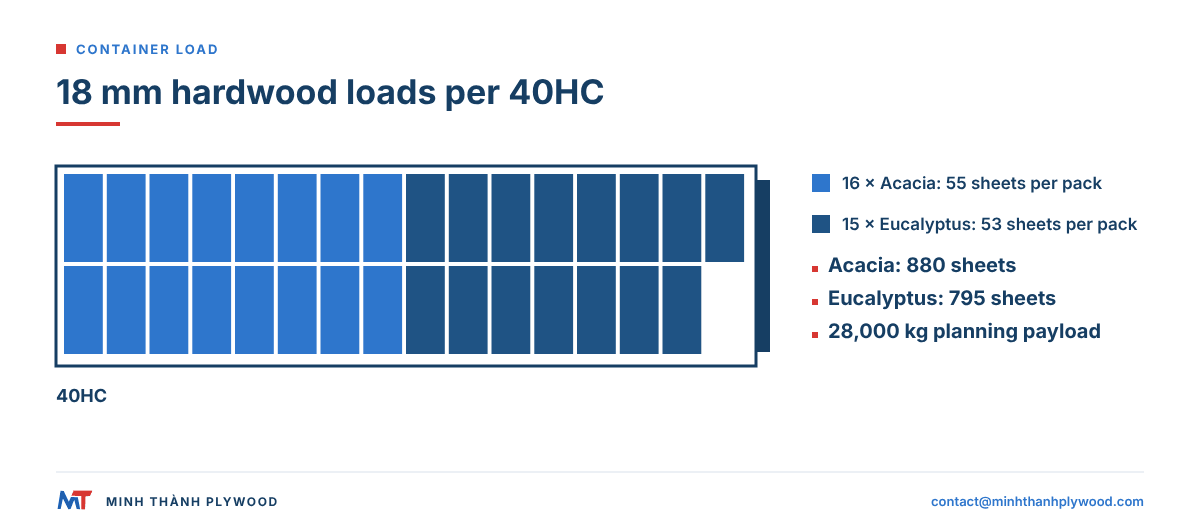
Structural plywood ships in strapped packs about one metre high in 40HC containers, and the heavier hardwood core sets the load. At 18 mm and 1220 × 2440 mm a 40HC holds 880 sheets on an acacia core or 795 sheets on a eucalyptus core, within a 28,000 kg planning payload.
Those counts come from the pack height and the panel weight: 16 packs of 55 sheets on acacia and 15 packs of 53 on eucalyptus. If your booking caps the payload lower, the sheet count drops with it. Every shipment is photographed and filmed before loading, and buyers get the photos and video. Typical days at sea from Hai Phong are 30–40 to Northern Europe and 20–30 to the US West Coast, by carrier and route.
What does Minh Thanh Plywood supply for construction?
Minh Thanh Plywood supplies construction and exterior plywood with water-resistant melamine-fortified or phenolic (WBP) glue, for uses such as stair treads, wall sheathing, roof decks and temporary works, plus film-faced plywood and LVL. CE is available* for European orders.
Exterior and CDX-type panels use utility C/D face/back appearance, matched to the order sample. Orders start at one 40HC with mixed specifications by agreement; production is 15–45 days after the 30% deposit, with the balance against the scanned B/L. See construction plywood from Vietnam and exterior plywood, or read about plywood roof sheathing.
*Supplied directly or through qualified partner mills.
Buyer questions, answered
What is structural plywood?
Structural plywood is plywood manufactured and certified to a structural standard, such as EN 636 with CE marking in Europe, AS/NZS 2269 in Australia or PS 1 in the US, so engineers can rely on its strength. It carries a permanent exterior-type bond and a grade stamp.
What is non structural plywood?
Non structural plywood is plywood made for furniture, joinery, linings, packing or formwork, with no structural certification. It can be well built and strong, but it carries no stress grade or design values, so it cannot be used where a building code calls for structural plywood.
Is structural ply waterproof?
The glue in structural ply is waterproof, but the panel is not. Structural plywood uses a permanent phenolic bond that does not fail in wet conditions; the wood still absorbs water, so exposed edges and faces need sealing or cover.
Is structural plywood the same as marine plywood?
No. Both use waterproof bonds, but marine plywood to BS 1088 controls core gaps and veneer species for boats, while structural plywood is graded for strength in buildings. One is not a substitute for the other without checking the standard.
What thickness is structural plywood for floors?
Floors usually take 15 to 25 mm structural plywood, often tongue-and-groove, chosen from the joist spacing and the floor load in the local span tables. Wall bracing uses thinner sheets, from about 7 mm.
What do F-grades such as F11 and F14 mean on structural ply?
F-grades are the stress grades of AS/NZS 2269 in Australia and New Zealand. The number rises with the panel's design strength, from F7 to F34; F11 and F14 are common for bracing, flooring and formwork.
Does structural plywood need CE marking in Europe?
Yes, when it is placed on the EU market for use in construction works. Under the Construction Products Regulation and EN 13986, plywood for structural use needs a Declaration of Performance and CE marking under assessment System 2+.
Can Vietnamese plywood be structural plywood?
Yes, when the mill makes it to the structural standard of the destination and holds the certification and documents that standard needs. CE marking is available* from Minh Thanh Plywood for European orders.
What is the difference between structural and non structural plywood?
Structural plywood is certified and stamped for load-bearing use with published design values; non structural plywood is not. The build can look similar, but only the structural sheet can go where an engineer or a building code relies on its strength.
What does F17 mean on structural plywood?
F17 is a stress grade in AS/NZS 2269 that shows the panel's bending strength. A higher F-number means higher design stresses; F17 is used for concrete formwork, commercial flooring and high-load structural work, while F11 and F14 are common in housing.
Is EN or CE plywood accepted as AS/NZS 2269 in Australia?
Not automatically. European plywood made to EN 636 is structurally strong, but it is not certified to AS/NZS 2269 unless it carries that grade stamp. Check the requirement with the engineer or building certifier before ordering.
What is structural hardwood ply?
Structural hardwood ply is structural plywood with hardwood veneers, such as eucalyptus, instead of softwood like radiata or hoop pine. Hardwood veneers are denser, so the panel is heavier and stiffer at the same thickness.