
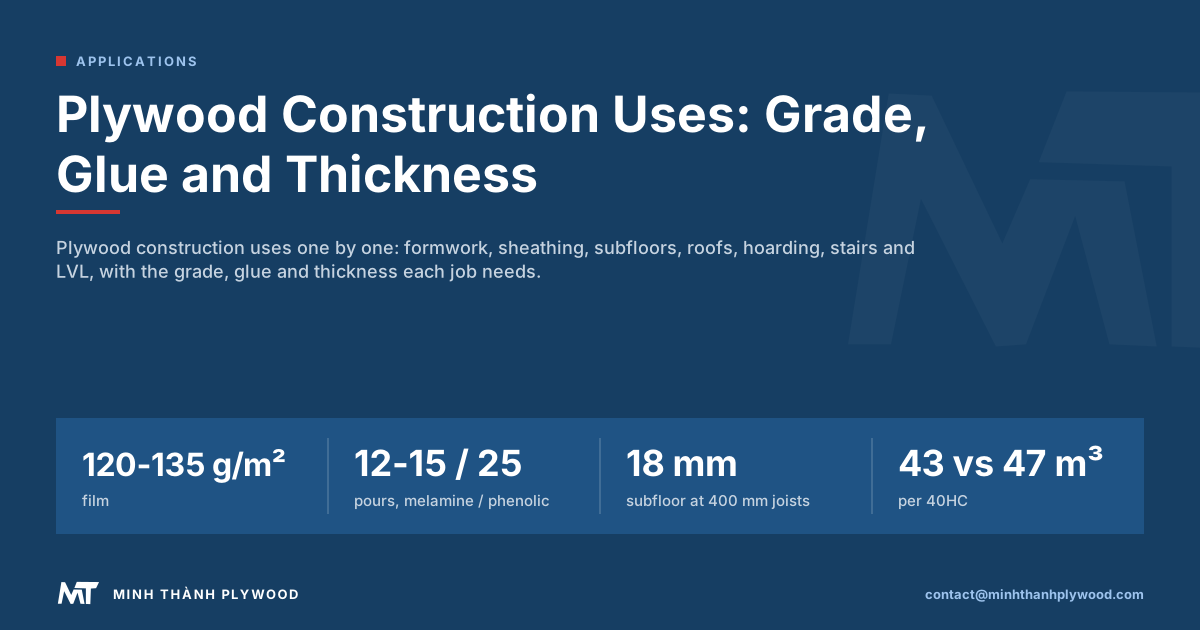
Plywood in construction does six jobs: concrete formwork, wall and roof sheathing, subfloors, site hoarding, stair treads and landings, and LVL beams and bearers. Each job asks for its own face, glue and thickness, so a contractor orders by use, not by the word plywood. Minh Thanh Plywood supplies film-faced, anti-slip, exterior and LVL panels for these uses.
What are the main uses of plywood in construction?
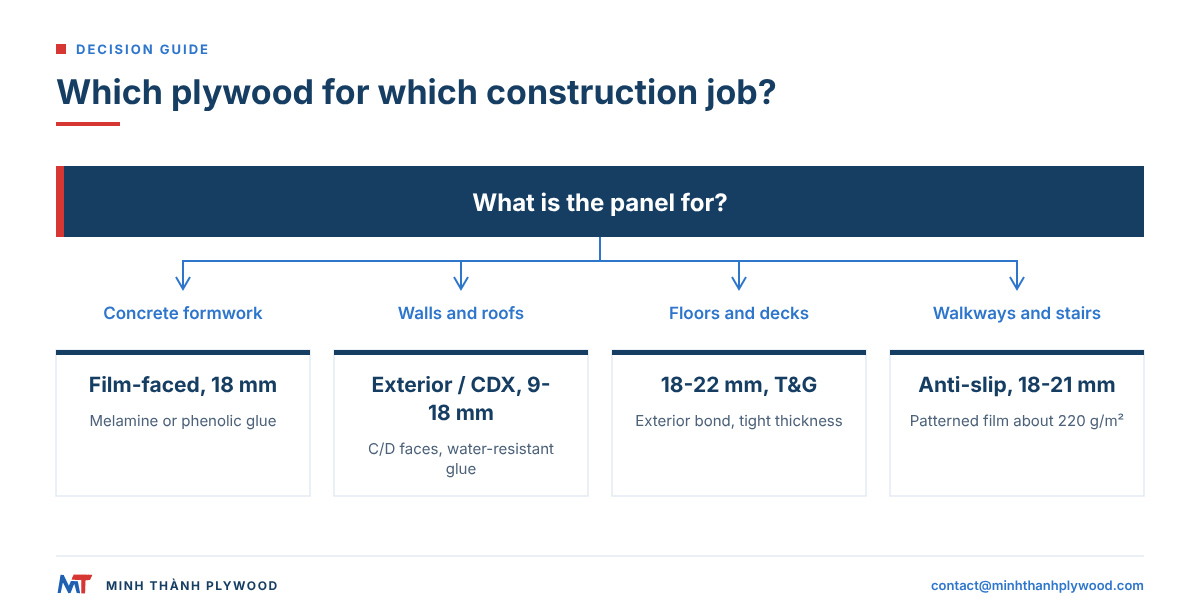
Plywood in construction is used for six main jobs: formwork, wall and roof sheathing, subfloors, hoarding, stair treads and landings, and LVL beams and bearers. The job decides the panel, meaning the face, the glue and the thickness. The table maps each use to the face, glue and thickness a contractor usually orders.
| Use | Panel type | Glue (bond) | Usual thickness | Where to read more |
|---|---|---|---|---|
| Concrete formwork | Film-faced plywood | Melamine-fortified or phenolic (WBP) | 12, 15, 18 or 21 mm | Film-faced plywood |
| Wall sheathing and bracing | Exterior or CDX-type, C/D faces | Melamine-fortified or phenolic | 9 to 12 mm | Exterior plywood |
| Roof sheathing | Exterior or CDX-type | Melamine-fortified or phenolic | 12 to 18 mm | Roof sheathing guide |
| Subfloors and floor decks | Exterior-bonded, often tongue and groove | Phenolic or melamine-fortified | 18 to 22 mm | Flooring over plywood |
| Hoarding, fencing and site protection | Commercial or exterior, painted | Melamine-fortified | 9 to 18 mm | This article, below |
| Stair treads, landings, walkways | Exterior or anti-slip | Phenolic or melamine-fortified | 18 to 21 mm | Anti-slip plywood |
| Beams, headers, formwork bearers | LVL | Phenolic or melamine-fortified | By section size | LVL |
Interior furniture plywood bonded with UF glue does not belong on this list. It is made for dry rooms, and on a building site it is used only for finished interior joinery after the building is closed.
Plywood sizes and thickness by use: the Philippines and the metric world
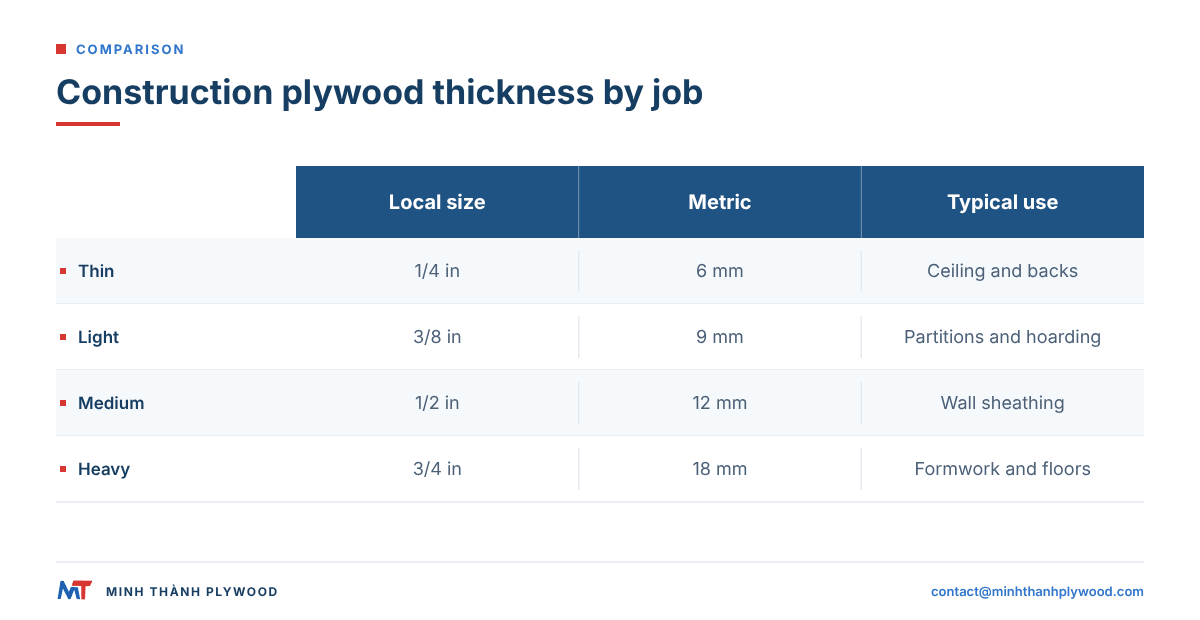
The standard sheet is 4 × 8 ft, which is 1220 × 2440 mm, and it is sold in the Philippines in inch thicknesses that map to metric panels. A Philippine vendor guide lists ordinary plywood in 1/4, 3/8, 1/2, 5/8 and 3/4 in, and marine plywood mainly in 1/4, 1/2 and 3/4 in (Vinawood, plywood sizes in the Philippines, read in October 2026).
| Local thickness | Metric panel | Use on a building site |
|---|---|---|
| 1/4 in | 6 mm | Ceiling boards, cabinet backs, thin partition skins |
| 3/8 in | 9 mm | Wall partitions, light hoarding, ceiling |
| 1/2 in | 12 mm | Wall sheathing, hoarding, curved or light formwork |
| 5/8 in | 15 mm | Roof sheathing, formwork, shelving |
| 3/4 in | 18 mm | Formwork, subfloors, stair treads, heavy hoarding |
The same vendor guide prices ordinary 4 × 8 ft sheets at about ₱350–450 for 1/4 in, ₱650–800 for 1/2 in and ₱1,000–1,200 for 3/4 in, and marine at about ₱450–600, ₱800–950 and ₱1,200–1,400 (Vinawood, plywood price Philippines, read in October 2026). Local names split plywood into ordinary and marine; ordinary means moisture-resistant (MR) glue for dry or protected work, and marine means phenolic or upgraded water-resistant glue for wet areas and exterior trim. For concrete formwork, Philippine contractors also use film-faced panels, which are marine-grade glue under a film.
Philippine rules matter to an importer. The Department of Trade and Industry’s Bureau of Philippine Standards requires plywood to carry the Philippine Standard (PS) mark when made locally, or the Import Commodity Clearance (ICC) sticker when imported (DTI-BPS, read in October 2026). The rule rests on DTI Department Administrative Order 20-06 of 2020. The marking must show the bonding class, thickness and formaldehyde emission rating. Before an order, we confirm with the buyer which documents the importer needs for that route.
Other markets read thickness the same way in millimetres: 9 mm and 12 mm for walls and hoarding, 12 to 18 mm for roofs, 18 to 22 mm for floors and 12 to 21 mm for formwork, as in the first table above.
Why do builders choose plywood over solid boards?
Builders choose plywood because cross-laminated veneers make a sheet that is strong in both directions and barely moves with moisture. Each veneer is laid with its grain at a right angle to the one below, so the panel resists splitting, holds nails close to its edges and keeps its size when the weather changes.
Three practical gains follow on site:
- Coverage. One 1220 × 2440 mm sheet covers about 3 m² of wall, roof or floor in one piece, with fewer joints than boards.
- Bracing. A nailed sheet stops a timber frame from racking; boards laid straight do not.
- Reuse. Film-faced and painted panels go from pour to pour or from site to site, which solid boards rarely survive.
The trade-off is that plywood is only as water-resistant as its glue. That is why the glue line is the first thing to check on a construction order, before the face.
How is construction plywood made?
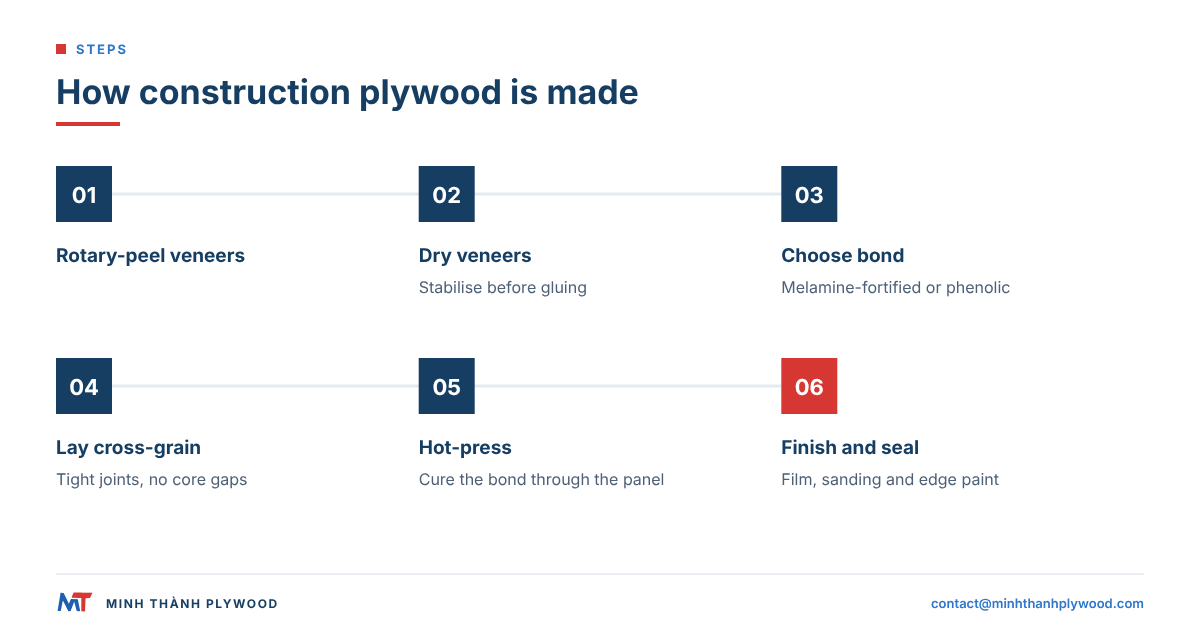
Construction plywood is made from rotary-peeled veneers, dried, coated with water-resistant glue, laid cross-grain in an odd number of layers and hot-pressed into one sheet. In northern Vietnam the core veneers are plantation eucalyptus or acacia; the faces are chosen for the job, from film for formwork to plain utility veneer for sheathing.
The steps that decide site performance are:
- Veneer drying to a stable moisture content before glue goes on, so the bond cures evenly.
- Glue choice: melamine-fortified for most formwork and sheathing, phenolic (WBP) for the longest life outdoors.
- Core laying: tight joints and no overlaps or gaps, which would show as soft spots under a screed or a wheel.
- Pressing under heat until the glue line has cured through the full thickness.
- Finishing: film pressed on for formwork, sanding for sheathing faces, edge sealing with paint.
At Minh Thanh, core layers are stitched both horizontally and vertically before pressing, so core veneers cannot open up into gaps inside the panel.
Formwork: which plywood holds concrete?
Film-faced plywood is the formwork panel: a smooth resin film on both faces releases from concrete and leaves a clean surface. Standard film runs about 120 to 135 g/m², with premium film from 135 g/m²; the glue under it decides how many pours the panel survives.
| Formwork choice | What it means on site |
|---|---|
| 18 mm, melamine-fortified glue | General slabs and walls, about 12 to 15 pours |
| 18 mm, phenolic (WBP) glue | Repeated pours and long projects, up to about 25 pours |
| 12 or 15 mm | Curved walls, columns, light work |
| 21 mm | Heavy pours and wider bearer spacing |
Reuse figures hold with proper handling, release agent and edge sealing. Panels dropped from height, stored wet on the ground or cut without resealing the edges lose pours fast, whatever their glue.
Sizes are 1220 × 2440 mm and 1250 × 2500 mm, and both suit the main formwork systems. For core, film and glue choices in detail, see the film-faced plywood page.
Anti-slip plywood: scaffolds, walkways and trailer floors
Anti-slip plywood is film-faced plywood with a heavier film, about 220 g/m², pressed with a raised pattern such as wire mesh, hexagon or rice grain. The pattern gives grip to boots, trolleys and wheels, which a smooth formwork film does not.
On a building site it is used for scaffold decking, ramps, temporary walkways, stair landings and hoist platforms. Off site, the same panel floors trucks and trailers. Thicknesses of 18 and 21 mm are the usual choice where people walk and wheels roll; Minh Thanh makes anti-slip plywood on order, with the pattern and film colour to the buyer’s specification.
Wall sheathing and bracing
Wall sheathing is the layer of panels nailed to the outside of a timber or steel stud frame: it braces the frame against wind and racking and carries the cladding and the weather barrier. Plywood used for sheathing is an exterior or CDX-type panel, with utility C/D faces and water-resistant glue.
Typical choices are 9 mm for light partitions and 12 mm for external walls, laid with the long edge across the studs. Nailing schedules such as 150 mm at panel edges and 300 mm in the field come from the structural design and the local building code, not from the panel maker.
Minh Thanh’s exterior plywood uses low-grade faces with melamine-fortified or phenolic (WBP) glue for this kind of outdoor work, including wall sheathing and stair treads.
Roof sheathing
Roof sheathing is plywood laid over rafters or trusses to carry the roofing and the loads of snow, wind and people. Its thickness follows the rafter spacing: around 12 mm is common at 400 mm centres and 15 to 18 mm at 600 mm centres, with clips or blocking at unsupported edges.
Exposure matters more on a roof than anywhere else, because panels can sit uncovered for days before the felt goes on. Specify exterior glue, leave a small gap between sheets for movement, and keep the top face clean of standing water. The full sizing method, with span ratings and metal-roof details, is in our plywood roof sheathing guide.
Subfloors and floor decks
A subfloor is the structural plywood deck screwed and glued to the joists, under the finished floor. It must be stiff enough not to bounce and flat enough for the floor covering to lie true.
- 18 mm is the usual subfloor at 400 mm joist centres.
- 22 mm suits 600 mm joist centres and heavier loads.
- Tongue and groove long edges lock adjacent sheets so the joints between joists do not step; see tongue and groove plywood.
Flatness is the property that floor layers notice first. Minh Thanh’s sanded panels hold thickness to ±0.2–0.3 mm and down to ±0.2 mm; commercial and film-faced panels hold ±0.5 mm. A deck built from panels that agree in thickness needs less levelling before the floor goes down, which is the subject of our guide to laying floors over plywood. The broader choice of floor panel is covered in plywood flooring.
Hoarding, fencing and site protection
Site hoarding is the painted plywood wall around a building site: it secures the site, carries signage and protects the public. It is usually 9 to 18 mm panels on a timber or steel post frame, painted on the street face and edge-sealed against rain.
Inside the site, the same panels protect finished floors, stairs and door frames while other trades work. A melamine-fortified bond suits hoarding for a single project; phenolic suits hoarding that will stand longer or be moved to the next site. Painted film-faced panels are a common shortcut: the film takes paint and sheds rain well.
Stair treads, landings and exterior details
Exterior plywood is used for stair treads, landings, balcony decks under a membrane and the soffits and fascias of a building. These parts see foot traffic and weather, so they need water-resistant glue and enough thickness not to flex underfoot, usually 18 or 21 mm.
For treads in wet or public areas, anti-slip film gives grip without a separate coating. For parts that will be painted or clad, a plain exterior panel with C/D faces is the cost-effective choice.
LVL in construction: beams, headers and formwork bearers
LVL (laminated veneer lumber) is made from veneers with their grain all in one direction, so it works as a beam rather than a sheet. On site it is used for headers over openings, floor and roof beams, rim boards, scaffold planks and the bearers and joists that carry formwork panels.
Because the veneers are glued and pressed, LVL is straight and uniform along its length, without the knots and splits of sawn timber. Minh Thanh produces LVL to the section sizes and glue the buyer specifies.
Which plywood grade and glue does each construction use need?
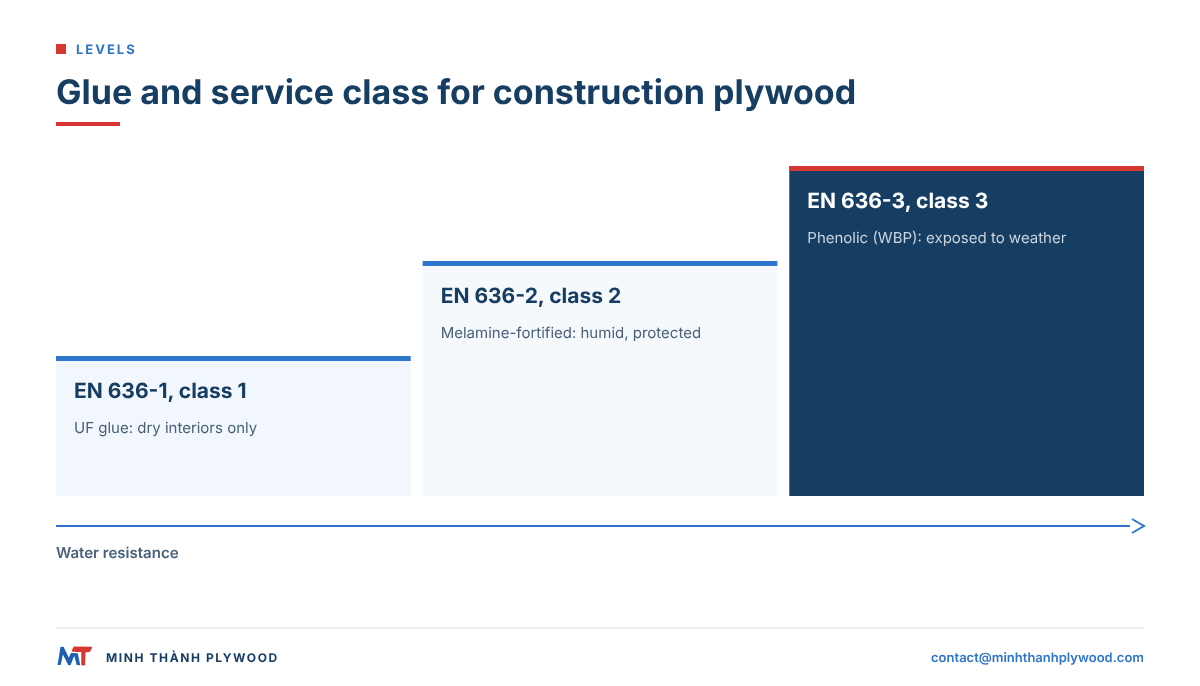
The glue sets where a panel may go, and the face grade sets how it looks. European buyers name the bond by EN 314-2 class and the panel by EN 636 service class; North American buyers use the PS 1 exposure rating.
| Service condition | EN 636 class | EN 314-2 bond class | Typical glue | Construction uses |
|---|---|---|---|---|
| Dry, inside a closed building | EN 636-1 | Class 1 | UF | Interior joinery only |
| Humid, protected from direct weather | EN 636-2 | Class 2 | Melamine-fortified | Hoarding, temporary works, sheathing behind cladding |
| Exterior, exposed to weather | EN 636-3 | Class 3 | Phenolic (WBP) or high-melamine | Formwork, roofs, exposed decks, long-life hoarding |
The European standard for plywood used in construction works is EN 13986, which brings in the EN 636 classes. CE marking of these panels rests on the EU Construction Products Regulation, Regulation (EU) No 305/2011 (checked October 2026). In the United States, structural plywood is graded to Voluntary Product Standard PS 1-22, the current edition listed by NIST (dated 2 October 2023).
Face grades for construction are utility grades: C/D on exterior panels, film on formwork. Paying for a furniture face on a sheathing panel adds cost and nothing else.
Can plywood get wet during construction?
Yes, plywood bonded with phenolic (WBP) or melamine-fortified glue can get wet during construction and dry out without delaminating. This is the meaning of “Exposure 1” on North American sheathing: built to take rain during normal construction delays, not to stay exposed for good.
Three habits keep wet panels sound:
- Store stacks off the ground on bearers, under a cover that lets air through.
- Seal every cut edge with paint or edge sealer, because water enters plywood through the end grain.
- Close in quickly: felt on roofs, wrap on walls, and the finished floor once the building is dry.
Interior panels with UF glue are the exception. They are made for dry rooms and should not stand in rain at any stage.
When was plywood first used in home construction?
Plywood entered home construction in the 1930s, when fully waterproof glues made exterior panels possible, and became the normal sheathing and subfloor material in North American houses after the Second World War. Wartime production had proven the panel in boats, aircraft and barracks, and post-war house building used it at scale.
Today the same cross-laminated principle is made with plantation hardwood cores in Asia, film faces for formwork and engineered products such as LVL. The history explains why building codes in North America treat plywood sheathing as a standard, well-documented material.
Is Vietnamese eucalyptus plywood strong enough for construction?
Yes. Eucalyptus is a dense plantation hardwood, about 650 to 750 kg/m³, and a eucalyptus core gives a hard, stiff panel that resists dents, holds screws and survives repeated formwork cycles. It is the standard core for film-faced and anti-slip panels from northern Vietnam.
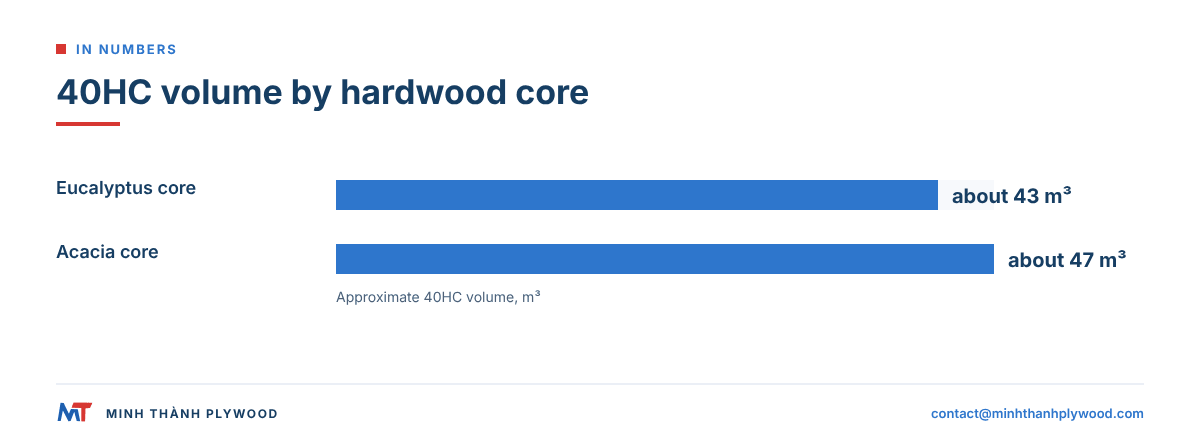
Acacia is the lighter alternative, about 580 kg/m³, chosen when a container should carry more cubic metres. A 40HC of premium film-faced plywood holds about 43 m³ with eucalyptus core and about 47 m³ with acacia core, because the heavier core reaches the payload first.
Okoume is a face veneer, not a core: on construction plywood it gives a lighter, smoother face, while the core stays eucalyptus or acacia.
Which certificates does construction plywood need for export?
Construction plywood needs the certificate the destination’s rules tie to its use. Formwork, hoarding and temporary works panels are bought on specification; structural panels for permanent building works need the market’s mark.
- European Union and UK: plywood placed on the market for construction works carries CE (or UKCA) marking under EN 13986 with a Declaration of Performance. CE is available* for Minh Thanh panels.
- United States and Canada: structural sheathing is graded and stamped to PS 1 or PS 2; non-structural uses are not.
- Every market: a quality system and documents. Minh Thanh holds ISO 9001:2015 (KAC25/0185) and supplies the EUDR compliance dossier (origin records and geolocation files) with orders.
*Supplied directly or through qualified partner mills.
How do you choose a Vietnamese construction plywood supplier?
Choose a construction plywood supplier in Vietnam by checking four things before price: the glue system, the core species, the film weight and whether the mill presses the panels itself. A contractor in Saudi Arabia, the Gulf or Africa buying film-faced shuttering plywood should ask for:
- The glue named on the quotation: melamine-fortified or phenolic (WBP), with the reuse target that goes with it.
- The core species: eucalyptus or acacia, and whether the core is stitched.
- Film weight in g/m² and the film colour.
- A free sample and a boiling test on it before the order.
- Loading photos and video of the container before it leaves.
Minh Thanh films and photographs every container before loading, and buyers receive the photos and video. Minimum order is one 40HC, with mixed specifications by agreement.
How should you specify construction plywood on an order?
Specify construction plywood with seven lines, in this order: the use, the panel type, the glue, the core, the face or film, the size and thickness, and the packing and quantity. The use comes first because it settles the rest.
A complete line for formwork reads like this: “Concrete formwork, film-faced plywood, phenolic (WBP) glue, eucalyptus core, black film 135 g/m² both faces, 18 × 1220 × 2440 mm, edges sealed, export packs, 1 × 40HC to your port.”
Production takes 15–45 days after the 30% deposit, with the 70% balance against the scanned B/L or by irrevocable L/C at sight, FOB Hai Phong, CFR or CIF. Send your line to contact@minhthanhplywood.com or through the construction plywood page, and we reply within hours.
Buyer questions, answered
What is plywood used for in construction?
Concrete formwork, wall and roof sheathing, subfloors, site hoarding and fencing, stair treads and landings, and, as LVL, beams, headers and formwork bearers. Each use needs its own face, glue and thickness.
Can plywood get wet during construction?
Panels bonded with phenolic (WBP) or melamine-fortified glue take rain during the build and dry out without the layers parting. Interior panels bonded with UF glue should be kept dry. Seal cut edges and cover stacks on site.
What thickness of plywood is used for formwork?
18 mm is the most common formwork thickness for slabs and walls; 12 and 15 mm are used for curved or light work and 21 mm for heavy pours. Spans between bearers decide the final choice.
How many times can film-faced plywood be reused in formwork?
With proper handling, release agent and edge sealing, melamine-bonded film-faced panels reach about 12 to 15 pours and phenolic-bonded panels up to about 25. The site's handling decides most of the result.
What is the difference between film-faced and anti-slip plywood?
Film-faced plywood has a smooth film for concrete faces. Anti-slip plywood carries a heavier film, about 220 g/m², pressed with a raised pattern so feet and wheels grip, for scaffold boards, walkways and trailer floors.
Which core species is best for construction plywood from Vietnam?
Eucalyptus gives the hardest, densest core for formwork and heavy floors; acacia is lighter and loads more cubic metres per container. Both are plantation timber grown in northern Vietnam.
Is Vietnamese eucalyptus plywood strong enough for construction?
Yes, for formwork, hoarding, stair treads and sheathing when it is bonded with water-resistant glue. Eucalyptus is a dense hardwood, about 650 to 750 kg/m³, so it holds screws and resists dents on site.
Does construction plywood need a certificate for export?
It depends on the use and the market. Structural panels sold for building works in the EU need CE marking under EN 13986, and US structural sheathing is graded to PS 1 or PS 2. Formwork and hoarding panels are bought on specification.
When was plywood first used in house construction?
Plywood entered house building in North America in the 1930s, once fully waterproof glues arrived, and became the normal sheathing and subfloor panel after the Second World War.
Is plywood or OSB better for construction?
Plywood is lighter for its strength, holds fasteners near edges better and recovers better after wetting; OSB is cheaper per sheet. Many builders keep plywood for floors, roofs in wet climates and formwork.