
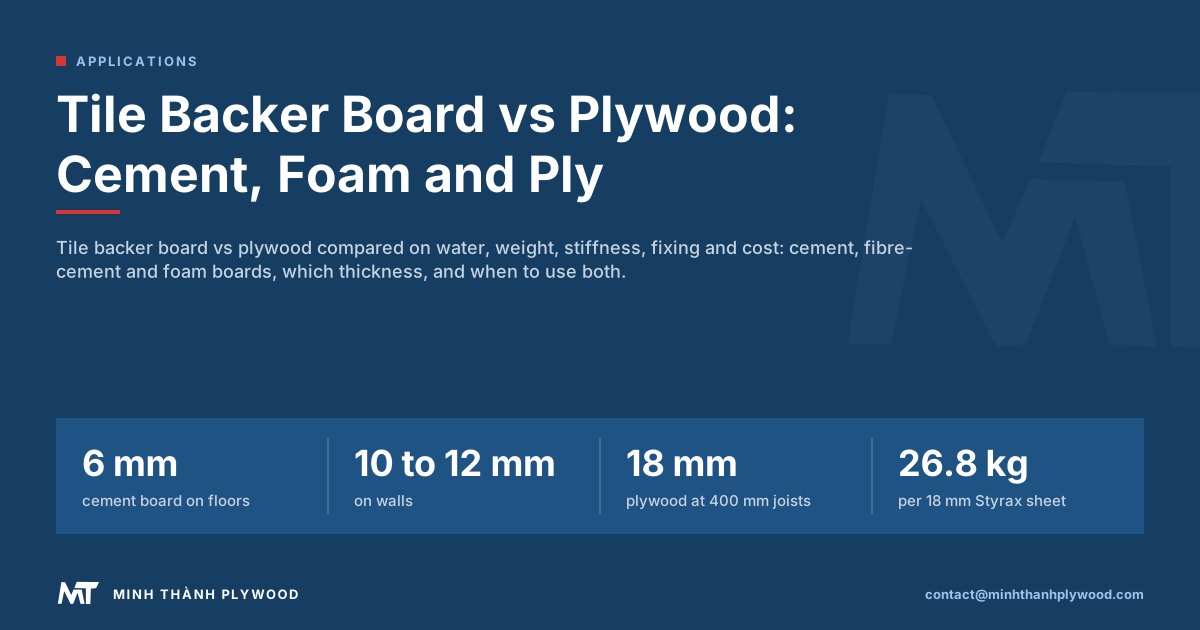
A tile backer board gives tile a surface that does not swell when wet; plywood gives the floor its stiffness and screw holding. On most timber floors the best answer is both: exterior plywood as the structural deck, a 6 to 12 mm backer board or membrane on top. Minh Thanh Plywood compares cement, fibre-cement and foam boards with plywood, row by row, with a verdict by use.
Tile backer board vs plywood: the short answer
Tile backer board is the better tiling surface; plywood is the better structural deck. A backer board does not swell or rot when wet, so tile adhesive bonds to a stable face. Plywood bends less between joists and holds screws, so the floor stays stiff. On timber floors the best build uses both.
| Use | Best choice |
|---|---|
| Tiled floor on timber joists | Plywood subfloor plus 6 mm cement board or a membrane |
| Shower walls on studs | Coated foam board or cement board, joints sealed |
| Dry wall with fittings | Plywood, primed, tiled directly |
| Bathroom floor on concrete | Backer board or membrane only, no plywood |
| Loft or upper floor where weight matters | Plywood plus foam board or membrane |
| Wet room floor | Plywood deck, falls formed, full waterproofing system |
The rest of this guide explains each row: what a backer board is, how the types differ, and what thickness to buy.
What is a tile backer board?
A tile backer board is a flat sheet made to be tiled on: cement, fibre-cement, gypsum-fibre or foam with a cement coating, which stays stable when wet and gives tile adhesive a strong key. It is fixed to studs, to a plywood deck or bonded to a solid floor, and tiled straight on.
Backer boards exist because ordinary building boards behave badly under tile. Plasterboard softens when wet. Chipboard and OSB swell at the edges. Plywood is stable and stiff, but its timber face still takes up water and moves. A backer board fills the gap: a surface that water does not damage, sitting on a structure that does not bend.
Types of tile backing board
Four types of tile backing board are sold in most markets: cement board, fibre-cement board, foam board and gypsum-fibre board.
- Cement board: Portland cement and aggregate, reinforced with glass-fibre mesh on both faces. Hard, heavy, unaffected by water. Cut by scoring and snapping, or with a diamond blade. Common in 6 and 12 mm.
- Fibre-cement board: cement reinforced with cellulose fibres, denser and smoother than mesh cement board. Holds screws closer to the edge. Also heavy.
- Foam board: extruded polystyrene (XPS) core with a thin cement-and-mesh coating on both faces. Very light, cut with a knife, waterproof when joints are sealed. Sold from 6 mm upwards for walls, shower trays and some floors.
- Gypsum-fibre board: gypsum with paper or cellulose fibres, moisture-resistant grades for bathrooms. Used on walls in dry and humid areas, rarely in showers without a membrane.
Cement board is specified in ASTM C1325, the standard for fiber-mat reinforced cementitious backer units, and water-resistant gypsum backing panels in ASTM C1178/C1178M.
A fifth surface does the same job without being a board: a sheet or liquid membrane laid straight onto primed plywood. The tiling on plywood guide covers membranes in detail.
Comparison table: plywood vs cement board vs foam board vs fibre-cement
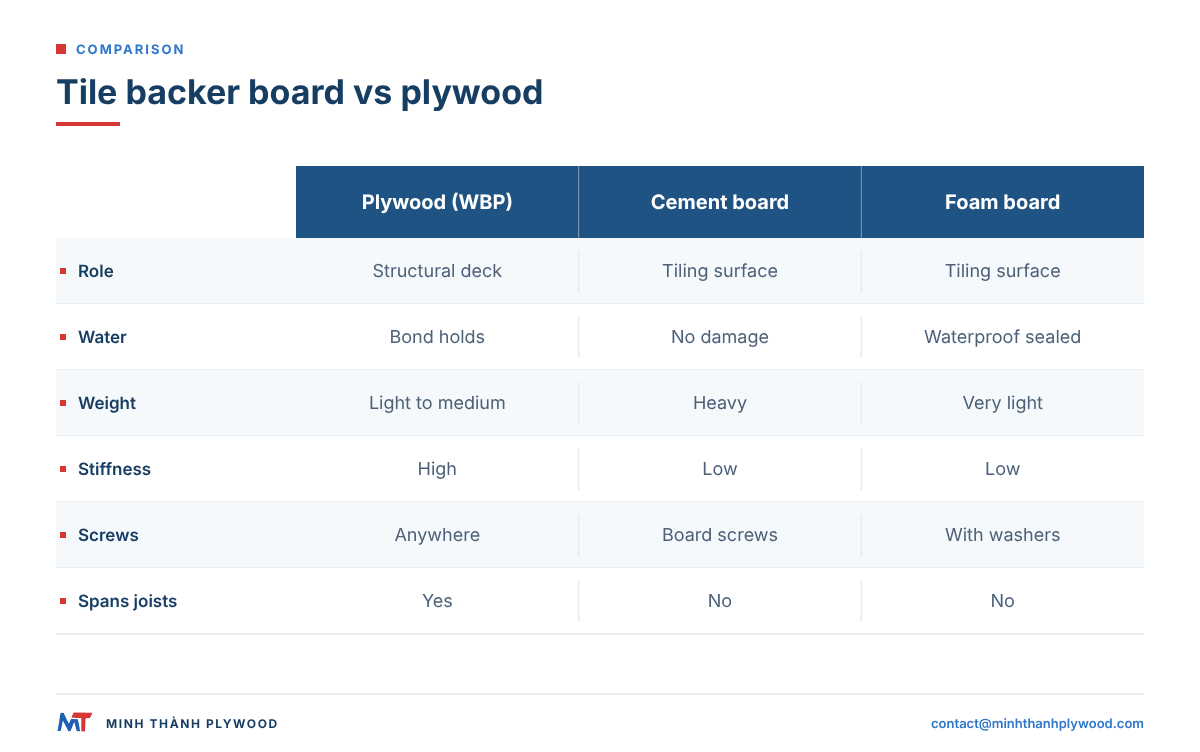
Plywood beats every backer board on stiffness and screw holding; every backer board beats plywood on stability in water. The table sets them out one metric per row.
| Metric | Exterior plywood (WBP) | Cement board | Fibre-cement board | Foam (XPS) board |
|---|---|---|---|---|
| Role | Structural deck and wall sheathing | Tiling surface | Tiling surface | Tiling surface, light walls |
| Effect of water | Holds bond, timber swells slightly | No damage, water passes through | No damage, slow to absorb | No damage, waterproof with sealed joints |
| Weight | Light to medium | Heavy | Heavy | Very light |
| Bending stiffness | High | Low | Low to medium | Low |
| Screw holding | Anywhere in the sheet | Needs board screws, not near edges | Better than cement board | Needs washers |
| Cutting | Saw | Score and snap or diamond blade | Saw with dust control | Knife |
| Spans joists alone | Yes, at the right thickness | No | No | No, unless rated as a floor element |
| Holds fittings (rails, cabinets) | Yes | Only into studs behind | Limited | Only with special plugs |
| Typical thickness for tiling | 12 to 22 mm | 6 to 12 mm | 6 to 12 mm | 6 to 20 mm |
| Waterproofing needed in showers | Yes, full membrane | Yes, coat or membrane | Yes | Joint and screw sealing |
Read the table by role. Plywood is the structure; the boards are skins. A board on a floor always sits on something stiff: plywood, a concrete slab or a rated system.
Waterproof backer board: which boards keep water out?
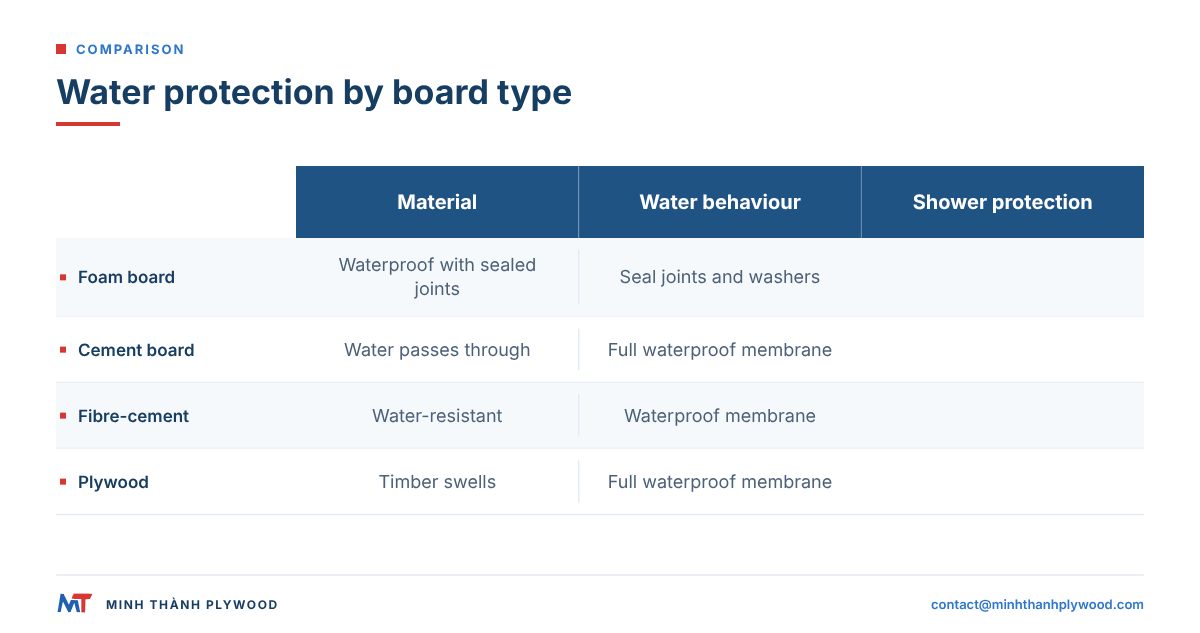
Foam backer boards are the only common type that is waterproof in itself, once the joints and screw heads are sealed. Cement and fibre-cement boards are water-resistant: water does not damage them, but it passes through to whatever is behind.
That difference decides the shower build:
- Foam board: seal every joint with the maker’s tape and sealant, cover each washer, tile.
- Cement backer board: fix, tape the joints with alkali-resistant mesh, then apply a liquid waterproofing coat or a sheet membrane across the full wet zone.
- Plywood: WBP-glued, primed, full waterproofing membrane with taped corners. Never bare in a shower.
A concrete backer board and a cement backer board are the same product under two names. Neither should be the only barrier between a shower and a timber stud wall.
Weight and handling
Cement and fibre-cement boards are much heavier than plywood of the same size; foam boards are much lighter. Weight matters on upper floors, in lofts and when one fitter carries sheets up stairs.
Plywood weight depends on the core. An 18 mm sheet of 1220 × 2440 mm weighs about 26.8 kg on a Styrax core, 31.1 kg on Acacia and 34.8 kg on Eucalyptus. Cement board is roughly twice as dense as a Styrax-core panel, which is why cement boards come in smaller sheets. Foam boards weigh a fraction of either and are easy to carry into a bathroom on the third floor.
The weight on the floor adds up: a tiled floor carries plywood, board, adhesive and tile. On a loft conversion or a timber-framed upper floor, a foam board or a membrane keeps the dead load down.
Does a backer board stiffen the floor?
No. A cement or foam backer board adds almost nothing to the stiffness of a floor. The joists and the plywood subfloor must already meet the deflection limit, L/360 for ceramic and porcelain and L/720 for natural stone, before the board goes down.
This is the most common misunderstanding about backer board. A 6 mm cement board over a springy floor moves with it, and the tiles crack along the line of greatest bending. Fix stiffness in the structure: closer joists, a thicker plywood subfloor, a second layer of plywood. Then add the board as the tiling surface.
A plywood subfloor of 18 mm or more on joists at 400 mm centres is the usual base. At 600 mm centres the subfloor needs to be thicker, or a second plywood layer added under the board.
What thickness backer board?
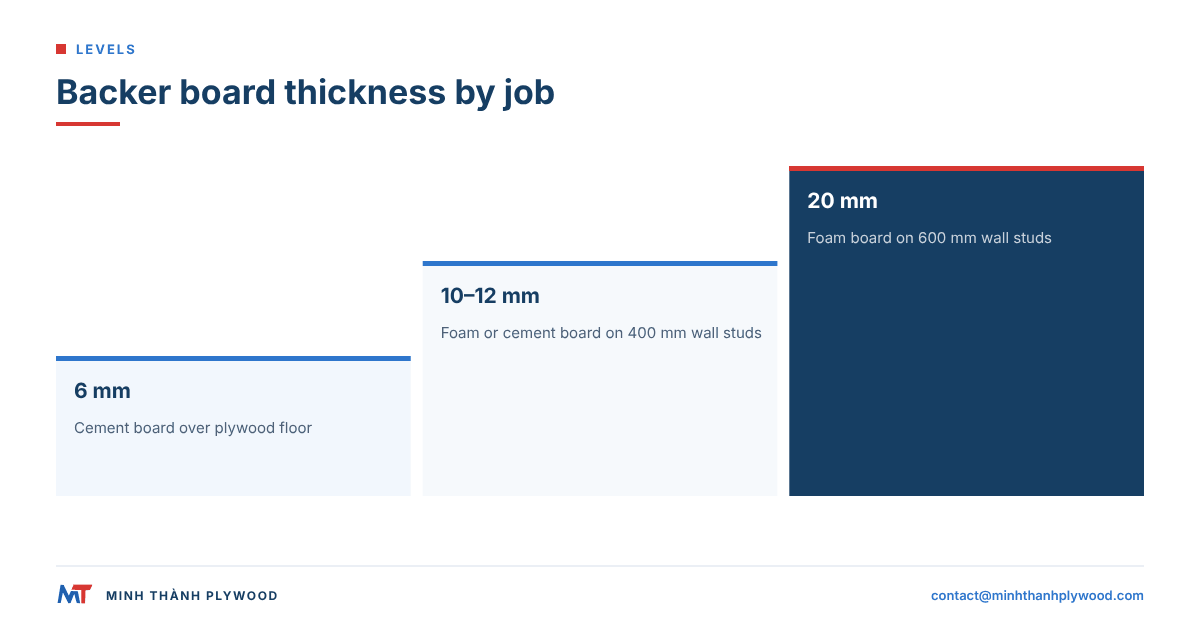
On floors over plywood, use 6 mm cement board as the common minimum; on walls fixed to studs, use 10 to 12 mm boards. The thinner board on floors works because the plywood carries the load; the thicker board on walls must span between studs on its own.
| Where | Board | Thickness | Under it |
|---|---|---|---|
| Floor over plywood | Cement board | 6 mm | 18 mm exterior plywood or more |
| Floor over plywood, upper storey | Foam board rated for floors | 6 to 10 mm | 18 mm exterior plywood or more |
| Wall on studs at 400 mm centres | Cement board | 12 mm | Studs |
| Wall on studs at 400 mm centres | Foam board | 10 to 12 mm | Studs |
| Wall on studs at 600 mm centres | Foam board | 20 mm | Studs |
| Over existing tiles or plaster | Foam board | 6 mm | Bonded to the old surface |
UK boards come in a few standard sizes: 1200 × 600 mm is the usual single board and kit size (Wickes sells 6, 10 and 12 mm in kits of 4, 6 or 10 boards), 1200 × 800 mm is a 12 mm fibre-cement size, 1200 × 2400 mm is the full 12 mm fibre-cement sheet, and No More Ply tongue-and-groove floor boards are 18 and 22 mm thick in 1200 × 600 mm.
Over a timber floor, BS 5385-3, the British Standard for floor tiling, expects a rigid deck with limited deflection, and UK adhesive makers set the common rule of 18 mm plywood on joists at 400 mm centres before any board goes down.
A 6mm tile backer board on a floor is a tiling surface, not a structure. Bed it in adhesive and screw it down; on its own it would crack between joists.
Can you put cement board over plywood?
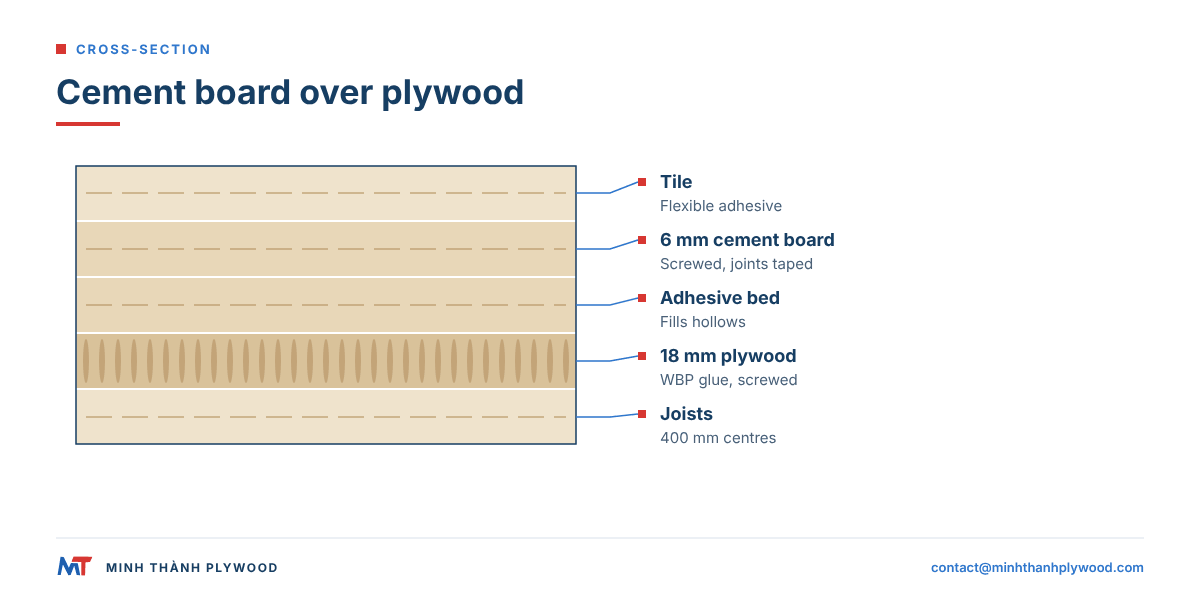
Yes. Cement board over plywood is the standard tiled floor build on timber joists. The plywood takes the load and stiffness; the cement board gives the tile a stable face.
- Check the plywood subfloor: exterior-glued, 18 mm or more, screwed to every joist, joints supported.
- Spread tile adhesive on the plywood with a notched trowel.
- Lay the cement board in the wet adhesive, rough side up, leaving a small gap at the walls.
- Stagger the joints: board joints must not line up with the plywood joints underneath.
- Screw the board down with corrosion-resistant board screws at close centres across the sheet, through into the plywood.
- Tape the joints with alkali-resistant mesh tape bedded in adhesive.
- Tile with a flexible adhesive, after waterproofing if the floor is in a wet zone.
The adhesive bed under the board fills small hollows and stops the board drumming. Skipping it is the most common reason cement board floors crack.
Fixing and cutting each board
Each board needs its own screws and blade. Plywood takes ordinary wood screws anywhere in the sheet. Cement board needs coated board screws with a ribbed head that countersink into the mesh, kept back from the edges. Foam board needs screws with large washers, sealed over before tiling.
Cutting is a matter of dust and time. Plywood and foam board cut cleanly. Cement and fibre-cement boards produce fine silica dust when sawn, so score and snap them where possible, or cut outdoors with dust extraction and a mask.
What does each option cost?
Plywood is usually the lowest-cost sheet per square metre for a structural deck; foam boards are the highest-cost per square metre but save labour and weight. Cement board sits between them.
The fair comparison is the finished build, not the sheet price:
- Plywood plus membrane: plywood as the deck, a sheet membrane on top; quick to lay, one layer of adhesive less.
- Plywood plus cement board: two sheets, an adhesive bed under the board, more screws, more weight.
- Foam board on walls: highest board price, fastest to fix and seal, no separate waterproofing coat.
UK shelf prices in October 2026 show where the money goes. Wickes lists a 6 × 600 × 1200 mm pre-primed fibre-cement board at £15, a 12 × 800 × 1200 mm fibre-cement board at £21, and XPS insulation boards at £15 for 10 mm and £17 for 12.5 mm, all in 1200 mm lengths.
Tiling Supplies Direct, a UK specialist, prices HardieBacker 6 and 12 mm at £11.60 to £12.99 and No More Ply tongue-and-groove 18 and 22 mm floor board at £26.90 to £33.90, all ex VAT, and carries JACKOBOARD, wedi, Marmox Multiboard and Schluter KERDI-BOARD at £6 to £75 a board depending on size and thickness.
| UK board (1200 mm lengths), Oct 2026 | Price | Source |
|---|---|---|
| Fibre-cement 6 mm, 600 mm wide, pre-primed | £15 | Wickes |
| Fibre-cement 12 mm, 800 mm wide | £21 | Wickes |
| XPS foam 10 mm / 12.5 mm, 600 mm wide | £15 / £17 | Wickes |
| HardieBacker 6 and 12 mm | £11.60 to £12.99 ex VAT | Tiling Supplies Direct |
| No More Ply T&G fibre-cement 18 and 22 mm | £26.90 to £33.90 ex VAT | Tiling Supplies Direct |
The board is a small line against the build: on a timber floor a plywood deck that is already stiff needs only a thin board or a membrane on top.
On timber floors the plywood is in every build, so its price is fixed; the choice is which layer goes on top. Minh Thanh quotes exterior plywood from US$250/m³ for commercial grades (October 2026); the final price depends on core, glue, thickness, size and quantity.
Plywood or backer board for tiling: verdict by use
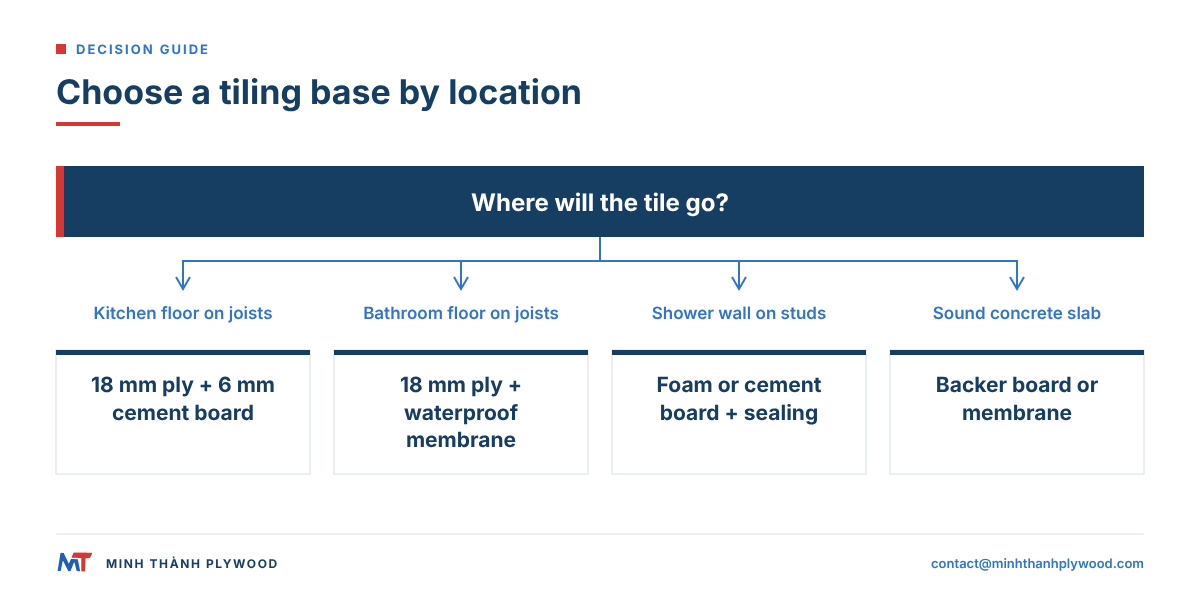
Use plywood where the tile needs a structure, such as a deck on joists or studs. Use a backer board where the tile needs a water-stable surface, such as a shower wall or a bathroom floor. On timber floors and in wet rooms, use both.
| Job | Verdict |
|---|---|
| Kitchen floor on joists | Plywood 18 mm plus 6 mm cement board or decoupling membrane |
| Bathroom floor on joists | Plywood 18 mm plus waterproofing membrane or sealed foam board |
| Shower walls on timber studs | Foam board or cement board with waterproofing |
| Tiled splashback on a plywood wall | Primed plywood, liquid waterproofing in the splash zone |
| Floor on a concrete slab | Backer board or membrane only, if the slab is sound |
| Hallway with natural stone | Two layers of plywood plus decoupling membrane |
| Garden room or cabin | Exterior plywood deck, membrane, flexible adhesive |
When the question is “plywood or backer board for tiling”, the honest answer on timber is that the choice is not either-or. Plywood is the floor; the board is the skin.
When plywood and backer board work together
Plywood and a backer board work together in three builds: the tiled timber floor, the wet room and the wall that must hold fittings.
- Tiled timber floor: plywood subfloor for stiffness, cement board or membrane for the tile.
- Wet room: plywood deck cut and packed to form the falls to the drain, then a foam tray or full waterproofing system.
- Wall with a vanity or heated rail: plywood sheathing on the studs to take screws, backer board or membrane over it in the wet zone.
In each, the plywood quality decides how long the build lasts. A plywood glued for dry use under a cement board in a bathroom will fail before the board does. For the bathroom version of this choice, read plywood in bathrooms.
What to specify for the plywood under the board
Under a backer board or membrane, specify exterior plywood with WBP or melamine-fortified glue, a closed, stitched core, and a stated thickness tolerance. Face appearance does not matter; the bond and the flatness do. A phenolic (WBP) bond is the usual route to Class 3 (exterior) of EN 314-2, the plywood bonding quality standard; ask for the class, tested on the panel, in writing.
Minh Thanh Plywood makes exterior plywood with utility C/D faces and WBP or melamine-fortified glue to the buyer’s specification. Cores are stitched both horizontally and vertically, and thickness tolerance is ±0.5 mm for commercial panels, so adjacent sheets meet level under a thin board. Panels leave the factory at 8–12 % moisture content. Standard sizes are 1220 × 2440 mm and 1250 × 2500 mm, thicknesses 3 to 40 mm.
A specification line for a tiled-floor deck reads: exterior plywood, WBP phenolic glue, eucalyptus core, C/D faces, 18 mm ±0.5 mm, 1220 × 2440 mm, one 40HC. Send it with your quantity and port through the quotation form, or ask for free samples. For the wider choice of floor finishes, see wood flooring types; for decks under loft boards, see chipboard flooring and loft boards.
Buyer questions, answered
Is plywood or backer board better for tiling?
Backer board is the better tiling surface, because it does not swell when wet; plywood is the better structural deck, because it is stiff and holds screws. On timber floors use plywood underneath and a backer board or membrane on top.
Can you put cement board over plywood?
Yes, it is the standard tiled floor build over timber. Bed the cement board in tile adhesive on the plywood, screw it at close centres with board screws, stagger its joints against the plywood joints and tape them with alkali-resistant mesh.
What thickness backer board should I use?
On floors over plywood, 6 mm cement board is the common minimum. On walls, 10 to 12 mm boards span between studs. Foam boards on walls are often 10 to 12 mm, thicker where they must span wider stud spacing.
Does tile backer board make a floor stiffer?
Hardly. Cement and foam boards add little bending strength. The joists and the plywood subfloor must meet the stiffness limit before the board goes down.
Is cement backer board waterproof?
Cement board is not damaged by water, but water passes through it. In showers it needs a waterproofing membrane or a liquid coat on top. Coated foam boards are waterproof themselves once their joints are sealed.
Can I use plywood instead of backer board in a shower?
Only with a full waterproofing membrane over WBP-glued plywood. Bare plywood, or plywood with only grout and tile over it, will take up water in a shower.
Do I need backer board on walls?
In dry areas, primed plywood or plasterboard takes tile without backer board. In showers and splash zones, use a backer board with sealed joints, or plywood with a full waterproofing membrane.
What is the lightest tile backer board?
Foam boards of extruded polystyrene with a cement coating are the lightest, a fraction of the weight of cement board, and cut with a knife. They suit walls and upper floors where weight matters.
Can backer board go on chipboard or OSB?
Board makers prefer plywood underneath. Chipboard and OSB swell at the edges when wet, so cover them with exterior plywood first, or follow the backer board maker's approved build for that deck.