
Yes, you can use plywood in a bathroom, and builders do for floors, walls and vanities. The glue class decides where: WBP for floors and anything near water, melamine-fortified MR for steam zones, interior UF only for dry cabinet parts. In showers, plywood is the backing and a membrane keeps water out. Minh Thanh Plywood maps each bathroom zone to the panel and the protection it needs.
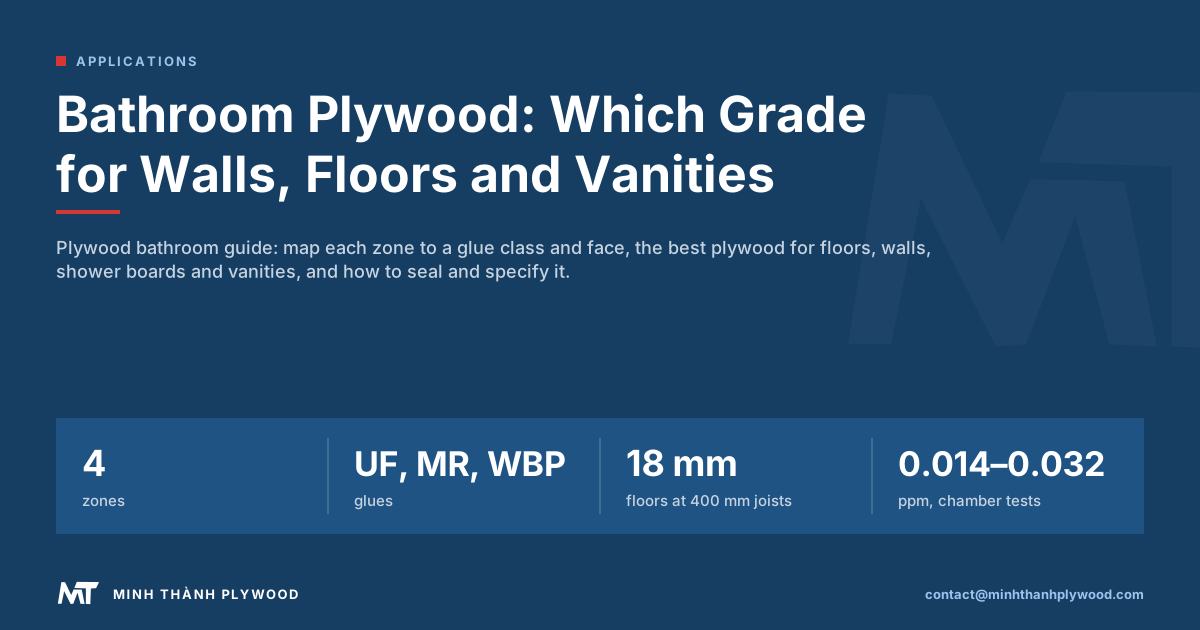
Can you use plywood in a bathroom?
Yes, you can use plywood in a bathroom for the floor, the walls, the vanity and the ceiling, as long as each part gets the right glue class and the wet zones get a waterproof layer on top. Plywood bathroom builds fail for one reason: a panel glued for dry rooms placed where water reaches it.
Three rules cover almost every bathroom:
- Glue class by zone: WBP near water, MR in steam, interior UF only where it stays dry.
- Plywood is the backing, not the barrier: in showers and on floors, a membrane, backer board or sealed finish keeps water off the panel.
- Edges and air: seal every cut edge, and run an extractor fan.
The rest of this guide applies those rules part by part, with the thickness and the line to write on the order.
Bathroom zone map: dry, steam, splash and wet
A bathroom has four moisture zones, and each takes a different plywood. Dry zones see only room air; steam zones see condensation; splash zones see drips and spray; wet zones see running or standing water.
| Zone | Where | Glue class | Protection on the plywood |
|---|---|---|---|
| Dry | Upper cabinets, shelves away from the bath, door frames | Interior UF at E0 emission (EN 636-1 dry) | Paint, lacquer or laminate |
| Steam | Ceiling, upper walls, tall cabinets, mirror cabinets | MR or melamine-fortified (EN 636-2 humid) | Sealed paint or laminate on all faces |
| Splash | Vanity carcass and doors, walls behind basins and toilets | MR at least (EN 636-2), WBP for the base (EN 636-3) | Edges sealed, laminate, HPL or two-pack lacquer |
| Wet | Shower walls, shower and bathroom floors, bath surround | WBP (phenolic), EN 636-3 exterior | Waterproofing membrane or backer board, then tile |
The zone, not the room, decides the panel. A tall cabinet beside a window in a large bathroom is a dry zone; the plinth under the same vanity is a splash zone, because the floor is mopped.
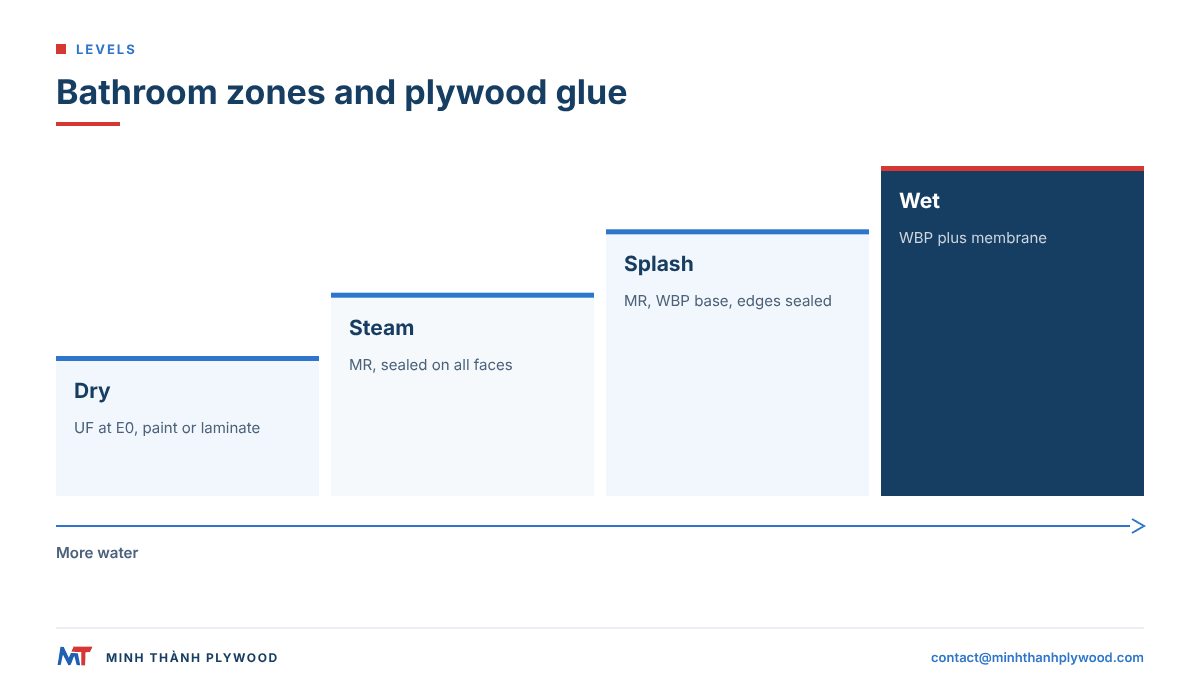
Glue class decides: UF, MR or WBP
The glue between the veneers decides how plywood behaves in a bathroom; the face species does not. Three glue types cover bathroom use.
- UF glue at E0 emission: the standard for furniture and interior panels. Strong and low-emission in dry rooms. Water reaching the core weakens the bond.
- MR or melamine-fortified glue: urea glue fortified with melamine, made for humid interiors. Holds through steam and occasional splashes.
- WBP (phenolic) glue: phenol-formaldehyde, dark glue line, holds after soaking and boiling tests. The glue for floors, wet walls and anything near standing water.
Bond quality classes are set in EN 314-2, plywood bonding quality requirements: Class 1 for dry interiors, Class 2 for humid interiors, Class 3 for exterior and wet use. UK merchants label sheets by the product standard EN 636: EN 636-1 for dry conditions, EN 636-2 for humid conditions and EN 636-3 for exterior conditions, which map onto bond Classes 1, 2 and 3.
The product standard, BS EN 636, covers plywood for dry, humid or exterior conditions.
Plydirect rates 636-1 as not suitable for bathrooms, 636-2 as acceptable for cabinets outside direct splash and 636-3 as the grade for steam and poor ventilation. Write the class on the order, because “moisture resistant” on a label can mean either of the first two.
Glue and emission are two separate lines. A WBP panel can be low-emission; a UF panel at E0 is low-emission but not water-resistant. Minh Thanh Plywood makes furniture panels with UF glue at E0 emission as standard and presses MR, melamine-fortified and WBP bonds to the buyer’s specification.
What plywood to use in a bathroom, part by part
What plywood to use in a bathroom depends on the part: WBP exterior plywood for structure near water, MR or WBP furniture plywood for the vanity, and interior furniture plywood only for dry cabinets.
| Part | Thickness | Glue | Face | Finish or cover |
|---|---|---|---|---|
| Subfloor, joists at 400 mm | 18 mm | WBP | C/D utility, sanded | Membrane or backer board, then tile or vinyl |
| Subfloor, joists at 600 mm | 22 mm | WBP | C/D utility | Same |
| Wall sheathing, dry | 12 mm | MR or WBP | C/D utility | Paint or tile |
| Wall behind shower | 15 mm | WBP | C/D utility | Waterproofing membrane, tile |
| Vanity carcass | 18 mm | MR, WBP for the base | Birch, poplar or engineered veneer | Laminate, HPL or lacquer |
| Vanity doors and drawer fronts | 18 mm | MR | Birch or engineered veneer | Two-pack lacquer or laminate |
| Vanity back | 6 to 9 mm | MR | Poplar or birch | Lacquer |
| Ceiling | 9 to 12 mm | MR | Pine, poplar or birch | Sealed paint or varnish |
| Bath panel | 12 to 15 mm | WBP | Birch or engineered veneer | Laminate or sealed paint, removable for access |
Thicknesses follow normal joinery and building practice; your fitter’s span tables and the membrane maker’s instructions set the final figure.
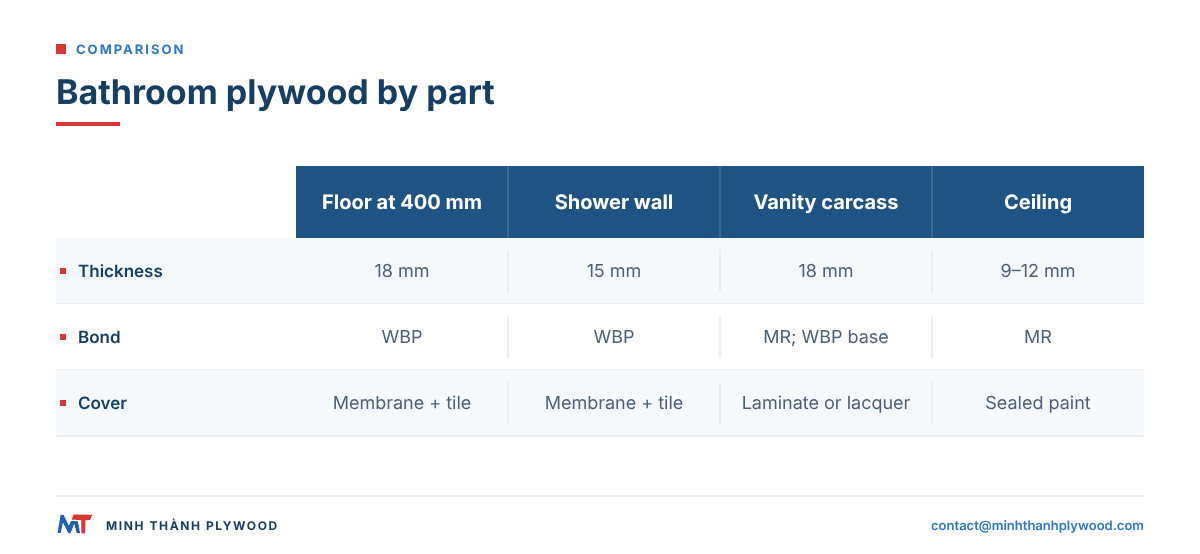
Best plywood for a bathroom floor
The best plywood for a bathroom floor is exterior plywood with WBP glue, 18 mm on joists at 400 mm centres and 22 mm at 600 mm centres, screwed at every joist and covered with a waterproofing membrane or backer board.
- Tongue-and-groove or blocked edges: every sheet edge supported, so tiles do not crack along a joint.
- Second layer for stone: a 12 mm overlay under natural stone or large-format tiles, joints staggered.
- Primer under the membrane: the membrane maker’s primer, never diluted PVA.
- Vinyl or sheet floors: a smooth underlay-grade face, filled screw heads, sealed joints at the walls.
What plywood for a bathroom subfloor is the same answer: structural WBP plywood. The face grade can be utility C/D because nothing will see it. For the full tiling build, read tiling on plywood.
Can I use plywood for bathroom walls?
Yes, plywood makes a good bathroom wall: it holds screws for vanities, mirrors, rails and grab bars anywhere on the wall, without hunting for studs. Use 12 mm exterior plywood on dry walls and 15 mm WBP plywood in the shower zone.
On dry and steam walls, prime and paint the plywood with a bathroom paint, or tile it with a flexible adhesive. In splash zones behind basins, add a liquid waterproofing coat under the tile. In the shower, cover the plywood with a full waterproofing membrane or fix a backer board over it.
One detail decides a plywood wall’s life: the joint where wall meets floor. Tape it with the membrane maker’s corner piece, so water on the floor cannot run into the bottom edge of the wall sheet.
Plywood shower boards and wet walls
Plywood shower boards work only as backing behind a waterproof layer: WBP plywood of 15 mm or more on studs, then a continuous membrane, then tile or a wall panel system. Bare plywood or plywood with only grout and tile in front takes up water in a shower.
Three shower builds use plywood well:
- Plywood plus sheet membrane plus tile: the membrane bonds to primed plywood with tile adhesive and laps at every joint.
- Plywood plus liquid membrane plus tile: two coats with fleece tape in corners and around the valve.
- Plywood plus laminate shower panels: the panel system is the waterproof layer; the plywood gives a flat, screw-holding base.
A board made for showers, cement or foam, is the alternative to a membrane. The tile backer board vs plywood comparison shows when each fits.
Plywood wet wall panels vs WBP plus membrane
Plywood wet wall panels are decorative laminate shower panels with a plywood core, fitted grout-free, and a builder picks them when a shower must be finished in one day with few joints. Fibo panels, sold in the UK as plywood wet wall by retailers such as Bath and Tile, are 2400 × 600 mm and about 10.2 mm thick, with a tongue-and-groove edge that locks into the next panel, in tile, stone, terrazzo and plain finishes. The core is birch plywood to EN 13986 with waterproof glue, a high-pressure laminate on the face and a balancing layer behind.
Fitting is by adhesive onto a flat, sound substrate, with a base profile in wet areas and a hybrid polymer sealant at joints, cut edges and around the tray. That substrate is often WBP plywood: the plywood gives a flat, screw-holding base and the panel is the waterproof face.
| Build | Face | Joints | Best when |
|---|---|---|---|
| WBP plywood, membrane, tile | Tile and grout | Many grout lines, membrane laps | A bespoke layout, curved walls, a tiled bench |
| WBP plywood, plywood-core wet wall panel | Laminate | Few, sealed tongue-and-groove | A quick, grout-free shower in a rental or a refit |
| Plywood, liquid membrane, tile | Tile and grout | Fleece tape in corners | Awkward shapes and niches |
Tile gives the widest choice of look and repairs by replacing one tile; the panel gives the fewest joints and no grout to clean. Either way, the plywood behind must be the wet-zone class.
Plywood for bathroom vanities and cabinets
Bathroom vanities take furniture plywood: 18 mm for carcasses with MR glue, and WBP or a sealed laminate for the base and under-sink parts. The face is chosen for the finish: birch or engineered veneer for lacquer, poplar for paint, any sanded face under laminate or HPL.
Furniture plywood beats chipboard and MDF in a vanity for two reasons. It holds hinge and runner screws after years of opening, and it does not swell to twice its thickness when a trap leaks. The edge that sits on the floor and the panel under the sink see the most water, so seal or laminate them first.
Minh Thanh presses furniture panels twice as standard: the core is pressed and calibrated, then the faces are pressed on. Sanded panels hold ±0.2–0.3 mm thickness tolerance, so doors stay flat and lacquer lies even. Faces include birch, poplar, engineered veneer and eucalyptus, graded by face/back pairs such as A/B for poplar or D+/D for birch against the buyer’s approved sample.
For vanities sold into the US and Europe, emission counts as much as moisture. Our furniture panels meet CARB P2 / TSCA Title VI (ICTT mill no. 23024); six ASTM D6007 chamber tests between April 2025 and June 2026 averaged 0.014–0.032 ppm against the 0.05 ppm limit. The limit for veneer-core hardwood plywood is set in EPA’s TSCA Title VI requirements.
Waterproof ply for bathroom use: is marine plywood necessary?
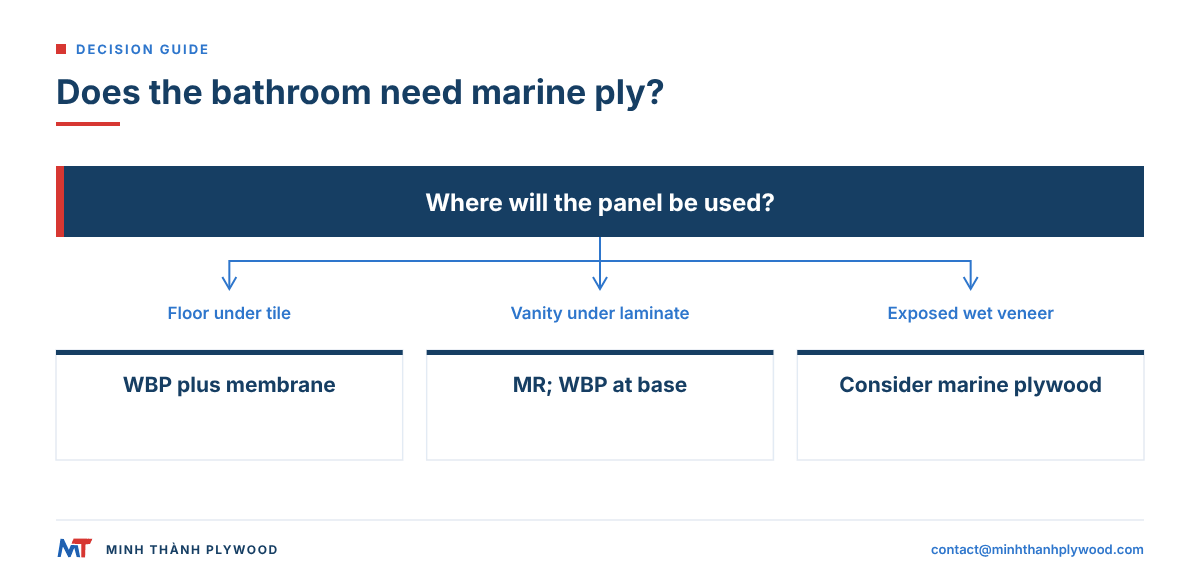
Marine plywood is rarely necessary in a bathroom. WBP-glued exterior plywood under a membrane, or behind a laminate, gives the same result for floors, walls, shower backing and vanity bases at lower cost.
There is no truly waterproof ply for bathroom use: every plywood is timber, and timber takes up water. What differs is whether the bond holds when it does. WBP glue holds; marine plywood adds a void-free core and better faces, which matter when the panel is seen and wet at the same time.
Marine plywood earns its price in a few places:
- an exposed timber bath panel or wet-room bench left as visible veneer,
- a boat or caravan bathroom where the panel is the finished surface,
- a commercial wet room where a void under a tile is not acceptable.
Everywhere else, spend the difference on a good membrane and an extractor fan. The marine plywood buying guide explains the grade in full.
How to waterproof plywood for a bathroom
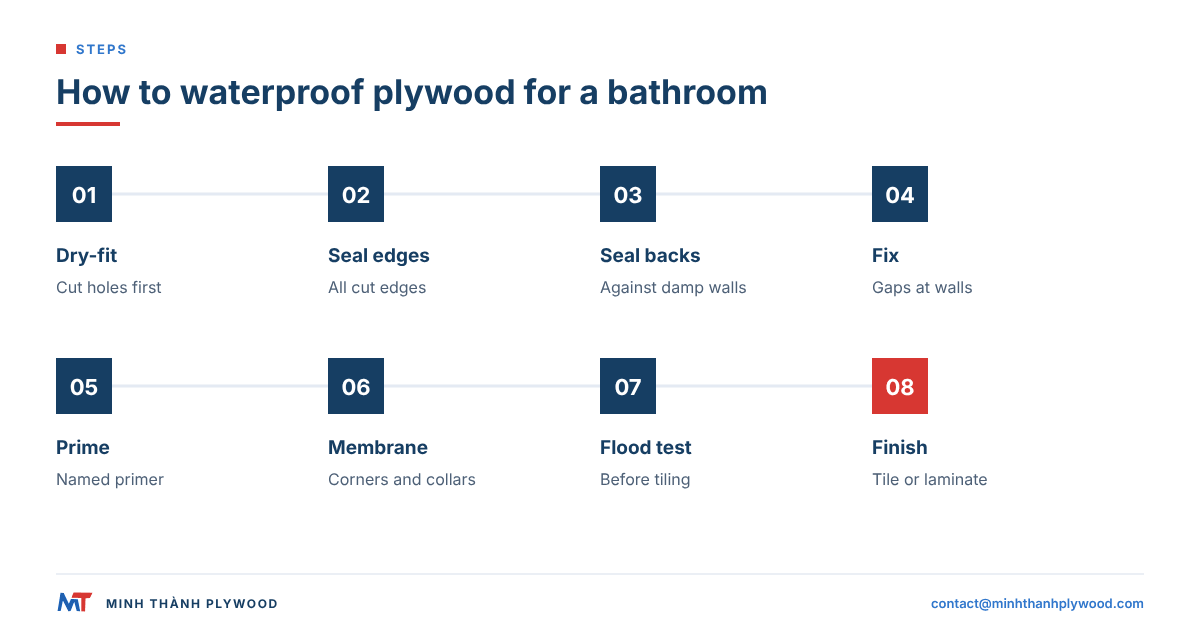
To waterproof plywood for a bathroom, seal its edges, prime its face and cover it with a membrane or a sealed finish, in this order.
- Cut and dry-fit all panels, including holes for pipes and drains.
- Seal every cut edge with an edge sealer, epoxy or the membrane maker’s primer; end grain takes up water fastest.
- Seal the back face of panels that sit against a damp wall or floor.
- Fix the panels with corrosion-resistant screws, leaving small gaps at walls.
- Prime the face with the primer the membrane or adhesive maker names.
- Apply the membrane: sheet or liquid, with corner pieces, pipe collars and joint tape.
- Test before tiling: flood a shower floor and watch for leaks.
- Finish: tile with flexible adhesive and grout, or laminate and seal.
For vanity parts, step 6 is a finish instead: laminate or HPL on both faces with sealed edges, or a two-pack lacquer on every surface including the underside.
Edge sealing and ventilation
Edges and air decide how long bathroom plywood lasts. An unsealed edge drinks water many times faster than the face, and a bathroom without extraction stays at high humidity for hours after every shower.
- Edges: seal before fixing, including the edges of holes for pipes; edge-band visible vanity edges.
- Floors: silicone the gap between floor and bath, tray or vanity plinth.
- Air: an extractor fan that runs on after the light goes off clears steam; an openable window helps but does not replace it.
Plywood leaves the Minh Thanh factory at 8–12 % moisture content, the normal range for indoor panels. Store sheets in the room for two days before fixing, so they settle to its air before sealing.
Cost by zone: MR, WBP and marine
The cost of bathroom plywood rises with the glue class: interior UF is the lowest-cost, MR costs more, WBP more again and marine plywood the most. The cheapest bathroom is one that puts each class only where it is needed.
| Zone | Right choice | Paying for more | Paying for less |
|---|---|---|---|
| Dry cabinets | UF at E0 | MR adds cost, little benefit | Not possible |
| Steam zone | MR | WBP adds cost, small benefit | UF risks swelling over time |
| Splash zone | MR, WBP base | Marine adds cost, no benefit under laminate | UF fails at the plinth |
| Wet zone | WBP plus membrane | Marine adds cost, little benefit under tile | MR or UF fails behind grout |
UK retail gives the yardstick. In October 2026 Wickes sells non-structural hardwood plywood of 18 × 1220 × 2440 mm at £30 to £37.50 a sheet and 12 mm at £29, while BS 1088 marine plywood of 18 mm in 2440 × 1220 mm sells at about £62 (Far Eastern B/BB, including VAT) to £117 (Indonesian hardwood, including VAT) from UK timber merchants. A buyer who imports by the container sets that margin against the FOB price.
Minh Thanh’s indicative starting prices are from US$250/m³ for commercial plywood and from US$350/m³ for furniture and interior plywood (October 2026). The final price depends on face, core, glue, thickness, size, quantity and delivery term.
Common bathroom plywood mistakes
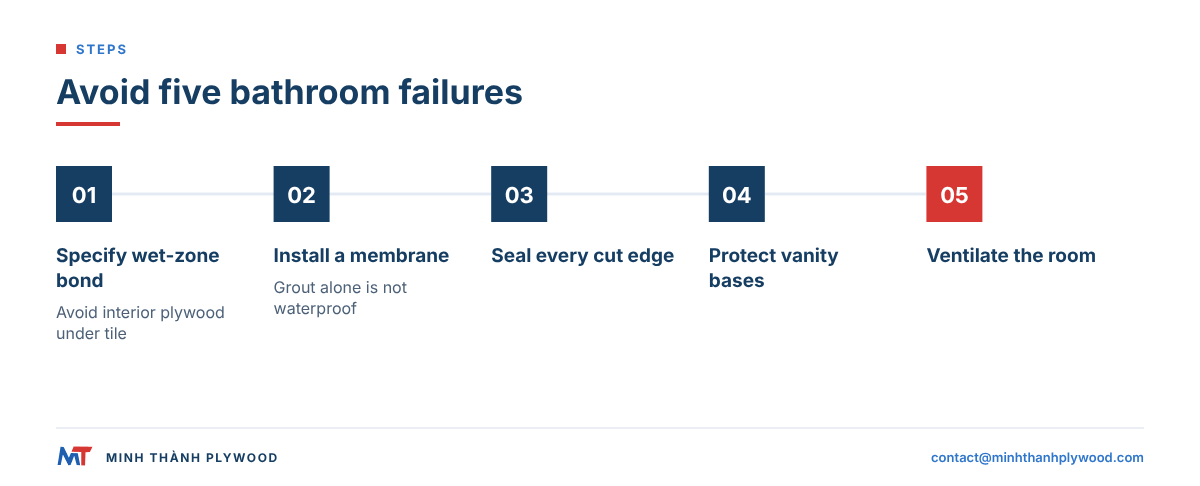
Most failed plywood bathrooms share five mistakes:
- Interior plywood under tile: hardware-store sheets with no glue class stated are usually interior grade.
- Grout trusted as waterproofing: grout and tile adhesive let water through; only a membrane stops it.
- Unsealed cut edges: around pipe holes and at the floor line.
- Chipboard vanity bases: they swell at the first leak and do not recover.
- No extractor fan: the whole room stays damp, and mould grows on unsealed timber.
Each is cheap to avoid at build time and expensive to fix after tiling.
What to write on the order for bathroom plywood
A bathroom plywood order needs six lines: use, glue class, core, face and grade, thickness and tolerance, size and quantity. Two orders cover most projects: one for the structure, one for the vanities.
- Structure: exterior plywood, WBP phenolic glue, eucalyptus core, C/D faces sanded, 18 mm ±0.5 mm, 1220 × 2440 mm, for bathroom floors and wet walls.
- Vanities: furniture plywood, MR glue, Styrax core, birch faces D+/D, 18 mm ±0.2 mm, 1220 × 2440 mm, double pressed, CARB P2.
Minh Thanh Plywood makes exterior plywood and furniture plywood in 1220 × 2440 mm and 1250 × 2500 mm, 3 to 40 mm thick, with mixed specifications in one 40HC by agreement. Production takes 15–45 days after deposit. Send your specification through the quotation form, or ask for free samples. For other floor finishes, start at wood flooring types.
Buyer questions, answered
Can you use plywood in a bathroom?
Yes. Use WBP-glued plywood for floors and anything near water, melamine-fortified MR plywood for steam zones such as ceilings and upper walls, and interior UF plywood only for dry cabinet parts. In showers, cover plywood with a waterproofing membrane.
What plywood is best for a bathroom floor?
Exterior plywood with WBP phenolic glue, 18 mm or more on joists at 400 mm centres, screwed and primed, with a waterproofing membrane or backer board under the floor finish.
Can I use plywood for bathroom walls?
Yes. Use 12 mm exterior plywood on dry walls and 15 mm WBP plywood behind showers, always under a waterproofing membrane or tile backer board in the wet zone. Plywood walls also hold screws for vanities and rails anywhere.
Is marine plywood necessary for a bathroom?
Usually not. WBP-glued exterior plywood under a waterproofing membrane does the job for floors, walls and wet zones. Marine plywood earns its price only where the panel itself stays exposed to water, such as an untiled bath panel or a boat-style wet room.
How do you waterproof plywood in a bathroom?
Seal every cut edge, prime the face, then cover it with a sheet or liquid waterproofing membrane with taped corners and joints. On exposed vanity parts, a laminate, HPL or a two-pack lacquer on all faces and edges keeps water out.
What type of plywood for a bathroom subfloor?
Structural exterior plywood with WBP glue, tongue-and-groove or with blocked edges, 18 mm on joists at 400 mm centres or 22 mm at 600 mm centres. Face grade does not matter because the floor finish covers it.
What thickness plywood for a bathroom floor?
18 mm on joists at 400 mm centres, 22 mm at 600 mm centres, plus a second layer of 12 mm under natural stone or large tiles.
What plywood for bathroom vanity cabinets?
18 mm plywood for carcasses and 6 to 9 mm for backs, with MR glue or WBP glue for the base and under-sink parts. A birch, poplar or engineered veneer face suits painted or lacquered fronts; laminate or HPL suits wipe-clean surfaces.
Is OSB or chipboard OK in a bathroom instead of plywood?
Plywood is the safer choice. OSB and chipboard swell at their edges when wet and do not recover, while WBP plywood keeps its bond and shape after wetting and drying.
Does bathroom plywood need ventilation?
Yes. An extractor fan that clears steam after each shower keeps the plywood near its normal moisture range. Without it, even WBP plywood stays damp for hours and mould grows on any unsealed surface.