
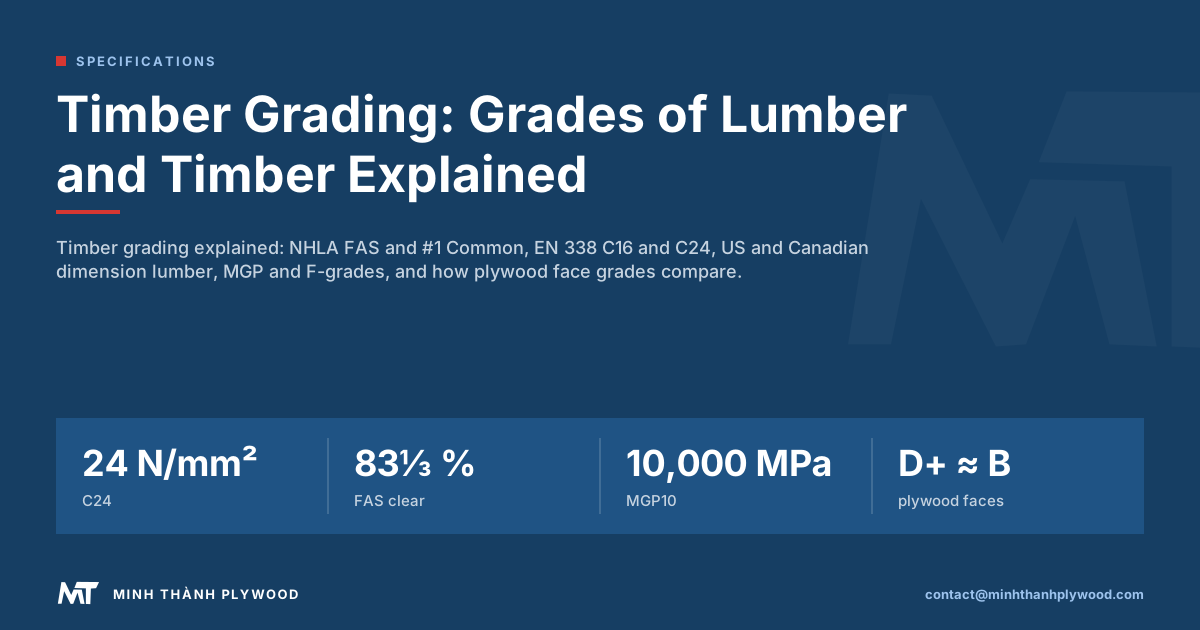
Timber grading sorts sawn wood into classes by appearance or by strength, so a buyer knows what a board will look like or what load it can carry. Appearance grades such as FAS count clear wood; strength grades such as C24 or MGP10 set design values. Minh Thanh Plywood grades plywood faces the same way, as face/back pairs matched to an approved sample.
What is timber grading?
Timber grading is the sorting of sawn wood into classes by appearance or by strength, to a published rule, so that buyer and seller mean the same thing by a grade name. A grader inspects each piece, by eye or by machine, and assigns it a grade that sets its price and its uses.
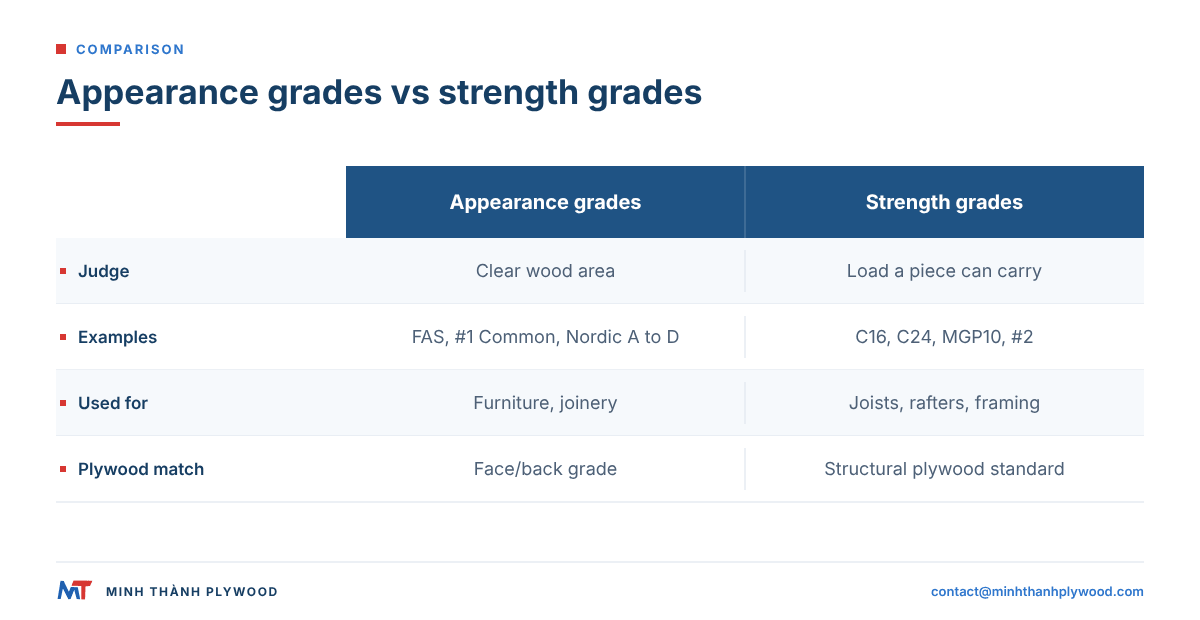
There are two families of grades:
- Appearance grades judge the clear, defect-free area of a board: the share of wood without knots, splits or stain. Hardwood for furniture and joinery is sold this way.
- Strength grades (stress grades) judge the load a piece can carry. Softwood for building is sold this way, because engineers need design values.
Most confusion in timber orders comes from mixing the two. An FAS oak board is beautiful but has no design value for a beam; a C24 spruce joist is strong but may have knots on every face.
What are the grades of lumber?
The grades of lumber depend on the wood and the market: hardwood uses appearance grades such as FAS and #1 Common; softwood for building uses strength grades such as Select Structural and #2 in North America, C16 and C24 in Europe, and MGP10 to MGP15 in Australia.
| Grading system | Region | Wood | Grade names, high to low | Graded for |
|---|---|---|---|---|
| NHLA rules | USA, global hardwood trade | Hardwood | FAS, FAS One Face, Selects, #1 Common, #2A Common, #3A Common | Appearance (clear yield) |
| NLGA / US grading rules | USA and Canada | Softwood dimension lumber | Select Structural, #1, #2, #3, Stud | Strength |
| EN 338 strength classes | Europe, UK | Softwood (C) and hardwood (D) | C14 to C50; D18 to D80 | Strength |
| BS 4978 visual grades | UK | Softwood | SS (special structural), GS (general structural) | Strength, mapped to C classes |
| AS/NZS 1748 machine grades | Australia | Pine | MGP15, MGP12, MGP10 | Strength (stiffness) |
| AS 1720.1 F-grades | Australia | All structural timber | F34 down to F5 | Strength |
| Nordic appearance classes | Nordic countries | Pine and spruce | A (A1–A4), B, C, D | Appearance |
Each system has its own grading agency and stamp. A grade from one system is not a grade in another until a rule maps them, as EN 1912 does for many European visual grades and EN 338 classes.
How does hardwood lumber grading work?
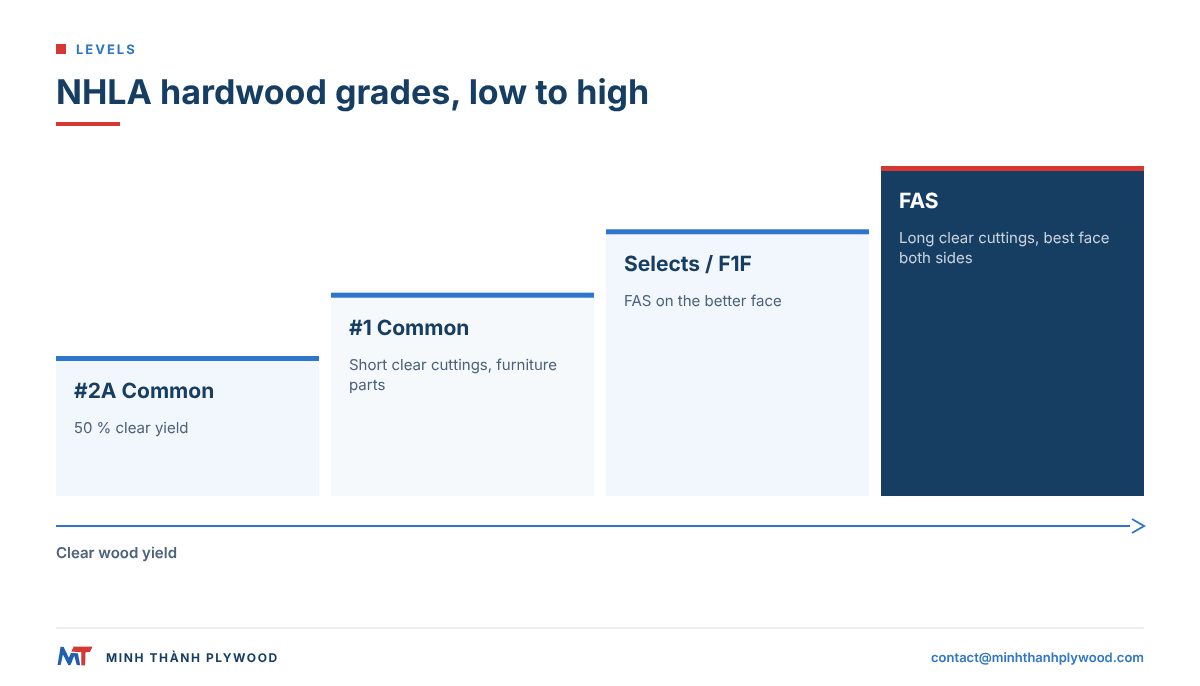
Hardwood lumber grading measures how much clear wood a board yields in usable cuttings. The National Hardwood Lumber Association (NHLA) rules set a minimum board size, a minimum cutting size and a minimum clear yield for each grade, judged from the poorer face.
| NHLA grade | Minimum board | Minimum clear cutting | Minimum clear yield | Typical use |
|---|---|---|---|---|
| FAS (Firsts and Seconds) | 6 in wide, 8 ft long | 4 in × 5 ft or 3 in × 7 ft | 83⅓ % | Long clear mouldings, joinery, high-end furniture |
| FAS One Face (F1F) / Selects | FAS on the better face, #1 Common on the other | As FAS on one face | 83⅓ % on one face | Parts with one visible face |
| #1 Common | 3 in wide, 4 ft long | 4 in × 2 ft or 3 in × 3 ft | 66⅔ % | Furniture parts, cabinets, kitchen doors |
| #2A Common | 3 in wide, 4 ft long | 3 in × 2 ft | 50 % | Flooring, smaller parts, painted work |
These yields and board sizes follow the NHLA Rules for the Measurement and Inspection of Hardwood Lumber as summarised by the American Hardwood Export Council (read October 2026). Higher grades give longer, wider clear pieces with less waste. Furniture makers often buy #1 Common because their parts are short; a joinery shop that needs long clear rails buys FAS.
What is C24 timber, and how is it different from C16?
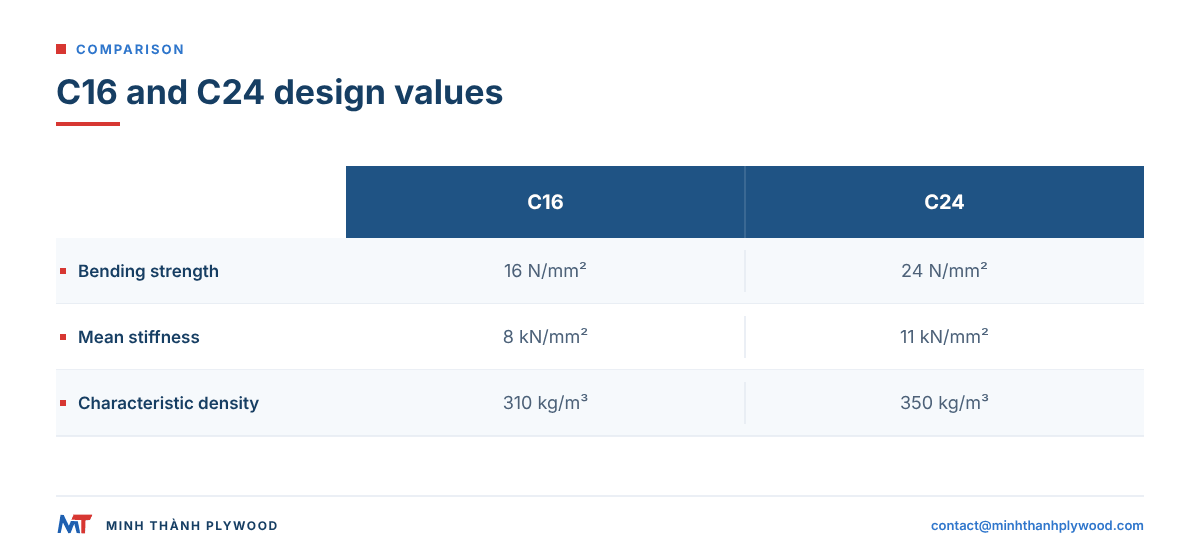
C24 is a softwood strength class of EN 338 with a characteristic bending strength of 24 N/mm²; C16 is the class below it, at 16 N/mm². The number in the class name is the bending strength, so C24 spans further or needs a smaller section than C16 for the same load.
| Property (EN 338) | C16 | C24 |
|---|---|---|
| Characteristic bending strength | 16 N/mm² | 24 N/mm² |
| Mean bending stiffness | 8 kN/mm² | 11 kN/mm² |
| Characteristic density | 310 kg/m³ | 350 kg/m³ |
| Mean density | 370 kg/m³ | 420 kg/m³ |
| Typical use | Studs, joists in short spans, general carcassing | Longer joists, rafters, exposed and visible framing |
In the UK, C16 and C24 are the two stocked construction grades, available off the shelf anywhere in the country (Timber Development UK, C16 and C24 strength graded timber, 2023); C27 and above are rarely specified, and trussed-rafter timber is ordered in a separate TR26 grade that suppliers list beside C16 and C24 (Taylor Maxwell strength data, 2022).
The values in the table are the EN 338 figures that Engineering ToolBox and UK suppliers reproduce (read October 2026). Timber is graded to them visually under BS 4978 (GS and SS for many species), with EN 1912 mapping other visual grades to the classes, or by machine, and it carries CE or UKCA marking under EN 14081-1, the harmonised standard. In the EU, CE marking of construction products falls under the Construction Products Regulation (EU) No 305/2011.
How does softwood dimension lumber grading work in North America?
North American dimension lumber is graded for strength under NLGA and US grading rules: Select Structural, #1, #2, #3 and Stud for joists and framing, and Construction, Standard and Utility for light framing. #2 is the everyday framing grade. NIST lists the umbrella standard for softwood lumber as the American Softwood Lumber Standard, PS 20-25.
Each piece carries a stamp with five items: the grading agency’s mark, the mill number, the species or species group (for example SPF or Douglas fir-larch), the grade and the moisture state, such as KD-19 for kiln-dried. Machine stress-rated lumber (MSR) carries a stiffness and bending rating instead of a visual grade name. Span tables in building codes list allowable spans by species group and grade, so the stamp is what the inspector checks.
How are timber grades used in Australia?
Australia grades house framing pine by machine as MGP10, MGP12 and MGP15. MGP10 is the standard framing grade, with a modulus of elasticity of 10,000 MPa: the “10” in the name is that rounded characteristic value, according to WoodSolutions and the AS/NZS 1748 background document (read October 2026). The machine grades sit under AS/NZS 1748, and all structural timber is graded by stress grade, from F5 to F34, under AS 1720.1.
- MGP grades (machine-graded pine): MGP10 for general framing, MGP12 and MGP15 for longer spans and stiffer members.
- F-grades: F17 is a common grade for hardwood beams and posts; F7 and F8 are common for softwood framing.
- Appearance grades for flooring and decking (Select, Standard, High Feature) are separate from structural grades.
- Engineered wood: LVL and structural plywood carry their own grades from the maker and from AS/NZS 4357 and AS/NZS 2269.
How does timber grading work, by eye or by machine?
Timber grading works by eye or by machine: visual grading judges each piece by its visible defects against a rule, and machine grading measures stiffness on every piece, then sorts it by measured values. Both are recognised when done by an accredited grader; in Europe the requirements for strength-graded structural timber sit in EN 14081-1, and the COFORD guide to grading structural timber walks through both routes (read October 2026).
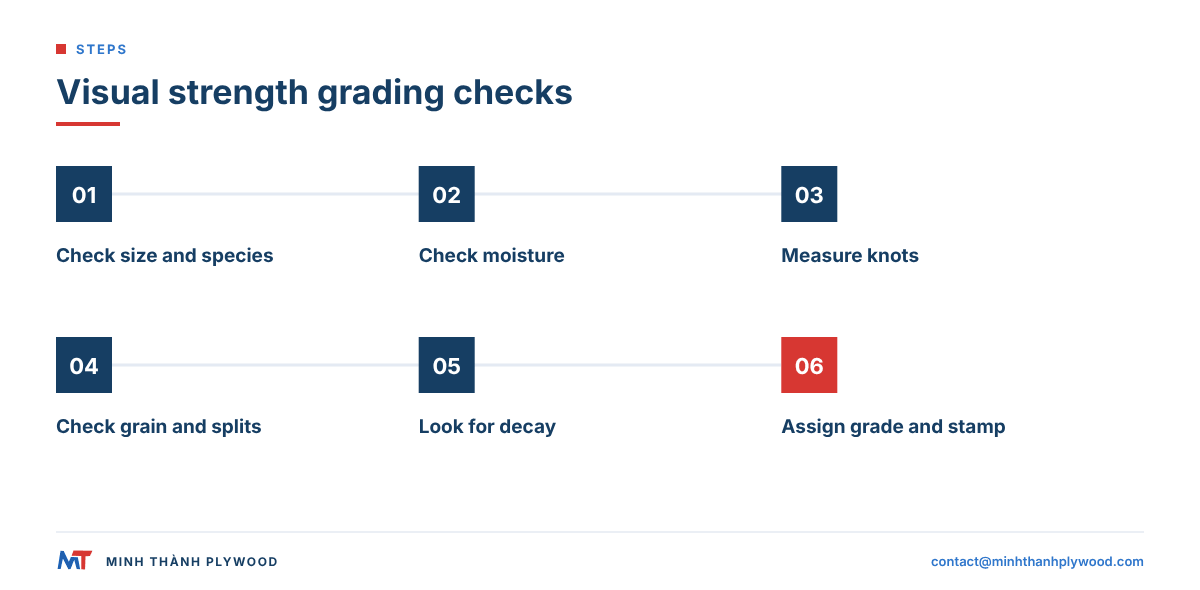
How a visual grader works through a piece:
- Check the size, the moisture content and the species.
- Measure knots against the width and position: edge knots weaken a joist more than centre knots.
- Measure the slope of grain, splits, checks and wane.
- Look for decay, insect damage and reaction wood.
- Assign the grade and stamp the piece.
A grading machine bends or vibrates each piece and assigns the grade from measured stiffness, often with a camera check of knots. It sorts more pieces into higher grades, because it measures what the eye can only estimate.
What defects decide the grade of timber?
The grade of timber is decided by knots, slope of grain, splits and shakes, wane, decay and distortion, measured against the limits of the rule. In strength grading, knot size and position count most; in appearance grading, the clear area left between defects counts most.
| Defect | What it is | Effect on grade |
|---|---|---|
| Knot | Base of a branch inside the wood | Size and position limit both strength and appearance |
| Slope of grain | Fibres not parallel to the edge | Lowers bending strength |
| Split, check, shake | Separation of fibres along the grain or the growth rings | Lowers strength and appearance |
| Wane | Bark or missing wood on an edge | Reduces bearing and nailing area |
| Decay and insect holes | Biological damage | Excluded or limited in most grades |
| Bow, spring, twist, cup | Distortion out of straight or flat | Limited by the rule for each length |
The same defects matter for veneer. A face veneer with an open knot or a split is graded down, which is why plywood faces are sorted sheet by sheet before lay-up.
How do plywood face grades compare with timber grades?
Plywood face grades are appearance grades, like hardwood lumber grades: they describe the face and back veneers, not the load the panel carries. Strength in plywood is set separately by a structural standard, such as EN 636 or AS/NZS 2269.
How Minh Thanh Plywood grades the faces it sells:
- Birch faces: named D+, D and E in Vietnam, quoted as face/back pairs such as D+/D or D/E. Individually D+ is about B, D about BB and E about CP/C on the European birch ladder, so D+/D is about B/BB.
- Pine faces: A/A, A/B and B/B, with B/C for utility parts; the ladder is comparable to the European softwood face classes I to IV and the US A to D grades.
- Poplar faces: A/A, A/B and B/B; buyers also order by the Chinese codes B/BB, BB/CC and CP, which map onto the same ladder.
- Eucalyptus faces: A/A, A/B and B/B; A/A for two visible faces, A/B for one, B/B for painting or overlay.
Every grade pair is matched to the buyer’s approved sample, which works like the grading rule for that order.
What is graded lumber, and why does the stamp matter?
Graded lumber is sawn wood inspected and marked to a published grading rule. The stamp is the proof: it names the grade, the species, the mill and the grading agency, and building inspectors and engineers accept nothing less for structural work.
Ungraded or “merchantable” timber may be strong, but it has no design values. For framing, beams and anything a code covers, specify the grade and ask for stamped pieces or a grading certificate. For appearance work, the grade name plus a photo or an approved sample settles the look before the order.
Which grade should you specify for each job?
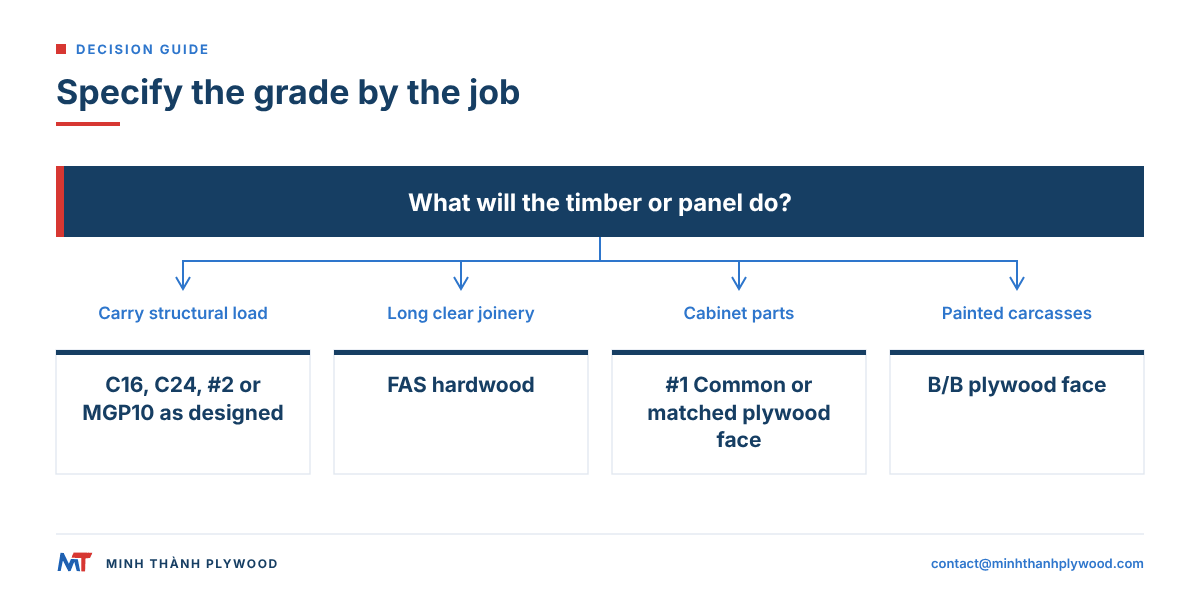
Specify a strength grade for anything that carries load and an appearance grade for anything that is seen. A joist needs C24, #2 or MGP10; a cabinet door needs FAS or #1 Common hardwood, or a plywood panel with an A/B or D+/D face.
| Job | Grade to specify |
|---|---|
| Floor joists and rafters (Europe, UK) | C16 for short spans, C24 for longer spans |
| Wall framing (USA, Canada) | #2 or Stud grade |
| House framing (Australia) | MGP10; MGP12 for longer spans |
| Long clear joinery rails | FAS hardwood |
| Furniture and cabinet parts | #1 Common hardwood, or a plywood panel with a matched face grade |
| Painted cabinet carcasses | Plywood B/B face on a Styrax or Eucalyptus core |
| Visible cabinet fronts in birch | Birch plywood D+/D or D/D |
For cabinet carcasses and furniture panels, plywood often replaces graded boards: it is flat, stable and comes in full 1220 × 2440 mm or 1250 × 2500 mm sheets.
How does plywood avoid the waste of timber grading?
Plywood avoids much of the waste of timber grading because defects are cut out at the veneer stage and the best veneers go to the faces. A log too knotty for FAS boards still yields good core veneers, and only the face needs to meet the appearance grade.
At our factory the cores are white Styrax or Eucalyptus from plantation timber grown near Ha Hoa. Core layers are stitched both horizontally and vertically, and furniture-grade panels are pressed twice: the core board is pressed and calibrated, then face and back are pressed on. Sanded panels hold ±0.2–0.3 mm thickness, down to ±0.2 mm, which a graded board cannot match without planing.
Why do grading rules differ between hardwood and softwood?
Grading rules differ because hardwood and softwood are bought for different jobs. Hardwood is mostly cut into furniture and joinery parts, so its grades measure the clear wood a cabinet shop can recover; softwood is mostly used as framing, so its grades measure the load a piece can carry.
That is why an NHLA grade says nothing about strength and a C24 stamp says nothing about appearance. A hardwood board is cut up into short pieces after purchase, so the grader judges the yield of clear cuttings. A softwood joist is used whole, so the grader judges its weakest point: the largest knot, the steepest slope of grain. Hardwood for structural use, such as oak beams, is strength-graded too, into the D classes of EN 338 or the F-grades of AS 1720.1.
How does moisture content affect timber grading?
Moisture content affects timber grading because wood shrinks, distorts and gains strength as it dries, so a grade is only valid at the moisture state on the stamp. Dry-graded timber, such as North American lumber stamped KD for kiln-dried, keeps its size and grade in a heated building. The US Forest Products Laboratory’s Wood Handbook (FPL-GTR-190, 2010) is the standard reference on how moisture changes wood.
Timber graded wet can still shrink and twist after delivery, moving out of its grade limits for bow or spring. For framing, specify kiln-dried, stamped timber; for joinery and furniture, specify kiln-dried stock close to the conditions of the room it will sit in.
Plywood starts drier and more stable than most sawn timber. Our veneers and finished panels are dried to 8–12 % moisture content at dispatch, the normal range for furniture plywood, and the cross-laid layers hold the panel flat as the air around it changes.
What should you write on a timber or plywood order?
Write the grading rule, the grade, the species, the size and the moisture content on a timber order, and the face/back grade, core, glue, thickness and size on a plywood order. A grade name without its rule is open to two readings.
A plywood specification line we can quote from:
- Face/back grade: birch D+/D, pine A/B or poplar B/B, matched to an approved sample.
- Core: white Styrax or Eucalyptus.
- Glue and emission: UF glue at E0 emission for furniture; MR or phenolic (WBP) bonds to the order.
- Thickness and tolerance: for example 18 mm ±0.2 mm, sanded.
- Size: 1220 × 2440 mm, 1250 × 2500 mm or a custom size.
- Packing and quantity: one 40HC, mixed specifications by agreement.
Free samples let you check the face grade before you order. See birch plywood and pine plywood for the faces we grade this way.
Buyer questions, answered
What are the grades of lumber?
Lumber is graded two ways. Hardwood is graded for appearance by clear-cutting yield: FAS, FAS One Face, Selects, #1 Common, #2A Common and lower. Softwood for building is graded for strength: Select Structural, #1, #2 and #3 in North America, C16 or C24 in Europe, MGP10 to MGP15 in Australia.
What is C24 timber?
C24 is a softwood strength class of EN 338 with a characteristic bending strength of 24 N/mm² and a mean bending stiffness of 11 kN/mm². It is the higher of the two common UK and European construction grades; C16 is the lower.
What is the difference between C16 and C24 timber?
C24 is stronger and stiffer than C16: a characteristic bending strength of 24 N/mm² against 16 N/mm². C24 can span further or use smaller sections, and it usually has fewer and smaller knots.
What does FAS mean in hardwood lumber?
FAS stands for Firsts and Seconds, the top NHLA hardwood grade. An FAS board is at least 6 inches wide and 8 feet long and yields at least 83⅓ % clear wood in cuttings, on both faces.
What is graded lumber?
Graded lumber is sawn wood that has been inspected and stamped to a published grading rule, by eye or by machine. The grade stamp names the grade, species group, mill and grading agency, so a builder or buyer knows what it is getting.
What is MGP10 timber?
MGP10 is a machine-graded pine grade in Australia under AS/NZS 1748. Its modulus of elasticity is 10,000 MPa, and it is the standard grade for house framing; MGP12 and MGP15 are stiffer grades.
Is visual grading or machine grading better?
Machine grading measures stiffness on every piece, so it sorts more precisely and assigns more pieces to higher grades. Visual grading needs no equipment and suits small mills and hardwoods. Both are valid when done to a recognised rule.
How do plywood grades compare with timber grades?
Plywood face grades describe only the look of the face and back veneers, like hardwood appearance grades. Plywood strength is set separately, by a structural plywood standard. A furniture panel graded A/B tells you about the face, not the load it can carry.
What is #1 Common lumber used for?
#1 Common is the hardwood grade for furniture parts, cabinets and kitchen doors, where short clear pieces are enough. It yields at least 66⅔ % clear wood in smaller cuttings and costs less than FAS.
Does timber grade affect price?
Yes. Higher appearance grades yield more clear wood per board, and higher strength grades carry more load, so both cost more. Buying the lowest grade that meets the job is the usual way to save without losing quality.